Summary
For most industrial dumpling, bao and wonton projects, a centrifuge belongs before filling chopping when the main problem is free wash water carried on the cabbage surface. The objective is to present the chopper with a defined, repeatable cabbage condition rather than allowing washing and drainage variation to become an uncontrolled chopping variable.
Liquid appearing after chopping is a different process question. Cutting cabbage damages tissue and can expose additional cellular liquid, while some filling recipes deliberately add salt, rest the chopped material, drain it, press it or adjust the formulation before mixing and forming. That downstream moisture decision should be validated against the actual filling recipe, mixer, depositor or former rather than being treated as the same job as pre-chop surface-water removal.
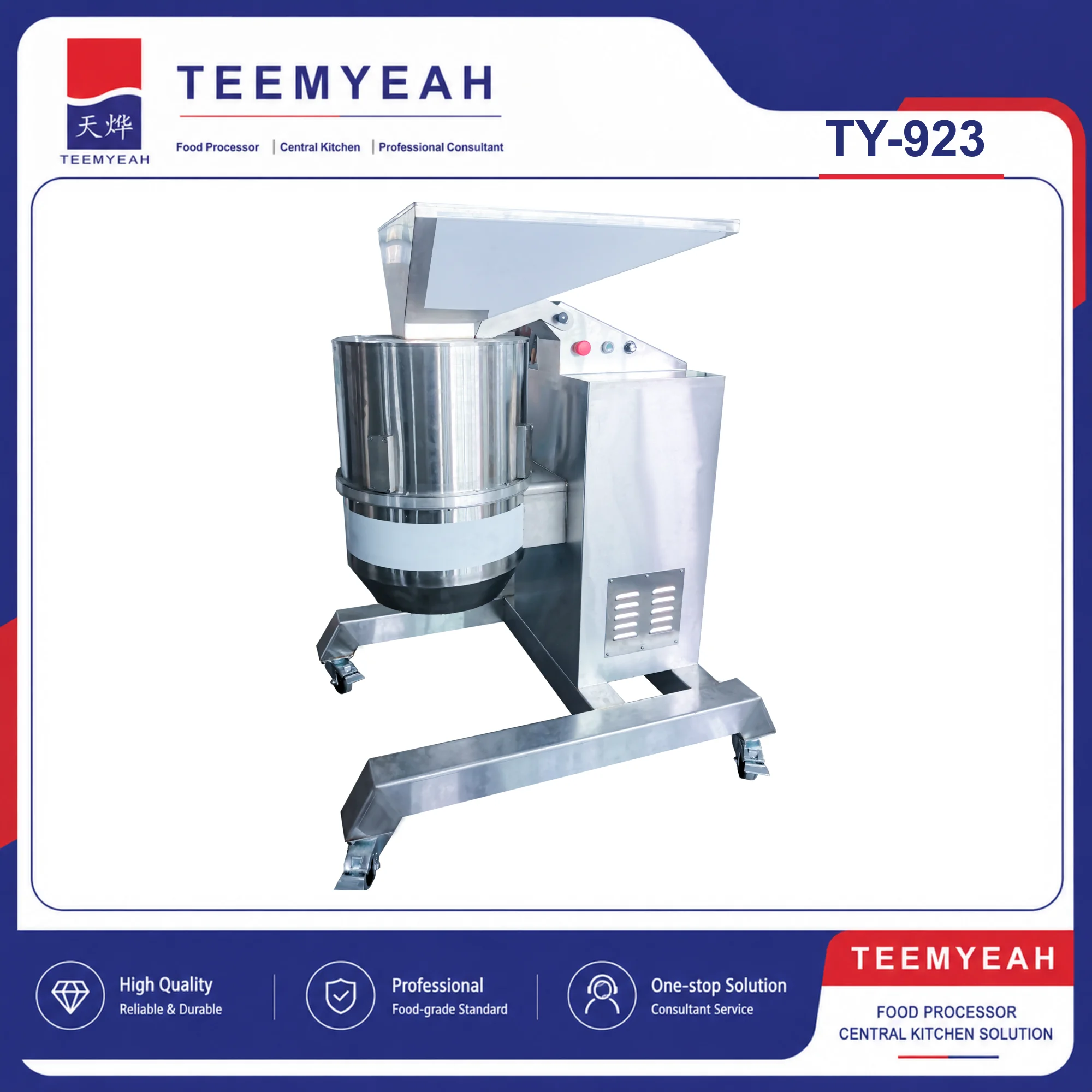
TEEMYEAH can configure and trial the supported route of core or trim as required, wash, drain or centrifugal surface-water removal, pre-cut preparation, and TY-923 filling chopping. The trial should record both chopped texture and visible free liquid, followed by a defined handoff to the buyer’s downstream filling process. The immediate technical-validation task is therefore not simply selecting a cabbage dewatering machine for dumpling filling. It is deciding exactly where water should be controlled and proving that the chosen sequence creates an acceptable filling input.
Why Cabbage Needs Its Own Dewatering and Chopping Decision
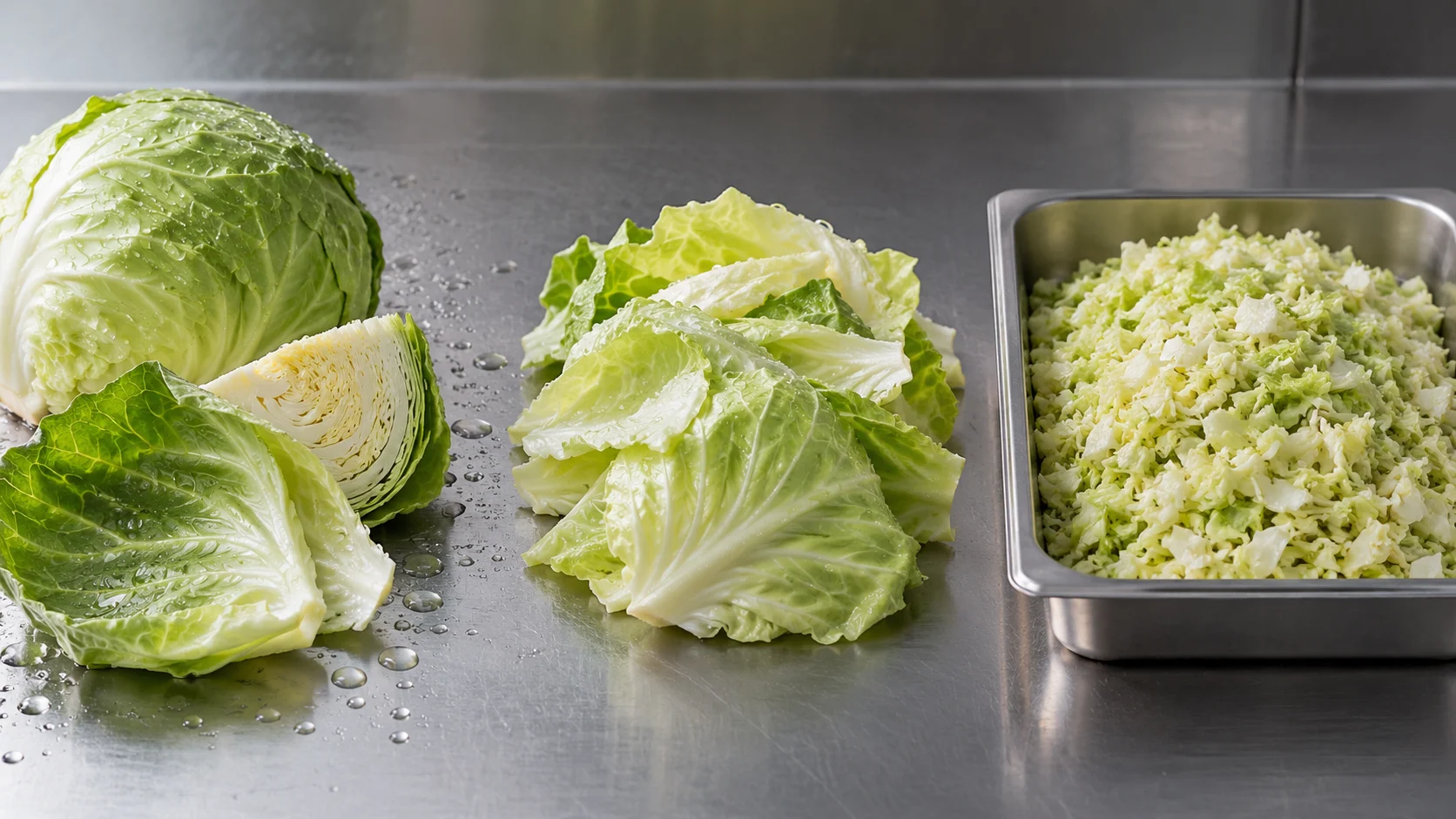
Cabbage appears simple until an industrial filling line has to produce the same usable chopped material across changing raw-material lots. A whole cabbage contains dense core material, thick ribs and thinner leaf tissue. The proportions change with variety, head size, maturity, trimming practice and the part of the head entering the line.
Those differences affect more than chopping texture. They change how cabbage is washed, how much water remains trapped between leaves, how easily pieces feed into downstream equipment and how much visible liquid may appear after chopping.
A trial therefore needs a defined cabbage preparation state. Comparing one batch of heavily drained quartered cabbage with another batch entering directly from washing tells the project team very little about the chopper itself. The chopping equipment is receiving two different process inputs.
Wash-water carryover is an upstream variable
After washing, free water can remain on leaf surfaces, between folded layers and around irregular cut edges. The amount entering the next operation depends on wash method, piece geometry, transfer time and drainage conditions.
If this surface water is the problem, controlling it before chopping is usually the cleaner engineering approach. A repeatable drain period or a defined centrifuge recipe creates a more consistent TY-923 feed condition and makes subsequent trial observations more meaningful.
Chopping creates a separate moisture condition
Once cabbage is finely chopped, the material has far more exposed cut surface. Cellular liquid released during chopping can become visible even when the cabbage entered the chopper with little external water. Finer texture, longer cutting exposure, cabbage condition and recipe handling may all influence what the buyer observes after discharge.
This is why pre-chop centrifugal treatment and post-chop moisture adjustment should not be combined into one acceptance question. One controls water carried from washing. The other evaluates the chopped filling material as part of the recipe and forming process.
For broader information about centrifugal surface-water removal methods, buyers can use TEEMYEAH’s vegetable dewatering process guide. This article focuses specifically on where that operation should sit in a cabbage filling route.
A Stage-by-Stage Process Map for Industrial Cabbage Filling
A practical technical-validation route can be structured as follows:
- Define the incoming cabbage. Record variety, average head dimensions, core condition, trimming requirement and whether the material arrives as whole heads, halves, quarters or another prepared form.
- Core or trim where required. If the filling specification excludes the core, core removal needs to be standardized before washing and chopping trials.
- Wash the cabbage. Use the buyer’s intended washing method or a representative condition that reproduces the likely water carryover.
- Control free surface water. Establish either a defined gravity-drain condition or a repeatable centrifuge load, speed, time and handling cycle.
- Prepare the feed geometry. Whole heads or large sections may require preparation into a form that feeds the chopping operation consistently.
- Run the TY-923 chopping trial. Evaluate representative settings and feed conditions rather than relying on a nominal catalog capacity.
- Inspect the chopped output. Record target texture, oversize pieces, excessive fines, visible free liquid and accepted usable output.
- Transfer the chopped cabbage into the real downstream process. Test the material with the intended mixer, seasoning sequence, existing moisture-adjustment operation, filling depositor or forming machine.
- Freeze the process position only after acceptance. The final equipment sequence should reflect the route that repeatedly produces acceptable downstream behavior.
This sequence is a useful starting point for many projects, but it is not a universal cabbage recipe. Another factory may intentionally chop washed cabbage first and then apply its established post-chop salting, resting, draining or pressing operation. The correct architecture comes from the actual product formulation and acceptance test.
TEEMYEAH’s role during technical validation is to make the supported surface-water-removal and chopping section measurable, then define the condition in which the chopped cabbage should be handed to the next production step. For projects combining multiple preparation operations, our custom food pre-processing line route can be reviewed around the buyer’s existing upstream and downstream equipment.
Spin Before Chopping or Control Moisture After Chopping?
The easiest way to make the decision is to identify where the unacceptable water is appearing.
Use pre-chop centrifugal treatment when wash-water carryover is the variable
If cabbage exits washing visibly wet, holds water between leaves or arrives at chopping with inconsistent drainage from batch to batch, a pre-chop surface-water-control step deserves testing.
The trial objective is not to force the cabbage toward an arbitrary moisture number. It is to establish a repeatable feed condition for chopping. Record the cabbage form, basket load, centrifuge speed, spin time, drainage before loading and the full handling cycle. Run the same cabbage through the TY-923 and compare chopped texture and visible liquid with a controlled non-centrifuged or differently drained condition where useful.
This approach helps answer a specific engineering question: does controlling wash-water carryover before chopping make the TY-923 input and downstream filling behavior more repeatable?
Use downstream moisture control when the liquid appears mainly after chopping
If washed cabbage reaches the chopper in a controlled condition but chopped material still releases liquid during mixing, seasoning or resting, the project has moved into a filling-formulation decision.
The buyer may already use salting, resting, draining, pressing or formulation adjustment. That step should be evaluated with actual filling ingredients and the real downstream machine because acceptance is no longer determined by cabbage surface condition alone.
In this route, TEEMYEAH can define the chopped-cabbage handoff: particle condition, visible free-liquid observation, batch identification and accepted output entering the next stage. The existing downstream moisture-control operation can remain directly after that handoff.
Some projects need both controls
There is no contradiction in removing excess wash water before chopping and still using recipe-specific moisture adjustment afterward. The two steps are solving different problems.
What should be avoided during feasibility work is assuming that a centrifuge before the chopper eliminates every later moisture issue, or assuming that a downstream press or recipe step makes uncontrolled wash-water carryover irrelevant. Technical validation becomes much clearer when the two variables are separated.
Choosing TY-980C, TW-980B1 or an Automatic TW-980 Line
The correct centrifugal architecture depends on product flow, cabbage form, required automation and the complete operating cycle. Basket volume or kilograms per basket should not be turned directly into an hourly line rate.
TY-980C for controlled batch trials and lower-volume sections
The TY-980C batch centrifuge uses a 65 L basket, adjustable 0-1200 rpm speed, a 1.1 kW drive and two baskets. Catalog references include 10 kg per basket for leafy vegetables and 15-20 kg per basket for root vegetables.
For a cabbage filling project, its strongest technical-validation role is a controlled batch surface-water-removal test. Speed, spin time, load condition and cabbage preparation can be varied deliberately before the material enters the chopping trial.

A basket-load figure alone does not establish practical hourly output. The complete cycle includes loading, acceleration and spinning, stopping, unloading, basket exchange or reset and operator handling. The intended cabbage condition must also physically suit the selected basket and process.
TW-980B1 for another batch architecture
The TW-980B1 batch centrifuge has a 70 L basket, adjustable speed and time, two baskets and a 1.5 kW drive.
It should be evaluated on the same complete-cycle basis. Buyers comparing TY-980C and TW-980B1 should provide the expected cabbage piece geometry, preferred operator workflow, upstream washing discharge pattern and downstream feed requirement rather than asking only which basket is larger.
TW-980LB and TW-980LV when the process needs automatic handling
The TW-980LB automatic centrifugal line is designed for continuous post-wash centrifugal dewatering of washed, cut leafy and root vegetables, including lettuce, cabbage and potato shreds. It automatically feeds product, performs controlled internal batch centrifugation and discharges the material. Its basket volume is 125 L.
A catalog rating of 1.5 t/h is associated specifically with root vegetables. It should not be transferred directly to cabbage filling production.
The larger TW-980LV automatic vegetable dewatering line uses a 250 L basket. Its 3 t/h catalog rating likewise applies specifically to root vegetables rather than cabbage filling output.
Automatic equipment becomes more relevant when upstream washing delivers material continuously enough to justify automated feeding, controlled centrifugal batches and automatic discharge. The technical question is whether the complete line architecture can accept the buyer’s actual cabbage form at the required process rhythm.
Capacity should therefore be validated from accepted cabbage output through the complete sequence. TEEMYEAH’s food-processing equipment capacity verification guide explains why nominal ratings should be separated from sustained accepted output under real product conditions.
How TY-115 Preparation and TY-923 Chopping Fit the Route
If the filling specification requires the cabbage core to be removed, the preparation step should be standardized before the chopping trial. The TY-115 cabbage corer supports Chinese cabbage, round cabbage and baby Chinese cabbage. It uses manual loading with automatic centering and coring, with a catalog reference of 10-15 heads per minute.
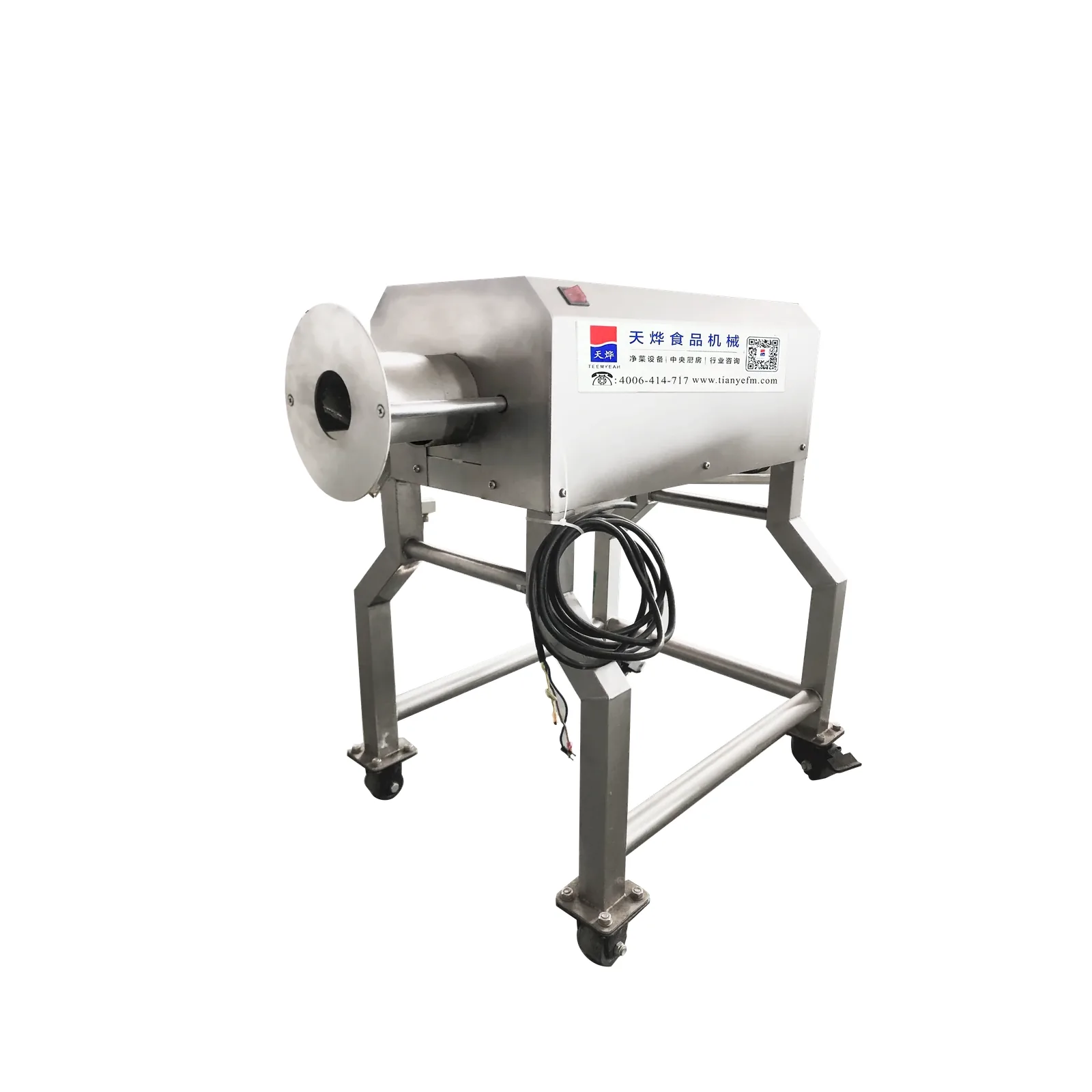
Core removal is not automatically required for every cabbage filling. It belongs in the route only when the intended filling texture and preparation specification call for it. That choice should be defined before trials because changing the ratio of core, rib and leaf entering the chopper changes the input itself.
The TY-923 Fruit and Vegetable Filling Chopper is documented for cabbage as well as garlic, ginger, potato, spinach, onion and peanuts. Its role is producing finely cut or paste-like vegetable material for bun and filling preparation.
The machine uses SUS304 construction, a built-in frequency converter and replaceable cutting-tool parts, with optional lifting-feeder compatibility. Its catalog capacity reference is 500-1,000 kg/h, but practical accepted-output capacity for cabbage should be measured with the intended cabbage condition and target texture.
A TEEMYEAH operating video demonstrates manual top-hopper feeding and ongoing discharge while chopping parsley and round cabbage. That demonstration confirms the physical chopping route. For project sizing, the relevant next step is a cabbage-specific trial recording feed condition, settings, texture, visible liquid and accepted output.
Buyers who need a broader explanation of cutting action and multi-ingredient trial planning can also review our industrial vegetable chopper working principle guide. The key issue here is narrower: preparing cabbage consistently enough that the chopper trial answers the moisture-sequence question.
Design the Trial Around Filling Acceptance, Not a Single Machine
A useful trial starts with representative cabbage. Samples should reflect the varieties, head sizes and preparation states expected in production rather than unusually uniform material selected only for demonstration.
Record the incoming cabbage condition before changing any setting. Useful observations include core status, average head or piece dimensions, visible water after washing, drainage duration and the intended pre-chop geometry.
Control the centrifuge variables
For batch trials, document the cabbage load condition, basket load, speed, spin time and the complete cycle. If two baskets are alternated, record how product staging and unloading affect the rhythm.
For an automatic TW-980LB or TW-980LV trial, document upstream feed behavior, product form entering the line, centrifugal settings, internal batch behavior, discharge continuity and the condition delivered to the next operation.
Control the chopping variables
The TY-923 should receive cabbage in a known preparation state. Record the feed geometry, machine setting, feed method and any setting changes between samples.
Evaluate the resulting cabbage using criteria relevant to the actual filling: target texture, excessive oversize pieces, excessive fines, visible free liquid and the mass of output considered acceptable for downstream use.
Texture and visible liquid should be recorded as separate observations. A sample can meet the desired chop texture yet still release more liquid than the downstream formulation accepts. Conversely, a drier-looking sample is not automatically acceptable if the particle profile is wrong for the filling.
Finish the trial in the buyer’s downstream process
The strongest acceptance test continues into mixing and filling rather than stopping at the chopper discharge.
Representative chopped cabbage should be processed using the intended seasoning, resting sequence and other filling ingredients, followed by the actual depositor, filler or former where available. The project team can then decide whether the selected pre-chop surface-water condition creates a suitable handoff for the established recipe.
Changeover and cleaning should also be observed if the line will process cabbage alongside onion, spinach, garlic, ginger or other filling ingredients. Record practical access, product retention areas, removable parts, restart procedure and the amount of material needed to establish the next stable run.
Cabbage Filling Dewatering Trial and Acceptance Matrix
| Process stage/route | Customer input | TEEMYEAH trial variable or equipment | Measurement/observation | Acceptance decision | Next action |
|---|---|---|---|---|---|
| Raw cabbage preparation | Variety, head size, core requirement and normal trimming practice | Preparation definition; TY-115 where core removal is required | Core/rib/leaf condition and resulting feed geometry | Confirm one representative cabbage preparation state for trials | Freeze preparation instructions before wash and chop comparison |
| Wash discharge | Actual wash method and expected transfer arrangement | Representative washing and drainage condition | Visible water on leaves, between layers and on cut surfaces | Determine whether wash-water carryover requires tighter control | Compare defined gravity drainage with centrifugal treatment if needed |
| Batch pre-chop surface-water removal | Expected cabbage pieces and batch flow | TY-980C or TW-980B1 settings and complete cycle | Load condition, speed, time, cycle duration and discharge condition | Select a repeatable pre-chop input state | Send representative output to the TY-923 trial |
| Automatic pre-chop surface-water removal | Continuous upstream flow, cabbage form and target line rhythm | TW-980LB or TW-980LV architecture | Feed behavior, internal batch cycle, discharge continuity and product condition | Confirm compatibility with the actual upstream and downstream flow | Define buffer and transfer arrangement |
| Pre-cut/feed preparation | Whole, halved, quartered or other cabbage geometry | Defined feed preparation for TY-923 | Feed consistency and handling behavior | Confirm a repeatable chopper feed condition | Keep geometry constant during setting comparisons |
| TY-923 chopping | Target filling texture and representative cabbage | TY-923 frequency setting, cutting-tool condition and feed method | Texture, oversize pieces, fines and accepted usable output | Select trial settings that meet the intended particle profile | Repeat with the chosen pre-chop moisture condition |
| Post-chop observation | Acceptable filling appearance and current recipe practice | Controlled collection and sample comparison | Visible free liquid recorded separately from texture | Determine whether the chopped material is ready for direct mixing or established downstream adjustment | Transfer representative samples into the actual filling sequence |
| Mixing/filling/forming | Mixer, seasoning sequence, existing moisture-control method, filler or former criteria | Defined handoff from TEEMYEAH chopping section | Downstream handling and acceptance under the buyer’s process | Confirm the process sequence to be used for project configuration | Freeze equipment position and handoff criteria |
| Changeover | Other filling ingredients and production sequence | Cleaning and restart observation across relevant equipment | Access, retained material, removable parts and return to stable production | Confirm whether the proposed sequence fits the planned SKU schedule | Add changeover requirements to the RFQ and layout review |
Capacity and Buffer Logic Between Washing, Centrifugation and Chopping
A cabbage line should be balanced around actual accepted flow rather than isolated catalog numbers.
A continuous washer may feed a batch centrifuge. In that case, product accumulation is inevitable unless washer discharge is deliberately interrupted or a buffer is provided. The buffer must accommodate the complete centrifuge cycle rather than only nominal basket loading.
The relevant cycle begins when a batch is prepared for loading and ends when the basket is ready to receive the next comparable batch. Load, spin, deceleration, unload and reset all matter. Product waiting upstream also changes drainage time, so the buffer itself can influence the cabbage condition presented to the centrifuge.
An automatic TW-980LB or TW-980LV changes the handling architecture because feed, internal centrifugal batches and discharge are integrated. Even so, the upstream washer, product form and downstream TY-923 demand must be reviewed together. A root-vegetable catalog capacity should not be used to declare cabbage line throughput.
The TY-923 should likewise be evaluated by sustained accepted cabbage output at the chosen texture. If a faster feed produces excessive fines, irregular pieces or a downstream filling condition that fails acceptance, that operating point is not the useful line capacity.
During feasibility work, we therefore recommend recording flow at the interfaces: washer discharge, centrifuge input, centrifuge accepted output, TY-923 feed and accepted chopped output. Those values reveal where buffer volume or process timing actually needs attention.
Cleaning, Changeover and Layout Inputs for the RFQ
Cabbage filling lines often share preparation equipment with other ingredients. That makes changeover part of configuration work rather than something to consider after the machine sequence is selected.
For U.S. facility reviews, 21 CFR 117.40 provides a useful equipment-cleanability reference. Apply the provisions relevant to the facility, product and sanitation program when cleaning access and changeover steps are approved.
Tell us whether the TY-923 will process cabbage only or alternate among cabbage, onion, spinach, garlic, ginger, potato or other filling materials. The order matters because the project team should inspect how much product remains during discharge, which cutting-tool parts must be accessed and how the next ingredient is introduced after cleaning.
The same applies to centrifugal equipment. Cabbage piece size and product form should be defined together with basket loading and unloading access. For automatic lines, sufficient space is needed for the feed interface, discharge transfer and any required buffer between washing, surface-water removal and chopping.
A useful RFQ layout package therefore includes the processing direction, available length and width, working-height constraints, upstream washer discharge position, existing conveyors or tables, desired operator positions, downstream mixer or filling-equipment location and the planned movement of baskets, bins or conveyors.
These inputs allow the project discussion to move beyond individual machine dimensions toward an executable process connection.
Frequently Asked Questions
Should a centrifuge normally be placed before the TY-923 cabbage chopper?
Place it before the TY-923 when the technical problem is inconsistent free water carried from washing. Define the cabbage preparation, drainage condition, centrifuge recipe and resulting TY-923 input state. If the primary moisture issue appears only after chopping, seasoning or resting, evaluate that as a separate downstream filling-process step.
How can we separate wash-water carryover from juice released during chopping?
Run the comparison with a controlled pre-chop input. Keep cabbage variety, preparation geometry and TY-923 setting as consistent as practical while changing the surface-water condition deliberately. Record visible liquid before chopping and again after chopping. A downstream sample can then be tested through the same mixing and filling sequence to determine whether the remaining issue originates mainly before or after cutting.
Why can we not calculate hourly cabbage throughput directly from kilograms per basket?
Because basket loading is only one part of the operating cycle. Practical output also depends on loading, spin time, acceleration and stopping, unloading, basket exchange or reset, operator handling and the accepted cabbage condition. A project should measure the complete repeating cycle using representative material.
When does an automatic TW-980LB or TW-980LV make more sense than a batch centrifuge?
Automatic architecture becomes more relevant when washed product arrives with enough continuity that automatic feeding, controlled internal centrifugal batches and automatic discharge improve the process connection. The decision should be based on actual cabbage form, upstream flow, required handling architecture, available buffer and downstream TY-923 demand. Root-vegetable capacity ratings should not be transferred directly to cabbage filling.
Which cabbage preparation details should we send before a trial?
Send the cabbage variety, typical head size, photographs, core-removal requirement, normal trimming method, washing method, intended pre-chop piece geometry and representative samples where practical. These details help determine whether TY-115 coring is relevant and how the cabbage should be prepared for a repeatable centrifuge and TY-923 trial.
Can chopped texture pass while visible free liquid still fails our filling requirement?
Yes. Record them as separate acceptance criteria. A TY-923 setting may create the desired particle structure while the resulting cabbage still shows more free liquid than the downstream filling system accepts. That result points toward further investigation of pre-chop water control, recipe handling or the existing downstream moisture-adjustment step rather than automatically changing the particle target.
How should TEEMYEAH equipment connect with our existing post-chop moisture-control step?
Define a clear handoff immediately after TY-923 chopping. Record the cabbage preparation state, selected chopping setting, accepted texture, visible free-liquid condition and batch identification. The chopped cabbage can then enter the buyer’s established salting, resting, draining, pressing, formulation, mixing or forming sequence under the same conditions used for production acceptance.
How should a multi-ingredient filling factory evaluate changeover?
Provide the expected ingredient sequence and indicate which products will share the centrifuge and TY-923. During trials, observe product retention, removable cutting parts, cleaning access, restart behavior and the amount of material required before the next ingredient reaches a stable accepted condition. These observations can then be incorporated into equipment spacing and daily production planning.
Send Your Cabbage Preparation Sequence for a Dewatering Review
If you are evaluating a cabbage dewatering machine for dumpling filling, send us the process sequence rather than only a target capacity. We need the cabbage variety and typical head size, core status, wash method, visible carryover water, intended pre-chop piece size, target filling texture, expected hourly flow, current post-chop moisture-control step and the acceptance criteria used by your downstream mixer, filler or former.
Representative cabbage samples or clear photos are especially useful when head geometry, leaf structure or preparation varies between suppliers.
TEEMYEAH will use these inputs to review where surface-water control should sit in the process, shortlist the appropriate batch or automatic centrifuge and TY-923 configuration, define representative trial conditions, and establish the texture, visible-free-liquid and downstream handoff observations that should be recorded before the equipment configuration is frozen.