







Summary
For spring-roll filling, the equipment decision should begin with the filling specification that must reach the mixer, cooker or former—not with the nominal capacity printed in a cutter catalogue. Cabbage and carrot behave differently during feeding, cutting, washing and water removal, so we normally evaluate them as two ingredient routes before defining where they should merge.
For cabbage, the key questions are how heads are trimmed and cored, whether washing occurs before or after shredding, what strand width and length are acceptable, how many short pieces and fines can enter the filling, and how much free surface water can remain. For carrot, the important variables shift toward julienne cross-section, strand length, root preparation, tool selection and breakage. A cutter that produces suitable cabbage strips is therefore not automatically the right machine for carrot julienne.
TEEMYEAH can configure washing, cutting, drainage, centrifugal surface-water removal and transfer around these specifications. The technical-validation stage should use representative cabbage and carrot in the actual preparation condition, measure accepted strands rather than total discharge, reproduce the intended wash sequence, and test the handoff condition that the downstream filling process expects. The result should be a measurable pre-processing specification that can support equipment matching and a representative trial before a final configuration is requested.
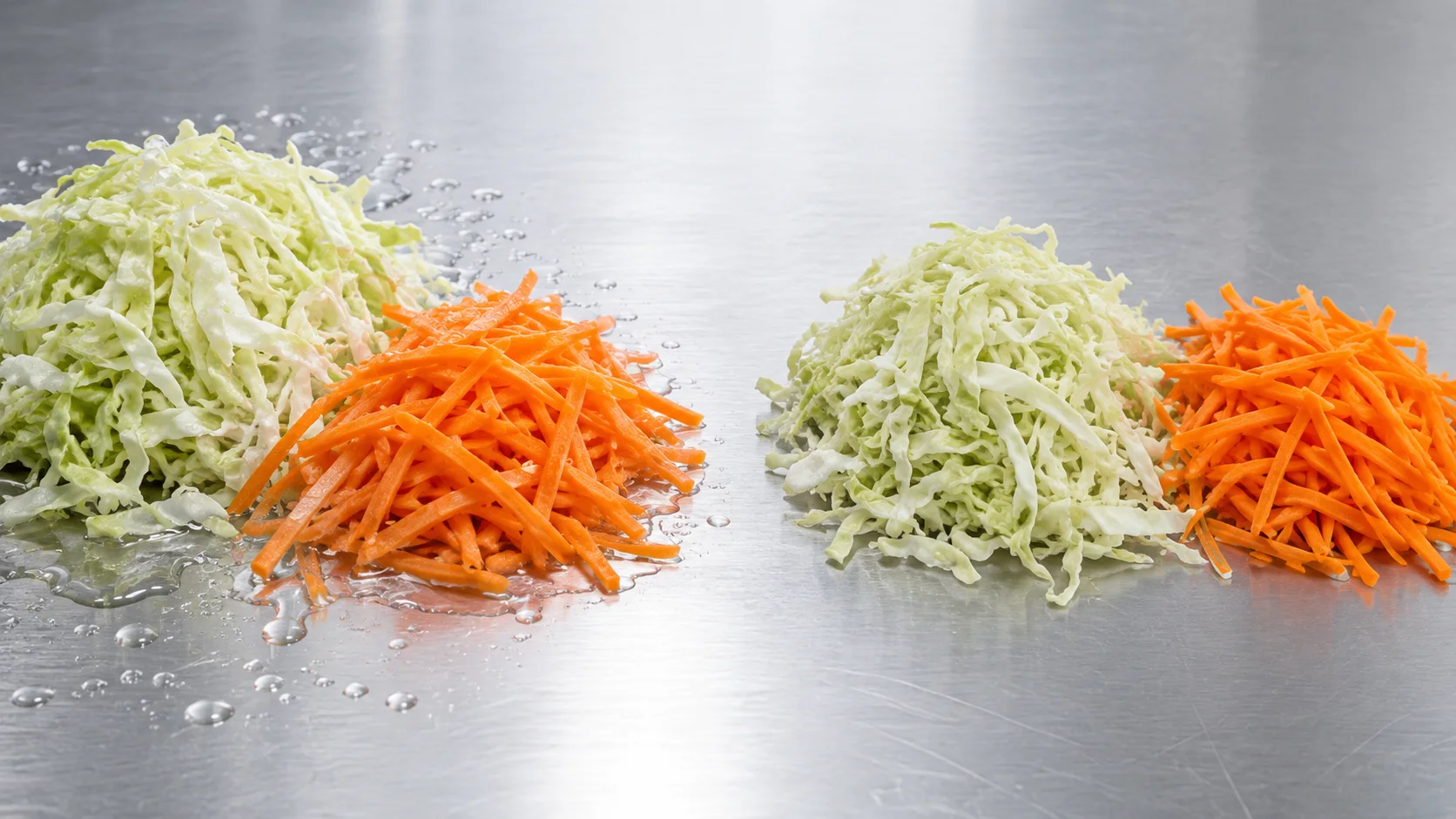
Vegetable Cutting Equipment for Spring Roll Filling Starts with the Strand Specification
The phrase vegetable cutting equipment for spring roll filling can describe several very different processing requirements. One factory may want long, visible cabbage strips mixed with fine carrot julienne. Another may require shorter cabbage strands because a particular mixer, cooker or forming system cannot accept long pieces reliably. A third may wash vegetables before cutting, while another prefers a post-cut washing stage because it wants cut-surface fluids and loose fines removed before mixing.
Those differences affect the equipment route more than a nominal kilograms-per-hour figure.
We therefore recommend defining the accepted filling component in measurable terms before choosing the cutter. For cabbage, useful inputs include target strand width, desired length range, allowable short pieces, acceptable fines, whether the strand should remain visibly distinct after washing, and the condition expected at the downstream handoff. For carrot, the buyer should specify the julienne cross-section separately from strand length because a 3 mm julienne is not equivalent to a generic “shred.”
The specification should also distinguish visible filling strands from finely chopped filling. Fine chopping creates a different particle-distribution problem: blade action, repeated impacts and chopping time can reduce ingredients into much smaller particles. That mechanism and its trial method are covered separately in our industrial vegetable chopper working principle guide. For this spring-roll application, the focus is on maintaining recognizable cabbage shreds or strips and carrot julienne through washing, drainage and transfer.
Cabbage and Carrot Should Usually Be Evaluated as Separate Cutting Routes
Cabbage and carrot may eventually enter the same filling, but they present different mechanical problems before mixing.
Cabbage is layered, compressible and variable in head density. The incoming head normally requires inspection, removal of damaged outer material where necessary, trimming and a defined coring or subdivision method before controlled feeding. Manual inspection can remain part of this preparation stage because raw heads are not geometrically uniform and the acceptable preparation standard depends on the buyer’s raw-material specification.
Carrot is firmer and more dimensionally stable, but root diameter, taper, preparation length and orientation can affect the resulting julienne. The cutting tool must create the required cross-section without generating an unacceptable fraction of fragments, wedges or short pieces.
| Decision point | Cabbage route | Carrot route | Why it matters |
|---|---|---|---|
| Incoming preparation | Inspection, outer-leaf trimming as required, coring and subdivision | Inspection, root-end preparation and size/orientation control as required | Preparation state changes feed stability and the resulting cut |
| Primary geometry | Visible shreds, strips or sections | Defined julienne cross-section and length | The two materials require different cutting actions and tools |
| TEEMYEAH candidates | TW-806, TW-805 or a trial of TW-902P where appropriate | TW-822, TW-822B, TW-922A or a trial of TW-902P where appropriate | Machine choice should follow ingredient geometry and accepted output |
| Main trial risks | Long/short strand distribution, fines, compressed feed, clumping | Broken julienne, off-section pieces, short fragments, inconsistent feeding | Total discharge alone does not show filling suitability |
| Water-management concern | Large surface area and layered strands can retain water between pieces | Water can remain on surfaces and collect within bulk material | The downstream mixer should receive a defined surface-water condition |
For industrial projects, separate cutting routes are often easier to validate because each cutter can be matched to one material family and one geometric requirement. A multifunction machine becomes interesting when the SKU schedule, available space or production pattern makes shared equipment valuable, but that should be proven with samples rather than assumed from the tool list.
Choosing the Cabbage Cutter
TW-806 for higher-capacity prepared leafy and long vegetables
The TW-806 industrial vegetable cutter is documented for prepared leafy and long vegetables including Chinese cabbage and cabbage. It can produce slices, shreds or sections, with an adjustable cutting length from 1 to 45 mm. The machine uses a 165 mm conveyor, dual-frequency adjustment and a door-open safety interlock. Its catalogue capacity is 800–1,500 kg/h.
Real TW-806 footage shows cabbage being discharged as visible shreds. A separate real line sequence also shows cabbage shredding with the TW-806 followed by transfer, washing and discharge stages. This makes the TW-806 a credible starting candidate when the filling specification requires a continuous cabbage-strand route.

The important qualification is the word candidate. Catalogue capacity does not tell the buyer what proportion of output will satisfy a specified strand range. The accepted production rate must be established using the actual cabbage preparation, feed method and cut target.
TW-805 when the required scale is lower
The TW-805 medium cutter is also intended for cabbage and other leafy or long vegetables. It produces slices, shreds or sections with an adjustable range of 1–30 mm and a catalogue capacity of 500–800 kg/h.
Where the required accepted cabbage output is below the operating range that justifies a larger cutter, or where a factory processes shorter campaigns and smaller batches, it can be reasonable to compare TW-805 trial results against TW-806 rather than automatically selecting the larger machine.
TW-902P when multifunction capability has operational value
The TW-902P quick-release multifunction cutter has separate leafy and root functions, with documented tools for leafy chopping, dicing, slicing and julienne. Its leafy cutting range is 1–60 mm and its catalogue capacity is 500–1,000 kg/h.
For a spring-roll project, that does not mean one TW-902P should automatically be specified for both cabbage and carrot. It means the machine can deserve a representative trial where shared equipment, fast tool access or a multi-SKU schedule creates a practical reason to investigate a multifunction platform.
If the cabbage specification is demanding and the carrot specification also requires a tightly defined julienne, dedicated cutters can provide a more straightforward validation route because each machine is evaluated against a narrower task. The decision should be based on sample results, changeover requirements and the accepted-output target rather than on the attraction of reducing the machine count.
Choosing the Carrot Julienne Route
Carrot should have its own cut specification. Terms such as “shredded carrot” are too broad for equipment selection because the cross-section strongly affects appearance, breakage behavior and how the ingredient distributes through the filling.
TW-822 for 2–4 mm carrot julienne
The TW-822 julienne cutter is intended for carrot and other firm roots. It produces slices or julienne with a documented 2–4 mm fixed cutting range. Catalogue capacity is 200–800 kg/h depending on the material.
Real TW-822 footage visibly shows carrot julienne being discharged into collection bins, confirming the intended equipment role. For technical validation, the buyer should go beyond appearance in the video and measure the actual cross-section, useful length distribution and quantity of broken pieces produced from representative carrot.

TW-822B and TW-922A for other scale and tooling requirements
TW-822B can process roots and fruits into slices, julienne or strips, with optional 3–6 mm tooling and a catalogue range of 500–1,200 kg/h depending on material and cut.
For substantially higher root throughput, the TW-922A high-speed julienne cutter has 3, 4 and 5 mm tool options and a catalogue capacity of 2–3 t/h.
These capacity numbers are useful for screening equipment size, but the spring-roll project should still be based on accepted carrot output. A high nominal feed rate has limited value if excessive short pieces, non-conforming cross-sections or rework reduce the quantity that can actually be released to the filling process.
Should Cabbage Be Washed Before or After Cutting?
There is no universal answer. The washing position changes what the wash stage is being asked to accomplish.
Washing prepared cabbage before cutting keeps the ingredient in larger pieces during water agitation and avoids exposing all cut surfaces to the wash stage. Post-cut washing, by contrast, can remove loose fines and some material released from freshly cut surfaces, but the washer must handle lighter, smaller and more easily entangled strands.
| Evaluation factor | Whole or prepared-piece washing before cutting | Post-cut cabbage washing |
|---|---|---|
| Incoming soil or loose debris | Removed before the cutter; useful when the cutting stage should receive cleaner prepared material | May require an earlier cleaning step if incoming material is too dirty for direct cutting |
| Cut-surface fluids | Created after washing and therefore remain with the cut material unless another step is added | Can be carried into the post-cut wash water and removed with the wash stream |
| Loose fines | Fines created by cutting remain in the product stream unless separated downstream | Post-cut washing and drainage can help separate some fines |
| Product handling | Larger pieces are generally easier to retain and transfer during washing | Individual strands receive more water handling and may tangle, clump or experience additional mechanical stress |
| Water carried downstream | Depends mainly on pre-cut drainage plus moisture created or retained after cutting | Cut strands leave the washer wet and normally require a deliberate drainage or centrifugal stage |
| Best validation method | Inspect cutting stability and downstream cleanliness after the pre-wash route | Measure fines loss, strand integrity, drainage and surface-water condition after post-cut washing |
The TW-606-3 continuous washer is documented as a first washing stage using water jets, bubbles, a debris-removal circuit and conveyor discharge. Its catalogue capacity is 800–2,000 kg/h.
For cut leafy vegetables, TW-406 uses spiral/bubble washing and incorporates vibratory drainage that removes fines and some large water droplets. Its catalogue capacity is 800–1,500 kg/h. This makes it relevant when the project deliberately chooses a cut-then-wash sequence.

The important design question is therefore not simply “Which washer has enough capacity?” It is “At what physical state should cabbage enter the washer, and what condition must it leave in?”
Surface-Water Management Is Part of the Filling Specification
After washing, the buyer needs to decide what “drained” means in measurable operating terms. A wet mass of cabbage strands can carry water between layers, collect in conveyor transfers and enter the filling mixer differently from material that has been spread and drained. More aggressive centrifugal treatment changes that condition again.
For spring-roll filling, we suggest defining a surface-water target by a repeatable test rather than using descriptions such as “fairly dry” or “not too wet.” Depending on the project, that test might use drained weight change over a fixed period, a defined centrifuge recipe, free-water observation in a receiving container, or another buyer-approved acceptance method that can be reproduced during the trial.
| Surface-water method | Relevant TEEMYEAH equipment | Best fit in validation | Key trial questions |
|---|---|---|---|
| Vibratory drainage and spreading | TYN-1400 | Continuous removal of free surface water while spreading material for transfer | Does drainage alone reach the mixer handoff condition? Is water still pooling after transfer? |
| Batch centrifugal removal | TY-980C | Flexible batch trials, multiple SKUs, recipe-based time and speed adjustment | What basket load, time and speed preserve strand integrity while reaching the water target? |
| Automatic centrifugal handling | TW-980LB | Projects where automatic feed, centrifugal processing and discharge justify line-level evaluation | Can the intended cabbage preparation be fed, dewatered and discharged consistently at the required accepted rate? |
Vibratory drainage when full centrifugation is unnecessary
The TYN-1400 vibratory drainage conveyor is intended for surface-water drainage and material spreading. Catalogue capacity is 800–1,200 kg/h for leafy material and up to 3 t/h for roots. Those ratings should not be interpreted as accepted spring-roll-filling output; they describe equipment handling ranges.
For some filling processes, removing free water and spreading the cabbage before transfer may be sufficient. This route has the advantage of continuous flow and avoids basket scheduling. The trial should determine whether the resulting material is stable enough for the next process without visible pooling or problematic clumping.
TY-980C for controlled batch centrifugal trials
The TY-980C batch basket centrifuge has a 65 L basket with adjustable time and speed. Typical basket loads differ between leafy and root materials, so basket load should be established as part of the actual-material recipe rather than converted directly into an hourly claim.
This equipment is particularly useful during technical validation because time, speed and loading can be recorded as controlled variables. One setting may leave too much free surface water; another may reach the desired surface condition but create more short strands or compact the product excessively. A representative test should examine both water removal and strand condition.
TW-980LB when automatic centrifugal handling deserves evaluation
The TW-980LB automatic centrifugal line is documented for washed lettuce, cabbage and potato shreds. It uses a 125 L basket and provides automatic feeding, centrifugal processing and discharge.

Its catalogue figure of 1.5 t/h applies to roots and should not be transferred to cabbage or to a spring-roll vegetable mix. For cabbage, the correct engineering question is how a representative strand specification behaves through automatic loading, the selected centrifugal recipe and discharge, and how many kilograms per hour meet the filling acceptance criteria.
Accepted Output per Hour Is More Useful Than Cutter Discharge per Hour
A spring-roll factory does not purchase cutter discharge. It needs usable filling ingredient delivered to the next process.
For that reason, accepted output should be calculated after deductions for non-conforming material and operational losses that are relevant to the chosen route. A practical capacity definition can be written as:
Accepted output per hour = material released to the downstream filling process after off-size strands, fines, clumps requiring intervention, manual finishing, rework and scheduled changeover effects are accounted for.
Suppose a cutter can physically discharge material at a high rate, but the actual cabbage produces a significant proportion of pieces below the minimum useful length. Those pieces still contribute to gross scale weight, but they should not automatically count toward the accepted filling capacity if the buyer’s specification excludes them.
The same logic applies to washing and centrifugal handling. If a high wash rate creates excessive fines or an aggressive centrifugal recipe generates strand damage that must be screened out, the usable line rate is lower than the gross equipment rate.
Our separate food processing equipment capacity verification guide explains this distinction in more detail. For the present application, capacity validation should follow the complete cabbage and carrot preparation route until the material reaches the agreed handoff point.
Plan the Route Around Buffers, Batches and Downstream Timing
Even when the individual machines are suitable, a filling-preparation subsystem can become unstable if the flow between them is not coordinated.
Cabbage cutting is commonly continuous. A washer may also discharge continuously. A batch centrifuge, however, requires loading, processing, unloading and the next basket cycle. Without an appropriate buffer, the cutter can produce material faster than the centrifuge can accept it during part of the cycle.
The design therefore needs to consider the timing relationship between stages rather than simply matching catalogue capacities.
Basket scheduling
For a batch centrifugal route, the trial should record actual load per basket, fill time, centrifugal time, discharge time and any operator intervention between cycles. The resulting cycle determines how many baskets are required to support the intended accepted flow.
Intermediate buffers
A buffer can decouple cutting from washing or washing from centrifugal treatment, but it must not create a new product-handling problem. Long cabbage strands can bridge or clump if the receiving geometry is poor. The trial should therefore observe both quantity and discharge behavior from the buffer.
Downstream mixer, cooker or former timing
The final handoff point matters because material that appears satisfactory directly after drainage may change while waiting. If the real production route includes a defined holding period before mixing, the representative trial should reproduce that delay rather than evaluating the ingredient only at the instant it leaves the machine.
Cleaning and Changeover Can Change the Best Equipment Choice
Spring-roll and frozen-snack factories often process multiple fillings or ingredient combinations. A technically capable cutter may still be inconvenient if the changeover pattern conflicts with the production schedule.
During feasibility review, we ask how often cabbage and carrot recipes change, whether different strand dimensions are required across SKUs, whether the same equipment will handle other vegetables, and whether ingredients are produced in long campaigns or short batches.
This is especially important when comparing a multifunction cutter against dedicated machines.
A shared cutter can reduce the number of machine bodies in the area, but production may need to stop while tools are changed and the machine is cleaned. Dedicated cabbage and carrot machines can allow the two ingredients to be prepared independently, which may be more credible where both streams must run at the same time or where their tool configurations rarely change.
The correct comparison therefore includes cleaning access, tool removal, restart checks, changeover frequency and the effect of these events on accepted hourly output.
How We Structure a Representative Spring-Roll Filling Trial
For a meaningful trial, the sample should reproduce the intended production condition closely enough that cutting, washing and water-removal observations can be transferred into the project design.
We begin with the actual ingredient specification. For cabbage, that includes variety or representative head type, incoming size range, core-removal method, trimming standard and the form in which cabbage reaches the cutter. For carrot, it includes diameter range, length preparation and whether the roots arrive peeled or otherwise prepared.
The target cut is then expressed numerically. Instead of “thin cabbage,” we need a strand width or cutting setting and the acceptable length range. Instead of “carrot strips,” we need the required julienne cross-section and desired usable length.
The wash sequence should also be reproduced. A buyer evaluating pre-cut washing should not use a post-cut washing trial and assume the handoff condition will be equivalent. Likewise, if production intends to wash after shredding, the trial needs to evaluate fines, strand handling and water removal after that exact sequence.
Surface-water treatment is recorded as a process variable. For a TY-980C test, for example, basket load, speed and time are recorded with the resulting product condition. For vibratory drainage, residence and discharge behavior should be observed. For an automatic centrifugal route, feed and discharge continuity become part of the test.
The final sample should then be presented to the real downstream requirement wherever practical. The engineering question is whether the prepared cabbage and carrot arrive with the dimensions, water condition and flow behavior expected by the buyer’s mixer, cooker or former interface.
Spring Roll Filling Pre-Processing Trial and Acceptance Matrix
| Trial field | Cabbage test | Carrot test | Acceptance record |
|---|---|---|---|
| Raw-material input | Variety/type, head size, trimming, core removal, subdivision and incoming condition | Root size range, preparation length, peeling/preparation state and incoming condition | Actual representative input approved for testing |
| Machine/configuration | For example TW-806, TW-805 or TW-902P candidate configuration | For example TW-822, TW-822B, TW-922A or TW-902P candidate configuration | Machine and complete process route recorded |
| Setting or tool | Cut-length setting, feed setting and relevant tool configuration | Selected julienne tool size and feed configuration | Repeatable setting identified by trial number |
| Sample size | Defined kilograms or batch count sufficient to observe normal variation | Defined kilograms or batch count sufficient to observe root-size variation | Input and recovered output weights recorded |
| Strand dimensions | Width and usable length distribution measured from representative samples | Julienne cross-section and usable length distribution measured from representative samples | Pass/fail limits agreed before final evaluation |
| Short pieces/fines | Weight or sample percentage below agreed useful size | Broken or short julienne and non-conforming fragments | Maximum accepted proportion recorded |
| Clumping | Observe strand entanglement after cutting, washing, drainage and holding | Observe bundling or compaction through collection and transfer | Intervention frequency and severity recorded |
| Surface water | Record drainage method or centrifuge recipe and resulting free-water condition | Record whether washing occurs and the required post-wash water condition | Buyer-approved surface-water acceptance method used consistently |
| Accepted output | Usable kilograms after off-size material, fines, manual finishing and rework | Usable kilograms after broken pieces, off-section material and rework | Accepted kg per test period converted to project capacity basis |
| Mixer/former handoff observation | Check flow, clumping, free water and compatibility with intended transfer/infeed arrangement | Check flow, distribution and compatibility with intended transfer/infeed arrangement | Observation made at the agreed downstream handoff point |
| Acceptance owner | Named buyer-side process, production or project representative | Named buyer-side process, production or project representative | Final acceptance criteria signed off by the project team |
The value of this matrix is that it turns general visual impressions into project inputs. A cabbage sample can look attractive while still containing too many short pieces for the buyer’s filling specification. A carrot julienne sample can appear uniform in a photograph while its cross-section is outside the required range. Recording dimensions, rejected fractions and downstream handoff observations creates a much stronger basis for configuration.
When a Multifunction Cutter Deserves a Trial
A multifunction cutter is worth evaluating when production has several vegetable SKUs, the plant values one shared platform, the required cabbage and root cuts fall within available tool configurations, and simultaneous processing is not essential.
TW-902P is relevant in this discussion because it has documented separate leafy and root functions and multiple cutting tools. Its 1–60 mm leafy range and 500–1,000 kg/h catalogue capacity make it a potential candidate for certain mixed-product preparation areas.
However, the decision should be made from the actual spring-roll specification. If cabbage needs a particular visible strand geometry while carrot requires a narrow julienne cross-section at a substantially different throughput, a TW-806 plus a TW-822-family cutter may provide a clearer engineering route. Each machine can then be tested with the ingredient it is intended to process.
Separate machines also deserve stronger consideration when cabbage and carrot need to run simultaneously, when frequent tool changes would interrupt production, or when one ingredient’s required capacity is materially higher than the other’s.
Information to Prepare Before Requesting a Configuration
A useful RFQ for a spring-roll vegetable preparation subsystem does not need to be complicated, but it should describe the product condition rather than only naming machines.
- Ingredient list and proportions: cabbage, carrot and any other vegetables that must use the same preparation area, including approximate formulation proportions where they affect scheduling.
- Incoming condition: whole cabbage heads, cored pieces, trimmed sections, washed or unwashed material; carrot preparation state and approximate size range.
- Cabbage strand specification: target width, target or acceptable length range, and limits for short pieces and fines.
- Carrot specification: required julienne cross-section and preferred usable length.
- Hourly accepted-output target: kilograms per hour that must meet the cut and water-condition criteria, not only gross feed rate.
- Wash sequence: whether cabbage and carrot are washed before cutting, after cutting or through different routes.
- Surface-water target: vibratory drainage, defined centrifugal condition or another measurable handoff requirement.
- Batch and SKU schedule: daily operating hours, batch sizes, changeover frequency and whether cabbage and carrot run simultaneously.
- Downstream interface: how the vegetables enter the buyer’s mixer, cooker or former, including transfer height, buffer arrangement and any maximum strand condition that affects infeed.
- Layout and utilities: available floor area, preferred material-flow direction, electrical requirements, water supply and drainage conditions.
With these inputs, we can evaluate whether the project is better served by dedicated cabbage and root cutters, a multifunction candidate, pre-cut or post-cut washing, continuous drainage, batch centrifugation or an automatic centrifugal route. The resulting configuration can then be linked to a representative trial rather than being built around catalogue capacity alone.
Procurement FAQs
Can we specify one machine for both cabbage and carrot to reduce the line footprint?
Possibly, but this should be justified by the cut specifications and production schedule. TW-902P has separate leafy and root functions and can be considered when shared equipment has operational value. If cabbage and carrot need different capacities, run simultaneously or require tightly controlled tool configurations, dedicated cutters such as TW-806 for cabbage and TW-822-family equipment for carrot may be easier to validate and operate.
Should we choose TW-805 or TW-806 for cabbage based only on kilograms per hour?
No. TW-805 has a catalogue range of 500–800 kg/h and TW-806 800–1,500 kg/h, but the project should compare accepted strands per hour. The trial needs to account for strand dimensions, short pieces, fines, feed preparation and any rework before selecting the appropriate machine size.
How do we choose between 2, 3, 4 or 5 mm carrot julienne?
Use the filling specification and downstream handling requirement. TW-822 covers a documented 2–4 mm fixed cutting range, TW-822B offers optional 3–6 mm tooling, and TW-922A has 3, 4 and 5 mm tool options. Representative carrot should be cut with the candidate geometry and assessed for cross-section, useful strand length, breakage and downstream mixing behavior.
Does cabbage need to be washed again after shredding if it was already washed before cutting?
That depends on the intended process. Pre-cut washing removes incoming debris before the cutter, while post-cut washing can remove loose fines and material released from cut surfaces. Adding a post-cut wash also creates a new water-removal requirement. The project should compare the two sequences against the required handoff condition rather than assuming one route is universally better.
Is vibratory drainage enough, or should we use a centrifuge?
If the downstream process only requires removal of free water and the material reaches the required handoff condition after continuous drainage, a vibratory drainage route may be sufficient. If tighter and recipe-controlled surface-water removal is needed, TY-980C provides adjustable batch time and speed. Automatic centrifugal handling with TW-980LB deserves evaluation where line automation and continuous feed/discharge integration are important.
Can the TY-980C basket size be converted directly into hourly capacity?
No. The TY-980C uses a 65 L basket, but actual loading differs by material. Hourly accepted output depends on basket load, filling time, selected centrifugal time and speed, unloading, operator handling and the percentage of material that remains within the strand acceptance limits after treatment.
Can we use the TW-980LB 1.5 t/h figure for shredded cabbage?
The 1.5 t/h catalogue figure applies to roots. A cabbage application should be evaluated using actual washed cabbage shreds, the selected basket recipe and automatic loading/discharge sequence. The useful project figure is the accepted cabbage output that meets the required strand and surface-water condition.
How large should a representative trial sample be?
The sample should be large enough to include normal raw-material variation and to operate the candidate machine through a meaningful processing period rather than only producing a handful of visually selected pieces. The required quantity depends on the machine, whether washing and centrifugal treatment are included, and whether the test needs multiple settings. We define the trial quantity after reviewing the ingredient and process route.
How should we compare two cutter candidates fairly?
Use the same representative raw material, preparation state, target dimensions and acceptance method. Measure usable strand output, short pieces, fines, rework and processing time rather than comparing only total discharge weight. If one candidate requires a different feed preparation or changeover procedure, those operational differences should also be recorded.
What should be confirmed before requesting a final spring-roll filling pre-processing configuration?
The project team should have agreed the cabbage strand target, carrot julienne target, incoming preparation condition, wash sequence, surface-water condition, accepted hourly output, SKU schedule and downstream handoff requirement. Once these are defined, machine matching becomes a technical configuration exercise rather than a catalogue comparison.
Send Your Spring Roll Filling Ingredient and Cut Specifications
For a spring-roll vegetable preparation project, send us your ingredient list and proportions, incoming condition, cabbage strand length and width target, carrot julienne cross-section and length target, hourly accepted-output target, intended wash sequence, target surface-water condition, batch or SKU schedule, downstream mixer/cooker/former infeed requirement, available layout and utilities.
We can use those inputs to match the cabbage and carrot cutting routes, washing position, drainage or centrifugal method, intermediate transfer and representative sample-trial plan. Where several configurations are technically plausible, we can define the variables that should be compared before the project proceeds to final equipment selection.