







Vegetable Dewatering: Methods, Equipment and Line-Matching Guide
Vegetable dewatering is not only a question of selecting a machine that removes water. In an industrial line, the more important question is whether the draining or dewatering stage can accept product from the washer at the required production rhythm, remove an appropriate amount of surface water for the next operation, and discharge product without creating excessive waiting, manual handling or work-in-process accumulation.

TYN-1200 · preliminary draining

TY-980C · batch chamber
Example stage sequence; adapt it to your product and downstream process.
This becomes particularly important when a continuous washing section feeds a batch centrifuge. A washer may release product continuously, while the centrifuge must be loaded, operated, stopped, unloaded and reset before the next batch can begin. Matching these two operating modes requires cycle information, realistic product loading data and a deliberate buffer strategy rather than a simple comparison of nameplate capacities.
This guide explains how to distinguish draining, centrifugal dewatering and project-specific air drying; how product condition affects method selection; and how to match dewatering capacity with upstream washing and downstream inspection, weighing or packing. For the previous process stage, see the Vegetable Washing Process, or return to the Process Knowledge Hub to review the broader pre-processing sequence.
Draining vs Dewatering vs Drying
Although these terms are sometimes used interchangeably in equipment discussions, they describe different process roles.
Draining primarily removes free water that can fall or flow away from the product. A vibratory draining conveyor, for example, can continue transferring vegetables while vibration and the screened conveying surface allow free water to separate. It should not automatically be treated as equivalent to centrifugal dewatering.
Centrifugal dewatering uses rotational force to remove more surface water from product held in a basket or processed through an automatic centrifugal system. In a manual batch machine, the processing sequence includes basket loading, lid locking, spinning, waiting for rotation to stop, basket removal and unloading.
Air drying uses airflow as an additional surface-water-removal stage. One TEEMYEAH whole-vegetable project used air drying before cutting. For your application, assess whether this stage is needed and confirm the result with representative product trials. Food-safety and shelf-life requirements need separate validation.
Vibratory draining
Main process role
Remove free surface water while transferring product
Operating pattern
Continuous
Typical selection question
Is preliminary draining sufficient before the next stage, or is stronger dewatering still required?
Batch centrifugal dewatering
Main process role
More intensive surface-water removal in discrete loads
Operating pattern
Batch
Typical selection question
Can the required production flow be supported after including loading, spin, stopping, unloading and reset time?
Automatic centrifugal dewatering
Main process role
Automated feed, dewatering and discharge sequence
Operating pattern
Continuous or automatically cycled system
Typical selection question
Does the product and required flow justify an integrated automatic dewatering stage?
Air drying
Main process role
Additional airflow-based surface-water removal
Operating pattern
Project-specific
Typical selection question
Is airflow needed for the particular product and downstream operation, and has the requirement been tested?
Why Surface Water Matters Operationally
Water carried out of the washing section becomes part of the material-handling problem downstream. Excess free water can enter inspection tables, weighing areas, crates, conveyors or packaging preparation zones. It can also make it harder to establish a predictable transfer condition between washing and subsequent operations.
The relevant engineering target is therefore not simply “make the vegetables dry.” A project should define how much free or surface water can reasonably remain for the next operation, while also considering product condition and handling intensity. The acceptable balance needs to be confirmed with the actual vegetable, cut specification and process sequence rather than assumed from equipment type alone.
In one project, dewatered product moved onward to inspection, metal detection and weighing/crating. Another used an inspection/weighing/packing table to transfer or temporarily hold product and support inspection and weighing with an external scale. These examples illustrate how the dewatering stage connects with the rest of the line.
Vibration Draining
A vibratory draining conveyor is useful where the process needs continuous transfer combined with removal of free water. Rather than collecting vegetables into baskets, product can move along a vibrating screen while water separates through the conveying surface.
TEEMYEAH’s TYN-1200 Vibratory Dewatering Conveyor uses linear vibration with twin drives. Its screened conveying structure includes a spray pipe underneath for debris collection and pneumatic water-level control.
TYN-1200 catalog specifications are 400 kg/h, 2310 × 1000 × 1100 mm, 380 V / 0.26 kW and approximately 300 kg machine weight. Confirm the achievable throughput for your vegetable, cut specification and line arrangement before sizing the complete process.
Vibration draining can also be used before a stronger dewatering stage. One 2026 root-vegetable planning example placed TYN-1200 after two TW-606-3 washing stages and before product collection and batch TY-980C centrifugal dewatering. In that configuration, vibration draining did not replace centrifugation; it served as an intermediate water-removal and transfer stage.

TYN-1200 screened conveying surface and vibration-drive assembly.
Centrifugal Dewatering
Centrifugal dewatering removes surface water by spinning washed vegetables in a basket or drum. Semi-automatic machines use manual basket loading and unloading, while automatic systems integrate product feeding and discharge. In both cases, match the complete operating cycle to the product and the surrounding line.
TY-980C Semi-Automatic Centrifugal Dewatering
The TY-980C vegetable centrifuge processes washed vegetables in removable baskets. The operator loads and unloads each basket while the machine performs the spinning step. Plan basket handling and transfer to the next operation when matching this semi-automatic arrangement to a continuous washing line.
Load the basket to approximately two-thirds and lock the lid before starting. Wait until rotation stops completely before removing the basket, and confirm the practical load with your actual vegetable and cut specification.

TY-980C semi-automatic centrifuge with a removable product basket.
Batch load is not hourly capacity. Include loading, spinning, stopping, unloading, basket swap/reset, cleaning and changeovers before sizing the dewatering stage or deciding how many machines are needed.
Cleaning and configuration details
Cleaning can further affect available production time. TY-980C cleaning requires isolation, opening four body latches, removal of the housing by two people, cleaning of the housing and basket, and reassembly. A realistic project calculation therefore needs to reserve time for cleaning and changeover rather than treating every scheduled minute as productive spinning time.
An earlier TY-980C project specification used approximately 10 kg per basket for leafy vegetables and 15–20 kg per basket for roots. That configuration specified 65 L, 0–1200 rpm, 1.1 kW and dimensions of approximately 1045 × 1025 × 1090 ±50 mm. These figures describe that earlier project, not a standard rating for every application. Confirm the current machine configuration and practical load for your product before selection.
Automatic Centrifugal Dewatering
Automatic centrifugal dewatering changes the handling architecture by integrating feeding, programmed dewatering and discharge rather than relying on repeated manual basket loading and unloading.
The TW-980LB Automated Vegetable Dewatering Line combines continuous feeding with automatic dewatering, touch-screen programs, an inner drum, an air knife and quick-removal conveyors. Catalog specifications include 6600 × 1800 × 2320 mm, 380 V three-phase five-wire / 9 kW, 125 L and approximately 1 t machine weight.
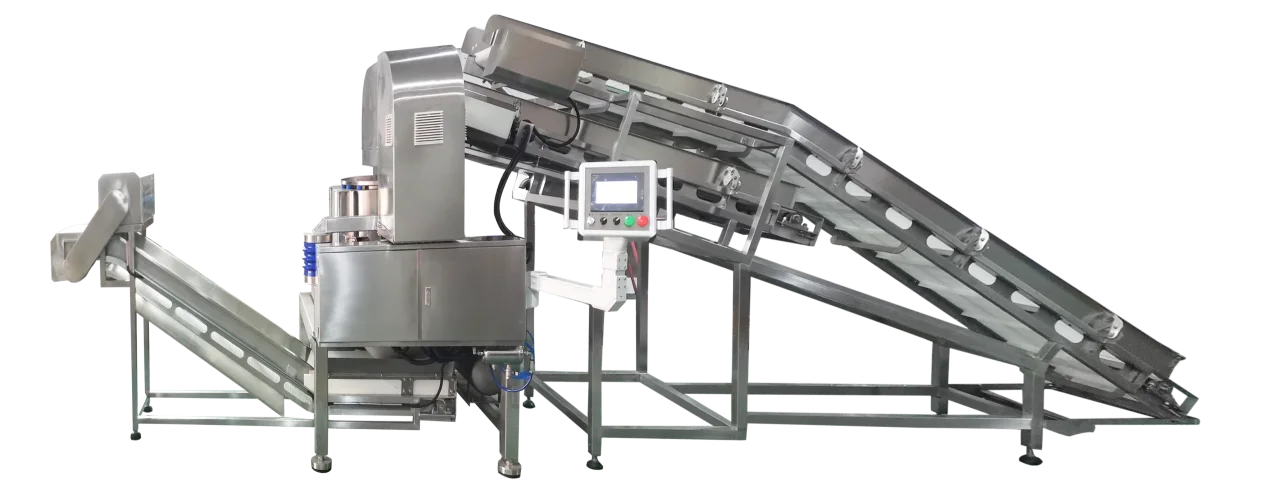
TW-980LB automatic dewatering equipment with connected conveyors for feeding and discharge.
The 1.5 t/h catalog rating applies specifically to root vegetables. Leafy vegetables, salad and RTE products require their own capacity assessment. Confirm the product, incoming flow and downstream operating conditions when matching the machine to your line; this rating is not a complete-line finished-output guarantee.
TW-980LV Automatic Centrifugal Dewatering
The TW-980LV Automatic Vegetable Dewatering Line combines continuous feeding with automatic centrifugal dewatering, touch-screen product programs, an inner drum and air-knife assistance. Review conveyor interfaces, cleaning access and compressed-air requirements alongside the upstream washer and downstream equipment.
Catalog specifications include 10430 × 2300 × 2845 mm, 380 V three-phase, five-wire / 13.5 kW, a 250 L drum, 900 mm dewatering-cylinder diameter and approximately 1.5 t machine weight.
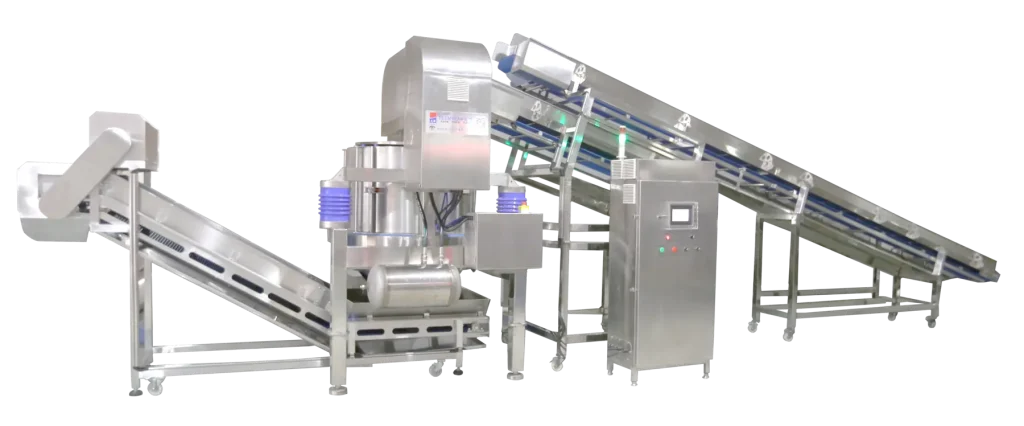
TW-980LV conveyor arrangement, centrifugal drum and control cabinet.
The 3 t/h catalog rating applies specifically to root vegetables. Leafy vegetables, salad and RTE products require their own capacity assessment. Confirm product-specific cycle data, incoming flow and downstream acceptance; this rating is not a complete-line finished-output guarantee.
Air Drying for Specific Product Requirements
Air drying should be considered separately from both vibration draining and centrifugal dewatering. It may be useful where a project requires an airflow-based stage before a later process, but the requirement should come from the product and downstream operation rather than from a general assumption that every washed vegetable needs an air-drying tunnel.
One whole-vegetable project used air drying before cutting. To assess a similar arrangement for your line, test the product under the proposed operating conditions and agree on the required surface-water level and product condition. Capacity and drying results need to be confirmed for that application.
If your process needs an airflow drying stage, consider the FG-5000 Vegetable Air Drying Line as part of the line review. Confirm its suitability and operating target through trials with your product.
Batch vs Continuous Logic
Use this sequence to review each operating step. Confirm cycle times and buffer requirements for your product and line.
The most important difference between batch and continuous dewatering is often not the physical water-removal mechanism but the way product moves through the line.
A continuous washer may discharge product every few seconds. A manual centrifugal dryer cannot necessarily accept that flow directly because one basket is being loaded while another may be spinning, stopping, being removed or unloaded. Without a planned transition, product can accumulate at the washer discharge or operators may be forced to interrupt upstream feeding.
Continuous draining equipment can help maintain transfer flow, while automatic centrifugal equipment can reduce some of the repeated manual basket-handling steps. Neither choice removes the need to verify actual product loading, process time, changeovers and downstream acceptance rate.
Product-Dependent Method Selection
Different vegetables carry water differently after washing. Whole roots, delicate leafy material, cut vegetables and mixed-SKU production can therefore require different dewatering strategies.
Method selection should begin with the condition in which the product reaches the dewatering stage: whole or cut, leaf or root, approximate piece size, product fragility, quantity of free water leaving the washer and the requirements of the next process. The target should be established experimentally when residual water and product handling intensity are both important.
Product mainly needs free-water removal during transfer
Method worth evaluating
Vibratory draining
Main project question
Can continuous draining provide an acceptable transfer condition without an additional centrifugal stage?
Product requires stronger surface-water removal in discrete quantities
Method worth evaluating
Batch centrifuge
Main project question
What practical basket load and complete cycle time are achievable with this product?
Higher-flow root-vegetable project requiring automated dewatering
Method worth evaluating
Automatic centrifugal system
Main project question
Can product feed, dewatering and discharge be integrated with upstream and downstream equipment?
Whole vegetable requiring an additional airflow stage
Method worth evaluating
Project-specific air drying
Main project question
What airflow stage is required before the next operation, and what result is acceptable in trials?
Continuous washer feeding manual batch dewatering
Method worth evaluating
Buffer plus one or more batch machines
Main project question
How much product arrives during each complete dewatering cycle, and how will WIP be controlled?
Loading, Cycle and Discharge Logic
Confirm for Your Product and Line
Why Batch Load Is Not Hourly Capacity
A basket load tells you how much product may be processed in one batch under a particular product condition. It does not by itself tell you how many kilograms can be processed per hour.
For a manual centrifuge, the relevant cycle includes at least:
loading time + dewatering/spin time + deceleration and complete stop + unloading time + basket swap/reset time
Include cleaning, changeovers, operating uptime and SKU mix in your production plan. Confirm these inputs and the complete cycle before calculating hourly throughput or the number of machines required; basket kilograms alone are not enough.
The earlier TY-980C project example uses different basket loads for leafy and root vegetables. Each value describes one product-specific batch, not the amount the machine can process per hour.
Matching Upstream Washing to Downstream Dewatering
The dewatering stage should be sized from the flow arriving from washing, not selected independently from it.
A practical review starts by identifying whether the upstream washer releases product continuously, intermittently or by batch. The next question is how the dewatering stage accepts product. Continuous-to-continuous transfer is structurally different from continuous-to-batch transfer, where a temporary accumulation point may be required.
Information Needed to Size Your Dewatering Stage
Product load per batch
What must be confirmed
Practical product quantity loaded without exceeding operating guidance
Why it matters
Defines material handled per completed batch
Confirm for Your Product and Line
Loading time
What must be confirmed
Time from empty basket to ready-to-run basket
Why it matters
Reduces the number of complete cycles available
Confirm for Your Product and Line
Spin/dewatering time
What must be confirmed
Operating time tested for your product
Why it matters
Core processing portion of the cycle
Confirm for Your Product and Line
Deceleration/stop time
What must be confirmed
Time until safe basket removal
Why it matters
Must be included rather than assuming immediate discharge
Confirm for Your Product and Line
Unloading time
What must be confirmed
Time to remove and empty the basket
Why it matters
Affects operator and basket availability
Confirm for Your Product and Line
Reset/basket swap
What must be confirmed
Time before the next load can begin
Why it matters
Can become significant in repeated manual operation
Confirm for Your Product and Line
Cleaning/changeover allowance
What must be confirmed
Time reserved for cleaning or SKU changes
Why it matters
Reduces productive operating time
Confirm for Your Product and Line
Uptime assumption
What must be confirmed
Realistic available running period
Why it matters
Prevents theoretical 60-minute-per-hour assumptions
Confirm for Your Product and Line
SKU mix
What must be confirmed
Product-dependent load and cycle differences
Why it matters
One setting may not represent the production day
Confirm for Your Product and Line
Upstream delivery pattern
What must be confirmed
Continuous, intermittent or batch
Why it matters
Determines buffer requirement
Confirm for Your Product and Line
Downstream acceptance pattern
What must be confirmed
Inspection, weighing, crating or packing flow
Why it matters
Determines whether dewatering discharge can leave immediately
Confirm for Your Product and Line
Measure or agree on each input to establish the complete operating cycle, then compare incoming product flow with the dewatering stage’s practical availability. Confirm loading, spin, stopping and handling times before deciding how many centrifuges your line needs.
Buffer and WIP Logic
A buffer between a continuous washer and a batch centrifuge can prevent every centrifuge cycle from immediately forcing a stop upstream. Its purpose is to temporarily decouple two different production rhythms.
Size the buffer for your product and operating rhythm. Agree on the acceptable amount of work in process, residence time, handling method, drainage arrangement, operator access and process controls. The centrifuge model alone does not determine the buffer size.
Downstream interruptions also matter. In one project, an automatic crating/weighing system held product temporarily during crate changes. Review whether your downstream equipment needs a similar buffer and how that interruption affects the dewatering stage.
When Parallel Dewatering Machines May Be Needed
Parallel batch centrifuges may be evaluated when one machine cannot align with the incoming product flow or when alternating baskets is needed to reduce upstream waiting.
To assess parallel machines, confirm product load per basket, loading, dewatering, stopping, unloading and reset or basket-swap times, together with cleaning allowance, expected uptime and SKU mix. Use the complete cycle and actual incoming flow to determine the machine quantity for your line.
Parallel equipment also creates its own operating questions: how product is divided between machines, where filled and empty baskets are staged, whether operators can service several machines without delay, and how discharged product recombines before the next process. These issues should be included in the layout and labor review rather than treated solely as a capacity calculation.
For broader capacity methodology, see Leafy Vegetable Line Capacity Matching and Rated Capacity vs Sustainable Output.
Downstream Inspection, Weighing and Packaging Interface
Dewatering capacity is only useful if product can leave the dewatering section at a rate the next operation can accept.
One project used automatic centrifugal dewatering followed by inspection, metal detection and weighing/crating. Another incorporated an inspection/weighing/packing table that transferred and buffered product while supporting manual inspection and weighing with an external scale. These configurations illustrate why discharge height, transfer direction, accumulation space and downstream cycle interruptions belong in the dewatering selection discussion.
For packaging-oriented projects, the engineering question is therefore not only how quickly water can be removed. It is also whether product can be discharged into inspection, weighing, crating or packing without repeatedly blocking the dewatering equipment or allowing excessive WIP to accumulate.
TEEMYEAH Equipment Selection by Process Role
For a broader model overview, browse Vegetable Dewatering and Drying Equipment. The individual machines below should be selected by process role rather than treated as interchangeable capacity options.
Process role
Continuous preliminary draining and transfer
Selection Considerations
Catalog reference is 400 kg/h; vibration draining is not equivalent to centrifugal dewatering
Process role
Manual batch centrifugal dewatering
Selection Considerations
Basket should be loaded to about two-thirds; practical output requires complete cycle data
Process role
Manual batch centrifugal dewatering
Selection Considerations
Load the basket to approximately four-fifths; confirm the complete cycle to determine hourly output
Process role
Automatic continuous-feed centrifugal dewatering
Selection Considerations
Catalog 1.5 t/h reference applies only to root vegetables
Process role
Automatic centrifugal dewatering with continuous product feeding
Selection Considerations
Catalog 3 t/h rating applies only to root vegetables; confirm product-specific cycles, compressed-air supply and conveyor interfaces.
Process role
Airflow drying matched to your product
Selection Considerations
Evaluate only where the product and downstream process justify an air-drying stage
Dewatering in Example Processing Lines
Two-Stage Washing → Vibration Draining → Batch Centrifugal Dewatering
One 2026 root-vegetable planning example placed TYN-1200 after two TW-606-3 washing stages. Product then moved to collection and TY-980C batch centrifugal dewatering. The arrangement illustrates how preliminary draining can sit between washing and a stronger batch dewatering step.
Two Wash Stages → Automatic Centrifugal Dewatering → Inspection and Weighing
Another root-vegetable project used two washing stages followed by automatic centrifugal dewatering, inspection, metal detection and weighing/crating. This shows a different architecture where dewatering was integrated into a more continuous downstream sequence.
Whole-Vegetable Processing with Air Drying Before Cutting
A separate whole-vegetable project used an air-drying stage before cutting. Assess a similar sequence against your vegetable, incoming water condition and the requirements of the next processing step.
Use these examples to compare process arrangements and identify the interfaces your project needs. A Leafy Vegetable Processing Line, RTE Salad Processing Line or Fresh-Cut Vegetable Processing project may need different water-removal methods, cycle settings and downstream interfaces.
Residual Water vs Product Damage: Make It a Project Test
A dewatering project often involves two competing concerns: removing enough surface water for the next process while avoiding an unnecessarily aggressive handling condition.
Neither result should be assumed from machine type alone. The appropriate decision is to test representative product under proposed operating conditions, inspect the condition of the vegetable after dewatering, observe remaining free or surface water and decide whether the result is acceptable for the next process.
For variable SKU production, the test may need to be repeated across materially different products. Leaf structure, root geometry, cut size, loading quantity and operating settings can all change how the product behaves in a basket, on a vibrating screen or through an automatic dewatering system.
Use the trial results to agree on operating settings, acceptable product condition and the remaining surface water your next process can handle. Moisture levels and product damage need to be assessed under those trial conditions. Packaging stability, shelf life and food-safety requirements need their own validation.
Frequently Asked Questions
What is the difference between vegetable draining and centrifugal dewatering?
Draining mainly removes free water that can separate naturally from the product, often while product continues moving through the line. Centrifugal dewatering applies rotational force for stronger surface-water removal. A vibratory draining conveyor should therefore not automatically be treated as a substitute for a centrifuge.
Can I calculate hourly capacity from the kilograms loaded into one centrifuge basket?
No. Basket kilograms represent one load, not hourly throughput. A practical calculation also needs loading, dewatering, stopping, unloading and reset time, together with cleaning/changeover allowance, uptime and SKU mix.
How many vegetable centrifuges do I need after a continuous washer?
Start with the actual incoming product flow and a complete cycle measured for your product. Include batch load, loading, spin, stopping, unloading and basket swap/reset, plus cleaning allowance, uptime and product mix. Once these inputs are confirmed, the project team can assess machine quantity and buffering; basket capacity alone cannot determine the answer.
Can a vibratory dewatering conveyor replace a centrifugal dryer?
Not necessarily. TYN-1200 is positioned as a continuous vibration draining and transfer stage. One project placed it before batch centrifugal dewatering, illustrating that both stages can serve different functions in the same process.
Is the TW-980LB rated at 1.5 t/h for leafy vegetables or salad products?
No. The 1.5 t/h catalog rating applies specifically to root vegetables. Leafy vegetables, salad and RTE products require a separate capacity assessment, and the complete line’s finished output must be confirmed for the project.
Why might a buffer be needed before batch dewatering?
A continuous washer and a batch centrifuge operate with different rhythms. A buffer can temporarily isolate those stages so that every centrifuge cycle does not immediately interrupt washing. Buffer size, WIP limits and handling controls must still be engineered for the individual project.
When should air drying be considered?
Consider air drying when your product and downstream process need an airflow-based surface-water-removal stage. One TEEMYEAH whole-vegetable project used it before cutting. Confirm the stage’s capacity and drying result through trials for your application.
What information should I provide when selecting a vegetable dewatering system?
Useful inputs include the vegetable and cut condition, upstream washer type and actual product flow, amount of free water leaving washing, desired downstream condition, batch or continuous preference, available labor, cleaning/changeover pattern, downstream inspection or packing sequence and representative product for testing. For batch equipment, complete loading, spin, stopping, unloading and reset information is especially important.
Match Dewatering to the Line, Not Just the Machine
A vegetable dewatering stage should be selected from the operating relationship between the washer, the water-removal method and the next process. For some projects, continuous vibration draining may be sufficient. Others may require manual batch centrifugation, parallel batch machines, an automatic centrifugal system or a project-specific air-drying stage.
The critical engineering work is to define actual product loading, complete cycle time, upstream delivery pattern, buffer requirements and downstream acceptance flow before converting equipment data into a production plan. Where residual water and product condition are important, representative product trials should form part of the selection decision.
Contact TEEMYEAH with your vegetable type, cut specification, upstream washing configuration, required production flow and downstream process. The project team can review whether draining, batch centrifugal dewatering, automatic dewatering or a project-specific air-drying stage is the more appropriate line architecture.