







Leafy Vegetable Processing Line for Lettuce and Greens
Cut labour on your wettest, most manual stations, extend shelf life, and ship a consistent, audit-ready product your contracts depend on — a complete cutting, washing, sanitizing, dewatering and packing line for lettuce, spinach, cabbage, herbs and mixed greens, configured around your product and building.
A complete processing system — not a single washing machine
Every stage in the line exists to protect two things you can charge for — shelf life and a consistent, contract-grade product. Real output depends on how receiving, trimming, cutting, washing, sanitizing, dewatering, inspection, packaging and cold-chain handling work together: a line that is fast at one stage still underperforms if the next stage becomes the bottleneck.
- Protect delicate leaves while removing soil, insects and field contamination
- Match the process to ready-to-cook, ready-to-eat, whole-leaf or mixed products
- Control water flow, residence time, organic load, sanitizer level and carryover
- Balance equipment capacity with inspection, changeover and packaging speed
- Plan product, personnel, packaging and waste flows before installation
Food-safety note: commercial washing and sanitizing support contamination control — they do not make produce sterile. Equipment must run inside a documented, validated food-safety system.

What this line changes on your floor
The engineering further down exists to move six numbers that decide whether a leafy line pays for itself. This is what a well-configured line is really bought for.
Take people off wet, manual stations
Washing, dewatering and packing are the wettest, hardest-to-staff jobs on a leafy floor. Automating them means output stops rising and falling with who shows up — and payback is usually counted in months.
Longer shelf life, less spoilage loss
Proper dewatering, cold-air drying and optional MAP keep greens fresher for longer — cutting the returns and write-offs that quietly eat leafy margins and widening how far you can distribute.
Contract-grade consistency
Every bag cut, washed and finished to the same spec is what lets you land and keep the QSR, retail and central-kitchen supply agreements that won't tolerate batch-to-batch variation.
Pass the food-safety audits RTE requires
SUS304 hygienic build with monitored, documentable sanitizing is the difference between selling ready-to-eat and staying stuck at ready-to-cook — and it's the ticket into big buyers and export.
Scale volume without scaling headcount
A continuous line lifts capacity to meet demand and replicates cleanly across sites — the way multi-kitchen operators grow output without growing the payroll at the same rate.
Support you can actually reach
Product testing on your own crop, layout to your building, commissioning, training and responsive after-sales — including overseas — so the capex isn't a gamble on a supplier who disappears after shipping.
The finished product determines the line
RTC ingredients, RTE salads and delicate whole-leaf products may share equipment categories, but their process sequence, hygiene controls, changeover rules and packing conditions differ. Pick the route that matches what you make.
Ready-to-Cook vegetable preparation
For central kitchens, restaurant-chain supply, catering production, hotpot ingredients and meal kits — products that will be cooked after delivery.
Typical Design Priorities
- Multi-SKU flexibility
- Stable hourly output
- Reduced manual handling
- Fast cleaning & changeover
- Integration with crates / foodservice packaging
Ready-to-Eat fresh-cut salad production
For salad processors, supermarket fresh-cut suppliers and manufacturers whose products may be eaten without further cooking.
Additional Project Considerations
- Raw and clean-zone separation
- Sanitizer monitoring and records
- Environmental sanitation program
- Controlled product residence time
- Packaging and cold-chain integration
Whole-leaf and herb processing
For spinach, coriander, parsley, mint, baby leaves and similar products where leaf integrity, entanglement control and gentle water movement matter more than aggressive agitation.
Typical Design Priorities
- Prevent bunching and conveyor entanglement
- Open folded leaves for soil removal
- Reduce drop heights and bruising
- Product-specific dewatering recipes
- Maintain appearance for retail / foodservice packs
Different leaves need different cutting, washing and dewatering
Product density, leaf shape, stem-to-leaf ratio, fold depth, incoming soil load and finished spec all influence equipment selection. This is a process-planning guide, not a fixed machine prescription.
Raw Material
Typical Product
Critical Requirement
Dewatering Direction
Application
Iceberg lettuce
Shreds, salad pieces, foodservice cuts
Clean cutting, fragment removal, controlled turbulence, low drop height
Basket or automated centrifugal
Fresh-cut salad, QSR, central kitchens
Romaine lettuce
Whole / chopped leaves, salad mixes
Open folded leaves, remove trapped soil, protect leaf edges
Drainage + recipe-controlled spin
Retail salad, foodservice packs
Baby spinach
Whole-leaf RTE packs, mixed salads
Gentle feeding, fine-particle removal, anti-entanglement design
Low-intensity, product-specific
Fresh-cut salad plants
Cabbage / napa
Shreds, hotpot cuts, stir-fry packs, coleslaw
High-throughput cutting, fragment separation, stable feeding
Batch or continuous centrifugal
Central kitchens, meal kits, retail
Bok choy / choy sum
Whole plants, sections, RTC packs
Stem-and-leaf balance, root-end soil removal, controlled transfer
Gentle centrifugal, recipe-controlled
Central kitchens, catering
Raw Material
Iceberg lettuce
Typical Product
Shreds, salad pieces, foodservice cuts
Critical Requirement
Clean cutting, fragment removal, controlled turbulence, low drop height
Dewatering Direction
Basket or automated centrifugal
Application
Fresh-cut salad, QSR, central kitchens
Raw Material
Romaine lettuce
Typical Product
Whole / chopped leaves, salad mixes
Critical Requirement
Open folded leaves, remove trapped soil, protect leaf edges
Dewatering Direction
Drainage + recipe-controlled spin
Application
Retail salad, foodservice packs
Raw Material
Baby spinach
Typical Product
Whole-leaf RTE packs, mixed salads
Critical Requirement
Gentle feeding, fine-particle removal, anti-entanglement design
Dewatering Direction
Low-intensity, product-specific
Application
Fresh-cut salad plants
Raw Material
Cabbage / napa
Typical Product
Shreds, hotpot cuts, stir-fry packs, coleslaw
Critical Requirement
High-throughput cutting, fragment separation, stable feeding
Dewatering Direction
Batch or continuous centrifugal
Application
Central kitchens, meal kits, retail
Raw Material
Bok choy / choy sum
Typical Product
Whole plants, sections, RTC packs
Critical Requirement
Stem-and-leaf balance, root-end soil removal, controlled transfer
Dewatering Direction
Gentle centrifugal, recipe-controlled
Application
Central kitchens, catering
Each washing stage should have a defined process function
Repeating the same tank three times does not create a high-standard line. Product movement, water condition and the purpose of each stage must be designed as one coordinated process.
Pre-Wash & Heavy Contaminant Removal
Separate loose soil, floating leaves, insects, larger particles and cut fragments while preventing product bunching.
Main Washing & Leaf Separation
Controlled water flow, air agitation or spray action opens folded leaves and removes smaller trapped material without excessive bruising.
Controlled Sanitizing or Final Rinse
Configure PAA or NaClO control according to local requirements and the customer’s validated food-safety plan. Other treatment systems may be evaluated for project-specific integration.
Counter-current water flow keeps the cleanest water at the final stage. Make-up water enters clean-toward-end; overflow and sludge go to drain screening and wastewater handling. The number of stages, filtration and sanitizer control are configured per product and food-safety plan.
Sanitizer control belongs in the process specification
TEEMYEAH’s confirmed core control options for leafy-vegetable washing are PAA and NaClO. Selection, target range, dosing logic and monitoring requirements must follow the customer’s validated process and applicable local rules.
Confirmed Control Option
Typical Application
Project Considerations
Peracetic acid (PAA)
Fresh-cut, RTE and central-kitchen lines requiring monitorable chemical dosing
XD-DM02 supports automatic PAA dosing, online concentration monitoring and operating records. The target concentration and operating method are defined by the customer’s validated food-safety program.
Sodium hypochlorite (NaClO)
Produce-washing operations where chlorine-based treatment is permitted and specified
XD-DM01 can be configured for NaClO dosing and process control. Performance depends on water condition, organic load, pH, contact conditions and the approved operating procedure.
Confirmed Control Option
Peracetic acid (PAA)
Typical Application
Fresh-cut, RTE and central-kitchen lines requiring monitorable chemical dosing
Project Considerations
XD-DM02 supports automatic PAA dosing, online concentration monitoring and operating records. The target concentration and operating method are defined by the customer’s validated food-safety program.
Confirmed Control Option
Sodium hypochlorite (NaClO)
Typical Application
Produce-washing operations where chlorine-based treatment is permitted and specified
Project Considerations
XD-DM01 can be configured for NaClO dosing and process control. Performance depends on water condition, organic load, pH, contact conditions and the approved operating procedure.
Other treatment technologies: ozone, electrolyzed water or third-party systems are not presented here as standard TEEMYEAH supply. They may be evaluated for interface integration only when required by the project and supported by the customer’s validated process, local regulations and an agreed supply boundary.
Hygienic Build Quality
- SUS304 standard contact material; SUS316L for high-chloride or aggressive-sanitizer environments
- Continuous / ground welds, radiused corners and sloped self-draining surfaces
- Tool-free access to wash zones; IP-rated washdown controls
- Automatic sanitizer dosing with online concentration monitoring and records
Water & Utility Planning
A proposal should define more than the water-inlet diameter — water use and wash performance depend on the whole strategy.
- Fresh-water make-up, recirculation and directional flow
- Coarse debris / leaf-fragment removal + optional fine filtration
- Overflow, water replacement, tank-bottom drainage and cleaning access
- Electrical, water pressure/quality, floor-drain, compressed air, cold-room and data inputs
End-to-end workflow, from receiving to packing
The final sequence is adjusted per project. These twelve stations are the decision points to review before individual machines are selected.
Receiving & inspection
Check supplier lot, temperature, damage and incoming soil load.
Sorting & trimming
Remove yellow, damaged or unsuitable leaves and foreign material.
Core / root removal
Prepare lettuce heads, cabbages or whole plants for consistent feeding.
Controlled cutting
Match cut size, knife type, conveyor speed and product spec.
Pre-washing
Remove loose soil, field debris, floating matter and excess fragments.
Main washing
Open and separate leaves while controlling turbulence and residence time.
Sanitizer control
Monitor and manage the selected produce-wash treatment where required.
Final rinsing
Apply a final rinse when required by the treatment and process plan.
Dewatering
Reduce free surface water via controlled drainage and centrifugal drying.
Final inspection
Remove remaining defects and verify spec before packing.
Mixing & weighing
Blend multi-component products and stabilize feed to packaging.
Packing & cold storage
Connect to foodservice, retail or MAP packing and hold temperature.
Modules selected by their role in the process
Final model and capacity are confirmed against your actual raw materials, product spec and line-balance calculation — nominal single-machine capacity is not guaranteed line output.
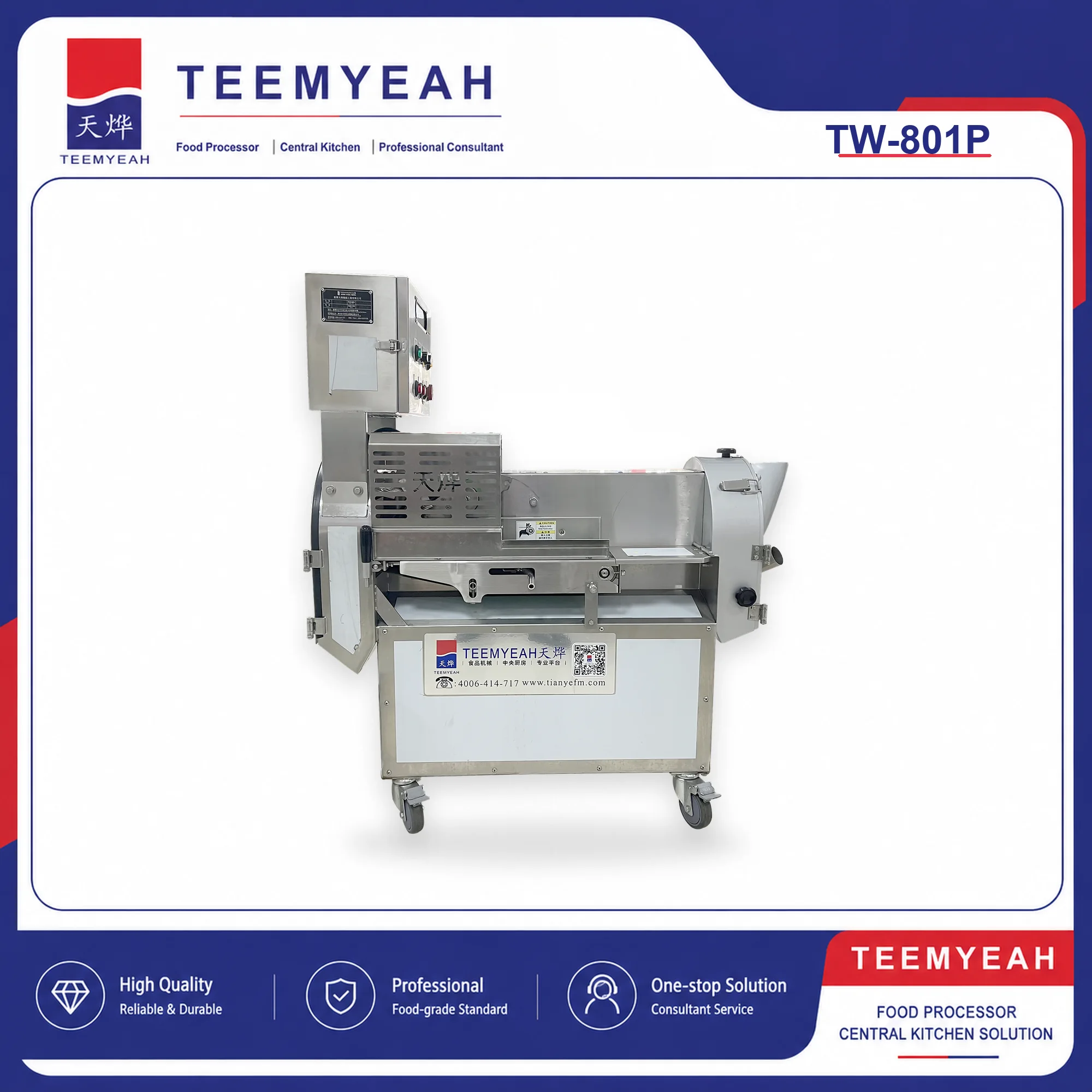
Controlled Cutting
Cutting principle, blade set, cut spec and feed rate matched to the product to reduce fragments and tissue damage.
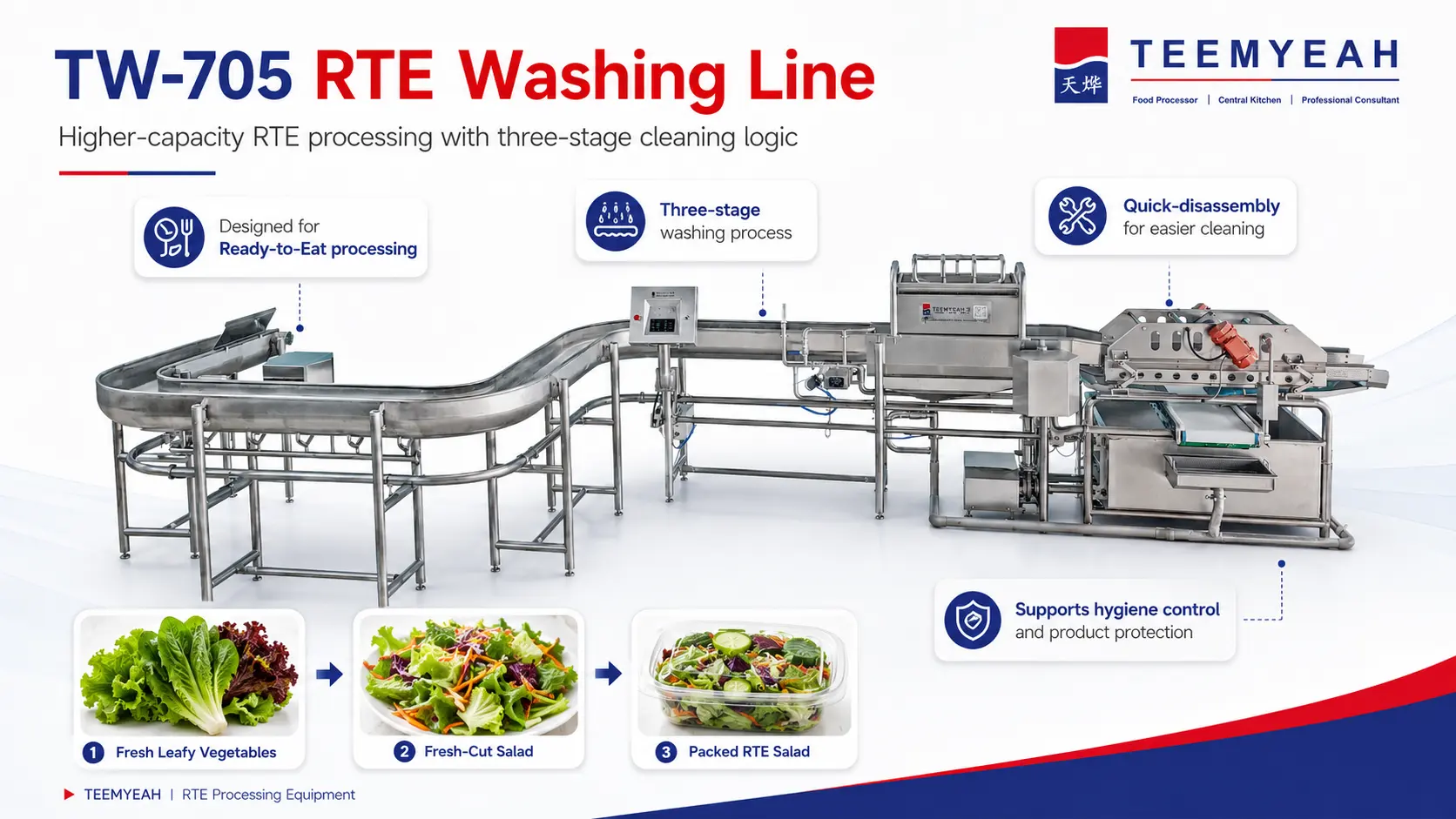
TW-705 Salad Production Line
Salad-greens washing using soaking, water-flow rinsing, tumbling and bubbling actions.
Catalog capacity: 800–1,000 kg/h

TW-706L Hotpot Washing Line
Whole-plant vegetables and central-kitchen washing workflows.
Catalog capacity: 800–1,500 kg/h

XD-DM02 PAA Dosing & Monitoring
Control cabinet, sensor and dosing pump keep sanitizer concentration inside a validated range with process records.

TW-980B1 Spin Dryer
Basket centrifugal drying for flexible batches and multiple SKUs, with controlled speed for delicate leaves.

TW-980LB Automated Dewatering Line
Continuous centrifugal dewatering for stable high-volume production and automated transfer.
The most automated line is not always the most suitable
Product range, labor availability, order stability, floor space, cleaning time and future expansion should set the automation level. TEEMYEAH can phase upgrades instead of forcing one fixed line.
Review processing-line control options when defining equipment visibility and operating-record requirements.
Compact / semi-automatic line
Removes a specific labor or quality bottleneck without automating every step.
- Manual trimming & inspection
- Standalone or connected cutting
- One- or multi-stage washing
- Basket spin drying
- Crate or foodservice packing
Best fit: central kitchen / catering · high SKU flexibility
Integrated leafy greens line
Coordinated cutting, washing, transfer, dewatering and downstream feeding with fewer manual handoffs.
- Metered feeding & inspection
- Continuous cutting & multi-stage washing
- Automated product transfer
- Automated centrifugal dewatering option
- Packaging-line interface
Best fit: factory-scale production · expansion by module
Hygienic RTE salad line
For ready-to-eat products needing comprehensive hygienic zoning and sanitizer control.
- Raw / clean-zone separation
- Sanitizer monitoring & records
- Controlled residence time
- MAP / cold-chain integration
- Environmental sanitation program
Best fit: RTE salad producers · audit-driven hygiene
Practical capacity is set by line balance — the slowest stage, product bulk density, cut size, washing residence time, dewatering cycle, changeovers, inspection load and packing speed all matter. Share your raw materials, finished products, daily/peak volume, packaging and factory layout, and we size the line to match.
24+
Years of food-processing equipment R&D
20,000+
Equipment applications & customer projects
SUS 304 / 316L
Food-grade contact surfaces
Turnkey
Config · layout · commission · train
Those outcomes are only as good as the partner behind the line
Four reasons operators pick TEEMYEAH to deliver the labour, yield, consistency, compliance, growth and support above.
Proven at scale
24+ years and 20,000+ processing lines delivered worldwide — you are not funding someone's first leafy line.
One partner for the whole line
As a total system integrator we deliver cutting, washing, sanitizing, dewatering, conveying, weighing and packing as one connected line — one accountable partner, not a box vendor and a pile of interface problems.
Tested on your own crop
The line is configured around your actual leaves, cuts, soil load, output and packaging — not generic catalog assumptions — so yield and quality are proven before you commit.
After-sales you can reach
Configuration, layout, commissioning, training and responsive after-sales — including overseas — closing the support gap that leaves many imported lines stranded.
Typical TEEMYEAH Scope
- Process discussion & line configuration
- Equipment selection, technical proposal & layout
- Manufacturing, quality inspection & factory-acceptance support
- Manuals, installation guidance, commissioning & operator training (as contracted)
- Spare-parts & after-sales support plan
Typical Customer / Site Scope
- Confirmed product & production requirements
- Building, floor, drainage & hygiene-zone construction
- Electrical, water, air & network to agreed interface points
- Local permits, food-safety validation & regulatory approval
- Site access, lifting & materials/utilities for testing
High-standard fresh-cut salad line on the TW-705 platform
Planned around product protection, staged washing, controlled transfer and downstream moisture management — not a collection of independent machines. Developed for a major retail and food-service customer.

Questions to resolve before buying a leafy vegetable line
A properly configured line processes lettuce, spinach, cabbage, bok choy, choy sum, herbs, baby leaves and mixed salad ingredients. Equipment and operating parameters are matched to leaf structure, product size, soil load, finished cut and packaging.
Some modules are technically compatible, but RTC and RTE production should not be combined by default. Hygienic zoning, product flow, sanitation, environmental controls and changeover validation must be assessed before equipment sharing.
It depends on incoming contamination, product type, cut spec and food-safety plan. Pre-washing suits heavily soiled material; post-cut washing removes cut fragments and field debris. Many industrial lines use a planned combination rather than one universal sequence.
It depends on raw-material condition and finished-product requirements. A common design separates pre-washing, main washing and controlled sanitizing or final rinsing; central-kitchen work may need fewer stages and high-standard fresh-cut may require more controls.
No. Washing and sanitizing are risk-control steps, not sterilization. Product safety also depends on raw-material management, hygienic design, sanitation, employee practices, packaging, temperature control and a validated food-safety program.
Practical output is set by the slowest stage, product bulk density, cut size, washing residence time, dewatering cycle, changeovers, inspection requirements and packing speed. One machine’s nominal capacity is not guaranteed line output.
Basket spin drying suits flexible, multi-SKU batches; automated centrifugal lines support continuous high volume. Delicate products need controlled speed, cycle time and loading to balance moisture removal with leaf protection.
Request a leafy vegetable line configuration
Share your raw materials, finished products, production target and factory conditions. We’ll discuss the process route, equipment modules, automation level and layout, then send a proposal.
Explore the rest of the Solutions family
Leafy Vegetable Processing Line
Cutting, multi-stage washing, sanitizing, dewatering & packing for lettuce, spinach and salad greens.
Root Vegetable Processing Line
Brush washing, peeling and cutting for potato, carrot, radish, taro and onion.
Custom Food Pre-Processing Line
Full pre-processing for meat, poultry, bone-in products and fish, designed around your central kitchen.