Summary
Food processing equipment capacity verification should answer a practical question: how much acceptable product can the equipment or line deliver repeatedly under the buyer’s real operating conditions? A catalog rating may describe instantaneous feed, an ideal raw material, one cut size, a short trial, or machine running time that excludes loading delays, stoppages, changeovers, cleaning, inspection, rejects, and product loss. It is therefore not the same as sustainable qualified output.
A defensible verification protocol fixes the raw-material specification, finished-product acceptance criteria, operator count, upstream and downstream conditions, test duration, measurement method, normal and boundary cases, and rules for downtime. It then records gross input, accepted output, yield, defects, line availability, product temperature, changeover time, cleaning time, alarms, interventions, and repeatability across multiple runs. The result should be expressed as accepted kilograms per elapsed production hour, not merely kilograms passing through the machine while it is moving.
This guide shows how central kitchens, fresh-cut processors, food manufacturers, and ready-to-cook or ready-to-eat facilities can convert supplier capacity claims into a factory acceptance test, product trial, and contractual capacity acceptance template.
Why a Capacity Number Often Creates False Confidence
A project team may receive three quotations for a vegetable processing line. One supplier states 800 kilograms per hour, another states 1,200 kilograms per hour, and a third offers 1,500 kilograms per hour. The numbers appear comparable, yet they may describe entirely different test conditions. One rating may refer to whole cabbage entering a cutter. Another may use pre-trimmed potatoes with uniform diameter. A third may record only the fastest ten minutes after the line has stabilized.
The purchasing risk does not come from the existence of a rated capacity. Ratings are useful screening data. The risk comes from treating an undefined rating as a promise of shift output, saleable yield, labor requirement, or line performance. A machine can move a large mass of raw material and still fail the business requirement because too much output is damaged, incorrectly cut, insufficiently cleaned, too wet for packing, or delayed by downstream handling.
Capacity is also a property of a process, not only of a motor or conveyor. A cutter may process 1,000 kilograms per hour while the manual trimming station supplies only 550 kilograms per hour. A washer may accept the cutter’s output, yet the spin dryer may create queues that reduce the complete line to 400 kilograms per hour. The apparent capacity of each machine can be technically correct while the line’s sustainable qualified output remains commercially inadequate.
For buyers, the correct comparison is not “Which quotation shows the highest kilograms per hour?” It is “Which supplier can demonstrate the required good output under an agreed protocol, explain the limiting conditions, and document what changes when the product, operator, recipe, or sanitation schedule changes?”
How Food Processing Equipment Capacity Verification Should Be Defined
Food processing equipment capacity verification is the documented process of testing whether equipment can repeatedly achieve an agreed quantity of conforming product within defined operating conditions. The phrase contains three separate obligations: the capacity measure must be defined, the test conditions must be controlled, and the result must be reproducible.
Rated capacity
Rated capacity is the supplier’s stated processing rate, usually expressed in kilograms per hour, pieces per minute, batches per hour, or containers per cycle. It may be based on design calculations, previous tests, a representative product, or catalog convention. Unless the basis is stated, the buyer should treat it as a screening range rather than an acceptance criterion.
Demonstrated gross throughput
Demonstrated gross throughput is the raw input mass processed during actual machine running time. It is useful for identifying the mechanical limit of a washer, peeler, cutter, conveyor, mixer, or dryer. It does not by itself account for rejects, trimming loss, product damage, stoppages, sanitation, or idle periods.
Sustainable qualified output
Sustainable qualified output is the accepted finished-product mass divided by total elapsed production time for the defined test window. “Accepted” means the product meets the agreed cleanliness, cut, damage, moisture, temperature, food safety, and packaging-preparation criteria. “Elapsed production time” should follow the protocol’s inclusion rules for planned and unplanned events. This is the measure most closely connected to staffing, order fulfillment, cold-chain planning, preparation cost, and revenue capacity.
Shift output
Shift output is the total accepted production available from a scheduled shift after start-up, product changes, sanitation, breaks, minor stops, fault recovery, and end-of-run procedures. A machine may demonstrate a strong one-hour rate but still deliver weak shift output because the surrounding workflow consumes too much time.
Reproducibility
Reproducibility means the result can be achieved again when the same product specification, recipe, staffing, setup, and measurement method are used. A single successful run establishes possibility. Repeated runs establish confidence. For most procurement projects, the protocol should include at least several repeated normal-condition runs and one or more agreed boundary-condition runs. The number is a project decision, not a universal regulatory threshold.
Normalize the Supplier Claim Before Comparing Quotations
Every capacity claim should be converted into a common statement before technical comparison. A useful normalized statement looks like this:
“The line shall produce at least 700 kilograms per elapsed hour of accepted 10-millimeter diced potato, using washed but unpeeled raw material within the agreed size and temperature range, with no more than the specified defect level, using four direct operators, during a four-hour test that includes minor stops but excludes the separately measured full sanitation cycle.”
This sentence is more valuable than a larger catalog number because it makes the commercial requirement visible. It also exposes missing information early enough for the supplier to challenge an unrealistic assumption.
| Claim element | Question to define | Why it changes the result |
|---|---|---|
| Material condition | Whole, trimmed, peeled, frozen, thawed, chilled, wet, dry, soil-loaded, or pre-sorted? | Preparation state changes feedability, resistance, loss, contamination load, and operator work. |
| Product range | Which species, cultivar, dimensions, maturity, temperature, and seasonal conditions are covered? | A uniform test lot may not represent difficult incoming materials. |
| Finished specification | What cleanliness, cut size, defect, moisture, damage, or temperature criteria define acceptance? | High mass flow is irrelevant when much of the output is nonconforming. |
| Time basis | Machine running time, clock time, batch cycle, production hour, or full shift? | Excluding stops and handling can materially inflate the apparent rate. |
| Labor boundary | Which loading, trimming, inspection, unloading, cleaning, and material-handling workers are counted? | Automation can move labor outside the machine without reducing total labor dependence. |
| Line boundary | Standalone machine or complete process from receiving point to accepted discharge? | Upstream starvation and downstream blocking determine line output. |
| Utilities and settings | Voltage, air, water pressure, water quality, temperature, speed, recipe, blade, and chemical conditions? | Performance may depend on utilities or settings unavailable in the buyer’s plant. |
| Test duration | Short demonstration, stable run, multi-hour trial, or repeated shift? | Longer tests reveal heating, fouling, accumulation, operator fatigue, and minor stoppages. |
Use Good Output, Not Material Movement, as the Primary Capacity Metric
The most direct verification formula is:
Sustainable qualified output (kg/h) = accepted finished-product mass (kg) ÷ total elapsed test time (h)
This formula prevents a common reporting error: stopping the clock whenever the line stops. A protocol may legitimately exclude a defined event, such as a full allergen changeover tested separately, but the rule must be written before the trial. Selective clock stopping after the test has begun makes the result difficult to audit and easy to manipulate.
Supporting formulas explain why the good-output rate differs from the catalog rate:
- Gross running throughput = raw input mass ÷ net machine running time
- Operating availability = net running time ÷ planned production time × 100%
- Good-output factor = accepted finished mass ÷ raw input mass × 100%
- Yield = usable finished mass ÷ raw input mass × 100%
- Defect rate = rejected or reworked output ÷ total measured output × 100%
- Labor hours per 1,000 kg = total direct labor hours ÷ accepted output in metric tons
Yield and quality should not be double-counted. Some processors define usable output as all product that can continue to the next stage, while others define accepted output only as product meeting a final customer specification. The protocol must identify which definition controls the contract.
Illustrative calculation
Consider a hypothetical vegetable preparation line with a catalog rating of 1,000 kilograms per hour. During an eight-hour verification shift, start-up, minor stops, one product change, and fault recovery leave 390 minutes of net running time. The line averages 900 kilograms per hour while running. The accepted finished output equals 88% of raw input after trimming, peeling loss, damaged pieces, and off-spec cuts are removed.
Raw input = 900 × 6.5 hours = 5,850 kg
Accepted output = 5,850 × 0.88 = 5,148 kg
Sustainable qualified output = 5,148 ÷ 8 = 643.5 kg/h
The calculation does not prove that 643.5 kilograms per hour is typical for any machine. It demonstrates why catalog capacity, gross running throughput, and qualified shift output are different quantities. The buyer must decide which quantity supports the business case.
Reverse the Calculation from Required Output to Required Feed Capacity
Capacity planning should begin with the accepted output required by orders, not with the largest supplier rating available. The reverse calculation is:
Required demonstrated running throughput = target sustainable qualified output ÷ (expected availability × expected good-output factor)
Suppose a fresh-cut processor needs 700 kilograms per elapsed hour of accepted product. Historical data or a conservative planning model indicates 88% operating availability and a 90% good-output factor.
Required demonstrated running throughput = 700 ÷ (0.88 × 0.90) = approximately 884 kg/h
A machine rated at 900 kilograms per hour would leave almost no operating margin. A machine rated at 1,200 kilograms per hour might be suitable, but only if the supplier demonstrates that the relevant product can actually be processed at or above 884 kilograms per running hour while maintaining quality. The reverse calculation also reveals whether the real constraint is equipment speed, yield, downtime, or product preparation.
Applying an arbitrary oversizing percentage is less reliable than testing the loss mechanisms. Excess capacity can increase capital cost, floor-space demand, water use, mechanical stress, and overfeeding risk. It can also create a line-balance problem when downstream inspection, dewatering, weighing, or packing cannot absorb the output.
Define the Product Test Matrix
A supplier cannot verify all possible raw materials, yet testing only the easiest product creates little decision value. The buyer and supplier should build a product test matrix that covers normal production and meaningful boundaries.
Normal conditions
The normal-condition lot should represent the material most likely to be processed during routine production. Its dimensions, temperature, soil load, maturity, moisture, trimming state, and storage history should be recorded. “Fresh vegetables” is not an adequate specification. For cutting tests, the blade set, target dimensions, feed orientation, and acceptable cut tolerance should also be fixed.
Boundary conditions
Boundary tests challenge the conditions most likely to reduce performance without creating an artificial worst case that the factory will never encounter. Examples include the smallest and largest raw-material sizes, a higher soil load, a colder or warmer product within the approved range, fragile leaves, dense root vegetables, mixed dimensions, or the highest planned feed rate. For computerized control, alarms, sensor failure response, recipe limits, and restart behavior may also require challenge tests.
Representative product families
A multi-SKU central kitchen should not average unrelated products into one headline capacity. Lettuce, cabbage, potato, carrot, onion, herbs, cooked ingredients, and frozen products can require different feed methods, settings, cleaning routines, and inspection levels. Group products only when their processing behavior and acceptance criteria are sufficiently similar. State a separate verified range for each family.
RTE and RTC separation
Ready-to-cook and ready-to-eat products may pass through similar equipment, but their verification priorities are not identical. An RTE product without a later kill step places greater emphasis on hygienic zoning, water management, equipment cleanability, sanitation verification, protected product flow, temperature control, and prevention of recontamination. Capacity testing must not encourage unsafe shortcuts, such as reducing cleaning or overloading a washer beyond the validated operating condition. Equipment performance cannot substitute for the facility’s hazard analysis and food safety controls.
Build a Capacity Acceptance Template Before the FAT
The acceptance template should be agreed before the factory acceptance test. Acceptance criteria written after the demonstration tend to reflect what happened rather than what the project needs. Criteria should be measurable, linked to a sampling method, and classified as mandatory, conditional, or informational.
| Acceptance item | Definition and measurement | Example project criterion | Required record |
|---|---|---|---|
| Sustainable qualified output | Accepted finished mass divided by total elapsed test time | At least the contract target in each normal-condition run | Timestamped input and output mass log |
| Gross running throughput | Raw input divided by verified machine running time | Enough to support target output at agreed availability and yield | PLC runtime or independent stopwatch log |
| Yield or good-output factor | Accepted output divided by raw input | Project-specific minimum by product family | Calibrated scale records and reject weights |
| Product quality | Cleanliness, cut distribution, damage, peel removal, moisture, or other specification | Defined sampling plan and defect limits | Sample sheets, photographs, measurements, laboratory results where applicable |
| Availability | Net running time divided by planned production time | Contract value or reported result with stop classification | Downtime log with cause and duration |
| Operator requirement | Direct workers needed inside the agreed process boundary | Maximum normal staffing by operating mode | Role list and observation record |
| Changeover time | Last accepted unit of SKU A to first accepted unit of SKU B | Maximum time for specified product and tooling change | Timestamped changeover checklist |
| Cleaning time | Production stop to documented release for next use | Measured for routine and full-clean procedures | Cleaning steps, staffing, inspection, and release record |
| Control-system behavior | Recipe control, alarms, data capture, restart, manual intervention, and access | All agreed challenge tests completed without unresolved critical deviation | Alarm log, screenshots, audit trail, challenge-test report |
| Utilities | Power, water, air, chemical, and temperature conditions during test | Within declared operating range | Meter readings and utility-condition log |
The example criteria are not universal benchmarks. A buyer may require a hard minimum for good output but accept reporting-only treatment for water consumption during an early product trial. Another project may treat cleaning time as a mandatory commercial criterion because the line will process allergens or switch frequently between RTE product families.
Run the FAT as a Controlled Production Experiment
A factory acceptance test is most useful when it resembles a controlled production experiment rather than a sales demonstration. The supplier should know what must be proven, and the buyer should know how the evidence will be collected.
1. Confirm the protocol and instruments
Before product enters the line, confirm scale calibration status, timing method, sampling tools, temperature instruments, moisture or dimensional measurement method, operator roles, recipe version, software version, blade or screen configuration, utility conditions, and data-recording responsibility. Any instrument used to determine acceptance should have suitable accuracy and be maintained for its purpose.
2. Inspect the installed test configuration
Record the actual machine model, options, guarding, contact materials, conveyor dimensions, controls, pumps, nozzles, blades, baskets, screens, and discharge arrangements. A successful test on a different configuration does not automatically verify the purchased configuration. Temporary manual assistance should be declared because it may hide a feed, discharge, or transfer limitation.
3. Conduct an empty and utility check
Confirm direction of rotation, emergency stops, interlocks, alarms, guarding, water circulation, drainage, air supply, speed range, recipe selection, and basic sensor response. This does not prove product capacity, but it reduces the chance that avoidable setup problems invalidate the product trial.
4. Stabilize with a declared warm-up quantity
Some equipment needs initial product to wet surfaces, fill conveyors, establish water circulation, stabilize cutting, or load a continuous line. The protocol should state whether the warm-up quantity is included in yield and capacity calculations. Discarding unexplained start-up loss can overstate performance.
5. Run the normal-condition tests
Use the agreed material lot, feed method, staffing, settings, and duration. Record every stop, even when it lasts only a few seconds. Minor stops often explain a large gap between mechanical speed and shift output. Repeated operator intervention, manual spreading, clearing, repositioning, or refeeding should be classified rather than ignored.
6. Sample quality during the run
Do not assess only the first and last tray. Sample at defined intervals and locations. A cutter may perform well when blades are clean but drift as product accumulates. A washer may produce different results when water load increases. A dryer may show acceptable average moisture while damaging a fragile product at the basket edge. Time-linked samples connect quality changes to process conditions.
7. Challenge agreed boundaries
Run the selected difficult product or setting without changing the acceptance method. If the supplier recommends a lower rate for the boundary case, document the verified rate rather than forcing the normal-condition target. Honest performance envelopes support better scheduling and configuration decisions.
8. Test changeover, cleaning, and restart
Measure changeover from the last accepted output of the first product to the first accepted output of the next. For cleaning, define the required end state and release method. Record disassembly, access, water removal, tool use, operator count, inspection, sanitation steps, reassembly, and restart losses. Equipment that is fast during production but difficult to clean may deliver poor daily capacity.
9. Test abnormal events and recovery
Where controls are critical, challenge foreseeable events such as product starvation, downstream blocking, sensor failure, emergency stop, power interruption, alarm acknowledgement, recipe change, unauthorized setting attempt, and restart. End-product observation alone cannot show how a computerized system behaves across all permissible limits or failure conditions. The complete system includes hardware, software, sensors, operators, procedures, and records.
10. Close deviations with evidence
A failed criterion does not always require immediate rejection. The parties may identify an incorrect setup, unsuitable raw-material range, missing component, software issue, or unrealistic requirement. Every deviation should have an owner, proposed correction, retest method, due date, and decision rule. A verbal promise to improve performance after shipment is not equivalent to a verified result.
Measure Downtime by Cause, Not as One Percentage
A single downtime figure cannot guide improvement or supplier evaluation. Classify stops so the buyer can distinguish equipment reliability from process design and labor dependence.
- Equipment fault: mechanical, electrical, pneumatic, hydraulic, software, or sensor failure.
- Product-related stop: bridging, blockage, wrapping, oversize material, excessive soil, or difficult feeding.
- Operator-related stop: delayed loading, incorrect setup, slow unloading, missed alarm, or insufficient training.
- Upstream starvation: the machine is ready but receives no product.
- Downstream blocking: discharge cannot continue because inspection, dewatering, weighing, packing, or storage is constrained.
- Quality stop: production pauses for adjustment after off-spec output.
- Planned stop: recipe change, blade change, routine inspection, scheduled cleaning, or break.
This classification supports line balance. If the cutter repeatedly waits for trimming, buying a faster cutter will not increase qualified output. If the washer blocks the dryer, a buffer may help only when the product can safely wait without damage, temperature rise, moisture pickup, or contamination risk. WIP is not free capacity; it occupies space, adds handling, complicates traceability, and can hide instability.
Verify Line Balance Under Real Upstream and Downstream Constraints
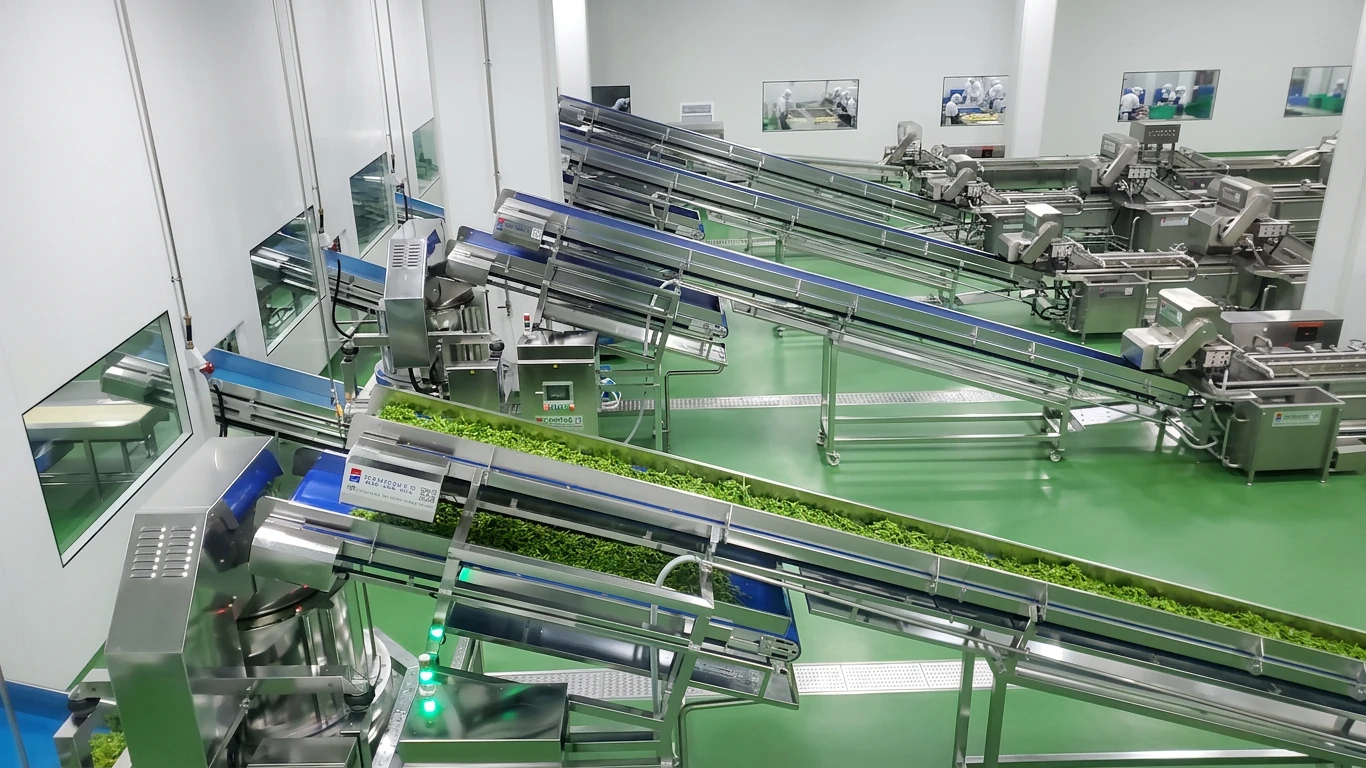
A complete vegetable processing line may include receiving, inspection, trimming, washing, sanitizing, peeling, cutting, sorting, dewatering, mixing, conveying, weighing, and packing preparation. Each stage has a different capacity basis. A continuous washer is usually described in kilograms per hour, while a basket dryer may be governed by batch mass, spin time, loading, unloading, and basket exchange.
Line capacity should therefore be modeled as a sequence of constraints rather than the minimum catalog number. The slowest effective stage sets the long-run rate, but short cycles, buffers, batch synchronization, product accumulation, and operator travel can make the result lower than that minimum.
For each stage, document:
- verified processing rate by product family;
- minimum and maximum stable feed;
- batch size and cycle-time distribution;
- required operators and manual touchpoints;
- buffer capacity and maximum safe residence time;
- changeover and cleaning sequence;
- failure response and bypass options;
- quality checks and release points.
A balanced line does not require identical nameplate capacities. It requires compatible effective capacities and a deliberate strategy for variability. A slightly faster downstream stage may recover from brief interruptions. Excessive oversizing can be wasteful, while undersizing a non-bufferable stage can permanently restrict output.
Include Cleaning and Changeover in the Commercial Capacity Model
Food plants do not sell “machine running time.” They sell conforming product made within a controlled process. Cleaning and changeover are therefore part of capacity economics, even when tested separately from the continuous production rate.
Changeover complexity grows with SKU count, cut styles, allergens, RTE and RTC separation, product colors, odors, soil loads, and tooling. A ten-minute blade change may become a forty-minute production interruption when product clearance, verification, guarding, test cuts, and quality release are included.
Cleaning time must also be defined carefully. A rinse, routine product-contact clean, full sanitation, allergen clean, and deep maintenance clean are not interchangeable. The acceptance protocol should specify the target cleaning procedure and release condition. Equipment should be installed and constructed so that it can be adequately cleaned and maintained, including adjacent spaces. Smooth, accessible product-contact areas, drainage, removable components, and suitable instruments are not only hygiene considerations; they determine how much scheduled production time remains available.
A practical shift-capacity formula is:
Qualified shift output = sustainable qualified running rate × available production time after planned changeovers and cleaning
Where production uses many short runs, the fastest machine may lose to a slower but easier-to-change configuration. Capacity verification should expose that trade-off before purchase.
Test Product Quality and Yield at the Same Time as Speed
Increasing feed rate can change the process. Vegetables may overlap on inspection belts, cutting chambers may become overfilled, wash water may carry a higher organic load, dewatering may become uneven, and conveyors may compress fragile products. Capacity cannot be accepted independently of quality.
Cleaning and washing
Measure the incoming contamination condition and define what “clean” means for the next process. Depending on the product and food safety plan, measurements may include visible soil, foreign material, damage, water temperature, sanitizer concentration, contact conditions, turbidity, water replacement, product temperature, and microbial or chemical verification performed under an appropriate program. A high transfer rate does not validate the food safety process.
Peeling and trimming
Record peel-removal effectiveness, edible flesh loss, manual rework, surface damage, and variability by raw-material size. An aggressive setting may improve apparent peeling completeness while reducing yield. Over-trimming can create a hidden raw-material cost that exceeds the labor saving.
Cutting
Define target dimensions, tolerance bands, fragments, fines, torn surfaces, incomplete cuts, and orientation defects. Cut consistency affects portion control, cooking consistency, visual quality, mixing behavior, and packing. Sampling should represent the whole run rather than selected good pieces.
Dewatering
Measure surface moisture or another agreed proxy together with bruising, breakage, clumping, and batch variation. Faster spin settings may reduce water while increasing damage. For fresh-cut salads, downstream packing behavior may be more commercially meaningful than a standalone dryer cycle time.
Mixing and conveying
Check blend uniformity, segregation, product fall height, compression, residence time, discharge completeness, and retained product. Residual material affects yield, allergen control, traceability, and changeover time.
Verify Controls, Records, and Manual Intervention
Modern food preparation equipment may use programmable logic controllers, touch-screen recipes, variable-frequency drives, automatic dosing, level sensors, timers, temperature inputs, alarms, and production records. A capacity test that ignores the control system verifies only part of the equipment.
The buyer should confirm that the software version and recipe used during the FAT match the delivered configuration. Critical settings should have defined access levels. Sensor readings used for acceptance must be accurate enough for their purpose and should be checked against suitable references. Alarms, overrides, manual interventions, data edits, and restart behavior should be recorded where they affect food safety, quality, or production evidence.
Repeated successful output is necessary but not sufficient to validate automated control. Boundary behavior matters: what happens when a sensor fails, a value reaches its permissible limit, power is interrupted, the downstream machine stops, or an operator selects the wrong recipe? A complete verification approach examines software, hardware, sensors, operators, procedures, and records together.
For the capacity report, preserve raw data rather than only a supplier summary. Useful records include timestamps, scale readings, runtime, stop codes, alarm logs, recipe identifiers, operator interventions, sample results, rejected mass, photographs, instrument identifiers, configuration notes, and signed deviations. These records allow the buyer to distinguish a genuine capacity shortfall from a setup or material problem.
Compare Manual, Semi-Automatic, and Integrated Options Honestly
Capacity verification should not begin with the assumption that maximum automation is always the correct answer. The same protocol can compare manual, semi-automatic, and integrated alternatives on good output, labor, quality, flexibility, sanitation, and changeover.
| Operating model | When it can be rational | What to verify | Main risk |
|---|---|---|---|
| Manual processing | Low or uncertain volume, highly variable products, frequent custom work, limited capital, or tasks requiring judgment | Labor hours per 1,000 kg, fatigue-related variation, training time, absence coverage, ergonomic exposure, yield, and peak-day capacity | Output and quality may depend heavily on staffing, skill, and attendance. |
| Semi-automatic cell | One stable bottleneck exists while inspection, trimming, loading, or sorting still benefits from human control | True total labor, handoff rate, buffer behavior, operator reach, cleaning, and whether manual stages can support machine speed | Labor may be displaced rather than reduced, creating hidden queues. |
| Integrated line | Demand is repeatable, product families are defined, upstream supply and downstream packing are ready, and sanitation resources can support the system | End-to-end qualified output, line balance, fault propagation, data integration, changeover, sanitation, maintenance capability, and recovery | A wrong configuration can amplify downtime, WIP, product damage, and cross-contamination exposure. |
Manual handling may remain the better choice for low-volume seasonal products or highly irregular raw materials. Semi-automation can be commercially stronger when one process—cutting, peeling, washing, or dewatering—limits output but the wider operation is not ready for an integrated line. Full-line automation becomes meaningful when the product mix, demand, layout, utilities, food safety zoning, maintenance support, and downstream capacity are sufficiently mature.
Know When the Proposed Equipment Is Not Suitable
A credible verification process must allow a “do not buy” conclusion. The proposed equipment or configuration may be unsuitable when:
- the supplier cannot define the raw-material and time basis behind the rating;
- required output is achievable only with a product preparation step excluded from the quotation;
- the test needs more manual feeding, sorting, or rework than the buyer can staff;
- acceptable quality falls sharply at the required rate;
- seasonal or boundary materials repeatedly jam, bridge, break, or bypass the intended process;
- cleaning access and drainage do not fit the sanitation program;
- RTE and RTC products would share equipment or space without an acceptable hygienic control strategy;
- downstream equipment cannot absorb the demonstrated output;
- changeovers consume too much of the available production window;
- control records, alarms, or sensor accuracy are inadequate for the intended use;
- maintenance capability, spare parts, or technical support do not match the operational risk;
- the business lacks enough stable demand to justify the fixed cost and complexity.
Automation can introduce new risks: dependence on specialized components, more complex cleaning, larger batches of nonconforming product before a fault is noticed, faster propagation of upstream errors, cybersecurity or access-control concerns, and longer recovery after a centralized control failure. Equipment does not replace process design, food safety management, preventive maintenance, operator training, or production supervision.
Connect the Acceptance Result to Cost and ROI
Once sustainable qualified output is verified, the project team can build a more credible operating model. The following formulas are useful:
- Preparation cost per kilogram = total direct preparation cost ÷ accepted output
- Annual labor cost change = difference in verified labor hours × loaded labor rate
- Annual raw-material value loss = raw input value × change in yield loss
- Capacity utilization = actual qualified output ÷ verified sustainable capacity × 100%
- Simple payback period = total investment ÷ annual net cash benefit
Total direct preparation cost may include direct labor, utilities, water treatment, cleaning chemicals, consumables, blades, routine maintenance, product loss, waste handling, and other costs inside the selected process boundary. The buyer should avoid applying national labor statistics or industry averages directly to one plant without adjusting for local wages, staffing rules, overtime, benefits, training, absenteeism, and shift patterns.
Verified capacity does not guarantee ROI. Demand may be lower than expected, raw-material supply may be inconsistent, new customer specifications may require slower processing, or the facility may not operate enough shifts to use the installed capacity. A commercially sound decision combines test evidence with realistic demand, product mix, sanitation schedules, maintenance capability, and financing assumptions.
What the Final Capacity Verification Report Should Contain
The final report should allow a technical reviewer who did not attend the FAT to reconstruct the result. It should include:
- equipment identification and tested configuration;
- protocol version, acceptance criteria, and approved deviations;
- raw-material descriptions, lot information, dimensions, temperature, preparation state, and photographs;
- finished-product specifications and sampling methods;
- operator names or roles and total labor inside the boundary;
- utility conditions and control settings;
- calibration or verification status of measuring instruments;
- input, output, reject, rework, and waste mass;
- runtime, elapsed time, stops, alarms, causes, and interventions;
- quality and food safety observations relevant to the trial;
- changeover, cleaning, inspection, and restart records;
- normal and boundary test results presented separately;
- photos, video references, software version, recipe identifiers, and configuration records;
- open actions, responsible parties, retest requirements, and final disposition.
The contract should also state how FAT results relate to site acceptance testing. Shipping, installation, local utilities, operators, actual upstream supply, and downstream integration can change performance. FAT verifies the agreed factory configuration; SAT confirms operation in the buyer’s environment. Neither should be replaced by an unstructured commissioning observation.
From Supplier Rating to an Acceptable Production Commitment
The purpose of capacity verification is not to force a supplier to guarantee every future production condition. It is to replace ambiguous claims with a defined performance envelope. That envelope should state which products were tested, how they were prepared, what settings and operators were used, how output quality was judged, which events affected elapsed time, and how reliably the result was repeated.
For a central kitchen or fresh-cut processor, the most decision-useful capacity number is usually accepted output per elapsed hour or per shift. Gross running throughput remains valuable because it identifies mechanical capability, while yield, availability, labor, and quality explain the conversion from raw input to saleable output.
A procurement team that follows this approach can compare suppliers on evidence rather than headline numbers. It can also identify when the project needs a different machine, a different line balance, a semi-automatic stage, better raw-material preparation, more sanitation time, or a revised production target. Capacity verification is therefore both a supplier-evaluation tool and a process-design exercise.
Turn Capacity Claims into a Testable Acceptance Plan
Before selecting a machine or complete food pre-processing line, define the raw material, finished-product standard, target qualified output, test duration, labor boundary, cleaning requirement, and normal and boundary conditions. TEEMYEAH can use this information to discuss a preliminary equipment configuration, capacity matching approach, product test, and line concept for central kitchens, food manufacturers, fresh-cut processors, and RTC or RTE facilities.
Download the Capacity Verification Checklist or review how a custom food pre-processing line can be configured around your product mix and process flow.
FAQ
1. What does a supplier’s rated capacity actually mean?
Rated capacity is a stated processing rate, but its meaning depends on the supplier’s test basis. It may refer to raw feed during machine running time, a design maximum, a short stable trial, one product size, or a batch cycle that excludes loading and unloading. Buyers should request the tested raw material, preparation state, finished specification, operator count, settings, utility conditions, test duration, and time exclusions. Until these details are known, the rating is best used to shortlist equipment rather than to predict accepted shift output.
2. What should a food processing equipment capacity verification protocol include?
A food processing equipment capacity verification protocol should define the machine or line boundary, raw-material range, normal and boundary test products, finished-product acceptance criteria, staffing, utilities, settings, test duration, sampling plan, downtime rules, and calculation formulas. It should also specify how input, accepted output, rejects, rework, product loss, changeover, cleaning, alarms, and manual interventions will be recorded. Acceptance thresholds and retest rules should be approved before the FAT so the result is not reinterpreted after the demonstration.
3. How long should a capacity test run?
The test must be long enough to reveal the performance mechanisms relevant to the project. A short run can confirm that the equipment processes the product, but it may not reveal fouling, blade wear, water-load changes, heating, repeated minor stops, operator fatigue, or downstream accumulation. Many buyers use several repeated stable runs plus a longer endurance run, but there is no universal duration suitable for every machine. Batch equipment should be tested across enough complete cycles to show variation, while continuous lines require enough elapsed time to evaluate stoppages and line balance.
4. Should the FAT use the buyer’s actual raw material?
Whenever practical, the FAT should use the buyer’s material or a documented equivalent because cultivar, size, maturity, temperature, soil load, storage condition, and trimming state can alter performance. Cross-border logistics or perishability may make exact material unavailable. In that case, the parties should approve a substitute specification and identify the remaining uncertainty. The buyer may require a later site acceptance test with local material. A successful test on a convenient but easier product should not be presented as full verification of a more difficult product family.
5. What is the difference between gross throughput and sustainable output?
Gross throughput measures how much raw material passes through the equipment during net running time. Sustainable output measures accepted finished product across the defined elapsed production window. The difference can include downtime, loading delays, product change, cleaning, trimming loss, peel loss, damaged product, off-spec cuts, rework, and downstream blocking. Gross throughput is useful for understanding mechanical capability. Sustainable qualified output is more useful for production planning because it connects the equipment to order volume, labor, yield, sanitation schedules, cold-chain timing, and cost per kilogram.
6. Should cleaning and changeover time be included in capacity?
They should be included in the shift-capacity model, although they may be measured separately from the continuous running test. The protocol should distinguish routine product change, tooling change, allergen change, RTE sanitation, and full deep cleaning. Measure from the last accepted output before the stop to the first accepted output after release, or use another clearly defined boundary. Excluding all cleaning and changeover can overstate available production time, especially in central kitchens and fresh-cut plants handling many SKUs. The applicable sanitation standard must never be reduced merely to achieve a higher capacity number.
7. How should multi-SKU equipment be tested?
Group SKUs into product families with similar processing behavior, then verify representative normal and difficult products within each family. Do not average lettuce, carrots, potatoes, onions, and herbs into one headline rate unless the line truly processes them under comparable conditions. Record the blade, recipe, feed method, operator requirement, yield, quality limits, and cleaning or changeover time for each family. The final report can state separate verified ranges, making scheduling more accurate and revealing whether one product requires another configuration or a lower sustainable rate.
8. What is the difference between FAT and SAT for capacity acceptance?
Factory acceptance testing verifies the agreed equipment configuration before shipment under the supplier’s controlled conditions. Site acceptance testing verifies installed performance with the buyer’s utilities, operators, raw material, upstream supply, downstream equipment, layout, and environmental conditions. FAT can identify design and configuration issues early, while SAT confirms that integration and local conditions do not prevent the required output. The contract should explain which criteria are closed during FAT, which are repeated during SAT, how installation-related deviations are handled, and whether final payment depends on defined acceptance evidence.
9. Does RTE equipment require a different capacity test from RTC equipment?
The mechanical calculations may be similar, but RTE verification must place greater weight on hygienic flow, cleanability, water management, sanitation, temperature control, protected discharge, and prevention of recontamination because the product may have no later kill step. A capacity test should not operate outside the facility’s food safety plan or use excessive loading that undermines validated process conditions. RTC products may receive cooking later, yet they still require controls against contamination, allergen cross-contact, deterioration, and unsafe handling. The intended use must therefore be declared before equipment selection and testing.
10. What documents should the buyer receive after capacity testing?
The buyer should receive the approved protocol, tested configuration, raw-material and finished-product specifications, calibration or instrument checks, input and output records, quality samples, yield calculations, runtime and downtime logs, alarm and intervention records, changeover and cleaning results, photos or video references, software and recipe identifiers, deviations, corrective actions, and signed conclusions. Raw data should accompany the summary where practical. The report should also identify conditions that were not tested and the requirements for later SAT or retesting. A certificate stating only that the machine passed is usually insufficient for technical evaluation.
Data and Source Note
This article uses regulatory and technical sources to define the verification principles, not to prescribe one universal acceptance threshold. Project criteria must reflect the product, jurisdiction, hazard analysis, customer specification, and production system.
- U.S. Electronic Code of Federal Regulations, 21 CFR 117.40, Equipment and Utensils, current edition: applied to equipment cleanability, maintenance, installation, food-contact materials, sanitary condition, and accuracy of instruments and controls in U.S. human-food manufacturing contexts.
- U.S. Electronic Code of Federal Regulations, 21 CFR 117.80, Processes and Controls, current edition: applied to sanitation principles, quality control, raw-material handling, safe water, cleaning and sanitizing, contamination prevention, work-in-process controls, and food preparation operations.
- International Organization for Standardization, ISO 22400-1:2014, confirmed current in 2025: applied as an industry-neutral framework for KPI concepts, terminology, construction, and use in manufacturing operations management.
- National Institute of Standards and Technology, A Hierarchical Structure of Key Performance Indicators for Operation Improvement in Production Systems, 2016: applied to the relationship among throughput, availability, efficiency, quality, maintenance, and supporting metrics.
- U.S. Food and Drug Administration, Guide to Inspections of Computerized Systems in the Food Processing Industry: applied to complete-system validation, challenge testing, sensor and input accuracy, records, alarms, manual intervention, software changes, and worst-case operating conditions.
- U.S. Food and Drug Administration, Good Manufacturing Practices for the 21st Century for Food Processing, Appendix E, 2004: used for contextual comparison of verification, validation, records, supplier evaluation, calibration data, test data, and process documentation across quality-system approaches.