




Summary
The FDA issued final guidance for ready-to-eat fresh-cut produce in August 2026. This fresh-cut produce guidance replaces the 2008 document and reflects FDA’s current thinking on biological-hazard control under 21 CFR part 117; the guidance itself does not create legally enforceable responsibilities unless it cites a specific requirement. For equipment buyers, the practical questions concern wash-water control interfaces, cleaning access, wet-environment design, drainage, separation of product and waste flows, dewatering and cold-chain handoffs, environmental-monitoring access and records. TEEMYEAH can discuss mechanical equipment and line-engineering inputs, but the buyer and qualified specialists retain responsibility for hazard analysis, regulatory interpretation, validation and final approval.
Final Guidance Status and Scope
FDA released the final Guide to Minimize Biological Hazards in Ready-to-Eat Fresh-Cut Produce in August 2026. FDA states that the final document reflects comments received on the October 2018 draft and replaces the agency’s 2008 fresh-cut produce guidance. The new document is organized around the regulatory framework that now governs many food facilities, particularly 21 CFR Part 117 and its CGMP and Preventive Controls for Human Food provisions.
For plant managers and project engineers, that change matters because the document goes well beyond a generic instruction to keep produce and equipment clean. It connects fresh-cut operations with facility-specific hazard analysis, process controls, sanitation controls, supply-chain controls, validation, monitoring, corrective actions, verification, records, time and temperature management, and training.
The guidance also devotes substantial attention to antimicrobial wash-water process controls. It discusses how a processor can determine whether such a control is appropriate, establish scientifically supported parameters, consider worst-case operating conditions, determine monitoring locations and frequencies, validate the process, respond to deviations and document the resulting system.
That does not mean every RTE salad plant needs the same wash system, antimicrobial chemistry, concentration, contact time, sensor arrangement or equipment sequence. FDA’s examples are examples. A plant processing shredded lettuce at one feed rate may generate a very different water and organic-load profile from a plant processing whole leaves, onions or mixed vegetables. If you need a broader explanation of the complete production sequence rather than the 2026 regulatory review task, see the fresh-cut vegetable processing guide.
Guidance is not a new regulation
This distinction should be made explicit in every internal project meeting. FDA guidance documents describe the agency’s current thinking and generally contain nonbinding recommendations unless they cite specific statutory or regulatory requirements. Applicable provisions of 21 CFR Part 117, by contrast, are binding U.S. regulations within their scope and subject to their exemptions and modified requirements.
A processor should therefore avoid two opposite mistakes. One is treating every example in the guidance as a mandatory operating number. The other is dismissing the document because it is “only guidance.” Its value is that it shows how FDA currently interprets and illustrates important food-safety issues in this category, while the facility remains responsible for determining which regulatory requirements and controls apply to its own operation.
Wash-Water Controls and Equipment Interfaces
Wash-water management is one of the most important practical areas in the 2026 guidance, but it is also one of the easiest areas to oversimplify.
FDA explains that fresh-cut produce wash systems can facilitate cross-contamination when pathogens released from contaminated product survive in the water and transfer to other product. An antimicrobial substance in wash water is therefore principally relevant to minimizing pathogen transfer through the water. The guidance explicitly explains that such a wash-water process control is not a kill step for pathogens attached to or internalized in produce.
This is why a plant should not frame its review as, “Which sanitizer will make the lettuce safe?” The more useful questions are: What hazard is being controlled? What is the water-mediated transfer mechanism? What operating parameters influence the control? What conditions represent the plant’s worst credible challenge? How will the plant know the system remains inside the validated conditions during production?
For terminology and the boundary between physical washing and antimicrobial control, the separate discussion of vegetable washing versus sanitizing is a useful background reference.
Do not copy an FDA example concentration into a purchase specification
The guidance includes detailed examples involving sodium hypochlorite and peracetic acid. Those examples are valuable because they demonstrate a validation logic, not because they establish a universal recipe for every salad factory.
Relevant conditions can include commodity, cut size, product feed rate, antimicrobial chemistry, organic load, water chemistry, temperature, pH where relevant, agitation, system configuration, antimicrobial demand, sampling location and lawful conditions of use. The guidance itself illustrates how changes in feed rate and cut size can affect organic-load accumulation, and how validation should consider worst-case operating conditions.
Peer-reviewed literature supports the same caution. Research on fresh-cut wash-water management has shown that organic matter and process conditions can affect antimicrobial performance and that real-time or in-process measurement can matter. The 2017 work by Gombas and colleagues specifically discusses validation approaches for controlling cross-contamination during fresh-cut leafy-vegetable washing, including evidence around critical antimicrobial levels and sensor placement. Those approaches are useful technical references within their stated context, not universal operating limits.
The decision between washing whole leaves and washing cut product can also change what enters the water and where contamination-transfer controls are needed. That sequencing issue is covered separately in whole-leaf washing versus cut-leaf washing.
Translate the validation into engineering requirements
Once the food-safety team defines the control, engineering can ask concrete questions. Where must a sample be taken? Is continuous measurement needed, or is manual measurement supported? Where should a sensor sit? Can it be accessed for inspection and calibration? How will dosing respond to changing conditions? Does recirculation produce substantially different conditions at different points in the tank or flume? What happens when product feed changes rapidly?
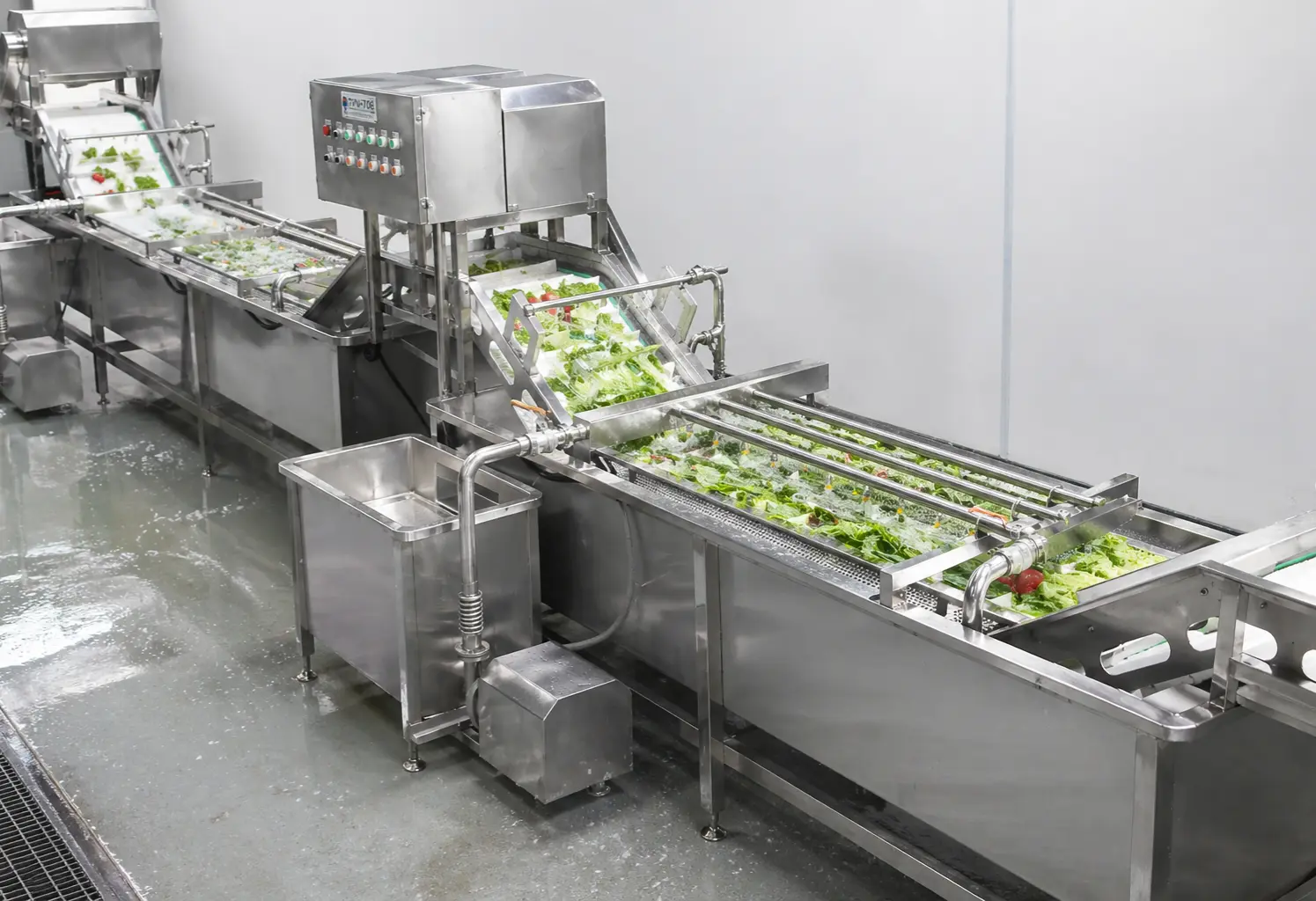
These are not questions that can be answered from a generic equipment catalogue. They require plant data and the facility’s validation strategy. A useful engineering review of a vegetable washing process should therefore document water source, make-up and recirculation strategy, product and cut state, expected feed range, solids and organic-load behavior, target control parameters, monitoring method, sampling position, drainage and cleaning access.
Cleaning Access and Wet-Environment Design
21 CFR Part 117 addresses the design, construction, installation, use and maintenance of equipment and utensils, including the requirement that food-processing equipment be adequately cleanable and maintained to protect against contamination. The 2026 FDA guidance translates those principles into practical fresh-cut examples such as reviewing cleanability before equipment purchase, maintaining equipment, cleaning and sanitizing after repairs, and considering how equipment and tool movement interact with plant traffic.
That makes hygienic access an engineering input rather than a post-installation sanitation problem.
During a plant review, the sanitation team should be able to identify the surfaces it must reach, the components that require removal or opening, the tools required, the inspection points after cleaning, the areas that retain water, and the paths by which cleaning liquid, debris or condensate could reach food-contact surfaces or exposed product.
Drainage deserves its own review
A machine can appear easy to wash while still creating a difficult wet-processing environment. Equipment legs, frames, guards, cable routing, transitions and floor interfaces can influence whether water drains cleanly or accumulates around the process.
Project engineers should therefore review machine drainage together with room drainage, floor slope, drain position, hose use, cleaning direction and the movement of employees and tools. This is particularly important where exposed RTE product is handled after a contamination-reduction opportunity and before packaging.
The correct output of this review is not a generic statement that equipment has “hygienic design.” It is a list of observable and testable access requirements for the specific sanitation procedure that the facility intends to use.
Environmental Monitoring and Facility Layout
Under 21 CFR Part 117, the hazard analysis must include evaluation of environmental pathogens whenever an RTE food is exposed to the environment before packaging and the packaged food does not receive a treatment or otherwise include a control measure that would significantly minimize the environmental pathogen.
This issue changes the way equipment projects should be reviewed. A washer or conveyor is not an isolated machine. Its location affects people movement, raw-material movement, drainage, maintenance access, cleaning-tool movement, splash, floor wetness and proximity to downstream exposed food.
A retrofit that improves mechanical capacity while creating uncontrolled cross-traffic can therefore solve one production problem and create another food-safety question.
Environmental monitoring is not simply a machine specification
Where environmental monitoring is required as a verification activity because contamination of RTE food with an environmental pathogen is a hazard requiring a preventive control, Part 117 sets expectations for scientifically valid procedures, organisms or indicators, locations, sampling sites, timing, frequency, analytical methods, laboratory identification and corrective-action procedures.
The equipment supplier should help the customer understand physical access and equipment geometry, but the supplier should not select a customer’s environmental-monitoring program or declare a facility microbiologically compliant. Those decisions belong to the food business and its qualified food-safety and laboratory resources.
Time, Temperature, Dewatering and Line Balance
FDA’s guidance includes time and temperature as a separate fresh-cut process-control topic. The facility’s hazard analysis should determine whether time and temperature are handled as CGMP measures, preventive controls or through another appropriate part of the food-safety system.
From an engineering perspective, temperature control cannot be reduced to the setpoint of one piece of equipment. Product can spend time waiting before cutting, during washing, between stages, in a buffer, during inspection, during dewatering, before packaging and in refrigerated storage.
That is why nominal machine capacity should be distinguished from line behavior. A high-capacity washer feeding an undersized downstream step can create residence time in an uncontrolled buffer. Conversely, an unnecessarily large downstream machine does not solve a control problem if the bottleneck is actually manual inspection, sanitation downtime or packaging.
Post-wash moisture removal also needs to fit the product and downstream process rather than being treated as a generic food-safety step. When reviewing the interface between washing, draining, centrifugal drying or other moisture-removal methods, the vegetable dewatering process provides additional engineering context.
Records: Make the Process Reconstructable
Records should allow qualified personnel to determine what was supposed to happen, what actually happened and what was done when the two differed.
For a fresh-cut plant, that can connect supplier verification, sanitation, monitoring, instrument checks, corrective actions, validation evidence, verification, training and reanalysis. It is therefore useful to define the record architecture during project specification rather than after the line has entered production.
Digital control can help, but automatic data collection is not inherently better evidence if timestamps, product identity, sensor status, calibration status, deviations and operator actions cannot be connected meaningfully. Similarly, a well-designed manual record may be adequate when it accurately supports the facility’s procedure.
The objective is traceable decision evidence, not digitalization for its own sake.
Who Owns Which Decision?
The food business retains responsibility for its food, facility, regulatory obligations and food-safety system. Where Part 117 requires involvement of a preventive controls qualified individual, those responsibilities must be performed or overseen accordingly. Validation may also require a process authority, microbiologist, qualified laboratory or other technical expertise depending on the hazard and control.
An equipment supplier has a narrower but still useful role. It can provide engineering information about equipment configuration, access, drainage, control interfaces, monitoring locations, line flow, utilities, documentation, service access and project constraints. It can also support equipment tests defined with the customer.
It should not claim to approve the customer’s hazard analysis, write the customer’s regulatory conclusion, certify that a process is FDA compliant, replace the customer’s PCQI, make laboratory decisions or sign off the facility’s food-safety plan.
During project definition, technical support and engineering review should therefore focus on the questions the equipment supplier can legitimately answer while clearly identifying the items that remain with the food business and its qualified specialists.
How to Run the Review Before an RTE Salad Line Project
A practical review can be completed in stages without pretending that the equipment team is performing the facility’s regulatory assessment.
- Map the actual products. Record commodity, cut state, intended use, packaging, relevant storage conditions and whether a later hazard-minimizing treatment exists.
- Map the actual process. Include receiving, trimming, cutting, washing, water recirculation, inspection, dewatering, mixing, packaging, buffers and storage.
- Overlay the hazard-analysis decisions. Identify which process steps correspond to controls, sanitation measures, supplier controls or other food-safety-system elements.
- Apply the gap matrix. Mark every applicable row as confirmed, partially confirmed or unconfirmed, and identify the evidence owner.
- Separate food-safety decisions from engineering consequences. For example, a validated monitoring requirement may create a sensor-placement requirement, but the equipment engineer should not invent the critical limit.
- Define representative conditions. Product range, cut sizes, expected feed rates, water conditions, organic-load challenge, room conditions and operating duration should be considered where they affect the intended control.
- Only then freeze the equipment specification. Access, drainage, instrumentation, controls, utilities, capacity and layout can now be connected to documented process requirements rather than assumptions.
This sequence is particularly useful for a plant that is upgrading only one stage of an existing production line. It prevents a local mechanical improvement from being evaluated independently of the process-control system around it.
Fresh-Cut Produce Guidance Engineering Impact
| Guidance topic | Engineering impact | Buyer must confirm |
|---|---|---|
| Cut-product washing and water control | Sampling points, circulation boundaries, filtration, make-up water and controlled dosing interfaces can affect the equipment design. | Hazard analysis, selected parameters, limits, monitoring frequency, corrective actions and validation owner |
| Cleanability and sanitation | Access to belts, screens, tanks, piping and protected electrical components affects cleaning work and inspection. | Cleaning method, chemicals, frequency, verification method and acceptable disassembly time |
| Cross-contamination and traffic | Product, people, tools, waste, packaging and returnable containers require a project-specific layout. | RTE/RTC boundary, room zoning, flow arrows and site responsibility |
| Drainage and the wet environment | Equipment outlets, floor drains, splash and low points affect placement and support design. | Drain capacity, invert level, cleaning flow and civil-work owner |
| Environmental monitoring and records | Equipment access and sampling locations can support the buyer’s program. | Program design, target organisms, locations, frequency, response and record retention |
Official Sources
FDA lists the document as Final, issued in August 2026. It is intended to help manufacturers and processors of RTE fresh-cut produce comply with applicable part 117 requirements, while stating that guidance recommendations are not legally enforceable unless a specific requirement is cited.
Frequently Asked Project Questions
Does the final guidance specify a required number of wash tanks?
No universal tank count is specified. The buyer must justify the process and controls for the product, hazards, water system and facility.
Which RFQ inputs affect wash-water equipment?
Provide wash-stage purpose, water source and quality, circulation plan, selected monitoring parameters, sampling locations, limits, corrective actions and responsibility for validation.
How should environmental-monitoring access be discussed with an equipment supplier?
Identify sampling locations and access needs defined by the buyer’s program. The supplier can support physical access but does not design or approve the program through an equipment quotation.
Where does TEEMYEAH scope end?
The commercial proposal should state the mechanical, controls, utility-interface and documentation scope. Hazard analysis, regulatory interpretation, microbiological validation and final site approval remain buyer or qualified-third-party responsibilities unless expressly contracted.
When should a retrofit be delayed?
Delay equipment release when product status, hazard-analysis inputs, drain and layout conditions, cleaning method or monitoring responsibility are still undefined enough to change the design.

