




Summary
A salad processing line upgrade should answer a practical question: which existing modules should be kept, modified, supplemented or replaced to improve accepted output without creating new interface, cleaning or control problems. Map the current line, measure synchronized input and output, identify starving and blocking, and record product damage, retained water, stops, utilities and operator work. Then compare the washer, dryer, inspection, buffer, conveyor and control options against the actual bottleneck. The downloadable site survey captures the 25 dimensions and evidence references needed for a retrofit review. TEEMYEAH uses those inputs to prepare a keep/replace/add assessment, not to approve the site’s food-safety program.
Find the True Bottleneck Before Selecting Retrofit Equipment
One of the most common errors in an existing fresh-cut line expansion is to identify the slowest-looking machine and immediately replace it. The visible queue is useful evidence, but it does not prove that the machine beside the queue is the true constraint.
A washer may appear to be limiting output because the cutter feeds it irregularly. A centrifuge may appear undersized because baskets are not available at the required moment. A packing machine may repeatedly stop upstream production even though every preprocessing machine has a higher catalogue capacity. Excessive rejected product can also make a high gross throughput number commercially meaningless.
The measurement should therefore be based on accepted saleable output: the amount of product leaving the assessed process in the required condition and accepted for the next defined stage. Gross feed weight, theoretical belt loading and nameplate kilograms per hour are supporting information, not substitutes for this measurement.
A practical stage observation records the amount of accepted product leaving the stage during a defined period of real operation. The observation should also capture stoppages, changeovers, loading and unloading time for cyclic machines, rejected or reworked product, waiting time, buffer accumulation and the reason for each interruption.
The processor can express the observed stage rate conceptually as:
Accepted stage output rate = accepted product leaving the stage ÷ net observed production time.
This number is most useful when compared across a representative production window rather than from a short demonstration under unusually favorable conditions. The product family matters as well. Whole romaine, cut iceberg, baby leaves, shredded cabbage and mixed salad components do not necessarily create the same handling rhythm or dewatering constraint.
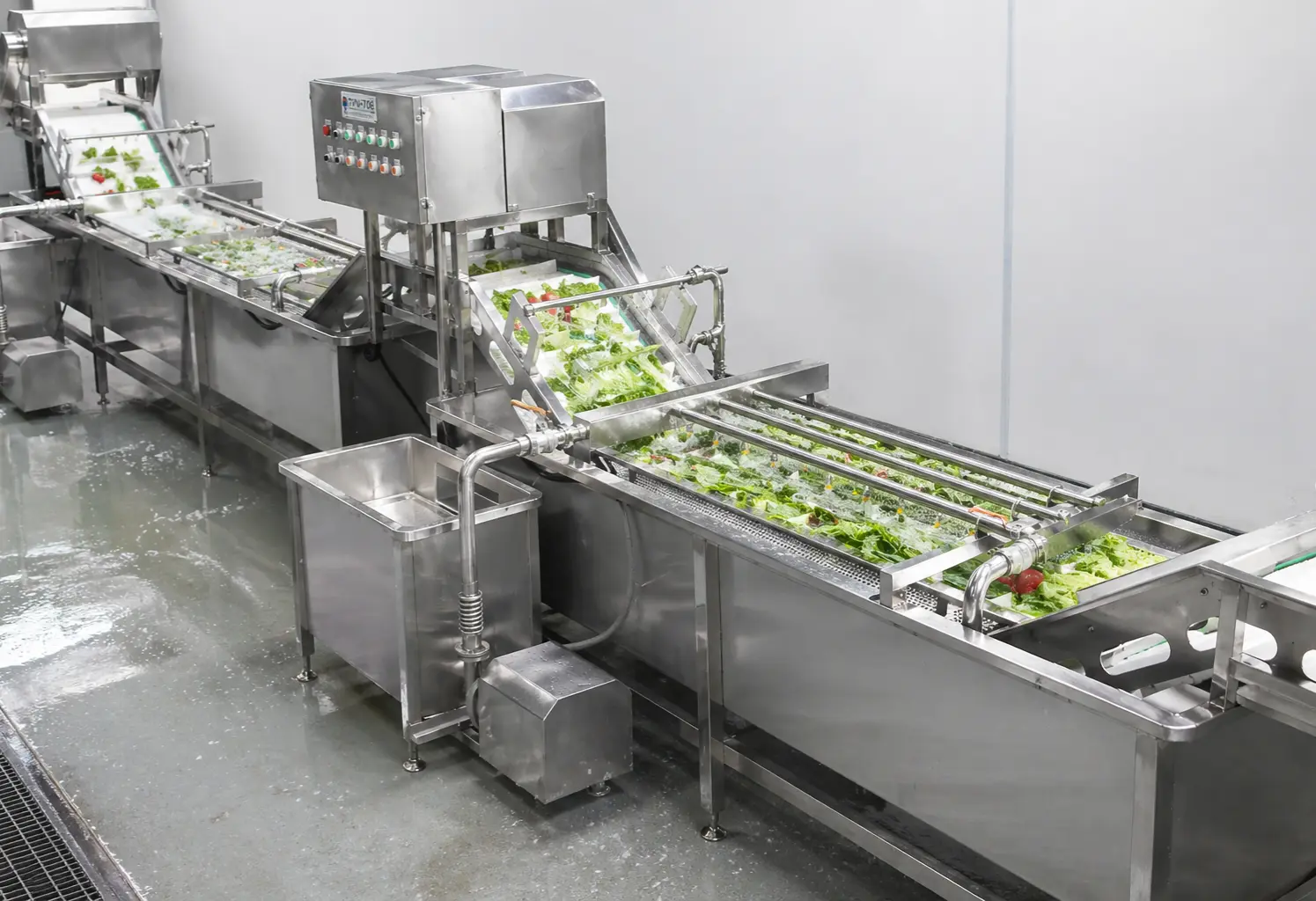
When cutting, washing and moisture removal are being assessed together, the broader leafy vegetable line capacity matching framework can help identify mismatched production rhythms. A retrofit assessment goes one step further by assigning a decision to the actual installed machine: keep it, change it, duplicate its capacity in parallel or remove it.
What Evidence Is Required to Keep an Existing Machine?
Retention should be an engineering conclusion rather than a preference to avoid expenditure. A machine is a credible retention candidate when a representative trial and interface review show that it can continue to perform its intended process purpose under the proposed upgraded conditions.
Evidence for retention should cover the product and finished specification, sustainable accepted output, upstream and downstream rhythm, transfer geometry, hygienic access, disassembly requirements, controls, emergency-stop and energy-isolation boundaries, utilities, drainage, maintenance clearance and relevant downstream interfaces.
A machine does not have to be the newest component in the room. Nor does it have to match every feature of a proposed new machine. It does, however, need to remain compatible with the required process and with the systems being connected around it.
This distinction prevents unnecessary replacement while avoiding the opposite mistake: keeping an existing unit simply because it still runs mechanically.
Retain–Modify–Add in Parallel–Replace Decision Matrix
Product, Flow and Capacity Decisions
| Assessment item | Retain | Modify | Add in parallel | Replace |
|---|---|---|---|---|
| Product and cut specification | Representative products can be processed in the required form without unacceptable damage, loss or handling problems. | A limited feed, guide, transfer or operating adjustment can accommodate the confirmed specification. | The existing process is suitable, but simultaneous or alternating processing is required for specific products or peaks. | The machine’s process principle is unsuitable for the required product or finished specification. |
| Accepted output | Sustainable accepted output meets the required stage demand under representative operation. | A clearly scoped adjustment can recover the required output without creating another constraint. | The stage is a measured capacity constraint and duplicated operating capacity can be balanced safely. | Required accepted output cannot be sustained reasonably with the existing equipment. |
| Stage input/output rhythm | Incoming and outgoing product flow can be synchronized with adjacent stages. | Timing, feed control or intermediate transfer changes can correct a limited mismatch. | A cyclic stage can use alternating machines while upstream and downstream flow remains controlled. | The operating rhythm fundamentally conflicts with the required line structure. |
| Conveyor working width and height | Working width and transfer elevation match the required product stream and adjacent equipment. | A transition conveyor, guide, elevation adjustment or other engineered interface can resolve the difference. | Product can be split into defined parallel lanes without uncontrolled feeding. | The required connection would create unreasonable product handling, guarding or access problems. |
| Infeed/outfeed geometry | Product enters and leaves predictably with adequate containment and distribution. | Chutes, guides, conveyors or transition sections can be modified within an agreed scope. | A controlled splitter and merger can serve parallel machines. | The basic geometry prevents a practical connection to the proposed configuration. |
| Product fall | Transfer drop is compatible with the product and accepted quality requirement. | A transition or elevation change can reduce an identified handling issue. | Parallel transfer can be arranged without creating additional damaging drops. | The installed position or machine arrangement makes acceptable product transfer impractical. |
Controls, Utilities and Operating Interfaces
| Assessment item | Retain | Modify | Add in parallel | Replace |
|---|---|---|---|---|
| Buffer and WIP | Existing buffer capacity absorbs normal stage variation without excessive holding or manual intervention. | A defined buffer, accumulation conveyor or operating logic can stabilize flow. | Buffering can feed and receive parallel units without uncontrolled accumulation. | The retained machine would create excessive or operationally unacceptable WIP under the target production pattern. |
| Controls and interlocks | Required run, stop and fault relationships can be safely integrated and documented. | Sensors, interlocks, local controls or interface signals can be added within a defined responsibility boundary. | Logic can balance loading and prevent one parallel unit from being overfed while another is unavailable. | The control architecture cannot reasonably be integrated to achieve the required operating and safety behavior. |
| Emergency stops | The emergency-stop boundary and effect on connected equipment are suitable for the final system. | Additional devices, circuits or defined interfaces can be engineered and verified by responsible parties. | Parallel equipment can be incorporated without creating ambiguous emergency-stop behavior. | The existing arrangement cannot be brought into the required safety architecture reasonably. |
| Energy isolation | Energy sources and isolation points can be identified and incorporated into the site’s applicable procedures. | Isolation provisions can be modified within the responsible engineering and EHS scope. | Each parallel machine can be isolated appropriately without compromising the rest of the system. | Safe integration of the required energy-isolation arrangement is not reasonably achievable. |
| Electrical supply | Existing supply and protection are compatible with the retained machine and proposed operating arrangement. | Defined electrical distribution or interface work can resolve the requirement. | Available infrastructure can support parallel equipment after responsible electrical review. | Electrical limitations or obsolete unsupported systems make continued use unjustifiable. |
| Water and drainage | Supply and drainage support the process without unmanaged overflow, standing-water or discharge problems. | Piping, drain connections or local drainage interfaces can be modified appropriately. | Additional equipment can be served without overloading available water or drainage infrastructure. | The retained stage cannot reasonably operate within the required utility and drainage conditions. |
Access, Maintenance and Trial Evidence
| Assessment item | Retain | Modify | Add in parallel | Replace |
|---|---|---|---|---|
| Sanitation access | Required surfaces and areas remain accessible under the customer’s sanitation program. | Guards, covers, access panels or surrounding layout can be changed without creating new unacceptable conditions. | Parallel equipment can be positioned with sufficient sanitation access around both units. | Required cleaning access cannot reasonably be achieved with the existing design or installation. |
| Disassembly | Routine removal of relevant food-contact or cleaning components can be carried out as required. | Limited component or access modifications can improve the required disassembly procedure. | Both parallel units can be cleaned and reassembled without making the sanitation window impractical. | The machine cannot be disassembled or accessed sufficiently for the required sanitation approach. |
| Maintenance clearance | Technicians can reach service points without interfering unacceptably with adjacent equipment. | Repositioning or local layout changes can restore access. | Two machines can be accommodated without losing required service space. | The retained location creates unresolved maintenance or service-access problems. |
| Upstream/downstream signals | Required ready, run, stop, fault or product-demand signals can be exchanged appropriately. | Defined signal interfaces, sensors or gateway logic can be implemented. | Control logic can select, alternate or balance parallel equipment predictably. | The existing control system cannot reasonably support the necessary line communication. |
| Packaging interface | Discharge form, rate, elevation and accumulation match the confirmed downstream requirement. | A buffer or transfer interface can bridge a clearly defined difference. | Parallel preprocessing can be merged without exceeding downstream acceptance. | The retained stage cannot support the confirmed packaging demand or product presentation. |
| Representative product trial | The machine demonstrates the required process purpose and accepted output under agreed trial conditions. | The proposed modification has defined criteria that can be retested. | Parallel logic can be demonstrated with realistic loading, discharge and buffer behavior. | Trials show that required process, output or quality conditions cannot be achieved reliably. |
A Measurable Existing-Line Assessment Workflow
- Define the target improvement. State what must change in measurable operational terms: accepted output, moisture condition, cleaning access, labor interaction, changeover behavior, production rhythm or another defined project objective.
- Define representative products. Record the product, incoming condition, cut specification, typical batch or flow pattern and important SKU variations. Do not assess the line using only an easy product if difficult products are commercially important.
- Create an equipment register. List every retained candidate with model information where available, current function, condition, working width, infeed and outfeed height, controls, utilities, drainage and service-access requirements.
- Map the physical interfaces. Measure machine positions, available floor space, transfer distances, conveyor elevations, product drops, surrounding access and the connection to downstream packing or other confirmed equipment.
- Observe actual stage cycles. Record accepted output, feed interruptions, discharge intervals, loading and unloading, product waiting, WIP accumulation, changeovers, cleaning-related constraints and the reason for stoppages.
- Identify the measured constraint. Compare stage behavior using accepted product and actual operating rhythm. Separate equipment limitations from procedural, maintenance, staffing, upstream-feed and downstream-demand problems.
- Classify each stage. Assign retain, modify, add in parallel or replace, and document the evidence supporting the decision rather than relying on supplier preference.
- Define the trial and acceptance plan. Agree representative product, operating conditions, measurements, mechanical checks, control checks and responsibilities before committing to the final retrofit configuration.
If the organization has not yet determined which process should receive automation or investment attention, that question should be resolved separately using a process-automation prioritization framework. A brownfield retrofit assessment is more productive once the improvement target is already defined.
Sanitation Access and Drainage Can Decide Whether a Machine Stays
A mechanically reliable machine can still become a poor retention candidate if the upgraded arrangement removes access needed for cleaning, inspection, disassembly or maintenance. Brownfield layouts are especially vulnerable because a new conveyor or washer may be inserted into space that previously served as operator or sanitation access.
The assessment should examine the installed arrangement rather than an isolated equipment drawing. Operators need room to reach cleaning points. Removable components need space to be removed. Drainage changes should not create unmanaged standing-water conditions around the new interface. Maintenance staff need access to service areas without requiring routine dismantling of unrelated equipment.
FDA’s August 2026 final guidance for ready-to-eat fresh-cut produce is nonbinding guidance intended to help applicable processors understand Part 117 requirements and recommendations. It reinforces the importance of sanitary equipment and facility conditions, sanitation practices, process water controls, verification and records. The guidance should not be interpreted as FDA approval of any particular washer or retrofit configuration, and washing should not be presented as a pathogen-elimination step.
Codex Alimentarius CXC 53-2003, including its ready-to-eat fresh pre-cut produce annex, similarly provides an international hygienic-practice framework relevant to cleanability, equipment condition, drainage and process hygiene. Codex guidance is not automatically national law, so local legal and customer requirements still need to be determined separately.
What the Equipment Supplier Can and Cannot Own
An experienced equipment supplier can contribute to the mechanical and process side of a brownfield project: reviewing products, layouts and installed equipment; discussing process sequence; defining equipment interfaces; preparing relevant drawings and documentation; supporting representative trials; and assisting with installation and commissioning within the agreed scope.
TEEMYEAH’s current technical support scope includes requirement review, site-condition and process-flow discussion, equipment selection, line integration, installation guidance, commissioning, operator training, maintenance and troubleshooting support. The exact responsibility for a retrofit project still needs to be defined contractually.
An equipment supplier does not replace the processor’s hazard analysis, food-safety plan, PCQI or other qualified food-safety personnel, process authority where required, qualified laboratory, EHS function, electrical or other locally regulated engineering responsibility, or local regulatory judgment.
For U.S. facilities subject to 21 CFR Part 117, the facility’s applicable hazard-analysis, preventive-control, monitoring, validation where applicable, verification and recordkeeping obligations remain with the responsible facility and qualified personnel. Requirements differ by jurisdiction, product and facility, so the retrofit specification should distinguish machine engineering from regulatory and food-safety ownership.
Diagnose the Current Line Before Choosing Equipment
| Record | Why it matters | Decision use |
|---|---|---|
| Synchronized input, accepted output and elapsed time | Separates a short running rate from sustainable output. | Shows whether the target washer or another stage limits the line |
| Stops, starving, blocking and operator interventions | Reveals interface and control losses hidden by nameplate capacity. | Supports buffer, conveyor or control-integration decisions |
| Product condition, damage, rejects and retained water | Prevents more wet or damaged output from being counted as an improvement. | Sets trial and acceptance checks |
| Water, debris, drainage and cleaning observations | Connects throughput to the wet-room and sanitation workload. | Supports keep, modify or replace decisions |
The former washer-audit page contributed the synchronized run record, water/debris observations and downstream-confounding checks. These now belong in this single retrofit decision page.
Measurements Before Retrofit
The former site-survey page contributed 25 field checks across installation access, equipment envelope, infeed/outfeed geometry, product flow, electrical supply, air, water, drainage, cooling, cleaning clearance, maintenance removal and control I/O. Use the downloadable survey to record each value as measured, drawing-based, nameplate-based, observed or unknown.
Download the Salad Line Retrofit Site Survey
The workbook includes a current-line map, the 25 measurement checks, evidence-source dropdowns, file references and a completion status. Unknown values remain visible instead of being converted into guessed dimensions.
After completing the workbook, attach it with the product photos, layout or operating records requested on this page. TEEMYEAH will use the submitted inputs to prepare the next defined engineering step; the download itself is not a quotation or validation result.
Frequently Asked Project Questions
When should an existing washer be kept?
Keep it when the synchronized run proves adequate accepted output, product handling and cleaning access, and when its utilities, controls and interfaces can support the proposed line.
When is an additional washer or dewatering unit useful?
Add a module when a defined stage is consistently limiting the line, parallel operation can be controlled and cleaned, and the upstream/downstream stages can absorb the new rate.
Which dimensions are mandatory before fabrication?
Confirm the equipment envelope, access route, infeed/outfeed heights and widths, floor and drain levels, maintenance-removal space and utility connection points.
Can TW-705, TW-475 and TW-980LB be combined in every retrofit?
No. TW-705 has controlled evidence for a long-path washing/filtering role; TW-475 currently lacks equivalent local controlled specifications; TW-980LB duty and capacity are product-specific. Confirm the actual product and interfaces.
What will TEEMYEAH return after reviewing the survey?
A preliminary view of which modules can be kept, modified, added or replaced, the unresolved interface questions and a proposed trial or budgetary scope.

