







Industrial Vegetable Washing: Methods, Equipment and Process Selection
Industrial vegetable washing is not simply a question of placing produce into water and selecting a washer by kilograms per hour. The washing stage has to match the incoming product condition, the type and quantity of soil or loose material entering the process, whether the vegetables are whole or already cut, the required production flow, and what happens immediately before and after washing.

Leafy vegetables in connected washing tanks and transfer conveyors.
A suitable industrial vegetable washing configuration therefore begins with the process task rather than the machine model. A plant handling whole root vegetables from the field faces a different washing problem from a fresh-cut operation receiving trimmed lettuce, while a central kitchen processing several vegetable groups may need still another arrangement. The objective is to define what the washing stage must accomplish, how material and water should move through it, and how the stage connects with cutting, inspection, draining or dewatering.
For related process stages and equipment families, you can also review the Process Knowledge Hub and Vegetable & Fruit Washing Equipment.
What Industrial Washing Must Accomplish
A washing stage should be specified around clearly defined process functions. Depending on the raw material and production sequence, those functions may include loosening adhering material, carrying away free soil or sand, separating floating or sinking debris, opening and moving leafy material through water, rinsing exposed surfaces, screening small fragments from the water/product stream, or preparing washed vegetables for the next inspection, cutting or dewatering step.
These functions should not be treated as interchangeable. Agitating product in a tank, directing it through a vortex, applying a water curtain and spraying clean water over the discharge can all be part of vegetable washing, but they act differently on the product and contamination load. The engineering question is which combination is appropriate for the actual material entering the machine.
Washing and sanitizing serve different purposes. A washer provides mechanical washing, product movement, debris separation and rinsing; these functions alone do not establish microbiological safety or regulatory compliance. Water quality, sanitation procedures, chemical treatment where applicable, cleaning, zoning and process validation must be addressed for each plant.
For that distinction in more detail, see Vegetable Washing vs Sanitizing.
Why Different Vegetables Need Different Washing Logic
Vegetables differ in geometry, density, surface structure, fragility and the way contamination reaches the processing line. A compact whole cabbage, loose lettuce leaf, shredded carrot, peeled potato and root vegetable carrying field soil do not behave in the same way in water. Product loading, water-flow intensity and residence therefore need to be considered together rather than assigned from a generic vegetable-washing specification.
The incoming condition matters just as much as the crop name. A vegetable may arrive whole, trimmed, cut, peeled, partially washed or mixed with loose leaves and fragments. The required washing stage should consequently be based on the actual feed presented to the machine, not only on the commodity listed on a purchasing sheet.
Whole-Product Washing vs Post-Cut Washing
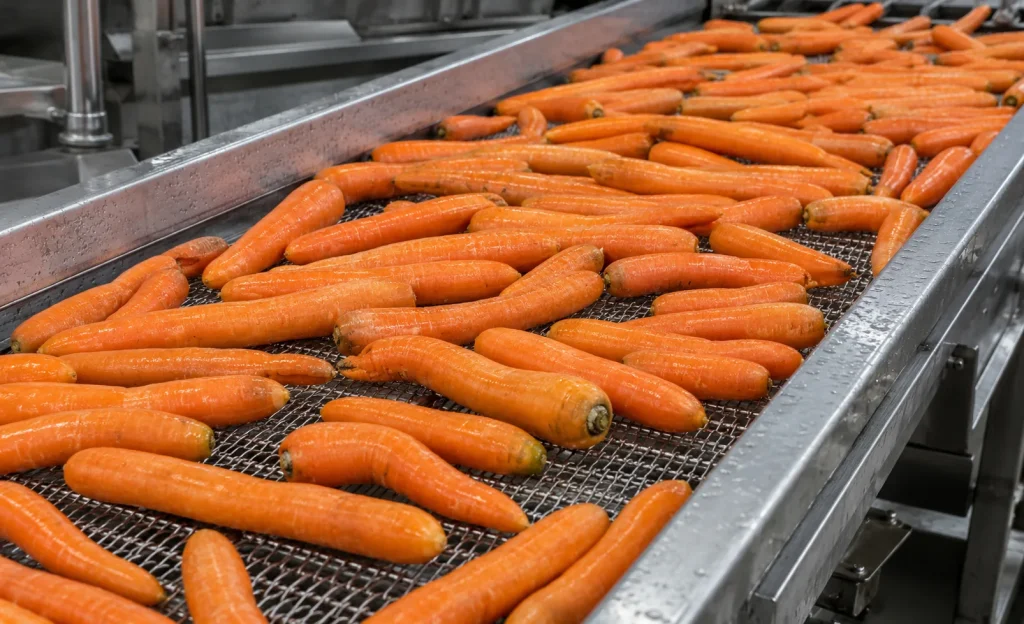
Whole carrots on a transfer conveyor.
Whole vegetables
Whole-product washing is often positioned early in the line to remove externally carried soil and debris before trimming or cutting. In one TEEMYEAH whole-vegetable project, washing took place before cutting. The right sequence for your line depends on the incoming product and the required finished form.
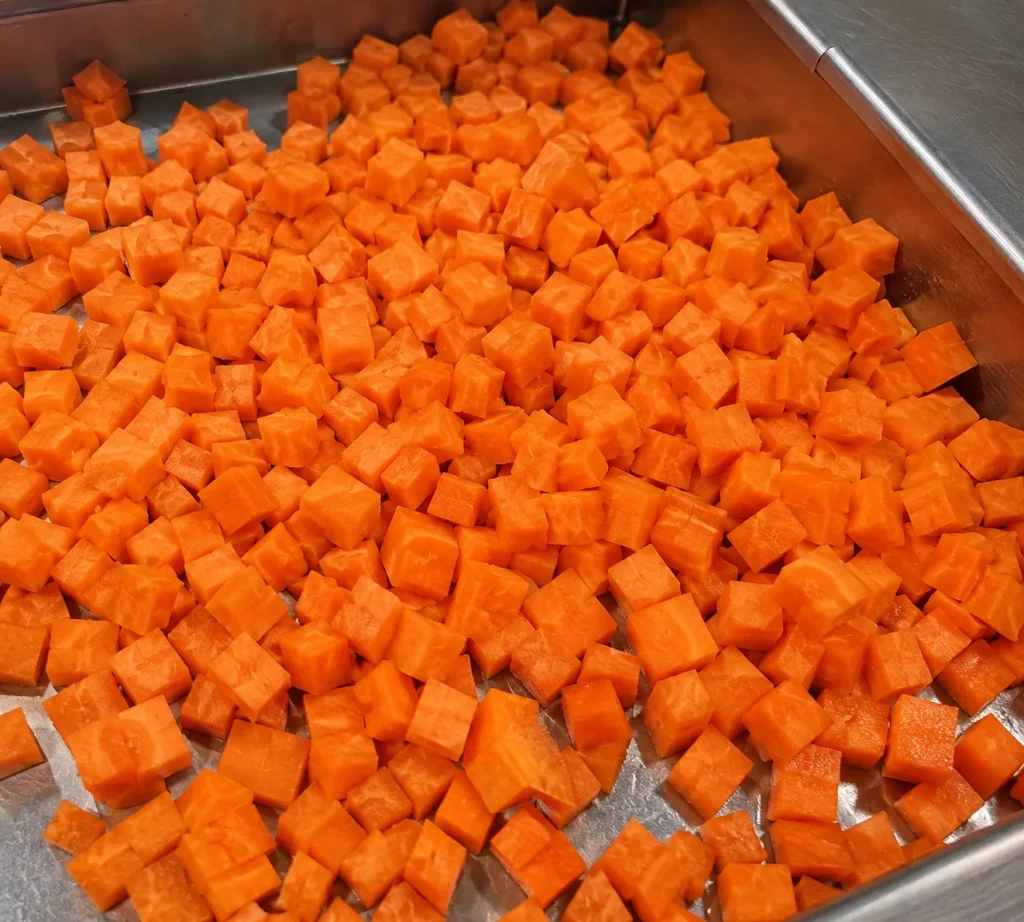
Diced carrot pieces.
Cut vegetables
Post-cut washing creates a different process condition. Cutting increases the number of exposed surfaces and usually introduces cut fragments into the water/product stream. The washer therefore has to be reviewed together with fragment screening, product transport, water management and the following draining or dewatering operation.
The choice between the two routes depends on the product specification and the overall line architecture. Some projects may wash before cutting, some after cutting, and some may use washing at more than one point for different purposes. The relevant comparison is explored separately in Whole Leaf vs Cut Leaf Washing.
Leafy Vegetables vs Root Vegetables
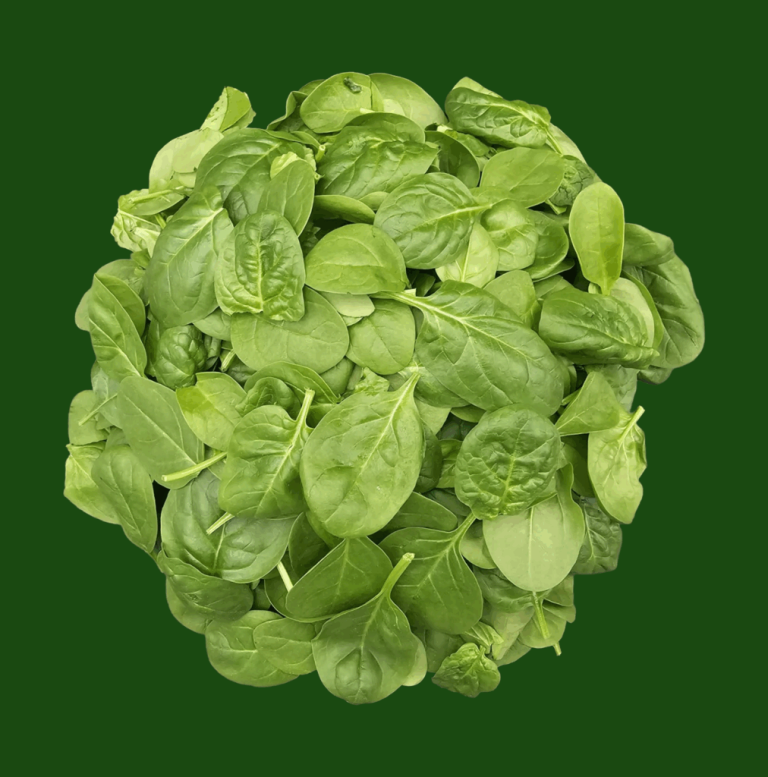
Spinach leaves.
Leafy vegetables
Leafy vegetables require attention to how individual leaves or cut pieces open, separate and travel through the water. Excessive loading can change circulation patterns, while water intensity and residence must be selected with product characteristics in mind. On the TW-705, water-flow intensity and bubble pressure can be adjusted to suit the vegetable and required washing time.
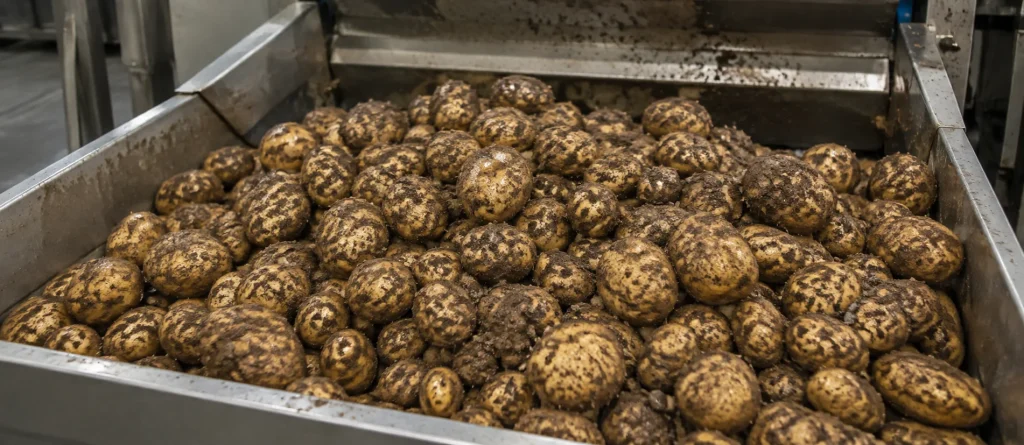
Soil-covered potatoes before preparation.
Root vegetables
Root vegetables can present a different problem because field soil may adhere more strongly to the product surface. Depending on the product and target finish, the process may include soaking, water washing or a separate brush washing/peeling route. Brush contact should not automatically be assumed to improve the process: surface finish and usable-product loss need to be evaluated together.
These distinctions are reflected in broader line architecture. See the Leafy Vegetable Processing Line and Root Vegetable Processing Line for application-level context.
Choosing an Industrial Vegetable Washing Method
No single washing method is universally appropriate. Industrial lines commonly combine hydraulic movement, air agitation, spray rinsing and physical debris separation, but the usefulness of each method depends on the vegetable, loading condition and intended process function.
Bubble washing
Uses air agitation in water to move product and disturb loose material
Product type, loading, bubble pressure, residence time
Check washing performance and product condition with representative product trials
Vortex / guided water flow
Uses controlled water movement to circulate and convey vegetables through the wash zone
Flow intensity, product density, loading and residence
Stronger movement is not automatically better
Shower / water-curtain washing
Applies water across moving or tumbling product
Flow, coverage, product presentation and water condition
Should be evaluated as one stage within the overall wash sequence
Spray rinsing
Applies a final or intermediate water spray to the product
Water quality, pressure/flow, nozzle condition and bed depth
Does not by itself guarantee residue or contaminant removal
Multi-stage washing
Divides washing into stages with separate functions
Function of each stage, water condition, product transfer and residence
More stages do not automatically mean a more hygienic process
Brush washing / peeling
Mechanical surface-contact route for selected root products
Brush specification, contact, raw-material condition and desired finish
Surface finish and usable-product loss should be evaluated together
Bubble Washing
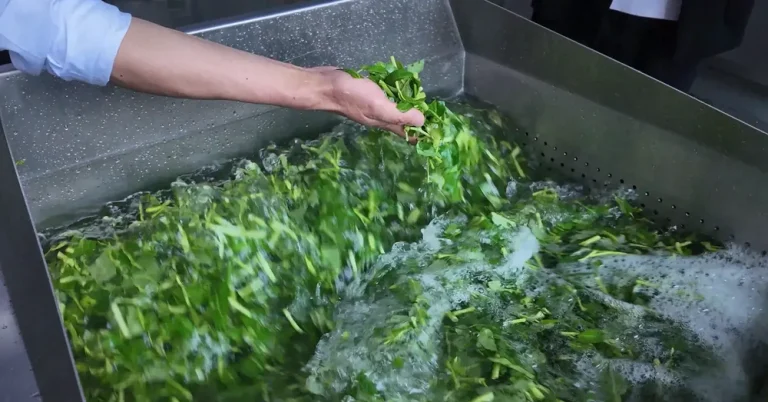
Leafy material in moving water; loading and water movement are process variables.
Bubble washing introduces air agitation into a water tank. Its process value depends on how that agitation interacts with the vegetable load. When different products need different movement conditions, adjustable bubble pressure is an important selection factor. The TW-705 allows bubble pressure to be adjusted according to vegetable characteristics.
Bubble washing should not be selected on the assumption that it is inherently gentler, stronger or more hygienic than another method. Product density, batch or continuous loading, residence and upstream contamination condition all affect how the stage performs in practice.
Vortex and Guided Water Flow
Vortex washing uses directed water movement to circulate product through the washing zone. The TW-506L uses a vortex wash tank without a conveyor running through the tank, while the TW-705 incorporates vortex action within a longer multi-function washing path.
Flow intensity should correspond to vegetable characteristics and the required wash time. A project should therefore be reviewed around actual product behaviour in the tank rather than assuming one fixed hydraulic setting will suit every SKU.
Shower and Spray Rinsing
Water curtains or shower zones apply water to moving or tumbling product. The TW-705 vortex/shower section combines 360-degree tumbling with water-curtain shower washing.
Spray rinsing can also be placed at a transfer or discharge point. On the TW-705, a clean-water spray rinse can be switched on or off, while its vibratory filtering conveyor can provide another clean-water spray. Whether such rinsing should be used depends on the plant’s water specification, nozzle condition, product-bed depth and required process sequence.
Single-Stage or Multi-Stage Washing?
A single washing stage may be sufficient when one clearly defined hydraulic and debris-removal function matches the incoming material. A multi-stage arrangement becomes relevant when the process needs to divide different tasks—for example, removing a heavy incoming soil load before a more controlled main wash, or separating the main washing function from a later rinse.
The number of tanks is not the main design criterion. Each stage should have a stated purpose, an expected incoming contamination condition and a defined relationship with the stages before and after it. Adding a second or third wash stage without defining what changes between them does not by itself demonstrate better process performance.
Pre-Wash, Main Wash and Rinse Functions
Pre-Wash
A pre-wash can be used when the incoming product carries a debris or soil load that should be reduced before the main washing operation. This can help separate the initial heavy-duty cleaning task from later washing conditions, but the exact arrangement depends on the vegetable and the condition in which it enters the line.
Main Wash
The main wash is where product movement, water contact, residence and debris separation should be matched to the primary cleaning task. Depending on the equipment architecture, this may use bubbles, vortex flow, shower washing or a combination of methods.
Rinse
A rinse stage may provide a separate water application after the main wash. Its function should be specified explicitly rather than assumed. Water quality, product loading and spray coverage still need operational control, and the presence of a rinse does not establish a food-safety outcome.
Stage count and function depend on the product and process.
Water Movement and Residence Time
Water movement determines how vegetables circulate, separate and pass through the washing zone. Too little movement may not create the intended product circulation, while unnecessarily aggressive movement may be inappropriate for certain products. Adjustable water-flow intensity and bubble pressure are therefore useful process variables when a line handles products with different physical characteristics.
Residence time also matters. TW-705 washing time is adjustable; the appropriate setting should be established for your product, loading level and washing objective through evaluation under actual operating conditions.
Water depth and level stability can also affect machine operation. The TW-705 includes pneumatic water-level control for pump protection, while its circulating tank automatically adds water when the level falls below a set point and stops adding water when that level is reached.
Product behaviour, loading, process objective and validation under actual operating conditions.
Handling Soil, Sand, Loose Debris and Floating Material
Floating material, stones and fine fragments require the separation function to be reviewed against the actual incoming load. Conceptual process functions are shown; equipment arrangements differ.
A washing tank must handle not only vegetables but also everything released from them. Sand, small cut fragments, damaged leaves and other loose material can accumulate or recirculate if separation functions are not considered during equipment selection.
The TW-705 includes a sand-settling zone. After washing, a vibratory filtering conveyor moves product while screening fine fragments. A separate fine-mesh waste conveyor drains and captures fragments and moves them toward automated collection.
The TW-506L uses a different arrangement: a drum separates fine debris and stones and opens leaf surfaces, followed by rotating-drum spray and recirculating filtration.
This is why contamination type needs to be discussed before selecting equipment. A line dominated by soil and stones presents a different separation problem from a line dominated by floating leaf fragments or fine material generated after cutting.
Product Damage Must Be Considered as a Process Variable
Vegetable washing is a handling operation as well as a cleaning operation. Product movement through water, transfer points, bubbles, vortex intensity, residence and mechanical contact can all influence product condition. Selection should therefore balance the intended washing action against the physical characteristics and commercial specification of the vegetable.
No washing method should be assumed to prevent all product damage or suit every vegetable equally well. Evaluate representative products, target cut dimensions where relevant, expected loading and the appearance required after washing.
Water Renewal, Make-Up and Recirculation
Water management should be treated as part of the washing process rather than an isolated utility calculation. Where water is recirculated, the plant needs to consider how solids are removed, when water is renewed or made up, and how its operating condition is monitored within the site’s sanitation and food-safety program.
The TW-705 has a circulating-water filter tank and integrated fill/make-up water. Its tank automatically adds water below a set level and stops when that level is restored. This controls water level; water consumption, renewal frequency and hygiene performance still need to be evaluated for the actual process.
The TW-506L includes recirculating filtration and has a full-tank water volume of 3 m³. Water-renewal requirements depend on the product and operating conditions.
Actual Capacity Is More Than the Washer's Nominal Rating
A washer’s nominal output helps with initial equipment sizing, but it is not the same as complete-line capacity. Sustainable throughput depends on the raw vegetable, product loading, cutting specification, washing residence, inspection requirements, transfers, draining or dewatering cycle, sanitation, changeovers and upstream and downstream equipment.
TW-705
The TW-705 has a nominal output of 800–1,000 kg/h for applications including iceberg lettuce, bok choy/Shanghai green, Chinese cabbage and sliced or shredded roots. This is a machine capacity figure; whole-line throughput and saleable packed output depend on the product and the rest of the process.
TW-506L
The TW-506L has a specified output above 1,000 kg/h. Confirm the required throughput with TEEMYEAH for your product and complete-line configuration rather than assuming a maximum output from this figure.
Washing Must Interface Correctly With Cutting and Dewatering
The washing machine cannot be engineered independently from its neighbouring operations. Upstream cutting can change the amount of fine material entering the wash stage, alter product density and change how pieces behave in water. A washer that receives whole vegetables therefore operates under a different material condition from one receiving shredded or sliced product.
Downstream draining or dewatering is equally important. Product leaving an immersion or spray washing stage carries surface water, so the next stage must be selected according to the vegetable, cut form and required subsequent process. Restricting flow at the dewatering stage can also reduce the sustainable throughput of an otherwise adequately sized washer.
Where available, review the Vegetable Dewatering Process when defining this interface.
Equipment-Selection Framework
A useful equipment discussion starts with the feed and required process result, then narrows the washing mechanism and machine configuration.
What enters the washer?
Whole, trimmed, cut, shredded, peeled or mixed product
Changes product movement, fragment load and required handling
What needs to leave the product?
Soil, sand, stones, loose fragments, floating material or a combination
Determines separation and filtration functions to review
How delicate is the product?
Leaf structure, cut size, surface condition and acceptable appearance
Affects flow intensity, agitation and residence
Is this pre-cut or post-cut washing?
Position relative to trimming and cutting
Changes debris load and exposed product condition
Is one wash function enough?
Pre-wash, main wash and/or rinse requirements
Determines single-stage versus multi-stage architecture
How should water be managed?
Make-up, filtration, renewal and plant water controls
Affects tank and filtration configuration
What production flow is required?
Real incoming load, SKU mix, operating hours and bottlenecks
Prevents nominal washer capacity being mistaken for line output
What follows washing?
Inspection, draining, dewatering, packaging or further processing
Determines discharge format and interface requirements
TW-705: Long-Path Multi-Function Washing for Selected Fresh-Cut Applications
The TW-705 Fresh-Cut Vegetable Washing Line combines a long-path washing system with a filtering conveyor system. It includes bubble washing, vortex washing, shower/rinse washing and a sand-settling zone. Water-flow intensity, bubble pressure and washing time can be adjusted to suit the product; the operating settings should be confirmed for your application.
Its filtering section adds process functions beyond product transport. A vibratory filtering conveyor screens fine fragments, a fine-mesh waste conveyor captures and conveys fragments toward collection, and the system includes automated waste collection, a circulating-water filter tank and integrated make-up water.
TW-705 may suit salad and fresh-cut projects that need long-path washing, debris separation, filtration and transfer after washing. Its nominal 800–1,000 kg/h capacity is a machine figure, not a whole-line output guarantee.
Cleaning access is also part of equipment selection. TW-705 has sanitary quick-release pipework for access. After each production run, isolate the power and clean the equipment promptly. Do not spray electrical controls, electrical components or motors with water.
TW-506L: Vortex Washing for Higher-Flow Continuous Processing
The TW-506L Industrial Vegetable Washer uses a vortex wash tank without a conveyor running through the tank. Its process includes a drum for fine debris/stone separation and leaf opening, rotating-drum spray and recirculating filtration.
This configuration can be considered for continuous vegetable washing that needs vortex movement and dedicated debris separation. Its specified output is above 1,000 kg/h, with a full-tank water volume of 3 m³. Confirm its suitability and operating output against your product and complete-line requirements.
The complete machine dimensions are 7650 × 1550 × 2050 mm. Front and rear tank dimensions describe individual sections and should not be used as the overall machine size when planning the layout.
Matching Other Products and Line Requirements
Batch, whole-product and multi-stage washing configurations can be considered once the raw material, stage functions and required production flow are defined. Explore the Vegetable & Fruit Washing Equipment range, then discuss your application with TEEMYEAH to confirm the washing mechanism, machine capacity and configuration.
For selected roots, a separate brush washer or washer/peeler route may also be considered where surface contact is part of the required process. Brush specification, raw-material condition, surface finish and usable-product loss should be assessed together.
Real Process Examples
Example 1: Two Washing Stages After Root Cutting
A 2026 root-processing project used this sequence:
wash/peel → sorting → cutting → bubble/spray wash 1 → bubble/spray wash 2 → dewatering
In this project, two bubble/spray washing stages followed cutting and preceded dewatering. The stage count was specific to that process; it does not mean all root-vegetable lines need two stages or that two stages always perform better than one.
Example 2: Washing Whole Vegetables Before Cutting
A different project placed washing before cutting. The washer therefore received whole vegetables, with a different product condition and debris load from a line washing cut material.
The contrast between these two projects illustrates why industrial vegetable washing should be designed around process position. The appropriate question is not simply "How many washing tanks are required?" but "What enters each washing stage, what function should that stage perform, and what product condition must it deliver to the next operation?"
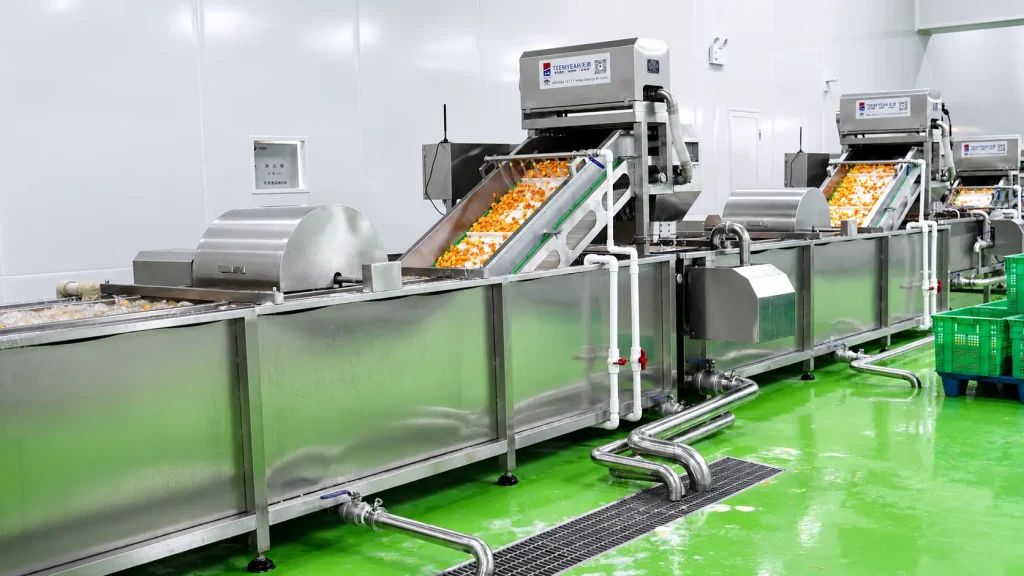
Cut root pieces passing between washing tanks on discharge conveyors.
Example equipment arrangement. Final layouts depend on the product and process.
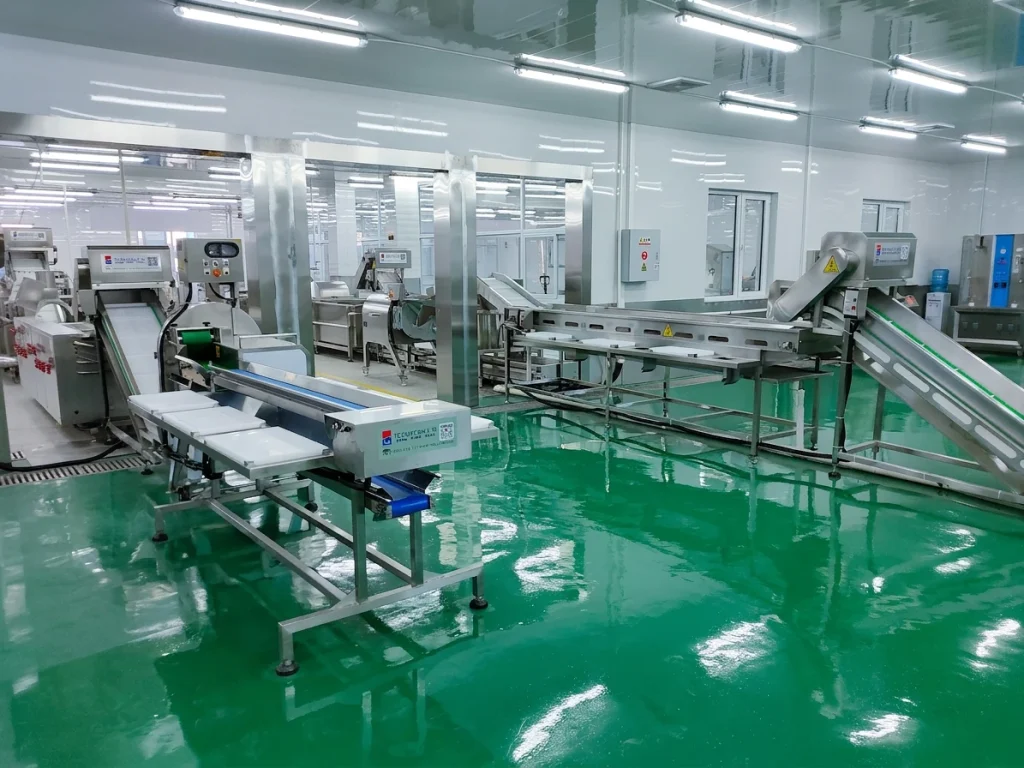
Stainless-steel conveyors and inspection positions illustrate downstream transfer interfaces.
Example transfer arrangement. Capacity depends on the complete line.
Frequently Asked Questions
What is the main difference between bubble washing and vortex washing?
Bubble washing uses air agitation within water, while vortex washing relies more heavily on guided water movement. Neither method has a universal advantage. Product characteristics, loading, intensity and residence need to be considered for the specific vegetable and process.
Should vegetables be washed before or after cutting?
Either arrangement can be appropriate. One TEEMYEAH project washed whole vegetables before cutting, while another root-processing project used two washing stages after cutting. The right position depends on incoming contamination, cut specification, fragment management and downstream requirements.
Does a four-stage washer automatically wash better than a single-stage washer?
No. Stage count alone does not establish washing performance or hygiene. Each stage needs a defined process function, such as pre-wash, main washing, debris separation or rinsing, and the complete sequence needs validation under actual operating conditions.
How should sand and small vegetable fragments be handled?
The separation method needs to match the debris. TW-705 includes a sand-settling zone, vibratory screening for fine fragments and a fine-mesh waste conveyor for fragment collection. TW-506L uses a drum for fine debris and stone separation.
Is the catalog capacity of a vegetable washer the same as line capacity?
No. TW-705 has a nominal machine output of 800–1,000 kg/h, while TW-506L is specified above 1,000 kg/h. These figures do not establish sustainable complete-line or saleable output. Cutting, washing residence, inspection, transfers, dewatering, sanitation and SKU mix all affect actual production flow.
Can washing water be recirculated?
Some TEEMYEAH configurations include recirculating filtration. TW-705 has a circulating-water filter tank with automatic make-up water control, and TW-506L also includes recirculating filtration. Water renewal, quality monitoring, sanitation and process validation still need to be defined for the plant and application.
Can the same washer process leafy and root vegetables?
Some washing equipment can be reviewed for more than one vegetable group, but that does not mean one configuration or setting is suitable for every product. Leaf structure, root-soil load, cut condition, fragment generation, water-flow intensity and the required downstream process should all be assessed before confirming equipment.
Does industrial vegetable washing make the product microbiologically safe?
Washing alone does not establish microbiological safety. Mechanical washing, water movement, debris separation and rinsing are parts of the processing system. Each plant needs to validate water quality and renewal, sanitation procedures, cleaning, hygienic zoning, product handling and the food-safety requirements for its application.
Define the Washing Task Before Selecting the Washer
A useful washing-equipment enquiry should describe the vegetable, incoming condition, whether it is whole or cut, major soil or debris load, target throughput, preferred process sequence and the operation immediately after washing. Photos or videos of the raw material can also help clarify how the product behaves before equipment is selected.
TEEMYEAH can use those inputs to review whether the project calls for a relatively simple washing stage, a combined bubble/vortex/spray arrangement, multiple washing functions, dedicated debris separation, or a root-specific route before the equipment configuration is discussed in detail.
For complete-line context, review the RTE Salad Processing Line, Leafy Vegetable Processing Line or Root Vegetable Processing Line.
Contact TEEMYEAH with your raw-material condition, target product, required production flow and intended process sequence to discuss the washing stage as part of the complete processing system.