







Summary
Whole leaf washing vs cut leaf washing is not a contest with one universal winner. Whole-leaf prewashing is usually the stronger starting point when incoming lettuce carries soil, field debris, damaged outer leaves, or variable organic load, because it keeps much of that load away from the cutter and the later hygienic zone. Post-cut washing becomes more valuable when the finished product is shredded, sliced, or portioned and the process must remove cut-surface fluids, small fragments, and material released during cutting. A two-stage strategy—controlled prewash, hygienic cutting, and a separate post-cut wash—often deserves evaluation for higher-risk ready-to-eat products or heavily soiled raw materials, but it adds water circuits, sanitation work, floor space, and another opportunity for product damage.
The right sequence depends on product form, field condition, RTE or RTC use, cut intensity, leaf fragility, wash-water control, dewatering capability, and the verified capacity of every downstream stage. A washer cannot compensate for contaminated incoming produce, poor zoning, blunt cutting blades, uncontrolled recirculated water, or weak sanitation. The practical answer should come from side-by-side product trials that measure saleable yield, wash-water loading, microbial process-control indicators, damage, residual moisture, labor, cleaning time, and effective—not catalog—throughput.
The Production Decision Hidden Inside a Simple Question
A central kitchen may receive romaine with soil around the base, trim it, wash the separated leaves, cut it for service, and cook it later. A fresh-cut processor may receive cleaner heads, core and shred them, wash the cut product under a controlled antimicrobial program, dewater it, and pack it as ready-to-eat salad. Both plants say they “wash lettuce,” yet the purpose of the wash, the exposed surfaces, the water load, and the consequence of a control failure are different.
The process-order decision affects more than visible cleanliness. Cutting ruptures plant cells. Juice, sugars, fine tissue, and fragments enter the next water circuit, increasing the load that a filtration and antimicrobial-control system must manage. At the same time, post-cut washing can remove those fluids and fragments from the product before dewatering and packing. Washing whole leaves earlier can protect the cutting stage from field debris and reduce the opportunity for one dirty lot to load a shared downstream wash, but a prewash alone may not remove material generated by the cutter.
This is why the question must be framed as a process-flow decision rather than an equipment preference. The project team needs to define what each wash stage is expected to remove, which hazards are controlled elsewhere, what condition the leaf must have when it reaches the cutter, and what moisture specification the final product must meet.
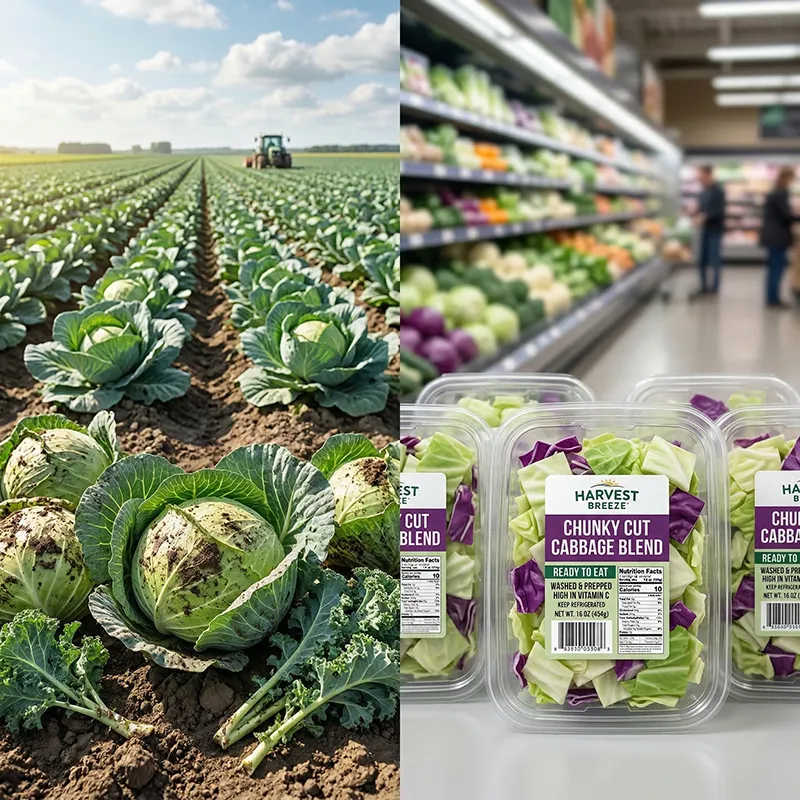
Whole Leaf Washing vs Cut Leaf Washing: The Core Process Difference
Whole-leaf prewash
Whole-leaf prewash means washing intact heads, whole plants, or separated but uncut leaves before size reduction. Depending on the product, operators may remove roots, cores, damaged outer leaves, or heavy debris before the washer. Its main process purpose is to reduce soil, insects, field matter, and loose contamination before the cutter and the higher-hygiene part of the line.
The term does not automatically mean “sanitized” or “ready to eat.” A prewash can be a soil-removal step, an antimicrobial-controlled step, or both, depending on the validated food-safety plan and local requirements. Leaf overlap, folds, hydrophobic surfaces, and dense heads may limit contact. If the line cuts after the only wash, the cutter can create fresh surfaces and tissue fluids that receive no later rinse.
Post-cut washing
Post-cut washing means that trimming and size reduction occur before the main wash. The wash acts on the actual saleable geometry—shreds, squares, strips, or chopped leaves—and can remove cutting fines and cell exudate. The trade-off is that far more cut edge is exposed to water and mechanical movement. Cut material also raises organic load quickly, which can consume some antimicrobials and make recirculated water harder to control.
Two-stage washing
A two-stage process separates functions. An early wash removes gross soil and stabilizes the load entering the hygienic cutting area; a later wash manages cut-surface residues and the final product condition. The two stages should not be treated as one long tank system with shared dirty water. Their zoning, circulation loops, filtration, water-change rules, monitoring points, and cleaning procedures need distinct purposes.
Comparison: What Each Washing Strategy Solves—and Creates
| Decision factor | Whole-leaf prewash | Post-cut washing | Two-stage wash |
|---|---|---|---|
| Incoming soil and field debris | Strong fit; keeps gross load away from cutting and cleaner zones. | Weak fit when dirty produce reaches the cutter first. | Strongest functional separation when the first stage removes gross load. |
| Removal of cutting fines and tissue fluid | Does not remove material created after the wash. | Strong fit; washes the final cut geometry. | Strong fit if the second stage is sized for the cut-product load. |
| Cut-surface exposure to shared water | Lower during the initial wash. | Higher; water control becomes critical. | Higher in stage two, but incoming gross load may be lower. |
| Delicate leaves and damage sensitivity | Can be favorable when intact leaves tolerate handling better. | Requires gentle movement and short, verified residence time. | Two handling events may increase bruising or edge damage. |
| RTE shredded or chopped salad | May be part of the control strategy, but does not address post-cut residues by itself. | Commonly relevant because there is no later cooking step and the final geometry is washed. | Often worth testing where raw-material load and final-product control both matter. |
| RTC whole or large-leaf product | Often sufficient when the product remains whole and will be cooked. | May add little value if there is minimal cutting before dispatch. | Usually difficult to justify unless soil load or customer specification requires it. |
| Water, filtration, and sanitation complexity | One principal circuit can be simpler, although heavy soil may demand robust separation. | One circuit, but rapidly changing organic load requires close control. | Highest complexity: separate circuits, controls, cleaning, and records. |
| Dewatering demand | Lower if the product is drained before cutting and not washed again. | Higher because small cut pieces retain surface water. | Usually highest total water contact; final dewatering becomes a line-balance constraint. |
| SKU flexibility | Suitable for whole-leaf families but may struggle with dense or folded products. | Can handle several cut formats if the washer and dewatering settings are adjustable. | Flexible in principle, yet recipes, changeovers, and validation multiply. |
| Investment and floor space | Usually lowest of the three when one stage meets the specification. | Moderate, with added attention to filtration and dewatering. | Highest; must earn its place through measured risk, quality, or capacity benefits. |
Start with Product Form, Not the Washer
The same farm lot can support several process routes. Whole spinach for cooking, chopped spinach for a frozen recipe, baby-leaf salad, and shredded romaine for an RTE pack do not create the same wash requirement. Product definition should include incoming form, trimming rules, cut dimensions, acceptable broken-leaf percentage, final moisture, packaging method, shelf-life target, and whether the customer will cook the product.
Whole plants and separated whole leaves
For hotpot ingredients, catering packs, and RTC products that remain whole or are cut only after washing, a whole-leaf route can be practical. It protects the cutter or manual knife station from mud and grit and may reduce cleaning interruptions. Dense heads still need a realistic contact assessment: water moving around a head is not the same as water reaching overlapped inner surfaces.
Shredded, sliced, and chopped leaves
More cuts create more exposed edge and more fines. Post-cut washing can improve removal of loose tissue and produce a more uniform input to dewatering, yet agitation that is acceptable for whole leaves may damage shreds. Blade condition matters as much as washing intensity. A blunt or unsuitable cutter can create crushed edges that no washer can repair.
Baby leaves and highly fragile products
Baby leaf, herbs, and tender salad components may arrive as naturally small units rather than products that need industrial cutting. In that case, “whole leaf” already resembles the final geometry. Gentle washing, short residence time, low drop heights, and controlled dewatering may matter more than adding a second wash. A two-stage system that doubles handling can reduce saleable yield even if visible cleanliness improves.
Soil Load and Seasonality Can Reverse the Preferred Sequence
Raw-material condition varies with field, weather, harvest method, supplier, and season. A process trial run with dry-season romaine may not represent wet-season product carrying mud near the base. Organic load is not merely a water-appearance issue. It can change sanitizer demand, filter loading, foam behavior, pump performance, water-change frequency, and the number of stops required to remove debris.
Track at least incoming soil score, trim loss, water turbidity or another plant-defined load indicator, filter cleanout frequency, antimicrobial residual where applicable, pH, water temperature, fresh-water addition, and the time at which the circuit moves outside its operating limit. The correct indicators depend on the antimicrobial and control plan; oxidation-reduction potential, for example, should not be treated as a universal substitute for direct concentration measurement.
Where incoming load is high or unpredictable, an early debris-removal and prewash stage can protect a later controlled wash. The dirty stage and clean stage should have intentional flow direction, physical separation, utensil control, and drainage that does not carry contamination backward. Reusing water from a cleaner stage in an earlier dirt-removal stage may be technically possible in some designs, but it requires an assessed water-management scheme rather than an informal overflow connection.
Food Safety: Washing Is a Cross-Contamination Control, Not a Kill-Step Promise
Leafy vegetables are frequently consumed without a later lethal treatment. For an RTE salad, washing may be the final direct product treatment before dewatering and packaging, but that does not mean it sterilizes the leaves. Public guidance for fresh-cut produce emphasizes prevention, sanitary operations, water quality, monitoring, and controls that minimize transfer through process water. It does not support a claim that washing can rescue contaminated raw material.
Cutting changes the control problem. A contaminated leaf can transfer microorganisms to a blade, belt, flume, tank, or other leaves. Cut tissue also contributes organic matter to the water. The antimicrobial program—when one is legally permitted and technically selected—must be designed around the water system, product, organic load, temperature, pH, contact conditions, and local regulatory requirements. The target residual in a water circuit should not be advertised as an equivalent reduction on the product.
A 2013 laboratory and dynamic-washing study using fresh-cut butterhead lettuce wash water illustrates this distinction. Without chlorine in the tested system, microbial contamination in the water built rapidly during one hour. Maintaining a low measured free-chlorine residual controlled water contamination more effectively under the study conditions, even at substantial chemical oxygen demand, but maintaining that residual in the presence of organic matter was operationally difficult. The study supports active wash-water control; it does not establish a universal plant setpoint or guarantee pathogen removal from lettuce.
What the sequence studies actually show
A 2010 inoculation study on romaine found that a chlorinated whole-leaf wash before cutting produced about one log greater pathogen reduction than the traditional cut-leaf sanitizer wash under its experimental conditions. It also reported much less transfer to uninoculated leaves in the tested whole-leaf-first sequence. The useful lesson is that cut tissue and released organic matter can materially change sanitizer performance and transfer dynamics. It does not prove that every whole-leaf industrial line is safer than every post-cut line.
A separate 2011 study compared washing whole leaves before slicing, washing after slicing, and slicing romaine while submerged in a sodium-hypochlorite solution. The submerged-slicing treatment performed best in that experiment and maintained an advantage during refrigerated storage. This is evidence that timing and mode of sanitizer contact matter. It is not a general recommendation to place industrial cutters in sanitizer tanks: mechanical safety, hygienic design, chemical exposure, blade access, water carryover, and regulatory acceptance would all require evaluation.
RTE and RTC Products Need Different Decision Thresholds
Ready-to-cook product is intended to receive cooking or another preparation step after dispatch. Ready-to-eat product may be consumed as sold, so the processor cannot assume a later kill step will correct upstream failures. This difference should affect zoning, environmental controls, water management, traffic patterns, packaging, release criteria, and the evidence required before changing process order.
For RTC whole lettuce, coriander, spinach, or similar hotpot and catering ingredients, whole-leaf washing may meet the commercial specification while limiting unnecessary cutting and water contact. For an RTE shredded salad, the final cut geometry, tissue-fluid removal, final rinse logic where applicable, dewatering, and hygienic transfer to packing are more prominent. A two-stage arrangement can be justified when the prewash meaningfully stabilizes the load entering an independently controlled post-cut system. Simply adding a second tank to the same uncontrolled circuit does not create a two-stage safety strategy.
Plants producing both RTE and RTC products should examine whether shared cutting, washing, dewatering, tools, drains, and staff movement fit their hazard analysis. Scheduling RTE after RTC is not automatically a substitute for validated cleaning and zoning. The process map should show where raw and washed products cross, where open RTE product is exposed, and how rework is controlled.
Capacity and Line Balance: Catalog Throughput Is Not Saleable Output
A washer rated in kilograms per hour does not define line output. Real throughput depends on leaf density, residence time, loading pattern, soil, cut format, inspection requirements, water-change events, dewatering cycle, changeovers, sanitation, stops, and the percentage of product that remains saleable. Post-cut product may occupy more volume per kilogram and can become the washer or dryer bottleneck even when the upstream cutter has a higher nominal rating.
Use accepted finished product as the common denominator:
- Saleable yield (%) = accepted finished kilograms ÷ incoming raw kilograms × 100.
- Effective throughput (kg/h) = accepted finished kilograms ÷ net production hours.
- Labor hours per 1,000 kg = direct production labor hours ÷ accepted kilograms × 1,000.
- Capacity utilization (%) = required stage rate ÷ verified sustainable stage rate × 100.
- Downtime rate (%) = unplanned stopped time ÷ scheduled production time × 100.
- Preparation cost per kilogram = labor + water + chemical + energy + sanitation + maintenance + measured reject cost ÷ accepted kilograms.
Illustrative calculation: comparing routes on the same daily demand
Assume a hypothetical plant needs 4,000 kg of accepted salad per day. Product trials—not supplier assumptions—produce the values below. The numbers are illustrative and do not represent a TEEMYEAH installation or an industry benchmark.
| Route | Trial yield | Raw input required | Net production time | Required raw rate |
|---|---|---|---|---|
| Whole-leaf wash, then cut | 91.0% | 4,396 kg/day | 6.4 h/day | 687 kg/h |
| Cut, then wash | 89.0% | 4,494 kg/day | 6.0 h/day | 749 kg/h |
| Two-stage wash | 90.5% | 4,420 kg/day | 5.7 h/day | 775 kg/h |
The two-stage route in this example needs the highest hourly rate because added cleaning and changeover time reduces net production time. Its slightly better modeled yield than the post-cut route does not automatically justify it. The team would still compare water use, food-safety controls, residual moisture, labor, capital cost, and the value of meeting the RTE specification. This is why a supplier’s nominal capacity should be tested against the actual SKU and full shift pattern.
Labor Dependence Moves; It Does Not Disappear
Whole-leaf washing can reduce manual rinsing and keep grit away from cutting, yet operators may still need to separate leaves, remove roots, trim defects, inspect folds, and manage wet product. Post-cut washing can automate movement of small pieces, but it may require closer attention to filter loading, chemical control, fines removal, dewatering, and frequent sanitation. A two-stage system adds transfer points and verification tasks even if it reduces manual washing.
Recruitment, training, turnover, and absence affect actual throughput because inconsistent loading or trimming changes washer residence time and yield. Measure labor by role and activity rather than using headcount alone: raw trimming, loading, inspection, water-control checks, dewatering, packing support, cleaning, changeover, and rework. Ergonomic review should include repetitive knife work, lifting wet baskets, reach distance, slippery floors, chemical handling, and access during cleaning.
Automation makes sense when it converts variable manual work into a controllable process and the plant can maintain that process. It makes less sense when demand is irregular, raw materials vary beyond the machine’s operating window, or sanitation resources are insufficient. Training remains necessary for product release, equipment adjustment, chemical safety, corrective action, and maintenance.
Matching Washer Type to the Process Strategy
Equipment selection should follow the required function. A whole-plant line needs controlled separation and movement without trapping soil in leaf folds. A post-cut line needs gentle but effective transport, debris and fine-particle management, stable residence time, and a discharge that feeds dewatering without creating WIP. A staged batch system may be better where the plant runs many recipes, needs independent tank steps, or cannot support a long continuous line.
Within TEEMYEAH’s current range, the TW-706L whole-plant vegetable washing line is positioned for whole lettuce, coriander, spinach, and central-kitchen or hotpot workflows. The TW-705 continuous fresh-cut and salad washing line is positioned for gentle multi-action washing of leafy and cut salad products, with project-specific layout discussion. The TW-475 multi-tank batch washing line provides independently controlled tanks and programmable transfer for plants that value staged recipes and a compact arrangement.
These product positions are starting points, not a claim that one model is automatically correct. Catalog capacity must be derated or confirmed against product bulk density, loading, residence time, wash objective, water condition, and downstream dewatering. A useful factory trial uses representative worst-case and normal raw material, not a small quantity of unusually clean leaves.
Hygienic design questions to ask
- Can operators see, reach, drain, and verify all product-contact areas?
- Can belts, strainers, nozzles, pumps, baskets, pipes, and tank interfaces be removed or opened without excessive downtime?
- Are there dead zones, hollow structures, flat ledges, trapped water, or difficult corners?
- Are dirty-stage and clean-stage water circuits separated and clearly identified?
- Can the system record water changes, concentration checks, pH, temperature, deviations, and corrective actions where required?
- Does discharge height and transfer geometry protect fragile leaves and match the dewatering equipment?
Do Not Select the Wash Sequence Without Selecting the Dewatering Strategy
Post-cut washing increases the importance of water removal. Small pieces retain water between folds and on cut surfaces. If the dryer cannot keep up, wet product accumulates between washing and packing, residence time varies, and the plant may slow the whole line. Aggressive centrifugal settings may raise breakage or bruising; weak settings may leave excessive moisture that affects pack weight, dressing adhesion, visual quality, or shelf-life performance.
Measure incoming and outgoing surface moisture using a repeatable plant method, along with dewatering cycle time, load size, leaf damage, temperature rise, product loss in the dryer, and time from wash exit to sealed pack. The washer, transfer conveyor, inspection position, dryer, and packing line must be balanced around the same saleable-output target. Adding a faster washer to a fixed batch dryer can increase WIP rather than throughput.
SKU Mix, Changeovers, and Traceability Often Decide the Business Case
A single high-volume romaine SKU is easier to automate than a daily schedule that alternates spinach, coriander, shredded cabbage, salad blends, and allergen-containing kits. Each product may require a different loading rate, water recipe, inspection standard, dewatering setting, and cleaning scope. A technically capable two-stage line can lose commercial value if frequent changeovers consume the available shift.
Map the production sequence by product family. Record product-to-product changeover time, full sanitation time, first-good-product time, and material held during transitions. Traceability should connect raw-material lot, production time, cutting setup, wash circuit, process-control readings, deviations, rework, and packed lot. If two water stages are used, the records must identify which stage was in control rather than producing one generic “washer checked” entry.
When Manual, Semi-Automatic, or Integrated Processing Is the Better Fit
Manual handling can still be rational
Manual washing and trimming may remain commercially reasonable for very low volume, seasonal production, frequent one-off SKUs, delicate premium leaves that need individual judgment, or a pilot business still proving demand. It is only rational when the plant can control water, hygiene, time, temperature, ergonomics, and records. “Hand washed” is not the same as “uncontrolled.”
Semi-automation often creates the best first step
A central kitchen may automate one high-labor wash stage while retaining manual trimming and inspection. This can stabilize throughput without forcing every SKU through one rigid route. It also gives the team operating data before adding cutting, automatic transfer, or dewatering. The equipment should be placed so that manual steps do not create cross-traffic or WIP between raw and washed zones.
Integrated automation needs stable demand and process discipline
A continuous or multi-stage line becomes more compelling when daily volume is predictable, product families share compatible settings, labor limits constrain growth, customer specifications require repeatable records, and the facility can support utilities, preventive maintenance, sanitation, and spares. Full integration is a process redesign: conveyors, controls, drainage, staffing, and release procedures matter as much as the washer.
When a Washing Strategy—or Automation Itself—Is Not Suitable
Whole-leaf-only washing is a poor fit when the finished cut product releases enough fines or tissue fluid that the downstream quality specification cannot be met without another controlled rinse, or when dense product geometry prevents adequate contact. It may also be unsuitable if wet whole leaves cannot be fed consistently into the cutter.
Post-cut-only washing is a poor fit when heavily soiled raw material would contaminate or damage cutters and belts before reaching the washer, or when the cut product is too fragile for the required agitation and dewatering. Sending mud, stones, insects, and damaged outer tissue into a precision cutting area is a process-design failure, not a washer challenge.
Two-stage washing is a poor fit when the added stage has no defined control purpose, the plant cannot separate circuits, or sanitation and monitoring resources are already stretched. More tanks can mean more surfaces, more water, longer changeovers, and more opportunities for out-of-control operation.
Automation is premature when product specifications are unstable, demand cannot support the cleaning and changeover burden, the building lacks drainage or hygienic zoning, or management cannot maintain the control system. A wrongly selected line can lower yield, damage leaves, consume floor space, move the bottleneck to dewatering, and create false confidence in food safety.
A Practical Test Framework Before Choosing the Process Order
- Define three input conditions. Test normal, worst credible seasonal, and supplier-variation lots. Record temperature, soil, damage, head or leaf size, and time since harvest.
- Fix the output specification. State cut size, acceptable defects, residual moisture, pack format, RTE or RTC use, and any customer microbiological or process requirements.
- Run comparable routes. Keep sample mass, cutter setup, water quality, and measurement method consistent when comparing whole-leaf, post-cut, and two-stage options.
- Measure the water system over time. A clean-water startup result is not enough. Observe load indicators, filtration, antimicrobial residual where used, pH, temperature, water addition, and deviation time through a realistic run.
- Measure product and operation together. Record saleable yield, defects, breakage, color, fines, moisture, effective throughput, labor, downtime, cleaning, changeover, and WIP.
- Challenge the bottleneck. Confirm that cutting, inspection, dewatering, conveying, and packing can sustain the selected washer rate without product accumulation.
- Review food-safety evidence. The facility’s qualified team should determine validation, verification, sampling, and corrective-action requirements for its jurisdiction and hazard analysis.
For investment review, calculate payback using documented annual savings and costs:
Simple payback period (years) = installed project investment ÷ verified annual net operating benefit.
Include labor redeployment, water, chemical, energy, sanitation, maintenance, consumables, reject reduction, and downtime. Treat new sales or avoided recall costs separately unless the commercial evidence is strong. A short modeled payback built on catalog throughput and assumed labor elimination is not a reliable project decision.
Which Process Is Better?
Whole-leaf prewashing is generally the better first barrier against soil, field debris, and unstable incoming load. Post-cut washing is generally better at removing material created by cutting and conditioning the actual final geometry. Two-stage washing can combine those functions for RTE products or difficult raw materials, provided the stages have separate purposes and the plant can control the added complexity.
The final choice should be conditional. Favor whole-leaf washing for whole or large-leaf RTC products, dirty incoming leaves, and damage-sensitive materials that do not need a final cut-product rinse. Favor post-cut washing when cut-surface fluids, fines, and a consistent final wash are central to the product specification and incoming material is controlled. Test two stages when both problems are material and measurable. In every case, automation is a redesign of process flow, water control, sanitation, labor, dewatering, and records—not simply the purchase of a washing machine.
Compare Washing Strategies for Your Product
Share representative raw-material photos or samples, incoming condition, finished cut specification, RTE or RTC use, target output, shift schedule, available layout, and current bottleneck. TEEMYEAH can use those inputs to discuss a preliminary process sequence, equipment configuration, capacity match, dewatering requirement, and product-test plan.
Start with the leafy vegetable processing line framework, then compare whether a TW-706L whole-leaf route, a TW-705 continuous fresh-cut route, a TW-475 staged batch route, or a tested two-stage concept fits the product and facility.
FAQ
1. Is whole leaf washing vs cut leaf washing better for RTE salad?
Neither sequence is automatically better for every RTE salad. Whole-leaf prewashing can reduce field debris and organic load before cutting, while post-cut washing removes tissue fluid and fines from the final geometry. A two-stage route may be appropriate when both functions are important, but it adds handling and control points. Because RTE salad has no assumed later cooking step, the choice should be supported by a hazard analysis and trials measuring wash-water control, product damage, residual moisture, yield, and effective throughput.
2. Should lettuce be washed before cutting?
Washing before cutting is often sensible when lettuce carries soil, insects, damaged outer tissue, or inconsistent field load. It keeps much of that material away from cutters and cleaner processing zones. The prewash must still provide adequate contact for the leaf form, and it does not remove fines or cell fluid produced later by cutting. If the finished product is shredded or sold as RTE, the plant should assess whether a separate post-cut step is needed to meet the final product and process-control specification.
3. Why does cutting change wash-water control?
Cutting ruptures cells and releases organic material, small tissue particles, and plant fluids. These materials raise the load in wash water, may increase demand on some antimicrobials, and can fill filters or create unstable conditions during a production run. Cut surfaces are also directly exposed to shared water and equipment. For that reason, post-cut systems need defined loading rates, filtration, water-change rules, monitoring, and corrective actions. A startup reading taken with clean water cannot represent conditions several hours into production.
4. Does sanitizer in the washer make leafy vegetables safe?
No. An antimicrobial used within its legal and validated conditions can help control microorganisms in process water and reduce cross-contamination, but it should not be presented as sterilizing lettuce or compensating for contaminated incoming produce. Performance depends on product, water chemistry, organic load, concentration, pH, temperature, contact conditions, and system design. RTE safety also depends on supplier controls, hygienic zoning, equipment sanitation, employee practices, temperature management, environmental controls, packaging, verification, and corrective action.
5. When is a two-stage leafy vegetable wash justified?
A two-stage wash is worth testing when incoming leaves carry enough soil or debris to destabilize a controlled final wash, while the cut product also releases fines or tissue fluid that must be removed. It can also support separation between a raw-material cleaning zone and a higher-hygiene post-cut zone. It is not justified merely because two washes sound safer. Each stage needs a distinct purpose, separate water-control logic, measurable limits, sufficient sanitation resources, and a demonstrated benefit in risk control, product quality, capacity, or customer specification.
6. Which route is more suitable for RTC leafy vegetables?
Whole-leaf washing is often the practical route for RTC lettuce, spinach, coriander, and similar ingredients that remain whole or in large pieces and will be cooked later. It can remove soil before trimming or portioning while limiting extra water contact and dewatering. The later cooking step does not excuse poor washing or cross-contamination, and the exact process still depends on customer specifications. If the RTC product is heavily cut, mixed, or held for extended chilled distribution, a post-cut or two-stage evaluation may still be appropriate.
7. How should washing-machine capacity be verified?
Verify capacity with representative product at the required residence time and cleanliness target, then measure accepted output over a realistic run. Include loading interruptions, filter cleaning, water changes, dewatering cycles, inspection, changeovers, and rejects. Report effective saleable kilograms per net production hour, not only kilograms entering the washer. The test should cover normal and worst credible seasonal raw material. Downstream cutting, conveying, dewatering, and packing must sustain the same rate, or the line will create WIP rather than additional output.
8. Can delicate baby leaves use post-cut washing?
Baby leaves can use a controlled wash, but many are already close to their final geometry and do not require industrial cutting. Their main limits may be mechanical damage, drop height, residence time, water movement, and dewatering force. Adding an unnecessary cut or second wash can increase bruising, broken leaves, and product loss. Trials should measure saleable yield, visible defects, fines, residual moisture, and quality through the intended shelf-life period, while the food-safety team separately verifies the wash-water control strategy.
9. Is batch washing or continuous washing better for multiple SKUs?
Batch washing can offer recipe flexibility, independent stage timing, and clearer lot separation for smaller runs or varied products. Continuous washing can provide steadier flow and lower handling per kilogram when product families and demand are stable. The deciding factors are not labels but changeover time, cleaning scope, loading consistency, residence-time control, downstream balance, and traceability. A multi-SKU plant should model its actual production schedule; a fast continuous line can be underused if frequent sanitation and setup changes consume the shift.
10. What information is needed for a leafy vegetable washing test?
Provide the vegetable type and variety, supplier and seasonal condition, incoming temperature, soil and defect level, current trimming method, finished cut size, RTE or RTC use, target yield, hourly and daily output, shift pattern, packaging format, final moisture expectation, available utilities, and layout limits. Bring enough representative material to run the washer, cutter, and dewatering step together. Define acceptance criteria before the trial so visible cleanliness, damage, yield, water behavior, labor, throughput, and sanitation time can be compared objectively.
Data and Source Note
FDA-hosted Commodity Specific Food Safety Guidelines for the Lettuce and Leafy Greens Supply Chain, First Edition (2006). This industry-developed voluntary document covers fresh and fresh-cut lettuce and leafy greens, primarily field-grown products, and explains why prevention is favored because removing pathogens after contamination is difficult. It also addresses wash water, fresh-cut operations, equipment sanitation, documentation, and cross-contamination. It is not a regulation, does not apply automatically to every operation, and does not cover all salad-kit or hydroponic contexts.
U.S. Food and Drug Administration, Guide to Minimize Microbial Food Safety Hazards of Fresh-cut Fruits and Vegetables (2008). This nonbinding guidance is intended for domestic and foreign fresh-cut produce firms. It supports preventive control, appropriate processing-water quality, control of recirculated water, management of organic buildup, correct use and monitoring of antimicrobials where applicable, sanitation, and records. It does not prescribe one universal wash sequence or validate a facility-specific antimicrobial setpoint.
Van Haute, Sampers, Holvoet, and Uyttendaele, “Physicochemical Quality and Chemical Safety of Chlorine as a Reconditioning Agent and Wash Water Disinfectant for Fresh-Cut Lettuce Washing” (2013). This peer-reviewed study used artificial and actual leafy-vegetable process water and a dynamic butterhead-lettuce washing model. In the study, water contamination accumulated to 5.4 ± 0.4 log CFU per 100 mL after one hour without chlorine; maintaining 1 mg/L free-chlorine residual kept measured contamination below 2.7 log CFU per 100 mL in the tested water conditions. These are study-specific findings about wash-water control, not recommended universal plant limits or guaranteed product reductions.
Toivonen, Lu, Delaquis, and Bach, “Slicing under Chlorinated Water Improves the Disinfection of Fresh-Cut Romaine Lettuce” (2011). This controlled romaine experiment compared whole-leaf washing before slicing, post-cut washing, and slicing while immersed in a 70 mg/L sodium-hypochlorite solution. The submerged-slicing treatment performed best under the study conditions. The result shows that treatment timing and mode can affect microbial and quality outcomes; it does not establish submerged industrial cutting as a generally validated commercial solution.
Nou and Luo, “Whole-Leaf Wash Improves Chlorine Efficacy for Microbial Reduction and Prevents Pathogen Cross-Contamination during Fresh-Cut Lettuce Processing” (2010). In this peer-reviewed inoculation study, chlorinated whole-leaf washing before cutting improved pathogen reduction by about one log unit over the tested traditional cut-leaf wash and reduced transfer to uninoculated leaves under the experimental conditions. The finding supports testing sequence effects but should not be generalized across commodities, sanitizers, water systems, equipment, and commercial operating conditions without validation.

