




Summary
An RTE salad processing line RFQ becomes comparable only when every supplier receives the same product, capacity, hygiene, utility, layout, packing-interface and project-scope data. State accepted output by SKU, the production window, incoming leaf condition, final cut, residual-moisture and damage checks, wash-stage purpose, cleaning and changeover requirements, utilities and the boundary between equipment supply and the buyer’s food-safety system. Download the editable RFQ template, complete the yellow fields and attach product photos, SKU quantities, cut specifications and a dimensioned layout. TEEMYEAH can then propose a preliminary configuration and identify which conditions still require a representative sample trial.
Prepare One Leaf-Family Record Before Listing Machines
Begin with incoming condition and intended product identity. Illustrative families include cut iceberg, chopped romaine, delicate baby leaf, and a leafy mix with separately prepared firm ingredients. These names organize the brief; they do not establish equivalent handling requirements.
For each family, state whether whole heads, detached leaves or cut leaves enter the supplier’s proposed scope. Record the trim and core condition, intended cut description, and any preparation performed elsewhere. Describe received wetness in observable terms and identify when the observation was made.
Photographs should include a scale reference and show a representative spread of material, including relevant variation. Record the lot, supply source and season represented. Where seasonal evidence is unavailable, identify that limitation instead of describing one delivery as representative of the year.
Worksheet A: Incoming Leaf Identity
| Leaf-specific record | Evidence and owner | Supplier question | Unresolved condition |
|---|---|---|---|
| Saleable SKU and leaf family | Product owner: SKU specification linked to leaf family | Can these leaf SKUs share an evaluation route? | Grouping awaits review of actual product differences |
| Whole head, detached leaf or cut leaf | Receiving lead: intake photographs and preparation boundary | Which leaf preparation steps fall within supply scope? | Upstream trim or cutting responsibility remains open |
| Received wetness, trim and core state | Operations: lot observations and receiving specification | Does this leaf state change feeding or preparation? | Incoming condition varies beyond documented examples |
| Leaf size, fragility and cut variation | Quality team: scaled photographs and approved examples | Which variations need separate leaf trials? | Range represented by available samples is incomplete |
| Acceptable leaves and rejects | Product owner: visual defect definitions and disposition rules | Where should leaf rejection be observed and recorded? | Borderline leaf defects lack buyer agreement |
Define rejects using the buyer’s product specification. Examples might address unwanted core material, unacceptable fragments or visibly damaged leaves, but the buyer must decide what is acceptable for the intended SKU. A supplier should not infer your commercial rejection rules from a photograph alone.
Include borderline examples where judgments differ. If product development accepts a leaf condition that quality rejects, resolve that disagreement before asking a machinery trial to establish acceptance. Otherwise, identical trial material could receive conflicting evaluations.
Build Reference and Challenging Representative Sample Packs
Prepare a reference pack representing a normal, acceptable incoming condition. Add a challenging representative pack covering a documented condition that the proposed route is also expected to accommodate. “Challenging” means relevant commercial variation within the agreed intake envelope, not deliberately contaminated material or an artificial abuse test.
For cut iceberg, the distinction might concern the documented range of prepared piece shapes. For chopped romaine, it might concern variation between leaf and rib portions. For baby leaf, it might concern the supplied range of leaf sizes and visible condition. These are illustrative reasons to separate samples, not claims about which condition will perform better.
Give every pack a unique identity linked to its leaf-family record. Include the source lot, preparation performed, packing date where known, received condition, intended SKU and reason for selection. Keep reference photographs associated with that identity rather than sending an unlabelled collection of images.
Agree physical sample logistics before dispatch. The buyer and receiving team should settle the required amount, packaging, transport conditions, destination, receiving availability and arrangements for product after the trial. Record any known change during transport that could affect interpretation. Do not ship raw-product samples without agreement.
The sample plan should also identify who checks condition on arrival and who decides whether it remains suitable for the planned mechanical assessment. A damaged or unrepresentative delivery may still support a limited observation, but that limitation should appear in the trial record.
Ask the supplier to state which questions the available samples can answer. Photographs may support initial route discussion; they do not demonstrate discharge behaviour or final surface condition. A short trial with one lot should not be presented as evidence for unrepresented seasons, leaf families or operating conditions.
Mechanical trials assess agreed equipment and product-handling questions. Food-safety validation requires a separately defined scope and qualified ownership. Do not include pathogen experiments in an equipment sample request.
Define the Measurement Handoff from Dewatering to Packaging
Connect each SKU to a named assessment point after dewatering and before packaging. Mark that point on the proposed route or layout. Specify whether the product is assessed directly at discharge, after a transfer, or at the packaging feed position; those are different observation locations.
State what the measurement represents. Is the recorded mass leaf product only, accepted leaf product after rejection, or a mixture that already contains separately prepared ingredients? Distinguish the leaf-route contribution from the finished packaged SKU.
Where loose volume, bed depth or loading method matters to an interface, record it as a project measurement with a defined method. Do not convert leaf mass to occupied volume using an assumed universal factor. Identify the vessel or conveyor, filling method, assessment location and any handling before the observation.
Worksheet B: Leaf Output and Wet-to-Pack Handoff
| Assessment field | Evidence and owner | Supplier question | Unresolved condition |
|---|---|---|---|
| Leaf mass basis for each SKU | Production planner: leaf-only or mixed-product output definition | Which measured leaf output does the proposal cover? | Finished pack weight has not been separated from leaf contribution |
| Post-dewatering assessment point | Engineering: marked discharge or transfer location | Where can representative leaf samples be collected? | Final transfer arrangement is undecided |
| Leaf surface condition and appearance | Quality team: approved method and reference examples | How will the agreed leaf condition be evaluated? | Acceptance method or reference lacks approval |
| Loose volume, bed depth and loading | Operations: measured leaf loading method and container geometry | What evidence is needed to assess discharge and packer feeding? | Only mass data are available |
| Leaf sampling and result approval | Quality and supplier trial lead: collection, recording and review responsibilities | Who collects, measures and accepts each leaf result? | Measurement ownership remains unassigned |
For a surface-condition assessment, identify who collects the sample, how soon after discharge it is assessed, what handling occurs beforehand and which method produces the result. If the buyer has no approved method, ask for a proposed evaluation approach and review it before testing. Do not insert an arbitrary moisture threshold simply to complete the RFQ.
Use the same discipline for visible damage and fragments. Agree the product reference, collection point and reporting method. Separate observations made before processing from those made at discharge so the review does not automatically attribute every visible defect to the proposed machine.
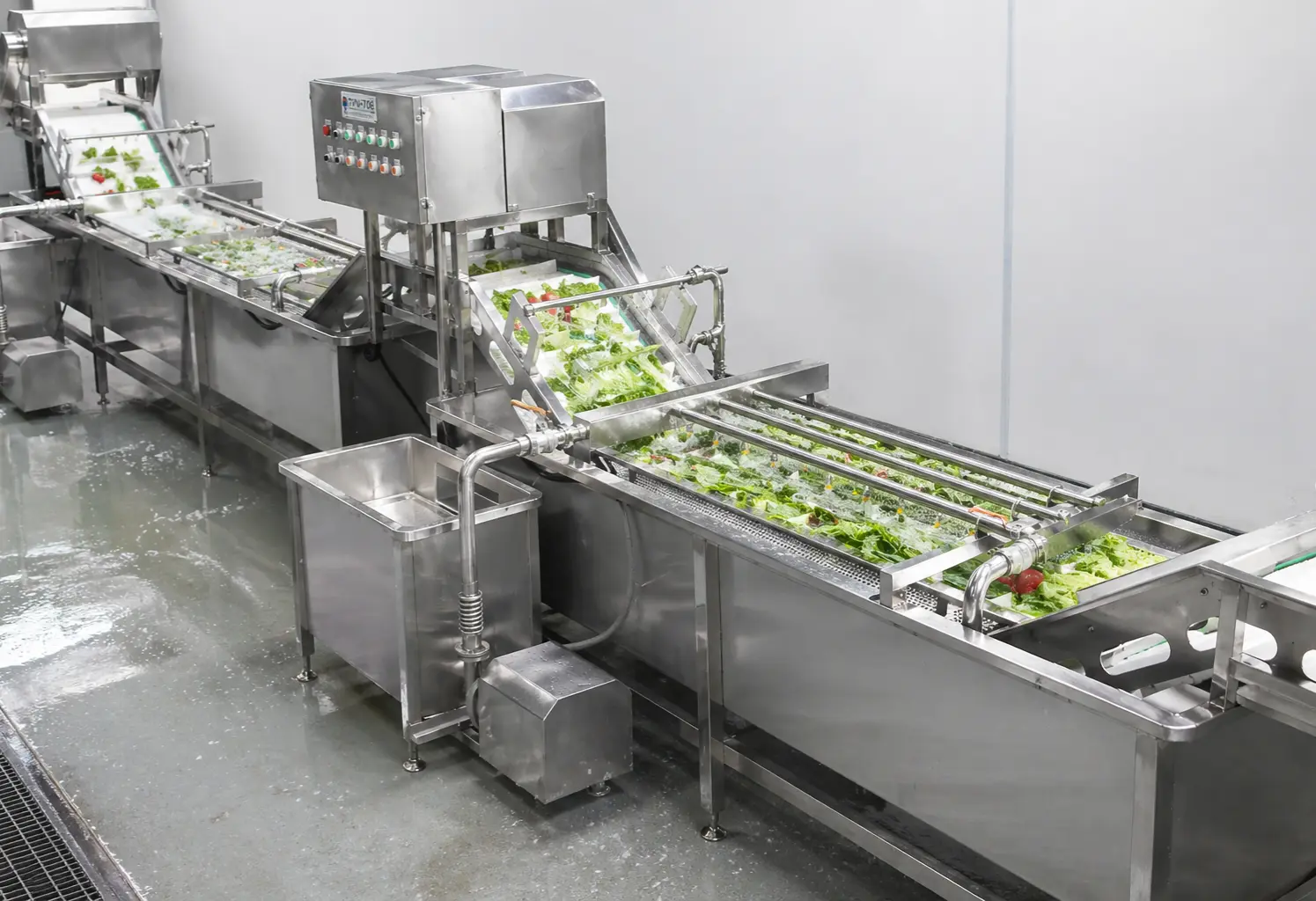
The vegetable dewatering process page provides context for that stage. The RFQ annex should carry your actual assessment conditions. For throughput definitions and stage matching, refer to fresh-cut vegetable line capacity planning; retain here the measurement basis needed to interpret the supplier’s offer.
Make Hygiene Requirements Buyer-Approved Engineering Inputs
The RFQ should translate the buyer’s hygiene program into features and review questions for the proposed leaf route. Relevant inputs include cleaning access, retained leaf material, emptying arrangements, cleaning chemistry compatibility and any specified monitoring interfaces.
FDA’s August 2026 final guidance addresses sanitation, water, drainage and equipment review before purchase. It also discusses product- and system-specific wash-water control validation. For this annex, the practical distinction is between requesting engineering provisions and establishing that the buyer’s process controls are validated.
Worksheet C: Leaf-Route Hygiene Review
| Buyer-approved input | Evidence and owner | Supplier question | Unresolved condition |
|---|---|---|---|
| Cleaning access around leaf-contact areas | Sanitation lead: intended cleaning method and access needs | How are leaf-contact surfaces and retention points accessed? | Access review awaits the proposed arrangement |
| Leaf fragments and wash-system emptying | Operations and sanitation: residue removal requirements | How are retained leaves removed during emptying? | Waste handling and cleaning sequence remain open |
| Leaf-route cleaning chemistry compatibility | Food-safety team: approved chemicals and conditions of use | Which proposed materials and components require compatibility review? | Cleaning program has not been supplied |
| Wash-water dosing and monitoring interfaces | Qualified food-safety lead: approved control requirements | What provisions and documentation can the proposed system support? | Control requirements or validation responsibilities remain open |
Where applicable, U.S. 21 CFR Part 117 addresses sanitary water and drainage, cleanable equipment and monitoring instruments, alongside food-safety planning requirements. Applicability belongs with the customer’s qualified advisers; these are not universal requirements that the machinery supplier can determine for every facility.
Use the FDA fresh-cut produce guidance review checklist for the broader review. Washing does not establish that exposed leaves are microbiologically safe. Equipment trials and supplier documents do not replace customer hazard analysis or required process validation.
Supply Wet-Room Evidence for the Actual Leaf Route
Send a marked layout showing where leaves enter, where product is assessed after dewatering and where it transfers toward packaging. Include the access needed for the intended cleaning and emptying activities. Distinguish measured site information from an architect’s preliminary arrangement.
Utility information should identify the conditions available at the proposed connection points and the operating cases still to be reviewed. For a leafy-salad route, that includes production, filling, emptying, cleaning and restart. A single building-level supply figure does not explain which simultaneous activities it represents.
Worksheet D: Wet-Room and Packaging Interfaces
| Leaf-route condition | Evidence and owner | Supplier question | Unresolved condition |
|---|---|---|---|
| Leaf washer filling and operating water | Site engineering: available supply conditions at connection points | What supply information is needed for each proposed operating case? | Site availability has not been verified |
| Leaf washer emptying and cleaning discharge | Site engineering and sanitation: drainage and solids-handling plan | How will discharge and retained leaf material reach the site system? | Discharge route or receiving capability is unconfirmed |
| Dewatering discharge into packaging feed | Packer supplier: feed position, loading method and control requirements | Can the proposed leaf discharge connect to this receiving arrangement? | Packer interface data are incomplete |
| Stopped packer with leaves upstream | Operations and food-safety team: approved hold and disposition approach | What stops, holds or diverts leaf flow when packaging stops? | Stop-and-restart behaviour is not agreed |
| Cleaning clearance around the leaf route | Site engineering: dimensions, obstructions and maintenance access | Can the proposed equipment be opened, emptied and accessed here? | Room measurements or access requirements remain provisional |
Where discharge is batch-based, ask how each release reaches the downstream receiver and what happens if that receiver cannot accept it. Record who owns the signal exchange and the operating decision. Avoid specifying a buffer solely because two machines have different nominal output descriptions.
Ask for an explicit response to a stopped-packer scenario: the leaf location when the stop occurs, upstream equipment response, operator action and restart boundary. Any permitted product holding conditions belong to the buyer’s approved program, not an assumption embedded in the conveyor quotation.
Decide What Is Ready for an RFQ Release
Incomplete evidence need not stop all supplier discussion. It should determine the status of the requested proposal and the claims that can reasonably be attached to it. Label the overall pack and identify any leaf-family record that has a different readiness status.
Worksheet E: Proposal Readiness Decision
| Release status | Leaf-specific evidence | Owner and evaluation | Proposal consequence |
|---|---|---|---|
| Preliminary concept | Named salad SKUs and intended incoming leaf states; samples incomplete | Buyer product lead confirms intended range; supplier records assumptions | Explore leaf routes and scope with open conditions stated |
| Conditional proposal | Leaf-family records supplied; sample envelope, wet-to-pack method or interfaces partly open | Buyer and supplier assign evidence owners and review outstanding leaf questions | Identify selections and commitments dependent on those answers |
| Confirmed design input | Agreed leaf envelope, measurement handoff and applicable interface evidence | Authorized buyer owners approve the revision; supplier confirms design basis | Use the defined leaf inputs for the agreed design scope |
“Confirmed design input” does not mean guaranteed performance or completed food-safety validation. It means the parties have identified and accepted the information on which the design is being developed. Keep any remaining validation or acceptance activities explicit.
Freeze the leaf-family and sample references used for each proposal revision. If a later SKU introduces a different incoming state, cut description or packaging interface, identify it as a change for review. Do not assume that an earlier sample result automatically covers the expanded range.
Documentation and assistance should also have a defined scope. TEEMYEAH’s technical support information describes project-dependent support activities; the quotation should establish which relevant reviews and deliverables are included.
Download the RTE Salad Processing Line RFQ Template
The workbook has four coordinated sheets for project identification, SKU and accepted-output capacity, hygiene and utilities, layout and project scope, plus a readiness signal that stays open while required inputs are missing.
After completing the workbook, attach it with the product photos, layout or operating records requested on this page. TEEMYEAH will use the submitted inputs to prepare the next defined engineering step; the download itself is not a quotation or validation result.
Frequently Asked Project Questions
Which capacity figure should appear in the RFQ?
Give both daily quantity and the peak accepted-output rate required inside the real production window. State the product condition, cut, stops, changeovers and bottleneck basis.
How many SKUs can share one line configuration?
Group products only when their handling, screens, wash energy, dewatering recipe, cleaning and packing handoff are compatible. The weakest or most delicate product can set the operating limit.
What should be included in the sample pack?
Include normal and difficult material, supplier or harvest variation, photos, dimensions, temperature, cut specification, quantity and an accepted-product example.
How should residual moisture be specified?
Name the buyer’s method, sample location, timing and acceptance rule. Do not use a descriptive phrase such as dry enough for packing without a reproducible check.
Can the RFQ ask the supplier to approve food-safety limits?
No. It should state buyer-approved requirements and ask the supplier to provide compatible equipment and interfaces.

