







Summary
Fresh-cut vegetable line capacity should be sized from the packed product customers will actually accept, not from the tonnes of raw vegetables entering the factory. A useful capacity model begins with accepted packs multiplied by declared net weight, adjusts for daily order peaks and SKU mix, then works backward through packing rejection, giveaway, inspection loss, dewatering or drainage, cutting and trimming, peeling or coring, sorting and raw-material culling.
This distinction matters because one tonne entering a vegetable processing line does not become one tonne of saleable product. Different vegetables, cut specifications, raw-material conditions and quality standards create different mass balances. Washing may temporarily increase measured weight through retained water; later drainage removes part of that weight. Overfilled packs consume acceptable product without increasing declared saleable kilograms, while rejected packs may have passed almost every upstream process before becoming non-saleable.
A defensible sizing model therefore combines yield-adjusted mass balance with net available production time, sanitation, changeovers, breaks, downtime, batch-cycle constraints, packaging cadence, cold holding, quality release and growth requirements. The result is not simply a machine kg/h target. It is an engineering definition of how much acceptable packed product the process must reliably produce under a defined product mix and operating window.
Fresh-Cut Vegetable Line Capacity Starts with Saleable Orders
Capacity discussions often begin in the wrong place. A project team says that the factory needs to process 8 tonnes, 15 tonnes or 30 tonnes of vegetables per day, and equipment selection begins from that raw-input figure. Yet the customer does not normally buy raw-input tonnes. The customer buys accepted bags, trays, food-service packs or bulk containers that meet the required product specification.
The engineering question should therefore be reversed: how much accepted packed product must leave the process, and what must every upstream stage handle to make that possible?
For a central kitchen, fresh-cut processor, food manufacturer or ready-to-eat salad facility, that calculation should normally begin at SKU level. Record the required number of accepted packs, declared net weight, order pattern, peak demand, cut specification and whether the product is ready-to-cook or ready-to-eat. Only after the required saleable output is established should the calculation move backward through packing, inspection, dewatering, washing, cutting, trimming, peeling, coring, sorting and incoming raw material.
This is different from a general equipment capacity verification exercise. Machine verification asks whether a specified machine can sustain a claimed operating rate under defined conditions. Saleable-output sizing asks what rates the machines need in the first place, given the factory’s actual orders and losses.
Begin with the commercial unit that the customer accepts
The most useful starting formula is simple:
Required saleable output = accepted packs × declared net weight
If an order requires 10,000 accepted 250 g packs, required saleable output is 2,500 kg. Packs rejected for seal defects, incorrect weight, appearance problems or another defined non-conformance do not count toward those 10,000 accepted packs.
Daily average demand is rarely enough for design. A restaurant chain, distributor or retail program may create concentrated production days, seasonal peaks or promotional demand. An order peak factor can therefore be applied to the accepted requirement:
Planning saleable demand = base required saleable output × order peak factor
The peak factor must come from the buyer’s order history or planning scenario, not from an arbitrary industry percentage. A factory with stable institutional contracts will have a different profile from one supplying highly variable retail promotions.
Define the Mass-Balance Terms Before Calculating Capacity
Many capacity disagreements are actually measurement disagreements. Receiving records, washing-machine discharge weights, cutting-room output, packaging records and sales data may all use the word “output” while measuring different material states.
A reliable mass balance gives every measurement point a specific definition.
| Mass-balance term | What it means | Where to measure it | Why it matters |
|---|---|---|---|
| Raw input | Vegetables released to production before sorting, culling, trimming, peeling or other preparation losses. | Receiving release, line-entry scale or verified batch weight. | Defines incoming material demand, but does not represent finished capacity. |
| Stage input | Material entering one defined operation, such as cutting, washing or dewatering. | Immediately before the stage where practical. | Used to size that specific operation rather than applying raw-input tonnes to every machine. |
| Gross processed output | Everything leaving a process before downstream acceptance, drainage, inspection or packing losses are fully resolved. | Stage discharge. | Can overstate useful output if retained water, defects or later rejects are included. |
| Acceptable product | Product meeting the relevant process specification and eligible to continue toward packing. | After inspection or quality decision points. | Separates usable product from trim, defects, contamination-related disposition and other losses. |
| Packed net weight | Actual product weight placed into an individual accepted package. | Packaging/checkweighing records. | May exceed declared net weight because of overfill or giveaway. |
| Saleable output | Accepted packs multiplied by declared net weight. | Accepted finished-pack records. | The most useful commercial capacity denominator because it represents product that satisfies the order. |
| Rework | Material formally identified for permitted reprocessing or another defined disposition. | At the point of segregation and re-entry. | Must not silently inflate first-pass yield or hide an unstable process. |
| Waste | Material removed from the saleable stream, such as culls, trim, peel, cores or rejected material that will not return to the process. | Each major rejection or removal point. | Shows where yield is being lost and affects waste-handling capacity. |
| Giveaway | Product placed above declared net weight in accepted packs. | Actual pack-weight distribution. | Consumes processing capacity and product even though it does not increase declared saleable kilograms. |
Why apparent kilograms can be misleading
Fresh-cut production is not always a simple solids-in, solids-out calculation. Washing can leave free or surface water on cut vegetables. A scale positioned immediately after washing may therefore record more mass than a scale after adequate drainage or dewatering. That temporary mass increase does not mean the process has created additional saleable vegetable.
The opposite error occurs when a factory treats all weight leaving dewatering as saleable. Product may still be rejected during final inspection, mixing, packaging or quality checks. Packaging giveaway creates another distortion: if a 500 g declared pack averages 515 g, the line is consuming more acceptable product than the declared saleable output indicates.
Water pickup, drainage, rejected packs and giveaway should consequently be visible in the mass balance rather than buried in one unexplained “yield percentage.” This is also why drainage and dewatering need to be evaluated as process-control and product-condition steps, not merely as equipment capacities.
Work Backward Through Yield, Stage by Stage
Once saleable demand is known, the process can be calculated in reverse. Each stage must supply enough acceptable material for the next stage after its own loss or retention characteristics are considered.
Required accepted processing output = saleable output / packing acceptance yield
For this simplified formula, packing acceptance yield should be defined consistently as declared saleable kilograms divided by acceptable product supplied to packing. That definition can incorporate rejected packages and product consumed as giveaway.
A plant that tracks those mechanisms separately can use the more diagnostic form:
Required packaging feed = saleable output × (1 + giveaway rate) / finished-pack acceptance rate
The same backward calculation applies to every upstream stage:
Stage input = downstream accepted need / stage yield
When the complete process is measured from raw material to accepted declared product:
Total saleable yield = saleable output / raw input
Therefore:
Required raw input = saleable output / total saleable yield
These formulas are deliberately transparent. They prevent a common design shortcut in which one assumed overall yield is applied without identifying where losses occur. A line with the same total yield can have very different equipment requirements depending on whether most loss occurs during initial sorting, cutting and trimming, dewatering, final inspection or packaging.
Yield belongs to a product specification, not just a vegetable name
“Carrot yield” or “lettuce yield” is too broad for detailed capacity planning. Yield may change with cultivar, size distribution, maturity, field condition, storage duration, seasonal quality, incoming defect level, peel specification, core removal, cut geometry and customer acceptance criteria.
The USDA Food Buying Guide illustrates the broader as-purchased versus edible-portion principle and explicitly notes that food condition, storage, handling and preparation equipment can affect yield. Its formal purpose is U.S. Child Nutrition Programs, however, not industrial fresh-cut line design. Its vegetable figures should therefore not be copied into a factory capacity model. Representative plant trials must replace generic table values.
The practical implication is straightforward: measure the raw material that the factory expects to buy and the finished specification it actually intends to sell.
Worked Hypothetical Example: Three SKUs with Different Saleable Yields
The following calculation is an illustrative hypothetical model only. Every number in the table is created to demonstrate the calculation method. The yields, order factors and capacities are not TEEMYEAH guarantees, customer results or universal industry benchmarks.
Assume a processor produces three SKUs: an RTE chopped-leaf product, an RTC diced-carrot product and an RTC shredded-cabbage product. Each experiences different illustrative sorting, trimming/cutting, drainage and packing losses.
| Illustrative SKU | Illustrative stage-yield chain | Total illustrative saleable yield | Saleable kg from equal 1,000 kg raw input | Base accepted-pack order | Illustrative peak factor | Planning saleable output | Illustrative raw input required |
|---|---|---|---|---|---|---|---|
| RTE chopped leaf, 250 g | 93% sorting × 82% trim/cut × 98% wash/drain retention × 98% packing acceptance | 73.2% | 732 kg | 10,000 packs = 2,500 kg | 1.12 | 2,800 kg | 3,823 kg |
| RTC diced carrot, 500 g | 97% sorting × 84% peel/trim/cut × 99.5% downstream retention × 99% packing acceptance | 80.3% | 803 kg | 4,000 packs = 2,000 kg | 1.10 | 2,200 kg | 2,741 kg |
| RTC shredded cabbage, 500 g | 96% sorting × 90% core/trim/cut × 99% downstream retention × 99% packing acceptance | 84.7% | 847 kg | 3,000 packs = 1,500 kg | 1.08 | 1,620 kg | 1,913 kg |
| Mixed-SKU shift total | Weighted by SKU demand | Approximately 78.1% weighted saleable yield | Not meaningful as a simple unweighted average | 17,000 base packs | SKU-specific | 6,620 kg | 8,477 kg |
The equal-input comparison is the key point. Feeding 1,000 kg of each hypothetical raw material does not create equal finished output: the illustrative results range from 732 kg to 847 kg of declared saleable product. A factory designed only around “one tonne of raw vegetables per hour” would therefore have no single answer to how many accepted packs it can produce.
The mixed shift exposes another issue. The illustrative order requires 6,620 kg of planned saleable output but about 8,477 kg of raw vegetables. If the line had seven net processing hours, the shift-wide average raw requirement would be approximately 1,211 kg/h. That number is still not sufficient for equipment selection because individual SKUs do not necessarily share the seven hours equally.
The RTE chopped-leaf campaign may occupy a defined hygiene-controlled production window. Carrot and cabbage may require different cutters, pack formats or changeover procedures. A packaging system may also face 11,200 peak-plan leaf packs, 4,400 carrot packs and 3,240 cabbage packs rather than one homogeneous 6,620 kg flow. Capacity must therefore be checked by stage and by time window, not by dividing the mixed daily tonnes by total shift hours.
Convert Daily Demand into Net-Hour Stage Rates
Daily tonnes become equipment requirements only after the time actually available for processing has been established.
Net available processing hours = scheduled hours − sanitation − changeovers − breaks − planned downtime
A nominal ten-hour shift is not automatically ten production hours. If product-contact equipment requires sanitation before or after a campaign, the time belongs in the capacity model. The same applies to cut-size changes, packaging-film or tray changes, allergen-related controls where relevant, operator breaks that stop the process, scheduled maintenance and other planned interruptions.
The required rate for each stage is then:
Required stage rate = stage input / net available processing hours
Where one stage is available for only part of the net shift, use that stage’s own available hours rather than the line-level figure.
Do not design every critical stage to operate continuously at its theoretical maximum
A process that requires every machine to remain at 100% of its theoretical rate for every available minute has almost no recovery capability. Small raw-material disturbances, operator interventions, inspection stops or packaging delays can cause the shift target to be missed.
Project teams can therefore define a utilization ceiling appropriate to their product risk, operating discipline and trial evidence:
Selected sustainable stage capability ≥ required stage rate / chosen utilization ceiling
There is no universal utilization percentage that should be copied into every project. A chosen ceiling must reflect the real process. A stable continuous conveyor may justify a different planning margin from a batch centrifuge, manually fed cutter or frequently changed packaging machine.
Nameplate Capacity Is Not the Same as Saleable Packed Capacity
Three capacity figures should be kept separate during supplier evaluation. Treating them as interchangeable is one of the fastest ways to oversize one machine while undersizing the complete line.
| Capacity measure | Definition | Useful for | What it does not prove |
|---|---|---|---|
| Nameplate or nominal kg/h | A stated equipment throughput under specified or assumed operating conditions. | Initial machine comparison and screening. | It does not prove sustainable mixed-SKU line output, yield or accepted packed production. |
| Sustainable stage output | The repeatable rate a stage can maintain with the specified raw material, cut size, feed method, operating window and quality requirements. | Line balancing and identifying likely bottlenecks. | It still does not include every downstream loss, package rejection or scheduling constraint. |
| Verified saleable packed output | Accepted packs × declared net weight over a defined production period, linked to the raw input, losses and operating time used to produce them. | Determining whether the complete process satisfies the actual demand case. | One successful run does not automatically validate other seasons, SKUs, pack formats or future demand scenarios. |
A nominal 1,000 kg/h cutter may be entirely adequate if its stage input is only 650 kg/h. Another nominal 1,000 kg/h machine can be insufficient if the product must pass 900 kg/h sustainably but irregular feeding, cut-quality requirements or frequent interruptions prevent that rate from being maintained. The useful comparison is between required stage load and demonstrated sustainable capability under relevant conditions.
For leafy-specific cutting, washing and dewatering interactions, the capacity question becomes more detailed than this article’s whole-factory saleable-output model. Those relationships are addressed separately in the leafy vegetable line capacity matching guide.
Stage Capacity, Buffers and Configuration Must Be Designed Together
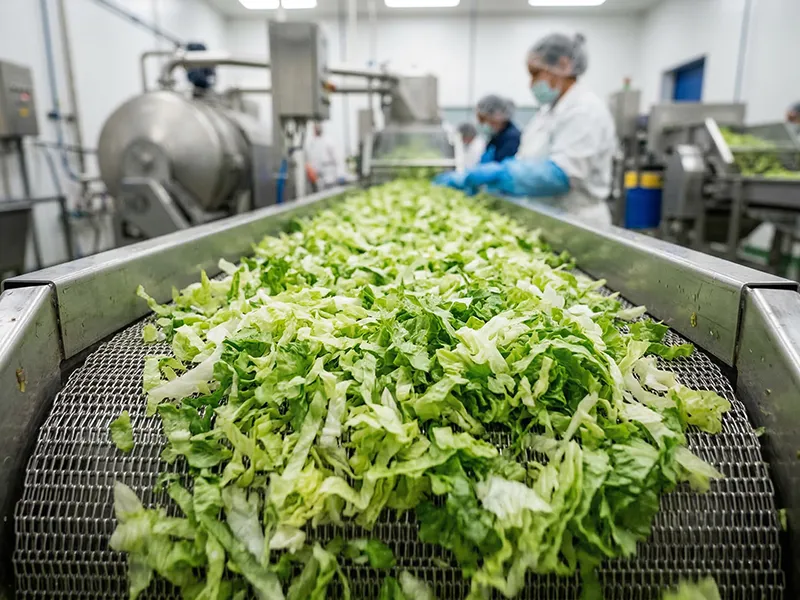
Line balance is not achieved by giving every machine the same kg/h label. Each operation sees a different material state, different required input and sometimes a different time window.
| Stage or decision | Capacity basis | Buffer question | Configuration implication |
|---|---|---|---|
| Raw receiving and sorting | Peak raw input after saleable-yield back-calculation, including realistic incoming-quality variation. | Can incoming bins or inspection stations absorb delivery peaks without forcing poor sorting decisions? | Highly variable raw material may justify flexible manual or semi-automatic grading rather than rigid automation. |
| Peeling, coring, trimming and cutting | Actual stage input by SKU and cut specification. | How much pre-cut or post-cut WIP can be held without creating quality, time or hygiene problems? | Multiple cut sizes may favor modular or parallel preparation equipment over one high-output machine with long changes. |
| Washing or controlled RTE wash steps | Downstream accepted need under the required process-control conditions. | Can upstream surges be buffered without overloading the washer or creating excessive residence time? | Hydraulic flow, product loading and sanitation controls must be considered with throughput; kg/h alone is insufficient. |
| Dewatering or drainage | Wet product entering the stage and required acceptable discharge condition. | How much wet WIP can safely wait if the dewatering step is batch-based? | Parallel batch units or a continuous method may be considered when one cycle-limited stage repeatedly starves packaging. |
| Mixing or recipe assembly | Recipe batch size, component ratios and batches per hour. | Are all components available simultaneously without excessive holding? | Ingredient synchronization may govern capacity even when individual vegetable stages have spare throughput. |
| Packaging | Accepted packs per minute by format plus product required for giveaway and rejects. | Can a controlled cold WIP buffer separate preparation from short packaging stops? | Pack format, changeovers and checkweigher or inspection rejects can make packaging the practical line constraint. |
| Cold holding and quality release | Packed production rate, dispatch schedule and release delay. | How much product may wait for quality release while the line continues running? | Cold-storage and WIP capacity may need to decouple production from QA release and shipping. |
| Sanitation and changeover | Minutes removed from production rather than kilograms processed. | No production buffer can replace required sanitation time. | A configuration that can be cleaned and changed efficiently may deliver more daily saleable output than a larger nominal machine. |
| Maintenance and redundancy | Criticality, expected intervention and recovery consequences. | What happens to upstream and downstream product when one critical stage stops? | Selective redundancy may be more valuable than simply increasing the nominal rating of every machine. |
Batch and Continuous Stages Need Different Capacity Logic
Continuous equipment is often discussed in kg/h, but batch processes require cycle arithmetic. A batch dewatering stage, mixer or other cyclical operation should be evaluated using acceptable product per completed cycle, realistic cycle time, loading and unloading time, fill consistency and any waiting between cycles.
A useful general expression is:
Sustainable batch throughput = acceptable kg per batch × completed production cycles per net hour
If actual batch size varies substantially, average batch throughput alone can hide peak accumulation. The line may deliver the required daily tonnes while repeatedly building wet work-in-process upstream of the batch stage and starving the packer downstream.
Continuous stages create a different risk. A conveyorized washer or cutting system may pass a high instantaneous rate, yet upstream feeding may arrive in waves. A buffer can smooth short disturbances, but excessive WIP should not be treated as free capacity. Fresh-cut vegetables can be time-, temperature- and condition-sensitive, particularly after cutting.
For each major interface, calculate both average accumulation and the credible short-term imbalance:
Accumulation rate = upstream discharge rate − downstream intake rate
If the value is positive, multiply it by the expected duration of the imbalance to estimate the required buffer. The result then needs a process and food-safety review: having enough floor space or totes does not automatically mean the product should be held that long.
RTE and RTC Capacity Cannot Be Treated as One Hygiene-Neutral Tonnage
Ready-to-eat and ready-to-cook products may share some commercial language, but their process risk and control requirements can be different. RTE fresh-cut vegetables are normally intended to be consumed without a later process that would significantly minimize biological hazards. That changes the significance of hygiene zoning, environmental exposure, wash controls, drainage, cold management, equipment cleaning and product handling after cutting.
The U.S. FDA’s August 2026 final guidance addresses ready-to-eat fresh-cut produce within its stated U.S. scope and explains that FDA guidance recommendations are not themselves legally enforceable unless specific regulatory or statutory requirements are cited. Separately, current U.S. CGMP provisions in 21 CFR 117.80 require applicable processing operations, including washing, peeling, trimming, cutting, sorting and dewatering, to be conducted so as to protect food from contamination and allergen cross-contact where applicable.
Those U.S. requirements should not be presented as global law. Outside that jurisdiction, applicable national and local requirements must be reviewed for the actual project.
Codex Alimentarius provides broader international hygienic-practice principles. Its Annex for RTE fresh pre-cut fruits and vegetables addresses cutting controls, cold handling and drainage or drying after washing, among other measures. These principles reinforce an engineering point relevant to capacity: a line cannot simply accelerate a wet process and assume that downstream product condition, hygiene controls and cold management will remain satisfactory.
Where a facility produces both RTC and RTE products, the capacity model should therefore identify whether processing is physically separated, temporally separated under an established program, or handled by dedicated equipment. Sanitation and transition time must be included in net available minutes rather than hidden inside a generic utilization allowance.
For a deeper process-control distinction, see vegetable washing versus sanitizing and the broader fresh-cut vegetable processing guide.
Raw-Material Variability Should Change the Capacity Model
A factory rarely receives identical vegetables for twelve months of the year. Incoming size, leaf damage, soil load, maturity, weather exposure, storage condition and supplier grading can alter both preparation time and usable yield. A project designed from one visually ideal sample risks confusing favorable material with stable process capability.
The capacity brief should therefore contain more than one yield case. A practical structure is:
- Expected case: representative material under normal purchasing conditions.
- Adverse but credible case: a poorer seasonal or supplier condition the operation expects to process commercially.
- Product-specification cases: materially different cut sizes, trim rules, pack formats or recipe combinations.
This does not mean equipment must be selected for every theoretical worst case. It means the commercial and engineering teams should understand what happens when raw quality moves away from the trial condition. Production may need more sorting labor, lower feed rate, additional trimming time, different yield assumptions or a different schedule.
Representative trials should measure every major mass transition
A useful raw-material trial is not just a video showing that vegetables can pass through equipment. Weigh the released raw input, culls, trim, peel or cores where applicable, post-cut product, post-wash and drained product, final inspection rejects, product delivered to packing, rejected packs and accepted saleable output.
Record process time as carefully as mass. The trial should identify actual feeding interruptions, changeovers, batch cycles, cleaning requirements and operator interventions. Cut consistency, product damage and final condition must be evaluated alongside kg/h because excessive throughput that fails the finished specification is not usable capacity.
TEEMYEAH’s role as a food pre-processing equipment supplier and customized food preparation solution provider can support this stage through process-flow discussion, raw-material testing, equipment matching and capacity planning. The project inputs should still come from the customer’s own products, specifications and operating requirements rather than from a generic industry yield assumption.
Packaging Cadence Can Become the Real Capacity Constraint
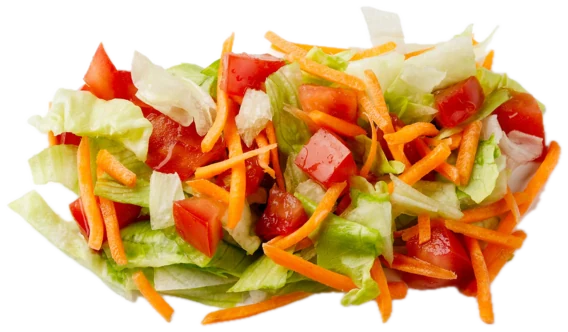
Preparation equipment is often specified in kg/h, while packaging demand is driven by packs per minute. The connection between those units changes with package size.
A line producing 2,000 kg/h into large food-service bags has a very different packaging requirement from a line producing the same kilograms into small retail packs. Mixed formats make the relationship more complex because film, tray, label or recipe changes consume time and may create startup rejects.
For every SKU, calculate:
Required accepted pack rate = required accepted packs / packaging production minutes available to that SKU
Then account for the actual product feed needed to create those accepted packs, including overfill and pack rejection. Checkweigher records are particularly valuable because they can show whether excessive giveaway is quietly consuming finished product.
Packaging should not be protected by uncontrolled accumulation of cut vegetables. If a buffer is required, its capacity, temperature, holding time, hygienic design, FIFO control and traceability need to be part of the process concept.
Cold Holding and Quality-Release Delay Are Capacity Variables
A line can meet its mechanical hourly target and still fail the daily business requirement if accepted product cannot move through cold holding and release quickly enough.
Consider a facility that completes packing faster than its quality-release process or dispatch schedule can clear finished goods. The problem is no longer the cutter or washer; available cold-storage positions become the limiting resource. A similar issue occurs if several production campaigns finish close together and all require temporary refrigerated holding.
Capacity planning should therefore record:
- packed kilograms and pallet or container count by SKU;
- expected time from packing to quality release;
- maximum credible release delay;
- dispatch and loading windows;
- temperature-control requirements under the applicable product plan;
- segregation needs for held, released, rejected or rework product.
For RTE fresh-cut products, the hygiene and temperature implications deserve particular attention. Codex recommends cold-temperature management from cutting through distribution for the RTE pre-cut products covered by its Annex. The required operating conditions must be defined by the facility’s food-safety system and applicable regulatory framework rather than invented during equipment sizing.
Labor Still Belongs in a Saleable-Output Capacity Model
Automation changes where labor is used; it does not make staffing irrelevant. Manual sorting and trimming may control yield. Operators may feed machines, inspect cut quality, move WIP, change product formats, perform sanitation and respond to interruptions. Maintenance and technical support requirements can also increase as the line becomes more integrated.
Useful plant-specific measurements include:
Labor hours per 1,000 kg saleable output = paid direct processing hours / saleable kg × 1,000
Preparation cost per saleable kg = relevant preparation labor and operating cost / accepted saleable kg
These metrics are more useful than simply counting operators because they connect labor to actual accepted output. Recruitment difficulty, training time, turnover and absence should be reflected through real factory records where available rather than through generic assumptions.
Labor variability can also affect yield. If trimming rules are subjective or training is inconsistent, different teams may remove different amounts of acceptable vegetable. Automating a downstream washer cannot repair that variation. The specification for acceptable trim and the method for measuring it must be stabilized before yield-based equipment calculations become dependable.
Reverse Judgment: When More Automation or More Nominal Capacity Is the Wrong Answer
A sound capacity study should be able to recommend less equipment, not only more.
When manual processing can remain rational
Manual preparation may remain commercially sensible when demand is low, seasonal or highly uncertain; SKU variety is high but individual volumes are small; incoming vegetables require substantial judgment-based trimming; product specifications change frequently; or the operation is still validating its market.
Manual work can also be strategically useful in inspection and final trimming even within an automated line. The relevant comparison is not “manual versus modern.” It is whether the process can meet the required saleable output, consistency, hygiene controls, ergonomics, labor availability and cost under the actual business conditions.
When semi-automatic processing is a better intermediate step
A central kitchen or growing processor may benefit from automating repetitive washing, cutting, conveying or dewatering while retaining manual grading, trimming, recipe assembly or inspection. This can reduce one bottleneck without forcing the factory to standardize every product around one integrated line before volumes justify it.
Phased automation is especially useful when demand growth is real but the future SKU mix remains uncertain. The line concept should preserve logical interfaces for later expansion rather than buying unnecessary capacity immediately.
When a smaller modular line can be better than one large line
One high-output line can look efficient on a spreadsheet yet become inflexible when several small SKUs compete for production time. A smaller modular configuration can sometimes reduce changeover exposure, simplify scheduling or let production capacity expand in stages.
The decision depends on the mass balance and time balance. If the largest SKU genuinely dominates demand and has stable specifications, a larger dedicated line may be rational. If demand is fragmented among many products with incompatible cut, hygiene or packaging requirements, flexibility can be worth more than maximum nominal throughput.
When parallel lines are justified
Parallel lines or parallel critical stages become worth evaluating when one production stream must remain independent from another, simultaneous SKU production materially improves scheduling, one stage is a single-point failure with unacceptable business consequences, or batch-cycle constraints make one large unit impractical.
Parallel equipment is not automatically better. It adds floor-space, sanitation, utilities, maintenance and control requirements. The justification should come from production scenarios and downtime consequences, not from a generic preference for redundancy.
What extra nominal capacity cannot repair
A larger machine cannot compensate for unstable incoming quality, inconsistent trimming rules, weak washing controls, inadequate drainage or dewatering, a packaging bottleneck, poor SKU scheduling, excessive WIP, insufficient cold holding or unrealistic sanitation windows. It may only move the bottleneck elsewhere faster.
Automation can also introduce new risks: faster propagation of upstream defects, greater dependence on maintenance, more complicated cleaning, accumulation when interconnected machines stop at different times, and a false assumption that a nominal rate guarantees compliant finished product.
Use a Sustained-Capacity Acceptance Test, Not a Short Peak Run
Once a preliminary configuration has been selected, the original saleable-output model should become part of testing and acceptance planning.
A meaningful sustained-capacity test defines:
- representative raw-material condition;
- SKU and cut specification;
- pack format and declared net weight;
- planned raw input;
- measured losses at relevant stages;
- net production period;
- changeover and planned stop treatment;
- product-quality acceptance criteria;
- accepted finished packs;
- giveaway and packaging rejection;
- rework treatment;
- saleable packed kilograms achieved.
The test should distinguish instantaneous peak throughput from sustainable output. Passing a short burst through one machine does not demonstrate a mixed-SKU shift. Conversely, a line does not need every machine to show the same kg/h value if the stage mass balances prove that each has sufficient sustainable capability.
This article provides the demand-side engineering brief. Product-specific testing, facility design and final supplier evaluation remain separate project steps.
A Practical Capacity Brief for a Fresh-Cut Project
Before requesting an equipment configuration, collect enough information to describe the process in commercial, mass-balance and time terms.
- List every important SKU and identify it as RTE or RTC.
- Record accepted packs per day and declared net weight for each format.
- Define realistic order peaks and production-day patterns.
- Document finished-product specifications, including cut size, trimming and acceptance rules.
- Measure representative raw input and stage losses rather than assuming one generic yield.
- Track overfill, package rejection, rework and waste separately.
- Map the required process flow and identify each stage input.
- Calculate sanitation, changeover, breaks and planned downtime to obtain net available minutes.
- Convert stage inputs into sustainable hourly or batch-cycle requirements.
- Check packaging cadence, WIP accumulation, cold holding and quality-release delays.
- Evaluate maintenance criticality, selective redundancy and recovery after stops.
- Run current and growth demand scenarios before final equipment selection.
This information provides a stronger basis for discussing a fresh-cut vegetable processing project than a request for “a 2,000 kg/h line” without defining what those kilograms represent.
Facilities focused on RTE salads can also review the RTE salad processing line context, while projects requiring broader or non-standard process combinations may need a custom food pre-processing line concept.
Calculate Required Saleable Output Before Selecting Equipment
If you are evaluating a new fresh-cut line or upgrading an existing preparation area, begin with the accepted product you need to ship. Prepare your SKU list, pack weights, daily and peak orders, representative raw-material information, cut specifications, current yield measurements, available production hours, sanitation requirements and layout or utility constraints.
TEEMYEAH can use those inputs to discuss a preliminary process recommendation, equipment configuration, capacity matching approach and line concept. Where representative products are available, raw-material testing can help replace provisional yield assumptions with measured stage data.
The objective is not to select the largest machine. It is to configure a process in which each stage can support the required accepted packed output without creating unnecessary oversizing, hidden bottlenecks or unrealistic operating assumptions.
FAQ
1. How should fresh-cut vegetable line capacity be calculated?
Fresh-cut vegetable line capacity should start with the accepted packed product required by the order. Calculate accepted packs multiplied by declared net weight, apply a realistic peak-demand scenario, and then work backward through packing acceptance, giveaway, inspection, drainage or dewatering, cutting and trimming, peeling or coring, sorting and raw-material losses. Convert the resulting stage loads into rates using net available processing time rather than scheduled shift length. This produces separate raw-input, stage and saleable-output requirements instead of assuming that one machine kg/h figure represents the whole line.
2. Why is raw-input capacity a poor basis for sizing a fresh-cut line?
Raw input includes material that may never become a saleable pack. Soil-related culling, damaged leaves, peel, cores, trimming, cutting losses, inspection rejects, packaging rejects and other dispositions reduce the amount that reaches customers. Different products also have different yields, so equal raw tonnes can create different finished output. Raw-input capacity is still important for receiving, sorting and upstream stages, but it should be calculated from the required saleable output rather than used as the only line-capacity target.
3. How do I calculate total saleable yield?
Total saleable yield is calculated as saleable output divided by raw input. Saleable output should use accepted packs multiplied by declared net weight, while raw input should represent product released into the defined process. For diagnostic work, also calculate yield at individual stages so that sorting, trimming, cutting, washing or dewatering, inspection and packing losses are visible. A single overall yield percentage can tell you how much raw material is required, but stage yields are needed to size equipment and identify where the process is losing usable product.
4. Should packaging giveaway be included in the capacity calculation?
Yes. Giveaway consumes acceptable product even though the extra grams do not increase declared saleable output. If accepted 500 g packs average more than 500 g, the preparation process must supply enough additional product to cover that overfill. A detailed calculation can therefore use saleable output multiplied by one plus the giveaway rate, then adjust for packaging rejection. Checkweigher data is useful because it separates actual packed mass from declared commercial output. Ignoring giveaway can make the preparation line appear more productive than it is commercially.
5. How should sanitation and changeover time affect line sizing?
Sanitation and changeovers should be deducted from scheduled production time before kg/h requirements are calculated. If a ten-hour shift contains cleaning, SKU changes, packaging changes, breaks and planned maintenance, the line does not have ten available processing hours. Each critical stage may also have a different available window. This is especially important where RTE and RTC campaigns require separation or defined sanitation procedures. Increasing machine capacity does not create additional daily output if the real constraint is insufficient operating time between required cleaning and changeovers.
6. How should batch dewatering equipment be included in line balance?
Batch equipment should be calculated from acceptable kilograms per completed batch and the realistic number of cycles that can be completed during net production time. Include loading, processing, unloading and any waiting between cycles. Average kg/h alone can hide accumulation: upstream washing may continue while a batch dewatering unit is occupied, causing wet WIP to build, followed by periods when packaging is starved. The design should evaluate cycle synchronization, buffer limits and whether parallel batch units or another process configuration is justified.
7. Should RTE and RTC vegetable products share one capacity calculation?
They can appear in one factory demand model, but they should not automatically be treated as one hygiene-neutral tonnage. RTE products may require different zoning, sanitation, washing controls, drainage, cold management and handling because they are intended to be eaten without a later step that significantly minimizes biological hazards. If RTE and RTC production use separate equipment or different production windows, calculate their available minutes and stage capacities separately. The final arrangement must align with the facility’s food-safety plan and applicable local regulatory requirements.
8. When is a smaller modular line better than one large line?
A smaller modular configuration can be preferable when production contains many low-volume SKUs, demand is still developing, changeovers dominate the schedule, different processes need to operate independently, or phased investment is commercially more sensible. One large line may be better when a stable high-volume SKU dominates demand and the process is highly repeatable. The comparison should include net daily saleable output, flexibility, sanitation time, packaging requirements, floor space, maintenance and future expansion—not only nominal machine kg/h.
9. What should a representative capacity trial measure?
A useful trial should measure representative raw input, major culls and trim, stage outputs, drained or dewatered product, inspection rejects, product sent to packaging, giveaway, rejected packs and accepted saleable output. It should also record production time, interruptions, batch cycles, operator interventions and product changes. Finished cut quality and product condition need to be checked alongside throughput. Trials should use representative raw material and required cut specifications; an ideal sample or short peak run is not sufficient evidence for sustained factory capacity across seasons and SKUs.
10. Does this sizing method provide a guaranteed quotation or validated process?
No. This method is an engineering brief for defining capacity and configuration requirements. It is not a guaranteed quotation, validated yield, food-safety plan, regulatory approval or proof that a proposed line will achieve a particular result. Final design requires representative raw-material trials, confirmed SKU and package specifications, review of the applicable food-safety plan and local regulations, layout and utility assessment, detailed equipment selection and sustained-capacity acceptance criteria. Commercial guarantees, if any, must be defined separately in project-specific technical and contractual documents.
Data and Source Note
This article uses public regulatory and technical references to establish definitions, hygienic context and the principle that preparation yield depends on product and process conditions. No public-source yield value has been used as a TEEMYEAH capacity claim or as a universal design benchmark.
- U.S. Food and Drug Administration — Guidance for Industry: Guide to Minimize Biological Hazards in Ready-to-Eat Fresh-Cut Produce, final guidance, August 2026. Used for the current U.S. definition and processing context of RTE fresh-cut produce. The document itself states that FDA guidance describes recommendations rather than independently creating legally enforceable responsibilities unless specific regulatory or statutory requirements are cited. Its scope is U.S. RTE fresh-cut produce as described in the guidance.
- Electronic Code of Federal Regulations — 21 CFR 117.80, Processes and Controls, current text reviewed August 2026. Used for U.S. CGMP context concerning raw-material handling, washing, equipment sanitation, work-in-process protection, and operations including peeling, trimming, cutting, sorting and dewatering. These are U.S. requirements for operations within the rule’s applicable scope and should not be presented as global legal requirements.
- FAO/WHO Codex Alimentarius — Code of Hygienic Practice for Fresh Fruits and Vegetables, CXC 53-2003, revised through 2017, including Annex I for Ready-to-Eat, Fresh, Pre-Cut Fruits and Vegetables. Used for international GHP context covering contamination control, cutting-edge condition, drainage or drying after washing, refrigeration and waste management. Codex principles do not provide plant-specific capacity or yield guarantees.
- USDA Food and Nutrition Service — Food Buying Guide for Child Nutrition Programs, Vegetable Resources. Used for the conceptual distinction between food as purchased and edible/prepared portions and for USDA’s warning that food condition, storage, handling and preparation equipment can affect yield. Its formal scope is U.S. Child Nutrition Programs, so its foodservice yield information should not be transplanted into industrial equipment sizing.
- USDA Food and Nutrition Service — Food Buying Guide, Section 2 Vegetables and Vegetable Yield Table. USDA’s download resource reports the Section 2 vegetable yield table as updated June 8, 2026, while the explanatory Section 2 guidance text carries an earlier update date. The material is used only to illustrate preparation-yield methodology; representative factory trials must replace generic foodservice table values for production-line design.
All numerical yields, stage losses, peak factors, pack quantities, raw-input requirements and mixed-SKU calculations in the worked example are illustrative hypothetical figures created solely to explain the sizing method. They are not TEEMYEAH project data, customer results, guaranteed capacities, regulatory limits or industry benchmarks.
This sizing framework is an engineering brief, not a guaranteed quotation, validated yield study, food-safety plan or regulatory approval. Final project design requires representative raw-material trials, confirmed SKU and pack specifications, local regulatory review, alignment with the facility’s food-safety plan, layout and utility review, equipment-specific engineering and sustained-capacity acceptance testing.
Editor-Only Research Source Verification
U.S. FDA — Guidance for Industry: Guide to Minimize Biological Hazards in Ready-to-Eat Fresh-Cut Produce, final, August 2026. FDA defines the covered fresh-cut and RTE context and states that guidance recommendations are not independently legally enforceable unless specific requirements are cited.
FDA final guidance page
Electronic Code of Federal Regulations — 21 CFR 117.80, Processes and Controls. Current text covers appropriate raw-material handling, safe washing water, sanitation, WIP/rework protection, contamination protection and processing steps including peeling, trimming, cutting, sorting and dewatering.
21 CFR 117.80
FAO/WHO Codex Alimentarius — Code of Hygienic Practice for Fresh Fruits and Vegetables, CXC 53-2003, revised through 2017. Annex I addresses RTE fresh pre-cut produce; the text includes cold-temperature management, cutting-control principles and drainage/drying after washing.
Codex CXC 53-2003 PDF
USDA Food and Nutrition Service — Food Buying Guide for Child Nutrition Programs: Vegetables. USDA states that vegetable yields may be affected by food quality and condition, storage, handling and preparation equipment. Its formal context is foodservice and Child Nutrition Programs, not industrial processing-line guarantees.
USDA Vegetable Resources
USDA Food and Nutrition Service — Food Buying Guide, Section 2 Vegetables. The explanatory section documents As Purchased and Edible Portion concepts. USDA’s download page separately reports the Section 2 Vegetable Yield Table as updated June 8, 2026.
USDA Section 2 Vegetables PDF
USDA Food Buying Guide download page

