




Summary
RTE salad washing stages should be chosen by function, product condition, soil or organic load, water separation, monitoring needs and accepted output. One tank can be appropriate when it performs a defined duty and the product is suitable; two or more stages become useful when the process must separate heavy debris removal, a controlled wash, and a final rinse or handoff. Tank count alone does not prove safety. Buyers should map product and water movement, define the purpose and limits of each stage, and verify the result with representative material. Send product photos, cut state, throughput, wash-water inputs and downstream dewatering requirements for a TEEMYEAH trial and configuration discussion.
Salad Washing Stages Should Be Defined as Functions
The three headings below—pre-wash, controlled wash and final rinse—are best treated as functional categories. They are not a mandatory three-tank architecture and should not be copied mechanically into every RTE lettuce wash process.
A site may divide one function across several modules. Another may combine compatible functions within one engineered system. A final rinse may be required in one process but not appropriate or necessary in another. Existing validated stages should not be removed or bypassed merely to make a line fit a simplified diagram.
| Function | Main process question | Typical output definition | Review emphasis |
|---|---|---|---|
| Pre-wash | What should be removed or reduced before controlled washing? | Product enters the next stage with the specified gross soil and debris condition | Soil release, debris separation, product loading and carryover |
| Controlled wash | Which water and process conditions require defined control? | Product leaves under the site-approved wash conditions | Water condition, treatment controls where applicable, exposure and ownership |
| Final rinse | Does the product/process require a defined post-wash rinse? | Product meets the approved downstream handoff condition | Lawful use instructions, water quality, carryover and downstream requirements |
The value of this framework is that it forces the project team to define what changes from one function to the next. When that change cannot be described, the stage may be poorly defined, unnecessarily duplicated or carrying responsibilities that belong elsewhere.
Pre-Wash: Define What Must Be Removed Before Controlled Washing
Pre-wash is often described casually as the first wash, but its process purpose should be stated more precisely. In many applications, the useful question is whether an initial step is needed to release or remove visible soil, loose plant material, field debris or other gross contamination before product reaches a more controlled washing environment.
Australian FSANZ guidance for relevant primary processors distinguishes washing from sanitising and notes that washing removes visible dirt, while residual dirt can affect the effectiveness of subsequent sanitizer use. That does not establish a universal multi-stage recipe, but it supports a practical engineering principle: a heavily soiled incoming product should not be treated as though every downstream water zone has the same job.
For a pre-wash function, the responsibility register should record the incoming product state rather than relying only on the product name. “Romaine lettuce” is not enough. The design team should ask what the expected incoming condition actually is: whole or cut, field soil present or not, loose leaves, damaged material, root-end debris, variable seasonal loading, and whether sorting or trimming has already occurred.
The output should also be observable. That does not mean inventing a universal cleanliness threshold. It means agreeing on what the plant expects to see before product progresses. For example, the register might state that gross debris should be removed to the degree required for the defined downstream wash step to operate under its intended conditions, with deviations escalated according to the site’s own food-safety and operating procedures.
Mechanical configuration follows from that definition. Bubble action, vortex movement, showers or sprays can perform different roles depending on product and process. The purpose should therefore be decided before selecting the hardware arrangement, rather than assigning a purpose after the machines have already been chosen.
Controlled Wash: Separate Water Control From a Claimed Kill Step
The controlled wash function is where terminology often becomes misleading. “Sanitizing tank,” “sterilization wash” or similar labels can imply an outcome that the process has not established.
FDA’s August 2026 guidance for RTE fresh-cut produce makes an important distinction: controlling wash-water cross-contamination is not the same as establishing a kill step for pathogens attached to or internalized in produce. The guidance also emphasizes that substances used in processing must be lawful for the intended use and applied under applicable conditions of use.
For a responsibility register, that distinction changes the questions the team should ask. Instead of beginning with “Which chemical should Tank 2 use?”, define:
- What product condition enters this controlled wash function?
- What water condition is intended to be maintained?
- Which treatment-related parameters, if any, are part of the approved process?
- Which instruments or observations are relevant to those controls?
- Who is authorized to assess a deviation?
- What happens to product movement if the controlled condition is not met?
The article on vegetable washing versus sanitizing covers the broader distinction between mechanical washing and wash-water treatment. The stage register should not reproduce a generic chemistry comparison. Its job is to document what the particular site’s approved process expects from this function.
In the United States, applicable provisions of 21 CFR Part 117 address matters including safe and adequate sanitary quality of food-contact water, plumbing that avoids contamination, cleanable equipment, relevant instruments that are accurate and maintained, and conditions under which washing, rinsing or conveying water may be reused. Those provisions do not create a universal number of wash tanks or a single process recipe. Applicability and implementation remain site-specific legal and food-safety questions.
Final Rinse: Make the Decision Explicit Instead of Assuming It
A final rinse is a particularly important example of why stage architecture should not be copied from another line.
Research literature has discussed pre-washing and final rinsing as possible elements in fresh-cut washing strategies, including in the 2009 review by Gil, Selma, López-Gálvez and Allende. The review also distinguishes issues related to microbial water quality and transfer risk from direct produce-surface decontamination. That research context does not make a final rinse universally required, nor does it validate a particular machine sequence.
The plant should therefore mark the final-rinse decision as either defined or pending qualified review. A pending decision is preferable to an unsupported assumption.
The review should consider the actual processing substance or treatment being used, its authorization and conditions of use, the product, the destination jurisdiction, customer requirements where applicable, and the site’s validated or approved process. If an existing process includes a required rinse, an equipment redesign should not bypass that step merely because a different supplier layout omits it.
Where a final rinse is used, its handoff should be defined just as carefully as the earlier functions. The team should know what water source serves it, what upstream carryover can enter it, what the product should look like when leaving, and what downstream step receives the product.
Define Water Movement, Not Just Product Movement
Most process diagrams make product flow obvious: lettuce moves from left to right. Water movement is often much less clear.
That omission matters because water may be supplied independently, recirculated within a module, transferred between sections, discharged, filtered or reused under defined conditions. The stage map should therefore have a water-flow layer alongside the product-flow layer.
A useful review asks where water enters, where it leaves, what may move upstream or downstream, and whether two mechanically separate sections truly have independent water circuits. Separate pumps alone should not be interpreted as proof of chemical or microbiological separation.
For example, the TW-475 four-stage washing line is described with independent stainless-steel vortex pumps, adjustable water movement and wash time, hydraulic tilting transfer, and a possible downstream-to-upstream water-reuse arrangement. Those are mechanical configuration characteristics. A project team still needs to determine how an actual site’s water-control responsibilities should be assigned.
This distinction is especially important when a project intends to reuse water. Under applicable U.S. requirements, reuse cannot be treated as a generic sustainability feature without considering whether it could increase food contamination or cause allergen cross-contact. Engineering drawings should therefore show the intended direction and boundaries of reuse clearly enough for the site’s qualified team to review them.
When Not to Add Another Washing Stage
Adding a vessel can feel like a straightforward response when the current process is unclear. It may be appropriate, but ambiguity should be investigated before hardware is added.
Do not add a stage merely because a competing proposal has more tanks, because a generic diagram shows three washing steps, or because the existing team’s responsibilities have not been documented. A new stage should solve a defined process need.
Reasons to pause the addition include:
- The intended function duplicates an existing stage without a defined difference in output.
- The actual problem is excessive incoming soil or inadequate upstream trimming, sorting or debris management.
- The proposed stage has no defined water source, discharge logic or ownership.
- The team has not resolved whether the issue is mechanical washing, wash-water control or downstream handling.
- A proposed final rinse has not been reviewed against the actual treatment’s lawful conditions of use and site requirements.
- The change could conflict with an existing validated process.
Conversely, one function may legitimately require several mechanical modules when product handling, debris separation, transfer or water management makes that configuration necessary. The correct design question is not “How many tanks should a salad line have?” but “What functions must the process perform, and what configuration can perform them under the site’s defined conditions?”
Connect Washing Decisions to Preparation and Dewatering
Washing-stage design should not stop at the washer boundary. The input condition is determined partly by preparation, while the downstream handoff affects dewatering and later processing.
A whole-head product, trimmed leaf and freshly cut leaf may enter washing with different physical characteristics and soil or cut-surface conditions. Likewise, the amount of free water transferred from the final washing function can affect the demands placed on the next operation.
For that reason, an RTE salad processing line review should connect preparation, washing, transfer and downstream moisture removal rather than optimizing each machine independently. Where the process continues into centrifugal, vibratory or other moisture-removal steps, the separate vegetable dewatering process should be evaluated using the actual product and required downstream condition.
This does not mean every project needs a complete new line. It means the stage responsibility register should identify the interfaces that remain important even when only one washing module is being replaced or inserted.
What a Supplier Needs From the Stage Register
An equipment supplier does not need to take over the customer’s hazard analysis to benefit from a better process definition. The register gives the supplier clearer engineering inputs.
Useful information includes product type and preparation state, expected incoming debris or soil condition, required handling gentleness, the purpose of each washing function, water-flow boundaries, transfer requirements, whether approved sprays or rinse functions are required, accessible observation needs, and the downstream product condition expected before dewatering or further processing.
The supplier can then review suitable washing mechanisms, transfers, filtration arrangements, pump configuration, water-routing options and control interfaces without presenting a generic machine sequence as a universal food-safety solution.
This is the appropriate point to review the broader vegetable washing process options and determine which mechanical configuration supports the site’s defined process responsibilities.
When One, Two or More Tanks Make Sense
| Configuration | When it can make sense | Evidence to confirm |
|---|---|---|
| One defined washing stage | Incoming product is controlled, debris load is manageable and one water circuit can meet the specified mechanical duty. | Representative product travel, debris removal, water observations, accepted output and downstream condition |
| Two stages | The process benefits from separating heavy debris removal from a controlled wash, or from protecting the later water condition. | Independent stage purpose, water circuit and transfer behavior; monitoring locations and trial results |
| Three or more stages | Different products, heavy organic load, a buyer-defined final rinse or capacity/residence constraints justify additional functions. | A written reason for each stage, separate water movement, line balance, cleaning workload and buyer-owned control plan |
| Parallel tanks or lines | Peak throughput or product segregation requires capacity that cannot be achieved by adding serial residence time. | Feed split, synchronization, controls, staffing, cleaning and recombination rules |
The former tank-count page contributed this configuration decision and the warning that physical separation can be defeated by shared water, splash, tools or uncontrolled transfers. Its useful content has been consolidated here so one page owns the RTE stage-and-tank decision.
TEEMYEAH Washing Equipment Evidence
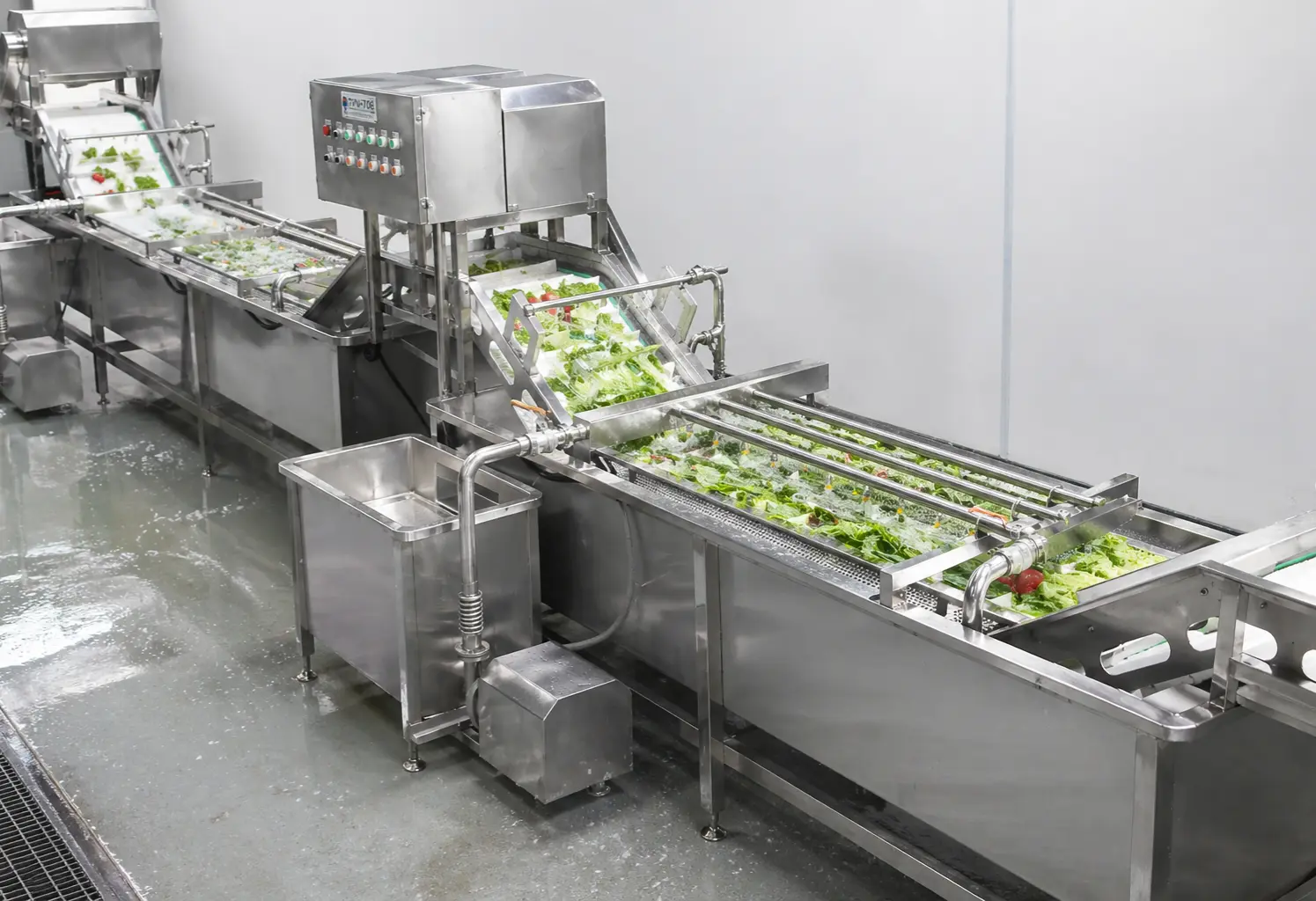
TW-705 is documented as a long-path salad washing line combining bubble, vortex and shower/rinse washing with a sand-settling zone, vibratory filtering discharge, waste collection, circulating-water filtration, adjustable wash time and PLC control. A clean-water spray can be switched on or off, and sanitary quick-release pipework supports cleaning access. Those features describe equipment functions; they do not prove a microbiological result. TW-475 is presented as a multi-tank option on the website, but the current internal evidence set does not support publishing universal tank purpose, sanitizer or capacity claims. TEEMYEAH therefore confirms the required stages from the submitted product, water and trial inputs.
Frequently Asked Project Questions
When should a second wash tank be added?
Add it when the second stage has a distinct, measurable duty and a separate water or transfer condition that improves the specified product outcome.
Can a four-tank line be compared with a two-tank line by tank count?
No. Compare stage purpose, residence, product load, water movement, filtration, monitoring, transfers, accepted output, cleaning and evidence from the same product.
Which product inputs affect stage selection?
Provide whole or cut state, leaf type, soil and foreign-material load, temperature, hourly rate, damage sensitivity and required condition before dewatering or packing.
How should wash-water inputs be submitted?
State water source and quality, circulation or single-pass plan, filtration, monitoring parameters and locations, make-up rate and the buyer-approved control and corrective-action ownership.
Does a factory trial validate food safety?
A trial can measure mechanical handling, debris removal, flow, damage, output and handoffs. The buyer’s qualified team must define and validate the food-safety process.

