







Summary
A leafy vegetable processing line configuration for a nominal planning target of 500 kg/h should not simply be a smaller version of a 1,000 or 2,000 kg/h line. At around 500 kg/h, modular or semi-automatic equipment can remain commercially sensible because product flexibility, manual trimming and frequent SKU changes may matter more than continuous flow. Around 1,000 kg/h, the project usually becomes more sensitive to line balance, automated transfer, wash residence time, buffer control and dewatering cycle capacity. At a 2,000 kg/h planning target, parallel equipment, duplicated critical stages, controlled WIP and stronger process integration often become necessary because a single cutter, washer or batch dewatering unit may not sustain the required saleable output across a real production shift.
These figures are planning targets, not guaranteed TEEMYEAH machine or complete-line outputs. Actual sustainable saleable output depends on the crop, incoming condition, trimming and yield loss, cut specification, washing method, water management, dewatering cycle, inspection criteria, packaging, sanitation, changeovers, uptime and SKU mix. Buyers should therefore compare configurations against a defined product and acceptance basis rather than purchasing a collection of machines whose catalogue capacities happen to show similar kg/h values.
Why 500, 1,000 and 2,000 kg/h Require Different Line Architecture
Consider three factories that all process lettuce. One central kitchen needs several cut formats across a changing daily menu. A fresh-cut processor supplies a relatively stable group of foodservice SKUs. A large RTE salad factory may run long production campaigns feeding downstream weighing and packing systems. Although all three operations can describe their process as cutting, washing and dewatering leafy vegetables, their correct equipment configurations may be very different.
The reason is that capacity is not merely a machine-selection question. It is an architecture question. A line must move enough acceptable material through every stage while allowing for biological raw-material variation, operator interventions, sanitation, product transitions and downstream constraints.
A planning tier is therefore most useful when it answers five questions:
- How much saleable product must leave the line during the defined production period?
- How much raw material must enter to support that output after trimming, rejects and other losses?
- Which stages are continuous, which are batch operations and which still depend on manual work?
- Where can material wait safely without damaging product quality or disrupting hygienic flow?
- Which stage becomes the real bottleneck when the factory processes its difficult products rather than its easiest test SKU?
This article focuses on those configuration differences. For the broader process sequence from preparation through cutting, washing and dewatering, see the leafy vegetable processing guide. For detailed calculations on matching individual processing stages, the separate line capacity matching guide addresses that subject in greater depth.
Define the Capacity Basis Before Discussing Equipment
Before a supplier proposes a cutter, washer, dewatering system or complete vegetable processing line, the buyer should define what “500 kg/h,” “1,000 kg/h” or “2,000 kg/h” actually means.
A useful procurement definition is:
Required capacity = accepted saleable finished product produced per clock hour under agreed operating conditions.
That definition is more demanding than a machine’s instantaneous feed rate. It forces the project team to specify whether the capacity calculation includes ordinary pauses, operator intervention, product inspection and predictable operational losses.
The distinction becomes particularly important for leafy vegetables because kilograms change meaning as the product moves through the process. Whole heads may lose cores and damaged leaves. Cutting generates fragments and off-spec pieces. Washing adds surface water temporarily. Dewatering removes part of that retained water. Inspection may reject additional product. Packaging may impose another throughput ceiling.
The project’s capacity specification should therefore distinguish among:
- Raw input: vegetables entering the preparation process.
- Prepared input: material remaining after sorting, coring and trimming.
- Wet processed output: product leaving washing before final moisture removal.
- Accepted saleable output: finished product meeting the buyer’s defined quality and packing criteria.
This is also why a nominal 1,000 kg/h target cannot be converted directly into a requirement that every machine must carry a “1,000 kg/h” catalogue rating. Different stages handle different material conditions and operate on different time bases.
Three-Tier Leafy Vegetable Processing Line Configuration
The following table is a planning framework rather than a fixed TEEMYEAH equipment package. A real configuration must be confirmed against representative vegetables, finished specifications, production scheduling and factory conditions.
| Decision Area | 500 kg/h Planning Tier | 1,000 kg/h Planning Tier | 2,000 kg/h Planning Tier |
|---|---|---|---|
| Typical commercial context | Central kitchen, foodservice supplier, smaller fresh-cut facility, new automation project or multi-SKU operation | Established fresh-cut processor, larger central kitchen, RTE/RTC operation or growing food manufacturer | Industrial fresh-cut operation, high-volume RTE facility, large foodservice supply center or major capacity expansion |
| Primary planning assumption | Flexibility may be as important as continuous flow | Balanced sustainable throughput becomes a central design requirement | Redundancy, parallelization and control of interfaces become increasingly important |
| Preparation | Manual or assisted trimming and inspection may remain practical | Structured preparation stations with controlled feeding and defined staffing | Multiple preparation positions, controlled infeed and potentially parallel product routes |
| Cutting logic | One flexible cutter may suit many projects if changeovers and actual feed are acceptable | One appropriately verified cutter may work, but parallel or dedicated cutting can be justified by SKU mix or changeover pressure | Parallel cutters or dedicated cut routes may be required when one unit cannot cover peak feed, multiple geometries or changeovers |
| Washing logic | Compact continuous washing or staged/batch-oriented washing may both be reasonable | Integrated continuous or multi-stage washing commonly becomes easier to balance with the rest of the line | Large continuous wash architecture, parallel washing lanes or duplicated stages may be required depending on residence time and product loading |
| Dewatering logic | Batch centrifugal dewatering may remain commercially practical if full cycle capacity is adequate; parallel units can reduce waiting | Automated centrifugal, continuous moisture-removal methods or parallel batch units should be compared through cycle calculations | Dewatering must be demonstrated at sustained wet-product feed; automated or multiple parallel units may be necessary |
| Transfer | Manual tubs, short conveyors or modular connections may remain acceptable in selected RTC applications | More automated transfer generally reduces starvation, uncontrolled accumulation and repetitive handling | Controlled conveying and routing become important because small interface losses can create large hourly deficits |
| Buffer / WIP strategy | Small, visible buffers sized for short interruptions | Defined intermediate buffers measured in minutes of production rather than arbitrary container quantity | Engineered buffers and controlled accumulation between critical stages, with strict product-time and hygiene limits |
| Automation level | Modular or semi-automatic often remains justified | Semi-integrated to integrated configuration commonly warrants evaluation | Integrated controls and coordinated operating logic become increasingly valuable |
| Controls | Independent machine controls may be sufficient for modular cells | Coordinated start/stop, alarms, speeds and interfaces become more useful | Central coordination, process status, buffer logic and production records should be considered according to project scope |
| Facility questions | Can the factory support hygienic product flow, cleaning access, water and drainage without overbuilding? | Can utilities support simultaneous operation of all stages and sanitation requirements? | Are water supply, drainage, power, refrigeration, waste handling and post-wash space designed for true peak operation? |
| Staffing that remains | Preparation, feeding, inspection, basket handling where applicable, sanitation and supervision | Preparation, inspection, QA, line operation, sanitation and maintenance | Raw-material preparation, QA, inspection, line supervision, sanitation, maintenance and technical support |
| Validation priority | Product suitability, changeover practicality, labor interfaces and batch-cycle proof | Sustained line balance, representative SKU trials, buffer behavior and dewatering performance | Sustained full-line trials, parallel-stage synchronization, failure recovery, sanitation recovery and downstream interface capacity |
| Main failure mode | Buying more automation than the production schedule can economically use | One hidden batch or manual bottleneck preventing the line from sustaining the target | Accepting a headline 2,000 kg/h claim without evidence that every critical stage and interface can sustain it |
What a 500 kg/h Configuration Usually Needs to Solve
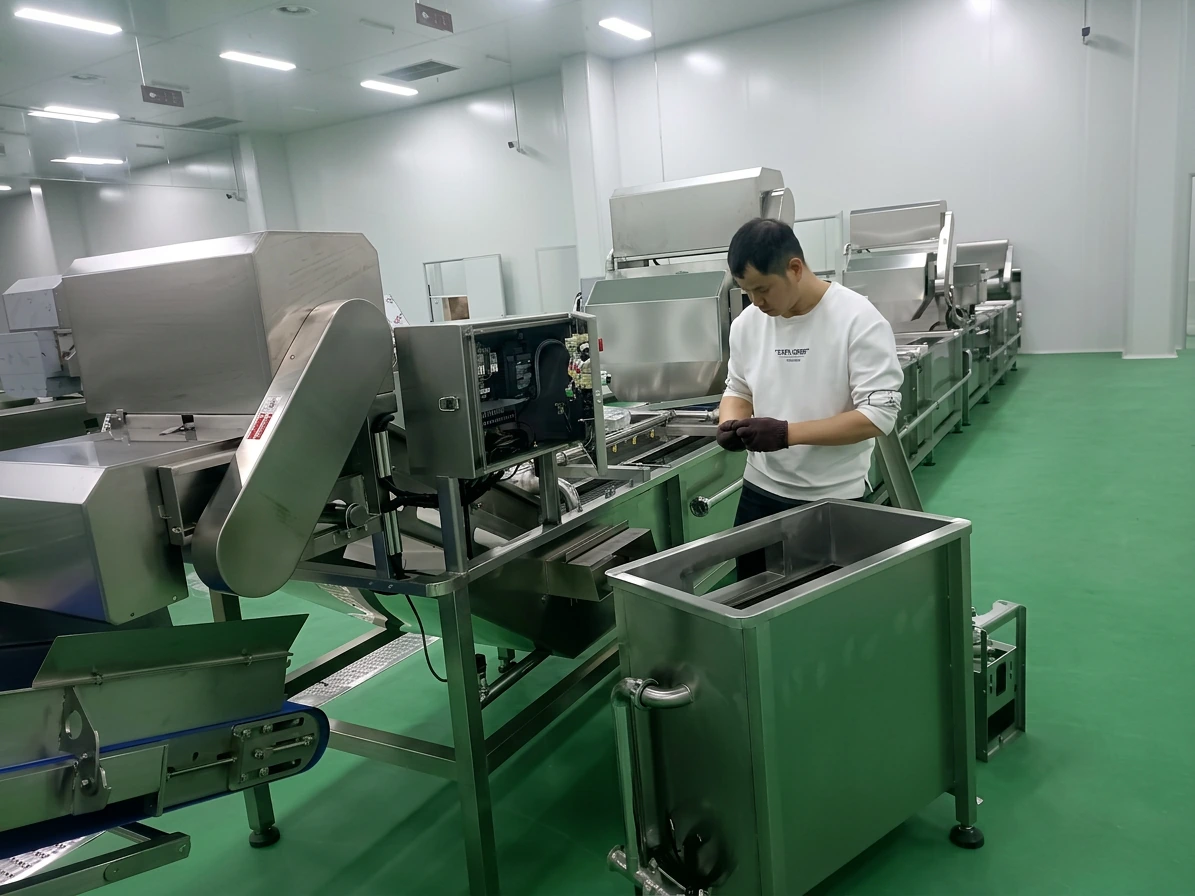
A 500 kg/h planning target often sits in the part of the market where unnecessary integration can be almost as damaging as insufficient automation. The plant may process lettuce in the morning, cabbage later in the shift and several smaller-volume products between them. Operators may still need to trim heads, remove defects or change blade sets frequently.
For that operating pattern, a modular line can be rational:
Preparation and inspection → cutting → washing → draining or dewatering → final inspection → packing interface.
The machines do not necessarily need to operate as one rigid continuous system. Short conveyors, controlled tubs or modest accumulation can preserve flexibility where production campaigns are short and sanitation between SKUs is frequent.
Where semi-automatic equipment makes sense
Manual work can remain appropriate when the task requires visual judgment and production volumes do not keep equipment utilized for enough of the shift. Typical examples include removal of variable outer leaves, selective trimming, defect inspection and specialized low-volume products.
That does not mean keeping every operation manual. Repetitive cutting, high-volume washing and moisture removal may still benefit from mechanization. The more useful question is whether each automated stage removes a genuine production constraint without creating a new one downstream.
The hidden 500 kg/h bottleneck: batch dewatering
A cutter and washer can appear comfortably large enough while a centrifugal dewatering operation determines the entire line output. The correct calculation must include loading, acceleration, dewatering, deceleration, unloading and readiness for the next batch—not only the programmed spin time.
If that cycle cannot accept wet product at the rate delivered by the washer, the project may require two parallel batch units, a different basket-handling strategy or a more integrated dewatering approach. Buyers can also compare an automated centrifugal system such as the TW-980LB dewatering line when the operating pattern justifies automated handling, but selection should follow product testing rather than capacity assumptions.
What Changes Around a 1,000 kg/h Planning Target
At approximately 1,000 kg/h of required saleable output, small inefficiencies start accumulating quickly. A five-minute disruption no longer represents a minor amount of product. A poorly timed cutter change can starve the wash line. A batch dryer that waits for manual baskets can back up wet product. A packaging system that cannot accept the flow may force the entire upstream line to slow down.
The configuration therefore becomes less about choosing individual machines and more about managing interfaces.
Controlled feeding matters more
A washer with adequate mechanical capacity cannot deliver stable processing conditions when the upstream cutter sends alternating surges and gaps. Controlled feeding can improve line balance by keeping product loading closer to the conditions established during testing.
For multi-SKU production, the project should also determine whether one flexible cutter is better than two more specialized cutting routes. A quick-release cutter such as the TW-801P multifunctional vegetable cutter can be evaluated where frequent product changes are relevant, but its actual suitability must still be verified against the intended vegetable and cut specification.
Wash residence time can limit capacity
Washing is not simply a matter of moving more kilograms through a tank. Product loading, water movement, defined residence or contact conditions, organic load and the operator’s water-management program all affect how a washing stage can be operated.
USDA Agricultural Research Service researchers have compared commercial fresh-cut lettuce and cabbage processed through traditional recirculated flume washing and an immersion-free single-pass spray architecture. In the 2018 study, samples were collected during commercial operation every 30 minutes over 2.5-hour periods on multiple production days. The work demonstrated that washing architecture can materially change process-water conditions and product handling. It does not establish that one washing system is universally correct for every product or factory.
That distinction matters at 1,000 kg/h: a supplier should not raise throughput simply by increasing conveyor speed if doing so changes the process conditions on which the wash step was designed.
Why 2,000 kg/h Often Requires Parallel Equipment
A 2,000 kg/h planning target exposes the weakness of treating a production line as a chain of nominal machine capacities.
If 2,000 kg of acceptable finished leafy product must leave the process every hour, raw-material preparation may need to handle considerably more than 2,000 kg/h. A single cutting route must also absorb changes in raw material and cut geometry. Washing must maintain the defined loading and process conditions. Dewatering has to handle the resulting wet material without accumulating WIP. Inspection and packing must accept the flow.
At this scale, parallelization can be an engineering requirement rather than an optional upgrade.
Parallel cutters
Two cutting routes may be preferable where several high-volume SKUs require different blade configurations, where a single cutter’s verified sustainable feed is insufficient, or where changeover on one machine would otherwise stop the complete production line.
Parallel machines are not automatically better. They increase cleaning scope, spare-parts requirements, floor-space demand and control complexity. The justification should come from production scheduling and measured capacity.
Parallel washers
Parallel washing may be considered when one wash train cannot sustain the required product loading while maintaining the process conditions established for the product. It can also support separation between product families or production campaigns.
This decision must remain linked to food-safety management. The FDA’s August 2026 final guidance for ready-to-eat fresh-cut produce emphasizes the biological-hazard context of products that generally do not receive a later kill step. Codex guidance likewise treats water, hygienic processing and prevention of cross-contamination as part of the complete system. Adding another washer increases throughput potential, but it also adds water circuits, cleaning surfaces, drainage and process-control requirements.
Parallel dewatering
Dewatering is frequently the stage where parallel capacity is easiest to calculate because batch operations expose their cycle constraint clearly. If one batch unit can only accept a certain mass per complete cycle, no upstream machine can make it process more product than that mathematical limit.
For high-volume lines, buyers should compare multiple batch systems with automated or continuous alternatives using representative product. Fragile lettuce, dense shredded cabbage and mixed vegetables may not behave the same way under identical moisture-removal settings.
Illustrative Mass-Balance and Line-Balance Calculation
The following calculation is hypothetical and illustrative only. The percentages are mathematical assumptions, not TEEMYEAH performance figures, industry benchmarks or expected yields for a specific vegetable.
Assume a project models the following accepted-mass factors:
- After raw sorting and trimming: 92.0%
- After cutting and cut-quality rejection: 98.5%
- After washing and transfer losses: 99.0%
- After final inspection and packing acceptance: 95.0%
Total illustrative saleable yield:
0.920 × 0.985 × 0.990 × 0.950 = approximately 0.853, or 85.3%.
The raw input required for each saleable-output tier would therefore be:
| Target Saleable Output | Illustrative Yield | Required Raw Input |
|---|---|---|
| 500 kg/h | 85.3% | 500 ÷ 0.853 ≈ 586 kg/h |
| 1,000 kg/h | 85.3% | 1,000 ÷ 0.853 ≈ 1,172 kg/h |
| 2,000 kg/h | 85.3% | 2,000 ÷ 0.853 ≈ 2,345 kg/h |
Now assume, again only for illustration, that the line is expected to achieve the target as an average across production clock time, but effective running availability during that period is modeled at 85% because ordinary micro-stops, interventions and production interruptions are included.
The required gross running rate becomes:
Required running rate = required raw input ÷ availability.
| Planning Tier | Raw Input Needed per Clock Hour | Illustrative Availability | Required Rate While Running |
|---|---|---|---|
| 500 kg/h saleable | ≈586 kg/h | 85% | ≈690 kg/h |
| 1,000 kg/h saleable | ≈1,172 kg/h | 85% | ≈1,379 kg/h |
| 2,000 kg/h saleable | ≈2,345 kg/h | 85% | ≈2,759 kg/h |
This calculation demonstrates why choosing machines according to the finished-product target alone can under-size the upstream process. A project targeting 2,000 kg/h of accepted output may require materially more than 2,000 kg/h of raw handling capacity under its own measured yield and availability assumptions.
For a real project, replace every illustrative percentage with data from the actual vegetable, season, cut specification and acceptance standard. The separate fresh-cut vegetable line capacity guide explains saleable-output sizing in greater detail.
Use Batch-Cycle Math Before Adding or Removing Dewatering Units
Batch equipment should be calculated in cycles rather than converted casually into kg/h.
A useful formula is:
Practical batch-stage capacity = accepted mass per batch × complete cycles per hour × operating factor.
The complete cycle must include every activity preventing the machine from accepting the next load. For a centrifugal dryer, that may include filling, acceleration, programmed dewatering, deceleration, discharge and basket handling.
If a hypothetical unit accepts 20 kg per complete 2.5-minute cycle, the theoretical result would be:
20 kg × (60 ÷ 2.5) = 480 kg/h.
If an illustrative operating factor of 90% is applied:
480 × 0.90 = 432 kg/h practical modeled capacity.
This is not a TEEMYEAH machine specification. It simply demonstrates the logic. If wet product reaches that operation at 900 kg/h, one such hypothetical unit would clearly be insufficient. Two would provide 864 kg/h under the same assumptions and would still be short; three would provide theoretical operating headroom.
The same principle applies to peeling, blanching, mixing or any other batch operation that might be included in a broader food pre-processing project.
Modular and Semi-Automatic vs Integrated Configurations
| Factor | Modular / Semi-Automatic | Integrated Configuration |
|---|---|---|
| Product variety | Often advantageous for many low- or medium-volume SKUs | Strongest where production families are defined and repeatable |
| Changeovers | Individual modules can sometimes be changed or cleaned independently | Changeover may affect a larger connected process and must be engineered deliberately |
| Labor | More feeding, transfer and WIP handling may remain | Can reduce selected repetitive transfer tasks but still requires operators, QA, sanitation and maintenance |
| Line balance | Operators can sometimes absorb temporary mismatches using controlled manual intervention | Requires stronger matching because a bottleneck can restrict the connected line |
| Expansion | Individual stages can often be upgraded incrementally | Expansion should consider controls, conveying, utilities and downstream interfaces |
| Capital exposure | Can support phased automation where demand remains uncertain | Can be commercially justified when utilization and stable demand support the integrated system |
| New risks | Manual handling, variable feeding and uncontrolled WIP | Control dependency, larger sanitation scope, more complex interfaces and potential line-wide stoppages |
Automation therefore should not be treated as a one-way progression from “manual” to “better.” A modular 500 kg/h cell operating six profitable SKUs can be a stronger solution than an underutilized integrated system. Conversely, a plant attempting to sustain 2,000 kg/h with repeated manual transfers may face unstable feeding, WIP accumulation, repetitive handling and increasingly difficult production coordination.
RTE and RTC Products Can Change the Same Capacity Decision
Ready-to-cook and ready-to-eat leafy vegetables can use mechanically similar equipment while requiring different process-control thinking.
For an RTC product that will undergo a defined downstream cooking or other processing step, the factory still needs appropriate hygiene, traceability and sanitation, but the intended use forms part of the hazard analysis.
RTE fresh-cut salad requires greater attention to post-cut and post-wash exposure because the product is commonly consumed without a later pathogen-reduction step. The FDA’s 2026 final guidance specifically addresses ready-to-eat fresh-cut produce within the U.S. Preventive Controls for Human Food context. Codex CXC 53-2003 and its annexes similarly address ready-to-eat fresh pre-cut produce and fresh leafy vegetables.
As throughput rises, this affects physical line configuration. Raw preparation, waste movement, washed-product handling, personnel routes and packaging interfaces should not be allowed to evolve accidentally simply because another parallel machine has been installed.
Buyers planning RTE production can review the RTE salad processing line route separately from general RTC or foodservice vegetable preparation.
Water Management Is a Capacity Constraint, Not Only a Food-Safety Topic
More vegetables per hour create more than a mechanical challenge. Soil, organic matter and product debris enter the washing system at a higher rate. Water treatment, renewal, filtration, monitoring and drainage must therefore be evaluated against the intended operating condition.
The USDA-ARS 2021 commercial study comparing traditional double-flume and immersion-free single-pass washing examined 33 conventional and emerging disinfection by-products in process water and washed lettuce and cabbage. Under the particular commercial conditions studied, process water in the flume system contained substantially higher concentrations of measured disinfection by-products than the single-pass system, while the researchers emphasized that wash-system configuration and operating conditions influenced formation and removal.
This finding should not be converted into a universal recommendation for one washer architecture. It demonstrates why the buyer needs to define the complete water-management system instead of asking only how many kilograms fit through a washer.
For RTE production, sanitation chemistry, monitoring methods and operating limits remain the food operator’s responsibility and must be validated for the actual product and applicable regulations.
Facility and Utility Questions Become More Important as Capacity Rises
A production line can be mechanically capable and still be unusable in the intended building.
Before finalizing the equipment configuration, confirm:
- Available electrical supply and the simultaneous load of connected equipment.
- Process-water supply under peak operating conditions rather than average daily consumption.
- Drainage capacity during production and sanitation.
- Waste and trim removal without crossing cleaner product routes.
- Cold-room and downstream packaging capacity.
- Access around equipment for cleaning, inspection and maintenance.
- Personnel movement between raw preparation and post-wash areas.
- Space for controlled WIP without blocking aisles or creating uncontrolled product dwell time.
- Maintenance access for motors, pumps, belts, baskets, filters, sensors and other service points.
- Expansion space if the project is expected to add products or volume later.
These questions are especially significant at the 2,000 kg/h tier. Doubling equipment does not automatically mean the building can support twice the production rate.
Automation Changes Labor Requirements; It Does Not Eliminate People
Recruiting difficulty, training time, turnover, absence and repetitive manual work are legitimate reasons for a processor to investigate food preparation automation. Yet an equipment configuration should identify which labor activities actually disappear, which move elsewhere and which become more technically demanding.
A leafy vegetable line can still require people for:
- Raw-material inspection and selective trimming.
- Feeding and production sequencing.
- Cut-quality checks.
- Foreign-material and defect inspection.
- QA records and process verification.
- Sanitation and pre-operational inspection.
- Blade, belt and consumable changes.
- Preventive maintenance and fault response.
- Recipe or SKU changeover.
- Supervision of downstream weighing and packaging interfaces.
For comparison between configurations, a useful metric is direct labor hours per 1,000 kg of accepted product. Measure it by process stage, not only as a total headcount. This reveals whether a proposed automation project genuinely removes a bottleneck or simply moves the same labor from one point in the factory to another.
Metrics Buyers Should Use to Compare Configuration Proposals
A supplier comparison becomes more meaningful when each proposal is translated into the same operating metrics.
| Metric | Calculation or Question | Why It Matters |
|---|---|---|
| Saleable yield | Accepted finished kg ÷ raw input kg × 100 | Connects raw-material cost to actual finished output |
| Sustainable throughput | Accepted kg ÷ total defined operating time | Separates real line performance from instantaneous machine rate |
| Labor hours per 1,000 kg | Total direct processing labor hours ÷ accepted kg × 1,000 | Shows where automation changes labor dependence |
| Changeover time | Last acceptable unit of SKU A to first acceptable unit of SKU B | Critical for multi-SKU plants |
| Downtime rate | Unplanned stop time ÷ scheduled production time | Exposes reliability and interface losses |
| Buffer coverage | Usable WIP mass ÷ downstream consumption rate | Converts buffer size into minutes of protection |
| Reject rate | Rejected processed mass ÷ processed mass | Prevents capacity from being achieved by sacrificing specification |
| Sanitation recovery | End of production to verified readiness for restart | Affects usable daily production window |
| Capacity utilization | Actual accepted output ÷ demonstrated sustainable capacity | Helps determine whether a larger line is economically justified |
When a 500 kg/h Line Is Already Oversized
A buyer should not choose the smallest of these three tiers automatically. Even a nominal 500 kg/h line can be excessive when:
- Daily production consists of only short batches.
- Most preparation time is spent on manual trimming that cannot feed the automated stages consistently.
- The factory produces many very small SKUs with frequent cleaning and blade changes.
- Downstream weighing or packaging is substantially slower.
- Demand is highly irregular and the line would operate at low utilization.
- The building lacks appropriate water, drainage, cold storage or hygienic space.
- Manual or targeted single-machine automation already meets production cost and service requirements.
Under those conditions, phased automation may produce a better commercial result. The first investment might address cutting consistency, washing labor or dewatering rather than installing a connected line.
When a 1,000 kg/h Configuration Is Not Justified
A 1,000 kg/h line becomes difficult to justify when the number comes from anticipated future growth rather than a realistic demand model.
A project team should ask how many hours per day the line would need to operate at its verified capacity. If expected saleable production requires only two or three hours of operation, a smaller configuration working for a longer planned period may offer more flexibility unless there is a genuine production-window constraint.
The larger line can also be unjustified when packaging, chilling, raw-material preparation or labor scheduling cannot support it. Increasing upstream equipment capacity in that situation merely moves WIP toward the unresolved bottleneck.
Investment decisions should therefore use actual order patterns, peak production requirements and capacity utilization—not the assumption that buying more capacity today automatically reduces future investment.
Why a Claimed 2,000 kg/h Line Should Not Be Accepted Without Trials and FAT Evidence
A supplier may be able to assemble a proposal in which the headline capacity of each major machine appears to be 2,000 kg/h or more. That is not evidence that the complete process will sustainably produce 2,000 kg/h of accepted leafy vegetable product.
Before treating that configuration as credible, the buyer should establish:
- The raw product used to define the capacity.
- The incoming preparation condition.
- The cut geometry and acceptable cutting defects.
- The raw-input versus saleable-output basis.
- Wash residence or operating conditions.
- Water-management conditions during the run.
- Dewatering batch size and full cycle time where applicable.
- Inspection criteria and rejects.
- Required operator interventions.
- Downstream transfer and packaging conditions.
- The sustained test duration.
- How ordinary stops are treated in the calculation.
If representative raw material cannot be tested, the resulting capacity remains a design assumption that should be clearly identified as such. For a large project, raw-material trials and a defined Factory Acceptance Test provide much stronger procurement evidence than catalogue data alone.
Supplier Verification Before Purchase
Equipment comparison at the supplier-selection stage should move beyond machine features. The supplier must demonstrate how the proposed configuration was derived and how it will be validated.
1. Define the product before the machinery
Provide representative raw vegetables, seasonal variation where relevant, incoming condition, finished cut, acceptable defects, intended RTE or RTC route, target surface-water condition and packaging requirement.
2. Fix the input and output basis
The RFQ and acceptance documentation should state whether capacity is measured as raw input, prepared input or accepted saleable output. If suppliers quote different bases, their kg/h figures cannot be compared directly.
3. Conduct representative product trials
A useful trial should evaluate more than whether the machine can physically process the product. Check cutting condition, product damage, wash handling, retained water, dewatering result, transfer behavior and practical operator intervention.
4. Use a sustained test duration
A short demonstration can confirm basic mechanical function but may not reveal gradual water-quality changes, accumulation, basket delays, operator fatigue, temperature drift or interface instability. Test duration should reflect what the buyer needs to prove.
5. Test important changeovers
For a multi-SKU factory, the line should not be accepted only on the easiest, longest-running product. Measure the change from commercially important SKU A to SKU B, including parts changes, cleaning and restart.
6. Define sanitation recovery
Cleaning is production time in reverse: every additional hour required before the next safe production run reduces available capacity. Review equipment access, removable components, areas where product can collect and the time required for the buyer’s sanitation procedure.
7. Confirm utility loads
Request project-specific electrical, water, drainage and other relevant utility requirements. The facility design should use agreed loads, not assumptions extrapolated from unrelated lines.
8. Review spare parts and maintenance
Identify wear components, recommended critical spares, replacement procedures, routine preventive-maintenance tasks and supplier support arrangements appropriate to the destination and project scope.
9. Define FAT and SAT separately
Factory Acceptance Testing confirms the agreed equipment or process scope under defined factory test conditions. Site Acceptance Testing confirms agreed functions after installation in the buyer’s facility. A successful FAT does not prove that site utilities, upstream feeding or downstream packaging will perform correctly unless those interfaces are included in the acceptance scope.
10. Preserve acceptance data
Record input mass, accepted output, rejects, operator count, production time, stops, alarms, changeovers and agreed product-quality observations. Capacity becomes far more useful when it can be reconstructed from recorded evidence.
The separate food processing equipment capacity verification guide provides a broader framework for converting catalogue ratings into measurable acceptance criteria.
Do Not Use a Convenient Sampling Point as a Substitute for Validation
Process monitoring should also be distinguished from microbiological verification. A 2019 peer-reviewed commercial fresh-cut lettuce study evaluated centrifuge effluent water as a possible alternative sampling point to finished-product testing. Across 95 paired observations, results from lettuce and centrifuge water coincided in many cases, but the alternative method showed insufficient sensitivity: only 47.6% of lettuce samples positive for the selected index organism were matched by positive centrifuge-water samples.
The researchers therefore did not consider that sampling approach a reliable replacement for finished-product testing in the studied context.
For equipment buyers, the lesson is broader than this individual study. Sensors, water measurements, machine records and convenient downstream samples can support process control, but none should automatically be treated as proof that a food-safety program has been validated. The food operator remains responsible for its hazard analysis, verification and applicable regulatory requirements.
Configuration Errors Can Destroy the Expected ROI
Return on investment depends on the performance of the complete operating system, not merely equipment purchase price.
A project can lose its expected economic value when oversized equipment remains idle, cutting produces excess rejects, a washer becomes limited by water management, the dewatering step creates WIP, sanitation consumes more time than modeled, or additional automation requires maintenance resources the plant does not have.
Rather than asking a supplier for a guaranteed payback period, build the commercial model from plant-specific variables:
Annual project benefit = verified labor-cost change + contribution from additional accepted production + measurable quality or waste benefits − added operating, sanitation and maintenance costs.
Simple payback = installed project investment ÷ annual project benefit.
Every term should be based on the buyer’s own wages, production schedule, product margin, yield data, utility costs, maintenance assumptions and expected demand. A supplier can help define the technical configuration; it cannot responsibly guarantee a financial result that depends on the buyer’s commercial and operational conditions.
A Practical Configuration Decision Framework
When comparing 500, 1,000 and 2,000 kg/h options, work through the decision in this order:
- Define accepted packed output by SKU and production window.
- Measure or estimate product-specific saleable yield.
- Calculate required raw input.
- Map preparation, cutting, washing, dewatering, inspection and packing stages.
- Classify every stage as manual, continuous or batch.
- Calculate each batch stage from complete cycle time.
- Identify the slowest sustainable stage.
- Model important product changeovers.
- Size controlled buffers in minutes of production.
- Check whether facility utilities can support simultaneous peak operation.
- Test representative products and difficult SKUs.
- Convert the resulting configuration into FAT and SAT acceptance criteria.
The correct answer may be a relatively simple 500 kg/h modular line, a balanced 1,000 kg/h integrated system, or a 2,000 kg/h architecture containing parallel processing routes. It may also be a smaller system than the buyer initially expected.
The defining question is not how many kilograms a supplier can place beside a machine model. It is whether the complete process can repeatedly convert the buyer’s real raw material into the required quantity of acceptable product under agreed production conditions.
Request a Configuration for Your Product Mix
If your project is already at equipment-selection or RFQ stage, share the raw vegetables, finished products, cut specifications, target saleable output, daily production schedule, RTE or RTC classification, SKU mix, sanitation approach, available layout, utilities and downstream packaging interface.
TEEMYEAH can use those inputs to discuss a project-specific leafy vegetable processing line, including process flow, equipment matching, capacity balance, modular versus integrated options, product testing and the validation scope required before final equipment selection.
For projects comparing approximately 500, 1,000 or 2,000 kg/h, request a configuration based on your product mix rather than selecting equipment from the target number alone. Representative raw-material testing and a clearly defined acceptance basis can then be incorporated into the technical discussion before quotation and final project confirmation.
FAQ
1. How should I compare a leafy vegetable processing line configuration at 500, 1,000 and 2,000 kg/h?
Compare the three options by required saleable output, raw-material yield, SKU mix, production window and the sustainable capacity of every processing stage. A 500 kg/h project may justify modular or semi-automatic equipment, while 1,000 kg/h generally requires tighter line balancing and more controlled transfer. A 2,000 kg/h project may require parallel cutters, washers or dewatering systems where a single machine cannot sustain the required conditions. Do not compare proposals only by catalogue kg/h values. Ask each supplier to define raw input, accepted output, uptime assumptions, product tested, changeovers and how the complete line capacity will be validated.
2. Does a 1,000 kg/h line need every machine to be rated at exactly 1,000 kg/h?
No. Individual machine capacity and complete-line saleable output are different measurements. Upstream equipment may need to process more than 1,000 kg/h of raw material because trimming, rejects and other yield losses occur before finished product is packed. Some machines also require operating headroom to absorb minor stops or variable feeding. Batch equipment must be calculated from full cycle time rather than catalogue feed rate. The correct configuration balances each stage around the required accepted finished output and the actual product conditions rather than forcing every machine to carry the same nominal number.
3. When are parallel vegetable washers necessary?
Parallel washers may be required when one washing system cannot sustain the target product flow while maintaining the defined loading, residence conditions and water-management strategy. They may also help separate product families or support higher-volume production campaigns. Parallel equipment should not be selected simply because the project target is large. Additional washers increase water circuits, sanitation scope, drainage requirements, floor space and controls. Representative trials should confirm whether one appropriately configured wash train is sufficient or whether parallel processing provides a measurable operational advantage.
4. Why can dewatering become the bottleneck of a leafy vegetable line?
Centrifugal dewatering is often batch-based, while cutting and washing may operate continuously. Its real capacity therefore depends on accepted batch mass and the complete cycle: loading, acceleration, dewatering, deceleration, unloading and preparation for the next load. If wet vegetables arrive faster than the dewatering stage can clear them, WIP accumulates and the upstream line eventually has to slow or stop. Buyers should calculate complete cycles per hour and test the actual vegetables. Parallel batch units, automated centrifugal handling or another moisture-removal method may be considered when one unit cannot sustain the required flow.
5. Is a 500 kg/h automatic line always better than manual vegetable preparation?
No. Manual preparation can remain commercially appropriate for variable trimming, visual inspection, small batches and facilities processing many low-volume SKUs. A fully integrated line may be difficult to justify if demand does not keep it utilized or if frequent product changes dominate the shift. Semi-automation can target the stages where repetitive work or inconsistency creates a real bottleneck, such as cutting, washing or dewatering. The objective is not to eliminate all manual work; it is to combine people and equipment in a process that achieves the required quality, labor productivity, hygiene and production schedule economically.
6. What information should I give a supplier for a 2,000 kg/h salad line quotation?
Provide the vegetable types, incoming condition, finished cut specifications, required accepted output, daily and peak production, shift pattern, SKU sequence, RTE or RTC classification, wash and sanitation requirements, required moisture condition before packing, available factory layout and downstream packaging interface. Where possible, include existing yield and reject data. The supplier should use these inputs to calculate raw feed, identify continuous and batch bottlenecks, assess parallel equipment needs and define a testing basis. A quotation that only lists machinery and nominal capacities does not provide enough information to verify a 2,000 kg/h complete-line claim.
7. What is the difference between nominal capacity and sustainable saleable output?
Nominal capacity is usually a stated equipment or planning rate under a particular set of assumptions. Sustainable saleable output is the quantity of conforming finished product that the complete process can repeatedly deliver during an agreed operating period. It includes the effects of raw-material yield, rejects, batch cycles, ordinary stops, feeding, inspection and other conditions defined in the test protocol. The distinction is essential because a machine may process raw vegetables rapidly while the complete line produces fewer accepted kilograms after preparation, washing, dewatering and quality inspection.
8. Should RTE salad and RTC leafy vegetables use the same line configuration?
Not automatically. Some mechanical stages can be similar, but the intended use changes the process-control requirements. Ready-to-eat fresh-cut vegetables are normally consumed without a later cooking or pathogen-reduction step, so post-cut exposure, wash-water control, hygienic separation, sanitation and downstream handling require particular attention within the operator’s food-safety system. Ready-to-cook products still require appropriate hygiene and process control, but their later processing step forms part of the product context. The operator should define the classification and hazard-control program before the supplier fixes the line configuration.
9. What should a FAT prove for a leafy vegetable processing line?
A Factory Acceptance Test should prove the functions explicitly agreed in the purchase specification. For a capacity-related FAT, that may include defined raw material, input mass, finished specification, test duration, operator boundary, accepted output, rejects, cutting quality, batch-cycle timing, stops, alarms and changeovers. Product trials can also evaluate transfer and dewatering behavior. FAT conditions should be recorded because they may differ from the buyer’s final factory. Site Acceptance Testing should subsequently address the agreed site interfaces after installation. Neither test should rely on an undefined “kg/h” number without a clear measurement basis.
10. How do I know whether paying for a larger line will produce a better ROI?
Model utilization before comparing purchase prices. Estimate the accepted kilograms required per day, production window, labor hours, current bottleneck cost, raw-material yield, expected maintenance and sanitation costs and the contribution generated by additional saleable production. A larger line can have poor economics if it operates only briefly each day or remains limited by packaging, trimming or cold storage. Conversely, higher capacity can be commercially justified when demand, production windows and downstream systems support it. Payback should therefore be calculated from the buyer’s actual operating data rather than from a supplier’s generic percentage or guaranteed return claim.
Data and Source Note
This article uses public regulatory guidance and peer-reviewed or government research to establish process-control context. The cited research is not used as evidence of TEEMYEAH equipment performance, guaranteed food-safety outcomes, line capacity, yield improvement or labor savings.
- U.S. Food and Drug Administration, 2026: Guide to Minimize Biological Hazards in Ready-to-Eat Fresh-Cut Produce, final guidance issued in August 2026. The document addresses manufacturers and processors of ready-to-eat fresh-cut produce under the U.S. Preventive Controls for Human Food framework. It provides food-safety guidance and examples; it does not specify a universal equipment configuration or processing capacity.
- FDA Human Foods Program, August 11, 2026: constituent update announcing the final fresh-cut produce guidance. The update notes the contamination context of fresh-cut RTE produce and the absence of a subsequent kill step for many such products. Applicability should be evaluated against the specific operation and jurisdiction.
- FAO/WHO Codex Alimentarius, CXC 53-2003: Code of Hygienic Practice for Fresh Fruits and Vegetables, including Annex I for ready-to-eat fresh pre-cut fruits and vegetables and Annex III for fresh leafy vegetables. Codex provides international hygiene guidance covering water, processing, contamination prevention, sanitation and related controls. National requirements may differ.
- USDA Agricultural Research Service, Bornhorst and co-authors, 2018: peer-reviewed commercial comparison of an immersion-free single-pass washing system with traditional flume processing for fresh-cut lettuce and cabbage. Commercial production was sampled repeatedly over multiple production days. The study helps demonstrate that washing-system architecture affects water and product conditions but does not establish a universal preferred washer for all products.
- USDA Agricultural Research Service, Zhang and co-authors, 2021: commercial evaluation of multiple disinfection by-products in traditional flume and immersion-free single-pass fresh-cut produce washing systems. The results relate to the studied equipment, water chemistry, sanitizer conditions and products and should not be generalized directly to another plant without validation.
- López-Gálvez and co-authors, 2019: peer-reviewed study assessing centrifuge effluent water against finished fresh-cut lettuce testing for detection of an index microorganism. The study used 95 observations and found inadequate sensitivity for treating centrifuge effluent as a reliable substitute for finished-product testing in the studied context. It supports caution when substituting convenient process measurements for validated microbiological verification.

