







Summary
A baby leaf salad processing line should be selected from the finished pack backward, using representative leaves rather than a headline machine capacity. Confirm the crop and maturity, incoming temperature and moisture, field condition, blend recipe, target pack weight, peak production window and acceptable finished-leaf condition. Those inputs determine how the line should feed, separate, wash, drain, dewater, inspect, blend and deliver product to the packer.
For fragile whole leaves, the decisive questions are practical: Can the washer open folds and separate leaves without creating excessive edge, stem or compression damage? Can it remove the expected sand, grit and foreign material while water condition remains controlled? Can the drainage and dewatering stages reduce free surface water without turning wet leaves into compressed clumps? Can the line deliver an even, measurable feed to blending and packing at the required peak rate?
A sound procurement process therefore combines equipment selection with a representative product trial and written acceptance method. Use the trial to fix operating settings, assess leaf damage and foreign-material capture, measure residual surface water consistently, count clumps, compare blend composition, record operator intervention and establish accepted output. The resulting data becomes the basis for the technical agreement, line-balance calculation and factory acceptance plan.
Why Fragile Whole Leaves Change the Equipment Decision
Baby spinach, baby chard and similar tender whole leaves behave differently from dense cut vegetables. They are light, flexible and easily folded. Stems can catch, broad surfaces can overlap, and multiple wet leaves can form a compact mass. A conveyor or water flow that moves a heavier product reliably may move a baby-leaf bed unevenly: part of the product advances while another part floats, folds or gathers at a transfer.
This affects quality as well as line control. Compression can mark the leaf blade, while repeated impacts can damage edges or stems. Research on baby spinach and Swiss chard found that damage increased through harvesting, washing and packaging, with crop species and leaf age influencing the result. A separate spinach study connects compression and crowding with mechanical injury and faster visible deterioration during storage. Buyers should therefore test the actual crop, maturity and incoming condition, select product-specific handling settings, and identify and remove highly damaged leaves before packing.
Wet behavior introduces another layer. After washing, overlapping leaves may trap water between surfaces. A deep, uneven bed can drain differently at its top and bottom, and a sudden discharge can deliver alternating slugs and gaps to the next machine. If the dewatering stage receives variable loads, the finished leaf condition can also vary. Further downstream, wet clumps can resist mixing, distort the intended blend ratio at the packer feed and make small target weights harder to supply consistently.
Equipment selection should address four linked mechanisms: leaf separation in the washer, controlled transfers between modules, pre-drainage before stronger dewatering, and stable delivery to inspection, blending or packing. Buyers investigating damage symptoms in an existing operation can use TEEMYEAH’s leafy vegetable damage guide alongside this baby-leaf selection method. The key distinction is that a visually gentle machine is only suitable when the complete sequence handles the representative product acceptably.
Define the Product and Pack Before Selecting Machines
Start the equipment brief with the leaves that will actually be sold. “Baby leaf mix” is too broad for line selection because products sharing that name can have different stem lengths, leaf sizes, maturity profiles, field loads and blend components. The brief should identify each SKU, its percentage of total production, seasonal changes and whether the line will handle single leaves or a multi-component mix.
Incoming condition matters at the same level as crop name. Record whether samples arrive dry, dew-wet, rain-wet or already washed; their temperature; the time from harvest; the container and fill depth; and visible sand, soil, insects, damaged leaves or decay. These factors change separation, water loading, inspection demand and feeding behavior. A test made only with unusually clean, cool and uniform leaves may not represent the difficult production window.
The pack specification should describe more than nominal weight. Define the accepted leaf appearance, stem condition, free-water expectation, blend tolerance, foreign-material standard and packer feed pattern. If several pack sizes share the line, identify the smallest pack, fastest packer demand and most difficult blend. These conditions often reveal whether the limiting point is washing, dewatering, inspection, blending or accumulation rather than the advertised capacity of one machine.
| Buyer input | What to record | Equipment decision it changes |
|---|---|---|
| Leaf specification | Species, variety, maturity, size range, stem length and fragile components | Feed depth, agitation, transfer and dewatering settings |
| Incoming condition | Temperature, wet or dry state, field load, damage and time from harvest | Inspection load, wash stages, water control and trial cases |
| Finished SKU | Single leaf or blend, component percentages, accepted appearance and defects | Mixing method, segregation control and acceptance sampling |
| Packing demand | Pack weights, packer feed requirement, peak window and planned changeovers | Buffering, discharge pattern and sustainable line output |
| Factory conditions | Layout, access, floor drainage, water, power, compressed air and hygiene zones | Machine arrangement, utility interfaces and cleanability access |

Set the process order specifically for each whole-leaf baby product. Position sorting, washing, treatment where specified, rinsing, drainage, dewatering, inspection and blending according to the actual leaf condition, finished pack and food-safety plan. TEEMYEAH’s whole-versus-cut washing guide covers the broader sequence decision, while the method here focuses on equipment selection and acceptance for fragile whole leaves.
Select Washing Around Separation, Foreign Material and Water Control
The washer must do more than immerse product. Baby leaves need enough controlled movement to separate overlapping surfaces, unfold leaves and release trapped material, but excessive or poorly directed force can increase impacts, folding or edge damage. Selection should examine the complete product path: how the leaves enter the water, how deep the product bed becomes, how water and product move relative to each other, where sand settles, how floating waste is removed, and how the leaves leave the tank.
The TW-705 fresh-cut vegetable washing line uses long-path bubble, vortex and shower/rinse washing. Its process features include sand settling, vibratory filtering, waste collection and circulating-water filtration. Water-flow intensity and wash time are adjustable, and a clean-water spray rinse can be selected. Quick-release sanitary pipework supports access for cleaning. These functions allow a project team to build a baby-leaf trial around product movement, foreign-material separation, water condition and cleaning access rather than treating the washer as a simple tank.
For footprint, utility and quotation planning, the TW-705 catalog values are 7250 × 1900 × 1400 mm, 380 V / 50 Hz / 4.0 kW and a nominal 800–1000 kg/h. Set the saleable baby-leaf output through representative-product testing that reflects the required residence conditions, acceptable damage, water-management plan, downstream dewatering and packing demand. The quotation can then present the catalog figure as a planning reference and the agreed baby-leaf output through the line-balance and acceptance calculation.
Water management belongs in the same equipment discussion. FDA leafy-greens guidance highlights the risk of water-to-product cross-contamination and recommends considering product variability, soil and organic load, pH, turbidity, throughput, disinfectant demand, filtration and the timing of water addition or replacement. In project terms, the buyer should provide expected worst-case field load and its validated treatment requirements; the proposed line should show sampling or monitoring points, filtration and waste removal, make-up and discharge logic, and cleaning access. Washing supports contamination control, but it is not sterilization.
The strongest washer trial combines product and water observations. Record whether folded leaves open, whether fine stems or small leaves gather at screens, whether sand settles rather than recirculates, whether floating waste is captured, and whether discharge is even. Observe the system across the planned run duration, not only during the first clean batch. If the project includes lettuce as well as baby leaf, the buyer can compare the specific wash/dry architecture in TEEMYEAH’s lettuce washing and drying line guide without assuming that lettuce settings transfer unchanged to baby spinach or a mixed-leaf SKU.
Choose Drainage and Dewatering as a Connected System
Water removal begins before the centrifugal dryer. A controlled discharge and drainage step can spread product, release free water and reduce the variability presented to final dewatering. This matters for baby leaves because a wet mass entering as a deep clump does not experience the same conditions as an even load. The preferred sequence should be judged by the finished leaf condition and downstream feed stability, not by how forceful one machine appears.
Choose the TYN-1400 vibratory dewatering conveyor after washing when the line needs continuous drainage, product spreading and controlled transfer before final dewatering. It advances the leaves while free water drains through the tray, helping condition the feed for the next stage. Use the representative baby-leaf trial to establish the achievable residual surface-water result and its acceptance method.
For flexible batch operation, the TW-980B1 vegetable spin dryer uses a basket centrifugal format with manual basket loading and unloading. Its adjustable operating parameters support facilities that need clear batch identity, recipe changes or manual control of loading. Test basket fill, product distribution, speed, time, unloading and labor rhythm together, then enter the verified baby-leaf load and cycle into the purchase specification.
For continuous production, the TW-980LB automated dewatering line combines continuous feeding with automatic centrifugal dewatering. Selectable programs and speed/time control support product-specific settings, while removable conveyors help with cleaning access. Confirm each baby-leaf SKU and transfer pattern through representative trials, and define the proposed output from the accepted baby-leaf result rather than capacity figures for other product categories.
| Module or route | Selection value | Baby-leaf acceptance focus |
|---|---|---|
| TW-705 washing | Adjustable water-flow intensity and wash time; staged separation and filtration functions | Leaf opening, damage, foreign-material capture, water condition and even discharge |
| TYN-1400 drainage | Continuous spreading, draining and transfer before stronger dewatering | Bed depth, clumps, free-water release and feed uniformity |
| TW-980B1 batch centrifugal | Manual basket workflow with adjustable operating parameters | Load distribution, recipe, handling touches, cycle rhythm and finished condition |
| TW-980LB continuous centrifugal | Automatic feed, selectable programs, speed/time control and removable conveyors | Continuous feed stability, program results, transfers, cleaning and packing interface |
The choice between batch and continuous dewatering is therefore operational as well as technical. A multi-SKU plant may value batch separation and fast recipe control, while a stable high-volume program may favor automated transfer. Compare labor, changeover, cleaning, traceability, peak-window demand and the packer interface. In either case, the acceptance target should describe the condition of the leaves and stability of the output, not only a machine speed or cycle time.
Calculate Sustainable Output Through the Peak Window
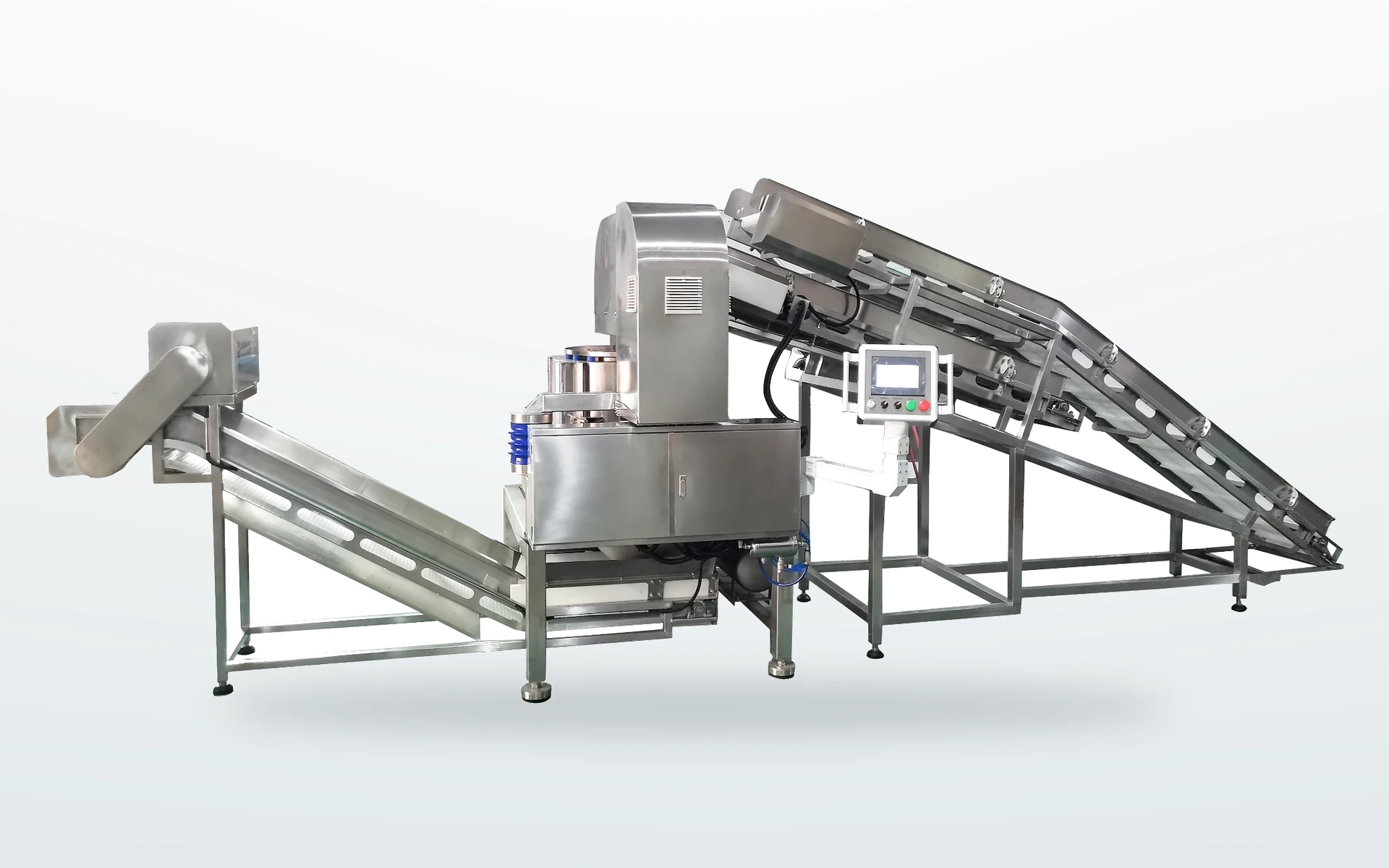
A baby leaf salad processing line is balanced only when each stage supports the same saleable output under the agreed product and operating conditions. Bulk density, leaf size, wet clumping and blend complexity can make mass flow irregular even when average kilograms per hour appear acceptable. The line-balance calculation should follow product from raw inspection through the packer, including pauses for changeover, cleaning, basket exchange, quality checks and replenishment.
Begin with the buyer’s shipment and packing plan. Convert the most demanding production window into the required number of accepted packs and kilograms, then add the SKU sequence and available operating time. Map that requirement against inspection, washing residence, drainage, dewatering, blending, weighing and packing. If the packer needs a consistent feed but the dewatering system discharges in batches, define the buffer or metering method. If a blend contains components with different handling behavior, decide whether they are washed and dewatered separately before controlled mixing.
Use several time intervals during the trial rather than one end-of-run total. Short-interval records reveal surging, starvation and accumulated delays that an hourly average can hide. Track accepted product, rejected leaves, stoppage reasons and operator interventions. TEEMYEAH’s leafy vegetable line capacity matching guide explains the general balance method; the baby-leaf project should add clump and blend measurements because those conditions directly affect the packing feed.
The commercial quotation should distinguish catalog data, proposed design rate and acceptance rate. The acceptance rate is the sustainable quantity of conforming product produced during the agreed test window with the stated sample, settings, staffing and inspection method. This makes comparisons between suppliers more useful: the buyer can see what will be tested, how conforming output is counted and which operating conditions support the result.
Build a Representative Trial and Written Acceptance Method
The trial should reproduce the products and conditions that are most likely to challenge the line. Bring the actual leaf types and maturity range, not a generic substitute. Include the expected cool product and any warmer or wetter condition that regularly reaches the factory. If one fragile component is a small percentage of a blend but drives visible complaints, test it separately and in the intended blend.
Before running, agree how each result will be measured. Use the same sample size, observation point, timing and scoring definitions for every run. Photograph or retain agreed reference samples where useful. Record machine settings with enough detail for the accepted run to be repeated. The trial should progress from a conservative baseline through controlled adjustments, changing one major variable at a time so the team can connect settings to results.
| Trial record group | Required entries | Acceptance evidence |
|---|---|---|
| Sample identity | Actual leaf type, variety or SKU, maturity, temperature and wet/dry condition | Lot record, sample photographs and incoming inspection |
| Operating record | Feed rate, bed or batch loading, water and wash settings, drainage condition, speed/time program and staffing | Time-stamped setting sheet and run log |
| Leaf and cleaning result | Damage score, foreign-material capture and accepted output | Defined samples before and after processing; conforming mass over the test window |
| Water and flow result | Residual surface-water method, clump count and output-feed observations | Repeated measurements at the agreed post-dewatering and pre-packing points |
| Blend and operation result | Blend deviation and operator intervention | Component checks from defined samples; count and reason for manual actions or stoppages |
A useful damage score separates the defect types that influence the buying decision. Define edge tears, stem breaks, blade bruising or translucent compression marks, then count or grade them in a fixed sample. Compare incoming and processed samples so existing field or transport damage is not attributed automatically to the line. The agreed limit should be tied to the buyer’s pack specification rather than borrowed from another crop.
Foreign-material capture should also be tested against the incoming challenge. Record what enters, what is removed at sorting, what settles or is filtered during washing, and what remains at final inspection. For surface water, choose one repeatable method—such as a documented mass-based sampling procedure or another agreed plant method—and fix the sampling delay after dewatering. A visual description such as “looks dry” is not precise enough for comparing settings.
Count clumps at a defined conveyor or packing-feed point using an agreed clump definition. For a blend, take repeated samples across the trial window and compare measured component proportions with the recipe. Record every operator action needed to open a mass, redistribute product, clear a transfer or correct feed. These observations show whether the line is genuinely stable or depends on unplanned manual handling.
Finish by identifying the accepted operating window, not only the single best run. The technical agreement should preserve the sample identity, settings, measurement methods, acceptance limits, sustainable output window and required staffing. It should also state which utilities and upstream or downstream conditions were present. This turns the trial from a demonstration into a usable factory acceptance reference.
Download the Baby Leaf Equipment Selection and Trial Matrix. Use it to prepare samples, compare washing and dewatering routes, and align the supplier, quality team, operations team and packer requirements before quotation approval.
Convert the Trial Into a Clear Technical Quotation
A strong request for quotation gives the supplier enough information to select modules and define interfaces. Submit the SKU list and recipes, crop calendar, representative incoming conditions, foreign-material profile, target pack formats, production hours and peak window. Add the building drawing, hygiene-zone plan, drainage locations, available water quality and pressure, electrical supply, compressed-air availability and the intended upstream and downstream equipment.
Ask the quotation to show the process sequence, machine models, dimensions, utilities, access clearances, transfer heights, control interfaces and cleaning approach. Catalog capacities should remain identified as catalog values. Proposed baby-leaf output should be connected to the named sample, test method, accepted settings and complete line balance. Options such as a clean-water spray rinse, added filtration, vibratory drainage, batch or continuous dewatering and conveyors should be written into the technical scope rather than left as assumptions.
The acceptance schedule should state when and where the representative test will occur, who supplies product and packaging materials, which measurements will be taken, and how conforming output will be calculated. It should identify the required records and the action if a result falls outside the agreed window. The same document can become the starting point for commissioning recipes and operator training.
Cleaning and changeover deserve their own review. Check access to tanks, pipework, filters, screens, baskets, drums and removable conveyors. Confirm how trapped leaves and waste are removed, where wash water and cleaning water drain, and how components are inspected after cleaning. For mixed SKUs, include the planned sequence and changeover criteria so the production schedule reflects real available time.
The TEEMYEAH leafy vegetable processing line hub remains the place to request a complete system configuration and quotation. Use this article’s selection and acceptance method to make that request product-specific: it gives the project team a shared basis for comparing the TW-705 washing platform, drainage options, batch or automated dewatering, and the required packing interface.
Frequently Asked Project Questions
1. Can one baby leaf line handle spinach, chard and mixed salad SKUs?
Potentially, when each component fits the agreed feed, wash, drainage and dewatering route. Test the most fragile leaf, the leaf most likely to tangle, and the complete blend. The technical agreement should list accepted SKUs and their operating recipes rather than treating all baby leaves as one product.
2. Should we select the washer from its nominal kilograms per hour?
No. Nominal data helps with initial comparison, footprint and utility planning, but saleable baby-leaf output depends on separation, residence conditions, incoming field load, acceptable damage, drainage, dewatering and downstream packing. Use an accepted test window and conforming output to set the project rate.
3. When does vibratory drainage add value before centrifugal dewatering?
It is useful when the washer discharge carries substantial free water or produces an uneven wet bed. A drainage conveyor can spread product and reduce drainable water before final dewatering. Confirm the benefit by comparing clumps, feed uniformity, finished-leaf condition and residual surface water with representative leaves.
4. Is batch or continuous centrifugal dewatering better for fragile leaves?
The better route depends on the SKU range and operating model. Batch baskets can support product separation and flexible recipes but require a defined loading and labor rhythm. Continuous dewatering supports automated transfer and steady production, provided feed stability and program results meet the acceptance criteria. Trial both routes when the decision materially affects layout or automation.
5. How should residual surface water be specified?
Use a repeatable measurement method at a fixed location and sampling delay. Record the sample mass, procedure and environmental or holding conditions that affect the result. Pair the measurement with observations of trapped water, clumps and packer behavior; do not rely only on a visual “dry” judgment.
6. How do we evaluate a mixed-leaf blend during the equipment trial?
Fix the recipe, prepare representative component lots, and take repeated samples from the agreed point before packing. Measure the component proportions and report deviation from the target recipe. Also record separation, clumps, surging and corrective operator actions, because an acceptable average can hide short periods of poor distribution.
7. What product samples should be sent for testing?
Send the actual species, varieties, maturity and size range planned for sale. Include the most fragile component and the difficult incoming condition that regularly occurs, while keeping transport and temperature history documented. Supply enough product to establish settings and run the agreed sustained-output window, plus the intended blend components where applicable.
8. What should be fixed before signing the purchase agreement?
Fix the accepted product scope, process sequence, equipment and options, utilities, layout interfaces, operating window, staffing basis, test sample, settings, measurement methods and acceptance limits. Include damage, foreign-material capture, residual surface water, clumps, blend deviation, accepted output and operator intervention so factory acceptance evaluates the complete production result.
Configure the Line Around Your Actual Baby Leaves
Prepare the SKU list, representative sample condition, finished pack specification, peak output window and factory layout with available utilities. TEEMYEAH can use these inputs to discuss the washing, drainage, dewatering and transfer route, define a representative trial and develop the equipment configuration and technical quotation.
Submit Your Baby Leaf SKU and Sample Plan.
References and Source Note
- Mulaosmanovic, E. et al. (2021). Processing of leafy vegetables matters: Damage and microbial community structure from field to bag. Food Control, 125, 107894.
- Ariffin, S. H. et al. (2017). Leaf injury and its effect towards shelf-life and quality of ready-to-eat spinach. Procedia Engineering.
- U.S. Food and Drug Administration. Commodity-Specific Food Safety Guidelines for the Lettuce and Leafy Greens Supply Chain, 1st Edition. Used here for wash-water cross-contamination, raw-material variability, organic-load, filtration and water-replacement considerations.


