Summary
Selecting carrot slicing equipment for dehydration starts with the dryer infeed specification, not with the slicer’s maximum catalogue output. The project team should translate the downstream requirement into a measurable cutting specification: nominal slice thickness, permitted thickness distribution, incoming root diameter range, acceptable end pieces and fragments, required surface-water condition, accepted hourly output, and the loading pattern at the dryer entrance.
The best machine is the one that can sustain the required accepted slice output under representative carrot and beetroot conditions. A fixed-disc slicer may suit a stable product specification, an optional-disc machine may support several confirmed recipes, a compact cutter may fit smaller production runs, a multifunction cutter may serve mixed production, and a high-output centrifugal slicer may be appropriate when continuous dryer demand is high. Each candidate should be assessed with the intended roots, tooling, feeding method and handoff arrangement.
Before contract acceptance, measure the thickness distribution, off-spec pieces, fines, end pieces, stoppages, operator interventions and actual dryer loading behavior during a sustained run. This connects cutter performance to production reality and prevents gross machine throughput from being mistaken for usable dryer feed.
Begin with the Dryer Handoff, Then Specify the Slicer
A dehydrated-vegetable factory does not purchase slices in isolation. It purchases a stable flow of prepared material that can enter a confirmed rinse, blanching, surface-water-removal and drying sequence without creating uncontrolled variation at the next stage.
That distinction matters because a specification such as “3 mm carrot slices at 800 kg/h” leaves several important questions unanswered. Does 3 mm describe a nominal target or a permitted range? Are tapered end pieces included? How much fragmented material is acceptable? Does the hourly figure refer to everything discharged by the cutter or only slices accepted for dryer loading? Is the material expected to reach the dryer wet, drained, centrifuged or otherwise surface-water controlled? Will it be loaded in a single layer, a shallow overlapping layer or to a defined bed depth?
The buyer or dryer supplier should provide the validated dryer infeed requirements. TEEMYEAH can then use those requirements to configure the upstream slicing and transfer interface. This creates a clear operational boundary: the cutter must deliver a measurable slice population and feed condition, while the downstream process owner defines how that material must enter the dryer.
Research on drying reinforces the importance of exact material geometry. In a study of electrohydrodynamic drying, Ding and co-authors prepared washed and peeled carrot material as rectangular slices measuring 13 × 8 × 1 mm and arranged them in a single layer under the study’s specific experimental conditions. The value of this example is not the dimensions as a commercial recipe; it is the discipline of defining geometry and loading conditions precisely before evaluating drying behavior. The full study is available through PLOS ONE and PubMed Central.
A beetroot drying study by Tagnamas and co-authors likewise reports that drying kinetics were affected by temperature and slice thickness. Its conditions should not be transferred directly into a factory specification, but the relationship supports an important project decision: thickness must be controlled as a distribution, not treated as a descriptive number on a quotation. The bibliographic record is available through RePEc for the Renewable Energy article.
Convert the Dryer Infeed Requirement into a Cutter Specification
A useful cutter specification describes what the downstream process can accept and how that result will be measured. It should cover the following inputs before equipment selection begins.
| Dryer-handoff input | How to express it for slicer selection | Why it affects the project |
|---|---|---|
| Nominal thickness | State the intended central thickness for each carrot or beetroot product. | It determines which cutting disc or tooling configuration should enter the shortlist. |
| Allowed thickness distribution | Define the permitted interval and the method used to classify accepted and off-spec slices. | A nominal value alone does not reveal how much of the output is thinner, thicker or irregular. |
| Root diameter distribution | Provide representative diameter bands and their approximate proportions, rather than only the smallest and largest roots. | Diameter changes slice area, piece mass, loading behavior and the number of end pieces produced per kilogram. |
| Preparation state | Confirm whether roots are washed, peeled, topped, tailed, manually trimmed and surface-wet when fed. | Preparation affects friction, feed stability, usable length, blade contact and downstream cleanliness. |
| Firmness and condition | Describe fresh, stored, softened, cracked, oversized, undersized or otherwise variable material. | Firmness and defects can change cut quality, breakage and feeding consistency. |
| Allowed end pieces and fragments | Define which irregular pieces remain acceptable and which must be separated or reworked. | The mass of usable dryer feed can differ materially from the cutter’s total discharge. |
| Surface-water state | Specify the condition required before dryer loading and identify any rinse, blanching, cooling, draining or surface-water-removal steps between cutting and drying. | Transfer and accumulation should be designed around the actual post-slicing sequence. |
| Accepted loading rate | State the required accepted kilograms per hour at the dryer entrance, including expected operating hours and changeovers. | This is the relevant capacity target for the integrated line. |
| Loading pattern | Provide dryer type, tray or belt width, loading depth or layer rule, overlap restrictions and preferred distribution across the width. | A slicer can meet its discharge rate while still creating an unsuitable or unstable dryer feed pattern. |
| Interface dimensions | Confirm dryer feed height, entry width, available floor space and whether the handoff is batch or continuous. | These inputs determine transfer height, conveyor arrangement, accumulation needs and operator access. |
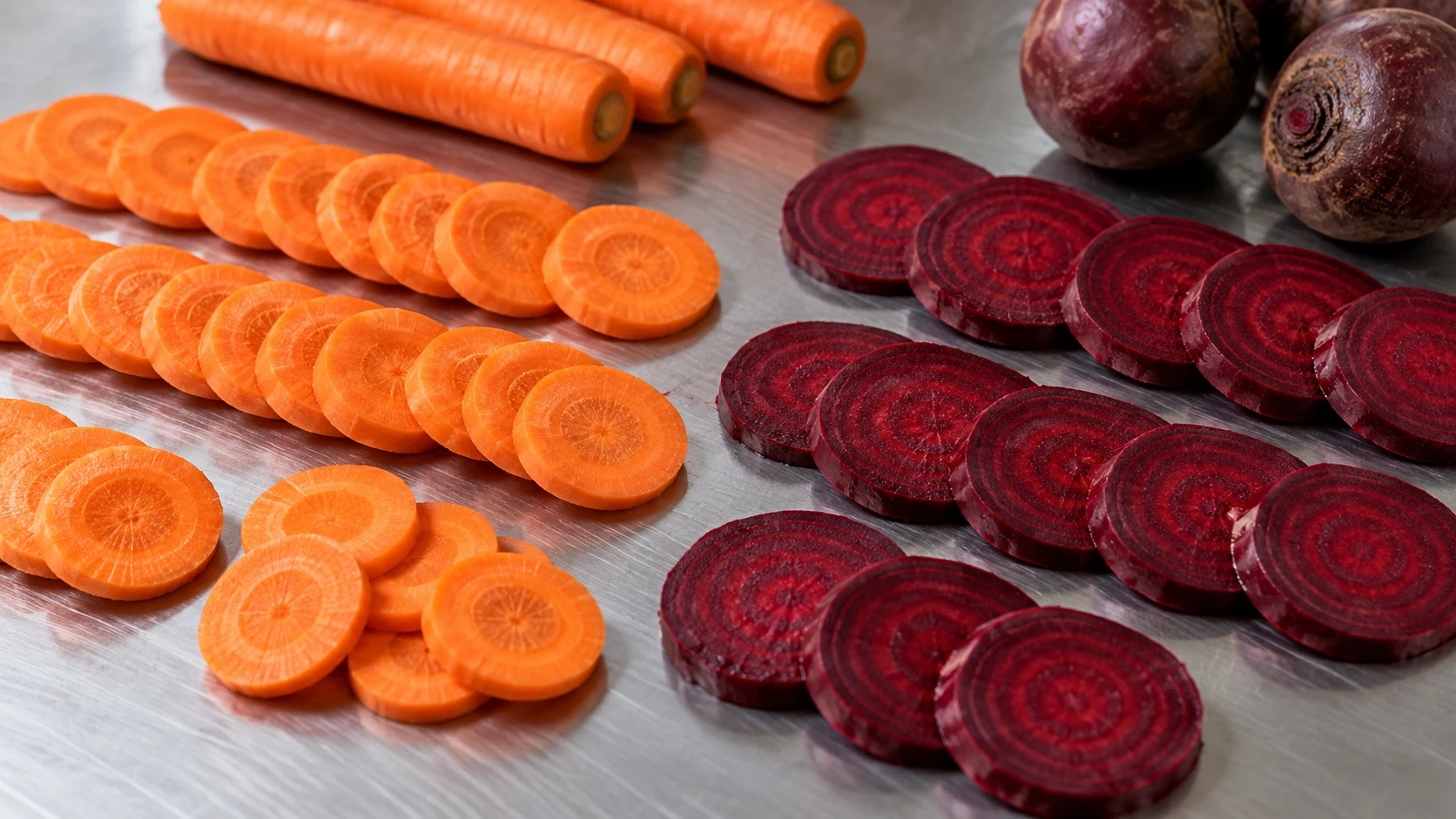
This specification should be product-specific where necessary. Carrot and beetroot follow the same equipment-selection and verification logic, but that does not mean they will automatically use identical tooling, feed settings or acceptance limits. Their actual diameter distribution, firmness, preparation state and required output must be represented in the selection process.
Why One Nominal Slice Thickness Is Not Enough
A drawing may show a perfectly uniform disc, yet real roots are biological materials. Their diameter changes along the length, ends taper, firmness varies, surfaces may be dry or wet, and manual preparation is rarely identical from piece to piece. The cutting system must manage that variation while operators maintain a repeatable feed method.
Diameter changes both geometry and mass flow
Two slices can have the same measured thickness but very different diameters and masses. When those pieces reach a tray or conveyor dryer, their coverage and overlap behavior may differ. A batch dominated by large beetroot discs can occupy the loading surface differently from a batch containing many smaller carrot discs, even if both are described by the same nominal thickness.
Diameter distribution also affects the relationship between pieces per minute and kilograms per hour. A cutter may process a high number of smaller roots but discharge less mass than it does with larger roots. For procurement purposes, the representative material set therefore needs both size information and a mass-based acceptance calculation.
Taper produces predictable end-piece variation
Carrots naturally narrow toward one end, while trimmed beetroot may retain curved or irregular terminal sections. The initial and final cuts can produce partial discs, wedges or pieces with changing cross-sections. These are not necessarily processing failures; they are a normal result of slicing a tapered raw material. The commercial question is how much of this output the buyer accepts for the intended dried ingredient.
If the finished product specification allows partial slices within defined limits, more of the cutter discharge may become accepted output. If the buyer requires visually complete discs or a narrowly standardized ingredient, the line may need more manual preparation, sorting or rework handling. That decision should be made before the capacity is quoted.
Firmness affects cut integrity
Firm roots generally respond differently from softened, cracked or heavily stored material. A disc selected with one raw-material condition may generate a different fragment rate when the supply condition changes. Representative trials should therefore include the firmness and storage variation expected in normal procurement, not only a carefully selected group of visually ideal roots.
Feed orientation influences repeatability
The way a root enters the cutting zone can affect the resulting shape, especially when product length, curvature and taper vary. Some operations may accept broad variation in slice presentation, while others need operators to maintain a defined orientation. The trial should record whether feed orientation is naturally stable, requires operator attention or creates a capacity constraint.
Blade condition changes over production time
A clean result at the beginning of a short demonstration does not fully describe sustained production. Blade condition, product residue and cleaning intervals can influence slice surface, fragments and operator interventions. Acceptance should include periodic samples across a continuous run so that early, middle and later output can be compared.
Separate Machine Throughput from Accepted Slice Output
Catalogue capacity helps narrow the equipment class, but it is not the final dryer-feed capacity. Three different rates should be discussed in every project:
- Gross cutter discharge: the total mass leaving the slicing machine during measured running time.
- Accepted slice output: the mass that meets the agreed thickness, geometry and fragment/end-piece rules.
- Sustainable dryer loading: the accepted mass that the complete handoff can place into the dryer according to the defined layer, depth, distribution and operating rhythm.
These quantities can be expressed without inventing a universal benchmark.
Accepted slice percentage (%) = accepted slice mass ÷ total sampled discharge mass × 100.
Here, “accepted slice mass” means only the sample fraction that complies with the contractually agreed classification method. “Total sampled discharge mass” includes accepted slices, off-spec slices, fragments, fines and end pieces collected within the same sample period.
Sustained accepted slice output (kg/h) = accepted slice mass produced during the measured run ÷ measured elapsed production time in hours.
The elapsed production time definition must be agreed in advance. If the purpose is to evaluate line availability, the time should include recorded stoppages and interventions. If a separate pure cutting rate is also required, it can be calculated from actual cutter running time, provided both figures are clearly labelled.
Sustainable dryer loading rate (kg/h) = accepted material loaded according to the agreed dryer infeed rule ÷ measured loading period in hours.
This final rate may be constrained by conveyors, rinsing, blanching, cooling, surface-water removal, accumulation, manual spreading or the dryer itself. Reporting it separately prevents a high cutter number from masking a bottleneck at the handoff.
The same approach applies to lower-output and high-output projects. A compact machine feeding batch trays needs an accepted-output definition just as much as a high-capacity slicer feeding a continuous belt. The difference is the operating rhythm, not the need for measurement.
Equipment Candidates for Carrot and Beetroot Slicing
TEEMYEAH offers several equipment types that can enter a project shortlist. The correct choice depends on the confirmed thickness requirement, product range, accepted output and dryer-loading arrangement. The broader root vegetable processing line page provides context for upstream preparation and line integration, while the table below focuses specifically on slicing before dehydration.
| Model | Verified cutting scope | Verified reference output | Best considered when | Selection point to confirm |
|---|---|---|---|---|
| TW-822 | Supports carrot and snack-food applications; slicing and shredding; fixed 2–4 mm cut. | 200–800 kg/h, depending on material. | The project needs a fixed-cut candidate within the stated range and values smooth cut surfaces, an opening body, easy cleaning and a waterproof switch. | Confirm whether its fixed cut matches the required distribution and accepted output with the actual roots. |
| TW-822B | Root and fruit slicing, shredding and strip cutting; one made-to-order disc per machine; optional 3–6 mm range. | 500–1,200 kg/h, depending on material and cut specification. | A project needs a purpose-selected disc within the stated range and a higher reference capacity than a compact machine. | Define the required disc before ordering; one made-to-order disc is supplied per machine. |
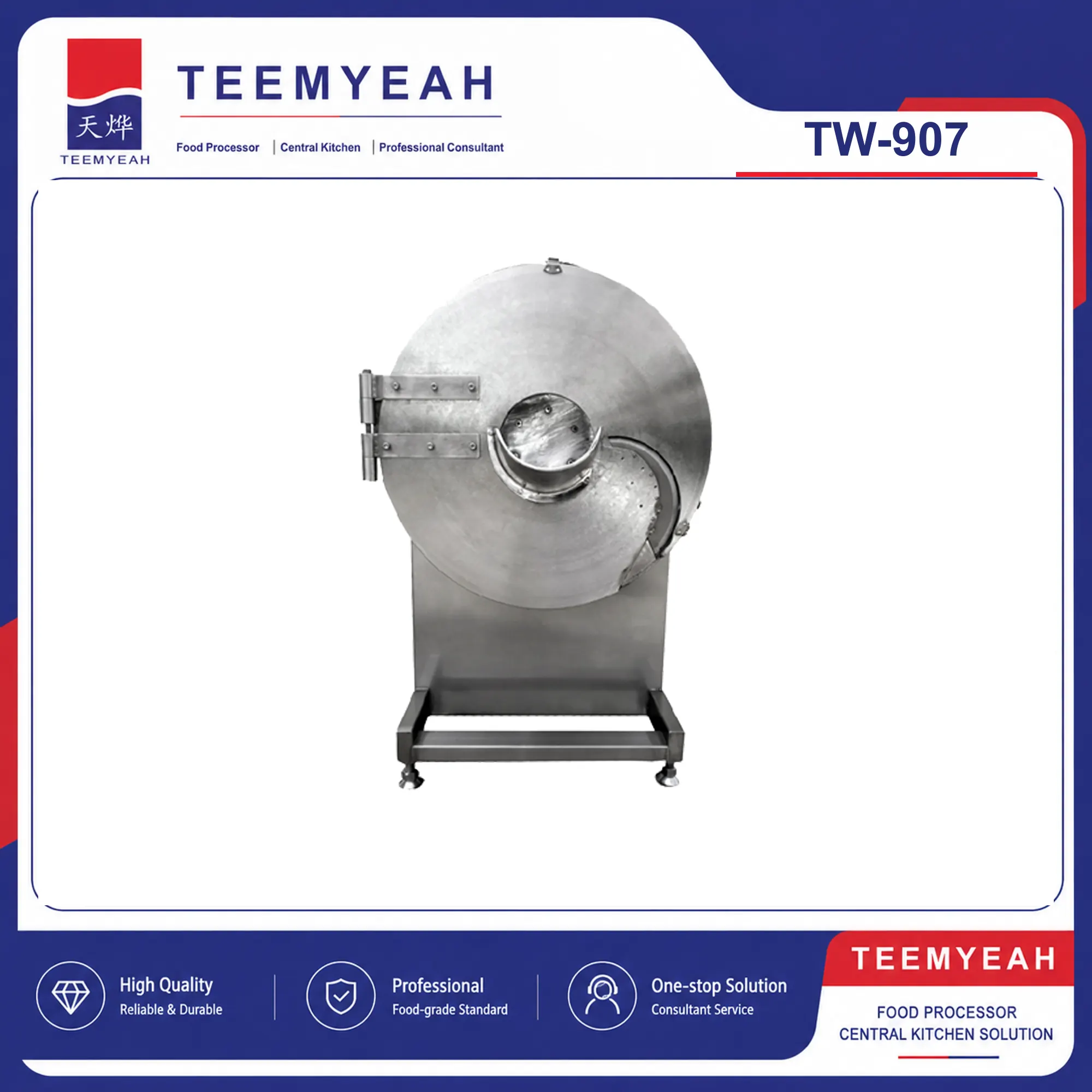
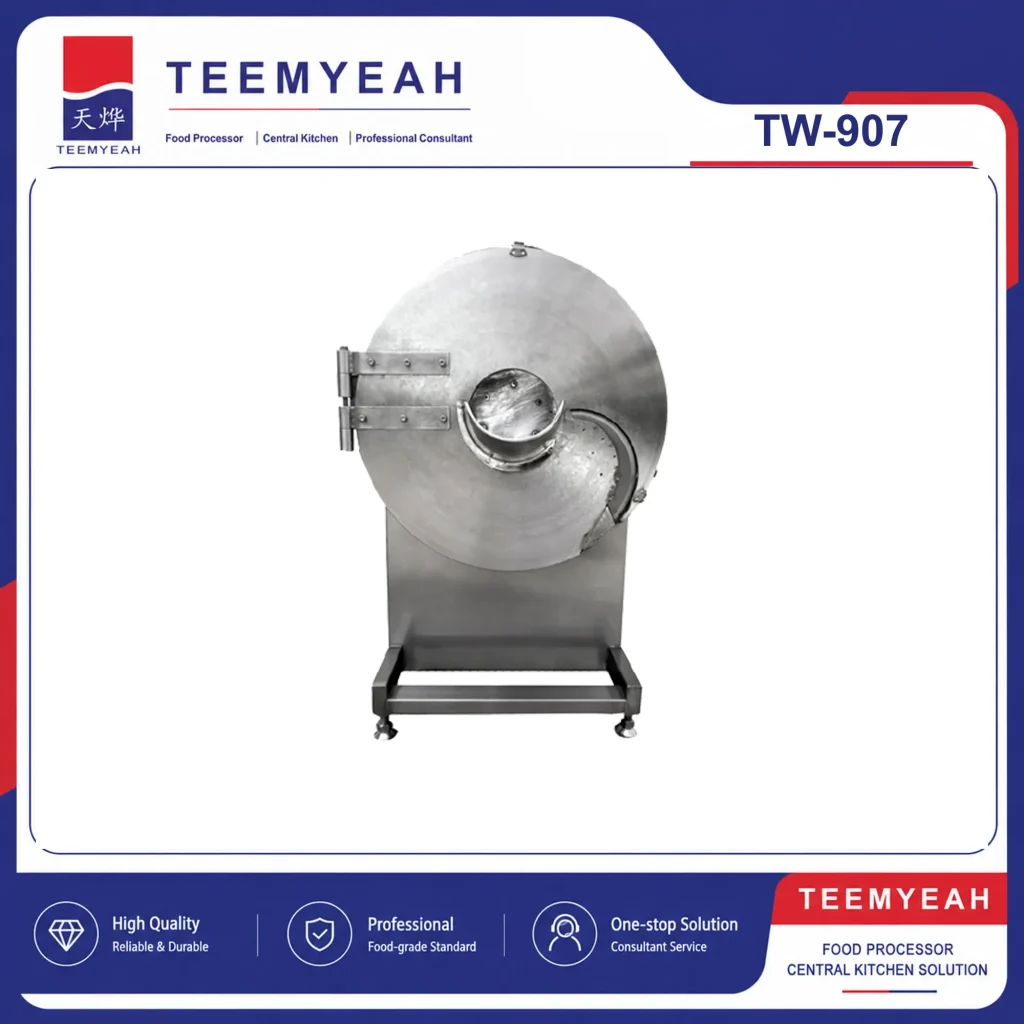
| TW-907 | High-output centrifugal slicing for sweet potato, taro, potato and compatible firm roots; minimum listed slice thickness 1 mm. | 1,500–3,000 kg/h. | Continuous production requires a high-output candidate and the roots are compatible with centrifugal slicing. | Trial the actual product using confirmed diameter, firmness, preparation, target thickness and downstream process. |
| TW-812S | Compact root and bulb cutter; explicitly includes carrot; optional slice discs of 2 mm and 4 mm. | 200–300 kg/h. | Production is smaller, recipes align with an available disc, or batch dryer loading makes compact operation practical. | Match the selected disc and feeding rhythm to the accepted slice and batch-loading requirements. |
| TW-801A | Multifunction root and leaf cutter with slicing, shredding and dicing tooling; 1–30 mm adjustable; root slicing disc supplied. | 300–1,000 kg/h. | The factory needs multifunction capability across several cut formats or products. | Verify the chosen root slicing setup rather than assuming the full adjustable range produces every required root slice identically. |
| TW-902P | Multifunction root and leaf cutter with root slicing and shredding discs, quick-release conveyor and safety cover. | 500–1,000 kg/h. | The project values multifunction production, conveyor access and faster release for cleaning or changeover. | Specify the root disc separately; the listed 1–60 mm adjustment refers to leafy cutting length, not a verified root-slice thickness range. |
All outputs in the table are selection references. Contract acceptance should be based on sustained accepted slice output under agreed material, tooling, feeding and measurement conditions.
When a fixed-disc cutter is the stronger candidate
A fixed-disc machine is attractive when the factory has a stable product specification, a limited number of slice recipes and a predictable dryer interface. The selection process becomes more direct because the target cut can be matched to a defined disc rather than relying on frequent adjustment.
This approach can also simplify operator training and reduce the chance of an unrecorded setting change. Its limitation is flexibility: if the dryer specification or customer product range later requires a substantially different thickness, the tooling strategy must be reviewed. The TW-822 is a fixed 2–4 mm candidate, while the TW-822B uses one made-to-order disc per machine within its optional 3–6 mm range.
When optional-disc or compact equipment fits the production rhythm
Compact equipment can be a better commercial choice when the dryer operates in smaller batches, when the daily volume is moderate, or when a factory wants close operator control over preparation and loading. The TW-812S, with optional 2 mm and 4 mm slice discs and a reference output of 200–300 kg/h, is one candidate for this type of project.
The key is to compare it with the actual batch cycle. A cutter does not need the highest available hourly capacity if it would simply create a large wet-product queue before tray loading. Conversely, a machine that appears sufficient by daily average may be too slow if each dryer batch must be loaded within a narrow time window. The production schedule should therefore show cutting, intermediate treatment, draining and loading as timed steps.
When multifunction cutting adds value
A multifunction cutter can support factories processing several root and leaf products or supplying multiple ingredient forms. TW-801A offers slice, shred and dice tooling with a listed 1–30 mm adjustment and a root slicing disc. TW-902P supports root slicing and shredding discs and includes a quick-release conveyor and safety cover.
Flexibility should still be assessed against the main dehydration product. Changeovers, cleaning, tooling identification and recipe control all affect the usable production schedule. Where one dried slice accounts for most of the factory’s volume, a dedicated cutter may provide a simpler operating routine. Where production changes frequently, multifunction capability may reduce the need for separate machines, provided each important recipe passes its own acceptance trial.
When high-output centrifugal slicing should be evaluated
The TW-907 industrial root vegetable slicer is the high-output candidate in this group. It is designed for sweet potato, taro, potato and compatible firm roots, has a minimum listed slice thickness of 1 mm and a reference output of 1,500–3,000 kg/h. The current specification lists 380 V three-phase power, 2.25 kW, dimensions of 850 × 750 × 1,400 mm and SUS304 construction.
For carrot or beetroot, compatibility should be established with the actual diameter, firmness, preparation state, target thickness and downstream process. This is especially important at higher rates because the cutter, transfer conveyor, intermediate process and dryer-loading system must operate as one balanced chain. A high gross discharge rate has little value if slices accumulate, overlap uncontrollably or wait too long before the next confirmed step.
Process Sequence from Prepared Roots to Dryer Handoff
The article begins with whole carrots and beetroot after receiving, washing and any required peeling or manual trimming. Broader options for washing, peeling and full-line configuration are discussed in TEEMYEAH’s industrial carrot processing line guide. For a dehydration project, the slicing section can be organized around the following sequence:
- Prepared-root verification: Confirm that washing, peeling and trimming have produced the agreed feed condition. Remove unsuitable roots, excessive defects and foreign material before the cutter.
- Topping, tailing and defect trimming: Complete manual preparation where the product specification requires controlled ends, removal of damaged areas or improved feed stability.
- Diameter and condition management: Segregate or record materially different root bands when size or firmness could change cutting behavior.
- Controlled feeding: Present roots to the cutter using the agreed orientation and feed rate. Avoid surges that make sampling or transfer inconsistent.
- Slicing: Operate the selected machine with the confirmed disc or tooling, recorded settings and defined blade condition.
- Immediate output observation: Check slice integrity, thickness spread, fragments, end pieces, accumulation and any signs of unstable discharge.
- Sampling and classification: Take periodic samples during the run and separate accepted slices from agreed off-spec categories.
- Transfer to the confirmed intermediate sequence: Move slices into the buyer-defined rinse, blanching, cooling, draining or surface-water-removal steps.
- Predryer flow control: Buffer or meter accepted material only where the product and process allow it, keeping the handoff synchronized with downstream capacity.
- Dryer loading: Deliver slices at the required feed height, belt or tray width, loading depth, layer pattern and batch or continuous rate.
This sequence should become a layout drawing with elevations, access zones and measured handoff points. The capacity relationship between stages can be explored further in TEEMYEAH’s guide to root vegetable processing line capacity.
Manual Work Remains Part of a Controlled Slicing Process
Automation does not remove the need for defined operator tasks. It changes those tasks from continuous hand cutting to material preparation, process monitoring and quality control.
Topping and tailing where required
Removing irregular ends can reduce the number of extreme end pieces and may improve feed presentation. Whether this step is commercially worthwhile depends on the accepted product definition. If tapered pieces are permitted in the dried ingredient, aggressive trimming may remove usable mass without adding value. If complete or consistently shaped slices are important, controlled trimming may improve the accepted fraction.
Defect removal and unsuitable-root rejection
Operators should remove roots that fall outside the agreed condition, including severe damage, softness or geometry that the selected cutter cannot handle consistently. The rejection criteria should be written and illustrated so that different shifts do not apply different standards.
Monitoring feed orientation
Where orientation affects slice shape or cutting stability, the feed station must give operators enough space and time to present roots consistently. A machine’s theoretical output should not be used as the line target if maintaining the required orientation reduces the practical feed rate. That operator-controlled rate should be captured during the trial.
Sampling and recording output
Operators or quality staff should collect samples at defined intervals, label the time and material band, and record abnormal conditions. This creates a traceable relationship between root condition, cutter operation and measured slice output.
Handling off-spec pieces
The project should identify where off-spec slices, fragments and end pieces go. Options may include permitted blending, rework through an approved route, use in another product or removal from the target stream. The selected route affects conveyor design, collection bins, labor and mass-balance reporting.
A Practical Acceptance Trial for Slicing and Dryer Handoff
A useful trial reproduces the expected operating window rather than testing one ideal root. The sample set should represent normal carrot and beetroot supply, including meaningful diameter and condition bands. Tooling, feed preparation, operator method and downstream interface should be recorded before the run begins.
| Trial element | Required definition | What to record | Acceptance decision |
|---|---|---|---|
| Representative material | Carrot or beetroot variety where relevant, diameter bands, firmness/condition bands, preparation and surface state. | Mass and approximate proportion of each agreed band used in the run. | The sample mix reasonably represents the intended production supply. |
| Tooling and machine setup | Machine model, disc or blade identification, settings, conveyor configuration and initial blade condition. | Setup used for every trial section and any changes made. | The accepted result is tied to a reproducible configuration. |
| Feed method | Orientation, loading method, number of operators and intended feed rhythm. | Operator interventions, feed surges, bridging, unsuitable roots and interruptions. | The required result can be sustained using the agreed labor and method. |
| Periodic samples | Sample timing, sample mass and collection point. | Early, middle and later samples, plus samples after any intervention or material change. | Performance remains within the agreed limits across the run. |
| Thickness measurement | Measurement tool, slice locations, number of measurements and classification intervals. | Individual readings or an agreed grouped distribution. | The measured distribution meets the contract specification. |
| Output classification | Definitions for accepted slices, thin/thick off-spec slices, end pieces, fragments and fines. | Mass of every category from each sample. | The accepted fraction and off-spec categories comply with agreed limits. |
| Output rate | Gross discharge, accepted output, actual running time and total elapsed time. | Mass, time, stoppages and the reason for each stoppage. | Sustained accepted output meets the contract target under the agreed time basis. |
| Operator demand | Planned tasks and staffing. | Manual trimming, orientation corrections, clearing, sampling and off-spec handling. | The operating method is practical for the buyer’s staffing plan. |
| Intermediate handoff | Confirmed rinse, blanching, cooling, draining or surface-water-removal sequence. | Accumulation, transfer interruptions, product handling and actual condition before loading. | The slices reach the loading point in the required state. |
| Dryer loading observation | Tray or belt width, feed height, loading depth or layer rule, permitted overlap and target loading rate. | Distribution across the width, overlap, clumping, gaps, manual spreading and loading interruptions. | The complete handoff can sustain the agreed loading pattern and rate. |
| Cleaning and changeover | Required access, cleaning endpoint and tooling-change procedure. | Time, tools, access issues and verification points. | The procedure fits the planned production schedule and hygiene program. |
Thickness measurement also needs a defined location rule. A single reading taken at the edge of a tapered or curved slice may not represent the piece. The buyer and supplier should agree whether measurements are taken at the center, at several defined positions, or according to another repeatable method. The same rule must be used throughout the trial and later factory acceptance.
Mass classification provides a clearer commercial picture than selecting a few attractive slices for visual inspection. Every sampled piece should enter an agreed category, and the category masses should reconcile with the total sample mass. Photographs can supplement the record, especially for end-piece and fragment definitions, but they should not replace measurement.
The trial plan can be incorporated into a broader food processing equipment factory acceptance test. For this application, the acceptance document should preserve the exact raw material, tooling, feed method, sample method and output classification used to establish compliance.
Design the Transfer Around the Actual Predryer Sequence
Slices may pass through rinsing, blanching, cooling, draining or another surface-water-removal stage before reaching the dryer. The exact sequence belongs in the project specification because it changes elevations, conveyor lengths, accumulation points and the condition of the product being transferred.
A continuous dryer may need a metered flow across a specified belt width. A tray dryer may need controlled batch collection followed by weighing or manual spreading. Neither arrangement should be inferred from slicer capacity alone.
Avoid uncontrolled accumulation
If cutting continues faster than downstream treatment or tray loading, slices may accumulate in a hopper, conveyor or container. The buyer should decide whether temporary buffering is permitted and, if so, define the allowable operating method. The line layout should make accumulation visible and manageable rather than allowing it to become an unmeasured part of production.
Match discharge height and width
The cutter outlet, transfer conveyor and receiving equipment must be coordinated in elevation. Excessive drop height may affect piece handling, while a narrow transfer point can concentrate slices that later require redistribution. Dryer belt or tray dimensions should therefore be available during layout development.
Define the surface-water condition
The project does not need a vague description such as “drained.” It needs an operationally recognizable condition and the equipment sequence used to reach it. The buyer may define this through a validated method, a time-and-process rule, or another measurable control appropriate to the factory. Once that condition is known, TEEMYEAH can assess the transfer equipment and space required before the dryer handoff.
Observe layer formation during the trial
Accepted thickness does not automatically produce an accepted loading pattern. Large slices can overlap; wet pieces may adhere; mixed diameters can create gaps or clusters. During interface testing, record whether material distributes across the width, whether manual spreading is required and whether the specified loading depth or layer rule can be maintained at the target rate.
Procurement Questions
Should we choose the slicer before the dryer supplier confirms its infeed requirement?
Shortlist the equipment class if necessary, but finalize the machine, tooling and accepted output only after the dryer infeed requirement is documented. The dryer supplier or buyer should confirm nominal thickness, permitted thickness distribution, loading depth or layer rule, belt or tray dimensions, feed height and loading rate. These inputs determine whether a candidate slicer and handoff can support the full process.
Can one slicer be accepted for both carrot and beetroot?
Yes, if both materials pass the agreed selection and trial method with the intended tooling. Test representative diameter, firmness, preparation and surface conditions for each root. The same equipment-selection logic applies, but each material may need its own accepted thickness distribution, feed method and output classification.
How should capacity be written into the purchase contract?
Use sustained accepted slice output under agreed conditions, not only gross machine throughput. Identify the raw material bands, preparation state, tooling, feed method, staffing, measurement method, run duration basis and acceptable off-spec categories. If dryer loading is included in the acceptance scope, state its rate and layer or depth rule separately.
When is a fixed-disc machine preferable to an adjustable multifunction cutter?
A fixed-disc candidate is often suitable when one slice specification dominates production and operating simplicity is important. A multifunction cutter becomes more attractive when the factory needs several cut formats or processes both root and leaf products. Compare the value of flexibility with changeover time, cleaning, tooling control and the accepted output of the principal dehydration product.
Does the highest-output model automatically provide the best dryer feed?
No. The selected cutter must match the capacity of every downstream step. A high-output machine can create accumulation if rinsing, blanching, surface-water removal or loading cannot maintain the same accepted rate. Evaluate gross discharge, accepted slice output and sustainable dryer loading as separate values.
How should end pieces be handled in the acceptance test?
Define them visually and operationally before testing. State whether they are fully accepted, accepted within a mass limit, routed to another product or rejected from the target dryer feed. Weigh the end-piece category in each sample so that its effect on accepted output is visible.
Do we need to test stored or non-ideal roots?
The trial material should represent normal purchasing conditions, including expected diameter and firmness variation. If stored, softened or irregular roots are likely to enter production, include agreed examples in the representative sample. This shows whether the selected tooling and feed method remain practical across the expected supply window.
What information is needed to specify the transfer to a continuous belt dryer?
Provide belt width, feed height, required loading depth or layer pattern, overlap rule, accepted hourly feed, upstream surface-water condition and any permitted accumulation. Also identify whether distribution across the width is performed by the existing dryer feed system, a new transfer arrangement or manual intervention. These details allow the cutter outlet and conveyor interface to be assessed as part of one system.
Send Your Root Samples and Dryer Infeed Specification
To shortlist carrot slicing equipment for dehydration or beetroot slicing equipment for dehydration, send TEEMYEAH clear photos of the actual roots and the process information that defines accepted dryer feed.
- Carrot and beetroot photos showing representative sizes and shapes
- Diameter distribution, including the approximate proportion in each relevant band
- Peeling, topping, tailing and manual trim state before slicing
- Nominal slice thickness and permitted thickness distribution
- Definitions and limits for acceptable fragments, fines and end pieces
- Required sustained accepted hourly output
- Dryer type and whether the handoff is batch or continuous
- Tray or belt width
- Loading depth, single-layer requirement or other layer rule
- Required feed height and available interface space
- Confirmed rinse, blanching, cooling and surface-water-removal sequence before dryer loading
TEEMYEAH can use these inputs to shortlist the appropriate slicer and tooling, define a representative carrot and beetroot sample trial, and review the transfer interface from prepared slices to the confirmed dryer-loading point.