







Summary
A central kitchen workflow is the controlled sequence through which ingredients move from receiving and release to preparation, processing, packing, chilled storage and distribution. A workable design must define more than the order of machines. It must show which hygiene zone owns each step, how products and people move, where work-in-process may wait, what information accompanies every handoff and how temperature control continues through loading.
The typical sequence is receiving, quarantine or release, raw-material storage, production issue, sorting, trimming or peeling, cutting, washing, dewatering, inspection, mixing or portioning, packing, chilling, order consolidation and refrigerated dispatch. Ready-to-cook and ready-to-eat products may share some early receiving activities, but their routes should separate wherever their hygiene controls, equipment, post-wash protection or subsequent kill steps differ.
Equipment should be selected only after the workflow has been mapped against actual raw materials, SKU schedules, target output, yield, cleaning time, peak-hour demand, product-temperature requirements and available space. The objective is not to create the fastest individual machine. It is to build a balanced, traceable process that delivers the required product safely and on time.
The Production Problems Hidden Between Receiving and Dispatch
A delivery vehicle arrives with leafy vegetables, root crops, proteins and packaging materials. Some ingredients need immediate refrigeration, several lots are awaiting inspection, and the first production order is already due. The trimming team pulls more material than the cutting section can process. Cut vegetables accumulate in open containers, the washing section alternates between waiting and overload, and the packaging team asks which lot should be used for a priority order.
None of these problems can be solved by quoting a faster washer in isolation. They are workflow failures: uncontrolled release, unclear production priority, unmatched stage capacity, excessive work-in-process, weak lot identity and poorly defined handoffs.
Food-safety evidence reinforces the importance of these operational details. A CDC analysis covered 2,677 reported U.S. foodborne illness outbreaks from 2014 through 2022 for which investigators identified at least one contributing factor. Across that dataset, prolonged time outside temperature control during preparation was identified in 13.1% of outbreaks, cross-contamination in 12.0%, and improper cooling in 9.4%. More than one contributing factor could be assigned to an outbreak, and the figures are not specific to central kitchens, but they show why movement, waiting time, personnel practices and temperature control cannot be separated from production planning.
The correct starting question is therefore not, “Which machines should we buy?” It is, “What must happen to each product, in what sequence, under whose control, and within what time?”
How to Map a Central Kitchen Workflow Before Choosing Equipment
A process map should describe the physical and informational movement of every major product family. It normally contains seven connected layers:
- Process sequence: the operations performed from receiving through distribution.
- Product status: received, quarantined, released, in process, held, reworked, rejected or finished.
- Hygiene zone: the environment and entry rules that apply to each operation.
- Flow routes: product, personnel, packaging, tools, reusable containers, waste and maintenance movement.
- Capacity and time: sustainable throughput, cycle time, changeover, cleaning time and permitted waiting.
- Control records: what is checked, who checks it, how frequently and what happens after a deviation.
- Handoff criteria: the conditions that must be met before the next operation accepts the product.
A simple block diagram is useful, but it is not sufficient when it only connects machine names. The map must also reveal delays, decision points, diverging product routes and controls that remain manual.
This sequence must be modified for the actual product. A cooked chilled product requires validated cooking and cooling steps. A frozen product requires freezing and frozen storage controls. An RTC vegetable kit may move from cutting and washing to chilled packing, while an RTE salad requires stronger post-wash protection because the consumer may eat it without a later kill step.
Build the Map Around Product Families, Not Department Names
“Vegetable preparation” is too broad to define a reliable process. Muddy potatoes, intact carrots, delicate lettuce and cut herbs create different soil loads, damage risks, washing requirements, yields and transfer conditions. Raw poultry introduces a different hazard profile from either vegetables or sealed dry ingredients.
Before drawing rooms or selecting equipment, the project team should create a product-family matrix containing:
- incoming product form and typical seasonal variation;
- supplier, packaging format and lot size;
- incoming temperature and storage requirement;
- soil load, foreign-material risk and expected trimming loss;
- allergen, raw-protein or other segregation requirements;
- finished cut, weight, moisture and appearance specifications;
- RTC, RTE, cooked, frozen or further-processing status;
- daily volume, peak-hour demand and production frequency;
- changeover and sanitation requirements;
- packaging format, target product temperature and dispatch window.
Seasonality should be treated as an operating condition rather than an exception. Raw materials may vary in size, maturity, soil adhesion, leaf density, moisture, firmness and usable yield. A line that performs acceptably with one harvest period may require different feed rates, trimming labor, cutting settings, water management or inspection frequency during another.
Grouping products only by the department that processes them can conceal these differences. Grouping by process behavior makes it easier to decide which products can share a route, which require dedicated equipment, and which may share equipment only under a controlled production sequence and validated sanitation procedure.
The Operational Sequence from Receiving to Chilled Distribution
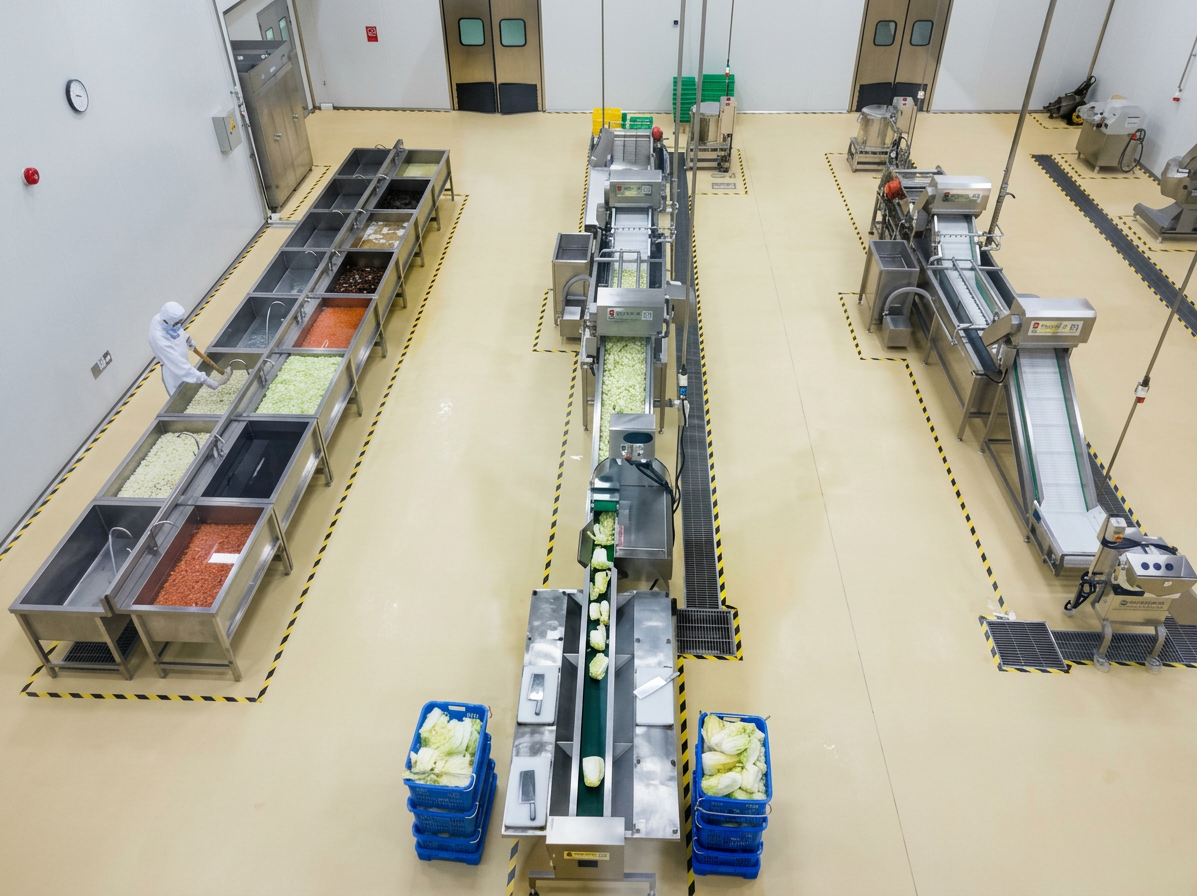
1. Receiving Must Control Status, Not Merely Count Deliveries
Receiving is the first production control point even when it is not classified as a critical control point in the facility’s food-safety plan. The team should identify the supplier, product, lot, quantity, delivery condition, packaging integrity and applicable temperature before the material enters released storage.
Accepted, rejected and held materials must remain distinguishable. A quarantined pallet placed beside released inventory without clear physical or electronic status can enter production accidentally. The handoff to storage should therefore occur only after an authorized acceptance decision.
Useful receiving metrics include vehicle waiting time, dock-to-storage time, percentage of deliveries arriving outside specification, quantity placed on hold and supplier-related rejection frequency. Appointment scheduling matters because simultaneous arrivals can overwhelm inspection space and leave temperature-sensitive materials waiting at the dock.
2. Storage Release Should Follow the Production Pull Rate
Raw storage protects materials only while inventory identity, stock rotation and temperature remain controlled. The production team should issue materials by confirmed order, lot and quantity rather than moving an entire shift’s supply onto the processing floor at once.
A practical release record identifies the production order, source lot, quantity, release time, destination and responsible operator. This creates a traceable connection between incoming materials and finished packs.
Over-staging creates several problems simultaneously: aisles become temporary storage, chilled materials spend longer outside controlled rooms, production priorities become unclear, and operators may select the most convenient container rather than the assigned lot. The issue quantity should therefore reflect what the next operation can absorb within its permitted dwell time.
3. Sorting, Trimming and Peeling Establish Yield and Downstream Stability
Low-hygiene preparation may include removing outer packaging, sorting, trimming damaged material, peeling, coring and preliminary soil removal. These tasks are often labor-intensive because raw-material variability is difficult to standardize completely.
The stage should be measured by accepted kilograms released downstream, not by kilograms placed on the worktable. Excessive trimming reduces yield and increases waste cost, while insufficient trimming transfers defects into cutting, washing and final inspection.
Yield should be monitored by product family and incoming lot:
Preparation yield (%) = acceptable prepared weight ÷ received raw weight × 100
The number must be interpreted with the raw-material specification. A lower yield does not automatically indicate poor operator performance if the incoming lot contains more soil, damaged tissue or non-usable portions.
Waste should leave through a defined route that does not cross clean product or clean-container movement. Workstation height, reach distance, container weight and repetitive knife work also require review. Mechanization may reduce selected lifting, peeling or cutting tasks, but ergonomic improvements and standardized work can be appropriate before full automation.
4. Cutting Must Be Controlled by Product Specification and Downstream Demand
Cut size affects more than appearance. It can influence portion weight, packing density, cooking consistency, mixing distribution and customer acceptance. Control therefore requires a defined specification, suitable raw-material condition, correct blade or cutting set, stable feeding and periodic verification.
Machine nameplate capacity does not describe the full cutting operation. Operators may need to orient products, remove oversized pieces, refill hoppers, inspect output and clear unsuitable material. Sustainable throughput should include these activities as well as minor stops.
Useful measures include accepted kilograms per operating hour, percentage within cut specification, recut quantity, damaged product, blade-change frequency and cleaning time. The cutting section should not continue producing simply because its machine is available when the washing or packing section cannot accept additional material.
5. Washing Requirements Depend on the Product and Intended Use
Washing may remove soil, loose debris, insects, tissue fluids or other visible contamination. For some RTE products, the process may also include a controlled antimicrobial intervention. These objectives should not be merged into the vague instruction to “wash thoroughly.”
A root-crop pre-wash, an RTC leafy-vegetable wash and an RTE salad process may require different stages, water conditions, monitoring and post-wash protection. When a sanitizer is part of a validated process, relevant parameters may include concentration, pH, contact time, water temperature, organic load, replacement frequency and actual product loading. Adding chemical cannot compensate for excessive soil, weak hygiene zoning or recontamination after washing.
Water can become a transfer medium when contaminated product and cleaner product share poorly controlled water or surfaces. The washing handoff should therefore specify both output quality and process completion: visible condition, completed control checks, lot identity and release to the correct downstream zone.
6. Dewatering and Draining Must Match Washing Output
Excess surface water can interfere with weighing, packaging appearance, dressing or marinade concentration and downstream handling. Dewatering requirements should be expressed as a measurable finished-product condition rather than an instruction to run the machine for a fixed time regardless of product.
Leafy vegetables, dense cut roots and delicate herbs respond differently to centrifugal force, residence time and handling. Excessive mechanical action may damage tissue, while inadequate dewatering can transfer unnecessary water into packaging.
Dewatering frequently becomes a hidden bottleneck because a nominally continuous washing section feeds a batch operation. The map must include loading, acceleration, cycle time, deceleration, unloading, basket handling and any waiting between cycles. Product leaving an RTE wash also requires protected transfer so that clean output does not return through the lower-hygiene route used by incoming materials.
7. Inspection, Mixing, Portioning and Packing Form the Finished-Product Handoff
Final inspection should have a defined purpose: cut conformance, visible foreign material, product damage, recipe accuracy, weight or packaging condition. It should not become an unlimited manual correction area that hides failures upstream.
Mixing and recipe assembly require lot traceability for every component. Packaging materials should enter by a clean route, remain protected and be verified against the production order. Label checks may include product identity, lot or batch code, use-by information, storage instruction and destination, depending on the product and regulatory system.
The packing rate must be included in line balancing. A high-output preparation line can create congestion if sealing, weighing or label verification is slower. Finished packs awaiting refrigeration need a defined maximum quantity, dwell time, temperature condition and release status.
8. Chilling and Distribution Are Production Stages, Not Logistics Afterthoughts
The cold chain does not begin when the delivery vehicle leaves. It begins when the product first requires temperature control and continues through processing, packing, cooling or temperature equilibration, storage, dispatch staging, loading, transport and customer receipt.
Cold-room air temperature is not a substitute for product-temperature control. Warm product placed into an overloaded room may cool more slowly than expected, particularly when containers are tightly packed or airflow is obstructed. The workflow should define whether the product enters packing already chilled or requires a pull-down step after packing.
For U.S. retail and food-service operations, the FDA Food Code uses 5°C or 41°F or less as the general cold-holding benchmark for time/temperature control for safety food. USDA consumer-oriented refrigeration guidance commonly uses 4.4°C or 40°F or below. These figures are reference points, not universal design limits. The applicable local law, product hazard assessment, customer specification, packaging system and validated shelf-life conditions should govern the project.
Dispatch controls may include order identity, product temperature, vehicle condition, loading start and finish time, route, seal status and receiving confirmation. A refrigerated vehicle cannot recover all temperature abuse created by excessive staging at a warm loading dock.
Define the Acceptance Rule at Every Handoff
A handoff occurs whenever responsibility moves from one team, zone, operation or control system to another. Unclear handoffs produce the familiar statement, “We thought the previous section had already checked it.”
Each handoff should answer five questions:
- What product and lot are being transferred?
- What output specification must be met?
- What quantity and temperature are acceptable?
- Which record proves that required controls were completed?
- Who accepts the product and what happens if it is outside specification?
| Handoff | Typical Acceptance Criteria | Core Record | Buffer Rule |
|---|---|---|---|
| Receiving to raw storage | Correct supplier and lot, packaging acceptable, required temperature and condition met | Receiving and deviation record | Unreleased material remains physically or electronically controlled |
| Storage to preparation | Correct order, lot, quantity and stock-rotation status | Material issue or batch-pick record | Issue only what preparation can absorb within the staging limit |
| Trimming to cutting | Defects removed, prepared yield recorded, product suitable for cutting | Yield and waste record | Maximum container count and dwell time displayed |
| Cutting to washing | Cut specification met, damaged or oversized pieces controlled | Cut-quality check | Upstream stops when protected wash-feed capacity is full |
| Washing to dewatering | Required stages completed, applicable wash controls within limits | Wash-process monitoring record | Clean product cannot wait in an uncontrolled raw-zone container |
| Dewatering to packing | Surface-moisture and product-condition specification met | Product inspection or release check | Queue sized to packing rate and permitted chilled dwell time |
| Packing to cold storage | Seal, weight, label, code and product identity verified | Pack and label verification record | Maximum time from pack completion to controlled storage defined |
| Cold storage to dispatch | Order complete, product released, temperature and vehicle condition acceptable | Dispatch and loading record | Staging quantity based on vehicle arrival and loading capacity |
Records do not need to be complex to be useful. FDA food-safety management guidance identifies several broad record categories, including prerequisite-program records, monitoring records, corrective-action records, verification and validation records, and calibration records. The format may be paper or digital, but responsibility, timing and deviation response must remain clear.
One-Way Flow Means Controlled Direction, Not Necessarily a Straight Building
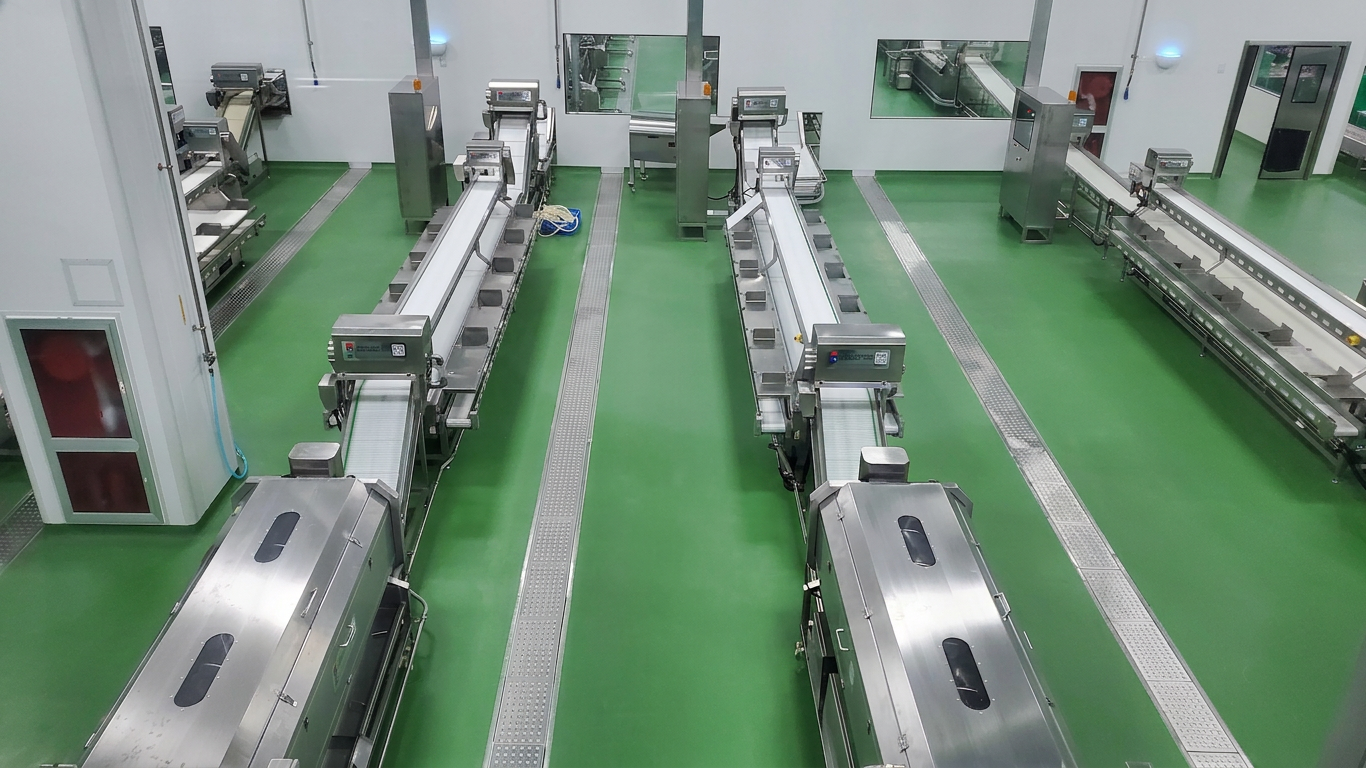
One-way product movement is intended to reduce return, crossing and confusion. It does not require every facility to be a long straight line. Existing buildings may need an L-shaped, U-shaped or multi-room arrangement. What matters is whether higher-risk incoming materials, clean products, waste, packaging and people have controlled routes.
The design review should trace at least six flows independently:
- Product flow: receiving through finished-product release.
- Personnel flow: entry, changing, hand hygiene, zone access and breaks.
- Clean packaging flow: protected storage to packing without unnecessary raw-zone exposure.
- Tools and reusable containers: dirty return, washing, sanitation, drying and clean release.
- Waste flow: trim waste, rejected product, packaging waste and wastewater-related activity.
- Maintenance flow: access for repair, parts and tools without uncontrolled entry into higher-hygiene production.
Where physical separation is impractical, carefully controlled time separation may be considered for suitable products. This requires defined production sequencing, complete line clearance, validated cleaning and sanitation, inspection, release and records. A line is not separated merely because RTC production occurs in the morning and RTE production begins later without proving that the transition controls are effective.
Zone boundaries should correspond to a change in operating rules. A painted floor line has little value when operators, carts, gloves, crates and cleaning tools cross it freely.
Queue and Buffer Design: Prevent Waiting Without Creating Uncontrolled WIP
A perfectly synchronized line with no buffer is vulnerable to every short interruption. An unlimited buffer hides bottlenecks, increases dwell time and consumes floor space. The practical objective is a controlled buffer that absorbs expected variation without allowing excessive work-in-process.
Common central kitchen buffers include:
- receiving or quarantine space awaiting release;
- production staging before raw preparation;
- a small decoupling buffer between batch and continuous operations;
- a hold area for product awaiting inspection or corrective action;
- temperature-equilibration space after packing;
- dispatch staging linked to a confirmed vehicle-loading time.
Every buffer should have a location, maximum quantity, maximum dwell time, product-status rule, temperature condition and named owner. Containers should preserve lot identity and prevent product from being mistaken for released finished goods.
A Simple Buffer Calculation
Planned buffer quantity = downstream consumption rate × intended recovery time
Consider a hypothetical line targeting 800 kilograms per hour. If the team wants enough protected WIP to cover a routine downstream interruption of ten minutes:
800 kg/hour × 10/60 hour = approximately 133 kg
This does not mean the buffer should automatically hold 133 kilograms. The project must still assess product temperature, container depth, fragility, lot separation, permitted dwell time and available hygienic space.
If the downstream operation stops for 20 minutes while upstream continues at 800 kilograms per hour, approximately 267 kilograms will accumulate. When the protected buffer holds only 150 kilograms, upstream must stop after roughly 11 minutes unless an approved alternative route exists. This is why stop logic is part of buffer design.
Use Sustainable Stage Capacity for Line Balance
Catalog capacity describes a machine under stated conditions. Line planning requires demonstrated sustainable capacity, including feeding, discharge, inspection, minor stops, changeover and cleaning allocation.
The effective line rate is normally constrained by the stage with the lowest sustainable output under the actual product mix:
Effective line throughput ≈ lowest sustainable critical-stage rate
A washer rated above the target does not solve a slower dewatering, inspection or packing operation. It may simply produce a larger queue.
| Metric | Calculation | What It Reveals |
|---|---|---|
| Actual throughput | Accepted finished kilograms ÷ operating hours | Delivered output after normal stops and handling |
| Yield | Accepted finished kilograms ÷ received raw kilograms × 100 | Usable conversion after trimming, defects and process loss |
| Labor intensity | Direct labor hours ÷ accepted output in 1,000 kilograms | How strongly volume depends on staffed manual work |
| Preparation cost | Relevant preparation cost ÷ accepted kilograms | Economic effect of labor, waste, utilities and operating inputs |
| Downtime rate | Unplanned stopped time ÷ scheduled production time × 100 | Reliability and recovery performance |
| Capacity utilization | Actual sustainable output ÷ demonstrated available capacity × 100 | Whether the line is underused, balanced or persistently overloaded |
| On-time production | Orders completed by required time ÷ total orders × 100 | Whether throughput supports the commercial delivery schedule |
| WIP dwell time | Time entering buffer to time leaving buffer | Exposure to delay, temperature change and schedule instability |
Where RTC and RTE Workflows Must Diverge
Ready-to-cook products are intended to receive a later cooking step. Ready-to-eat products may reach the consumer without another kill step. This distinction changes the consequence of contamination after washing, cutting, dewatering or packing.
The two categories may use the same supplier receiving system or raw-material identification procedure, but the workflow should show the point at which their routes diverge. Depending on the hazard assessment, the RTE route may require stronger separation, dedicated tools or equipment, controlled personnel entry, more detailed wash-process monitoring, protected post-wash transfer, stricter sanitation verification and tighter packing controls.
The existence of a later cook step does not make RTC handling uncontrolled. Raw proteins, allergens, foreign material, time outside refrigeration and lot identity still require management. The distinction is that the downstream cooking process may provide a validated risk-reduction step that is absent from many fresh-cut RTE products.
Projects considering shared RTC and RTE equipment should account for the complete transition: product removal, disassembly where required, cleaning, sanitation, rinsing where applicable, inspection, verification, release, tool control and production records. Sharing based only on a lower purchase price can transfer cost into longer changeovers, sanitation labor, testing, scheduling restrictions and higher operating risk.
Translate the Workflow into Equipment Requirements
Once the future-state workflow is agreed, each process stage can be converted into an equipment requirement specification. The specification should define:
- incoming raw-material size, temperature and condition;
- required finished format and acceptable variation;
- minimum sustainable output and peak requirement;
- maximum product hold-up inside the machine;
- feeding, discharge and transfer method;
- permitted product damage and yield expectations;
- changeover frequency and SKU sequence;
- cleaning access, disassembly and inspection requirements;
- operator positions and manual intervention;
- water, power, drainage, compressed-air or refrigeration needs;
- failure response, bypass options and restart procedure;
- maintenance access, wear parts, spare parts and service plan;
- future expansion and connection to downstream modules.
Equipment examples should be evaluated in this context. A staged batch washer such as the TW-475 can divide washing into independently timed stages and has a published batch capacity of 15–20 kilograms. That may suit products needing controlled batch treatment, but it must be assessed against required cycles, loading labor, water-management logic and downstream dewatering capacity.
A fully automated vegetable dewatering system such as the TW-980LB has a published catalog capacity of 0.6–1.2 tonnes per hour. The appropriate operating rate still depends on the vegetable, cut form, incoming surface water, required moisture condition, cycle settings and the ability of packing to accept its output.
These examples demonstrate why equipment capacity should not be copied directly into a project throughput promise. Raw-material testing and line-level calculations are needed to determine whether an individual machine supports the intended workflow.
Comparison: Manual, Semi-Automated and Integrated Workflows
| Approach | Where It Can Fit | Advantages | Main Risks |
|---|---|---|---|
| Predominantly manual | Low or irregular volume, frequent recipe changes, delicate products, skilled trimming or early-stage operations | Low initial investment, high flexibility and rapid adaptation to new SKUs | Labor dependency, variable output, repetitive work, inconsistent methods and limited scale |
| Semi-automated | Stable high-labor stages combined with variable inspection, trimming, feeding or packing | Targets the main bottleneck while preserving manual judgment and product flexibility | Manual transfers may remain; stage capacities can become mismatched if integration is ignored |
| Integrated line | Stable product families, repeatable specifications, sustained demand and enough volume to use the line effectively | More predictable flow, reduced manual handling and stronger control of repeatable operations | Higher capital exposure, synchronized downtime, more demanding sanitation, maintenance and changeover planning |
Manual handling remains reasonable when demand is low, products change constantly or skilled visual judgment adds value. The priority may be clearer work instructions, better workstation design, improved containers and a more disciplined production schedule.
Semi-automation is often appropriate when one or two operations create most labor pressure or delay. A cutter, peeler, washer, dewatering machine, conveyor or weighing system can improve a constrained step while people continue to handle variable trimming, inspection and recipe changes.
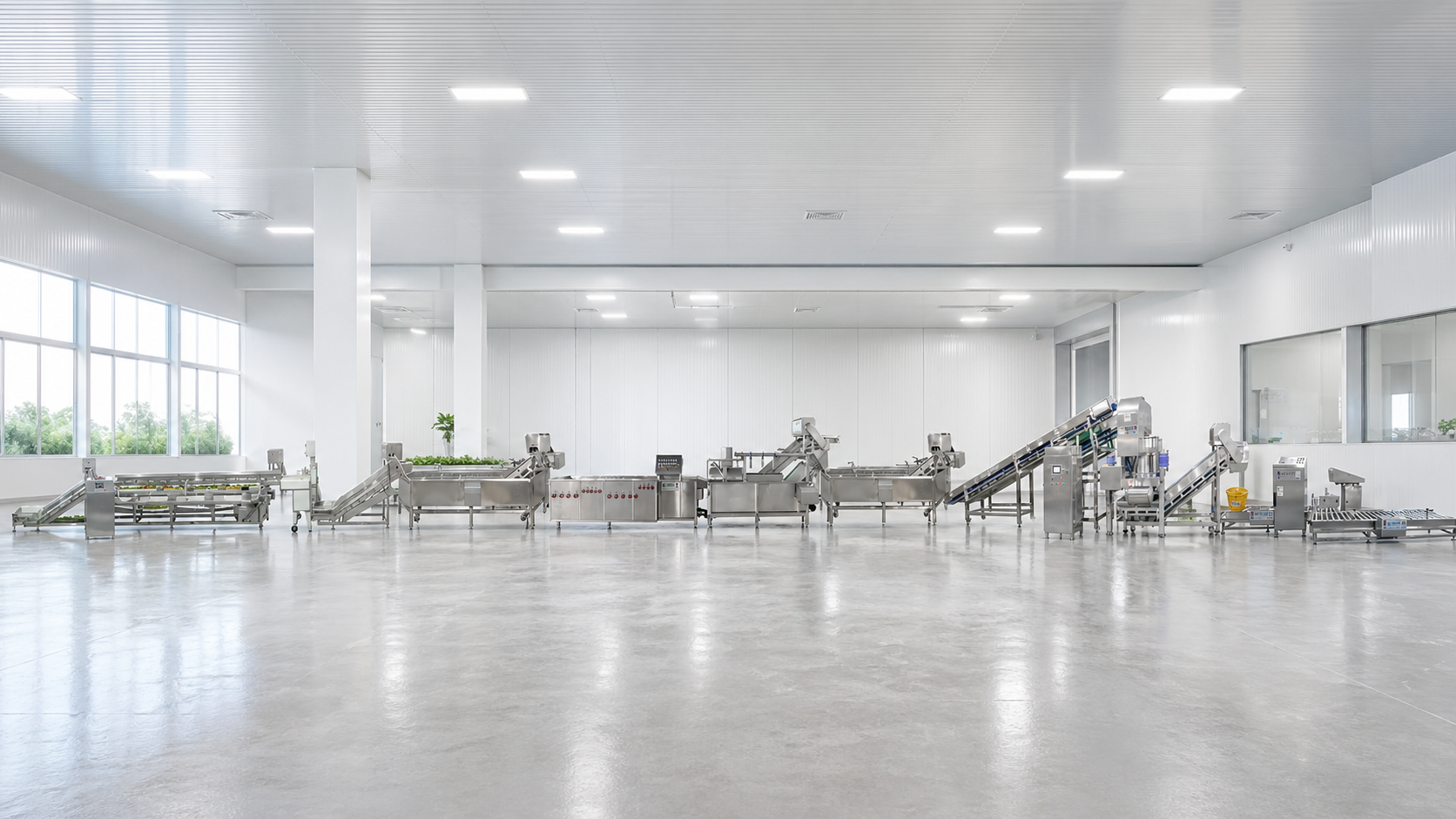
An integrated line becomes commercially meaningful when demand is repeatable enough to support it, the product families are compatible, upstream supply is stable, sanitation can be executed, downstream packing and refrigeration are ready, and maintenance resources are available.
Recruitment difficulty, absenteeism, training time and turnover may strengthen the case for mechanizing repetitive tasks, but they should be measured locally. Automation does not remove the need for trained operators. It changes the required skills toward setup, monitoring, sanitation, troubleshooting, quality control and preventive maintenance.
When the Workflow Should Not Be Fully Automated
Full-line automation may be unsuitable when:
- daily output is too low to use the installed capacity;
- the SKU schedule changes faster than the line can change over;
- raw-material variability prevents stable feeding or machine settings;
- seasonal demand creates long periods of underutilization;
- manual trimming or inspection is essential to product value;
- actual yield, cycle time and labor baselines have not been measured;
- packing, refrigeration or dispatch cannot absorb additional output;
- the facility cannot provide adequate drainage, utilities or sanitation access;
- maintenance staff, spare parts and response procedures are not available;
- the expected commercial benefit depends on an unverified sales forecast.
Automation also creates new risks. A connected line can stop when one critical module fails. Excessive conveyor speed may damage delicate product. Larger internal product hold-up can increase loss during a deviation. Complex equipment may extend sanitation time when cleanability was not assessed. Operators may also assume an automated wash or dosing system makes verification unnecessary.
Incorrect equipment selection can result in lower yield, unstable cuts, excessive water use, product damage, insufficient washing contact, undersized dewatering, packing queues and a line that reaches its catalog rate only during short demonstrations.
The correct response is often phased automation. Stabilize the workflow, establish baseline data, improve the dominant bottleneck, verify the result and add the next stage when demand and operating capability justify it.
Evaluate ROI at Process Level
A payback model should include the complete installed and operating effect, not only the machine purchase price.
Annual verified net benefit = labor and overtime reduction + recoverable yield value + reduced rework or waste + contribution from additional accepted demand − added utilities, sanitation, maintenance, consumables and service cost
Simple payback period = net installed investment ÷ annual verified net benefit
Net installed investment may include equipment, freight, duties, foundations, drainage, power distribution, water systems, refrigeration changes, guarding, conveyors, installation, commissioning, training and initial spare parts.
The calculation should use observed baseline data and conservative operating assumptions. Labor hours cannot be counted as savings when employees remain necessary elsewhere in the same process unless their time is genuinely removed, reassigned to productive work or avoids future hiring. Additional theoretical capacity has no value when the business lacks demand, packaging capacity, chilled storage or delivery capability.
Yield improvements should also be verified by product tests. A small change in trimming loss can matter commercially for expensive raw materials, but no universal improvement percentage should be assumed across different products and suppliers.
What the Workflow-Mapping Workshop Should Produce
A useful project workshop should begin with production evidence rather than a preferred equipment list. The team should bring:
- raw-material photographs, dimensions and seasonal samples;
- finished-product specifications and packaging formats;
- daily demand and peak hourly demand by SKU;
- current labor by task and shift;
- measured cycle times, waiting time and cleaning time;
- raw and finished weights for yield calculations;
- temperature and dispatch requirements;
- customer audit, allergen, RTC and RTE requirements;
- available layout, column positions, doors, drains and utilities;
- planned growth and likely future product families.
The resulting project package should contain:
- a current-state workflow showing actual movement and delays;
- a future-state process flow by product family;
- a hygiene-zone and controlled-crossing diagram;
- a stage-capacity and line-balance table;
- a buffer matrix defining quantity, dwell time and status;
- a handoff and control-record matrix;
- equipment requirement specifications;
- a preliminary layout and utility direction;
- a testing plan for uncertain products or processes;
- a phased investment plan linked to verified demand.
This package allows equipment suppliers, food-safety teams, production managers and building engineers to evaluate the same operating concept. Without it, different parties may optimize different parts of the project and produce a facility that contains suitable individual machines but an unsuitable overall process.
View the Complete Process and Layout Requirements
Before requesting a final equipment configuration, document your raw materials, finished formats, RTC or RTE status, daily and peak-hour output, SKU schedule, current labor, available floor plan, cold-storage capacity, dispatch windows and hygiene requirements.
TEEMYEAH supports central kitchens, food manufacturers, fresh-cut processors and RTC/RTE facilities as a food pre-processing equipment supplier and customized food preparation solution provider. A preliminary evaluation can cover the process sequence, capacity matching, buffer requirements, equipment configuration, layout direction and raw-material testing needs.
The objective is to develop a line concept that can be operated, cleaned, monitored and expanded—not simply to assemble the largest possible machine list.
FAQ
1. What is a central kitchen workflow?
A central kitchen workflow is the defined movement of ingredients, information and responsibility from receiving through preparation, packing, storage and distribution. It identifies every process step, product status, hygiene zone, handoff, buffer, control record and release decision. A complete workflow also covers personnel, tools, packaging, waste and chilled logistics. It should be mapped before equipment is selected because the required machine capacity and layout depend on the process sequence, SKU mix, permitted waiting time and downstream demand.
2. Should vegetables be cut before washing or washed before cutting?
The correct order depends on the raw material, contamination load, intended product and validated process. Muddy root vegetables may need preliminary washing before peeling or cutting. Some leafy-vegetable processes remove damaged outer leaves, cut the product and then use staged washing to remove debris and tissue fluids. RTE products may require more tightly controlled post-cut washing and protected transfer. The sequence should be based on hazard assessment, product quality, water management and testing rather than a universal rule.
3. How much WIP buffer should a central kitchen include?
The buffer should cover expected short interruptions without allowing excessive dwell time or uncontrolled accumulation. A starting calculation is downstream consumption rate multiplied by the intended recovery time. The result must then be checked against product temperature, fragility, container depth, lot separation, hygiene-zone space and maximum permitted waiting. Each buffer needs a maximum quantity, maximum dwell time, product-status rule and stop instruction. A larger buffer is not automatically safer or more efficient because it may conceal a persistent bottleneck.
4. How is actual central kitchen throughput calculated?
Actual throughput is accepted finished output divided by genuine operating time. The measurement should include normal feeding, discharge, inspection and minor stops, while planned sanitation or full changeover time may be reported separately. For multi-SKU facilities, throughput should be recorded by product family because one rate cannot represent lettuce, potatoes and poultry accurately. The effective line throughput is usually limited by the slowest sustainable critical stage, not the machine with the highest catalog capacity.
5. Can RTE and RTC products use the same processing line?
Shared use may be possible for some products, but it requires a documented risk assessment and a controlled transition between categories. The change may involve line clearance, disassembly, cleaning, sanitation, inspection, verification, dedicated tools and formal release before RTE production begins. Shared drains, carts, containers, personnel routes or post-wash areas can undermine separation even when the main washing machine has been cleaned. Dedicated routes are generally easier to control when RTE volume and risk justify them.
6. When is manual food preparation still the better option?
Manual preparation can remain appropriate when volume is low, demand is irregular, recipes change frequently, raw materials vary widely or skilled trimming contributes to product quality. It can also be sensible during market testing before demand is proven. The process should still use standard work, ergonomic stations, controlled containers, yield measurement and traceability. Semi-automation may become preferable when one repetitive operation creates most labor pressure while the rest of the process still requires human judgment.
7. What records are needed at central kitchen handoffs?
The required records depend on the product and food-safety system, but common examples include receiving checks, material-issue records, yield and waste records, cut-quality checks, wash-process monitoring, sanitation release, packing and label verification, product-temperature logs, corrective actions, calibration and dispatch records. Each record should identify the product or lot, time, result, responsible person and response to a deviation. Recording information that no one reviews does not create control; verification responsibility must also be assigned.
8. What temperature should chilled central kitchen products maintain?
The correct limit depends on the food, hazard analysis, local regulation, packaging, shelf-life validation and customer specification. As a U.S. food-service reference, the FDA Food Code generally requires time/temperature control for safety food to be held at 5°C or 41°F or less. USDA consumer refrigeration guidance uses 4.4°C or 40°F or below. A project should not copy either number without confirming its applicable regulatory and product requirements. Product temperature, not only cold-room air temperature, must be considered.
9. How can a central kitchen identify its real bottleneck?
Measure the sustainable accepted output, waiting time, downtime and WIP accumulation at every stage during a representative production schedule. The bottleneck is usually the operation that constrains completed output or repeatedly causes upstream waiting and downstream starvation. It may change by SKU: trimming can constrain one product, washing another and packing a third. Catalog capacities alone cannot identify it. Changeover, sanitation, labor availability, feeding and discharge must be included in the analysis.
10. What information is required before selecting central kitchen equipment?
Provide the raw materials, incoming dimensions and condition, finished specifications, daily and peak-hour output, SKU schedule, batch sizes, current process, RTC or RTE status, target product temperature, packaging format, cleaning requirements, available space and utilities. Layout drawings and representative raw-material samples are particularly valuable. The supplier should also understand future expansion, maintenance resources and customer audit requirements. This information allows equipment to be matched to the workflow instead of forcing the workflow around a preselected machine.
Data and Source Note
This article uses the FDA Food Code 2022, FDA retail and food-service HACCP materials, the Codex General Principles of Food Hygiene, the WHO Five Keys to Safer Food, USDA refrigeration guidance, CDC outbreak-investigation resources and OSHA ergonomics guidance as general reference frameworks.
The FDA Food Code is a model code intended for adoption by relevant U.S. jurisdictions; it is not automatically federal law for every central kitchen. Codex and WHO materials provide internationally relevant hygiene principles but do not replace national regulation, customer standards or a product-specific hazard analysis.
The CDC percentages cited in the introduction cover 2,677 reported U.S. outbreaks from 2014 through 2022 with one or more identified contributing factors. They describe the investigated outbreak dataset and should not be interpreted as a central-kitchen incident rate or a prediction for an individual facility.
All buffer calculations and line-balance examples are illustrative calculations, not operating limits. Published equipment capacities are manufacturer specifications and should be confirmed against actual raw materials, process settings and acceptance criteria through testing. ROI and payback must be calculated using project-specific verified costs, demand and operating performance.

