







Summary
A successful central kitchen is not defined by the amount of automation it contains. It is defined by whether the entire production system consistently delivers safe food, predictable throughput, stable product quality, and the flexibility to support future business growth.
This central kitchen planning guide explains how to move from business requirements to an installation-ready food preparation facility. Rather than asking whether automation should be adopted, it focuses on the broader decisions that determine whether a project will perform as intended after commissioning. These include business objectives, SKU strategy, production capacity, process flow, hygienic zoning, equipment matching, building utilities, validation, and supplier collaboration.
The guide also explains where manual operations remain appropriate, where semi-automated processing offers the best balance, and where integrated production lines become commercially justified. Automation alone cannot compensate for poor workflow, inadequate sanitation planning, unrealistic throughput assumptions, or weak production management.
The framework applies to central kitchens, food manufacturers, fresh-cut vegetable processors, ready-to-cook (RTC) producers, ready-to-eat (RTE) facilities, airline catering and institutional catering, and companies expanding multi-site food production. It is intended to help project teams reduce planning risk before equipment procurement begins while providing a structured roadmap for future layout design and equipment selection, validation, and supplier evaluation.
Introduction

Many food production projects begin with a discussion about equipment. Experienced project teams usually begin somewhere else.
Before selecting washers, cutters, peelers, conveyors, mixers, or packaging systems, successful projects define what the business is trying to achieve. That may involve reducing labor dependency, supporting additional retail customers, improving batch consistency, expanding into ready-to-cook products, increasing food safety controls for ready-to-eat production, or building sufficient capacity for future expansion.
Those business objectives eventually influence every engineering decision inside the facility.
A central kitchen serving twenty restaurant locations operates differently from a fresh-cut vegetable processor supplying supermarkets. Likewise, a ready-to-eat salad facility has significantly different hygienic requirements from a ready-to-cook vegetable preparation center because RTE products may not receive a further pathogen-killing step before consumption. Under preventive food safety systems such as the U.S. Food Safety Modernization Act (FSMA), facilities are expected to identify hazards, implement preventive controls, verify those controls, and maintain documented records rather than relying primarily on end-product inspection.
Planning therefore becomes an exercise in designing a production system instead of purchasing individual machines.
This guide presents that planning framework from the perspective of business decision makers, engineering teams, production managers, procurement professionals, and factory planners.
It intentionally complements—not duplicates—our article When Should a Central Kitchen Automate Food Preparation?
That article discusses automation timing. This guide explains how an entire facility should be planned regardless of whether individual processes remain manual, become semi-automated, or evolve into integrated production lines.
How to Use a Central Kitchen Planning Guide to Define Business Requirements
The most common planning mistake is allowing equipment discussions to begin before defining business requirements.
Machines rarely fail because of their mechanical capability. More often, projects underperform because the production system was designed around assumptions that later prove inaccurate.
Typical planning questions include:
- How many SKUs will be produced?
- What is the expected daily throughput?
- Which products generate the highest margin?
- What seasonal fluctuations exist?
- Are products sold chilled, frozen, or freshly prepared?
- Which customers impose specific audit or traceability requirements?
- What expansion is expected during the next five years?
Without these answers, even technically capable equipment may become a constraint.
For example, a vegetable washing system designed for continuous high-volume processing may be inappropriate for a business producing dozens of short production runs with frequent sanitation changeovers.
Conversely, a manual preparation room that works efficiently for ten restaurant locations may become overwhelmed when supplying one hundred stores.
Business strategy therefore becomes the first design document.
Define Success Before Designing the Process
Instead of asking,
“How many kilograms per hour should this machine process?”
begin by asking,
“What business outcome should this facility achieve?”
Examples include:
| Business Objective | Planning Implication |
|---|---|
| Reduce labor dependency | Analyze labor hours, ergonomics, recruitment challenges, absenteeism, and operator consistency before considering automation. |
| Improve food safety | Review hygienic zoning, sanitation procedures, environmental monitoring, allergen management, and preventive controls. |
| Expand distribution | Evaluate future throughput, storage capacity, dispatch scheduling, and production flexibility. |
| Increase SKU diversity | Prioritize rapid changeovers, modular equipment, and simplified cleaning procedures. |
| Improve product consistency | Focus on standardized cutting, mixing, weighing, batching, and documented process controls. |
The production system should support these objectives without becoming unnecessarily complex.
Understand the Difference Between Business Capacity and Equipment Capacity
Many feasibility studies rely on equipment specifications alone.
That creates unrealistic expectations.
Equipment suppliers often publish theoretical capacities under controlled operating conditions. Actual production depends on many additional variables:
- raw material variability
- operator performance
- sanitation interruptions
- product changeovers
- upstream bottlenecks
- downstream packaging speed
- inspection activities
- maintenance
- product quality requirements
The practical question is not:
“How fast can the cutter operate?”
It is:
“How much saleable product leaves the facility every hour?”
Those are different measurements.
Theoretical Capacity vs. Actual Throughput
An installation-ready facility should distinguish between several performance metrics.
| Metric | Definition | Why It Matters |
|---|---|---|
| Theoretical Capacity | Maximum equipment output under ideal conditions | Useful for equipment comparison |
| Actual Throughput | Average production achieved during normal operation | Determines production planning |
| Capacity Utilization | Actual output ÷ Available capacity | Indicates whether additional investment is justified |
| Yield Percentage | Saleable product ÷ Incoming raw material | Influences profitability |
| Labor Hours per 1,000 kg | Total labor ÷ Production volume | Helps compare manual and automated processes |
| Downtime Rate | Planned + unplanned stoppage time | Reveals operational losses |
An illustrative calculation demonstrates the difference.
Illustrative example
Theoretical cutter capacity:
600 kg/hour
Average sanitation:
30 minutes every 4 hours
Upstream washing delay:
10%
Product changeover:
20 minutes twice daily
Actual shift throughput becomes substantially lower than multiplying 600 kg/hour by operating hours.
This difference often explains why projects with apparently sufficient equipment still miss production targets.
SKU Strategy Often Determines the Entire Factory Layout
Some central kitchens process only five products.
Others produce hundreds.
The number of stock keeping units (SKUs) affects nearly every planning decision.
High-volume, low-SKU production favors continuous flow.
High-SKU operations prioritize flexibility.
High SKU Facilities
Characteristics include:
- frequent product changes
- smaller production batches
- repeated sanitation cycles
- diverse cutting specifications
- changing packaging formats
- more production scheduling complexity
Planning priorities become:
- modular equipment
- flexible conveyors
- accessible cleaning
- simplified line reconfiguration
- reduced changeover time
Low SKU Facilities
Facilities producing limited product ranges often emphasize:
- continuous flow
- higher throughput
- larger batch sizes
- simplified logistics
- fewer interruptions
These projects frequently justify greater integration between washing, cutting, dewatering and conveying, mixing, and packaging because utilization remains consistently high.
Neither approach is universally better.
The correct solution depends on commercial requirements rather than engineering preference.
Product Characteristics Matter More Than Many Planning Teams Expect
Food preparation facilities process biological materials rather than standardized industrial components.
Raw materials vary continuously.
Differences may include:
- seasonal moisture
- maturity
- size distribution
- soil contamination
- temperature
- sugar content
- leaf structure
- firmness
- peel thickness
Fresh-cut vegetable processors often experience seasonal variation that influences washing efficiency, peeling performance, cutting quality, and final yield.
A planning exercise that ignores raw-material variability risks selecting equipment optimized only for laboratory conditions.
Instead, project teams should define:
- expected raw material range
- acceptable finished-product specification
- allowable trimming losses
- acceptable product damage
- required cut consistency
- downstream cooking or packaging requirements
Whenever practical, production trials using representative raw materials provide better planning data than relying exclusively on catalogue specifications.
Process Flow Before Equipment Selection

Equipment should follow process flow—not define it.
Every production system can be represented as a sequence of value-adding operations.
For many vegetable preparation facilities, the simplified sequence resembles:
Receiving → Inspection → Washing → Sorting → Peeling → Cutting → Washing (if required) → Dewatering → Mixing → Portioning → Packaging → Cold Storage → Dispatch
Not every facility uses every step.
Ready-to-cook production may eliminate secondary washing after cutting.
Ready-to-eat products may require additional hygienic controls, environmental monitoring, validated sanitation procedures, and stricter segregation because consumers may eat the product without another pathogen-reduction step. FDA’s preventive controls framework explicitly emphasizes sanitation controls, monitoring, verification, employee training, and documented corrective actions where appropriate.
Mapping the Process Before Purchasing Equipment
A useful planning exercise is to document every step using four questions.
- What enters this operation?
- What leaves this operation?
- What could delay this operation?
- How will this step be cleaned and verified?
Repeating these questions throughout the process often identifies hidden constraints before construction begins.
Typical production bottlenecks include:
- insufficient washing capacity
- manual inspection stations
- dewatering limitations
- packaging speed
- cold-room staging
- forklift traffic
- sanitation changeovers
Many expensive production interruptions originate outside the machine that appears to be causing delays.
A well-balanced production line therefore focuses on the interaction between operations rather than maximizing the speed of a single piece of equipment.
*(Part 2 continues with hygienic zoning, line balancing, equipment matching, building interfaces, utilities, validation and acceptance, when manual, semi-automatic, or fully integrated approaches are appropriate, common planning mistakes, CTA, FAQ, verified references, and suggested internal links.)
Hygienic Zoning: Designing the Facility Around Food Safety, Not Just Equipment
A production line can only perform as well as the environment in which it operates. Even when equipment is correctly specified, poor hygienic zoning increases the likelihood of cross-contamination, inefficient cleaning, unnecessary product movement, and operational delays.
For central kitchens, hygienic zoning should be established before equipment locations are finalized. The objective is to separate activities according to their contamination risk while maintaining efficient product flow from receiving to dispatch.
Although the exact zoning strategy varies by product, a practical planning model typically includes:
| Zone | Typical Activities | Primary Planning Focus |
|---|---|---|
| Raw Material Area | Receiving, inspection, initial washing, trimming | Soil removal, waste handling, traffic control |
| Intermediate Processing | Peeling, cutting, secondary washing, dewatering | Controlled product flow, equipment accessibility, operator safety |
| High-Hygiene Area | Mixing, portioning, RTE packaging | Personnel control, sanitation verification, environmental hygiene |
| Cold Storage & Dispatch | Finished product staging and shipment | Temperature control, traceability, loading efficiency |
The greatest planning challenge is not separating rooms—it is preventing unnecessary movement of products, employees, equipment, tools, and waste between different hygiene zones.
For ready-to-cook (RTC) products, subsequent cooking by the customer may provide an additional pathogen reduction step. That does not reduce the need for good manufacturing practices, but it does influence the overall risk assessment.
For ready-to-eat (RTE) foods such as fresh-cut salads, sandwiches, or prepared vegetables consumed without further cooking, hygienic controls become significantly more stringent because there may be no later opportunity to eliminate microbial hazards. This is reflected in preventive food safety regulations and internationally recognized hygiene principles.
The U.S. FDA’s Preventive Controls for Human Food rule emphasizes hazard analysis, preventive controls, sanitation controls where appropriate, monitoring, corrective actions, verification, and recordkeeping as part of a preventive food safety system rather than relying solely on end-product testing. See the FDA guidance on Preventive Controls for Human Food.
Similarly, the Codex General Principles of Food Hygiene describe hygienic design, contamination prevention, process control, sanitation, and personnel hygiene as integrated elements of food safety management rather than independent activities.
Process Flow Should Move in One Direction
One-way product movement reduces operational complexity.
Whenever practical, facility planning should minimize situations where:
- raw materials cross finished products
- waste exits through clean production areas
- clean equipment returns through dirty zones
- maintenance personnel repeatedly enter high-hygiene areas
- forklift routes intersect with pedestrian traffic
Simple directional flow often improves sanitation efficiency as much as additional equipment investment.
Hygienic Design Extends Beyond the Processing Line
The processing line is only one component of hygienic facility design.
Project teams should also review:
- handwashing station placement
- changing rooms
- boot sanitation points
- tool storage
- cleaning chemical storage
- waste collection routes
- floor drainage
- floor slope
- wall finishes
- ceiling accessibility
- compressed air quality where product contact is possible
European food hygiene legislation similarly requires food premises to support hygienic operation through appropriate design, construction, maintenance, and cleaning. See Regulation (EC) No 852/2004 on the Hygiene of Foodstuffs.
The objective is not simply regulatory compliance. Good hygienic design reduces cleaning time, improves operational consistency, and makes future production expansion easier.
Line Balancing and Equipment Matching: Designing the Entire Production System
Many production problems are incorrectly attributed to individual machines.
In reality, most throughput losses occur because adjacent operations are not balanced.
A cutting machine capable of processing 1,200 kg per hour provides little benefit if washing supplies only 700 kg per hour or if packaging can finish only 650 kg per hour.
The effective capacity of the line is determined by its bottleneck.
Planning therefore focuses on line balance rather than maximum machine capacity.
Equipment Should Be Selected as a Coordinated System
Typical vegetable preparation lines include multiple interconnected operations:
Receiving → Washing → Inspection → Peeling → Cutting → Washing (if required) → Dewatering → Mixing → Conveying → Portioning → Packaging
Each operation influences the next.
Questions that should be answered during planning include:
- Does upstream equipment consistently feed downstream equipment?
- Can surge accumulation be controlled without excessive work-in-progress inventory?
- How much buffer capacity is acceptable?
- Which operation has the longest cleaning time?
- Which process determines the overall production schedule?
- Which machine limits future expansion?
Oversizing every machine rarely produces the best outcome. Instead, capacity should be matched across the production line while allowing reasonable operational flexibility.
Practical Performance Indicators
Instead of relying only on equipment specifications, project teams should monitor operational metrics such as:
- throughput per hour
- yield percentage
- labor hours per 1,000 kg
- preparation cost per kilogram
- sanitation time
- changeover duration
- downtime rate
- on-time production rate
- customer order fulfillment
These indicators provide a more complete picture of production performance than equipment speed alone.
Hypothetical Capacity Matching Example
Hypothetical planning example
A central kitchen intends to process 4,800 kg of vegetables during one 8-hour production shift.
Assume:
- Planned sanitation: 40 minutes
- Planned product changeover: 20 minutes
- Expected operating efficiency: 90% during available production time
Available processing time:
8 hours = 480 minutes
480 − 40 − 20 = 420 minutes
Effective production time:
420 × 90% = 378 minutes
Required average throughput:
4,800 kg ÷ 378 minutes ≈ 12.7 kg per minute
≈ 762 kg/hour
In this example, selecting a cutter rated at 1,500 kg/hour while washing and packaging operate near 750 kg/hour provides little operational advantage. The project team would instead evaluate whether balanced capacities, reduced downtime, or future expansion justify additional investment.
The calculation is illustrative rather than prescriptive, but it demonstrates why production planning should be based on the complete process rather than a single machine specification.
Building Interfaces and Utilities Should Be Defined Before Installation
Equipment installation begins long before machines arrive on site.
An installation-ready facility requires coordination between production engineers, building designers, contractors, utility suppliers, and equipment manufacturers.
Late design changes involving utilities are often among the most expensive project modifications.
Typical Building Interfaces
Depending on the production process, planning may include:
- electrical supply
- water supply capacity
- hot water generation
- steam availability
- compressed air
- refrigeration systems
- drainage capacity
- wastewater handling
- ventilation
- humidity management
- lighting
- network connectivity
- production data infrastructure
Each utility should be evaluated against current production requirements and expected future expansion.
Space Planning Is More Than Equipment Footprint
Machine dimensions represent only part of the required floor area.
Additional space may be needed for:
- operator access
- sanitation activities
- maintenance clearance
- product inspection
- ingredient staging
- temporary pallet storage
- spare equipment movement
- forklift circulation
- waste handling
- emergency exits
Projects that maximize equipment density often become more difficult to clean, maintain, and expand.
Ergonomics and Occupational Safety
Facility planning should also consider the interaction between employees and equipment.
Manual trimming, repetitive cutting, lifting containers, awkward postures, and prolonged standing may contribute to musculoskeletal risks if workstation design is poor.
OSHA’s guidance on Ergonomics in Poultry Processing discusses broader ergonomic principles—including task design, repetition, force, and workstation layout—that are relevant to many food-processing environments where repetitive manual preparation occurs.
Similarly, moving equipment, conveyors, rotating components, and mechanical drives should be evaluated for safeguarding requirements. OSHA’s Machine Guarding resources outline principles for protecting employees from hazards associated with machinery.
Integrating safety considerations during facility planning is generally more effective than attempting to retrofit protective measures after installation.
Comparing Manual, Semi-Automatic, and Integrated Production Systems
The appropriate production model depends on business objectives, product characteristics, labor availability, customer requirements, and expected growth rather than on automation alone.
| Evaluation Factor | Manual Production | Semi-Automatic Production | Integrated Production Line |
|---|---|---|---|
| Initial investment | Lowest | Moderate | Highest |
| Labor dependence | High | Medium | Lower, but still requires skilled operators, sanitation, maintenance, and supervision |
| Production flexibility | Very high for small batches | High | Highest when designed for planned product families rather than unlimited variation |
| Throughput consistency | Operator dependent | Improved consistency | Most consistent when line balance is maintained |
| Changeover efficiency | May be simple but labor intensive | Often faster with modular equipment | Depends on hygienic design, product similarity, and cleaning requirements |
| Product standardization | Variable | Improved | Highest potential consistency when supported by process control |
| Suitable SKU profile | Small volumes, frequent changes | Mixed production environments | Medium to high volume with predictable demand |
| Expansion potential | Limited by labor availability | Incremental expansion possible | Supports long-term capacity planning when correctly specified |
| Typical planning priority | Workforce organization | Process optimization | System integration and lifecycle performance |
No column should be interpreted as universally superior.
A manual operation may be entirely appropriate for seasonal production, product development, highly customized orders, or businesses with low daily throughput.
Semi-automatic production often provides an effective balance for companies experiencing steady growth while maintaining diverse product portfolios.
Integrated production lines become commercially attractive when production volume, consistency requirements, labor availability, sanitation efficiency, and long-term expansion justify the additional planning complexity and capital investment.
The most successful facilities are rarely those with the highest degree of automation. They are the facilities in which business objectives, hygienic design, process flow, equipment matching, utilities, and operational management have been planned as one coordinated production system.
Commissioning, Validation, and Acceptance: Turning a Design into an Operating Facility
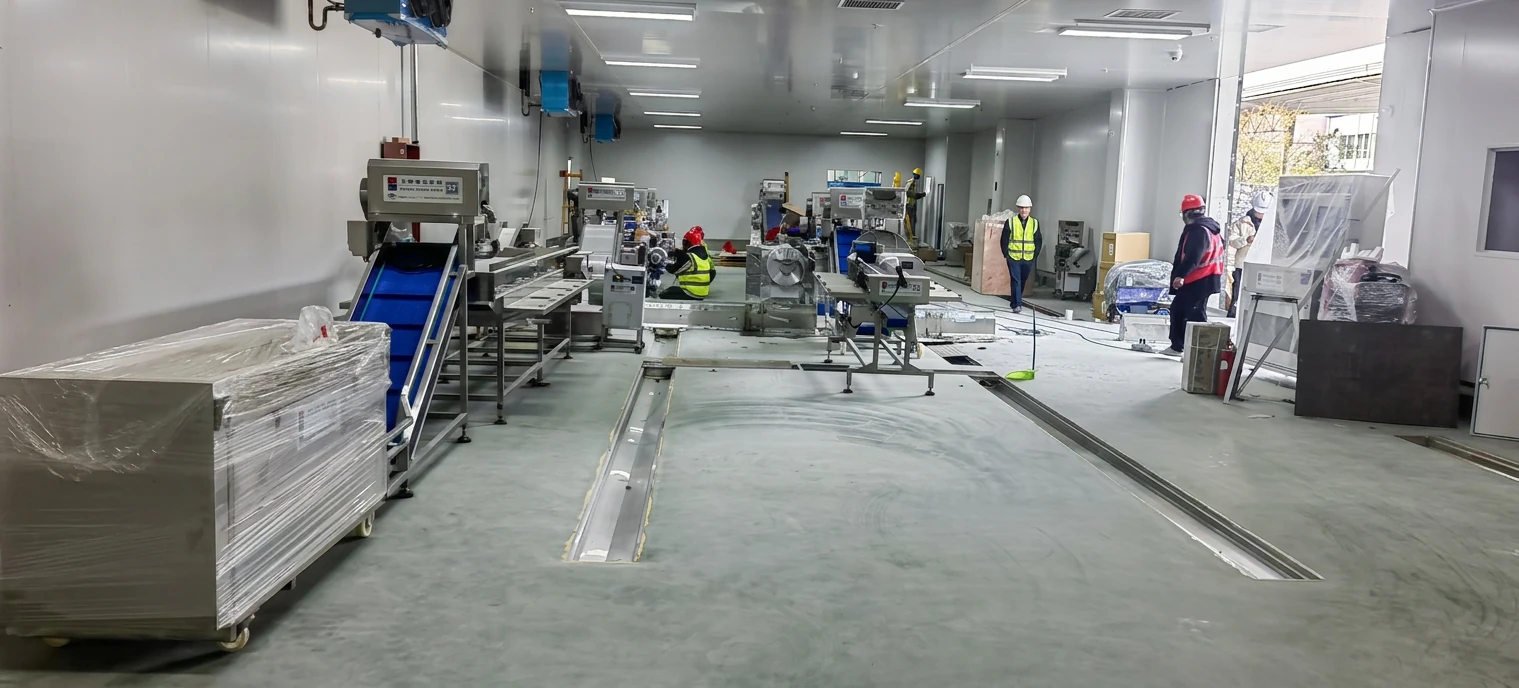
A central kitchen project is not complete when the equipment is delivered or mechanically installed. The true transition occurs during commissioning and validation, when the production system demonstrates that it can consistently meet the agreed operational, quality, and food safety objectives under normal working conditions.
Project teams sometimes focus heavily on factory acceptance while giving less attention to site acceptance and operational validation. In practice, installation conditions, utility stability, operator training, and product characteristics can significantly influence real-world performance.
An effective acceptance process should therefore evaluate the production line as an integrated system rather than testing each machine independently.
Typical Commissioning Stages
Although each project differs, commissioning commonly progresses through several phases:
- Mechanical completion
- Equipment installed according to approved layout
- Utilities connected
- Guards and safety devices verified
- Required documentation available
- Utility verification
- Electrical supply
- Water pressure and flow
- Compressed air
- Drainage
- Refrigeration or chilled water systems where applicable
- Functional testing
- Equipment starts, stops, and operates correctly
- Emergency stop systems function as intended
- Sensors and controls respond properly
- Conveyors, feeders, and downstream equipment communicate correctly
- Product trials
- Representative raw materials processed
- Target specifications evaluated
- Throughput measured
- Product damage assessed
- Cleaning procedures verified
- Operator training
- Normal operation
- Cleaning procedures
- Routine adjustments
- Basic troubleshooting
- Safety procedures
- Performance acceptance
- Agreed production indicators reviewed
- Documentation completed
- Remaining issues resolved before project handover
Acceptance should rely on measurable criteria that have been agreed before installation rather than subjective impressions during the first production day.
Validation Should Reflect Actual Production Conditions
Validation is not intended to prove that equipment can operate at its theoretical maximum.
Instead, it should demonstrate that the complete process consistently achieves the intended result under expected operating conditions.
Depending on the facility, acceptance criteria may include:
- required hourly throughput
- acceptable yield range
- finished product specification
- cut size consistency
- sanitation effectiveness
- changeover duration
- product temperature
- equipment availability
- traceability documentation
- operator safety functions
For facilities producing ready-to-eat foods, sanitation and preventive food safety controls become particularly important. The FDA’s guidance on Preventive Controls for Human Food emphasizes preventive controls, monitoring, verification, corrective actions, and recordkeeping as components of a food safety system. Likewise, the HACCP Principles and Application Guidelines describe a structured approach to identifying hazards, establishing controls, and verifying that those controls function as intended.
Validation should therefore confirm both production performance and the effectiveness of operational procedures that support food safety.
Planning for Maintenance, Spare Parts, and Long-Term Operation
Equipment selection should consider the entire operating life of the production line rather than focusing exclusively on initial procurement.
A production system that performs well during acceptance testing may still become expensive if maintenance planning is neglected.
Questions worth addressing before installation include:
- Which components are expected to wear most quickly?
- What preventive maintenance schedule is recommended?
- Which spare parts should remain on site?
- How quickly can critical replacement parts be obtained?
- Who performs routine maintenance?
- Which activities require specialist support?
- How are software updates or control-system backups managed where applicable?
The answers influence long-term production reliability just as much as machine specifications.
Preventive Maintenance Supports Consistent Production
Preventive maintenance should be incorporated into production planning rather than treated as unexpected downtime.
Typical scheduled activities include:
- lubrication where appropriate
- inspection of belts and chains
- bearing checks
- blade replacement
- calibration of weighing systems
- inspection of sensors
- conveyor alignment
- verification of safety devices
- replacement of seals and wear components
Planning maintenance windows during scheduled sanitation periods may reduce disruption compared with responding only after failures occur.
Spare Parts Strategy Should Match Business Risk
Not every spare component needs to be stored on site.
However, critical production components that could stop the entire line may justify local inventory.
Factors affecting spare-parts planning include:
- lead time
- supplier location
- component cost
- failure frequency
- production seasonality
- consequences of downtime
The appropriate strategy varies between facilities.
A processor supplying hospitals or airline catering may tolerate less production interruption than a business producing seasonal specialty products.
After-sales support should therefore be evaluated as part of project planning rather than only after commissioning.
A Practical Decision Framework for Evaluating Production Performance
Planning decisions become more objective when multiple operational indicators are reviewed together rather than relying on one measurement such as machine speed.
The following framework can support internal discussions before major capital investment.
| Indicator | Purpose | Typical Planning Question |
|---|---|---|
| Throughput (kg/hour) | Measures production output | Can customer demand be met consistently? |
| Capacity Utilization (%) | Indicates how fully available capacity is used | Is additional equipment justified? |
| Yield (%) | Measures saleable output from incoming raw material | Are trimming losses acceptable? |
| Labor Hours per 1,000 kg | Measures labor dependence | Where is manual work concentrated? |
| Preparation Cost per kg | Combines labor and operating cost | Which process contributes most to unit cost? |
| Downtime Rate (%) | Measures production interruptions | Are stoppages caused by equipment, sanitation, scheduling, or material flow? |
| Payback Period | Supports investment evaluation | Does expected operational improvement justify capital expenditure under realistic assumptions? |
No single metric should determine investment decisions. Instead, they should be interpreted together alongside customer requirements, food safety expectations, and future business plans.
Hypothetical Illustrative Calculation
The following example is illustrative only. It is not a benchmark or expected project outcome.
Assume a central kitchen currently processes 6,000 kg per day.
Current operating indicators:
- Throughput: 800 kg/hour
- Capacity utilization: 88%
- Yield: 91%
- Labor: 26 labor hours per 1,000 kg
- Preparation cost: US$0.34 per kg
- Downtime: 9%
Following a proposed process redesign that includes revised workflow, selective equipment upgrades, and improved line balance, management estimates the following hypothetical operating scenario:
- Throughput: 980 kg/hour
- Capacity utilization: 82% (allowing reserve capacity for growth)
- Yield: 92%
- Labor: 21 labor hours per 1,000 kg
- Preparation cost: US$0.30 per kg
- Downtime: 5%
If the project requires a capital investment of US$450,000 and the estimated annual operating savings equal US$90,000, then the simple illustrative payback calculation would be:
Payback Period = Capital Investment ÷ Annual Net Savings
US$450,000 ÷ US$90,000 = 5 years
This example demonstrates the planning method rather than recommending a target payback period.
Actual financial evaluation should also consider maintenance costs, financing, product mix, expected demand growth, utility consumption, depreciation, production risk, and the value of improved customer service or additional capacity.
When Automation Is Not Appropriate
Automation is a powerful tool, but it is not the correct solution for every production environment.
Projects sometimes fail because organizations attempt to automate unstable processes rather than improving those processes first.
Manual Production May Still Be the Best Choice
Manual preparation remains commercially reasonable when:
- production volume is low
- products change frequently
- recipes evolve regularly
- seasonal demand is unpredictable
- capital investment cannot yet be justified
- skilled manual preparation adds customer value
In these situations, standardized work instructions, ergonomic improvements, and better workflow may produce greater benefits than immediate automation.
Semi-Automatic Production May Offer the Best Balance
Many growing businesses occupy the middle ground between manual preparation and fully integrated production.
Semi-automatic solutions can improve consistency while preserving operational flexibility.
Typical applications include:
- automated washing with manual inspection
- mechanical cutting combined with manual finishing
- automated conveying between selected operations
- modular processing cells that can be expanded over time
This phased approach may reduce project risk while allowing future development as demand increases.
New Risks Introduced by Automation
Automation also creates new operational challenges that should be recognized during planning.
Potential risks include:
- equipment becoming oversized for actual demand
- reduced flexibility for highly customized products
- longer recovery time following major equipment failures
- increased dependence on preventive maintenance
- greater training requirements for operators and technicians
- more complex spare-parts management
- software or control-system integration issues
- higher utility requirements
- increased cleaning complexity if hygienic design is overlooked
Automation therefore shifts some risks rather than eliminating them.
Successful projects manage these new risks through thoughtful engineering, realistic capacity planning, operator training, preventive maintenance, and supplier collaboration.
Common Planning Mistakes
Many avoidable project delays originate during the planning stage rather than during equipment installation.
Some of the most common mistakes include:
- selecting equipment before defining business objectives
- sizing the line according to theoretical rather than actual throughput
- underestimating sanitation time and product changeovers
- ignoring future SKU expansion
- overlooking utilities and building interfaces
- providing insufficient maintenance access around equipment
- failing to balance upstream and downstream capacities
- treating food safety as a documentation exercise rather than a facility design requirement
- assuming automation alone will resolve labor, quality, or scheduling issues
- delaying operator training until production begins
Each of these issues can increase costs even when the equipment itself performs exactly as specified.
Early collaboration between operations, engineering, quality assurance, procurement, and equipment suppliers often identifies these risks before construction starts.
Conclusion
Planning a central kitchen is fundamentally a business and process design exercise rather than an equipment purchasing exercise.
The most successful facilities begin with clearly defined business requirements, realistic production forecasts, and a thorough understanding of product characteristics. From there, process flow, hygienic zoning, line balancing, utilities, maintenance planning, validation, and acceptance criteria are developed as parts of one coordinated production system.
Whether a facility ultimately operates with predominantly manual processes, a semi-automatic configuration, or an integrated production line depends on its products, customers, labor environment, growth strategy, and operational priorities. No single production model is universally correct.
Automation should therefore be viewed as one possible outcome of careful planning—not as the starting point.
When introduced at the appropriate stage and supported by sound process design, hygienic facility planning, validated operating procedures, and well-trained personnel, automation can strengthen consistency, scalability, and operational resilience. Without those foundations, even sophisticated equipment cannot compensate for an unbalanced process or an inadequately planned facility.
An installation-ready central kitchen is the result of aligning business objectives, engineering decisions, food safety principles, and long-term operational planning into one practical, sustainable production system.
Explore the Central Kitchen Planning Framework
A successful central kitchen project starts with understanding the production process before selecting equipment. Whether you are evaluating an existing preparation operation, planning a new centralized facility, or expanding production capacity, a structured planning discussion can help identify the most important technical and commercial priorities.
Early Evaluation
If your project is still in the planning stage, consider starting with a process review that focuses on:
- Evaluating your current preparation process
- Identifying the primary production bottleneck
- Reviewing current and target production capacity
- Understanding whether automation is commercially justified
- Determining which process should be improved first
Project Consultation
If you are preparing for equipment procurement or facility construction, a technical discussion can include:
- Preliminary process recommendations
- Capacity matching across the production line
- Equipment configuration concepts
- Hygienic layout considerations
- Product testing discussions
- Customized production line planning
- Review of project requirements before quotation
As a food pre-processing equipment supplier, customized food preparation solution provider, and vegetable processing equipment manufacturer, TEEMYEAH supports central kitchens, food manufacturers, fresh-cut processors, and RTC/RTE facilities with process planning, equipment matching, sanitary design considerations, line integration, and long-term operational support.
FAQ
1. What is the first step when using a central kitchen planning guide?
The first step is defining the business requirements rather than selecting equipment. Project teams should establish target products, expected production volume, SKU mix, customer requirements, food safety expectations, available labor, future expansion plans, and investment objectives. These decisions determine process flow, hygienic zoning, production capacity, and equipment selection. Starting with machines before understanding operational requirements often results in bottlenecks, unnecessary investment, or insufficient flexibility as the business grows.
2. How do I determine the production capacity my central kitchen actually needs?
Capacity planning should be based on customer demand, peak production periods, production shifts, sanitation time, product changeovers, expected downtime, and future growth—not simply theoretical equipment ratings. A practical planning exercise evaluates required hourly throughput, daily production targets, reserve capacity, and seasonal variation. Actual throughput is typically lower than theoretical capacity because cleaning, maintenance, inspections, and material handling consume productive time. Planning with realistic operating conditions reduces the risk of under- or over-sizing the facility.
3. What is the difference between a ready-to-cook (RTC) and a ready-to-eat (RTE) production facility?
Ready-to-cook products are intended to receive a subsequent cooking step before consumption, while ready-to-eat products are consumed without additional pathogen reduction by the customer. As a result, RTE facilities generally require stricter hygienic zoning, sanitation controls, environmental hygiene practices, and process management because contamination introduced during production may remain in the finished product. The exact requirements depend on applicable regulations, product characteristics, and the facility’s hazard analysis.
4. Is full automation always the best choice for a central kitchen?
No. The most appropriate production model depends on business objectives, production volume, labor availability, product diversity, and financial priorities. Manual production may remain suitable for low-volume or highly customized operations. Semi-automatic systems often provide an effective balance between flexibility and consistency for growing businesses. Integrated production lines become attractive when sustained production volume, standardization requirements, and long-term expansion justify the additional investment and planning complexity.
5. Which production indicators should be monitored before investing in a new preparation line?
Instead of focusing on machine speed alone, project teams should monitor several operational indicators together. These typically include throughput per hour, capacity utilization, yield percentage, labor hours per 1,000 kilograms, preparation cost per kilogram, downtime rate, sanitation time, changeover duration, and customer delivery performance. Reviewing multiple indicators provides a more complete understanding of operational performance and helps identify whether process improvements or equipment upgrades are commercially justified.
6. Why is line balancing more important than buying faster equipment?
The overall production line can only operate as fast as its slowest process. Installing a higher-capacity cutter, washer, or conveyor rarely improves production if another operation becomes the bottleneck. Effective line balancing ensures that upstream and downstream equipment, labor resources, product flow, and sanitation schedules work together as one coordinated system. This approach typically produces more reliable performance than maximizing the speed of individual machines.
7. What information should be prepared before discussing a project with equipment suppliers?
Providing complete project information allows suppliers to develop more appropriate recommendations. Useful information includes raw material characteristics, finished product specifications, daily and peak production targets, SKU count, operating shifts, available floor space, utility conditions, hygienic requirements, preferred process flow, packaging format, and future expansion plans. Sharing these details early reduces redesign work and supports more accurate equipment matching and layout discussions.
8. How should a central kitchen evaluate suppliers beyond equipment specifications?
Supplier evaluation should include more than equipment performance. Project teams should review process planning capability, production line integration experience, sanitary design considerations, commissioning support, operator training, documentation quality, spare-parts planning, maintenance recommendations, after-sales service, and technical communication throughout the project. A supplier that understands production flow and long-term operation may help reduce implementation risk even when different equipment configurations are technically feasible.
Data and Source Note
This article discusses general planning principles for central kitchens, food pre-processing facilities, fresh-cut vegetable production, and RTC/RTE operations. Regulatory requirements vary by country, product category, customer specifications, and facility type. Project teams should always confirm the regulations applicable to their jurisdiction and intended market.
The following primary references provide the regulatory and technical framework cited throughout this guide:
- U.S. FDA – Preventive Controls for Human Food (FSMA)
- U.S. FDA – HACCP Principles and Application Guidelines
- USDA FSIS – Sanitation Performance Standards Compliance Guide
- OSHA – Machine Guarding
- OSHA – Poultry Processing Ergonomics
- European Union – Regulation (EC) No 852/2004 on the Hygiene of Foodstuffs
- FAO/WHO Codex Alimentarius – General Principles of Food Hygiene (CXC 1-1969)
These sources establish regulatory principles relating to preventive food safety management, hygienic facility design, sanitation, hazard analysis, occupational safety, and food hygiene. They should not be interpreted as equipment specifications or as direct engineering requirements for every facility. Individual projects should be designed according to applicable local regulations, customer standards, product characteristics, and site-specific engineering conditions.

