Summary
A central kitchen project checklist should convert a business requirement into a controlled engineering brief before a supplier reviews the layout, selects equipment, tests products or prepares a quotation. It needs more than a daily tonnage and a floor plan. A decision-ready brief defines every product and SKU, the required saleable output by time window, raw-material condition, yield assumptions, process stages, hygiene status, changeovers, labor model, available space, material and personnel flows, utilities, wastewater constraints, cleaning method, interfaces, acceptance criteria and responsibility boundaries.
The most useful checklist also distinguishes confirmed data from assumptions. Rated machine capacity is not the same as sustainable line throughput, and a layout that fits equipment is not necessarily operable, cleanable or hygienically defensible. Ready-to-cook and ready-to-eat products require separate risk decisions, especially when exposed ready-to-eat food has no later lethality step.
Use this central kitchen project checklist as the content of a project brief, not as a machine shopping list. The outcome should let the owner, food-safety team, facility engineer and equipment supplier identify missing decisions, compare proposals on the same basis and agree what must be demonstrated during product trials, factory acceptance, installation and site acceptance.
Why a Central Kitchen Quotation Can Be Precise and Still Be Wrong
A restaurant group may know that it needs a vegetable processing line. Procurement may already have a target budget, production may ask for 1,000 kilograms per hour, and the architect may have reserved a stainless-steel processing room. None of those facts establishes what the system must actually deliver. The demand could comprise 30 SKUs with different cut sizes, a short morning dispatch window, variable trimming yield and several hygiene transitions. A nominally fast line could spend much of the shift waiting for manual preparation, changing blades, being cleaned or feeding a slower batch dewatering stage.
The opposite problem is just as common. A team can send suppliers dozens of documents without resolving the few decisions that govern the project: which products are in scope, what condition must leave the preparation area, how peak demand is calculated, which process steps are shared, where raw and finished product routes cross, and who supplies utilities or downstream interfaces. More files do not automatically create better engineering information.
This article is therefore narrower than a general central-kitchen planning guide and more decision-oriented than a generic request-for-proposal intake list. It describes the project brief that should exist immediately before layout review, representative product testing, engineering consultation and comparable quotations. Its job is to expose uncertainty early. An unknown may be acceptable; an unmarked assumption hidden inside a supplier proposal is not.
What the Central Kitchen Project Checklist Must Decide
A supplier-ready project brief should answer three questions: what result is required, under what operating conditions, and how will both parties decide whether the delivered scope is acceptable? Each input should carry a status such as confirmed, measured, provisional, to be tested or excluded. This simple discipline prevents an early estimate from quietly becoming a contractual promise.
| Decision area | Minimum project-brief input | What remains unsafe to assume |
|---|---|---|
| Products | SKU list, incoming condition, required finished form, intended use and packaging handoff | That similar ingredients can use the same route, settings or sanitation procedure |
| Demand | Saleable quantity by SKU, peak window, shift pattern, dispatch deadline and growth scenario | That daily volume equals required hourly throughput |
| Process | Included stages, manual tasks, existing equipment, inspection points and responsibility boundaries | That every listed machine belongs in one continuous line |
| Facility | Dimensioned layout, access, floor levels, columns, doors, drains, cold rooms and adjacent operations | That footprint alone proves the layout is workable |
| Hygiene | Product risk classification, zones, crossings, cleaning method, chemicals and verification ownership | That equipment construction creates a compliant hygiene system |
| Utilities | Available supply and connection conditions for power, water, drainage, air and other services | That a nominal building supply is available at every machine under peak load |
| Acceptance | Representative products, test method, duration, measured variables, tolerances and sign-off authority | That a short visual demonstration proves sustained production performance |
If one of these areas is incomplete, do not force false precision. Record the gap, name the owner, set a due date and state how it will be closed: plant measurement, laboratory or product test, regulator consultation, utility survey, layout review or commercial decision.
1. Define Products and SKUs Before Discussing Equipment
“Vegetables,” “salad” or “meal components” are not engineering specifications. A useful product matrix describes what enters the facility and what must leave each preparation route. Variety, size, maturity, soil load, field temperature, packaging condition and seasonal variation may change handling. The finished definition should cover cut geometry, acceptable tolerance, surface moisture, defect criteria, temperature, portion or pack handoff and intended use.
Intended use matters because ready-to-cook and ready-to-eat products do not create the same decision context. A product that will receive a validated downstream cooking or other lethality step may permit a different process and zoning strategy from exposed ready-to-eat food that will not receive such a step. This does not mean that one label automatically dictates a layout. The food operator must perform the product-specific hazard analysis and confirm applicable controls.
| Field for each SKU | Example of decision-grade detail | Why the supplier needs it |
|---|---|---|
| Raw material | Ingredient, variety where relevant, whole or pre-trimmed, size range, temperature and expected soil or debris load | Determines preparation method, feeding, washing intensity and inspection needs |
| Finished specification | Slice, shred, dice, whole washed, peeled or trimmed condition; tolerance and unacceptable defects | Defines cutting method, quality checks and potential yield loss |
| Intended use | Ready-to-cook, ready-to-eat, further processing, cooking, mixing or direct packing | Changes risk assessment, separation, cleaning and downstream interface decisions |
| Demand pattern | Normal and peak saleable kilograms by dispatch window, production days and seasonal range | Converts commercial demand into stage loads and schedule pressure |
| Yield and loss | Measured receiving rejection, trim, peel, cut, wash, dewatering and inspection losses | Prevents raw input and waste handling from being understated |
| Changeover relationship | Shared equipment, blade or recipe change, allergen status, sanitation transition and sequence constraints | Determines usable time and whether sharing is practical |
Attach photographs, short process videos and samples of acceptable and unacceptable finished product where possible. For seasonal crops, provide more than the best current sample. Testing only uniform premium material can make a machine appear suitable while leaving the real operating range unexamined.
2. Convert Saleable Demand into Sustainable Stage Capacity
Capacity should begin with what customers, outlets or downstream production must receive—not with raw purchasing volume and not with the largest number on a machine data sheet. Document demand by SKU and by required completion time. A kitchen that must dispatch most production by 10:00 has a different capacity problem from one that can produce the same daily mass across two shifts.
Use measured plant data where available. When it is not available, label the value as a provisional assumption and test a reasonable range. The basic calculations are:
Required saleable rate = peak saleable demand ÷ available production window
Yield percentage = accepted saleable output ÷ raw-material input × 100
Required raw input = required saleable output ÷ yield percentage expressed as a decimal
Stage load = raw input × cumulative upstream yield
Required stage rate = stage load ÷ net available runtime at that stage
Net runtime should exclude scheduled cleaning, planned maintenance, breaks, start-up, product changeovers and other known losses. Continuous equipment should be assessed at a sustainable rate under the required product condition. Batch equipment should be modeled using effective batch load, actual cycle time, loading and unloading time, and the number of whole cycles needed.
Illustrative calculation: suppose a hypothetical route must deliver 900 kilograms of accepted product during a six-hour production window. If the provisional total yield is 75%, the route requires 1,200 kilograms of raw material. If the receiving and preparation stage has only five net operating hours after planned activities, it must handle an average 240 kilograms per hour. This does not select a machine. It shows which assumptions require measurement and whether the labor, waste route and downstream stages can support the demand.
Line balance must be checked stage by stage. Cutting, washing, peeling, sorting, dewatering, mixing, conveying and packing handoff rarely carry identical loads or operate for identical periods. The bottleneck is the required stage with insufficient usable capacity under the actual schedule. It may move when the SKU mix changes.
Metrics worth including in the project brief
- Labor hours per 1,000 kilograms: direct preparation labor hours ÷ accepted output × 1,000.
- Preparation cost per kilogram: attributable labor, utilities, consumables, maintenance and waste costs ÷ accepted output.
- Yield percentage: accepted output ÷ raw input × 100, recorded by SKU and loss point.
- Downtime rate: unplanned unavailable time ÷ scheduled production time × 100.
- On-time production rate: orders or batches completed by the required handoff time ÷ total scheduled orders or batches × 100.
- Capacity utilization: actual conforming output ÷ demonstrated sustainable capacity for the same product and conditions × 100.
Labor records should also show recruitment difficulty, training time, skill dependence, absenteeism, turnover and ergonomic exposure by task. These figures help identify where automation may stabilize flow, but they do not prove that a fully integrated line is the right answer.
3. Freeze the Process Scope and Every Handoff
Draw one process flow for each product family, even when several SKUs appear to share a route. Show receiving, storage, thawing where relevant, manual preparation, washing, cutting, peeling, sorting, dewatering, mixing, inspection, transfer, buffering, packing handoff, cold holding, rework and waste removal. Mark where ingredients, water, packaging, operators and cleaning tools enter; mark where product, by-products, wastewater and waste leave.
The scope should identify what TEEMYEAH or another equipment supplier is being asked to provide and what remains with the customer, building contractor or third party. Central-kitchen projects often involve cooking, refrigeration, ventilation, packing, water treatment, wastewater treatment, fire protection, building works and digital systems beyond a food pre-processing supplier’s scope. A clear interface schedule is more useful than calling the project “turnkey” without defining the term.
For every interface, record the physical connection, control signal, working height, transfer method, product condition, capacity basis and responsible party. Existing machines require the same review. Age alone does not determine whether they can remain; suitability depends on their actual output, dimensions, guarding, hygiene condition, cleaning access, controls and compatibility with the new process.
4. Review Layout as Four Flows, Not as an Equipment Footprint
A layout drawing should show raw materials, finished products, personnel and waste as separate movement layers. Add cleaning tools, packaging materials, maintenance access and mobile bins where they materially affect the route. Crossings should be identified and assessed by contamination source, product exposure, frequency, congestion and reliability of the proposed control.
Codex Alimentarius General Principles of Food Hygiene, CXC 1-1969, revised text issued in 2022, treats location, layout, maintenance and cleaning as connected hygiene considerations. It recognizes physical separation, distance, traffic flow, airflow and separation in time with suitable cleaning and disinfection as possible controls between areas with different hygiene levels. These are principles for risk-based design, not a substitute for local law or the operator’s hazard analysis.
Dimension the clear working envelope around each machine, not only its frame. Operators need room to feed, inspect and remove product without twisting or reaching into unsafe positions. Sanitation crews need access to open covers, remove parts, position cleaning equipment and inspect food-contact surfaces. Maintenance staff need isolation points and safe access. Mobile bins, pallets and work-in-process can consume aisles that appear clear on an architectural plan.
Layout information to submit
- Scaled floor plan with room dimensions, ceiling height, columns, slopes, curbs, door openings and floor levels.
- Locations and capacities of drains, water points, electrical panels, air supply, ventilation and refrigeration interfaces.
- Receiving, raw storage, preparation, processing, packing, cold holding, dispatch, waste and chemical-storage areas.
- Operator entry, gowning, handwashing, footwear control and zone-transition points.
- Maximum permitted work-in-process at each buffer and the container format used.
- Installation access, delivery route, lifting restrictions and the largest allowable equipment envelope.
Walk the proposed flow with production, sanitation, food safety and maintenance teams before positions are frozen. A layout that looks efficient to an equipment designer can become difficult to clean, staff or service when daily operating behavior is added.
5. Confirm Utilities, Drainage and Wastewater at Point of Use
“Water and three-phase power available” is not a utility specification. The brief should state supply conditions at the intended connection, simultaneous demand assumptions, permitted pressure or voltage variation, water quality requirements, drainage capacity, discharge route and which party supplies each connection. Where data are unknown, arrange a facility survey before quotation is treated as final.
| Utility or service | Information to confirm | Common project consequence if omitted |
|---|---|---|
| Electrical power | Voltage, phase, frequency, available load, protection, panel location, cable route and local electrical standard | Control redesign, insufficient capacity or late installation work |
| Process water | Source, quality, temperature range, pressure, peak flow, storage and treatment responsibility | Unstable washing, inadequate cleaning supply or unexpected treatment scope |
| Hot water | Required use, temperature at point of use, recovery capacity and simultaneous sanitation demand | Cleaning schedule cannot be executed as planned |
| Compressed air | Pressure, flow, air quality, drying or filtration and connection standard | Unreliable pneumatic operation or unsuitable contact risk |
| Drainage | Drain locations, invert levels, flow capacity, solids capture, backflow control and cleanability | Standing water, overflow, inaccessible cleaning or contamination routes |
| Wastewater | Expected volume and variability, solids, organic load, chemicals, temperature, pH, pretreatment and discharge approval | Noncompliant discharge, overloaded treatment or operating restriction |
| Cooling and ventilation | Room conditions, heat and moisture loads, condensation control and product-temperature targets | Condensation, uncomfortable work areas or failure to hold the intended product condition |
Wastewater cannot be planned from water consumption alone. Vegetable soil, peel, starch, fat, protein residues, detergents and sanitation chemicals may affect solids, organic loading, pH and treatment requirements. In the United States, EPA’s National Pretreatment Program addresses nondomestic discharges to publicly owned treatment works and includes local limits; the relevant control authority must determine actual obligations. Outside the United States, the project team should obtain requirements from the competent local sewer, environmental or industrial-park authority.
6. Turn Hygiene Zoning and Cleaning into Engineering Inputs
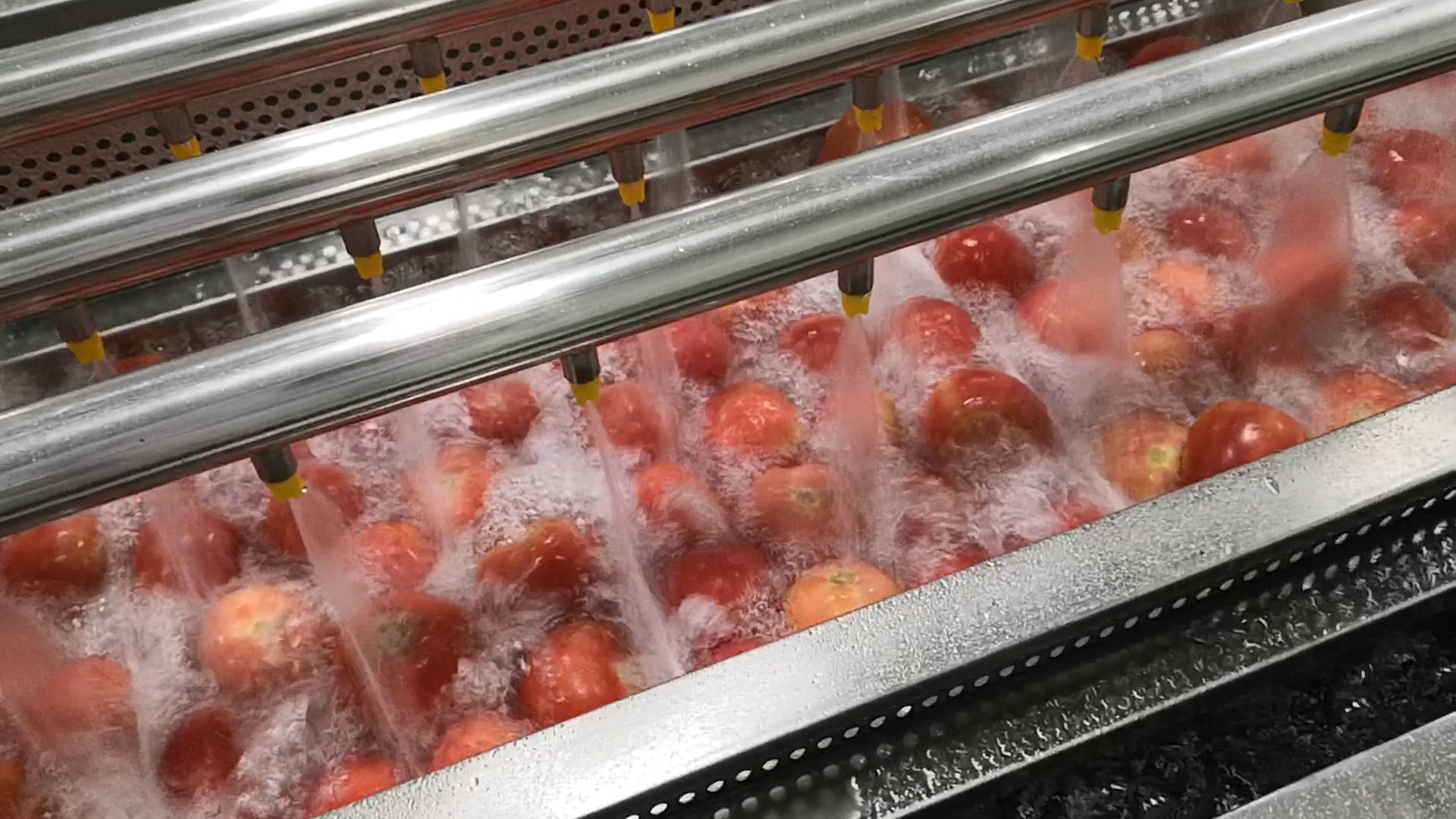
Terms such as low care, high care, raw, cooked, ready-to-cook and ready-to-eat are useful only when the project defines what they mean for its products and controls. Mark exposed-product areas, contamination sources, personnel transitions, utensil ownership, drainage direction, air relationships where relevant, and any shared equipment or route. A frequent crossing between dirty raw material and exposed ready-to-eat product deserves a stronger control than an occasional crossing of sealed containers.
Ready-to-eat fresh-cut products require particular caution because there may be no later lethality step to correct a failure in raw-material control, washing, sanitation, handling or environmental hygiene. Equipment does not “make a line safe” by itself. The operator remains responsible for hazard analysis, preventive controls, sanitation procedures, employee practices, verification and compliance with the competent authority.
The United States provides a useful example of why jurisdiction must be recorded. FDA identifies current good manufacturing practice requirements in 21 CFR Part 117 for food facilities within its scope, while many restaurants, cafeterias and other retail food establishments are primarily regulated by state and local authorities. The FDA Food Code is a model used by retail and foodservice jurisdictions; the 2022 edition is the latest full edition listed by FDA, but adoption and enforceable wording vary. A project serving another country must use that market’s applicable laws and competent authorities rather than importing U.S. provisions by default.
Cleaning information that belongs in the brief
- Products, soils and allergens handled on each machine and the required production sequence.
- Dry, wet, foam, manual, clean-in-place or other cleaning method, including prohibited methods.
- Approved detergents and disinfectants, concentrations, contact times, rinse requirements and material-compatibility constraints.
- Disassembly steps, removable parts, lifting needs, cleaning tools, drainage and drying expectations.
- Available sanitation window, crew size, responsibility and release-to-production procedure.
- Monitoring and verification method, acceptance limits, records and corrective-action ownership.
Codex guidance calls for written cleaning and disinfection procedures where appropriate, covering the areas and equipment, responsibilities, method, frequency, monitoring and verification. It also warns that pressure washing can spread contamination from floors and drains. That is why cleaning trials should assess access and residue removal, not merely whether external surfaces look stainless and smooth.
Cleaning and servicing also create occupational hazards. For U.S. workplaces, OSHA’s control-of-hazardous-energy framework requires appropriate energy-control procedures and worker training for covered servicing and maintenance activities. Other jurisdictions have their own machinery-safety and isolation requirements. The project brief should identify electrical, pneumatic, hydraulic, gravitational, thermal and stored-energy sources and require accessible isolation as part of equipment and layout review.
7. Compare Manual, Semi-Automatic and Integrated Approaches
Automation level should follow product stability, repeatable volume, labor exposure, process-control need, cleaning burden, facility readiness and commercial demand. It should not be chosen from labor cost alone. Automating an unstable specification can reproduce inconsistency faster, while connecting incompatible stages can create more work-in-process and harder sanitation.
| Operating approach | Conditions that may support it | Main limitations to brief |
|---|---|---|
| Primarily manual | Low or irregular volume, many delicate or seasonal products, frequent bespoke cuts, limited capital, or an early-stage concept still learning demand | Recruitment, training, absenteeism, ergonomic load, output variability, traceability and dependence on individual skill |
| Semi-automatic modules | One or two stable bottlenecks, mixed SKUs, phased investment, existing usable equipment, or a need to retain manual inspection and flexible routing | Transfers between modules, labor balance, buffer control, repeated handling and separate controls or cleaning routines |
| Integrated processing line | Repeatable product families, sustained demand, defined specifications, sufficient utilities and sanitation capacity, compatible stage rates and disciplined production scheduling | Higher interface dependence, line-wide downtime, changeover complexity, training, controls, spare-parts strategy and reduced flexibility if the SKU basis changes |
Manual processing remains rational when demand is too variable to load equipment economically, when skilled visual judgment dominates the task, or when the product portfolio has not stabilized. Semi-automatic food preparation often offers a better intermediate step: a washer, cutter, peeler or dewatering unit can address a measured constraint while the rest of the process remains flexible. A connected vegetable processing line becomes more defensible when stage loads, product routes, cleaning transitions and dispatch demand are sufficiently repeatable.
New risks must be stated in the proposal. These may include product damage from unsuitable transfer, poor cut consistency from incorrect tooling or feeding, water carryover, inaccessible niches, an oversized upstream stage flooding a slower downstream stage, control failure, harder fault isolation, and greater dependence on one integrated system. Food preparation automation cannot replace process design, food-safety management, preventive maintenance or trained operators.
8. Define Product Testing and Acceptance Before the Purchase Order
Supplier evaluation becomes meaningful when every bidder receives the same product matrix, process boundary and acceptance basis. Ask which assumptions underlie the configuration, which inputs remain to be confirmed, how each stage is sized, what utilities are required, how cleaning and maintenance access are addressed, and where supplier responsibility ends. Compare exclusions as carefully as included machines.
Representative product testing should answer defined questions. Can the proposed method produce the required finished specification across the expected raw-material range? What yield, damage, cut variation, surface condition and sustained rate are observed under the agreed test conditions? Can the system be cleaned and changed over using the planned method and time? Does the outlet condition match the next process?
| Test or acceptance item | Define before testing | Evidence to retain |
|---|---|---|
| Test material | Variety, source, maturity, size, temperature, incoming condition, quantity and sampling method | Photos, lot information and pre-test inspection record |
| Finished quality | Cut dimensions and tolerance, defects, damage, peel removal, cleanliness or surface-moisture criterion as applicable | Agreed sample, measurements, images and disposition of nonconforming product |
| Throughput | Test duration, feed method, staffing, settings, included stops, acceptable output definition and measurement points | Time log, input mass, accepted output, rejects and interruptions |
| Yield | Loss categories and weighing points | Mass balance covering product, trim, peel, rejects, rework and unexplained variance |
| Cleaning and changeover | Method, chemicals, disassembly, crew, start and finish points, inspection and release criteria | Procedure, time record, inspection result and verification result where applicable |
| Interfaces and controls | Upstream and downstream conditions, signals, alarms, stoppage response and recovery | Interface check, alarm log and agreed open-item list |
A factory acceptance test verifies the agreed equipment scope before shipment under the conditions that can reasonably be reproduced at the supplier’s facility. A site acceptance test verifies installation, utilities, interfaces and agreed operation after installation. Neither automatically validates the customer’s food-safety plan, shelf life or every commercial SKU. Those responsibilities and any additional process-validation work must be stated explicitly.
Acceptance criteria should be measurable and conditional. “Good cutting,” “easy cleaning” or “meets capacity” invites disagreement. State the product, input condition, staffing, runtime, output measurement, tolerances and allowable exclusions. If a criterion cannot be demonstrated until site utilities or downstream equipment exist, assign it to site acceptance rather than pretending it was proven earlier.
9. Build a Controlled Document Package
The central kitchen project brief is the index that connects commercial demand, food-safety decisions and engineering documents. Give every revision a date, owner and approval status. Suppliers should be told which version governs the quotation.
| Document | What it should contain | Needed for |
|---|---|---|
| Product and SKU matrix | Incoming and finished specifications, intended use, demand, yield, changeovers and risk notes | Process selection, testing and capacity |
| Demand and capacity model | Peak windows, shifts, usable time, stage loads, buffers and growth scenarios | Line balance and equipment sizing |
| Process flow diagrams | Every step, rework, WIP, inspection, water, waste and interface | Scope, hazard review and controls |
| Dimensioned facility layout | Building constraints, zones, flows, drains, services, access and adjacent systems | Layout review and installation planning |
| Utility schedule | Supply conditions, points of use, simultaneous loads and responsibility split | Engineering and cost definition |
| Cleaning and hygiene requirements | Methods, chemicals, transitions, verification, isolation and sanitation window | Hygienic design and operating review |
| Interface and responsibility matrix | Customer, supplier and third-party scope for equipment, building works, controls and services | Comparable quotation and contract review |
| Test and acceptance plan | Materials, methods, measurements, tolerances, test stages and sign-off authority | Product trial, factory acceptance and site acceptance |
Useful supporting material includes current-process videos, equipment nameplates, maintenance records, photos of problem areas, utility survey results, local regulatory correspondence and downstream-machine drawings. Do not send confidential recipes or customer information unless it is needed and appropriately controlled.
10. Evaluate the Commercial System, Not Only Equipment Price
A quotation should identify equipment, options, exclusions, utilities, documentation, packing, delivery basis, installation responsibility, commissioning, training, recommended spares, warranty terms and after-sales arrangements. It should also show which capacity and product assumptions support the selection. A low equipment price can become expensive if building changes, additional conveyors, drainage upgrades, controls integration, import costs or extended downtime were omitted.
Return on investment should use plant-specific cash flows. A transparent model can include verified labor changes, yield effects, waste disposal, utilities, consumables, sanitation time, maintenance, spare parts, finance, installation, training and downtime. Benefits that depend on future sales should be separated from savings supported by current operations.
Simple payback period = total project investment ÷ annual net cash benefit
Annual net cash benefit = verified annual savings and contribution gains − added annual operating costs
The result is a scenario, not a guarantee. Run base, downside and upside cases, with the assumptions visible. A supplier can help estimate equipment-related inputs, but the customer should own demand, labor rates, ingredient cost, product yield, selling contribution and utilization assumptions.
Long-term operation belongs in the selection decision. Confirm routine maintenance tasks, critical spare parts, wear components, local technical capability, remote support process, control-system backups, documentation language and training scope. A machine that meets a short test but cannot be maintained within the operating model is not a complete project solution.
When Automation or a Complete Line Is Not Yet the Right Decision
Pause a complete-line purchase when the product specification is still changing, demand is speculative, raw-material variability has not been sampled, available utilities are unknown, the food-safety concept is unresolved, or the building cannot support hygienic flow and cleaning. In these cases, more automation may lock the project into the wrong assumptions.
A manual or modular pilot may be more appropriate when the business is validating new menus, processing small seasonal volumes or serving customers with frequent bespoke requirements. A targeted machine can be justified when one measured bottleneck—such as cutting, washing, peeling or dewatering—dominates labor or schedule performance and its interfaces are manageable.
Do not proceed merely because a supplier can fit machinery into the room. Wrong equipment selection can increase product damage, over-trimming, water use, cleaning time, WIP, downtime and dependence on specialist support. It can also reduce flexibility when new SKUs arrive. The decision gate should be evidence: stable enough products, a defendable capacity model, workable flows, confirmed utilities, defined hygiene controls and measurable acceptance criteria.
Submission-Ready Central Kitchen Project Checklist
- List every in-scope SKU, raw-material condition, finished specification, intended use and downstream destination.
- State normal and peak saleable demand by SKU, dispatch window, shifts, production days and growth scenario.
- Provide measured or provisional yield by loss point and show the raw input and stage-load calculation.
- Map each process route, manual operation, inspection, WIP buffer, rework loop, cleaning transition and waste exit.
- Mark which steps are new, existing, customer-supplied, supplier-supplied or excluded.
- Submit a dimensioned layout with four flows, zone boundaries, installation access and point-of-use services.
- Confirm power, water, hot water, compressed air, drainage, wastewater, cooling and ventilation conditions.
- Define the hygiene concept, RTE and RTC separation decisions, allergens, cleaning method, sanitation window and verification ownership.
- Describe staffing, labor hours, skill constraints, absenteeism exposure, ergonomics, maintenance capability and preferred automation phase.
- Set representative product-test questions and measurable factory and site acceptance criteria.
- Issue an interface and responsibility matrix covering building works, utilities, controls, downstream systems, installation and commissioning.
- State the quotation basis, commercial exclusions, documentation, training, spares, support and scenario assumptions for return on investment.
Once this package is coherent, equipment selection becomes an outcome of process design. The supplier can explain how modules might be matched, what must be tested and where constraints remain. The buyer can compare proposals against the same operating requirement instead of comparing machine lists that solve different problems.
Submit Your Central Kitchen Planning Information
If your project is approaching layout review, product testing or supplier selection, send TEEMYEAH your product matrix, saleable capacity targets, process routes, available layout, utility information and known hygiene requirements. As a food pre-processing equipment supplier and customized food preparation solution provider, TEEMYEAH can review the defined preparation scope, discuss raw-material testing, examine line balance and develop a project-specific equipment and layout direction for further engineering confirmation.
Submit your central kitchen planning information to begin an engineering consultation. Include the documents already available; unresolved items can be identified during the review rather than hidden inside a premature quotation.
FAQ
1. What should a central kitchen project checklist contain before quotation?
A central kitchen project checklist should define products and SKUs, incoming and finished conditions, intended use, saleable demand, peak production windows, yield, process stages, existing equipment, layout constraints, utilities, hygienic zones, cleaning, wastewater, labor, interfaces and acceptance criteria. Each value should be marked as measured, confirmed, provisional, to be tested or excluded. This lets suppliers base their proposals on the same requirement and makes hidden assumptions easier to find. A machine list and a total daily tonnage are not enough because they do not reveal stage loads, SKU changes, sanitation time, product risk or downstream dependencies.
2. How much information is needed before requesting a central kitchen layout?
At minimum, provide a dimensioned room plan, product routes, required process stages, estimated stage loads, work-in-process containers, hygienic zone boundaries, personnel and waste routes, drains, service points, doors, columns, ceiling height and adjacent operations. The supplier also needs space for feeding, inspection, cleaning, maintenance and installation—not only machine footprints. Early concept layouts can use clearly labeled assumptions, but equipment positions should not be frozen until the production, sanitation, food-safety and maintenance teams have reviewed the flows. Local building, fire, drainage and food-facility requirements remain the project owner’s responsibility to confirm.
3. Should central kitchen capacity be specified per hour or per day?
Specify both, but connect them to SKU and time. Daily saleable output describes overall demand; hourly or batch stage rates show whether the process can meet dispatch windows. Start with accepted product required by each deadline, divide by the usable production window, work backward through yield to raw input, and calculate the load reaching every stage. Deduct cleaning, changeovers, breaks, maintenance and planned stops from available time. A rated hourly capacity for one machine cannot represent the whole line when upstream preparation, batch dewatering, inspection or packing handoff operates under different conditions.
4. What is the difference between rated capacity and sustainable throughput?
Rated capacity is a stated equipment figure under defined or sometimes limited test conditions. Sustainable throughput is the conforming output that a process can repeatedly deliver with the actual product, feed method, settings, operators, changeovers, cleaning, stops and downstream constraints. Buyers should ask how a rating was established and whether the product used resembles their raw material. Acceptance testing should define input condition, duration, staffing, measurement points, rejects and allowable interruptions. A high instantaneous rate does not prove that a multi-SKU central kitchen can maintain the required saleable output across its real production window.
5. Can ready-to-cook and ready-to-eat products share equipment?
They should not be assumed to share equipment automatically. The decision depends on the products, hazards, downstream lethality, exposure, allergens, production sequence, equipment cleanability, sanitation validation, environmental controls and applicable local requirements. Exposed ready-to-eat food with no later lethality step may require stronger separation and control than a product that will be cooked. Sharing may be possible in some operations through dedicated parts, physical separation, scheduling and validated cleaning, but the food operator must justify the control through its hazard analysis. The equipment supplier can support design and cleaning-access discussions but cannot make that food-safety decision for the operator.
6. What utilities should be confirmed before equipment selection?
Confirm electrical voltage, phase, frequency, available load and protection; process and cleaning water quality, temperature, pressure and peak flow; hot-water recovery; compressed-air pressure, flow and quality; drainage location, level and capacity; wastewater characteristics and discharge conditions; and any refrigeration, cooling or ventilation interfaces. Record these values at the intended point of use and state who supplies each connection. Local electrical, plumbing, environmental and food-facility rules vary. A building may have a utility in principle but still lack sufficient simultaneous capacity or a practical route to the proposed machine location.
7. What products should be used for equipment testing?
Use representative products from the expected operating range, including meaningful variation in size, maturity, temperature, soil load, firmness or season where those factors affect performance. Define the required finished sample, quantity, feed method and test questions in advance. Premium, uniform material may show what the equipment can do under favorable conditions but may not test normal production risk. Retain input and output weights, settings, time logs, images, defects, rejects and interruptions. If several SKUs use the same machine differently, test the products that challenge capacity, damage, cleaning or changeover—not only the easiest SKU.
8. What should be included in central kitchen acceptance criteria?
Acceptance criteria should cover the agreed equipment scope, representative product, input condition, finished specification, measurement method, sustainable test duration, staffing, throughput, yield or loss categories, product damage, utilities, controls, alarms, safety functions, interfaces, cleaning access, documentation and training. Separate factory acceptance from items that can only be verified after site installation. State who records data, what tolerance applies, how nonconformities are handled and who can sign off. Avoid subjective phrases such as “good quality” or “easy to clean” unless the contract converts them into an observable method and measurable result.
9. When is semi-automatic processing better than a complete line?
Semi-automatic processing may be preferable when volumes are moderate or irregular, the SKU mix changes frequently, manual inspection remains valuable, existing equipment can be retained, or only one stage is a proven bottleneck. Standalone modules allow phased investment and may preserve routing flexibility. The trade-off is continued labor for transfers, loading, unloading, buffering and coordination, plus possible differences in working height, controls and cleaning procedures. Compare total preparation cost, labor hours, WIP, sanitation and on-time output rather than assuming that either more or less automation is inherently superior.
10. Can an equipment supplier guarantee food safety or return on investment?
No responsible equipment supplier should replace the operator’s food-safety system or guarantee a financial outcome that depends on customer-controlled assumptions. A supplier can discuss hygienic design considerations, process flow, cleaning access, equipment matching, testing, documentation and support. The food business remains responsible for hazard analysis, controls, sanitation, verification, staff practices and regulatory compliance. Return on investment depends on actual demand, utilization, labor, yield, product value, utilities, maintenance, finance and downtime. Use transparent base, downside and upside scenarios, and treat supplier estimates as inputs to be verified rather than guaranteed results.
Data and Source Note
This article uses no claimed TEEMYEAH customer result, universal equipment-output figure, labor-saving percentage or guaranteed payback period. The 900-kilogram capacity example is a hypothetical calculation used only to demonstrate the relationship among saleable demand, yield, raw input and net runtime.
Regulatory and hygiene context was checked against the U.S. Food and Drug Administration’s How to Start a Food Business resource and its current good manufacturing practice reference to 21 CFR Part 117; the FDA 2022 Food Code portal for U.S. retail and foodservice model-code context; FAO/WHO Codex Alimentarius General Principles of Food Hygiene, CXC 1-1969, 2022 text; the U.S. Occupational Safety and Health Administration’s Control of Hazardous Energy (Lockout/Tagout) overview; and the U.S. Environmental Protection Agency’s National Pretreatment Program. FDA, OSHA and EPA material is presented only within its United States scope. The FDA Food Code is a model, and enforceable requirements depend on jurisdictional adoption. Codex principles are not a substitute for local law, competent-authority review or a product-specific hazard analysis.