







Summary
Leafy vegetable damage during processing rarely comes from one obviously defective machine. Bruising, tearing, broken edges, water-soaked tissue, crushed stems and excessive fragments usually develop through a chain of small stresses: compressed receiving bins, over-trimming, blunt cutting, long drops, crowded conveyors, aggressive washing, excessive dewatering, uncontrolled waiting and rough packaging.
The commercial consequence is larger than visible waste. A factory may retain most of the incoming weight while losing saleable yield because the product no longer meets appearance, cut-size, texture, shelf-life or packaging specifications. Damage can also release cellular fluids, increase respiration, accelerate deterioration and complicate hygiene control in fresh-cut ready-to-eat production.
The correct response is not automatically more automation. Some facilities need better incoming specifications, lower drop heights, sharper blades, smaller batches, improved line balance or shorter waiting times. Others may benefit from gentler washing, controlled dewatering or integrated transfer. The appropriate level of automation depends on raw-material variability, product value, daily volume, SKU complexity and the facility’s ability to control, clean and maintain the process.
A useful investigation therefore measures accepted product rather than theoretical machine capacity. By mapping defects to their likely damage points, conducting controlled trials and calculating accepted throughput, processors can identify which process should be improved before selecting equipment.
Leaf Damage Is Often Discovered Too Late
A batch of lettuce may look acceptable when it leaves the cutter. After washing, however, the tank contains an unusual quantity of fragments. The product emerging from dewatering appears compressed, and several hours later the cut edges begin to darken. By the time the product reaches packaging, operators are removing torn pieces, wet clumps and damaged leaves that were counted as usable material when production began.
The immediate conclusion may be that the washer is too strong, the cutter is unsuitable or the dewatering machine is running too fast. Any of those explanations could be correct. They could also be wrong.
The product may have arrived warm and tightly compressed. Rapidly grown spinach may have weaker structural integrity than material received during another season. A trimming team may have created uneven bunches that entered the cutter inconsistently. A conveyor may have dropped the leaves onto a hard surface. The washer may be receiving more kilograms per minute than its water-to-product ratio can handle. Product may be sitting in deep totes while the packaging area completes a changeover.
Leafy vegetable damage during processing is therefore a process-flow problem before it is an equipment problem.
That distinction matters for central kitchens, fresh-cut processors, food manufacturers and ready-to-eat salad facilities. Buying a faster machine does not necessarily improve accepted output. In some operations, it merely moves more damaged product toward packaging.
What Counts as Leafy Vegetable Damage?
“Damage” should not be limited to visibly destroyed leaves. In industrial food pre-processing, it includes any physical or physiological change that reduces the quantity of product meeting the finished specification.
Common forms include:
- bruised or translucent tissue;
- folded or collapsed leaves;
- crushed ribs and stems;
- torn leaf margins;
- ragged or feathered cut edges;
- excessive small fragments;
- compression marks;
- water-soaked areas;
- clumped or matted leaves;
- excessive wilting;
- premature discoloration;
- uneven particle dimensions;
- product that remains too wet for packing;
- product rejected after waiting because damage became more visible.
Some defects are immediate. A torn spinach leaf or crushed lettuce rib can be identified on the line. Others are latent, meaning that the process creates the injury but the full defect appears later through browning, softening, moisture release or accelerated deterioration.
A production team that checks quality only at the washer discharge may therefore miss damage that becomes commercially significant after two hours of chilled holding or one day inside the package.
Physical Weight Is Not the Same as Saleable Yield
A process can retain weight while losing value.
Leaves that have absorbed or retained surface water may make the recorded output heavier. Broken fragments may remain in the batch. Damaged leaves may still pass across the final weighing scale. None of these outcomes proves that the product meets the buyer’s specification.
Saleable yield is the proportion of incoming material that becomes accepted finished product. Acceptance may depend on:
- specified cut dimensions;
- intactness and visual appearance;
- maximum fragment level;
- absence of crushed stems;
- surface-moisture limits;
- pack-weight consistency;
- temperature;
- microbiological and sanitation controls;
- expected shelf-life performance;
- customer-specific defect tolerances.
Yield analysis must therefore separate mass retention from commercial acceptance.
Why Leafy Vegetables Are Difficult Industrial Raw Materials
Industrial systems perform most predictably when the incoming material has stable dimensions, strength, density and surface characteristics. Leafy vegetables have none of those advantages.
One delivery may contain dense, mature heads with strong ribs. Another may contain tender leaves with high moisture content and limited structural strength. Baby leaves, spinach, lettuce, cabbage, kale, bok choy and herbs cannot be expected to respond identically to cutting, water movement or centrifugal force.
Even the same variety may behave differently because of:
- cultivar;
- growth rate;
- maturity;
- harvest conditions;
- seasonal temperature;
- irrigation and rainfall;
- time between harvest and processing;
- field heat;
- storage humidity;
- transport vibration;
- compression in cartons or bins;
- previous insect or mechanical injury;
- supplier trimming practices.
USDA research material has specifically described folding, water soaking and bruising as manifestations of spinach leaf breakage and examined whether rapid growing conditions can reduce structural integrity. This does not mean every summer spinach shipment will fail. It demonstrates why settings validated with one seasonal batch should not automatically be treated as universal.
Product Temperature and Turgor Affect Handling
Turgor is the internal water pressure that gives plant tissue firmness. Leaves with different hydration and temperature conditions can respond differently to bending, compression and impact.
A firm leaf may resist mild handling but crack under a sharp fold. A warm or weakened leaf may collapse under pressure that would not visibly affect a colder, stronger batch. Produce that has already been compressed during transport may enter the processing room with damage that becomes evident only after cutting or washing.
Receiving inspection should therefore record more than supplier name and gross weight. Useful observations include:
- product temperature;
- leaf firmness;
- visible compression;
- percentage of wilted material;
- stem brittleness;
- head density;
- free water in containers;
- field dirt and foreign material;
- evidence of previous damage;
- variation among cartons within the same lot.
Without these records, a process team may blame equipment for damage that began before the product entered the factory.
Where Leafy Vegetable Damage During Processing Occurs
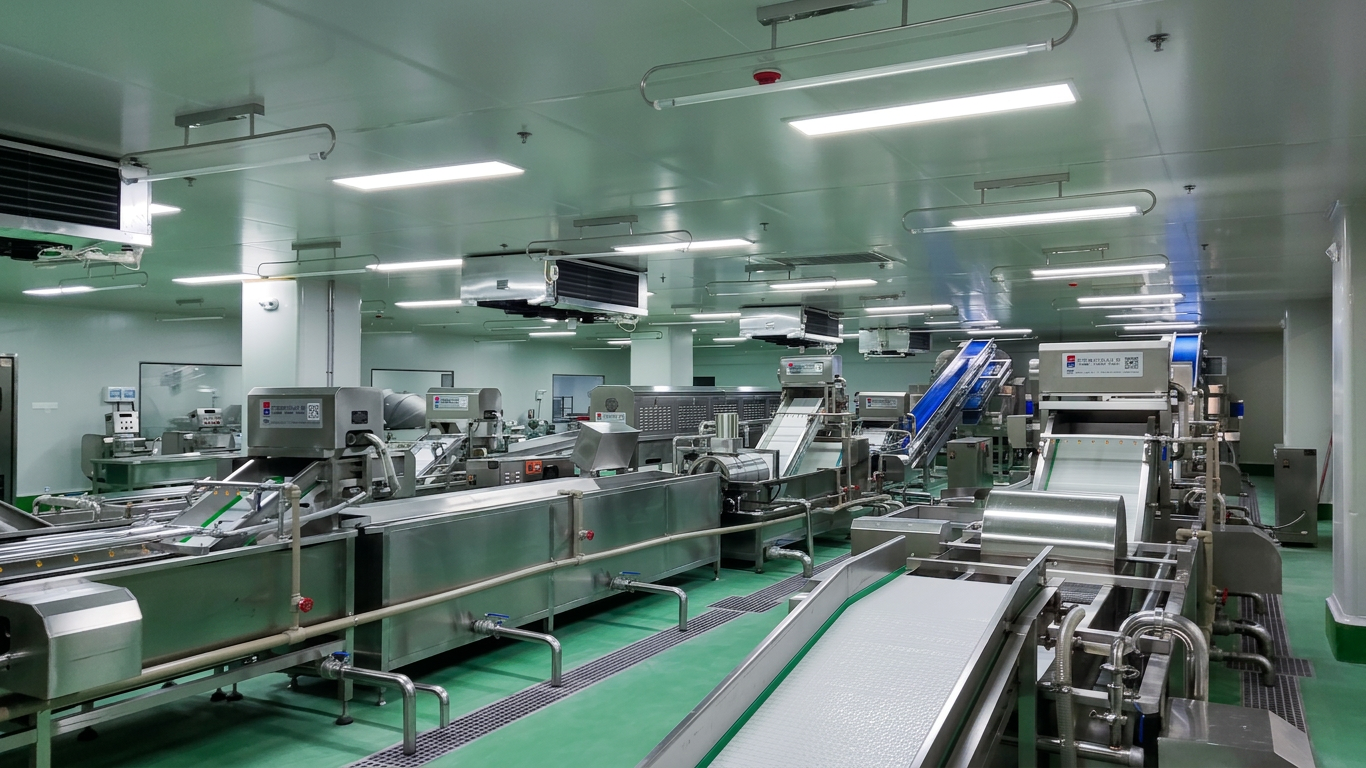
A damage investigation should follow the material from receiving through packaging. Looking only at the process where defects become visible can lead to the wrong corrective action.
Receiving and Unloading
The earliest damage may occur when cartons are overfilled, pallets are stacked beyond the container’s load-bearing capacity or bulk bins place excessive pressure on lower layers.
Potential mechanisms include:
- vertical compression;
- impact during unloading;
- cartons dropped from vehicles or pallets;
- dragging bags or crates;
- long ambient waiting before chilled storage;
- workers pressing product into undersized containers;
- mixing strong and delicate varieties in the same handling system.
Observable patterns include flattened leaves, crushed lower cartons, wet patches, folded ribs and a higher defect rate from the bottom of containers.
A practical receiving trial is to inspect and label samples from the top, middle and bottom of several cartons. If lower-layer product consistently shows more damage before processing, changing washer settings will not remove the original cause.
Sorting and Trimming
Manual sorting is often described as gentle because people can adapt their grip. In practice, performance depends heavily on training, pace, workstation design and production pressure.
Damage can arise through:
- pulling leaves rather than cutting cleanly;
- squeezing bunches to increase handling speed;
- dropping trimmed product into deep bins;
- overfilling totes;
- repeated handling during inspection;
- using dull knives;
- removing more tissue than the finished specification requires.
Over-trimming is a direct yield loss. Rough trimming also creates irregular pieces that move unpredictably through cutters and washers.
Manual work remains valuable where raw materials require judgment, but the operation should measure labor hours, trim loss and defect variation by shift. A large team does not guarantee gentle handling, especially during absenteeism, rapid recruitment or peak-volume periods.
Cutting
Fresh-cut processing deliberately breaks the vegetable’s natural surface. Cutting exposes internal tissue, releases cellular fluids and changes respiration and deterioration behavior. The goal is not to eliminate injury—cutting is itself a controlled injury—but to create the required geometry with the least unnecessary crushing and tearing.
Cutting damage may come from:
- blunt or damaged blades;
- incorrect blade geometry;
- unsuitable cutting speed;
- overloaded feed areas;
- inconsistent product orientation;
- compressed bunches entering the cutter;
- product too large or too dense for the selected configuration;
- excessive recutting of off-spec pieces;
- residue accumulation around blades;
- movement between the blade and supporting surface.
Typical evidence includes feathered edges, crushed ribs, strings of connected tissue, irregular dimensions and rising fragment levels.
A sharp blade does more than improve appearance. It reduces the amount of tissue crushed outside the intended cut line. Blade condition should therefore be treated as a process parameter rather than a maintenance issue that is addressed only after failure.
Transfers, Chutes and Conveyors
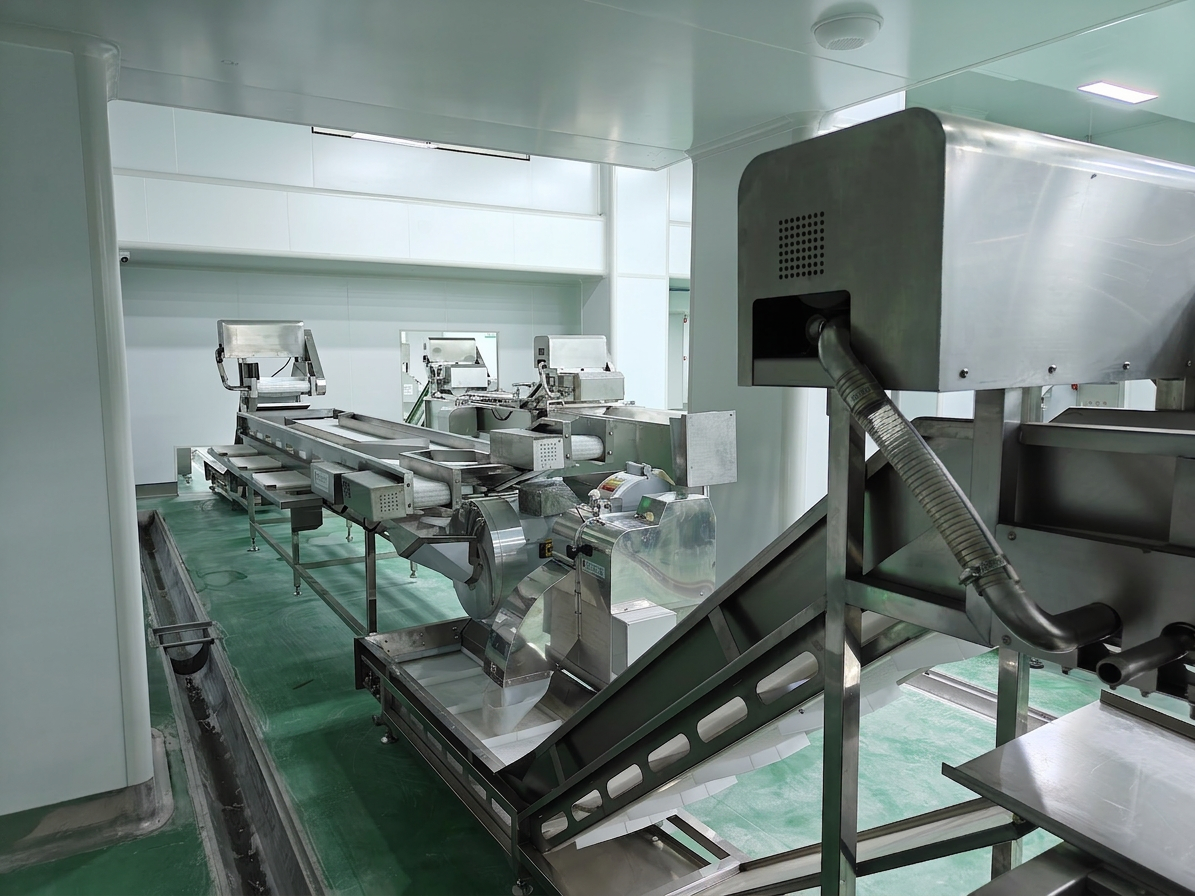
A washer, cutter or dewatering unit can perform correctly while the connection between machines creates the main damage.
Common transfer risks include:
- excessive drop height;
- impact against a perpendicular surface;
- narrow chutes that compress product;
- abrupt changes in conveyor speed;
- product trapped at sidewalls;
- sharp edges or protruding fasteners;
- paddles or flights applying concentrated force;
- reverse flow at congested discharge points;
- workers pushing accumulated leaves into the next stage.
Damage produced by transfer is often uneven. Leaves may appear acceptable across most of the belt while one side of the product stream contains crushed pieces. Video taken from above and from the discharge side can reveal repeated impact or accumulation that is difficult to see from the operator position.
A useful principle is that every uncontrolled fall converts height into impact. Delicate leaves generally benefit from controlled transitions, progressive speed changes and discharge points that do not create a hard collision.
Washing
Washing must remove soil, insects, field debris, cellular fluids and other unwanted material while controlling water hygiene. The most vigorous possible movement is not automatically the most effective process.
Damage can increase when:
- air or water agitation is too strong for the product;
- the tank is overfilled;
- the residence time is excessive;
- product repeatedly contacts internal surfaces;
- water jets strike delicate leaves directly;
- a pump or recirculation path captures product;
- leaves become trapped under conveyors;
- different products share one setting despite different fragility;
- upstream feeding arrives in slugs rather than a steady flow;
- the water-to-product ratio becomes too low.
The FDA’s fresh-cut guidance distinguishes among produce types and notes that vigorous washing is more suitable for produce that is not easily bruised or injured. This is an important boundary: stronger action may support cleaning for robust products, but it should not be generalized to delicate leafy vegetables.
More bubbles, more turbulence or more residence time should not be treated as automatic improvements. The relevant question is whether the wash stage reaches the required cleaning outcome while keeping defects within the accepted limit.
Dewatering
Dewatering removes excess surface water after washing. It is not thermal drying, and the objective is not to remove the leaf’s internal moisture.
Insufficient dewatering can create:
- wet packs;
- inaccurate pack weights;
- diluted sauces or dressings;
- clumping;
- unstable packaging conditions;
- water accumulation during storage.
Excessive or poorly controlled dewatering can create:
- compression against a basket or belt;
- tearing from repeated movement;
- crushed stems;
- fragmented leaves;
- uneven moisture because the load is unbalanced;
- damage during loading and unloading;
- repeated handling when one cycle is insufficient.
Centrifugal speed is only one variable. Basket loading, load distribution, cycle time, acceleration, deceleration, product type and post-cycle discharge all influence the result.
A process with a lower speed and well-balanced load may remove surface water more consistently than a higher-speed process with overloaded baskets. Continuous systems may reduce manual transfer but can also damage product if belt movement, airflow, vibration or retention time is unsuitable.
Waiting, Buffers and Work-in-Progress
Work-in-progress, or WIP, is material that has entered production but has not reached the next completed process stage.
WIP is necessary when stages do not operate at exactly the same rhythm. It becomes harmful when product waits in conditions that create compression, warming, moisture accumulation or uncontrolled holding time.
Risk increases when:
- deep totes are filled with delicate cut leaves;
- warm product waits for an available washer;
- washed product waits for dewatering;
- dewatered product waits in a humid room;
- packaging stops while upstream equipment continues;
- batches lose traceability during congestion;
- older and newer product are mixed;
- workers compress product to fit more into each container.
The problem may appear to be insufficient machine capacity when the real cause is line imbalance. A faster cutter, for example, can create more WIP ahead of a slower washer and increase damage even though the cutter itself produces acceptable pieces.
Mixing and Packaging
Mixing can improve product uniformity, but repeated tumbling or aggressive paddles may damage tender leaves. Packaging can create compression when fill weights are too high, bags are undersized or operators press product to remove air.
Potential defect patterns include:
- intact single-SKU leaves but damaged salad mixes;
- breakage concentrated after seasoning or ingredient addition;
- acceptable bulk product but crushed retail packs;
- moisture pooling after product is compressed;
- damage at sealing jaws or package-transfer points;
- leaves trapped in package seals.
The finished pack is the point where operational defects become customer-visible. Quality inspection should therefore compare product before mixing, after mixing and after packaging rather than treating the packing area as a passive final step.
Damage-Point Diagnostic Table
| Process point | Likely damage mechanism | Observable defect pattern | Diagnostic check | Corrective direction |
|---|---|---|---|---|
| Receiving | Compression, impact, temperature exposure | Flattened lower layers, wet patches, folded ribs | Compare top, middle and bottom carton samples before processing | Revise container loading, pallet stacking, unloading and receiving limits |
| Trimming | Squeezing, tearing, over-trimming | Irregular pieces, excessive trim loss, shift-to-shift variation | Weigh trim waste and audit operator methods by shift | Improve knives, workstation ergonomics, training and trim specifications |
| Cutting | Blunt blades, overload, crushing | Ragged edges, connected tissue, inconsistent dimensions | Compare blade condition, feed rate and defect rate | Sharpen or replace blades, stabilize feeding, test suitable cutting configuration |
| Transfer | Drop, collision, trapping | Damage concentrated at one discharge or belt side | Record slow-motion video and measure drop heights | Reduce falls, improve chute geometry and match conveyor speeds |
| Washing | Excessive agitation, crowding, long residence | Fragments in water, bruising, folded or water-soaked leaves | Split one lot across controlled wash settings | Reduce force or residence time, stabilize feed and increase water-to-product control |
| Dewatering | Excessive force, unbalanced load, rough discharge | Crushed stems, tearing, clumping, inconsistent moisture | Compare load weight, cycle profile and residual moisture | Optimize load, speed, time and discharge rather than increasing speed alone |
| WIP holding | Compression, warming, long delay | Matted leaves, moisture release, delayed discoloration | Record tote depth, product temperature and hold time | Reduce buffer depth, rebalance the line and apply time limits |
| Mixing | Tumbling, paddle pressure, excessive duration | Damage appears only in mixed products | Inspect before and after mixing | Reduce mixing intensity, batch size or duration |
| Packaging | Overfilling, pressing, seal interference | Crushed packs, trapped leaves, moisture pooling | Compare bulk-product quality with sealed packs | Adjust fill weight, package size, air removal and transfer handling |
Comparing the Main Damage Mechanisms
Not all visible defects have the same origin. Correct diagnosis depends on the shape and distribution of the damage.
Impact Damage
Impact occurs when product falls or collides with equipment, containers or other product. It is usually concentrated around transfer points and may affect the leading edge of the product stream.
Reducing drop height, redirecting the flow and cushioning the transition are more relevant than changing the main processing machine.
Compression Damage
Compression develops when leaves are pressed between product layers, container walls, belts, baskets or packaging.
It often appears in lower tote layers, overfilled baskets and tightly packed bags. Reducing batch depth or container fill may solve more than reducing line speed.
Shear, Abrasion and Tearing
These mechanisms develop when leaves rub against surfaces, become trapped or move at different speeds across adjacent components.
Evidence can include torn margins, small fragments and damage concentrated along one conveyor edge. Surface finish, alignment, side gaps and belt transitions deserve inspection.
Hydraulic Damage
Hydraulic damage results from unsuitable water movement, direct jet impact, repeated recirculation or excessive turbulence. It is often accompanied by fragments in wash water and folded or water-soaked tissue.
The corrective action may involve pressure, flow direction, air volume, residence time, tank loading or feed consistency.
Cutting Damage
Cutting damage follows a geometric pattern. Ragged edges, crushed ribs and inconsistent dimensions point toward blade condition, product orientation or feed loading.
A downstream washer may reveal the damage by separating weak fragments, but the cut may have created the weakness earlier.
Centrifugal or Mechanical Dewatering Damage
This damage is often batch-dependent. An overloaded or unbalanced basket may produce one damaged section while other product remains acceptable.
Cycle design should be evaluated as a profile—loading, acceleration, operating speed, duration, deceleration and unloading—not as one speed setting.
Time-and-Temperature Damage
Time and temperature do not always create the initial physical injury, but they influence how quickly the injury becomes visible. Cut leafy greens also require appropriate temperature control because cutting damages the waxy surface and exposes internal fluids and nutrients.
A batch that waits warm after cutting may show faster deterioration than an otherwise similar batch transferred promptly through a controlled cold process.
How to Measure Saleable Yield Correctly
A basic yield formula is:
Saleable yield percentage = Accepted finished-product weight ÷ Incoming net raw-material weight × 100
The calculation is only useful when the measurement boundary is defined.
Gross Pack-Out Yield
Gross pack-out yield = Accepted packed weight ÷ Total incoming lot weight × 100
This includes unavoidable supplier defects, roots, outer leaves, soil and normal trimming loss. It is useful for purchasing and total material-cost analysis.
Process Yield
Process yield = Accepted finished-product weight ÷ Net usable material entering the evaluated process × 100
This isolates what happens after defined sorting and unavoidable trimming. It is more suitable for comparing cutting, washing, dewatering or transfer alternatives.
Damage Loss Rate
Damage loss rate = Product rejected for process-related physical damage ÷ Net usable material entering the process × 100
Damage waste should be recorded separately from:
- foreign material;
- unavoidable outer-leaf removal;
- decay present at receiving;
- specification-driven stem or root removal;
- microbiological or temperature rejection;
- product used for approved rework.
Water Can Distort the Result
Washed product may carry additional surface water. Dewatered product may weigh less because free water has been removed, even when the quantity of acceptable leaf tissue has not decreased.
Comparable yield trials should weigh product at the same defined condition, such as:
- before washing;
- after a standardized draining period;
- after a defined dewatering cycle;
- immediately before packaging.
Residual surface moisture should be measured or evaluated separately. Otherwise, a wetter process may appear to produce a higher yield.
Illustrative Yield Calculation
The following is a hypothetical example, not a performance claim for any factory or machine.
A processor receives a 1,000-kilogram lot of lettuce.
- Incoming lot: 1,000 kg
- Soil, damaged outer leaves and unavoidable receiving rejection: 70 kg
- Specification-driven trimming: 80 kg
- Net usable material entering cutting and washing: 850 kg
- Fragments and damaged product rejected after processing: 55 kg
- Off-spec cut pieces sent to approved rework: 20 kg
- Accepted packed product: 775 kg
The gross pack-out yield is:
775 ÷ 1,000 × 100 = 77.5%
The process yield is:
775 ÷ 850 × 100 = 91.2%
The process-related damage loss rate is:
55 ÷ 850 × 100 = 6.5%
These three figures answer different questions. Gross yield helps evaluate the whole supply and production system. Process yield evaluates conversion performance after normal raw-material preparation. Damage loss focuses on the specific operational pain investigated in this article.
The Faster Line Can Produce Less Saleable Product
Nominal capacity is the kilograms a machine can receive under defined conditions. Accepted throughput is the amount of conforming product the process actually delivers.
A useful calculation is:
Accepted throughput = Feed rate × Runtime fraction × Saleable yield
Consider another hypothetical comparison.
Configuration A: Higher Nominal Speed
- Feed rate: 1,200 kg/h
- Runtime fraction after stoppages and congestion: 75%
- Saleable yield: 78%
Accepted throughput = 1,200 × 0.75 × 0.78 = 702 kg/h
Configuration B: Lower Nominal Speed but Better Control
- Feed rate: 950 kg/h
- Runtime fraction: 90%
- Saleable yield: 88%
Accepted throughput = 950 × 0.90 × 0.88 = 752.4 kg/h
Configuration B is nominally slower, yet it produces more accepted product per hour.
This reverse judgment is important when selecting a vegetable processing line. Faster movement is not commercially valuable when it increases stoppages, breakage, rework or rejection.
Preparation Cost per Accepted Kilogram
Labor and operating costs should also be divided by accepted output, not raw feed.
Preparation cost per accepted kilogram = Total preparation cost for the period ÷ Accepted finished kilograms
Relevant cost categories may include:
- direct labor;
- supervision;
- temporary labor;
- water;
- energy;
- cleaning chemicals;
- sanitation labor;
- packaging affected by wet or damaged product;
- maintenance;
- blade replacement;
- rework;
- disposal;
- downtime;
- overtime;
- rejected finished packs.
A process that reduces headcount beside one machine may still increase total cost if it needs more sorting, rework, cleaning or maintenance downstream.
Labor Hours per 1,000 Kilograms
A practical labor indicator is:
Labor hours per 1,000 accepted kilograms = Total direct production labor hours ÷ Accepted kilograms × 1,000
Include workers involved in:
- receiving and unloading;
- trimming and inspection;
- machine feeding;
- transfer;
- cutting;
- washing;
- dewatering;
- sorting;
- packaging support;
- changeovers;
- production cleaning.
This approach is more reliable than counting the people visibly standing beside a machine. Automation may remove one repetitive task while creating responsibilities for monitoring, sanitation, maintenance and material replenishment.
Diagnostic Trials Before Changing the Line
A damage investigation should isolate variables. Changing the cutter, washer, dewatering speed and packaging method at the same time may improve the result, but the team will not know which change mattered.
Define the Finished-Product Standard
Before testing, agree on:
- acceptable cut dimensions;
- maximum fragment percentage;
- damaged-leaf tolerance;
- stem condition;
- surface-moisture target;
- pack appearance;
- product temperature;
- sampling method;
- inspection timing;
- permitted rework.
Without a written acceptance standard, different observers may classify the same leaf differently.
Use Representative Raw Material
A convenient, strong batch may make every configuration look gentle. Trials should include:
- normal material;
- a known delicate variety;
- realistic seasonal variation;
- expected head or leaf sizes;
- normal incoming temperatures;
- representative soil and moisture conditions.
Results from one lot should be treated as evidence for that test condition, not proof of universal performance.
Establish a Manual or Current-Process Baseline
The baseline should record:
- kilograms entering each stage;
- accepted output;
- trim loss;
- process-damage waste;
- fragments collected from water or screens;
- residual surface moisture;
- labor hours;
- active processing time;
- waiting time;
- changeover time;
- cleaning time;
- product temperature;
- quality immediately after production;
- quality after the normal holding interval.
Without a baseline, the facility cannot determine whether a proposed change has improved the process.
Change One Important Variable at a Time
For washing, a trial might compare:
- feed rate;
- residence time;
- agitation setting;
- water level;
- water-to-product ratio;
- discharge method.
For dewatering, variables might include:
- load weight;
- product distribution;
- speed;
- cycle time;
- acceleration;
- discharge method.
For transfer, the trial could compare:
- drop height;
- belt-speed differential;
- chute angle;
- product-bed depth;
- continuous versus batch feeding.
Inspect for Delayed Defects
Product should be inspected at commercially relevant intervals. A useful program may include:
- immediate post-process inspection;
- post-pack inspection;
- inspection after chilled holding;
- inspection during the normal shelf-life validation program.
The appropriate intervals depend on the product and operation. The purpose is to identify whether a seemingly acceptable process creates latent damage.
Record the Whole Process, Not Only the Machine
A machine trial should document what happens before and after the test unit. A washer may perform well under steady feeding but fail when the cutter releases large product surges. A dewatering unit may meet the moisture target but create a packaging delay because unloading is too slow.
The test boundary should therefore include feeding, discharge, labor, buffers and downstream use.
When Gentler Handling Is More Appropriate Than More Automation
Automation is justified when it improves a defined operational outcome. It is not justified merely because a process contains manual work.
Manual Handling May Remain Reasonable When
- production volume is low or highly seasonal;
- the product mix changes constantly;
- raw materials require complex visual judgment;
- premium whole-leaf appearance is more important than speed;
- batches are too small for stable continuous operation;
- demand is uncertain;
- facility space is limited;
- maintenance capability is not available;
- damage occurs mainly in supplier packaging rather than factory handling.
The manual process still requires standards, ergonomics, training and measurement. “Manual” should not mean uncontrolled.
Semi-Automation May Be the Better Choice When
- one stage creates most of the damage or labor burden;
- trimming must remain manual but washing can be controlled;
- product feeding requires human inspection;
- multiple SKUs need flexible batch production;
- the factory wants to validate settings before integrating a line;
- packaging capacity does not support continuous upstream output;
- capital risk needs to be staged.
A standalone cutter, washer or dewatering machine can be commercially sensible when its interfaces are planned.
Integrated Automation May Make Sense When
- daily volume is consistently high;
- customer specifications are stable;
- product families can be grouped by similar handling requirements;
- manual transfer creates repeated damage;
- line balance can be engineered around real accepted capacity;
- hygiene zoning and sanitation procedures support the system;
- maintenance and spare-parts responsibilities are defined;
- downstream packaging and cold storage can absorb the output;
- the business has confirmed demand for the additional capacity.
An integrated line can reduce uncontrolled drops, repeated manual lifting and WIP accumulation. It can also spread one incorrect setting across a much larger volume, so control and testing become more—not less—important.
When Automation Can Increase Leaf Damage
Automation introduces new risks when the process is selected around catalogue speed rather than product behavior.
Potential problems include:
- one setting applied to all varieties;
- continuous feeding that exceeds wash or dewatering capacity;
- excessive conveyor speed;
- repeated impacts at machine interfaces;
- long startup and shutdown losses;
- loss of human inspection at critical points;
- difficult cleaning around belts, chutes or enclosed structures;
- maintenance delays that lead operators to run damaged components;
- large WIP buffers created by synchronized stoppages;
- high rework volumes after an incorrect batch setting;
- unsuitable dewatering for fragile products;
- excessive line complexity for small, variable batches.
Equipment cannot replace raw-material specifications, sanitation management, preventive maintenance, food-safety controls or operator training.
The correct question is not, “Can this task be automated?” It is, “Can this process be controlled more reliably at the required product quality, hygiene condition and accepted throughput?”
Product Damage and Food Safety Are Connected but Not Identical
Physical damage is primarily a quality and yield issue, but fresh-cut production creates additional food-safety considerations.
Cutting disrupts tissue and releases cellular fluids. FDA guidance explains that these fluids can provide nutrients that support microorganisms if they are present. Fresh-cut products may also lack a later lethal process, particularly in ready-to-eat applications.
Damage does not prove that a product is contaminated. A visually intact leaf is not automatically safe, and a bruised leaf is not automatically unsafe. The connection is that unnecessary tissue damage, extensive handling and uncontrolled process water can make the process more difficult to manage.
For RTE production, particular attention should be given to:
- raw-material approval;
- separation of raw and cleaner processing zones;
- controlled personnel and container movement;
- wash-water quality and monitoring;
- hygienic equipment design;
- cleanable blades, belts, chutes, baskets and food-contact surfaces;
- protection from recontamination after washing;
- sanitation verification;
- temperature control;
- batch and corrective-action records.
The FDA recommends maintaining cut leafy greens at 41°F or 5°C or below during storage and display in the context covered by its retail guidance. Individual factories must apply the legal, customer and food-safety requirements relevant to their jurisdiction and product.
RTC vegetables may undergo cooking later, but this does not remove the need for controlled hygiene, traceability and cold-chain management. RTE and RTC operations should not be treated as identical simply because they process similar leaves.
Processors evaluating shared or separated flows can review the detailed discussion of RTE and RTC processing separation.
Line Balance Matters More Than Isolated Machine Speed
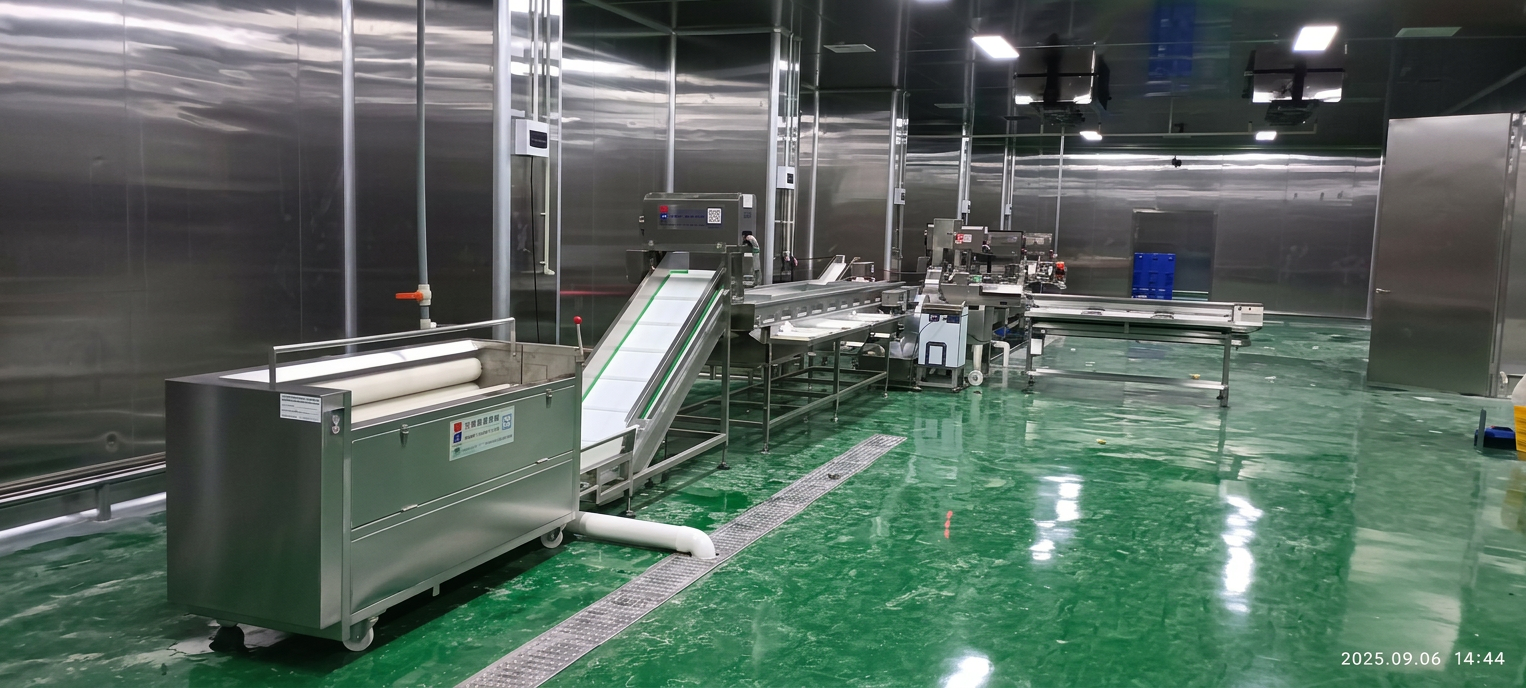
Line balance is the alignment of practical capacity among connected process stages.
A cutter rated above the washer’s sustainable input can create surges. A washer operating continuously may overwhelm a batch dewatering area. A high-capacity dewatering unit may deliver product faster than the inspection and packaging team can handle.
The resulting WIP creates:
- deeper product piles;
- longer waiting;
- higher compression;
- temperature drift;
- mixed batches;
- rushed manual handling;
- inconsistent sanitation timing;
- missed dispatch windows.
Actual throughput should be measured across the complete production window, including:
- startup;
- feeding interruptions;
- inspections;
- blade changes;
- product changeovers;
- wash-water management;
- basket handling;
- packaging stops;
- cleaning;
- unexpected downtime.
Facilities considering broader capacity and process-flow questions can use the Leafy Vegetable Processing Guide as the cluster-level framework, while the food processing equipment investment decision guide explains why machine capacity and production capability must be evaluated separately.
SKU Complexity Can Hide the Damage Problem
A line that performs well with shredded cabbage may damage baby spinach. A setting suitable for whole lettuce leaves may not suit short-cut salad pieces. Product behavior can also change after adding herbs, denser vegetables or other ingredients to a salad mix.
Useful production grouping should consider:
- structural strength;
- leaf size;
- stem-to-leaf ratio;
- cut format;
- incoming soil load;
- required washing intensity;
- dewatering tolerance;
- finished moisture target;
- hygiene classification;
- cleaning and changeover requirements.
SKU count alone does not describe complexity. Ten similar lettuce specifications may be easier to schedule than three products requiring completely different cutting, washing and dewatering conditions.
When product families cannot share stable settings, flexible semi-automatic cells may be more suitable than one rigid continuous line.
Recruitment, Training and Absence Affect Product Damage
Labor availability is often discussed only as a cost. It also influences quality stability.
New or temporary workers may:
- grip or compress leaves inconsistently;
- overfill containers;
- feed machines in surges;
- miss blade or belt damage;
- apply incorrect settings;
- delay product during handoffs;
- mix accepted and rejected material;
- follow sanitation procedures inconsistently.
Experienced workers can adapt to delicate material in ways that fixed equipment cannot. The risk is that the factory becomes dependent on a small number of skilled individuals.
A useful improvement program should therefore compare:
- defect rates by shift;
- labor hours per accepted tonne;
- training time to competent operation;
- absenteeism-related output loss;
- operator-to-operator variation;
- ergonomic exposure;
- overtime;
- supervision burden;
- error recovery.
Automation may reduce repetitive handling, but it shifts competence toward setup, monitoring, sanitation and maintenance. A process that operators cannot understand or clean reliably is not an operational improvement.
A Five-Step Framework for Reducing Leafy Vegetable Damage
1. Define the Accepted Finished Product
State the required cut, appearance, moisture, temperature, pack format and defect tolerance. “Good quality” is not a measurable specification.
2. Map Every Contact and Waiting Point
Follow the product from the delivery container to the sealed package. Record drops, compression zones, conveyor changes, manual transfers, WIP locations and product temperatures.
3. Quantify Loss by Category
Separate unavoidable raw-material loss, specification trimming, mechanical damage, rework and unexplained variance.
4. Test the Lowest-Complexity Corrective Action
The most appropriate intervention may be:
- revised receiving containers;
- lower tote fill;
- sharper blades;
- controlled feeding;
- a shorter drop;
- reduced washing intensity;
- a different wash sequence;
- balanced dewatering loads;
- smaller WIP buffers;
- improved packaging settings;
- operator training.
5. Evaluate Automation Only Against Measured Results
Compare manual, semi-automatic and integrated alternatives using:
- accepted kilograms per hour;
- saleable yield;
- labor hours per 1,000 accepted kilograms;
- preparation cost per accepted kilogram;
- fragment rate;
- residual surface moisture;
- downtime;
- sanitation time;
- changeover time;
- batch consistency;
- maintenance requirements.
The preferred option is the one that improves the required outcome with manageable operational risk. It is not automatically the option with the highest motor power, greatest nominal capacity or most equipment.
Why the Improvement Sequence Matters
A factory may want to automate washing because it appears labor-intensive. Diagnostic evidence may show that most damage actually originates at cutting and transfer. Installing a more advanced washer would improve process control but would not correct blunt blades or a damaging discharge.
Another facility may blame dewatering for torn leaves. A split-lot trial may show that the product enters the dewatering area already weakened by an overloaded wash tank. Reducing the dewatering speed alone could leave the product too wet without materially improving intactness.
The sequence should therefore be:
Defect definition → damage mapping → measurement → controlled trial → process correction → equipment evaluation
Reversing that sequence increases the risk of purchasing equipment that treats the symptom rather than the cause.
Conclusion: Protect Accepted Output, Not Just Machine Throughput
Leafy vegetables bruise, break and lose yield because they encounter impact, compression, cutting, friction, water movement, centrifugal force and uncontrolled waiting throughout the process.
The visible defect may appear at washing, dewatering or packaging, but its origin may be receiving, trimming, cutting or transfer. Raw-material condition and seasonal variation further change how much mechanical stress the leaves can tolerate.
Processors should therefore judge performance by accepted product rather than raw kilograms moved. Saleable yield, damage loss, accepted throughput, labor hours, residual moisture, waiting time and preparation cost provide a more reliable basis for improvement than nominal machine capacity.
Automation can reduce repeated manual handling and stabilize process parameters. It can also multiply damage when product settings, machine interfaces, sanitation or line balance are incorrect. The objective is not to automate every movement. It is to create a controlled process that repeatedly delivers the required product with acceptable yield, hygiene, labor and operating cost.
Identify Where Product Damage Occurs
Before changing equipment, map your current process from receiving to packaging and record where bruising, fragments, compression, moisture problems and waiting begin.
TEEMYEAH supports central kitchens, fresh-cut processors, food manufacturers and RTC/RTE facilities as a food pre-processing equipment supplier, vegetable processing equipment manufacturer and customized food preparation solution provider. The appropriate starting point is a process review: raw materials, finished specifications, current and target capacity, damage patterns, labor use, product testing and facility constraints.
The leafy vegetable processing line framework can help you understand how cutting, washing, dewatering and transfer should be evaluated as one connected flow. The aim at this stage is not to assume that a complete line is required, but to identify which process should be improved first and whether gentler handling, selective mechanization or integrated automation is commercially justified.
FAQ
1. What causes leafy vegetable damage during processing?
Leafy vegetable damage during processing is usually caused by a combination of impact, compression, cutting, abrasion, water movement, dewatering force and excessive waiting. Common sources include overloaded receiving containers, blunt blades, long conveyor drops, crowded wash tanks, aggressive water jets, unbalanced dewatering loads and deep WIP totes. Raw-material condition also matters. Tender, warm, rapidly grown or previously compressed leaves may tolerate less force than mature, well-conditioned material. Because defects often become visible downstream, processors should inspect the entire route from receiving to packaging rather than assuming the machine where damage appears is the original cause.
2. How should a processor calculate saleable yield for leafy vegetables?
Saleable yield should be calculated as accepted finished-product weight divided by the incoming weight within a clearly defined measurement boundary. Gross pack-out yield uses the total received lot, while process yield uses the net usable material entering the evaluated cutting, washing or dewatering process. Process-related damage, unavoidable trimming, supplier defects, foreign material and approved rework should be recorded separately. Weights must also be compared at consistent moisture conditions because wash water can temporarily increase product weight. The most useful result is not the heaviest output, but the quantity that meets cut, appearance, moisture, temperature and packaging specifications.
3. Can industrial washing damage lettuce and other leafy vegetables?
Yes. Industrial washing can damage leafy vegetables when agitation, jet pressure, residence time, tank loading or internal contact is unsuitable for the product. Overfeeding may reduce the water-to-product ratio and cause leaves to collide or become trapped. Direct jets can strike delicate tissue, while excessive turbulence may fold or tear weak leaves. This does not mean low-force washing is always better; the process must still achieve the required soil and debris removal while controlling water hygiene. A controlled split-lot trial should compare cleaning effectiveness, fragment generation, visible damage and post-holding quality across different settings.
4. Does higher dewatering speed always produce a better result?
No. Higher speed may remove more surface water, but it can also increase compression, tearing or imbalance-related damage. Dewatering performance depends on the complete cycle, including load weight, product distribution, acceleration, operating speed, duration, deceleration and unloading. An overloaded basket may produce uneven moisture and higher damage even at a moderate speed. A lower-speed, balanced cycle may deliver a better commercial result if it reaches the packaging moisture target with fewer broken leaves. The correct setting should be determined by testing residual moisture, accepted yield, fragment rate and product condition after the normal holding period.
5. How can a factory determine whether damage comes from cutting or washing?
Take representative samples immediately after cutting and before washing, then compare them with samples collected after washing. Inspect cut-edge quality, broken ribs and fragment levels at both points. Ragged edges, crushed tissue or connected pieces visible before washing usually indicate blade, feeding or cutting problems. If pre-wash product is acceptable but fragments rise sharply after washing, investigate tank loading, agitation, residence time and discharge transfer. Some cutting damage becomes more visible during washing because weakened tissue separates in water, so the trial should include close examination of cut edges and material collected from screens or filters.
6. Why does leafy vegetable damage sometimes appear after packaging?
Some injuries are latent. Cutting, folding, compression or impact may damage cells without creating an immediate visible defect. During subsequent holding, the tissue can release moisture, soften, discolor or lose structural strength. Warm waiting, excessive pack compression and unstable residual moisture can accelerate the appearance of these problems. Quality checks performed only at machine discharge may therefore underestimate damage. Processors should inspect product immediately after processing, after packaging and during a defined chilled holding period. The appropriate interval depends on the product and intended shelf-life, but it should reflect the point when customers normally receive or use the product.
7. Are baby leaves and spinach more difficult to process than mature lettuce or cabbage?
They can be, although performance depends on variety and incoming condition. Baby leaves and spinach generally have less structural mass than dense cabbage or mature lettuce ribs, making them more sensitive to direct jets, trapping, long drops and excessive dewatering. Rapid growth conditions, temperature, hydration and transport compression may further change their mechanical tolerance. The practical implication is that one universal setting should not be assumed. Product families should be grouped according to strength, size, stem content, cut format, washing requirement and dewatering tolerance, with representative trials conducted for delicate seasonal conditions.
8. Should a facility automate to reduce leafy vegetable damage?
Automation may reduce damage when repeated manual transfer, uncontrolled drops, inconsistent washing or variable dewatering creates the problem. It is not automatically the correct solution. Manual handling may remain appropriate for low volumes, highly variable products or operations requiring extensive visual judgment. Semi-automation can be suitable when one stage is the main constraint. Integrated automation becomes more reasonable when volume, specifications and product families are stable enough to support controlled settings and balanced capacity. The decision should compare accepted throughput, yield, labor, sanitation, changeovers and maintenance rather than relying on nominal machine speed.
9. Does leafy vegetable damage create a food-safety risk?
Physical damage does not prove contamination, but it can make fresh-cut process control more demanding. Cutting and tearing expose internal fluids and nutrients, while extensive handling and shared process water can create opportunities for contamination to spread if controls are inadequate. Ready-to-eat products require particular attention because they may not receive a later cooking or lethal step. Appropriate controls include approved raw materials, wash-water management, hygienic zoning, cleanable equipment, sanitation verification, post-wash protection, temperature control and traceable records. Product quality inspection should support, but never replace, the facility’s food-safety system.
10. What information should be collected before selecting washing or dewatering equipment?
Collect representative raw-material samples, product varieties, seasonal condition ranges, incoming temperature, finished cut specification, required surface-moisture condition, current damage patterns and target accepted capacity. Record the existing process yield, labor hours, waiting time, changeovers, cleaning time and downstream packaging capacity. Equipment trials should define feed rate, batch size, operating settings, test duration and acceptance method in advance. The supplier should also understand available space, drainage, utilities, hygienic zoning and maintenance capability. These details help determine whether the operation needs a process adjustment, standalone machine, semi-automatic cell or integrated line.
Data and Source Note
The publishable article body intentionally contains no external links. The following source material is provided for editorial verification only.
The USDA Agricultural Research Service publication on mechanical injury supports the article’s explanation that mechanical damage disrupts tissue and cell integrity and can reduce produce quality and shelf life.
The USDA National Agricultural Library research-project record supports the discussion of spinach folding, water soaking, bruising and the possible relationship between rapid growth conditions and reduced leaf structural integrity. The record describes a research objective and should not be interpreted as a universal performance rule for all spinach lots.
The FDA fresh-cut produce guidance supports the discussion of exposed cellular fluids after cutting, the absence of a lethal process in many fresh-cut operations, processing-water control, product-specific washing intensity, equipment cleanability, temperature management and production records.
The FDA temperature-control recommendations support the discussion of cut leafy greens, damage to the waxy cuticle, exposure of internal nutrients and maintaining cut leafy greens at 41°F or 5°C or below within the scope of that guidance.

