







Summary
This fresh-cut vegetable processing guide explains how to turn whole vegetables into controlled ready-to-cook (RTC) or ready-to-eat (RTE) products without treating automation as the starting point. A reliable operation begins by defining the finished product, expected consumer use, food-safety controls, raw-material condition, daily production schedule and acceptable quality limits. These decisions determine the process sequence, hygiene zones, equipment functions, monitoring records and practical line capacity.
RTC and RTE products may use similar operations—such as sorting, peeling, cutting, washing, dewatering, mixing and packaging—but they do not carry identical risks. RTE products are intended for consumption without a subsequent pathogen-reduction cooking step, so contamination prevention, hygienic separation, wash-water control, temperature management and post-wash handling require particular attention. RTC production still requires effective hygiene and process control; anticipated cooking should never be used to excuse poor manufacturing practices.
The most suitable production model may remain manual, introduce automation at one bottleneck, or connect several stages into an integrated vegetable processing line. The decision should be based on actual throughput, labor hours, yield, changeover losses, sanitation time, downtime, product damage, order stability and future demand. Equipment creates value only when it fits a well-defined process. It cannot replace supplier control, food-safety management, sanitation procedures, maintenance capability or trained operators.
Why Fresh-Cut Processing Must Be Designed as a Production System
A typical fresh-cut operation contains tasks that appear straightforward when viewed separately. Workers receive vegetables, remove unsuitable material, trim or peel them, cut them into specification, wash them, remove excess water and prepare them for cooking, packaging or distribution. Problems emerge when these tasks are expanded from a kitchen-scale activity into a repeatable commercial process.
A cutter may produce faster than operators can inspect the output. A washing system may accept the nominal feed rate but lose effectiveness as soil and organic material accumulate. A dewatering stage may become a queue point because different products require different cycle times. Packaging may stop upstream production whenever film, labels or containers are changed. Meanwhile, raw materials continue to age in work-in-progress containers, product temperature changes and employees create additional handling movements to keep the floor operating.
This is why line performance cannot be predicted by reading the highest capacity printed on an equipment specification sheet. A fresh-cut line is a network of dependent operations. Its practical output is constrained by the slowest repeatable stage, the available production time and the variation introduced by agricultural raw materials.
Process design therefore needs to answer several connected questions:
- What products will be manufactured, and are they RTC, RTE or subject to further processing?
- Which cut dimensions, appearance, moisture condition and packaging specifications must be met?
- How much raw material must be received to produce the required finished quantity?
- Which hazards and quality defects must be prevented, reduced, detected or controlled?
- Where can raw materials, people, tools, waste, water and packaging move without creating cross-contamination routes?
- How much net production time remains after sanitation, changeovers, breaks, inspections and maintenance?
- Which operation limits output today, and which operation will become the next bottleneck after it is improved?
A production line should be the physical expression of these answers. Buying machines before resolving them often transfers an existing problem from one station to another.
How to Use This Fresh-Cut Vegetable Processing Guide
The guide is intended as a central decision framework rather than a detailed operating procedure for one commodity. Leafy greens, potatoes, carrots, onions, cabbage, herbs and mixed vegetables behave differently during cutting, washing and moisture removal. Their specific processing requirements should be examined separately through the leafy vegetable processing guide and the root vegetable processing guide.
Facility teams can use the framework in three ways. An existing plant can map its current process and identify where labor, yield or schedule losses arise. A business considering fresh-cut production can define the operating model before committing to equipment. A project team planning a new facility can translate customer specifications and food-safety requirements into zones, utilities, line capacities and equipment interfaces.
The commercial question is not simply, “How many kilograms can this machine process?” A more useful question is, “What controlled output can the complete system deliver, for the required product mix, during the available production window?”
What Counts as a Fresh-Cut Vegetable Product?
Fresh-cut vegetables have been physically altered from their whole form through operations such as trimming, peeling, coring, slicing, chopping, shredding or dicing while remaining fresh rather than being thermally processed, frozen or dehydrated. Depending on the market, the term may include packaged salads, washed and cut ingredients, peeled root vegetables, foodservice vegetable packs, meal-kit components and bulk prepared vegetables supplied to central kitchens.
Not every prepared vegetable carries the same process implications. A peeled potato intended for immediate cooking, a shredded cabbage mix sent to a restaurant and a packaged salad marked ready to eat may all be described commercially as fresh-cut, yet their hazards, customer expectations and facility controls differ.
| Product Category | Typical Final Use | Primary Process Priority | Important Design Questions |
|---|---|---|---|
| RTC vegetable ingredients | Cooked by a central kitchen, restaurant, caterer or consumer | Preparation efficiency, cut consistency, yield and cooking performance | What cooking step follows? What pack size and delivery interval are required? How much SKU flexibility is needed? |
| RTE fresh-cut vegetables | Consumed without a further pathogen-reduction cooking step | Contamination prevention, hygiene zoning, temperature control and controlled post-wash handling | Where does the clean-handling zone begin? How will environmental, water and temperature controls be monitored? |
| Fresh-cut ingredients for further manufacturing | Used in soups, sauces, ready meals, fillings or other processed foods | Specification consistency, scheduling and integration with downstream production | Must the vegetable line feed production continuously or in batches? What happens if the downstream process stops? |
| Mixed vegetable packs | Meal kits, stir-fry packs, salad blends or foodservice portions | Ingredient ratio, cut compatibility, moisture balance and traceability | Can ingredients share processing conditions? How will individual lots remain traceable after mixing? |
This product classification should be completed before selecting a washing machine, cutter or packaging system. The intended use affects the hazard analysis, facility layout, process records, cleaning strategy and acceptable level of equipment sharing.
RTE and RTC Are Process-Control Categories, Not Marketing Labels
Ready-to-cook products are intended to undergo cooking or another further process before consumption. Ready-to-eat products are expected to be consumed without an additional microbiocidal step. That distinction changes how a processor should evaluate contamination risks after cutting and washing.
Cutting breaks the plant’s natural exterior barrier and exposes moisture and nutrients from internal tissues. Fresh-cut products can also be handled, conveyed and mixed through multiple operations. When no later kill step is expected, contamination introduced after washing may remain with the finished product. RTE line design must therefore pay close attention to everything that touches the product after its final controlled wash or treatment, including conveyors, dewatering equipment, inspection tables, utensils, gloves, containers, weighing systems and packaging surfaces.
RTC production should not be treated as unrestricted raw processing. Poor washing, uncontrolled cross-contamination, damaged packaging or inadequate temperature control may still affect food safety, quality and the customer’s ability to handle the product safely. Cooking performance can also suffer when cut dimensions, product condition or batch composition vary.
Some facilities want one line to produce both categories. Technically shared equipment may be possible in selected situations, but the decision cannot be made from mechanical compatibility alone. Production sequence, validated cleaning, personnel movement, utensil control, air and water exposure, environmental monitoring expectations, changeover verification and the risk of recontaminating RTE products must all be examined. The dedicated article on RTE and RTC processing separation addresses this decision in greater detail.
| Control Area | RTC Processing | RTE Processing | Line-Design Consequence |
|---|---|---|---|
| Expected downstream treatment | A cooking or further processing step is intended | No further pathogen-reduction cooking step is expected | RTE post-wash equipment and handling require stronger contamination-prevention controls |
| Raw-to-finished separation | Defined according to the hazard analysis and downstream use | Usually requires clear control of movement into cleaner post-wash areas | Personnel, product, packaging, tools and waste routes must be mapped |
| Wash-water management | Required to prevent the process from spreading contamination | Particularly important because washing does not create a sterile product | Monitoring points, corrective actions and record responsibilities must be specified |
| Changeover control | Driven by allergens, product specifications, soil load and process compatibility | May require more extensive sanitation and verification before RTE production | Available production time must include the true changeover procedure |
| Finished-product temperature | Set by product, storage period, customer specification and applicable requirements | Cold-chain continuity is a central control from processing through distribution | Cooling capacity and product temperature—not only room temperature—must be evaluated |
Map the Process Before Selecting Equipment
A process map describes more than the order of machines. It records what enters and leaves each stage, the purpose of the operation, the expected product condition, the monitoring requirement and the response when a limit or specification is not met.
A common fresh-cut vegetable route may include:
- Supplier approval and raw-material specification
- Receiving, lot identification and acceptance inspection
- Temporary holding or precooling where appropriate
- Removal of outer leaves, roots, cores, defects and foreign material
- Peeling, trimming or size preparation
- Controlled cutting, slicing, shredding or dicing
- Pre-washing or heavy soil removal
- Main washing and product separation
- Controlled antimicrobial wash or other validated treatment where used
- Final rinsing where required by the process
- Drainage or dewatering
- Post-wash inspection
- Mixing, weighing or portioning
- Packaging and label control
- Chilled holding, order consolidation and distribution
The route is not universal. Heavily soiled root vegetables may need washing before peeling to prevent soil from entering later processing areas. Delicate leaves may require gentle feeding and multiple washing functions. An onion line may need different trimming, ventilation and waste handling. A mixed-product central kitchen may need flexible batch transfers rather than a single continuous line.
Each transition deserves as much attention as the equipment itself. A hygienic washer can still discharge into an uncovered container that waits beside a raw-product route. A consistent cutter can be followed by uncontrolled manual handling. A high-capacity dewatering system may discharge faster than the inspection or packaging team can manage.
The separate central kitchen workflow guide provides a more detailed treatment of receiving, zone transitions, queues, records and chilled distribution. For a fresh-cut line project, those facility-wide flows should be overlaid with the equipment process map before the layout is approved.
Define the Control Purpose of Every Processing Stage
A line becomes easier to evaluate when every stage has a stated purpose. “Wash vegetables” is too broad. One wash stage may remove heavy soil, another may open folded leaves, while another maintains controlled water conditions close to finished-product handling. Repeating the same mechanical action several times does not automatically create a better process.

| Stage | Control Purpose | Useful Measurements | Common Design Failure |
|---|---|---|---|
| Receiving | Accept suitable raw material and preserve lot identity | Supplier lot, product temperature, damage, soil load, maturity and rejection reason | Accepting material that the line cannot process without excessive trimming or washing |
| Trimming and peeling | Remove defects and inedible material while protecting usable yield | Trim loss, defect rate, labor time and usable recovery | Over-trimming to compensate for poor incoming quality or inconsistent specifications |
| Cutting | Create the required dimensions with limited tissue damage | Cut-size compliance, fragments, blade condition, product damage and feed stability | Choosing capacity without testing actual vegetable size, density and cut requirements |
| Washing | Remove soil, debris and loose contamination while controlling cross-contamination through water | Water condition, organic load indicators, treatment variables, product loading and residence time | Using one fixed setting for products with different structures and contamination loads |
| Dewatering | Remove free surface water without unacceptable bruising or breakage | Residual surface moisture, product damage, cycle time, loading consistency and discharge rate | Treating dewatering as thermal drying or maximizing spin intensity without evaluating product condition |
| Inspection | Detect defects that remain after mechanical processing | Defects removed, foreign material findings, staffing requirement and line speed | Providing insufficient belt width, lighting or operator access for the inspection burden |
| Mixing and weighing | Maintain recipe ratios and controlled portions | Ingredient variance, giveaway, segregation, product damage and batch identity | Mixing delicate and dense products with unsuitable handling intensity |
| Packaging and chilled holding | Protect the finished product, apply correct information and maintain required conditions | Seal integrity, label verification, pack weight, product temperature and release status | Allowing packaging speed or cold-room capacity to become an unplanned line bottleneck |
Raw-Material Variation Is a Line-Design Variable
Vegetables are not standardized industrial components. Variety, field condition, maturity, harvest weather, transport time, storage history, size, temperature and soil load can all change how a batch behaves. A process that performs well with one supplier’s product may struggle with the same named vegetable from another region or season.
Raw-material variation affects several commercial outcomes. Larger size variation may reduce cutter feed stability. Wet or fragile leaves may sustain more damage. High soil loads can consume washing capacity and increase water-management demands. Poor incoming condition may increase manual sorting and trim loss. Mature root vegetables may require different peeling conditions from smaller or more tender material.
The incoming specification should therefore describe measurable acceptance characteristics rather than relying only on the commodity name. Depending on the product, the facility may record:
- Variety or supplier-defined grade
- Size distribution and average unit weight
- Product temperature
- Visible soil, insects or foreign material
- Damage, decay, yellowing, sprouting or dehydration
- Maturity and firmness
- Expected trimming or peeling loss
- Time between harvest, receipt and processing
These records help distinguish equipment instability from raw-material instability. Without them, a falling yield or slower washing rate may be blamed on operators or machinery when the underlying change began at receiving.
Yield Must Be Managed Alongside Throughput
A line can increase kilograms processed per hour while reducing the quantity of saleable product recovered from each incoming lot. This is why throughput alone is an incomplete performance measure.
Yield percentage can be calculated as:
Yield percentage = finished acceptable product weight ÷ incoming raw-material weight × 100
The measurement boundary must remain consistent. One facility may calculate yield after trimming, another after dewatering and another after packaging. Comparisons are meaningful only when the starting and ending points, product specification and weighing method are the same.
Yield loss may arise from unavoidable inedible material, incoming defects, peeling, trimming, cutting fragments, product damage, inspection rejection or material left in equipment. These categories should be separated whenever practical. A single total-loss number does not show whether the corrective action belongs in purchasing, operator training, blade maintenance, equipment settings or product specification.
Over-trimming is particularly difficult to detect when manual preparation is paid or evaluated primarily by speed. Workers may remove extra usable material to finish the task faster or to avoid customer complaints. Automated peeling or cutting can also reduce yield when the raw material is outside the equipment’s intended size range or when settings are not adjusted for seasonal conditions.
A sound yield review asks what proportion of the loss was necessary to meet specification, what proportion was caused by incoming quality and what proportion was created by the process itself.
Theoretical Capacity and Actual Throughput Are Different Numbers
Theoretical capacity describes equipment output under stated or assumed operating conditions. Actual throughput is the acceptable finished output produced by the complete system during real scheduled time.
Practical line output can be estimated through three connected calculations:
Net available production time = scheduled shift time − planned non-production time − unplanned downtime
Practical stage capacity = acceptable output produced ÷ actual running time
Line throughput = the lowest sustainable practical capacity among all required stages
Planned non-production time may include sanitation, startup checks, breaks, blade changes, product changeovers, label changes, inspections and scheduled maintenance. Unplanned downtime may include blockages, missing raw material, equipment faults, packaging interruptions, quality holds and insufficient staffing.
Illustrative Capacity Model
The following hypothetical example demonstrates the calculation method. It is not an industry benchmark or a prediction of project performance.
Assume a facility schedules an eight-hour shift, equal to 480 minutes. Planned sanitation and startup require 75 minutes, two product changeovers require 20 minutes each, and breaks plus production meetings use 35 minutes. During the shift, unplanned interruptions total 30 minutes.
Net production time = 480 − 75 − 40 − 35 − 30 = 300 minutes, or 5 hours.
If the sustainable bottleneck capacity for the day’s product mix is 800 kilograms per hour, the indicative shift output is:
5 operating hours × 800 kilograms per hour = 4,000 kilograms.
Multiplying 800 kilograms by the full eight-hour shift would produce a misleading figure of 6,400 kilograms because it assumes that every scheduled minute is productive. The model should be refined with actual production records, product-specific rates and acceptable-output measurements.
Line Balance Controls Flow, Waiting Time and Product Condition
Line balance means matching the practical capacities and cycle patterns of connected operations. Exact equality is neither realistic nor always desirable. Some stages need controlled buffers, and batch equipment may feed continuous equipment. The objective is to prevent repeated starvation, uncontrolled accumulation or excessive waiting.
Work in progress is not simply an inventory number. Fresh-cut products continue to change while waiting. Cut surfaces lose moisture, product temperature may rise, damaged tissue may release fluids and mixed lots may become harder to trace. Containers positioned in walkways also create handling, sanitation and occupational-safety problems.
A line-balance study should record:
- Minimum, normal and peak feed rate for each stage
- Batch size and cycle time where batch equipment is used
- Maximum allowable waiting time between operations
- Buffer location, container type and maximum quantity
- Operator interventions needed to keep product moving
- Recovery procedure after a downstream stop
- Product disposition when time or temperature limits are exceeded
Oversizing every machine does not solve line balance. It can increase capital cost, floor-space use, water demand and cleaning time while leaving the true bottleneck unchanged. Limited excess capacity may be justified at a difficult-to-expand stage, but it should be a deliberate engineering decision rather than a reaction to catalog numbers.
SKU Complexity Can Consume More Capacity Than Product Volume
A plant producing one stable item for a long run has a different capacity profile from a central kitchen producing many vegetables, cuts and pack sizes in short batches. Two facilities processing the same daily tonnage may require very different equipment and staffing models.
Every SKU can introduce changes in raw-material handling, cutter setup, blade set, wash conditions, dewatering program, inspection standard, recipe, package, label and sanitation requirement. The economic unit is therefore not only kilograms per hour. It also includes productive minutes lost per changeover.
Changeover loss can be calculated as:
Changeover loss percentage = total changeover time ÷ scheduled production time × 100
Projects with many short runs often benefit from modular or semi-automatic equipment that can be cleaned and reconfigured quickly. A highly integrated continuous line may be efficient for stable high-volume products but commercially awkward when the production plan changes every 30 minutes.
Product sequencing can reduce unnecessary changeovers. A facility may schedule products from lower to higher soil load, from non-allergen to allergen-containing recipes where applicable, or from RTE to RTC only when supported by its hygiene and sanitation plan. The correct sequence must follow the facility’s hazard analysis rather than a generic rule.
Labor Dependence Includes More Than Headcount
Manual vegetable preparation is sometimes described as inexpensive because it requires limited capital equipment. That view often excludes recruitment, supervision, training, absence cover, skill variation, employee turnover, repetitive work and the management time needed to maintain consistent output.
Labor dependency can be measured through:
- Direct labor hours per 1,000 kilograms of acceptable output
- Overtime hours caused by preparation delays
- Temporary or replacement labor use
- Training time before an operator reaches the required standard
- Output variation by shift or team
- Rework, trim loss or specification failures associated with manual tasks
- Production lost because critical positions were unstaffed
The basic labor-efficiency formula is:
Labor hours per 1,000 kilograms = total direct labor hours ÷ finished output in thousands of kilograms
Automation can reduce repetitive carrying, cutting, loading or wet handling, but it also changes the skill requirement. Integrated systems need operators who can set recipes, observe abnormal flow, complete control records, perform changeovers and recognize when equipment is producing unacceptable results. Maintenance personnel must understand drives, sensors, pumps, blades and control systems.
Ergonomic design remains important in both manual and automated facilities. Workstation height, reach distance, container weight, repetitive knife motion, prolonged standing, awkward lifting and access during cleaning should be assessed. Mechanical assistance can reduce selected exposures, but poorly positioned controls, difficult disassembly or heavy removable components can introduce new problems.
Food Safety Depends on a Control System, Not a Washing Claim
Fresh-cut processing can bring preparation into a more controlled environment, but processing also creates new opportunities for contamination to spread. Cutting exposes internal plant tissue, and common washing systems may place large quantities of product in contact with shared process water.
Washing should not be described as sterilization. FDA guidance states that washing, including washing with disinfectants, can reduce but not eliminate pathogens when present. The same guidance emphasizes that antimicrobial effectiveness depends on interacting conditions such as water temperature, pH, hardness, contact time, product throughput, water-to-product ratio and organic material.
This has several practical implications:
- A sanitizer setpoint is not meaningful without a defined monitoring method and operating context.
- Organic load can change during production and affect treatment performance.
- Water recirculation requires controls that prevent the system from becoming a contamination-transfer route.
- Operators need defined corrective actions when monitored conditions move outside established limits.
- Chemical use must follow applicable regulations, approved uses, supplier instructions and the facility’s validated process.
- Produce washing cannot compensate for unsuitable incoming material, contaminated equipment or poor personnel hygiene.
The line design should identify where water enters, how it moves, where debris is removed, what is recirculated, what is discharged, how tanks are drained and how operators verify cleaning. Where appropriate, counter-current arrangements can expose product to progressively cleaner water as it moves through the process, but the design still needs product-specific validation and monitoring.
Temperature Control Begins Before the Cold Room
Temperature management is often discussed as a storage issue, yet product can gain heat during receiving, trimming, cutting, washing, dewatering, inspection and packaging. A cold room cannot instantly reverse extended exposure on a warm processing floor, especially when warm product is packed in dense containers or stacked without adequate airflow.
FDA retail guidance recommends maintaining cut leafy greens at 41°F (5°C) or below during storage and display. That figure is an important U.S. reference for cut leafy greens, not a universal operating setpoint for every vegetable, product or jurisdiction. Commodity sensitivity, customer specifications, shelf-life validation, local regulation, process duration and distribution conditions must be considered.
Temperature records should distinguish room air, process water, equipment display values and actual product temperature. A chilled room may still contain product that has not cooled adequately. Monitoring devices should be positioned, calibrated and used according to their purpose.
A process-temperature review should examine:
- Temperature and condition at receiving
- Maximum time before processing
- Temperature change during washing
- Waiting time before and after dewatering
- Product temperature at packaging
- Cooling capacity of finished-product storage
- Loading practices and transport conditions
- Response to refrigeration failure or dispatch delay
Hygienic Zoning Must Follow Risk and Movement
Hygienic zoning separates activities according to contamination risk and product vulnerability. The number and naming of zones vary by facility, but the underlying principle is to prevent contaminants from moving from receiving, soil-removal, waste or raw-handling activities into areas where washed RTE product is exposed.
Zoning cannot be created by drawing colored areas on a layout while leaving movement uncontrolled. A practical zoning plan addresses:
- Product direction and crossover points
- Personnel entry, clothing and hand-hygiene transitions
- Tools, gloves, bins, crates and cleaning equipment
- Packaging-material entry
- Waste and rejected-product removal
- Maintenance access and spare-part handling
- Floor drainage and standing-water control
- Condensate, hoses and overhead structures
- Post-sanitation equipment reassembly
Water and drains require particular attention in wet vegetable facilities. Poor drainage creates standing water, complicates cleaning and may allow traffic or cleaning activity to move contamination. High-pressure spraying during production can create aerosols and spread material beyond the area being cleaned.
The suitability of processing RTC and RTE products in the same room or on shared equipment must be determined through a documented risk assessment. Separation by time is not automatically equivalent to physical separation; its success depends on the cleaning method, verification, environmental conditions and operating discipline between production runs.
Sanitary Design Determines Whether the Line Can Be Controlled
Food-contact equipment should be designed so that surfaces can be reached, cleaned, inspected and maintained. Stainless-steel construction alone does not establish sanitary design. Equipment can still contain hollow sections, inaccessible joints, horizontal ledges, damaged seals, difficult-to-drain tanks or components that require excessive time and tools to remove.
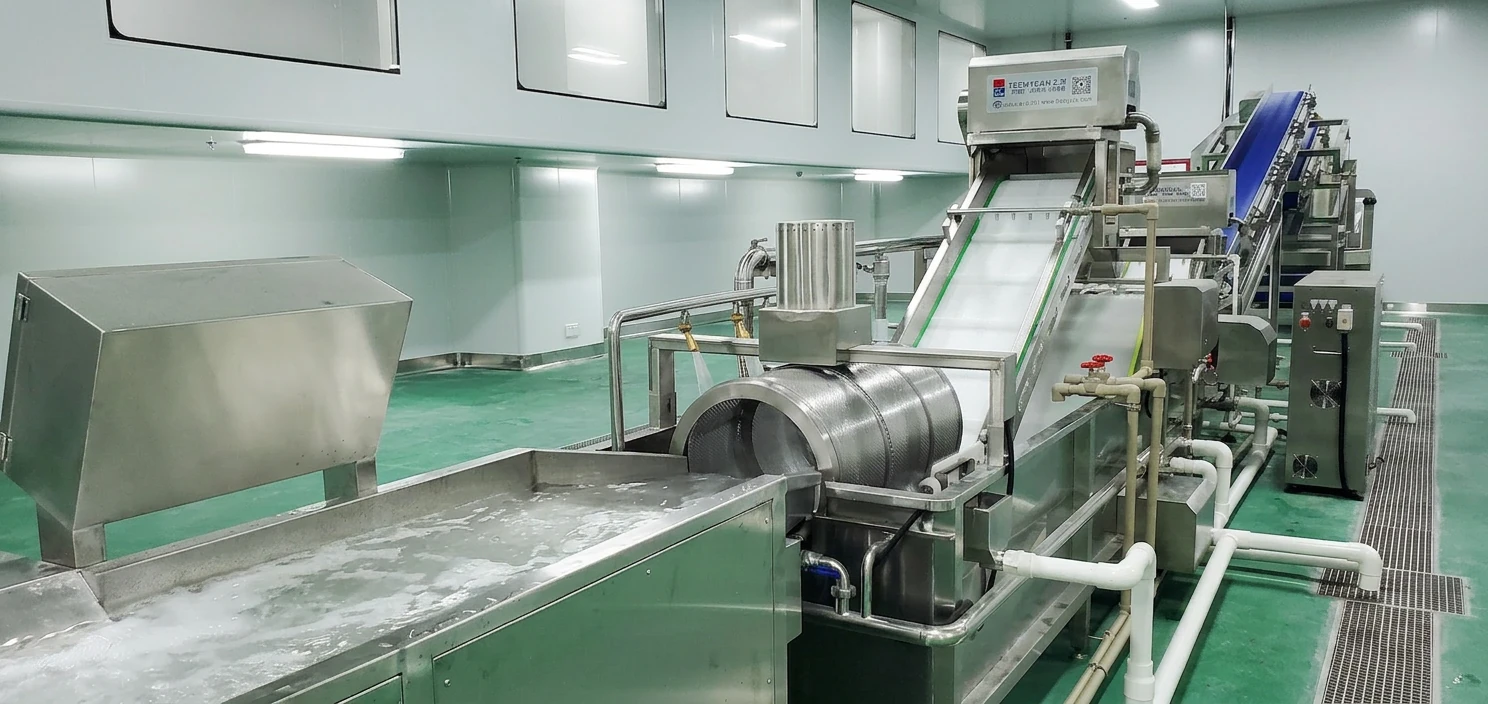
When evaluating sanitary design, project teams should examine:
- Accessibility of food-contact and adjacent surfaces
- Ability to drain water and product residue
- Condition and continuity of welds
- Crevices, threads, hollow areas and overlapping joints
- Belt removal and access below conveyors
- Tool requirements for routine disassembly
- Visibility for post-cleaning inspection
- Protection of bearings, motors, sensors and electrical components during washdown
- Safe access for cleaning and maintenance
- Reassembly controls that prevent missing or incorrectly installed parts
Cleaning time is part of production capacity. A line with a high running rate may deliver less daily output than a slower line if sanitation requires extensive disassembly or repeated recleaning. Equipment selection should therefore compare total available output over a shift or week rather than only the nominal hourly rate.
Sanitation planning should define who removes gross debris, how chemicals are prepared and applied, which surfaces require disassembly, how rinsing is controlled, how cleaning effectiveness is verified and how the line is released for production. Equipment cannot create these procedures, but its design can make them practical or impractical.
Equipment Should Be Selected by Process Function
A fresh-cut line may use receiving conveyors, inspection tables, peeling machines, cutters, washing tanks or flumes, spray systems, dosing controls, filtration, dewatering equipment, mixers, weighing systems and packaging interfaces. The appropriate combination depends on the product route rather than a standard package.
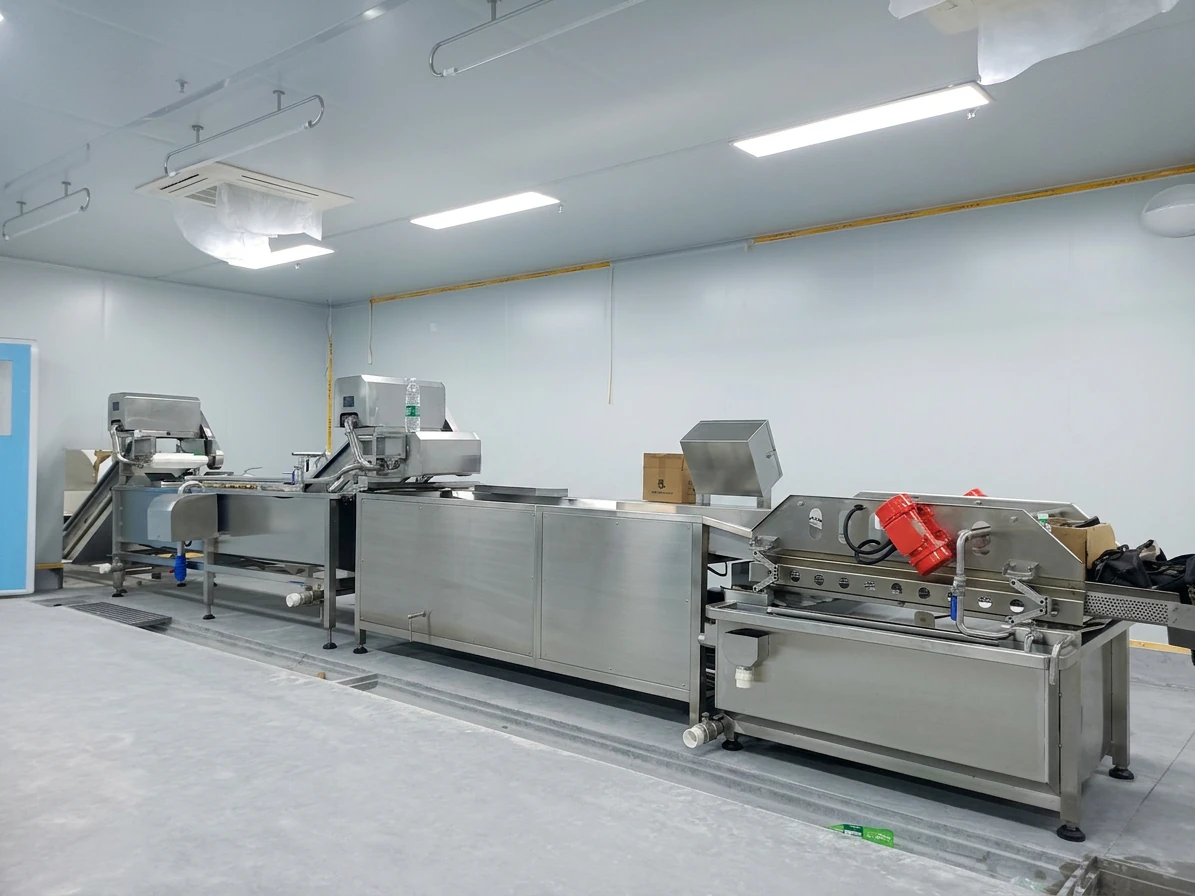
Each equipment decision should be supported by a process requirement:
- Feeding and conveying: maintain a controlled, non-damaging flow and avoid excessive drop heights.
- Peeling: achieve the required surface finish without unacceptable edible loss.
- Cutting: meet dimension and appearance specifications across the expected size range.
- Washing: provide the required soil removal, product separation and process-water control.
- Dewatering: remove free water to the required condition without excessive breakage.
- Inspection: give operators or automated systems sufficient presentation and time to detect defects.
- Mixing: maintain recipe distribution while protecting delicate components.
- Weighing and packaging: match product flow, pack formats, labeling and cold-chain requirements.
Testing actual raw materials is particularly useful when product behavior cannot be inferred reliably from a catalog. Testing should use representative varieties, sizes, soil conditions and finished-product specifications. A visually successful trial is not enough; the team should record feed rate, acceptable output, yield, product damage, cleaning observations and operator interventions.
Manual, Semi-Automatic and Integrated Production Compared
| Decision Factor | Manual Processing | Semi-Automatic Processing | Integrated Processing Line |
|---|---|---|---|
| Typical production pattern | Low volume, irregular demand or many specialized products | Defined bottlenecks with continued manual flexibility | Stable medium- or high-volume production with repeatable routes |
| SKU flexibility | High when skilled labor is available | Usually high if standalone modules are easy to clean and reset | Depends strongly on line design, bypass options and changeover time |
| Labor dependence | High and sensitive to operator skill and attendance | Reduced at selected stages | Lower direct handling at connected stages but greater technical-skill requirement |
| Process consistency | Can vary by person, team and shift | Improved where equipment settings are standardized | Potentially more repeatable when feeding, controls and maintenance remain stable |
| Capital commitment | Low | Moderate and suitable for phased investment | High and dependent on coordinated facility preparation |
| Expansion approach | Add labor or workstations | Add or connect modules as demand becomes clearer | Increase shifts, add parallel capacity or install planned expansion modules |
| Main risk | Labor instability, inconsistent output and ergonomic exposure | Creating disconnected islands of automation and repeated handling | Overinvestment, poor flexibility, complex sanitation or insufficient technical support |
No option is inherently superior. Manual preparation may be rational for low-volume specialty products that require judgment and change frequently. Semi-automation is often suitable when one or two stages—such as cutting, washing or dewatering—create measurable losses. Integrated automation becomes more defensible when demand is stable, several connected bottlenecks exist and the facility can support the required hygiene, utilities, maintenance and operating discipline.
Automation Can Introduce New Risks
Automation reduces selected manual activities but creates dependence on equipment availability and interface control. A single failed conveyor, sensor or discharge mechanism can stop several connected operations. Faster processing can also spread a process deviation through more product before it is detected.
Common automation risks include:
- Oversized machines operating at unstable low loading
- Undersized downstream equipment creating permanent queues
- Product damage caused by excessive transfer height or mechanical force
- Complex cleaning requirements that shorten available production time
- Controls or software that local personnel cannot troubleshoot
- Missing spare parts for wear components or imported controls
- Insufficient manual bypass or recovery procedures
- Operators relying on displayed settings without checking actual product condition
- Increased water, drainage, refrigeration or electrical demand beyond facility capacity
Automation should therefore be accompanied by operating standards, alarm-response procedures, preventive maintenance, spare-parts planning and clearly defined responsibilities. A connected line is not autonomous; it concentrates the need for competent operation.
Records Turn Production Activity into Process Control
A control is difficult to verify when the facility cannot show what happened, who checked it and what action followed a deviation. Records should be designed around decisions rather than collected for their own sake.
Depending on the facility and applicable food-safety system, useful records may include:
- Supplier and incoming lot information
- Receiving inspection and acceptance decisions
- Raw-material and finished-product temperatures
- Cutting setup, blade inspection and product specification checks
- Wash-water or treatment monitoring results
- Corrective actions and affected-product disposition
- Sanitation completion and verification
- Changeover authorization
- Equipment inspection, maintenance and calibration
- Packaging-material, label and date-code verification
- Finished-product lot formation and release status
- Cold-storage and dispatch conditions
Traceability becomes more complex when several incoming lots are mixed into one product or one incoming lot is divided among many finished SKUs. The traceability design should be tested through a mock exercise that follows material forward to customers and backward to suppliers. A record system that exists only on paper but cannot reconstruct actual production relationships is not performing its intended function.
Reliability, Maintenance and After-Sales Support Affect Real Capacity
Equipment reliability should be evaluated in the context of the complete production schedule. A minor recurring stoppage may create more lost output than an infrequent major repair. Maintenance planning therefore needs both technical information and operating data.
Useful reliability indicators include:
Downtime rate = equipment-related downtime ÷ scheduled production time × 100
Availability = operating time ÷ planned production time × 100
Mean time to repair = total repair time ÷ number of repair events
These measures should be interpreted carefully. A high availability number does not prove that the equipment is producing acceptable product, while a short repair time may depend on spare parts and technicians being immediately available.
Before purchasing, the project team should clarify wear parts, recommended spares, documentation language, electrical and control-component availability, remote support, site service boundaries, installation responsibilities and operator training. Maintenance access should also be reviewed during layout planning. Equipment positioned too close to a wall may fit physically but remain impossible to service or clean properly.
Evaluate Economics with a Complete Cost Model
Labor savings are only one part of an automation decision. A stronger financial model includes raw-material yield, product damage, overtime, water, chemicals, energy, sanitation labor, changeover time, downtime, maintenance, spare parts, packaging losses, training and financing costs.
Preparation cost per kilogram can be calculated as:
Preparation cost per kilogram = total relevant preparation cost ÷ acceptable finished kilograms
The cost boundary should be explicit. One model may include only direct labor and utilities, while another includes depreciation, maintenance, quality-control labor and allocated facility costs. Results cannot be compared unless the same cost categories are used.
A basic payback calculation is:
Simple payback period = net project investment ÷ estimated annual net operating benefit
Annual net operating benefit should account for both improvements and new costs. It may include reduced labor hours, avoided overtime, improved yield or additional contribution from capacity that can actually be sold. It should subtract additional maintenance, utilities, consumables, financing and technical labor.
Payback is not guaranteed by installing equipment. Demand may not reach the forecast, product mix may change, or the line may operate below planned utilization. Sensitivity analysis should test conservative, expected and higher-demand conditions rather than relying on one exact forecast.
When Automation Is Not the Right Decision
Manual or lightly mechanized processing may remain appropriate when daily volumes are low, products are highly specialized, demand is uncertain or the business needs maximum flexibility. Skilled manual trimming can also be more suitable for irregular vegetables or premium specifications that require visual judgment.
A complete integrated line may be premature when:
- The product portfolio and customer specifications are not yet defined.
- Demand consists of many very small, irregular orders.
- The facility cannot provide suitable drainage, utilities, hygiene separation or chilled capacity.
- Current performance has not been measured, so the real bottleneck is unknown.
- Management has not standardized operating and sanitation procedures.
- The organization lacks maintenance personnel or access to technical support.
- Raw-material supply is inconsistent and no incoming specification is enforced.
- Packaging or sales demand—not vegetable preparation—is the real constraint.
In these situations, targeted improvement may produce a better result. The facility might reorganize product flow, improve receiving specifications, standardize cutting, add a standalone washer, mechanize dewatering or improve packaging capacity before integrating the entire line.
Phased automation also allows the operation to collect data. A processor can confirm actual product behavior, cleaning time and market demand before committing to later modules.
A Project Decision Framework for Fresh-Cut Line Design
A line concept should not be prepared from daily tonnage alone. Project teams need a structured requirement package that connects commercial demand with process and facility conditions.
| Decision Area | Information Required | Why It Matters | Evidence to Review |
|---|---|---|---|
| Finished products | RTC or RTE status, cut specifications, pack format, shelf-life target and customer standards | Defines hygiene, equipment functions and downstream interfaces | Product specification sheets, sample packs and customer requirements |
| Raw materials | Vegetable types, varieties, sizes, soil load, temperature and seasonal range | Determines feeding, peeling, cutting, washing and yield behavior | Representative samples, supplier records and receiving data |
| Capacity | Daily average, peak day, peak hour, batch size, shifts and growth scenario | Prevents equipment from being sized only to an annual average | Order history, production schedules and demand forecast |
| SKU and changeovers | Products per shift, sequence, cleaning requirements and pack changes | Shows how much scheduled time is actually available | Current production plan or proposed SKU matrix |
| Facility | Room dimensions, columns, doors, drains, floor levels and hygiene zones | Controls equipment access, movement and cleanability | Measured drawing, photographs and utility plan |
| Utilities | Electricity, water quality and pressure, drainage, compressed air and refrigeration | Determines whether the proposed line can operate as designed | Utility specifications and site engineering review |
| Food-safety controls | Hazard analysis, wash-water strategy, sanitation, environmental controls and records | Ensures equipment operates within the facility’s control system | Food-safety plan, SOPs, SSOPs and customer audit requirements |
| Commercial evaluation | Investment boundary, labor cost, yield, operating cost, demand and risk assumptions | Supports realistic ROI and phased-investment decisions | Cost model, sensitivity analysis and implementation plan |
Supplier evaluation should examine more than whether each machine is available. The supplier should be able to explain the process route, capacity assumptions, interfaces, cleaning access, raw-material testing method, layout requirements and supply boundary. The customer remains responsible for its product specifications, facility, regulatory obligations and validated food-safety system, while the equipment supplier should state clearly what is included and what requires third-party or site engineering.
Explore the Fresh-Cut Processing Framework
A reliable fresh-cut project begins with a process map, not a machine list. Review the intended products, current and target capacity, raw-material condition, RTE or RTC status, available production time, hygiene requirements and facility constraints before deciding which stage should be automated.
Teams at an early stage can use the fresh-cut vegetable processing framework to compare product routes and identify the main bottleneck. Projects with defined requirements can move into a preliminary line concept covering equipment configuration, capacity matching, hygienic considerations and layout discussion.
TEEMYEAH works as a food pre-processing equipment supplier, vegetable processing equipment manufacturer and customized food preparation solution provider for central kitchens, food manufacturers, fresh-cut processors and RTC/RTE facilities. A technical discussion can begin with representative raw materials, finished-product specifications, average and peak output, packaging requirements and a measured factory layout. Product testing and a staged implementation plan can then be considered where they are relevant to the project.
FAQ
1. What is a fresh-cut vegetable processing guide used for?
A fresh-cut vegetable processing guide helps a project team define the complete production system before selecting equipment. It connects finished-product requirements with receiving, trimming, peeling, cutting, washing, dewatering, inspection, packaging, sanitation, temperature control and traceability. It should also help the team distinguish nominal machine capacity from practical line throughput. The guide is not a substitute for a facility-specific hazard analysis or operating procedure. Its purpose is to organize the questions that determine whether manual processing, semi-automation or an integrated vegetable processing line is appropriate.
2. What is the main difference between RTE and RTC vegetable processing?
Ready-to-eat vegetables are intended to be consumed without a later pathogen-reduction cooking step, while ready-to-cook vegetables are intended for further cooking or processing. RTE production therefore places particular emphasis on preventing contamination after the final controlled washing stage, maintaining hygienic separation and protecting the cold chain. RTC production still requires effective sanitation, water control, traceability and temperature management. Expected cooking should not be treated as permission to accept poor incoming material or uncontrolled cross-contamination.
3. Can one vegetable processing line produce both RTE and RTC products?
One line may be mechanically capable of processing both categories, but mechanical compatibility is not enough to approve shared production. The facility must evaluate product sequencing, hygienic zoning, employee movement, tools, waste routes, validated cleaning, environmental conditions and changeover verification. It must also determine whether RTE products could be exposed to contamination from raw or RTC production. In some facilities, dedicated equipment or rooms are justified. Others may use controlled time separation, but only when the risk assessment and verification program support it.
4. How is the actual capacity of a fresh-cut vegetable line calculated?
Actual line capacity is based on acceptable finished output during net operating time. Start with scheduled shift time, subtract sanitation, startup, breaks, changeovers, planned maintenance and unplanned downtime, and then determine the sustainable rate of each required processing stage. The slowest repeatable stage usually limits the line. Product density, cut size, soil load, inspection burden, dewatering cycles and packaging speed can all change throughput. A single machine’s catalog capacity should not be presented as guaranteed finished-line output.
5. Which KPIs should a fresh-cut processor measure?
Useful KPIs include finished yield, labor hours per 1,000 kilograms, acceptable throughput per hour, preparation cost per kilogram, downtime rate, changeover time, on-time order completion, product-temperature compliance and specification pass rate. The definitions and measurement boundaries must remain consistent. For example, yield measured after trimming cannot be compared directly with yield measured after packaging. The purpose of KPIs is to identify the cause of variation and support process decisions, not merely to produce a management dashboard.
6. Does washing make fresh-cut vegetables safe to eat?
Washing is one part of a food-safety system and should not be described as sterilization. It can remove soil and reduce contamination, but it cannot guarantee elimination of pathogens. Poorly controlled shared wash water may also transfer contamination between products. Safety depends on incoming-material controls, water quality, validated treatment conditions where used, sanitary equipment, personnel hygiene, environmental sanitation, temperature management, packaging and distribution. The facility should monitor the variables defined by its process and establish corrective actions when operating limits are not met.
7. When is manual vegetable preparation still commercially reasonable?
Manual preparation may remain reasonable for low volumes, highly variable orders, specialized trimming or products that need visual judgment. It can also support a new business while demand and specifications are still developing. The decision should account for more than wage cost, including training, absence cover, output variation, over-trimming, ergonomic exposure and supervision. Manual work becomes less suitable when recurring labor shortages, inconsistent cuts, missed schedules or growing production volumes create measurable commercial problems.
8. When is semi-automation better than a complete line?
Semi-automation is often appropriate when one or two process stages create most of the delay or inconsistency. A processor may automate cutting, washing or dewatering while retaining manual inspection, trimming and packing. This approach preserves flexibility, limits initial investment and allows the team to collect operating data before integrating more equipment. It is less effective when standalone machines create repeated lifting, uncontrolled waiting or incompatible capacities. The interfaces between manual and automated stages still need to be designed as part of one process.
9. What information should be sent to a vegetable processing equipment supplier?
A useful project brief includes raw-material types and representative photographs, finished cut specifications, RTE or RTC status, average and peak production demand, operating hours, SKU count, batch sizes, packaging formats and target implementation date. It should also include a measured facility layout, hygiene-zone concept, available utilities and any customer or regulatory requirements. Providing only a daily tonnage figure is rarely sufficient because the same volume can require very different equipment when product mix, changeovers and contamination loads differ.
10. How should ROI for a fresh-cut processing line be evaluated?
ROI should include labor, yield, product damage, overtime, water, chemicals, energy, sanitation, maintenance, spare parts, downtime, financing and the value of additional saleable capacity. Any additional capacity should be counted only when credible demand exists. A simple payback period divides net investment by estimated annual net operating benefit, but the assumptions should be tested under conservative and higher-demand scenarios. Equipment does not guarantee payback; utilization, product mix, operator competence, maintenance and market demand determine the financial result.
11. Why is raw-material testing important before line selection?
Vegetable behavior varies by variety, size, maturity, temperature, soil load and season. Testing representative material can reveal feeding problems, excessive fragments, peeling loss, bruising, unsuitable wash intensity or insufficient dewatering. A useful test records acceptable throughput, yield, finished-product condition, operator intervention and cleaning observations. Tests performed with unusually clean or uniform samples may not represent daily production, so the project team should agree on what material and specification the test is intended to represent.
12. Can equipment replace food-safety procedures and staff training?
No. Equipment can support controlled feeding, cutting, washing, dosing, monitoring, dewatering and record collection, but it cannot define the facility’s hazard analysis or ensure that employees respond correctly to deviations. The processor remains responsible for supplier controls, sanitation procedures, employee hygiene, training, verification, traceability and product release. Automated systems may make selected controls more repeatable, yet they also require competent operators and maintenance personnel. Process design, management discipline and equipment must work together.
Data and Source Note
This article uses official guidance and technical references to establish general fresh-cut processing principles. Regulatory applicability, legal obligations and acceptable processing conditions vary by country, product and facility. Project teams should confirm current local requirements and validate their own processes.
- U.S. Food and Drug Administration, Guide to Minimize Microbial Food Safety Hazards of Fresh-Cut Fruits and Vegetables, 2008.
- U.S. Food and Drug Administration, Current Good Manufacturing Practice and Risk-Based Preventive Controls for Human Food, modernized 2015.
- U.S. Food and Drug Administration, Recommendations for the Temperature Control of Cut Leafy Greens, 2010.
- Codex Alimentarius Commission, Code of Hygienic Practice for Fresh Fruits and Vegetables, CXC 53-2003, revised through 2017.
- Food and Agriculture Organization of the United Nations, Processing of Fresh-Cut Tropical Fruits and Vegetables: A Technical Guide, 2010 publication series and 2011 edition.
- Food and Agriculture Organization of the United Nations and World Health Organization, Microbiological Hazards in Fresh Leafy Vegetables and Herbs, 2008.
- Food and Agriculture Organization of the United Nations and World Health Organization, Prevention and Control of Microbiological Hazards in Fresh Fruits and Vegetables, 2023.
- U.S. Occupational Safety and Health Administration, Ergonomics guidance for workplace risk identification and control, current guidance resource.

