







Summary
Root vegetable processing is more than a sequence of washing, peeling and cutting operations. It is a production system in which raw-material variability, product specifications, hygiene requirements, equipment selection and production planning all influence the final cost, throughput and product quality. Potatoes, carrots, cassava, taro and similar crops behave differently because of differences in size, shape, maturity, soil conditions and peel characteristics. A process that performs well for one product may generate unnecessary waste or inconsistent results with another.
This root vegetable processing guide explains how to evaluate the complete process rather than focusing on individual machines. It examines raw-material assessment, process flow, washing, peeling, cutting, yield control, line balance, production capacity and food safety considerations for central kitchens, food manufacturers, fresh-cut processors and ready-to-cook or ready-to-eat operations. It also discusses situations where manual preparation remains commercially reasonable, when semi-automatic equipment may provide the best balance, and when a fully integrated processing line becomes justified. Throughout the guide, practical decision frameworks are combined with evidence from recognised food safety guidance, peer-reviewed research and international technical references while avoiding assumptions that every facility should automate every step.
Root Vegetable Processing Guide: A Process Design Challenge, Not a Machine Purchase
A successful root vegetable processing operation begins with understanding the production objective rather than selecting equipment. Two facilities may process the same potato variety yet require completely different process designs because their finished products, daily production volumes, labour availability and hygiene requirements differ. A central kitchen preparing peeled potatoes for same-day cooking has different priorities from a fresh-cut processor supplying packaged retail products or a manufacturer producing ingredients for ready-to-cook meals.
For this reason, the primary question is not which washer, peeler or cutter to buy. The more useful question is how raw materials should move through the preparation process with the lowest practical level of waste while maintaining consistent quality and an appropriate food safety programme. Every subsequent equipment decision should support that objective instead of determining it.
Root vegetables introduce production variability that is often underestimated during project planning. Soil type, harvesting methods, seasonal weather, storage conditions and natural differences in crop size all influence washing efficiency, peeling performance, cutting consistency and achievable yield. Even within a single delivery, operators may encounter substantial variation in diameter, shape and surface defects. Process planning therefore needs enough flexibility to accommodate expected variation without creating unnecessary bottlenecks.
International technical references on root crop processing have long emphasised that raw-material quality and preparation procedures influence downstream efficiency as much as processing equipment itself. Likewise, food safety guidance for fresh-cut produce stresses that sanitation should be integrated throughout production rather than treated as a final washing step. These principles apply whether production remains largely manual or incorporates significant automation.
Why Raw Material Differences Matter Before Processing Begins
Every processing line starts with agricultural products rather than uniform industrial components. Potatoes harvested from different fields may have different soil loads, moisture levels and peel adhesion. Carrots vary in length and taper. Cassava presents different peeling challenges depending on maturity and storage time, while taro often requires careful handling because of its irregular geometry and surface texture.
These differences affect nearly every downstream decision. Heavy soil contamination increases washing demand. Thin-skinned products may require gentler peeling methods to preserve usable product. Large size variation can reduce cutting consistency if equipment settings remain unchanged throughout production. Ignoring these variables frequently results in unnecessary trimming, inconsistent product dimensions or unstable throughput.
Before establishing a process sequence, production teams should document several characteristics of incoming raw materials.
- Average and maximum product size.
- Seasonal variation in dimensions and appearance.
- Typical soil contamination level.
- Frequency of damaged, diseased or mechanically injured products.
- Storage duration before processing.
- Required finished-product specification.
These observations create a practical baseline for process design. They also help determine whether incoming products should be graded before peeling, whether additional washing stages are justified or whether different cutting configurations will be needed for different production runs.
Another important distinction concerns the intended market. Products destined for ready-to-cook applications normally undergo further thermal processing by the customer, whereas ready-to-eat products may receive no additional kill step before consumption. That difference influences sanitation strategy, process separation, environmental hygiene and operational controls throughout the facility. Equipment alone cannot compensate for weaknesses in food safety management, employee training or process verification.
Production planning should therefore begin with four connected questions:
- What raw materials arrive at the factory throughout the year?
- What finished products must be delivered consistently?
- Which process steps create the greatest operational uncertainty?
- Which performance indicators will define success beyond theoretical hourly capacity?
Answering these questions establishes the foundation for subsequent decisions about washing systems, peeling methods, cutting technology, line balance and production capacity instead of treating each stage as an isolated equipment purchase.
Designing the Washing Sequence for Consistent Quality and Hygiene
Washing is the first major processing step that directly influences downstream performance. Its purpose extends beyond making vegetables look clean. An effective washing sequence removes soil, stones and field debris, reduces the transfer of contaminants to later process stages, protects peeling equipment from excessive wear and supports consistent product quality. When washing performance is inadequate, problems often appear later as lower peeling efficiency, higher maintenance requirements and unnecessary product loss.
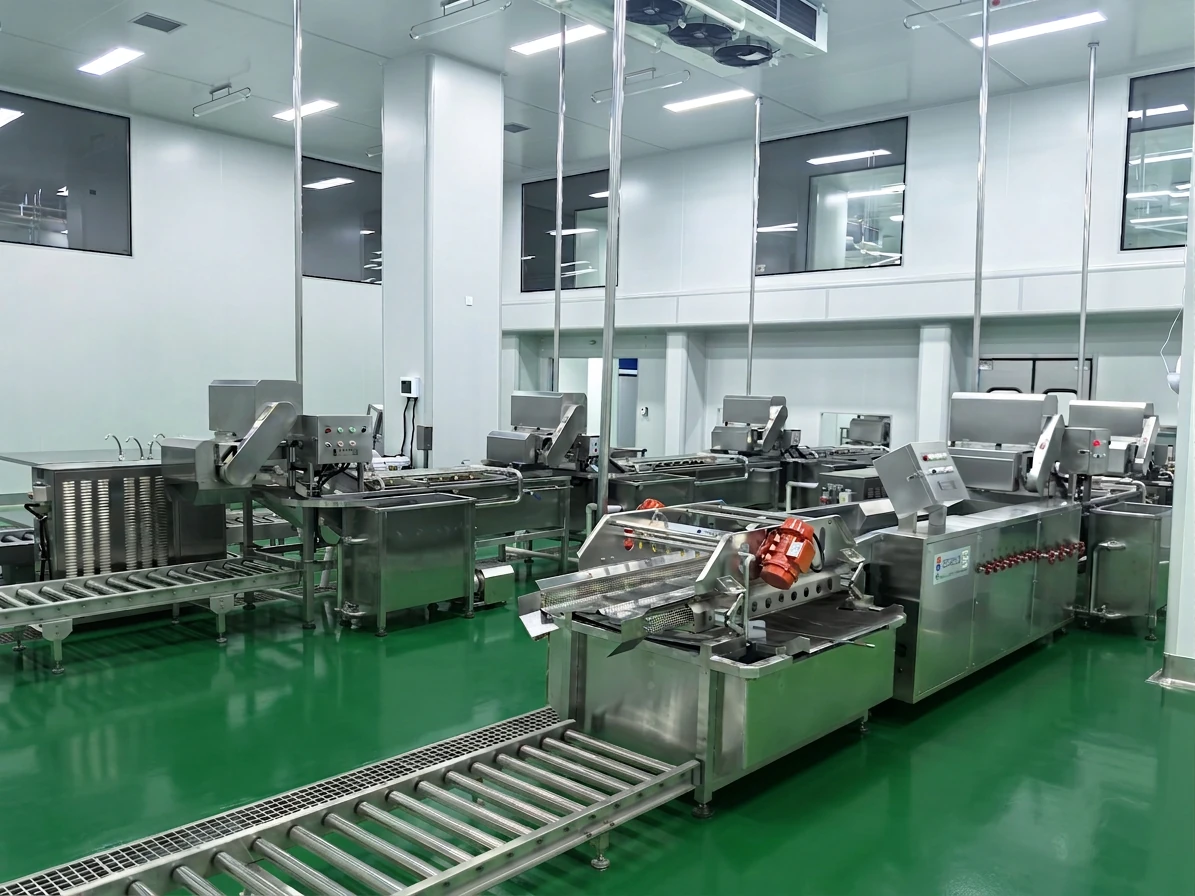
The appropriate washing configuration depends on the incoming condition of the crop rather than a fixed production recipe. Potatoes harvested in dry conditions may require substantially different washing intensity from carrots or taro processed immediately after wet harvesting. Facilities that receive products with heavy soil loads may benefit from separating coarse cleaning from final washing instead of attempting to achieve every objective in a single operation.
A practical sequence commonly includes reception, removal of large foreign materials, primary washing to eliminate loose soil, inspection where necessary and a final washing stage before peeling or cutting. Between these stages, product transfer should minimise unnecessary drops and impacts that increase bruising or create additional trim loss.
Water management is equally important. Reusing wash water without appropriate monitoring or treatment can reduce cleaning effectiveness and increase the possibility of transferring contamination between products. Published guidance for fresh-cut produce emphasises that wash systems should be managed to maintain water quality throughout production rather than assuming that water alone improves food safety. The objective is process control, not simply greater water consumption.
Facilities processing ready-to-eat products typically require stricter environmental and sanitation controls than operations supplying ingredients that will later be cooked. That distinction affects equipment zoning, cleaning procedures, personnel movement and verification activities throughout the process. It should be considered during line planning rather than after equipment installation.
Performance indicators for washing should include measurable operational outcomes instead of visual appearance alone. Useful indicators include visible soil removal, frequency of equipment cleaning caused by accumulated debris, water replacement intervals, downstream peeling consistency and the proportion of rejected product attributable to inadequate cleaning. Monitoring these factors over time provides a more reliable picture of process stability than relying on subjective inspection.
Comparing Peeling Methods Without Assuming One Solution Fits Every Factory
Peeling directly affects yield, product appearance, throughput and operating cost. Removing too little peel may increase downstream trimming requirements or leave unacceptable surface defects. Removing too much reduces usable product and lowers material efficiency. Research on potato processing has shown that peeling performance has a measurable influence on overall manufacturing yield, demonstrating why optimisation should focus on balancing product quality with material recovery instead of maximising peeling speed alone.
The most appropriate peeling method depends on raw-material characteristics, finished-product requirements and production objectives. A method that performs well for uniform potatoes may not provide satisfactory results for irregular taro or cassava. Similarly, premium fresh-cut products may justify different peeling priorities from ingredients intended for further cooking or industrial processing.
Manual peeling remains a practical option for low production volumes, highly variable specialty products or operations where frequent product changes make automation difficult to justify. Skilled operators can selectively remove defects while preserving usable material, although consistency depends heavily on training and operator fatigue.
Mechanical abrasion peeling offers predictable throughput for many commercial potato and root vegetable applications. However, excessive abrasion or poorly matched operating parameters may remove more edible material than necessary, particularly when product size varies significantly.
Steam peeling, where appropriate, can provide efficient peel removal for certain industrial applications with suitable product characteristics, although supporting infrastructure, utility demand and overall process integration require careful evaluation during project planning. It is not automatically the preferred choice for every facility or every root vegetable.
| Peeling approach | Best suited for | Primary advantages | Key limitations | Project considerations |
|---|---|---|---|---|
| Manual peeling | Small batches, specialty products, frequent SKU changes, irregular raw materials | Flexible decision-making, selective defect removal, low initial equipment investment | Labour dependent, variable consistency, limited throughput, ergonomic demands | Appropriate where production volume is modest and skilled labour is available |
| Mechanical abrasion peeling | Medium to high-volume processing of relatively consistent root vegetables | Repeatable operation, compatible with continuous production, reduced manual handling | Yield depends on raw-material uniformity and equipment adjustment | Requires monitoring of peel loss, wear components and upstream washing quality |
| Steam peeling | Selected industrial operations with suitable products and supporting utilities | Potentially high throughput with controlled peel removal for compatible products | Higher infrastructure requirements and process complexity; not suitable for every application | Evaluate alongside utility availability, product specifications and total line design |
| Combined or staged approach | Operations processing multiple products or quality grades | Balances efficiency with targeted manual finishing where required | Requires careful line balance and clear operating procedures | Can improve flexibility when product variation is significant |
The decision should therefore be based on total process performance rather than equipment capability alone. A peeling method that achieves excellent hourly throughput may still reduce commercial performance if it creates excessive trim loss, frequent stoppages or additional manual correction before cutting. Conversely, a slower process may deliver stronger overall results when yield, product appearance and downstream stability are considered together.
Achieving Consistent Cutting Quality Across Different Products and SKUs
Cutting is often the stage where preparation quality becomes immediately visible to customers. Uniform dimensions contribute to predictable cooking performance, packaging consistency and product presentation, while excessive variation can affect portion control, texture and downstream processing. For processors supplying central kitchens, ready-to-cook ingredients or fresh-cut products, cutting quality should therefore be evaluated as a production metric rather than simply an equipment characteristic.
Selecting a cutting method begins with the finished product specification. Dice, slices, strips, wedges and irregular cuts all place different demands on product orientation, blade geometry and feeding systems. A cutter that performs well for potatoes intended for French fries may not deliver equivalent results for carrots destined for soup mixes or taro prepared for regional food products.
Blade condition also deserves routine attention. Dull or damaged blades may increase crushing, surface tearing and dimensional variation while placing additional mechanical load on the process. Regular inspection and documented replacement intervals support more predictable production than waiting until product quality visibly deteriorates.
Raw-material variability remains another important factor. Large differences in diameter or length can reduce dimensional consistency even when equipment settings remain unchanged. Where practical, grading products before cutting may improve overall uniformity and reduce downstream sorting requirements, particularly for premium products with tight specifications.
Quality verification should extend beyond occasional visual inspection. Many processors monitor representative samples throughout production using dimensional tolerances, weight distribution, surface appearance and the percentage of pieces outside specification. Trend analysis helps identify gradual process drift before customer complaints or excessive waste become apparent.
Managing Product Changeovers Without Sacrificing Productivity
Many facilities process multiple root vegetables, several finished product sizes or different customer specifications within the same production day. In these environments, changeover efficiency influences effective capacity almost as much as nominal equipment speed. A line capable of high hourly throughput may still deliver disappointing daily output if frequent cleaning, blade replacement or equipment adjustments consume excessive production time.
Successful changeover planning starts by grouping compatible production runs wherever commercial requirements allow. Running products with similar dimensions or cut specifications together can reduce adjustment frequency and simplify sanitation scheduling. Production planners should also distinguish between routine operational adjustments and mandatory cleaning procedures associated with allergen management, food safety or product category separation.
Documented changeover procedures improve repeatability by defining equipment settings, inspection points and verification steps. Recording actual changeover duration instead of planned duration provides useful information for identifying recurring delays and prioritising improvement projects.
Important performance indicators include average changeover time, first-pass product acceptance after restart, cleaning duration, blade replacement frequency and the proportion of planned production time consumed by non-processing activities. Monitoring these indicators provides a more realistic understanding of productive capacity than equipment nameplate ratings alone.
A Practical Framework for Calculating Yield and Production Capacity
Capacity planning should distinguish between theoretical equipment capability and sustainable production output. Published equipment ratings typically describe performance under defined conditions, while actual factory performance depends on raw-material quality, operator practices, sanitation requirements, maintenance, product mix and planned stoppages. Comparing theoretical and actual performance helps identify opportunities for process improvement without assuming that additional equipment is always required.
Yield should also be analysed as a process measurement rather than a single financial outcome. Excessive peel removal, unnecessary trimming, damaged product and avoidable handling losses all reduce the proportion of incoming material converted into saleable product.
Illustrative calculation framework (hypothetical example):
Yield percentage
Yield (%) = (Saleable finished product weight ÷ Incoming raw-material weight) × 100
Illustrative example:
Incoming potatoes: 1,000 kg
Saleable peeled and cut product: 820 kg
Illustrative yield = (820 ÷ 1,000) × 100 = 82%
This example is intended only to demonstrate the calculation method. Actual yield varies according to crop condition, product specification, peeling method, trimming practices and customer quality requirements. Values from one factory should not be generalised to another.
Effective hourly throughput
Effective throughput = Total saleable production ÷ Total operating hours
Where significant stoppages occur, many production teams also calculate productive operating time separately from scheduled shift length to understand whether reduced output results from equipment constraints, sanitation, waiting for raw materials, staffing interruptions or downstream congestion.
Capacity utilisation
Capacity utilisation (%) = (Actual average throughput ÷ Planned sustainable throughput) × 100
Using a sustainable planning figure rather than an idealised maximum helps create production schedules that are more achievable under normal operating conditions.
Balancing the Production Line Instead of Maximising Individual Machines
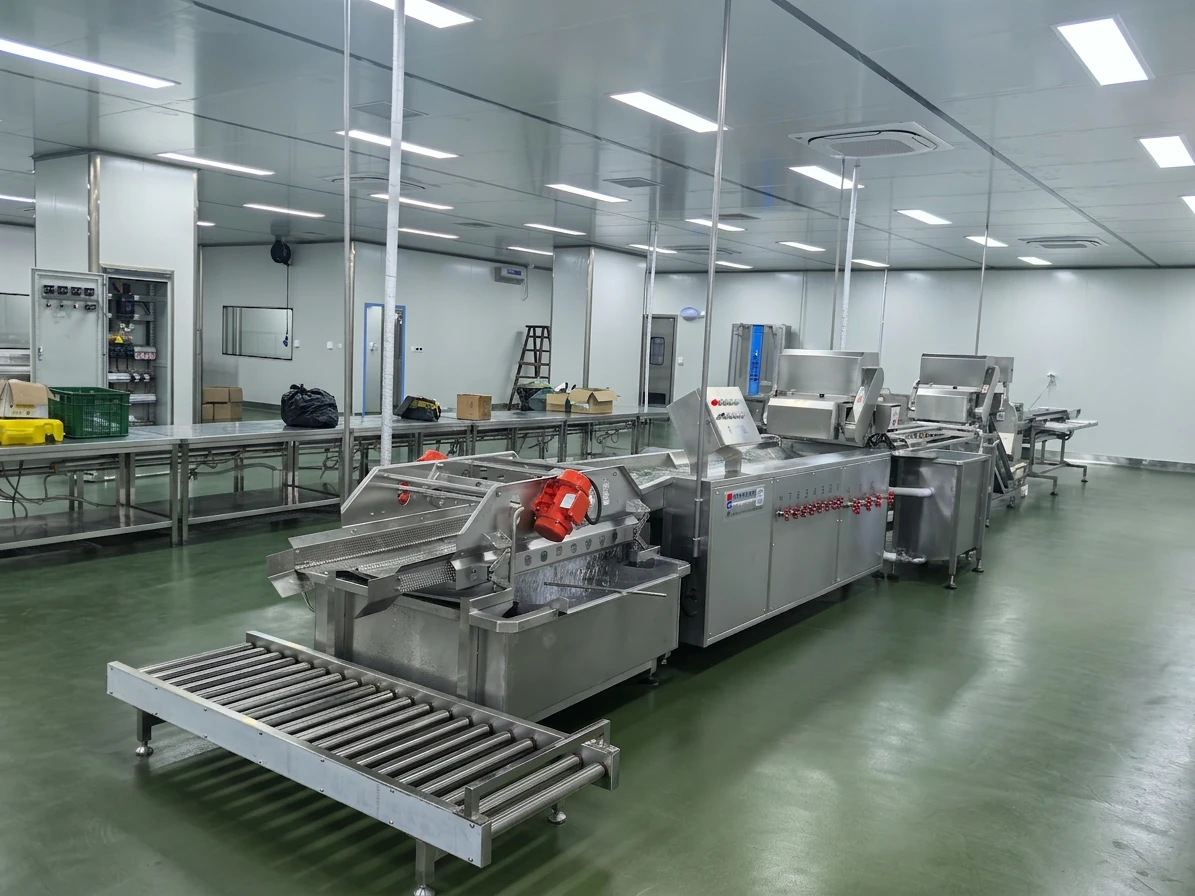
Line balance refers to matching the capability of each processing stage so that material flows steadily from reception through washing, peeling, cutting and subsequent operations. When one stage consistently operates more slowly than the others, work-in-progress accumulates upstream while downstream equipment waits for product. The slowest sustainable stage effectively determines overall production output.
Improving line balance therefore requires observation of the complete process instead of concentrating on the fastest machine. Increasing cutter speed alone provides little benefit if peeling remains the limiting step, just as adding additional washing capacity may not increase finished output when packaging or inspection creates the primary constraint.
Useful operational measurements include queue length between process stages, average waiting time, frequency of operator intervention, unplanned stoppages, percentage utilisation of each stage and the relationship between scheduled production volume and completed customer orders. Together, these indicators provide a clearer picture of process performance than hourly equipment ratings considered in isolation.
A balanced processing line supports consistent product flow, more predictable labour allocation and improved production planning. It also provides a stronger foundation for evaluating future investments because decisions are based on verified process constraints rather than assumptions about where the bottleneck exists.
Integrating Food Safety and Hygiene into Everyday Production
Food safety in root vegetable processing depends on the interaction between raw materials, people, equipment, water and operating procedures. Washing, peeling and cutting can improve product presentation and remove soil, but they do not automatically eliminate microbiological hazards. For this reason, production planning should incorporate hygienic process design from the beginning instead of relying on a final washing step to compensate for weaknesses elsewhere in the operation.
Freshly cut vegetables are particularly sensitive because peeling and cutting expose internal plant tissue, release nutrients and increase surface moisture. These changes may create conditions that allow microorganisms to survive or multiply if time, temperature and sanitation controls are not managed appropriately. The degree of risk varies according to the finished product, storage conditions and whether an additional validated kill step will occur before consumption.
For facilities operating in the United States, guidance published by the U.S. Food and Drug Administration for fresh-cut fruits and vegetables emphasises preventive controls, sanitation, water management and employee hygiene throughout production. Similar preventive principles are reflected in food safety systems adopted in many other jurisdictions, although detailed regulatory requirements differ between countries and should be verified against the applicable national legislation.
Managing Processing Water to Reduce Cross-Contamination Risk
Water is essential for washing root vegetables, transporting product and supporting cleaning operations. At the same time, it can become a pathway through which contamination is transferred from one product to another if process controls are inadequate. Increasing the volume of wash water alone does not necessarily improve food safety; maintaining appropriate water quality throughout production is equally important.
Research on fresh-cut produce has highlighted that wash systems should be managed as controlled processing steps rather than passive rinsing operations. Water quality monitoring, replacement schedules and, where appropriate, validated water treatment or disinfectant management all contribute to reducing the likelihood of transferring microorganisms between successive batches. These measures should form part of an overall food safety management system instead of being treated as independent technical solutions.
Facilities should also consider how water flows through the production process. Designing systems so that cleaner operations are not exposed to heavily contaminated recirculated water can support more stable hygiene performance. Regular inspection of tanks, filters, pumps and spray systems helps maintain both cleaning effectiveness and operational reliability.
Separating Ready-to-Cook and Ready-to-Eat Production Requirements
Not every processed root vegetable presents the same level of food safety risk. A product intended for cooking before consumption differs fundamentally from one that will be eaten without further heat treatment. This distinction should influence facility layout, sanitation procedures and operational controls rather than being viewed solely as a packaging or marketing difference.
Ready-to-cook (RTC) products are normally expected to receive further cooking by the customer or downstream manufacturer. Although hygienic handling remains essential, the intended thermal process forms part of the overall food safety strategy.
Ready-to-eat (RTE) products require a more stringent approach because consumers may eat them without any subsequent kill step. Environmental hygiene, personnel practices, equipment cleaning, temperature control and process verification therefore become even more critical. Facilities producing both RTC and RTE products should evaluate whether physical separation, production scheduling or dedicated processing areas are needed to reduce opportunities for cross-contamination. The appropriate approach depends on the products, process design and applicable regulatory requirements.
Sanitary Design and Efficient Cleaning
Sanitary design is not limited to selecting equipment manufactured from corrosion-resistant materials. It also involves ensuring that equipment can be inspected, cleaned and maintained without creating inaccessible areas where residues may accumulate. Smooth product-contact surfaces, appropriate drainage, avoidance of unnecessary dead spaces and practical access for cleaning all contribute to hygienic operation.
Cleaning procedures should be developed alongside production planning because sanitation directly affects available operating time. A line requiring extensive disassembly after every product change may reduce effective daily capacity even if its nominal processing speed appears attractive. Evaluating cleaning time as part of equipment selection provides a more realistic understanding of total operating efficiency.
Documented sanitation procedures should define responsibilities, inspection points, verification activities and acceptance criteria before production restarts. Facilities using validated cleaning verification methods may also establish objective release criteria that support consistent decision-making across production shifts.
Traceability, Maintenance and Long-Term Reliability
Reliable production depends on more than mechanical performance. Accurate production records help processors understand how raw materials, operating conditions and maintenance activities influence finished-product quality. Traceability systems typically record information such as supplier batches, production dates, processing times, equipment settings and finished-product identification. The level of detail should match business requirements and applicable regulatory obligations within the relevant market.
Maintenance should be integrated into production planning rather than treated solely as a response to equipment failure. Preventive inspection of wear components, drive systems, bearings, seals and cutting tools can reduce unexpected downtime and improve process consistency. Recording recurring faults also supports evidence-based decisions about spare parts, operating practices and future process improvements.
Operational reliability should be assessed using multiple indicators rather than a single measure. Unplanned downtime, maintenance frequency, repeat failures, production interruptions caused by worn cutting components and the proportion of planned production completed on schedule all provide useful insight into the stability of the overall process. These measurements help distinguish isolated equipment issues from broader process design challenges and create a stronger foundation for future capacity expansion.
Choosing the Right Level of Automation by Working Backwards from Your Production Reality
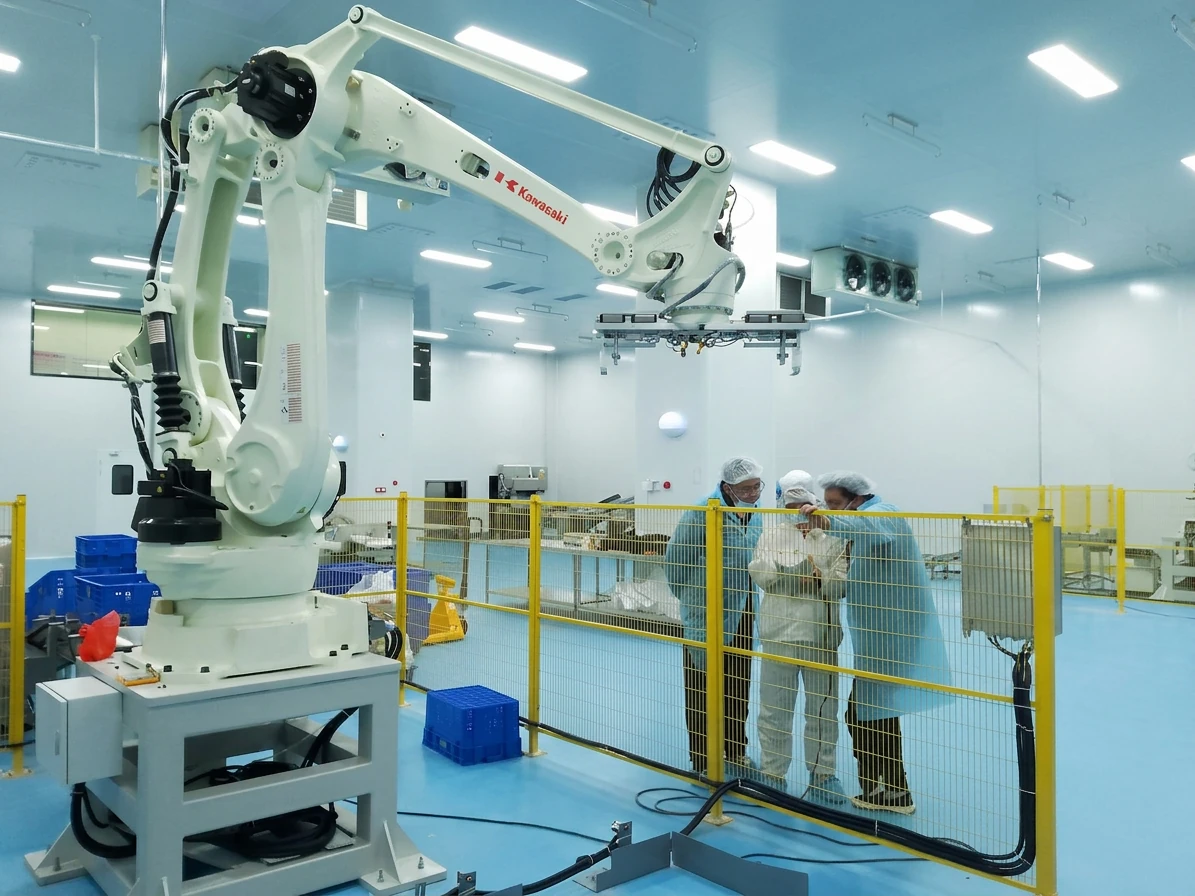
Automation should be the outcome of a process evaluation rather than the starting assumption. A common planning mistake is to compare manual preparation with a fully automated line without considering the wide range of intermediate solutions. In practice, many successful facilities operate with a combination of manual inspection, semi-automatic preparation and automated transfer because that configuration best matches their product mix and business model.
The most appropriate processing approach depends on production volume, labour availability, finished-product specifications, hygiene objectives, expected growth and available capital. Evaluating these factors together usually produces a more robust decision than comparing equipment speeds alone.
When manual preparation remains a commercially reasonable choice
Manual handling may continue to be appropriate where daily production volume is relatively low, product dimensions vary significantly, customer specifications change frequently or products require visual judgement that is difficult to standardise. Small central kitchens, pilot production facilities and businesses serving niche markets often benefit more from disciplined process control and staff training than from immediate investment in extensive automation.
The limitations become more apparent as production expands. Labour availability, consistency between operators, ergonomic demands and production scheduling can become increasingly difficult to manage, particularly during seasonal peaks.
When semi-automation offers the best balance
Semi-automatic processing frequently provides the strongest balance between flexibility and productivity. Typical examples include automated washing combined with manual inspection, mechanical peeling followed by selective hand trimming or automated cutting supplied by manually graded raw materials.
This approach allows businesses to improve throughput and consistency while preserving flexibility for changing product specifications. It can also reduce project risk by allowing operators to gain experience with new processes before introducing additional automation.
When an integrated processing line becomes justified
A fully integrated processing line is generally easier to justify when production is sustained over multiple shifts, demand is predictable, product specifications are well defined and the business requires repeatable throughput with controlled material flow. Integration can also support better line balance, improved traceability and more consistent production planning when upstream and downstream processes have been designed to operate together.
Even in these situations, success depends on appropriate process design, operator training, preventive maintenance and food safety management. Purchasing additional equipment cannot compensate for poor production planning or unstable raw-material supply.
Understanding the Risks of Automation and Incorrect Equipment Selection
Automation introduces new responsibilities alongside potential operational benefits. Higher mechanical complexity may require additional technical skills, planned maintenance and spare-parts management. Equipment designed for relatively uniform potatoes, for example, may not perform efficiently when processing highly irregular cassava or mixed batches without suitable adjustment.
Oversized systems can operate below efficient utilisation for extended periods, increasing operating costs without delivering corresponding commercial value. Undersized equipment may create persistent bottlenecks, forcing manual intervention or limiting future expansion.
Incorrect process sequencing can also reduce performance. Installing a high-capacity cutter ahead of an inadequately matched peeling stage does not increase finished output if peeled product cannot be supplied consistently. Similarly, selecting equipment solely on advertised hourly capacity without considering cleaning time, changeovers and maintenance may lead to disappointing daily production.
These risks reinforce the importance of evaluating the complete production system rather than individual machines in isolation.
Planning Investment in Phases Instead of Assuming a Single Expansion Path
Many organisations expand processing capability over several investment stages. An initial project may focus on improving the most restrictive production step, followed by later upgrades as customer demand and operational experience increase. This phased approach can reduce implementation risk while providing opportunities to validate production assumptions before committing to larger capital expenditure.
Illustrative investment logic:
- Measure the current preparation process using yield, effective throughput, labour hours per 1,000 kg, downtime and product consistency.
- Identify the verified production bottleneck rather than the perceived one.
- Estimate the operational effect of removing that bottleneck under realistic production conditions.
- Compare the expected improvement with investment, operating costs, maintenance requirements and anticipated business growth.
- Review results after implementation before planning the next expansion stage.
Any payback assessment should be based on site-specific assumptions, verified operating data and expected utilisation. There is no universally applicable payback period because labour costs, production schedules, raw-material characteristics, maintenance practices and customer demand vary significantly between facilities.
Information to Prepare Before Discussing a Processing Project
Collecting accurate production information before evaluating equipment or line configuration usually leads to more practical recommendations and reduces unnecessary redesign later in the project.
- Root vegetable types and seasonal variation.
- Expected hourly and daily production volume.
- Finished-product specifications, including cut sizes and quality requirements.
- Whether products are intended for ready-to-cook or ready-to-eat applications.
- Current process flow and known production bottlenecks.
- Available factory space and preferred material flow.
- Cleaning schedules, changeover frequency and hygiene expectations.
- Future capacity targets and expected product expansion.
Providing these inputs enables discussions to focus on process suitability, capacity matching and operational objectives rather than comparing equipment specifications in isolation.
Conclusion
A successful root vegetable processing operation is built on process design rather than individual equipment selection. Washing, peeling, cutting, yield management, line balance, sanitation and maintenance all influence the commercial performance of the complete production system. Decisions made at one stage frequently affect every stage that follows.
The most effective projects begin with a clear understanding of raw materials, finished-product requirements and measurable production objectives. From that foundation, businesses can evaluate whether manual preparation, semi-automation or an integrated processing line provides the most appropriate balance between flexibility, consistency and long-term operational needs. Automation should support a well-designed process, not replace it.
Explore the Complete Root Vegetable Processing Framework
If you are evaluating a new preparation process or planning to upgrade an existing operation, begin by reviewing the complete processing workflow before selecting individual equipment. TEEMYEAH provides resources covering integrated root vegetable processing concepts, washing, peeling, cutting, capacity planning and line configuration for central kitchens, food manufacturers and fresh-cut processing facilities.
You can continue by exploring the complete root vegetable processing line framework to understand how individual process stages connect across a production system. If you already have defined production goals, you can also review guidance on process configuration and discuss raw materials, target capacity, layout considerations and production objectives to determine whether process improvements or phased automation are commercially justified for your facility.
FAQ
1. What is the most important factor when planning a root vegetable processing line?
The starting point is a clear definition of the finished product rather than the equipment itself. Product type, required cut size, daily production volume, hygiene expectations, available floor space and anticipated future growth all influence process design. Raw-material variability should also be considered because potatoes, carrots, cassava and taro respond differently to washing, peeling and cutting. Planning around these practical factors helps reduce unnecessary redesign and supports more consistent production than selecting individual machines based solely on their advertised capacity.
2. How can processors improve yield without compromising product quality?
Yield improvement usually comes from controlling the entire preparation process instead of focusing on a single operation. Consistent raw-material grading, appropriate washing, correctly adjusted peeling, sharp cutting tools and careful product handling all contribute to reducing avoidable losses. Measuring yield regularly allows production teams to identify where edible product is being removed unnecessarily. Improvements should always be evaluated alongside customer specifications because maximising yield has little value if the finished product no longer meets the required quality or appearance standards.
3. Is full automation always the best choice for root vegetable processing?
No. The most suitable level of automation depends on production requirements rather than technology alone. Smaller operations with highly variable products or frequent recipe changes may continue to benefit from manual preparation or semi-automatic processing. Larger facilities with stable production schedules and consistent specifications may gain advantages from greater integration. A good root vegetable processing guide should therefore explain how to match automation to operational needs instead of assuming every business should install a fully integrated production line.
4. Why is processing water management so important during washing?
Processing water can remove soil and debris, but it can also transfer contamination if it is not properly managed. Effective water management involves maintaining appropriate water quality, monitoring operating conditions and following documented sanitation procedures that fit the facility’s food safety programme. The exact controls depend on the production process, product type and applicable regulations. Treating washing as a controlled processing step rather than a simple rinsing operation supports both product quality and more reliable hygiene performance.
5. Which production measurements should be monitored on a routine basis?
Useful operational indicators include yield percentage, effective hourly throughput, planned versus actual production output, downtime, changeover duration, product rejection rates and maintenance frequency. Monitoring these measurements over time provides a clearer understanding of process performance than relying only on theoretical equipment capacity. When reviewed together, these indicators help identify bottlenecks, evaluate improvement projects and support informed decisions about future process changes, staffing requirements or equipment investments.
6. How should processors evaluate production capacity when comparing different processing solutions?
Capacity should be evaluated using sustainable production output rather than theoretical machine ratings. Planned sanitation, routine maintenance, changeovers, raw-material supply, operator availability and product inspection all affect actual throughput. Comparing solutions using effective hourly production, overall line utilisation and the proportion of saleable finished product provides a more realistic assessment than relying on maximum advertised capacity. Processors should also consider future production requirements so that any selected solution remains appropriate if product volume or the product range expands over time.
7. What is the difference between throughput and yield?
Throughput measures how much product moves through the process during a defined period, while yield measures how much saleable product is obtained from the incoming raw material. A facility may achieve high throughput but poor yield if excessive peeling, trimming or handling damage reduces usable output. Likewise, excellent yield may not satisfy customer demand if production speed is insufficient. Reviewing both indicators together gives a more complete understanding of operational performance and helps identify whether improvements should focus on productivity, material efficiency or overall process design.
8. How often should processing equipment be maintained?
Maintenance frequency depends on equipment design, operating hours, product characteristics and the manufacturer’s recommendations. Instead of relying only on repairs after failures occur, many processors implement preventive maintenance schedules that include inspection of wear parts, cutting blades, bearings, seals and drive components. Recording maintenance activities together with production performance helps identify recurring issues before they cause significant downtime. A structured maintenance programme supports more predictable operation, although it should always be adapted to the actual conditions of the individual facility.
9. What information should be prepared before discussing a new processing project with a supplier?
Useful information includes the types of root vegetables to be processed, expected hourly and daily production volumes, finished-product specifications, whether products are intended for ready-to-cook or ready-to-eat applications, available factory space, current production bottlenecks and future expansion plans. Information about seasonal raw-material variation, cleaning requirements and preferred production flow is also valuable. Providing this information early helps ensure that discussions focus on process suitability and capacity matching rather than comparing equipment specifications in isolation.
10. How can a business decide whether to improve the existing process or invest in a new processing line?
The decision should be based on measurable operational evidence rather than assumptions. Processors should review yield trends, labour requirements, effective throughput, downtime, maintenance records, product quality consistency and customer expectations before selecting a course of action. In some situations, targeted improvements to washing, peeling or cutting may resolve the primary constraint. In others, broader process redesign or line integration may be justified. The objective is to match investment with verified operational needs instead of assuming that larger or more automated systems always produce better commercial outcomes.
Data and Source Note
This article draws upon publicly available technical guidance, peer-reviewed research and international reference material relevant to root vegetable processing, fresh-cut produce handling and food safety. The information is intended to support process planning and technical discussion rather than replace site-specific validation, regulatory compliance activities or professional engineering assessment.
U.S. Food and Drug Administration. Guidance for Industry: Guide to Minimize Microbial Food Safety Hazards of Fresh-cut Fruits and Vegetables. Guidance document. Scope: preventive food safety practices for fresh-cut produce, including sanitation, water management and operational controls. Limitation: guidance reflects the United States regulatory context and should be interpreted together with applicable local regulations in other jurisdictions.
Food and Agriculture Organization of the United Nations. Utilising Root Crops — Quality Control Procedures and Equipment. Technical reference. Scope: processing principles, quality considerations and equipment relevant to root crops. Limitation: provides broad technical guidance and should not be interpreted as performance data for specific commercial processing lines.
Somsen, Capelle and Tramper. Manufacturing of Par-fried French-fries: Part 2: Modelling Yield Efficiency of Peeling. Journal of Food Engineering, 2004. Scope: modelling the influence of peeling efficiency on manufacturing yield in potato processing. Limitation: findings relate to the study conditions and should not be generalised directly to different crops, facilities or processing objectives.
Edelenbos. Preparation and Handling of Fresh-cut Root Vegetables. Acta Horticulturae, 2016. Scope: preparation methods, handling practices and quality considerations for fresh-cut root vegetables. Limitation: discusses technical principles that require adaptation to individual products, facilities and food safety systems.
Gil and colleagues. Fresh-cut Product Sanitation and Wash Water Disinfection: Problems and Solutions. International Journal of Food Microbiology, 2009. Scope: scientific review of sanitation practices, wash water management and cross-contamination control for fresh-cut produce. Limitation: the review summarises available evidence and should be applied together with current regulatory requirements, validated processing procedures and facility-specific risk assessments.

