
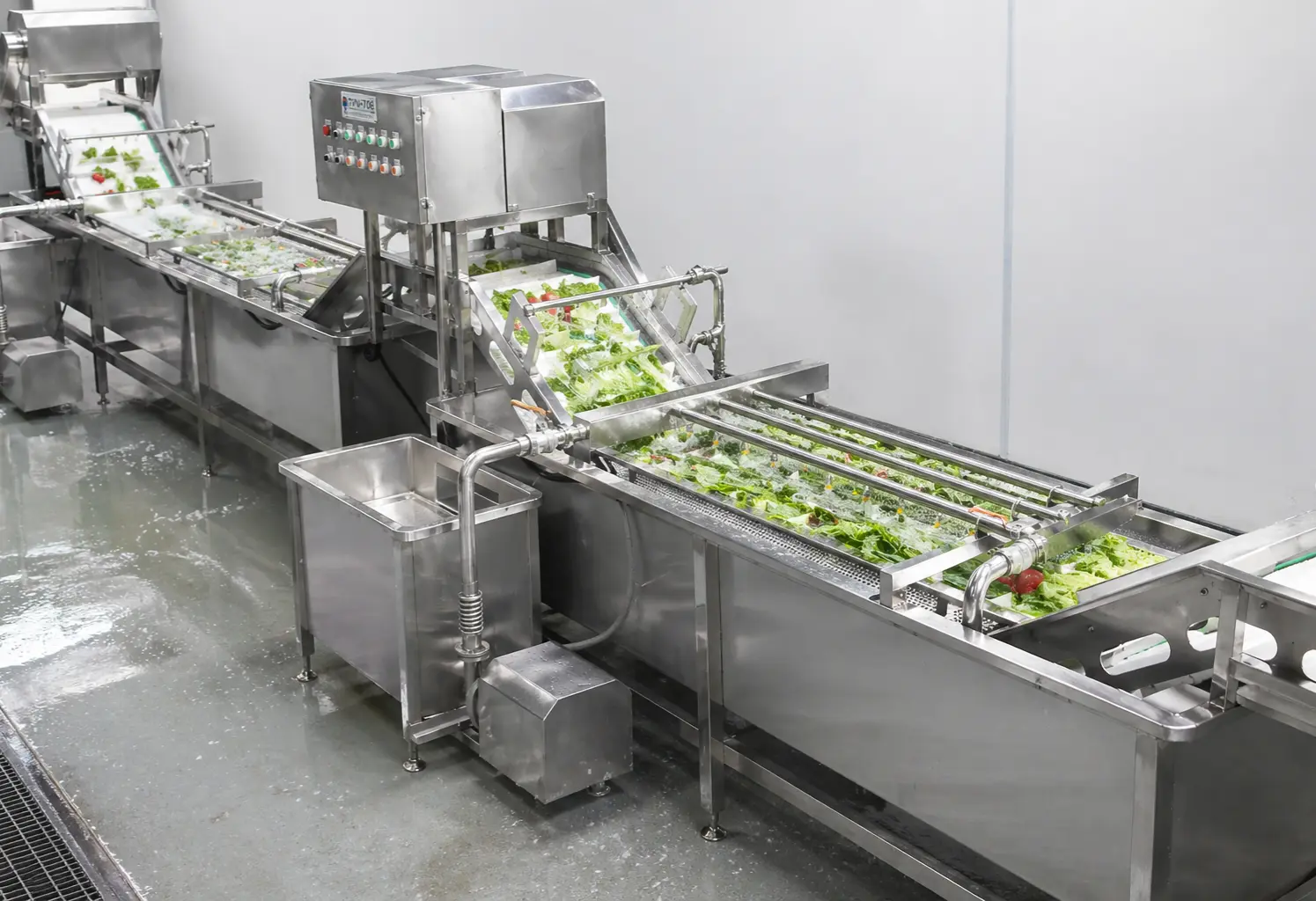


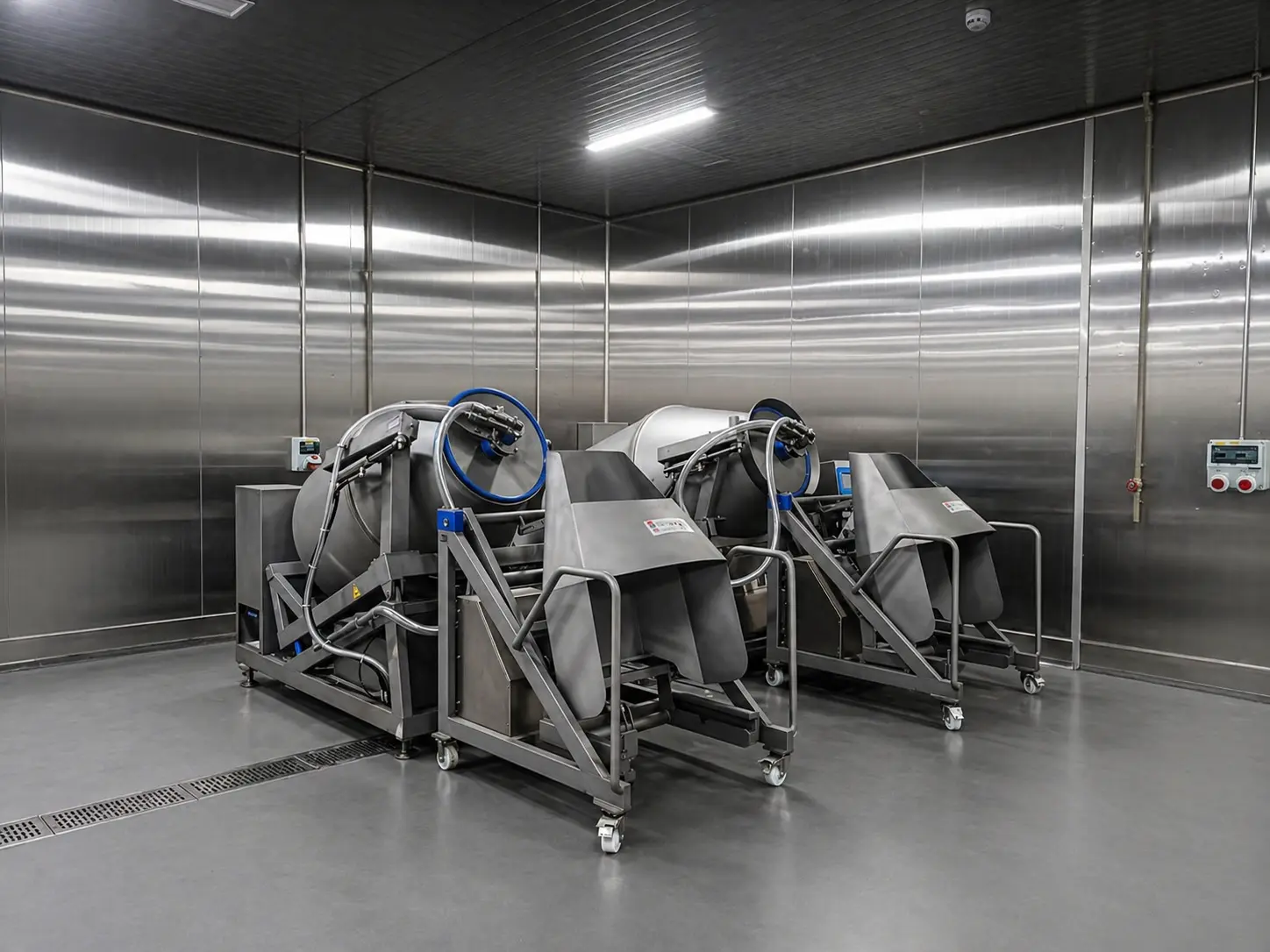


Manual ingredient preparation is rarely a problem when a food business is small.
A restaurant serving a limited number of meals can wash vegetables in a sink, peel potatoes by hand and rely on experienced kitchen workers to cut ingredients throughout the day. A local catering business may prepare several hundred kilograms of produce each week without needing a dedicated processing system. Even a young food manufacturer can often absorb production fluctuations by adding temporary workers or extending shifts.
For a while, this approach appears flexible and inexpensive.
There is no major capital investment. Employees can switch quickly between ingredients. A skilled worker can adjust to variations in raw materials without reprogramming a machine. When demand increases, management may initially respond by adding another preparation table, hiring more people or creating an additional shift.
The limitations usually emerge gradually.
Orders continue to grow, but preparation output becomes unpredictable. Different shifts produce different cut sizes and yields. Experienced employees are difficult to replace. Wet-processing areas become congested. Production managers add labor, but downstream cooking or packing equipment still waits for ingredients. Quality problems that were manageable at a smaller scale begin affecting hundreds or thousands of kilograms of product.
At that point, manual ingredient preparation is no longer simply a labor method. It has become a constraint on growth.
This does not mean every food business must immediately build a fully automated factory. It means that preparation methods must evolve as production volume, product complexity and customer expectations increase.
The central question is not whether people are capable of preparing food manually. They clearly are.
The more important question is:
Can a labor-dependent preparation system continue to deliver the required volume, consistency, yield, food safety and traceability as the business becomes larger and more complex?
For many growing restaurant groups, catering companies, central kitchens and food manufacturers, the answer eventually becomes no.
What Is Manual Ingredient Preparation?
Manual ingredient preparation refers to food-preparation activities performed primarily by employees using knives, peelers, cutting boards, sinks, baskets, trays and small kitchen appliances.
Typical tasks include:
- inspecting raw materials;
- removing damaged portions;
- trimming roots, stems, fat or bones;
- peeling vegetables;
- slicing, dicing and shredding;
- washing ingredients;
- transferring wet products between containers;
- draining or spinning products;
- portioning ingredients;
- transporting prepared food to cooking, mixing or packaging areas.
Manual preparation does not necessarily mean the facility uses no equipment. A kitchen may have a small vegetable cutter, tabletop slicer or commercial salad spinner while still relying heavily on employees for feeding, transferring, washing and handling products.
The distinction is better understood as a spectrum.
At one end is an entirely manual preparation room. At the other is a continuous processing line with conveyors, automated cutting, multi-stage washing, controlled dosing, dewatering and packaging integration.
Most growing food businesses operate somewhere between these two extremes.
The challenge is deciding when the existing position on that spectrum no longer supports the company’s operating requirements.
Why Manual Preparation Works at the Beginning
Manual preparation offers genuine advantages during the early stages of a food business.
It requires relatively little capital. The company can process different products without purchasing specialized machines. Workers can adapt to irregular ingredients, small batches and frequently changing recipes. If production volumes are uncertain, a business can avoid investing in equipment that may initially remain underused.
This makes manual preparation appropriate for:
- new food businesses with uncertain demand;
- low-volume restaurants;
- businesses with highly customized menus;
- seasonal operations;
- pilot production;
- premium products requiring significant hand finishing;
- facilities handling many products in very small quantities.
At this stage, flexibility may be more valuable than maximum throughput.
The economics change as volume becomes more predictable. When the company processes the same high-volume ingredients every day, the labor used for repetitive cutting, peeling, washing and transfer becomes increasingly visible.
A worker may be flexible, but that flexibility is not free. The business pays for every hour of repetitive preparation, as well as recruitment, supervision, training, breaks, absences, overtime and variations in individual performance.
Manual processing is therefore not inherently cheap. It is simply easier to begin because much of its cost appears as recurring operating expenditure rather than upfront capital investment.
Growth Changes the Economics of Food Preparation
A food business rarely outgrows manual preparation because of one dramatic event.
The transition is usually caused by several pressures accumulating at the same time:
- production volume increases;
- product variety expands;
- customer specifications become stricter;
- labor availability becomes less predictable;
- the company opens additional outlets;
- preparation space becomes crowded;
- food-safety documentation becomes more demanding;
- margins become sensitive to small yield differences;
- delivery schedules become less tolerant of delays.
At low volumes, management can solve many problems by adding effort.
At higher volumes, additional effort stops creating proportional output.
This is the point where a business encounters diminishing returns from labor.
Adding one more worker to an uncongested preparation room may increase output. Adding six more employees to the same sinks, tables and cutting areas may create interference, waiting and unnecessary movement. Workers begin competing for workspace, tools and washing capacity.
Labor increases, but productive throughput does not rise at the same rate.
This relationship can be summarized as follows:
| Stage of business growth | Typical preparation model | Main advantage | Emerging limitation |
|---|---|---|---|
| Startup or low volume | Primarily manual preparation | Flexibility and low capital cost | Output depends heavily on individual workers |
| Early growth | Manual work with small standalone machines | Selected tasks become faster | Transfer and washing remain labor intensive |
| Multi-site or medium volume | Semi-automated preparation department | Better throughput and consistency | Bottlenecks move between disconnected processes |
| High-volume production | Integrated pre-processing line | Stable flow, measurable capacity and stronger control | Requires process engineering and capital planning |
| Large-scale or high-hygiene production | Automated line with monitoring and packaging integration | Repeatability, traceability and scalable output | Greater maintenance and technical-management requirements |
The correct transition point differs by business. A company processing 300 kilograms of one vegetable every hour may benefit from automation earlier than a company preparing 300 kilograms across 40 different ingredients.
Volume matters, but repetition, product mix and required consistency matter just as much.
The First Warning Sign: Labor Grows Faster Than Output
One of the clearest indications that a business is outgrowing manual preparation is that headcount increases faster than acceptable production output.
Suppose a preparation department originally used six workers to produce 1,200 kilograms during a shift. As orders increased, management added four employees. Output rose to 1,600 kilograms rather than the expected 2,000 kilograms.
The extra labor did not create proportional capacity because the department still had:
- the same number of sinks;
- limited cutting-board space;
- the same drainage system;
- too few weighing stations;
- narrow transfer routes;
- one shared dewatering machine;
- the same cleaning window.
The limiting factor was no longer the number of people. It was the process configuration.
A useful measure is:
Labor productivity = acceptable finished kilograms ÷ total direct labor hours
The word “acceptable” matters.
If employees process more material but create additional damage, inconsistent cuts or rework, the operation has not achieved a true productivity improvement.
Labor is also more expensive than the base wage shown on a payroll report. The total cost may include:
- employer taxes;
- benefits;
- overtime;
- recruitment;
- onboarding;
- supervision;
- uniforms and personal protective equipment;
- absence coverage;
- turnover;
- training losses.
The U.S. Bureau of Labor Statistics reported a median hourly wage of USD 16.45 for food preparation workers in May 2024. That figure represents wages rather than the complete employer cost and varies substantially by market, but it illustrates how repetitive preparation labor becomes a material operating expense when multiplied across many workers and shifts.
The relevant business question is not whether labor is “cheap” in one country.
It is whether the preparation department can add capacity without requiring headcount to rise at almost the same rate.
Labor Availability Can Become More Important Than Labor Cost
A business may be willing to hire more workers and still be unable to maintain adequate staffing.
Food preparation work often involves standing, wet conditions, temperature variation, repetitive movement and early or late shifts. These conditions can make recruitment and retention difficult, especially when employees have alternative employment options.
Labor shortages do not affect only restaurants. They can constrain school kitchens, hospitals, catering facilities, food factories and centralized production operations.
When staffing becomes unreliable, managers experience several secondary costs:
- experienced workers spend time training new employees;
- output changes between shifts;
- supervisors are pulled into production;
- overtime increases;
- production schedules become conservative;
- employees rush preparation to meet dispatch deadlines;
- quality inspections may be shortened;
- menu or product availability may be restricted.
A facility can possess sufficient theoretical demand, raw materials and downstream equipment but still fail to reach production targets because ingredients are not prepared on time.
This is why automation is frequently introduced as a capacity-stabilization measure rather than purely a wage-reduction measure.
The goal is not always to eliminate jobs. It may be to ensure that production is less vulnerable when several employees are absent or when experienced workers leave.
Repetitive Manual Preparation Also Creates Ergonomic Pressure
Ingredient preparation contains many repetitive and physically demanding tasks.
Employees may stand for extended periods, reach into deep sinks, lift wet baskets, move food carts, chop ingredients, twist while transferring products and repeatedly use hand tools.
The U.S. Occupational Safety and Health Administration identifies lifting, reaching, repetitive work, deep-container access and hand-tool use as musculoskeletal risk factors in foodservice work. OSHA also notes that prolonged standing and repeated chopping, reaching and lifting can create ergonomic hazards in restaurant food-preparation areas.
In poultry processing, where cutting, trimming, washing, deboning and other repetitive hand tasks are performed at industrial frequency, OSHA has cited research finding a higher prevalence of carpal tunnel syndrome among workers performing the most repetitive hand-manipulation tasks.
These findings do not mean that purchasing a machine automatically creates a safe workplace.
Machines introduce their own hazards, including blades, rotating components, conveyors, electrical systems and pinch points. Automation must be accompanied by guarding, interlocks, emergency stops, safe cleaning procedures and lockout controls.
The wider principle is that repetitive physical work should not be treated as an unlimited production resource.
Good automation shifts employees away from high-frequency physical tasks and toward inspection, monitoring, controlled feeding, sanitation and quality management.
The Second Warning Sign: Production Output Depends on Particular Employees
Many manual preparation departments rely on several highly experienced workers who understand the ingredients, recipes and expected quality.
They know how much to trim from each vegetable, how to adjust their cutting technique and how to recognize when incoming material is unsuitable. Their experience is valuable.
It can also become an operational vulnerability.
When quality depends on individual judgment rather than a controlled process, the business may struggle to reproduce results across:
- different shifts;
- new facilities;
- newly hired teams;
- franchise locations;
- seasonal labor;
- contract manufacturers.
One worker may produce a 5-millimeter slice while another produces 7 millimeters. One team may remove more outer leaves than another. One shift may wash produce for five minutes, while another relies on visual judgment.
At small scale, these differences may be absorbed during cooking.
At industrial scale, they affect:
- cooking time;
- packaging weight;
- texture;
- appearance;
- yield;
- seasoning distribution;
- shelf life;
- customer complaints.
A scalable food business converts knowledge that exists in employees’ habits into defined production specifications.
Those specifications may include:
- acceptable incoming material;
- trim standard;
- cut dimension and tolerance;
- wash time;
- water conditions;
- chemical concentration where applicable;
- dewatering target;
- finished-product temperature;
- defect threshold;
- pack weight.
Automation does not replace the need for skilled employees. It makes important outcomes less dependent on a particular individual being present.
The Third Warning Sign: Product Consistency Declines as Volume Rises
Manual preparation is influenced by fatigue, workload, skill and time pressure.
A worker may produce highly consistent cuts during the first hour of a shift but greater variation later in the day. When orders are delayed, employees may feed small machines too quickly, shorten inspection or overload washing containers.
Inconsistent preparation affects the next process.
Consider diced potatoes used in a ready meal. Larger pieces may remain undercooked while smaller pieces soften excessively. Uneven shredded cabbage can create inconsistent pack appearance and dressing coverage. Damaged leafy vegetables may release more cellular fluid and deteriorate more rapidly.
Fresh-cut produce is particularly sensitive because cutting breaks the natural exterior barrier. FDA guidance notes that chopping or shredding releases plant cellular fluids and can create conditions in which pathogens, if present, may survive or grow. Cutting can also allow contamination to spread once the surface integrity of the produce has been broken.
Product consistency is therefore not just a visual issue.
It can influence process control, food safety, cooking performance and shelf life.
A suitable cutting system can standardize dimensions more effectively than large-scale hand cutting, but only when the machine matches the ingredient. Excessive blade speed, unsuitable feed pressure or blunt tools can create crushing, tearing and juice loss.
Automation improves consistency only when equipment is selected and operated correctly.
The Fourth Warning Sign: Yield Becomes Unpredictable
Growing food businesses often focus on labor before they focus on yield.
Yet raw-material yield can be equally important.
Yield is calculated as:
Yield percentage = acceptable prepared product ÷ incoming raw material × 100
Suppose two preparation shifts each receive 1,000 kilograms of carrots.
One produces 850 kilograms of acceptable finished product. The other produces 810 kilograms because employees peel more aggressively and reject a greater number of irregular pieces.
The four-percentage-point difference represents 40 kilograms in a single batch.
If the company processes 1,000 kilograms per day for 300 days, the annual difference becomes 12,000 kilograms.
| Scenario | Incoming material per year | Yield | Acceptable annual output |
|---|---|---|---|
| Manual process A | 300,000 kg | 81% | 243,000 kg |
| Manual process B | 300,000 kg | 85% | 255,000 kg |
| Difference | — | 4 percentage points | 12,000 kg |
This is an illustrative calculation, not a claimed performance result for a particular machine. It demonstrates why yield control becomes financially important as throughput increases.
A lower purchase price for equipment can be quickly offset by:
- excessive peeling;
- cutting breakage;
- bruising;
- product trapped inside machines;
- unsuitable washing intensity;
- unnecessary trim;
- poor separation of usable and rejected material.
Global food loss data also provides useful context. FAO estimates that 13.3% of food was lost globally in 2023 between post-harvest and retail stages, including transport, storage, wholesale and processing. The figure does not describe loss inside one particular food factory, but it shows the scale of inefficiency occurring before food reaches consumers.
For an individual business, the correct response is to measure loss at each internal stage rather than assume that all trim is unavoidable.
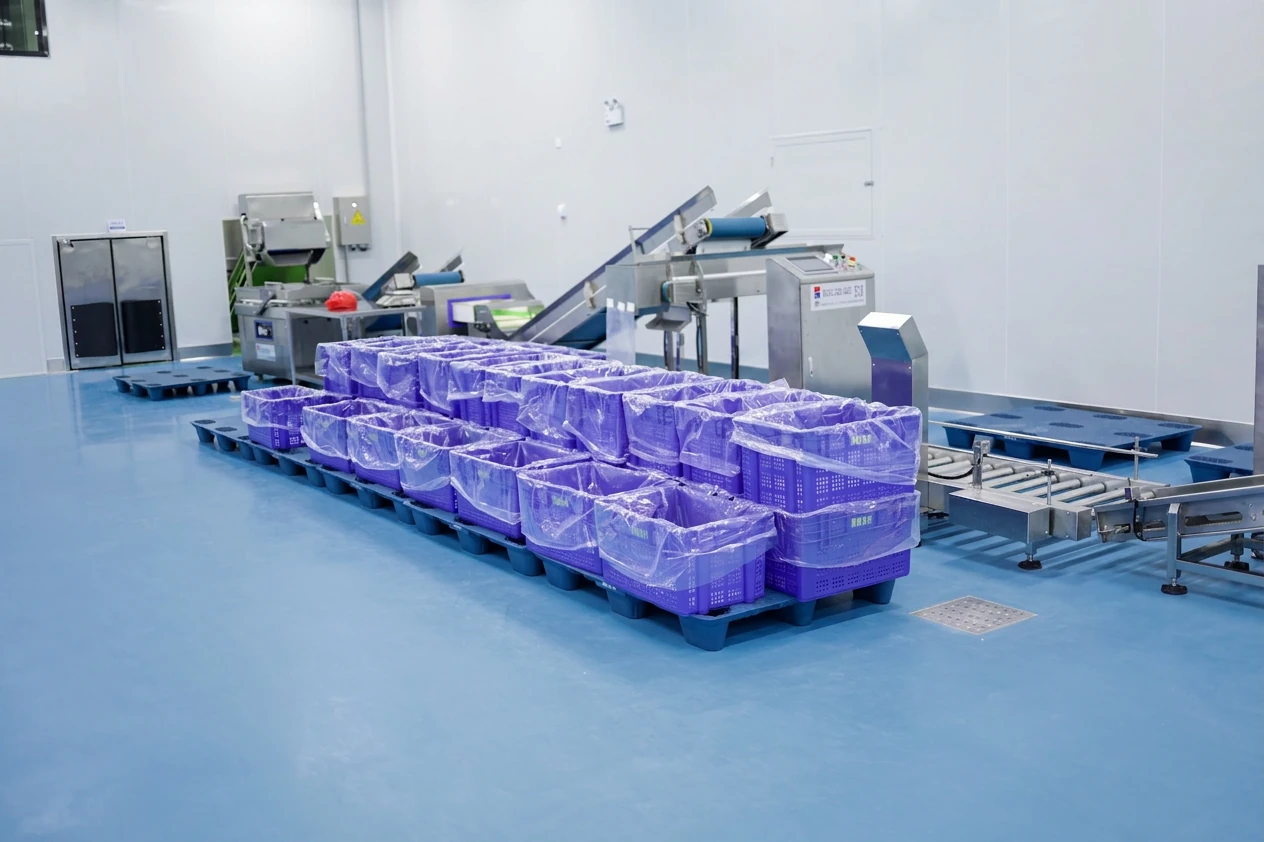
The Fifth Warning Sign: Preparation Becomes the Bottleneck
Many companies invest in cooking, filling, freezing or packaging equipment before upgrading raw-material preparation.
The result is an unbalanced production system.
A packaging machine may be capable of handling 1,200 kilograms per hour, while manual cutting and washing provide only 700 kilograms. The expensive packaging machine spends part of the day waiting.
Management may initially blame the packaging line for failing to reach its rated output. The real bottleneck exists upstream.
A process map often reveals hidden waiting:
Receiving → sorting → trimming → cutting → washing → dewatering → inspection → cooking or packaging
Every arrow represents material transfer. Every process has its own capacity.
If one stage is slower than the rest, work-in-progress accumulates before it and downstream equipment becomes starved.
A business has probably outgrown its manual preparation model when:
- cooking vessels frequently wait for ingredients;
- packaging schedules are delayed by washing or cutting;
- employees prepare tomorrow’s ingredients during overtime;
- raw materials remain too long in uncontrolled staging areas;
- production managers cannot predict when a batch will be ready;
- different departments blame one another for missed output.
Automation should address the actual bottleneck rather than simply the task that appears most labor intensive.
Installing a fast cutter will not solve the problem if washing and dewatering remain too slow.
The Sixth Warning Sign: Adding More Space Does Not Solve Congestion
Manual preparation requires worktables, sinks, cutting boards, baskets, temporary storage and employee movement.
As volume grows, managers often add another table or move preparation into an adjacent room.
This can increase capacity temporarily, but it may also fragment the process.
Employees begin transporting ingredients between rooms. Wet products travel through mixed-traffic areas. Waste crosses clean-product routes. Supervisors have difficulty seeing the complete process.
Expansion without process redesign can create:
- unnecessary walking;
- cross-traffic;
- floor-water accumulation;
- uncontrolled waiting;
- difficult supervision;
- mixed raw and processed materials;
- longer cleaning time.
A well-designed pre-processing line uses floor space differently.
Machines may occupy more fixed space than cutting tables, but they can establish a defined product flow. Ingredients enter at one end, pass through controlled operations and leave in a predictable condition.
The objective is not to fill the room with machines. It is to reduce random movement and create an understandable sequence.

The Seventh Warning Sign: Multiple Locations Repeat the Same Work
Restaurant groups and catering companies often reach a stage where dozens of kitchens perform the same preparation tasks independently.
Each location receives whole vegetables, employs workers to trim and cut them, manages waste, cleans the preparation area and attempts to follow the same recipes.
This model duplicates:
- labor;
- equipment;
- storage;
- cleaning;
- supervision;
- waste handling;
- food-safety controls.
It also makes consistency more difficult.
One outlet may achieve an 85% yield from cabbage while another achieves 75%. A location with experienced employees may complete preparation before service, while another struggles throughout the day.
Centralized ingredient preparation can convert these repeated local tasks into one controlled process.
A central kitchen or food-preparation facility can receive ingredients in bulk, prepare them to a defined standard and distribute them to outlets in appropriate pack sizes.

This approach may improve:
- purchasing control;
- yield measurement;
- cut consistency;
- recipe standardization;
- outlet labor allocation;
- traceability;
- waste concentration;
- production records.
Centralization is not automatically the right solution for every ingredient.
The business must consider shelf life, cold-chain capability, delivery distance, packaging, transport frequency and local regulations. Some ingredients are best prepared close to use, while others are strong candidates for centralized processing.
The business should centralize processes where the operating value exceeds the additional packaging and distribution complexity.
Manual Preparation Versus Automated Pre-Processing
The comparison between manual and automated preparation should not be reduced to “people versus machines.”
Each method has advantages and limitations.
| Evaluation area | Manual preparation | Automated or semi-automated preparation |
|---|---|---|
| Initial investment | Relatively low | Higher capital requirement |
| Product flexibility | Strong for very small and irregular batches | Depends on machine design and changeover capability |
| Labor dependency | High | Lower for repetitive operations |
| Output consistency | Depends on employee skill and fatigue | More repeatable when properly configured |
| Capacity expansion | Usually requires more labor and workspace | Can increase output without proportional labor growth |
| Yield control | Can vary between workers and shifts | Can be more measurable but depends on machine suitability |
| Cleaning | Simple tools may be easy to clean, but many workstations increase total area | Equipment can centralize cleaning, although poor design may be difficult to sanitize |
| Production data | Often limited | Easier to measure by machine, batch and process |
| Maintenance requirement | Low mechanical complexity | Requires preventive maintenance and spare parts |
| Food-safety control | Highly dependent on procedures and supervision | Can improve process control but does not replace hygiene management |
| Best application | Low volume, high customization, pilot production | Repetitive, growing or high-volume operations |
Automation is not superior in every situation.
A chef preparing a small quantity of decorative vegetables may work more effectively by hand. A central kitchen processing two tonnes of cabbage each day has a very different economic and operational requirement.
The aim is to use manual work where human judgment creates value and equipment where repetition, capacity and consistency dominate.
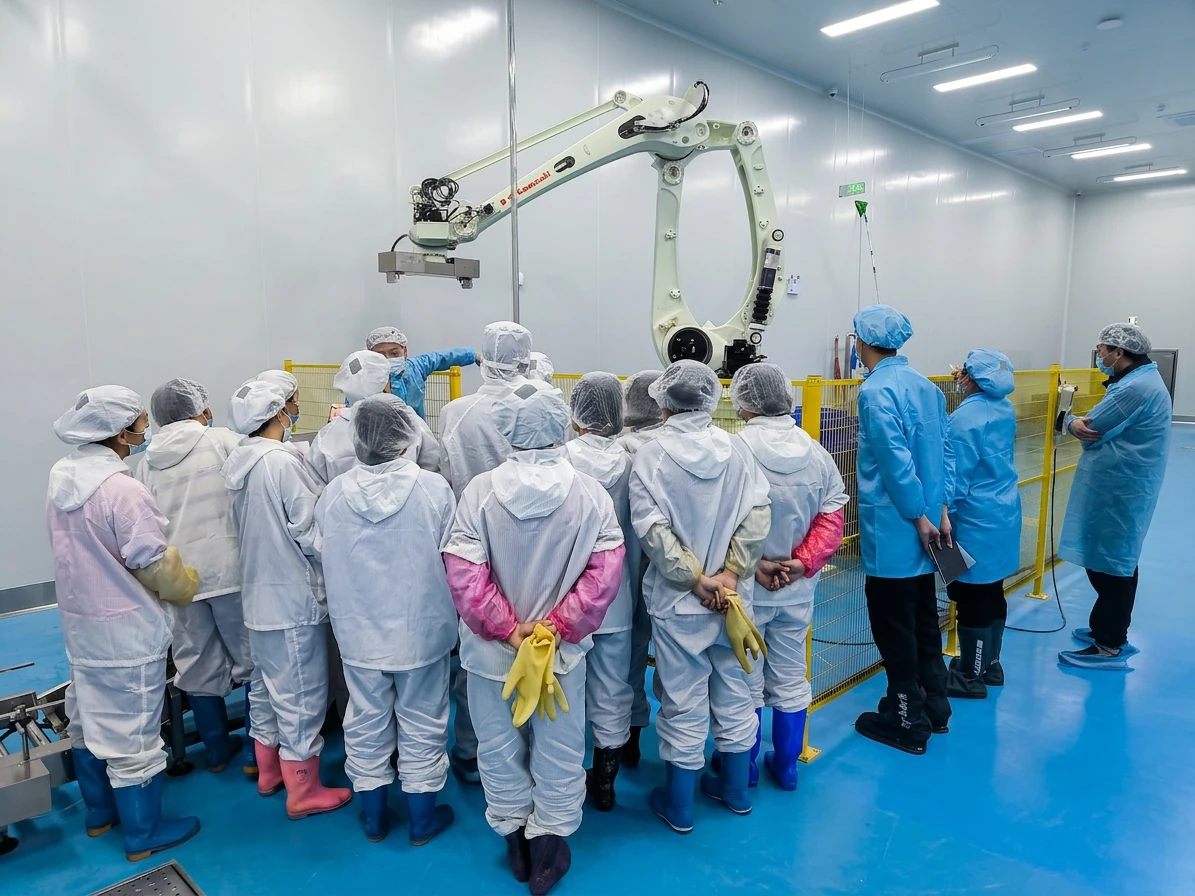
Automation Does Not Mean Removing Every Worker
Food automation is often described as though a machine will completely replace a preparation department.
In reality, most food pre-processing systems remain human-machine operations.
Employees may still be needed to:
- inspect incoming ingredients;
- remove defective material;
- perform complex trimming;
- load machines;
- monitor process conditions;
- change blades;
- verify cut quality;
- collect samples;
- complete sanitation;
- manage exceptions.
The value of automation is frequently that fewer people can produce a more stable volume, not that the process becomes unmanned.
Chipotle’s publicly reported automation trials illustrate this collaborative approach. The company tested an avocado-processing system designed to cut, core and remove avocado flesh, while employees continued completing the guacamole process. It also tested an automated bowl-and-salad assembly system. Reuters reported that the company was evaluating employee and customer feedback before determining broader deployment.
The same case also demonstrates why automation must be evaluated across the complete work cycle. Chipotle had previously tested an automated tortilla-chip system but found that setup and cleanup costs offset much of the expected labor saving.
A machine can automate the visible production action and still fail to reduce total labor if it requires:
- lengthy setup;
- constant correction;
- difficult cleaning;
- manual transfer before and after the machine;
- frequent product changeovers;
- extensive reassembly.
The correct comparison is:
setup + production + transfer + changeover + cleaning + maintenance
—not production speed alone.
When Is a Food Business Ready for Automation?
A business is usually ready to examine food-preparation automation when several of the following conditions occur together:
- one or more ingredients are processed repeatedly;
- daily or weekly volume is becoming predictable;
- labor availability is constraining growth;
- preparation output varies by shift;
- product yield is not stable;
- downstream equipment waits for ingredients;
- the company is opening additional outlets;
- customers require more consistent specifications;
- food-safety documentation is becoming stricter;
- preparation areas are congested;
- overtime is becoming routine;
- the company plans to launch RTC or RTE products.
The presence of one condition does not automatically justify a complete line.
The correct first step is to collect production data.
Businesses should measure:
- incoming kilograms by product;
- acceptable finished kilograms;
- direct labor hours;
- preparation time;
- cleaning time;
- changeover time;
- defect and damage rates;
- waiting time;
- downtime;
- daily demand variation.
Without these measurements, automation decisions are often based on impressions.
What Should Be Automated First?
The first automated process should usually be the repetitive bottleneck with measurable volume and a clear quality standard.
Common starting points include:
- vegetable cutting;
- potato or root-vegetable peeling;
- high-volume washing;
- leafy-vegetable dewatering;
- ingredient conveying;
- weighing and portioning.
A business should not necessarily automate the task with the largest number of workers.
It should identify the task where automation creates the greatest improvement in the complete process.
For example, cutting may employ eight workers, but washing may determine total capacity. Automating cutting alone could create a pile of cut product waiting to be washed.
A process-level evaluation asks:
- Which stage has the lowest sustainable capacity?
- Where does product wait?
- Which operation creates the most variation?
- Which stage causes the greatest yield loss?
- Which task is hardest to staff?
- Which task limits future growth?
The answer may lead to a standalone machine, a semi-automated cell or an integrated line.
Equipment Selection Must Consider More Than Price
Once a company recognizes that manual preparation is limiting growth, there is a risk of moving too quickly to the cheapest machine that appears to solve the problem.
This can replace one constraint with another.
A food pre-processing machine should be evaluated through its effect on the complete operation.
Product Suitability
Equipment must be suitable for the actual ingredients.
Leafy vegetables, root vegetables, tomatoes, fruit and meat respond differently to cutting, pressure, agitation and transfer.
A generic demonstration using another product cannot prove suitability.
Whenever practical, conduct tests using representative raw materials, including products that are difficult to handle.
Finished-Product Quality
The supplier should understand what acceptable output means.
Evaluation criteria may include:
- cut dimensions;
- dimensional tolerance;
- breakage;
- bruising;
- residual peel;
- torn leaves;
- moisture;
- temperature;
- visual defects.
A machine that processes a high input weight but creates unacceptable output is not a high-capacity machine in commercial terms.
Yield
Measure acceptable output against incoming weight during testing.
Do not evaluate only speed.
A small increase in product damage or peeling loss can create a substantial annual cost at high throughput.
Sustainable Capacity
Ask whether the published capacity represents:
- short-term peak capacity;
- continuous capacity;
- input capacity;
- discharge capacity;
- acceptable finished output;
- capacity for the customer’s actual product.
The machine must be evaluated together with upstream and downstream processes.
Operational Stability
Stable output is more valuable than a high catalogue number that cannot be maintained.
Ask the supplier to demonstrate extended running, product accumulation, normal stops and restart behavior.
Examine:
- jamming frequency;
- belt tracking;
- sensor reliability;
- motor loading;
- feeding consistency;
- product carryover;
- discharge control.
Cleanability
Cleaning is part of production economics.
A machine that saves two hours of preparation labor but adds three hours of difficult sanitation does not create the expected benefit.
Inspect whether:
- belts can be removed easily;
- tanks drain completely;
- food-contact areas are visible;
- covers require tools;
- pipework retains water;
- hollow sections are sealed;
- cutting assemblies can be accessed safely;
- reassembly is simple and repeatable.
For fresh-cut produce, hygienic design is particularly important because cutting breaks the product’s protective surface. FDA guidance emphasizes controlling equipment sanitation, processing water, employee practices and cross-contamination as parts of one connected system.
Maintenance and Spare Parts
Automated equipment creates new technical responsibilities.
The buyer should understand:
- preventive-maintenance intervals;
- blade-replacement requirements;
- belt and bearing life;
- lubrication points;
- sensor types;
- motor and control brands;
- locally available components;
- custom parts;
- critical spare parts;
- expected lead times.
Maintenance should not be considered only after failure.
NIST research involving manufacturers found that businesses relying more heavily on preventive and predictive maintenance reported substantially less unplanned downtime and fewer defects than more reactive operations. The reported comparison showed 52.7% less unplanned downtime and 78.5% fewer defects for the group making greater use of preventive and predictive approaches, although these manufacturing-wide findings should not be treated as guaranteed results for a particular food line.
The practical lesson is that equipment value depends partly on whether the company and supplier can keep it operating.
After-Sales Support
After-sales service should be evaluated before the purchase, not after a breakdown.
Buyers should ask:
- Who responds to technical problems?
- Is remote video diagnosis available?
- Is on-site service available in the customer’s region?
- What is included in the warranty?
- Which items are treated as wear parts?
- Are manuals and wiring diagrams provided?
- Is operator and maintenance training included?
- How quickly can critical parts be shipped?
- Can the supplier support future modifications?
- Is there a clear technical escalation process?
A lower-priced machine with poor documentation and unavailable parts can become costly when production stops.
Supplier Engineering Capability
A supplier should understand more than individual machine models.
For an integrated project, it should be able to discuss:
- process flow;
- product characteristics;
- capacity balance;
- hygiene zones;
- water management;
- transfer heights;
- cleaning access;
- downstream requirements;
- future expansion.
A salesperson can quote equipment. A competent project team should explain why the proposed configuration fits the application.
Research and Development Capability
Food products vary by region, variety, maturity, size and season.
Standard equipment may require adaptation.
A supplier with internal engineering and testing capability is better positioned to adjust:
- blade systems;
- conveyor dimensions;
- belt openings;
- tank lengths;
- water movement;
- spray pressure;
- machine speed;
- control logic;
- discharge design.
The question is not simply how long the supplier has existed. It is whether the company can solve application-specific problems after the order is placed.
Safety
Automation should reduce repetitive physical work without introducing uncontrolled machine risk.
Assess:
- guards;
- safety interlocks;
- emergency stops;
- access to blades;
- electrical protection;
- lockout arrangements;
- safe cleaning procedures;
- operator training.
A machine that requires employees to bypass guards during normal operation is not an acceptable productivity solution.
Scalability
The equipment should fit the current project while allowing reasonable future development.
Ask whether the system can later support:
- additional capacity;
- another washing stage;
- new cutting dimensions;
- sanitizer dosing;
- automatic weighing;
- packaging integration;
- process monitoring;
- additional product categories.
Overbuying can waste capital, but purchasing a system with no expansion path can force premature replacement.
Comparing Two Equipment Proposals
The following comparison illustrates why price alone does not reveal the better investment.
| Evaluation factor | Proposal A | Proposal B |
|---|---|---|
| Purchase price | Lower | Higher |
| Claimed capacity | 1,500 kg/h | 1,200 kg/h |
| Capacity definition | Raw input, product unspecified | Acceptable output using agreed product |
| Product trial | Short water test | Extended test with customer material |
| Yield measurement | Not included | Incoming and finished weight measured |
| Cleaning design | Fixed covers and tool removal | Quick access and removable food-contact parts |
| Spare parts | Supplied after request | Startup and critical-parts package defined |
| Component availability | Several custom components | Standard regional motors and sensors |
| Technical support | General sales contact | Defined engineering escalation route |
| Expansion | Limited | Additional washer and packaging connection possible |
Proposal A may still be appropriate for a simple or low-utilization application. Proposal B may create greater long-term value for a high-volume facility.
The decision depends on the buyer’s products, production schedule, risk tolerance and total cost of ownership.
Use a Weighted Selection Method
A structured evaluation prevents the lowest price from automatically overriding operating requirements.
| Evaluation category | Suggested weighting |
|---|---|
| Product quality and acceptable yield | 20% |
| Sustainable capacity | 15% |
| Reliability and operational stability | 15% |
| Hygienic design and cleanability | 15% |
| Process fit and technical solution | 10% |
| Maintenance and spare-part availability | 10% |
| After-sales support | 10% |
| Purchase and installation cost | 5% |
| Total | 100% |
The weighting should reflect the application.
An RTE salad facility may assign greater weight to hygienic design and water control. A remote catering facility may prioritize spare-part availability and simple maintenance. A high-volume RTC central kitchen may emphasize changeover speed, capacity and labor efficiency.
Price remains part of the decision. It should simply be evaluated alongside the costs that will continue after installation.
The Transition Should Be Planned, Not Rushed
Outgrowing manual preparation does not mean a company must replace the entire department at once.
A staged transition is often more practical.
Stage 1: Measure the Current Process
Document labor, volume, yield, defects, cleaning and waiting.
Stage 2: Standardize the Product
Define incoming and finished-product specifications.
Stage 3: Automate the Main Bottleneck
Introduce a suitable cutter, washer, peeler or dewatering machine.
Stage 4: Connect Repetitive Processes
Reduce manual transfer and balance capacities.
Stage 5: Strengthen Monitoring
Record throughput, yield, downtime, water conditions and quality.
Stage 6: Integrate Downstream Production
Connect preparation with cooking, mixing, freezing or packaging where appropriate.
This staged approach allows the company to learn from actual operating data.
It also reduces the risk of building a highly automated line around an unstable product range or poorly defined process.
What Successful Automation Actually Looks Like
Successful automation does not always produce a dramatic, employee-free production floor.
It may look like:
- six employees producing the volume previously requiring twelve;
- preparation finishing two hours earlier;
- downstream equipment receiving ingredients continuously;
- yield varying by less than one percentage point instead of five;
- cut dimensions remaining stable across shifts;
- cleaning becoming easier to verify;
- supervisors spending less time resolving staffing emergencies;
- a restaurant group opening new locations without duplicating an entire preparation team;
- production data becoming reliable enough for accurate costing.
The objective is not maximum mechanization.
It is scalable control.
Final Perspective
Manual ingredient preparation is not a primitive or inherently poor production method.
It is often the correct method when volumes are low, products change frequently and demand remains uncertain.
The problem arises when a growing business expects the same labor-dependent system to support industrial-scale requirements.
As production expands, manual preparation can become increasingly difficult to control. Labor grows faster than output. Product dimensions vary. Yield becomes unpredictable. preparation areas become congested. Downstream equipment waits for ingredients. Knowledge remains concentrated in experienced employees. Multiple locations repeat the same work.
At that stage, the company has not necessarily run out of people.
It has outgrown the structure through which those people are working.
Automation should not be treated as a fashionable technology purchase or a simple headcount-reduction exercise. It is a process-design decision.
The correct equipment should improve the performance of the complete operation by delivering:
- stable acceptable output;
- appropriate product quality;
- strong yield;
- manageable cleaning;
- reliable operation;
- safe working conditions;
- accessible maintenance;
- responsive technical support;
- room for future growth.
The most useful question is therefore not:
“How many workers can this machine replace?”
It is:
“Can this process support the volume, consistency, safety and operating discipline our business will require over the next five years?”
When the existing manual system can no longer answer that question confidently, the business has reached the point where preparation must evolve.
Is Manual Ingredient Preparation Limiting Your Growth?
TEEMYEAH develops standalone food pre-processing equipment and integrated solutions for vegetable washing, cutting, peeling, dewatering and centralized ingredient preparation.
Our team evaluates projects according to the actual raw materials, finished-product requirements, capacity targets, current labor arrangement, RTE or RTC application, factory layout and future expansion plans.
A preliminary process assessment can help identify whether the most suitable next step is a single machine, a semi-automated preparation area or a connected processing line.
To begin the assessment, prepare:
- your main raw materials;
- required finished shapes and dimensions;
- current and target production volume;
- current number of preparation workers;
- raw-to-finished yield where available;
- production and cleaning hours;
- available factory layout;
- RTE or RTC application.
Website: teemyeah.com
Email: [email protected]
WhatsApp: +86 131 1273 2696
Frequently Asked Questions
What is manual ingredient preparation?
Manual ingredient preparation is the use of employees, hand tools, sinks, cutting boards and small appliances to inspect, trim, peel, cut, wash, drain and portion raw food materials before cooking or further processing.
When does a food business outgrow manual preparation?
A business may be outgrowing manual preparation when labor grows faster than output, product consistency declines, yield varies between shifts, preparation delays downstream production, staffing becomes unreliable or multiple locations repeat the same work.
Is manual food preparation always less expensive than automation?
No. Manual preparation usually requires less initial capital, but its recurring costs include labor, supervision, recruitment, training, overtime, yield variation and duplicated work. The lower-cost option depends on volume, utilization, product mix and the complete cost of operation.
Does automation eliminate the need for food-preparation workers?
Usually not. Employees remain important for inspection, trimming, loading, monitoring, quality control, cleaning and exception handling. Automation typically reduces repetitive labor and makes output less dependent on individual performance.
Which food-preparation task should be automated first?
The strongest candidate is usually a repetitive process with stable volume, measurable quality requirements and a clear effect on total capacity. Common starting points include cutting, peeling, washing and dewatering.
How can a company tell whether preparation is the production bottleneck?
Indicators include cooking or packing equipment waiting for ingredients, overtime being used to prepare the next day’s materials, accumulation before washing or cutting and missed dispatch times caused by incomplete preparation.
Can food-preparation automation improve product consistency?
Yes, suitable equipment can create more repeatable cutting, washing and dewatering conditions. Results still depend on raw-material variation, correct settings, blade condition, controlled feeding and employee supervision.
Can automated equipment improve yield?
It can improve yield when it reduces excessive trimming, inconsistent peeling or product damage. Unsuitable equipment can also reduce yield, which is why trials should measure acceptable finished output rather than only throughput.
How should yield be measured during an equipment trial?
Record the incoming raw-material weight, unavoidable trim, machine loss, damaged or rejected product and acceptable finished weight. The trial should use representative raw materials and an agreed finished-product specification.
Is catalogue capacity reliable?
Catalogue capacity can provide an initial reference, but it may represent peak input under specific conditions. Buyers should request product-specific sustainable capacity and define acceptable finished output before testing.
What is the difference between peak capacity and sustainable capacity?
Peak capacity is the highest short-term throughput achieved under favorable conditions. Sustainable capacity accounts for feeding, product variation, downtime, blade changes, cleaning, operator activity and downstream limitations.
What should companies consider besides equipment price?
Important factors include product suitability, finished quality, yield, stable operation, cleaning time, hygienic design, maintenance access, spare-part availability, after-sales support, safety and expansion capability.
Why is after-sales support important?
Even reliable equipment eventually requires troubleshooting, wear parts and maintenance. Clear documentation, responsive technical support and accessible spare parts reduce the risk of extended production stoppages.
How can buyers evaluate equipment reliability?
Request references for similar applications, examine component brands, review preventive-maintenance requirements and conduct an extended factory test using actual products. A short demonstration cannot prove shift-level reliability.
Why is cleanability important when selecting equipment?
Cleaning affects food safety, labor cost and available production time. Equipment with inaccessible food-contact areas, poor drainage or difficult belt removal may create more sanitation work than expected.
Should a growing restaurant group build a central kitchen?
A central kitchen can be valuable when many outlets repeat the same high-volume preparation tasks. The business must also evaluate packaging, cold-chain distribution, shelf life, delivery frequency and local food-safety requirements.
Can RTE and RTC products use the same preparation line?
It may be mechanically possible, but the decision requires hazard analysis, hygienic zoning, water management, product sequencing and validated cleaning. RTE products generally require stricter controls because they may not receive a later cooking step.
Is a fully automated line better than a semi-automated system?
Not necessarily. Semi-automated systems may be more appropriate for facilities with many products, small batches or frequent changeovers. The best level of automation matches the production model rather than pursuing automation for its own sake.
How should a business calculate the return on preparation equipment?
The calculation should include labor savings, increased output, improved yield, lower rework and reduced outsourcing. Maintenance, utilities, consumables, financing, cleaning labor and spare parts must also be included.
What information does an equipment supplier need?
A supplier normally needs the product list, raw-material photographs, required cuts, capacity by product, operating hours, RTE or RTC classification, washing requirements, existing labor, available layout, utility conditions and downstream process.
Can a business automate gradually?
Yes. Many companies begin with one high-volume bottleneck, standardize the process and later connect cutting, washing, dewatering, inspection and packaging as demand becomes more predictable.

