







Summary
The brush peeling vs abrasive peeling decision should begin with the finished-product specification, not with a machine catalogue. Brush peeling generally gives processors a wider operating window when the objective is washing, light skin removal or controlled surface cleaning. Abrasive peeling applies stronger removal action and can be more suitable when a firm root requires more complete skin removal, but excessive contact can also remove saleable flesh. Neither mechanism is automatically the higher-yield or higher-throughput option.
For potatoes and other root vegetables, the useful question is therefore not simply “Which peeler is better?” It is “Which combination of contact mechanism, residence time, loading and raw-material condition produces the required surface finish with the highest acceptable first-pass yield?” Variety, maturity, storage history, size distribution, irregularity, skin adhesion and downstream requirements can all change the result.
A defensible equipment decision should compare acceptable yield, residual peel, over-peeling, hand-trimming requirement, product damage and sustainable throughput in a controlled plant trial. The method that removes the most skin is not necessarily the method that creates the most valuable finished product.
Brush Peeling vs Abrasive Peeling Is a Process-Selection Problem
A processor buying a potato or root vegetable peeler can easily be drawn toward a simple comparison: one machine appears gentler, another looks more aggressive, and the supplier provides a nominal capacity for each. That comparison is incomplete because peeling is not an isolated operation. Its output becomes the input for inspection, trimming, cutting, cooking, freezing, fresh-cut packing or another downstream process.
The correct peeling method therefore depends on what the next operation needs.
A potato destined for fries may need a substantially different surface specification from a carrot entering a central kitchen slicing operation. A processor selling peeled whole potatoes may care about visual appearance that would be irrelevant after dicing. A ready-to-cook ingredient may subsequently receive a validated cooking step, whereas an RTE fresh-cut product can enter a very different food-safety environment after its protective surface has been removed.
This is why an integrated root vegetable processing line should be configured backwards from the finished product. Peeling intensity, inspection requirements, cutting capacity and downstream washing cannot be selected intelligently if the acceptable peeled surface has never been defined.
The central engineering objective is better expressed as:
Achieve the required surface condition at the required sustainable output while minimizing unnecessary flesh removal, manual rework and downstream disruption.
That definition immediately changes the purchasing discussion. A more aggressive peeling mechanism can be valuable if it converts unacceptable residual skin into acceptable first-pass product. The same action becomes a liability once it starts removing edible flesh that the specification did not require the plant to remove.
How Brush Peeling and Abrasive Peeling Actually Differ
Brush peeling relies on repeated flexible surface contact
Brush systems use rotating brushes to move, clean and abrade the surface of the root. Depending on brush material, stiffness, geometry, rotational speed, product loading and exposure time, the same basic mechanism can range from washing and polishing to meaningful skin removal.
This adjustable character makes brush processing useful when the boundary between “cleaning” and “peeling” is commercially important. Some buyers do not need a uniformly white potato with every superficial mark removed. Their target may instead be a clean root with loose skin removed and a controlled amount of the natural surface retained.
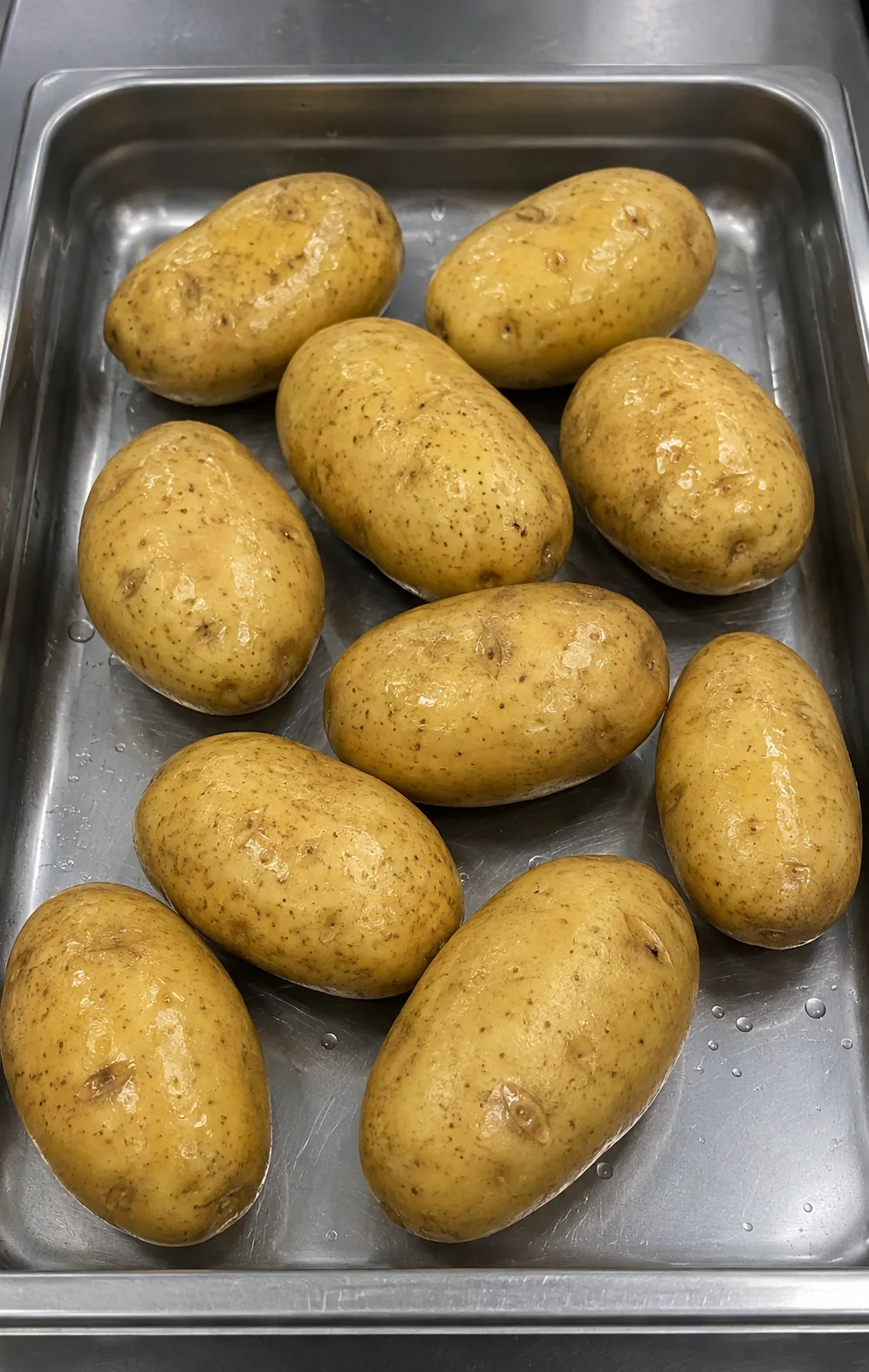
Research on an abrasive-cutter brush developed for pumpkin also illustrates why contact geometry matters. In that study, flexible brush elements were investigated partly because they could reach different areas of an irregular vegetable surface. The exact experimental results apply to the studied pumpkin variety and test configuration, not to commercial potato lines, but the mechanism reinforces an important plant-design principle: product geometry and the way the peeling element contacts concave and convex areas can influence both removal and loss.
For processors evaluating a conventional brush configuration, TEEMYEAH’s TY-1000A cleaning and peeling machine is one example of equipment based on brush contact for potatoes, carrots, lotus roots, sweet potatoes and other root or tuber applications. Equipment selection still requires product testing because a catalogue capacity does not establish acceptable yield for a particular crop.
Abrasive peeling applies stronger frictional removal
Abrasive peeling places the root against a rough peeling surface so that repeated contact removes the skin mechanically. Its value is straightforward: where a light brush action leaves too much attached peel, stronger abrasion can move the process toward a more completely peeled surface.
The trade-off is equally important. Abrasion does not inherently distinguish unwanted skin from valuable flesh. Contact must stop when the required surface specification has been achieved. Continuing beyond that point converts peeling into over-peeling.
A frequently cited 1995 Journal of Food Engineering study by Singh and Shukla evaluated a specific batch-type abrasive potato peeler. Under that study’s conditions, the reported machine operated at 100 kg/h, with 78% peeling efficiency and 6% peel losses. Those numbers should not be used as current industrial benchmarks. The machine, crop, scale and experimental conditions were specific to that study. What remains useful for modern buyers is the measurement logic: peeling efficiency and material loss must be evaluated together.
Mechanism does not determine plant throughput by itself
Abrasive action should not automatically be labelled “faster,” and brush action should not automatically be labelled “higher yield.” Sustainable throughput is determined by how rapidly the equipment can produce material that actually passes the plant’s specification.
Consider a nominally fast peeler that leaves 20% of its output requiring hand trimming. The machine discharge rate may look impressive while the trimming table becomes the real line bottleneck. Conversely, operating a gentler machine too conservatively can preserve raw material but create excessive residual peel and labour.
The useful throughput figure is therefore acceptable output per hour, not simply kilograms entering or leaving the machine.
Brush Peeling vs Abrasive Peeling: Decision-Value Comparison
| Decision Factor | Brush Peeling | Abrasive Peeling | What the Buyer Should Test |
|---|---|---|---|
| Primary surface action | Repeated brush contact ranging from cleaning to controlled skin removal | Stronger frictional removal against an abrasive surface | Whether the action reaches the required finish without unnecessary flesh removal |
| Typical starting application | Light peeling, polishing, cleaning or products where controlled skin retention is acceptable | Roots requiring stronger skin removal than a light brush process can achieve | Actual crop samples representing normal and difficult incoming conditions |
| Risk when action is too mild | Residual peel, extra inspection and hand trimming | Residual peel if residence time or contact is insufficient | Residual-skin rate and rework kilograms per batch |
| Risk when action is too aggressive | Surface damage and avoidable flesh removal | Over-peeling, flesh loss and possible damage to irregular or projecting areas | Total mass loss versus the minimum removal needed to pass specification |
| Irregular product geometry | Brush flexibility can be advantageous in some equipment geometries, but performance remains design- and crop-dependent | Abrasive contact can act differently on protruding and recessed areas depending on equipment geometry | Separate acceptance scores for concave, convex, narrow and irregular surfaces |
| Yield control | Can provide a wider adjustment window for lighter removal requirements | Can achieve stronger removal but requires careful control once the acceptable surface is reached | Accepted first-pass yield rather than total discharged weight |
| Rework | May rise when the target requires deeper or more complete peel removal | May reduce residual-peel rework when stronger removal is needed, but can create loss if over-applied | Manual trimming minutes and rework kilograms per 1,000 kg raw material |
| Throughput | Depends on loading, residence time, brush configuration, raw material and required finish | Depends on abrasive intensity, loading, residence time, raw material and required finish | Accepted kg/h over a realistic production run |
| Wear and maintenance | Brush wear can gradually change contact and peeling performance | Abrasive surface wear can change removal intensity | Performance before and after representative operating periods and inspection intervals |
| Cleaning challenge | Brush assemblies require access for removal of soil, peel and product residues | Abrasive surfaces, discharge areas and peel-removal paths require effective access and cleaning | Actual cleaning procedure, disassembly requirement, inspection access and cleaning time |
| Best purchasing criterion | The mechanism that meets the product specification at the lowest acceptable total process cost and risk | Yield + rework + throughput + cleaning + downstream compatibility | |
The table deliberately avoids declaring a universal winner. The same potato variety can behave differently after changes in maturity, storage or incoming skin condition. Different suppliers may also use very different brush geometries, abrasive surfaces, water application, product movement and retention mechanisms. Comparing mechanism names without comparing the operating window can therefore be misleading.
Raw-Material Variables Can Change the Peeling Result More Than the Machine Label
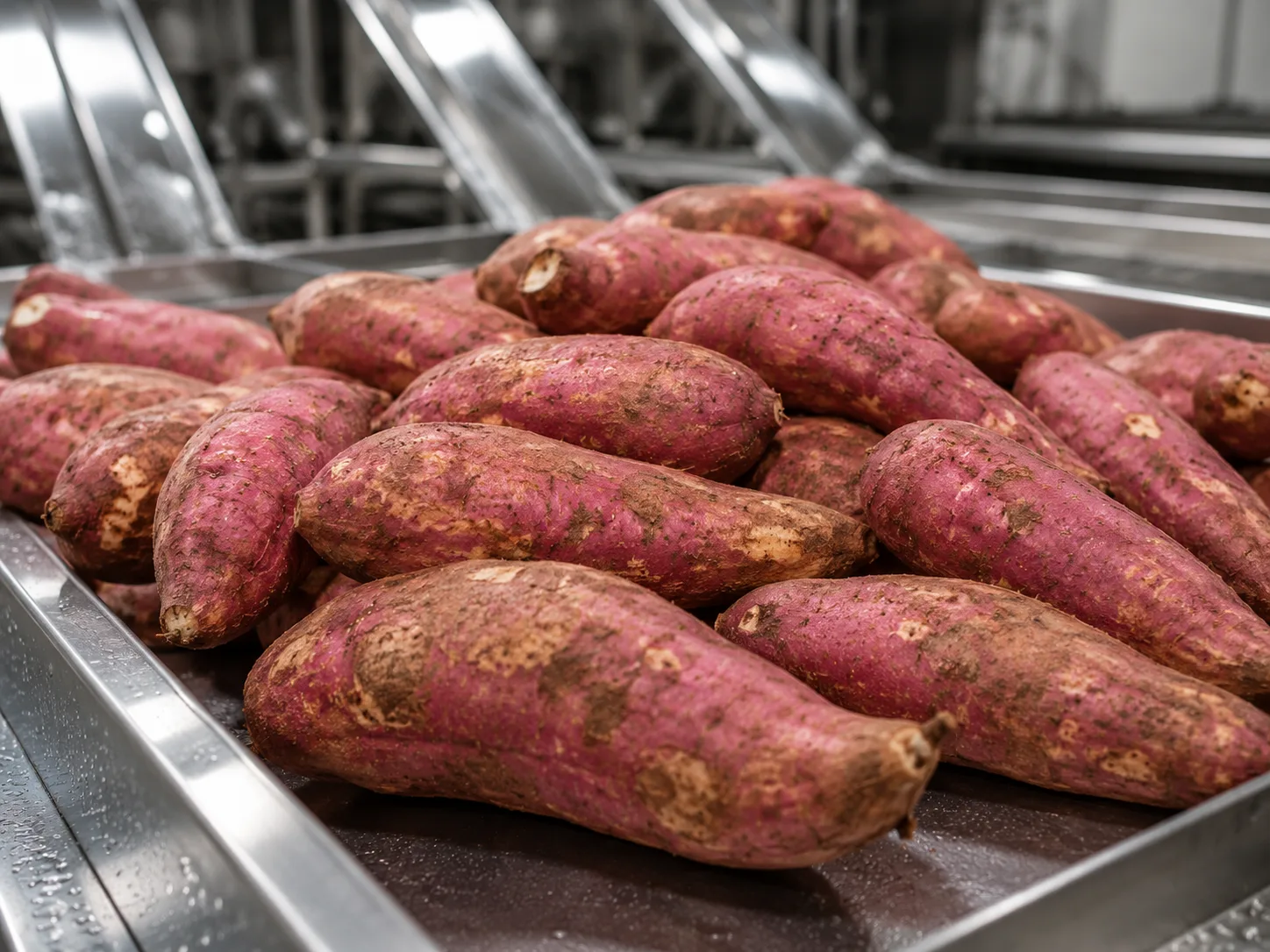
Root vegetables are biological raw materials. They do not enter a factory with the dimensional consistency of manufactured components. A machine selected from one clean sample can behave differently when commercial batches arrive with changed size distribution, field soil, storage history or surface condition.
Variety and skin adhesion
Different varieties can differ in skin characteristics and flesh condition. The amount of mechanical action necessary to release the skin may therefore change even when the finished specification remains identical. A plant trial should include the principal commercial varieties rather than assuming that a successful result on one variety validates the entire procurement decision.
Maturity and storage condition
The relationship between skin and flesh changes during crop development and storage. From a procurement perspective, this means the sample sent for testing should represent the crop the factory will actually process during the year. A perfect test conducted only on one unusually easy batch can create an overly optimistic operating window.
Size distribution and geometry
Small and large roots do not necessarily experience identical contact in the same peeling zone. Curvature, deep eyes, tapered ends, concave surfaces and irregular shapes can create regions that receive either insufficient or excessive mechanical action.
Grading before peeling may therefore be worth evaluating when raw-material variation is wide. The goal is not grading for its own sake; it is to determine whether a narrower size range produces enough improvement in peeling consistency, throughput or yield to justify the additional handling step.
Soil load should be treated before it becomes a peeling variable
A peeler should not be expected to solve every dirty-end problem. Heavy mud, stones, sand and field debris can interfere with contact, increase cleaning demand and expose downstream equipment to unnecessary wear. Where incoming contamination is substantial, pre-washing and heavy-particle separation should be evaluated as part of the process rather than compensating by simply increasing peeling intensity.
The broader root vegetable processing guide explains why receiving, pre-washing, peeling, inspection and cutting should be evaluated as a connected process. A highly effective peeler can still underperform commercially if inappropriate upstream preparation makes its incoming condition unstable.
Do Not Compare Peelers Until You Define Yield, Over-Peeling and Rework
Peeling discussions often become confused because different teams use the word “yield” differently. Production may define yield as everything leaving the peeler. Quality may count only pieces passing the visual specification. Finance may care about packed saleable product. These numbers are not interchangeable.
For a peeling trial, define the measurement basis before the first batch is processed.
Usable product yield
Usable Yield (%) = Accepted Product Mass ÷ Peeler Inlet Mass × 100
“Accepted product” should mean material that meets the agreed peeling specification. If pieces requiring hand trimming are counted as accepted output in one trial and rejected in another, the comparison becomes meaningless.
First-pass yield
First-Pass Yield (%) = Product Accepted Without Rework ÷ Peeler Inlet Mass × 100
This metric is particularly useful when comparing a gentle operating condition with a more aggressive one. The gentler condition can appear to have excellent mass yield while transferring a large amount of work to the trimming station.
Rework rate
Rework Rate (%) = Product Requiring Additional Trimming or Re-Peeling ÷ Peeler Discharge Mass × 100
Record labour separately as minutes of hand trimming per 1,000 kg of incoming crop. That turns a visual quality difference into an operational variable that can be compared across trials.
Peeling mass loss
Peeling Mass Loss (%) = (Peeler Inlet Mass − Peeler Discharge Mass) ÷ Peeler Inlet Mass × 100
This figure must be interpreted carefully. Some mass removal is intentional because peel and unacceptable surface material must leave the product. The commercial problem is not “loss” in the abstract; it is unnecessary removal beyond what the finished specification requires.
Over-peeling relative to a reference condition
A useful factory approach is to prepare a controlled reference sample using the minimum manual trimming necessary to achieve the agreed finish.
Estimated Excess Removal (%) = Machine Mass Loss (%) − Reference Necessary Removal (%)
This is an internal comparison tool, not a universal scientific definition. The reference preparation itself must be standardized. Yet it gives purchasing teams a more meaningful way to distinguish necessary peel removal from potentially avoidable flesh loss.
This distinction matters because peel loss is repeated on every production batch. TEEMYEAH’s article on potato peeling yield loss and material cost examines this economic effect in more detail. The machine purchase price is paid once; raw-material loss continues for as long as the process runs.
Accepted throughput
Accepted Throughput (kg/h) = Accepted Product Mass ÷ Measured Operating Minutes × 60
Use accepted product, not simply peeler discharge. This prevents a configuration that creates substantial hand rework from appearing faster than it really is.
Annual material value sensitivity
Annual Material Value of a Yield Difference = Annual Raw-Material Input × Yield Difference × Raw-Material Cost per kg
For an illustrative calculation only, consider a plant processing 3,000 kg of potatoes per production day for 250 days. Annual input would be 750,000 kg. A two-percentage-point difference in usable yield represents 15,000 kg of material. If the hypothetical average raw-material cost were USD 0.50/kg, the corresponding material value would be USD 7,500 per year. This is not a TEEMYEAH customer result, a market price assumption or a promised saving. It simply demonstrates why apparently small yield differences deserve measurement.
The Required Surface Finish Determines How Much Peeling Is Enough
One reason plants over-peel is that “fully peeled” has never been converted into an inspectable standard. Operators continue removing material until a product looks unquestionably clean, even if the customer would have accepted a less aggressive finish.
USDA’s peeled potato grade standards provide a useful reminder that finished-product quality involves more than peel removal. The standards evaluate factors including varietal characteristics, color, defects, texture and size uniformity. They do not establish a universal peel-loss target for every commercial factory.
A private processor should therefore develop acceptance criteria that correspond to its own customer and downstream process. Depending on the product, a practical specification might record:
- percentage of surface with residual skin;
- maximum acceptable number or area of visible skin patches;
- tolerance for eyes or superficial defects;
- surface damage or gouging;
- minimum usable dimensions after peeling;
- requirements before slicing, dicing or fry cutting;
- allowable hand-trimming requirement.
Photographic reference standards can be particularly useful. A quality team can define an acceptable example, a borderline example and a reject example, then use those references consistently during brush and abrasive trials.
Once this threshold exists, the machine can be optimized to reach it—not to exceed it by the largest possible margin.
A Practical Peeling-Method Decision Matrix
| Observed Plant Condition | Likely Test Direction | Reason | Decision Metric |
|---|---|---|---|
| Product mainly needs heavy washing and light skin removal | Start with brush peeling | A less aggressive operating window may meet the specification without unnecessary flesh removal | First-pass yield and residual peel |
| Brush trial leaves excessive firmly attached skin even after practical adjustment | Test stronger brush configuration or abrasive action | The existing surface action may be below the required removal threshold | Rework reduction versus added mass loss |
| Abrasive trial produces good visual peeling but noticeably reduces usable dimensions | Reduce intensity or compare with brush action | The process may be removing saleable flesh after the required finish has already been achieved | Accepted yield and excess removal |
| Irregular roots show clean protrusions but residual skin in recessed areas | Review contact geometry before increasing overall aggression | More intensity may over-peel exposed surfaces without solving poor contact elsewhere | Surface-area acceptance by geometry |
| Peeler discharge is high but trimming station is congested | Increase first-pass peeling effectiveness or improve grading | Nominal peeler throughput is not the line throughput | Accepted kg/h and trimming minutes |
| Yield varies substantially between incoming batches | Investigate raw-material segmentation and adjustable recipes | One fixed setting may not suit the commercial raw-material range | Yield distribution by variety, size and incoming condition |
| Many low-volume SKUs require different surface specifications | Consider semi-automatic processing | Maximum mechanization may create excessive setup and changeover burden | Total preparation cost and changeover time |
| Stable high-volume product has repeatable specification and predictable demand | Evaluate integration with upstream washing and downstream inspection/cutting | Line balance becomes more valuable as volume and repetition increase | Sustainable line output, WIP and utilization |
How to Run a Plant Trial Before Selecting a Peeling Mechanism
A credible trial is not a demonstration in which a supplier processes a few visually attractive potatoes. It is a controlled comparison designed to expose the operating window.
1. Define the acceptance specification before testing
Agree on residual skin, defects, surface damage, hand-trimming tolerance and the downstream use of the product. Photograph the agreed standard. If different customers require different finishes, test them as separate recipes rather than averaging the specifications together.
2. Build a representative raw-material set
Include normal production material and, where practical, the difficult conditions the factory expects to encounter. Record variety, size range, storage status, obvious surface characteristics and incoming soil condition. Do not intentionally mix radically different samples unless mixed-batch operation is what the factory will actually require.
3. Standardize the mass balance
Weigh incoming material, accepted first-pass product, material requiring rework, rejects and collected peel or removed material where measurement is practical. Wet root processing can complicate mass measurements through surface water, so weighing and draining procedures should remain consistent between trials.
4. Test more than one operating point
A single setting cannot show whether a machine has a useful operating window. For brush peeling, the test may vary relevant machine settings, loading or residence time. Abrasive trials should similarly examine practical levels of contact rather than simply running the most aggressive condition.
5. Measure accepted output, not theoretical capacity
Run long enough to observe feeding stability and realistic product flow. Record inlet rate, discharged rate, accepted first-pass product and manual rework. If downstream inspection cannot keep pace, that limitation belongs in the result.
6. Inspect product damage after the next process step
A surface that appears acceptable immediately after peeling may behave differently during cutting, cooking or further handling. Where the peeler is being purchased as part of a processing line, include the most relevant downstream step in the evaluation.
7. Record cleaning and changeover requirements
Production performance is only part of equipment utilization. Observe where peel fragments, mud and residues collect. Record access requirements, components requiring removal and the actual cleaning procedure proposed for the factory.
8. Compare total process performance
The winning setting should not be selected using one metric. Review yield, first-pass acceptance, rework, throughput, product damage, cleaning burden and compatibility with downstream capacity together.
The Best Peeler Can Still Create a Poorly Balanced Vegetable Processing Line
Equipment selection frequently fails at the interfaces between machines. A peeler may comfortably process more raw material than the downstream inspection conveyor, cutter or packing process can accept. The predictable result is work-in-process accumulation, stop-start operation or pressure on employees to bypass inspection standards.
The reverse can also happen. An expensive cutter may spend much of the shift waiting for peeled product because the peeling step is constrained by rework.
For line design, compare:
- required finished output per hour;
- expected usable yield at the peeling stage;
- first-pass acceptance rate;
- manual trimming capacity;
- downstream cutting or processing capacity;
- planned cleaning and changeover periods;
- SKU mix and production sequence.
If the factory requires 800 kg/h of acceptable peeled material, a nominal 800 kg/h peeler provides no real safety margin when yield, rework, loading interruptions and cleaning are considered. Conversely, oversizing the peeler without considering downstream demand can simply move the bottleneck.
For plants requiring a larger brush-processing format, the TY-1500A cleaning and peeling machine is designed for root and tuber applications using brush mechanisms. Its published catalogue capacity should be treated as equipment specification data; actual accepted throughput for a crop and finish still needs to be established under the intended operating conditions.
Hygienic Design and Food Safety Still Matter in a Mechanical Peeling Decision
Peeling changes the product surface, generates wet organic residues and creates equipment areas that require effective cleaning. A procurement comparison focused only on kilograms per hour and motor power therefore misses an important operational requirement: can the machine be cleaned, inspected and maintained in a manner consistent with the plant’s food-safety program?
For U.S. facilities subject to 21 CFR Part 117, food-contact equipment is expected to be adequately cleanable and maintained to protect food against contamination. The regulation also requires food-contact surfaces to be cleaned as frequently as necessary and, in applicable wet-processing situations, cleaned and sanitized as necessary. Requirements in other jurisdictions must be evaluated separately.
During equipment review, examine:
- access to brush or abrasive contact areas;
- ability to remove accumulated peel, mud and fragments;
- drainage and standing-water locations;
- access beneath guards, covers and transfer points;
- whether food-contact components can be inspected after cleaning;
- the documented procedure for brush or abrasive-element replacement;
- separation between dirty incoming roots and cleaner downstream product flow.
RTC and RTE applications require different risk thinking
Not every peeled root is an RTE product. A peeled potato sent directly to cooking has a different downstream hazard-control context from shredded carrots or another fresh-cut item intended to be eaten without a further process that significantly minimizes biological hazards.
FDA’s August 2026 final guidance for ready-to-eat fresh-cut produce defines fresh-cut produce to include vegetables physically altered by operations such as peeling, chopping, dicing, shredding and slicing when they remain in fresh form. Its recommendations are specifically framed around the covered RTE fresh-cut operations and applicable U.S. preventive-controls requirements.
A buyer should therefore avoid two opposite errors: assuming that buying a hygienically designed peeler alone makes an RTE process safe, or assuming that every root-peeling application requires the same controls as an RTE fresh-cut facility. Equipment design supports a food-safety system; it does not replace hazard analysis, sanitation procedures, zoning, water management, personnel practices or verification.
When Manual or Semi-Automatic Peeling May Be the Better Decision
Automation should not be treated as the predetermined answer. A mechanically elegant solution can be commercially poor when the production environment does not provide enough stable work for it.
Manual preparation can remain rational at low or highly variable volume
Manual peeling and trimming may remain appropriate when batches are small, products change continuously, raw-material geometry is exceptionally irregular or customer specifications depend heavily on visual judgement. A pilot kitchen processing several niche SKUs may gain more from disciplined work standards, sharp tools and better workstation design than from installing a dedicated high-output peeling system.
Manual work also creates a useful benchmark during equipment testing. A carefully controlled hand-prepared sample can help estimate how much material actually needs to be removed to meet the finished specification.
Semi-automation can preserve flexibility
Mechanical peeling followed by targeted manual trimming is often a practical intermediate configuration. It allows the machine to remove repetitive surface material while people handle defects, deep eyes or unusual shapes that would require excessive mechanical removal to eliminate automatically.
The question is whether rework remains controlled. If labour spends most of the shift correcting the peeler’s output, the plant has not really automated the bottleneck.
Integrated automation becomes more attractive when repetition is high
Integration usually deserves closer evaluation when the plant has sustained volume, predictable products, defined quality specifications and downstream processes capable of receiving a stable flow. At that point, automatic feeding, peeling, inspection, cutting and conveying can reduce intermediate handling and make line balancing more meaningful.
It also introduces new responsibilities: preventive maintenance, spare brushes or abrasive elements, operator training, controlled machine settings and planned sanitation become part of daily production. Automation removes some forms of labour dependency while creating greater dependency on process control and equipment reliability.
A Better Equipment-Selection Framework for Potato and Root Vegetable Peeling
When a buyer reaches the shortlist stage, the decision can be reduced to five questions.
Does the mechanism achieve the required surface?
If not, capacity and price are irrelevant. Reject the setting or configuration that cannot consistently meet the finished specification.
How much acceptable product remains?
Compare accepted yield, not simply percentage peel removed. The objective is to preserve commercial product after necessary skin and defects have been taken away.
How much work is transferred downstream?
Measure trimming minutes, rework mass and downstream congestion. A peeler that merely moves labour to another workstation has not delivered the expected process improvement.
Can the result be maintained across real raw-material variation?
Test multiple representative batches and settings. A narrow operating window that works only on ideal raw material creates production risk during seasonal or supplier changes.
Can the complete process support the required daily output?
Include loading, inspection, cleaning, changeovers and downstream equipment. The correct solution is the one that works as part of the factory, not the one with the most attractive isolated machine figure.
Once these questions are answered, brush peeling vs abrasive peeling becomes much easier to evaluate. Brush action is often the logical starting point where controlled cleaning or light removal is sufficient. Stronger abrasive action deserves testing when attached skin remains unacceptable. The final decision should follow measured product results rather than a generic rule about which technology is superior.
Select the Right Peeling Method for Your Root Vegetable Process
If you are evaluating brush peeling, abrasive peeling or a complete root vegetable preparation line, prepare a representative sample of the raw material and define the product you actually need after peeling. Useful project information includes crop and variety, normal size range, incoming soil condition, required surface finish, target accepted output per hour, downstream cutting or cooking process, daily operating hours and available layout.
TEEMYEAH can use those inputs to discuss a preliminary peeling configuration, capacity matching and product-test plan. For brush-based applications, the TY-1000A and TY-1500A can be evaluated against the required raw material and finished specification rather than relying on nominal machine capacity alone.
The objective of the test should be clear: find the operating condition that produces the required finish with acceptable yield, manageable rework and enough sustainable throughput for the rest of the line.
FAQ
1. Brush peeling vs abrasive peeling: which is better for potatoes?
Neither method is universally better. Brush peeling is a logical starting point when potatoes need washing, polishing or controlled skin removal and the processor wants to limit unnecessary flesh removal. Abrasive peeling can be useful when attached skin remains unacceptable under practical brush conditions. The decision should be made by testing the actual potato variety and specification. Compare first-pass accepted yield, residual peel, flesh loss, hand-trimming requirement and accepted kilograms per hour rather than choosing only from the mechanism name or catalogue capacity.
2. Does abrasive peeling always remove more potato flesh?
No. Abrasive peeling does not automatically create excessive loss, but its stronger removal action can increase the risk of over-peeling if exposure continues after the required surface has already been achieved. A mild brush process can also waste product if it is operated too aggressively or for too long. The relevant measurement is unnecessary removal relative to the product specification. Establish a reference finish, measure incoming and accepted product mass, and compare loss and rework across practical settings.
3. Can a brush peeler completely peel potatoes?
A brush peeler can provide substantial skin removal, but whether it can meet a particular definition of “completely peeled” depends on the potato, brush configuration, loading, residence time and acceptance standard. Deep eyes, irregular geometry or firmly attached skin may still require trimming or a stronger peeling approach. Buyers should avoid defining success as maximum visible removal. If potatoes will later be diced, cooked or further trimmed, the commercially useful finish may require less removal than a peeled-whole retail specification.
4. How should potato peeling yield be measured?
Use a defined mass balance. Record the weight entering the peeler and separately weigh product accepted without additional work, product requiring rework and rejects. Usable yield can be calculated as accepted product mass divided by peeler inlet mass. First-pass yield is even more useful because it excludes material requiring additional trimming. Keep draining and weighing procedures consistent because wet processing can change surface-water mass. The same quality standard must be used for every trial or the percentages will not be comparable.
5. What is over-peeling?
Over-peeling is the removal of edible material beyond what is necessary to achieve the agreed finished-product specification. It should not be confused with total peel loss because some material must intentionally be removed. A plant can estimate excess removal by preparing a controlled reference sample using the minimum trimming necessary to meet its specification, then comparing that reference loss with machine trials. This is an internal process-control method rather than a universal regulatory definition, but it helps separate necessary removal from potentially avoidable yield loss.
6. Does the highest-capacity peeling machine give the highest production output?
Not necessarily. A nominal machine capacity usually describes equipment throughput under specified conditions; it does not automatically represent kilograms of saleable product. If a high discharge rate creates residual peel that requires extensive hand trimming, the trimming station can become the actual bottleneck. Sustainable output should therefore be measured as accepted kilograms per hour after the agreed peeling standard is applied. Inspection capacity, feeding interruptions, cleaning, changeovers and downstream cutting or packing capacity should also be included in the line calculation.
7. Should potatoes be washed before mechanical peeling?
Pre-washing deserves serious evaluation when potatoes arrive with substantial mud, sand, stones or field debris. Separating heavy contamination before the main peeling stage can stabilize the incoming condition and prevent the peeler from being used as the only dirty-end cleaning device. The exact process depends on soil load, water strategy and factory design. A clean incoming surface also makes peeling trials easier to compare because changes in performance are less likely to be caused by uncontrolled quantities of soil rather than the peeling mechanism itself.
8. How do I test a root vegetable peeling machine before buying it?
Define the acceptable surface first, then supply representative raw material rather than only ideal samples. Run multiple practical machine settings and measure incoming mass, accepted first-pass product, rework, rejects, peeling loss and accepted throughput. Record product condition after the next important process step, such as cutting or cooking. The test should also examine cleaning access, residue accumulation and changeover requirements. A useful trial identifies an operating window that can tolerate normal crop variation, not simply one setting that produces an attractive sample.
9. When is semi-automatic peeling better than a fully integrated line?
Semi-automation can be a better fit when product volumes are moderate, SKU mix changes frequently or irregular defects still require human judgement. A mechanical peeler combined with manual inspection and selective trimming can remove repetitive work without forcing the factory to automate every exception. The configuration becomes inefficient when manual correction consumes most of the labour that the machine was intended to reduce. Measure rework minutes per 1,000 kg and determine whether downstream staff are inspecting the product or effectively completing the peeling process by hand.
10. Are peeling requirements different for RTC and RTE root vegetables?
Yes, because downstream use changes the process-risk context. An RTC potato that will receive a validated cooking step is not equivalent to a fresh-cut vegetable intended to be eaten without further processing that significantly minimizes biological hazards. In the United States, FDA’s 2026 RTE fresh-cut produce guidance includes peeling among the physical alterations that can create fresh-cut produce within its defined scope. Equipment selection still forms only one part of food-safety management; sanitation, zoning, water, personnel practices and hazard controls must be designed for the actual product and jurisdiction.
Data and Source Note
This article uses published research and regulatory material to establish decision principles rather than to claim universal machine-performance values. USDA Agricultural Marketing Service peeled-potato grade standards were reviewed to understand finished-product quality factors; they are U.S. grade standards and do not establish a universal commercial peel-loss target.
Singh and Shukla’s 1995 Journal of Food Engineering paper, “Abrasive peeling of potatoes,” reported performance for a specific 100 kg/h batch abrasive peeler, including 78% peeling efficiency and 6% peel loss. Those figures describe the authors’ study conditions and should not be treated as expected performance for modern commercial equipment.
Emadi, Abbaspour-Fard and Yarlagadda’s 2008 Journal of Food Engineering study investigated an abrasive-cutter brush using a specific pumpkin variety and experimental apparatus. Its findings are used here only to illustrate the importance of contact geometry, brush properties and produce surface shape; the numerical results are not extrapolated to potatoes or TEEMYEAH machines.
Somsen, Capelle and Tramper’s 2004 peer-reviewed research on potato steam peeling distinguished wanted peel removal from unwanted yield loss. Because that study investigated steam peeling in French-fry production, its reported loss values are not used as benchmarks for brush or abrasive equipment. The useful principle is that total removal should be separated conceptually from necessary removal when analysing production yield.
Food-safety discussion reflects current U.S. 21 CFR Part 117 requirements concerning equipment, food-contact surfaces and sanitary operations, together with FDA’s August 2026 final guidance for biological hazards in ready-to-eat fresh-cut produce. These sources have specific U.S. regulatory scopes. Facilities in other countries, and products outside the covered RTE fresh-cut category, require evaluation under their applicable regulations and food-safety systems.

