







Summary
The correct calculation is not simply the weight before peeling minus the weight afterward. A useful assessment separates necessary skin removal, removal of eyes and defects, avoidable over-peeling, rejected tubers, manual rework, water-related measurement variation and any saleable by-product recovery. It must also compare outputs that meet the same finished-product specification.
Manual, abrasive, knife, steam and other peeling methods can all be appropriate under certain conditions. Their economics depend on tuber size, shape, variety, storage condition, defect load, required appearance, daily volume, downstream product and operating control. No published percentage can predict the result in a particular factory.
A defensible decision therefore starts with a repeatable batch trial. Record raw input mass, acceptable peeled output, peel waste, defect trim, rejects, labor, time, water, rework and downstream quality. The resulting mass balance can show whether a method change is commercially justified—or whether the larger opportunity lies in raw-material grading, operator control or product specifications.
Why a Small Potato Peeling Yield Loss Becomes a Large Cost
Peeling loss often appears harmless when viewed as a few extra kilograms in one batch. The economic picture changes when that difference is multiplied by daily input, operating days and delivered raw-material cost.
Consider a hypothetical factory processing 5,000 kilograms of potatoes per day for 280 days per year. If one process removes 21% of incoming mass and an alternative meeting the same quality specification removes 18%, the difference is three percentage points. That represents 42,000 kilograms of additional potato material removed during the year:
Annual avoidable mass = Annual raw input × Difference in peeling loss
5,000 kg/day × 280 days × 0.03 = 42,000 kg/year
At a hypothetical delivered potato cost of USD 0.45 per kilogram, the gross raw-material value of that difference would be USD 18,900 per year. This is not a promised saving, an equipment quotation or a complete return-on-investment calculation. It simply illustrates why recurring yield loss may become larger than the purchase price of a peeling machine or process upgrade.
The real calculation must use the factory’s actual delivered cost rather than a national average or commodity headline. Potato prices vary by geography, season, variety, contract terms, processing specification, transport and storage condition. USDA statistics, for example, show substantial differences among state-level farm prices in the United States. Those figures provide market context, but they do not represent the delivered cost paid by a particular processor.
Yield loss also affects more than raw-material expenditure. The removed flesh may already have absorbed receiving, storage, washing and internal handling costs. Excessive peeling can increase wastewater solids, waste handling, cleaning demand and the volume that operators must inspect. If peeling becomes the line bottleneck, it can also reduce actual throughput even when a machine’s rated capacity appears sufficient.
What Potato Peeling Yield Loss Actually Means
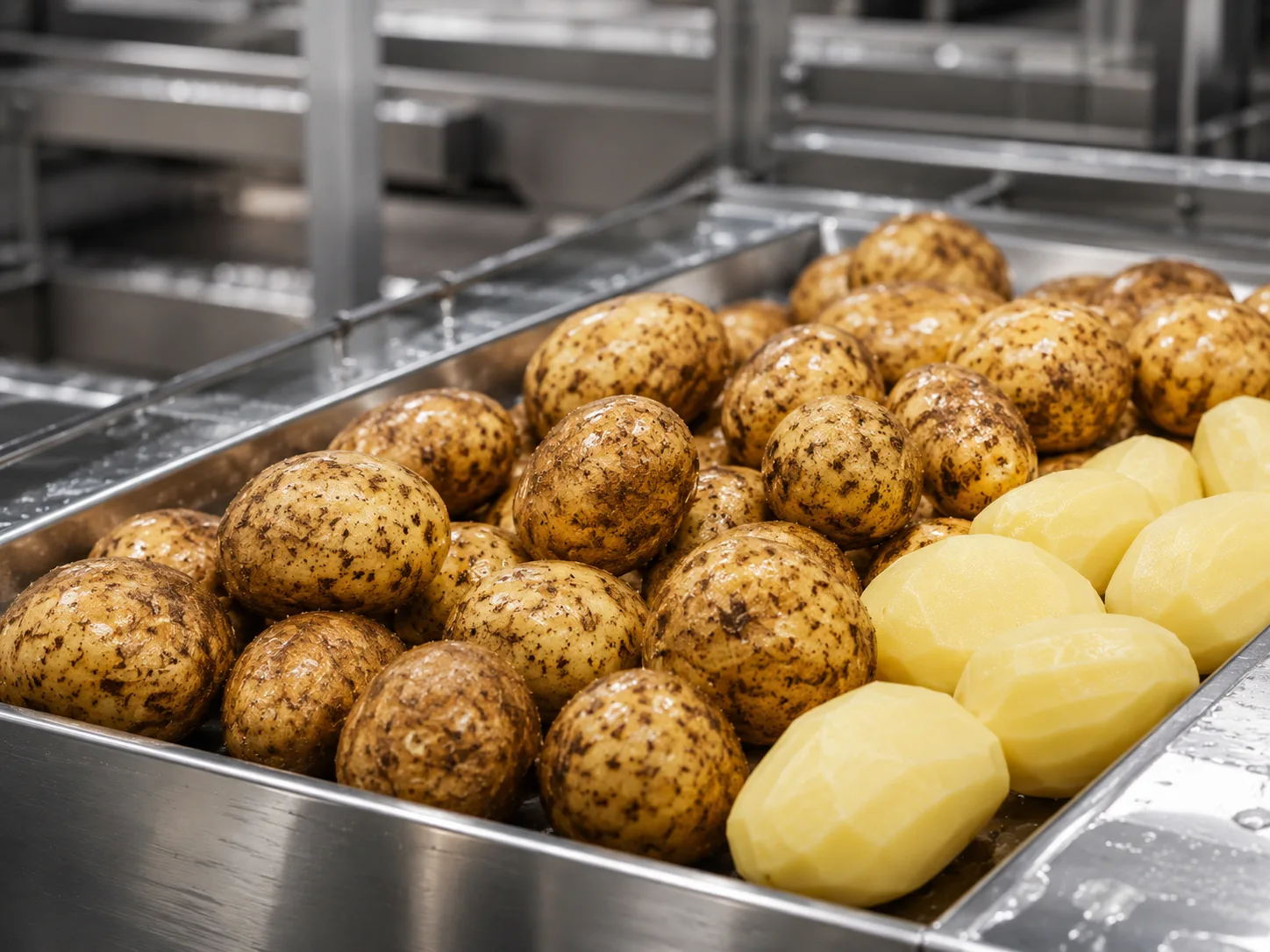
A single “peeling loss percentage” can hide several different outcomes. Before comparing people, machines or technologies, the production team should define what is being removed and why.
Necessary skin removal
This is the skin and immediately associated material that must be removed to meet the agreed product specification. The required degree of peeling may differ between peeled whole potatoes, diced ingredients, fresh-cut packs, French fries, potato salad, mashed products and products that will receive further trimming or cooking.
A lightly peeled potato with small patches of skin may be acceptable for one ready-to-cook product but unacceptable for a premium fresh-cut specification. Yield figures are therefore meaningless unless the acceptance standard is fixed.
Necessary defect removal
Eyes, sprouts, green areas, bruises, rot, cuts, pest damage and other defects may require removal even after the external skin has been detached. This material is not automatically an equipment loss. It may reflect the incoming crop, storage management, supplier grading or the finished-product specification.
If one test batch has a heavier defect load than another, the second method may appear to provide higher yield even when the peeling action itself is no better. Defect trimming must therefore be weighed separately.
Avoidable flesh removal
Avoidable loss is sound edible tissue removed beyond what was needed to satisfy the same specification. It may result from excessive residence time, overly aggressive abrasion, repeated passes, inconsistent manual knife depth, poor tuber presentation, unsuitable batch loading or attempts to remove deep defects through surface peeling.
This is the part of the loss that a process change may reduce. It cannot be identified reliably by looking only at total peel waste. The team must inspect the waste, separate sound flesh where practical and establish a reference for the minimum removal needed to produce acceptable potatoes.
Rework, rejects and unaccounted mass
Potatoes that require manual finishing after mechanical peeling are not necessarily lost, but rework consumes time and can restrict throughput. Whole rejected tubers should be recorded separately. Water carried into or out of a sample, product held inside equipment, floor loss and uncollected starch can prevent the mass balance from closing.
A credible trial does not force every difference into the category of peel loss. It shows where the mass went.
The Core Formulas for Measuring Potato Peeling Yield Loss
The most useful measurements are simple enough to repeat during normal production, yet detailed enough to distinguish process performance from raw-material condition.
Usable peeled yield
Usable peeled yield (%) = Acceptable peeled output mass ÷ Raw input mass × 100
“Acceptable” means the potatoes have passed the same inspection standard and any defined finishing step. Comparing untrimmed output from one method with fully finished output from another creates a false advantage.
Total peeling-stage loss
Total peeling-stage loss (%) = (Raw input mass − Acceptable peeled output mass) ÷ Raw input mass × 100
This result is useful as an operational headline, but it combines necessary and avoidable removal unless the waste streams are classified.
Avoidable loss delta
Avoidable loss delta = Test-method loss − Reference necessary-removal loss
The reference may be produced through carefully controlled manual finishing, a validated low-loss setting or another method that consistently meets the same specification. It is not automatically the method with the highest visible yield. Potatoes left with unacceptable skin or defects have not produced a genuine yield improvement.
Mass-balance closure
Mass-balance closure (%) = Recorded output streams ÷ Raw input mass × 100
Recorded streams may include acceptable peeled potatoes, peel and surface tissue, defect trim, whole rejects, retained samples and recoverable by-products. A result materially below or above 100% suggests that drainage, scale accuracy, retained product or unrecorded waste is affecting the test.
Annual material value of a yield difference
Annual gross material value = Annual raw input × Yield difference × Delivered raw-material cost
Where peel or starch has a genuine recovery value, subtract the value lost by changing the waste stream. Avoid assigning an optimistic by-product credit unless the factory has a buyer, a specification and a reliable recovery route.
How to Separate Necessary Removal from Over-Peeling
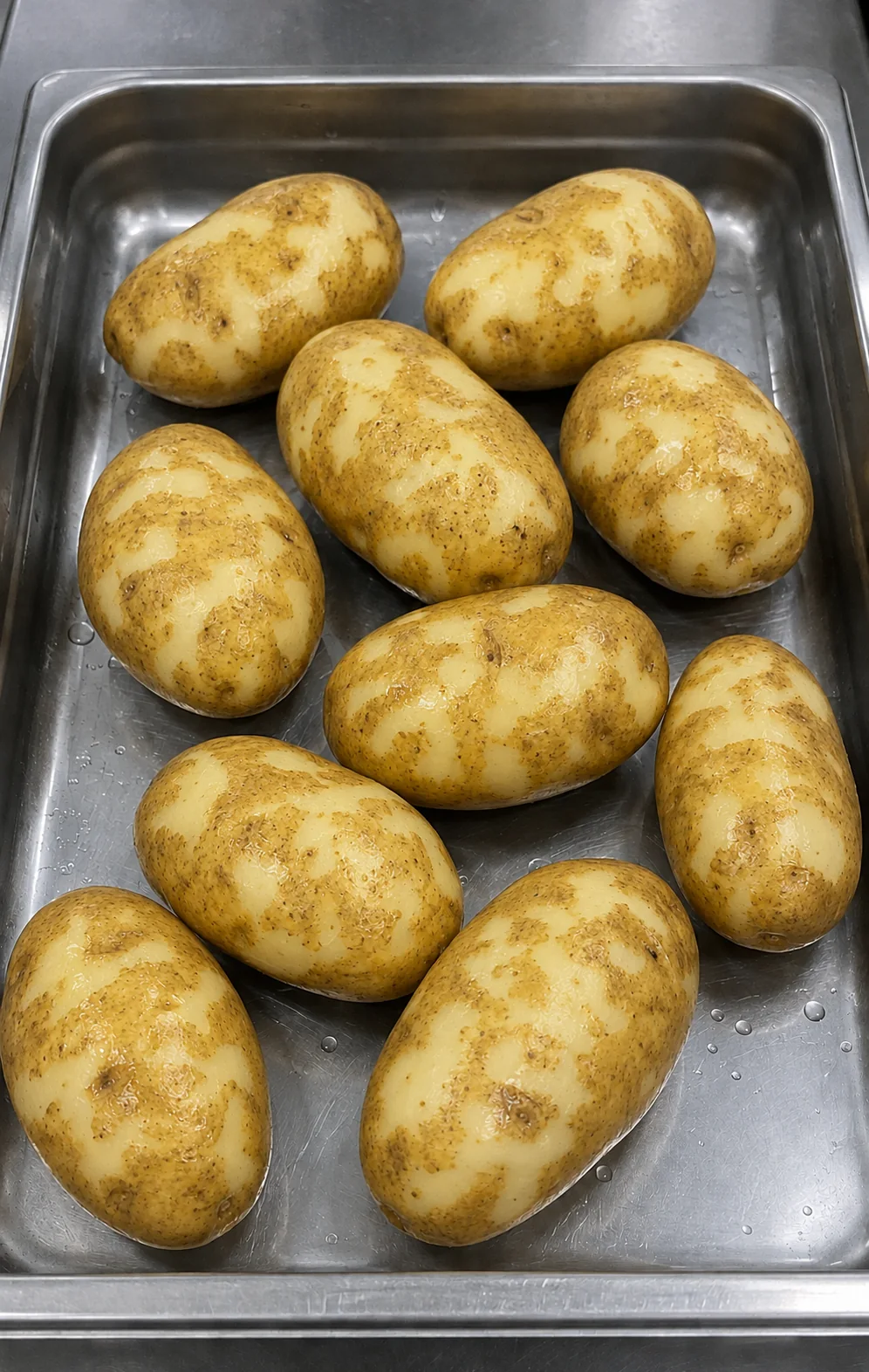
The most difficult part of a yield study is not weighing potatoes. It is defining the minimum removal needed to meet the customer or downstream process requirement.
A practical reference procedure begins with a representative raw-material sample. After washing and sorting, trained evaluators peel or finish each tuber only to the agreed visual and defect standard. The removed material is divided into categories such as skin, defective tissue and sound flesh. This reference is not intended to replace production. It provides an estimate of how much of the incoming mass genuinely needed removal.
The test method is then applied to matched samples. Its output must pass the same inspection. Any remaining skin or defects are removed and weighed as rework trim. If the test method produces more total removal than the reference, the difference may indicate avoidable loss. If it produces less removal but requires substantial finishing, the apparent yield advantage may disappear once labor, rework and final output are included.
Waste inspection is particularly valuable. Thin skin fragments with minimal flesh suggest a different result from thick wet pieces containing visibly sound potato. The team can photograph standardized waste samples, measure the proportion of sound flesh in selected subsamples and track changes between settings.
The reference should be repeated across incoming lots. Potato geometry and surface area strongly influence how much material must be removed. Small tubers generally have more surface area relative to their mass than large tubers, while irregular shapes and deep eyes complicate uniform peeling. A single baseline cannot represent every season, supplier or variety.
Why Raw Material Can Change Peeling Yield Before the Machine Starts
Peeling is an interaction between the process and a biological raw material. Two deliveries with the same net weight may behave very differently.
Size and shape distribution
Uniform, rounded potatoes are easier to expose consistently to an abrasive surface or controlled thermal effect. A mixed lot may contain small tubers that are over-processed while larger or irregular tubers remain incompletely peeled. Sorting into practical size bands can sometimes improve both yield and completion without replacing the peeler.
Eyes, defects and mechanical damage
Deep eyes cannot always be removed economically through general surface peeling. Extending the peeling cycle until every eye disappears may sacrifice sound flesh from the rest of each tuber. A better process may combine moderate peeling with targeted inspection and trimming—or improve supplier specifications so fewer heavily defective potatoes enter the line.
Variety, maturity and storage condition
Varieties differ in shape, skin adhesion, dry matter, physical structure and suitability for particular potato products. Storage can affect firmness, sprouting, dehydration and defect development. FAO guidance emphasizes that vegetable varieties differ in their processing suitability and that receiving evaluation should consider technological properties rather than appearance alone.
Soil load and pre-washing
Dirt and grit can distort the peeling process and increase wear. Proper washing also makes inspection more reliable. If the peeler is being used partly as a washer, an apparent improvement in throughput may come with unnecessary surface removal, contaminated recirculation water or inconsistent exposure.
These factors should be recorded for every test lot. Without raw-material descriptors, a factory may attribute seasonal yield deterioration to operators or equipment when the incoming potatoes have changed.
Comparison: Manual, Abrasive, Knife and Steam Peeling
No peeling method is universally lowest-cost. The appropriate choice depends on scale, product specification, raw-material uniformity, utilities, maintenance capability and the value of edible tissue.
Historic FAO material describes mechanical, chemical and thermal approaches and reports broad peeling-loss observations for several vegetables. Another FAO potato-processing section describes abrasion, lye and steam as common methods and notes that ideal peeling should remove only a thin external layer while leaving no eyes or blemishes requiring later trimming. These figures and descriptions are useful for understanding the problem, but they are not performance guarantees for current equipment.
| Method | Potential strengths | Main yield risks | Best evaluated when | Trial variables to control |
|---|---|---|---|---|
| Manual knife peeling | Flexible response to irregular shapes and local defects; low initial equipment requirement | Variable peel depth, operator fatigue, inconsistent standards, high labor dependence and possible excessive trimming | Volumes are low, SKU variety is high, raw material is irregular or targeted defect removal dominates | Operator skill, knife condition, time per batch, accepted finish and rework |
| Abrasive peeling | Relatively simple, compact and suitable for many small or medium processing operations | Sound flesh may be removed when exposure is too long, loading is unsuitable or tubers differ greatly in size | Batch or continuous volume supports mechanization and the crop responds well to controlled abrasion | Batch load, residence time, abrasive condition, speed, water flow, size grade and discharge timing |
| Knife or blade peeling | Can produce a defined cutting action and may suit comparatively regular products | Geometry mismatch, blade setting and presentation can create deep cuts or leave unpeeled areas | Tuber size and shape are sufficiently controlled and blade maintenance can be managed | Calibration, blade sharpness, alignment, feed orientation and size distribution |
| Steam peeling | Can support high-throughput industrial processing and rapid loosening of the surface layer | Non-uniform heat effect, heat-ring development, capital and utility requirements, and loss of underlying tissue | High and stable volume can justify industrial utilities, pressure equipment and downstream peel removal | Steam pressure, exposure time, pressure release, tuber size, peel-removal action and heat-ring quality |
| Combined or staged process | Allows moderate primary peeling followed by targeted finishing rather than aggressive whole-surface removal | Poor line balance may shift the bottleneck to inspection; responsibilities between stages may be unclear | Defect load is variable and complete removal through one mechanism would sacrifice excessive flesh | Primary peel endpoint, inspection staffing, trim specification, rework rate and downstream capacity |
What the steam-peeling research demonstrates
A peer-reviewed study by Somsen, Capelle and Tramper separated wanted removal from unwanted loss in steam peeling for par-fried French-fry manufacture. In the studied industrial context, the authors identified substantial unwanted loss and developed a model relating peel removal and heat-ring development. Their conclusion emphasized a homogeneous peeling effect with limited heat-ring development.
The study proves that total peel loss can conceal an avoidable component and that uniformity matters. It does not prove that every steam peeler creates the same loss, that steam peeling is unsuitable, or that its reported percentage should be inserted into another factory’s financial model.
What abrasive-peeling research does not prove
Peer-reviewed work on abrasive potato peeling has evaluated machine construction and operating performance under defined conditions. Such studies demonstrate that abrasion can be mechanized and measured. They do not establish a universal loss percentage for every abrasive peeler, because tuber properties, machine geometry, batch size, exposure and endpoint criteria change the result.
For purchasing decisions, the decisive evidence is a controlled test using the factory’s potatoes and acceptance standard.
How to Design a Repeatable Potato Peeling Batch Trial
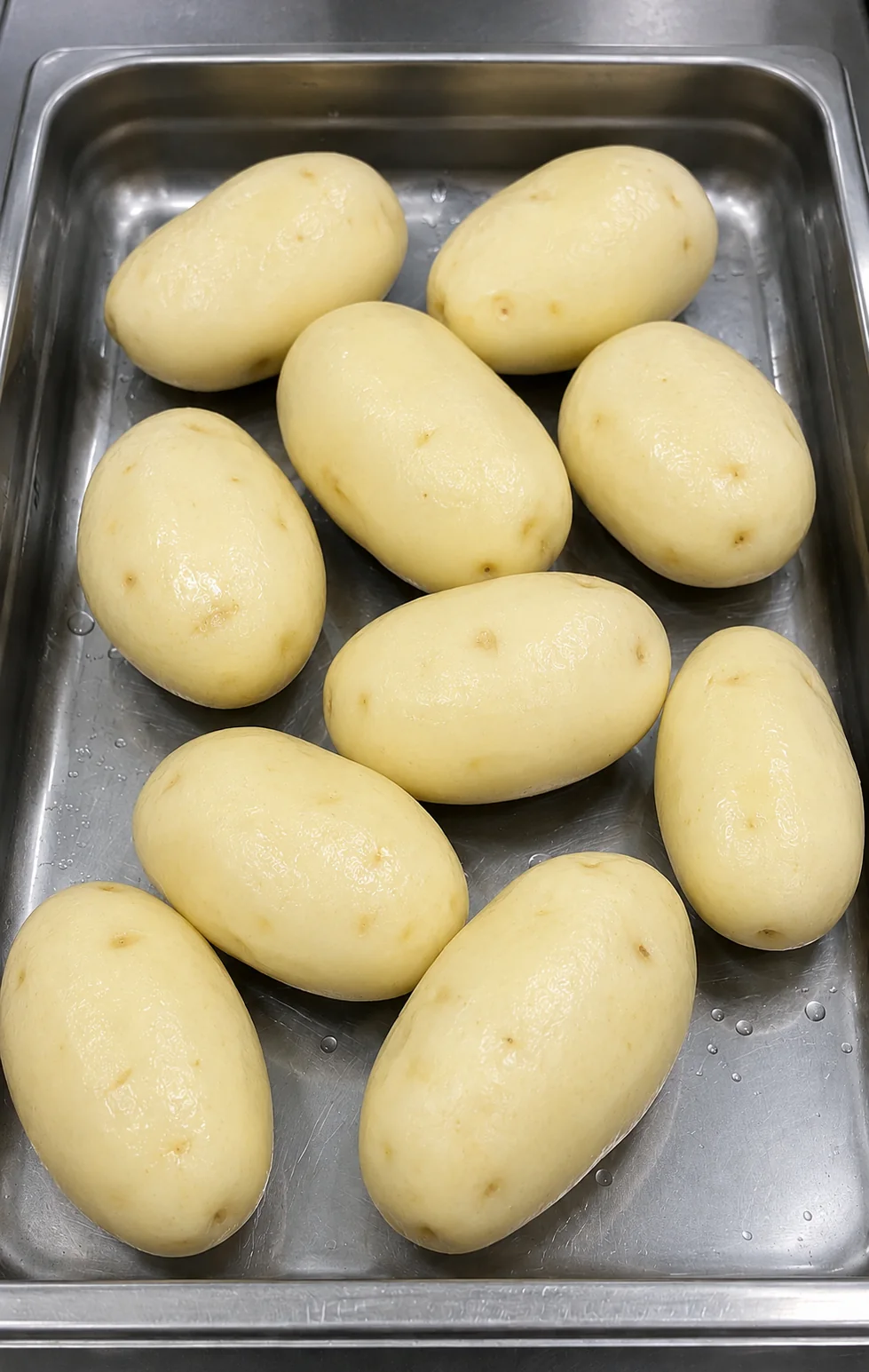
A supplier demonstration becomes decision-quality evidence only when the input, settings, outputs and acceptance criteria are documented. Running one attractive batch without a mass balance is not enough.
1. Define the finished-product standard
Specify whether isolated skin patches are permitted, how eyes and green tissue are handled, whether minor defects will be removed later, and which surface condition is acceptable. Use reference photographs and a simple inspection checklist. The same standard must apply to every method.
2. Create representative and matched lots
Do not give one method large round potatoes and another method a mixed delivery. Randomize or grade the source lot, record the number of tubers per kilogram where practical, and distribute comparable size and defect profiles among test batches.
When the factory receives materially different seasonal crops, test more than one condition. A method optimized for smooth stored potatoes may not behave the same with freshly harvested, soil-covered or heavily sprouted material.
3. Control weighing and drainage
Use a scale with suitable capacity and resolution, verify zero before each batch, use the same containers and document any check weights or calibration status. NIST Handbook 44 is a U.S. reference for specifications and tolerances covering commercial weighing devices, including scales. An internal process trial may fall under different local requirements, but measurement traceability remains essential.
Wet potatoes can retain different amounts of surface water. Establish a consistent draining period before each weighing stage. Do not compare freshly sprayed output with a reference sample that has drained for ten minutes.
4. Record settings and operating events
For an abrasive peeler, this may include load mass, cycle time, rotation or operating speed, water flow, abrasive condition and discharge delay. For steam peeling, record the validated pressure, exposure, pressure release and downstream peel-removal conditions. For manual work, record the operators, working time, breaks and knife condition.
Also note stoppages, bridging, repeated cycles, incomplete discharge and material left in the machine. These events affect sustainable output even when the nominal cycle suggests a higher capacity.
5. Separate and weigh output streams
| Measurement | Why it matters | Recommended record |
|---|---|---|
| Raw input | Denominator for all yield calculations | Net mass, supplier lot, variety if known, size distribution, defects and storage condition |
| Acceptable peeled output | Determines genuine usable yield | Mass after standardized drainage and final acceptance inspection |
| Primary peel waste | Shows removal by the main process | Wet mass, drainage method and visual assessment of flesh content |
| Manual finishing trim | Prevents incomplete peeling from appearing efficient | Mass, labor minutes and reason codes such as skin, eyes, green tissue or damage |
| Whole rejects | Separates incoming quality failure from general surface loss | Mass, count and reject reason |
| Unaccounted or retained product | Tests reliability of the mass balance | Floor loss, equipment retention, samples and estimated uncollected solids |
| Time and labor | Connects yield with throughput and operating cost | Run time, loading, unloading, inspection, rework, cleaning and number of operators |
| Quality after peeling | Confirms that higher yield did not reduce product suitability | Skin remaining, defect removal, surface damage, discoloration and downstream cutting result |
6. Repeat the trial
One batch cannot show process variation. Repeat each condition enough times to observe whether the result is stable. Present the average together with the range, batch-level data and raw-material descriptors. A setting with slightly better average yield but frequent unacceptable batches may be less useful than a stable condition.
7. Test downstream effects
Peeling is not an isolated objective. Check whether the output cuts consistently, holds its shape, cooks evenly and meets color and appearance requirements. Surface damage may increase starch release, create fragments or affect downstream washing. A yield advantage should not be accepted if it creates a larger loss after cutting, blanching, cooking or quality sorting.
A Yield-Loss Calculator Framework for Commercial Decisions
The financial model should compare the current process and proposed process at the same accepted output standard. Separate material value from labor, utilities and capital so assumptions can be reviewed rather than hidden inside one payback figure.
| Variable | Calculation or input | Evidence needed |
|---|---|---|
| Annual raw input | Daily input × operating days | Production records and realistic operating schedule |
| Current acceptable yield | Accepted peeled output ÷ raw input | Repeated current-process mass balances |
| Proposed acceptable yield | Accepted peeled output ÷ raw input | Matched trial using the same specification |
| Recovered potato mass | Annual input × yield difference | Validated difference rather than literature benchmark |
| Gross material value | Recovered mass × delivered potato cost | Actual purchase, freight and receiving cost basis |
| Labor change | Difference in productive and rework hours × loaded labor cost | Time study including inspection and cleaning |
| Utility and consumable change | Water, energy, steam, chemicals and wear parts | Measured or supplier-supported consumption assumptions |
| Waste or by-product effect | Disposal cost change or documented recovery value | Actual disposal invoices or enforceable recovery route |
| Annual net benefit | Material, labor and other benefits minus incremental operating costs | Agreed finance and operations assumptions |
| Simple payback | Installed incremental investment ÷ annual net benefit | Complete installed cost and conservative net benefit |
The investment figure should include more than the machine price. Depending on the method, it may include conveyors, water management, steam supply, drainage, electrical work, guarding, ventilation, platforms, installation, commissioning, training, spare parts and production disruption.
The model should also test several scenarios. A conservative case may use the lower end of the observed yield difference, fewer operating days and higher maintenance cost. A base case may use the trial average. An upside case can be shown separately, but it should not become the purchasing assumption.
If the investment is justified only when every favorable assumption occurs simultaneously, the project is fragile. If it remains attractive after allowing for raw-material variation, cleaning time and maintenance, the commercial case is stronger.
Yield Cannot Be Evaluated Without Throughput and Line Balance
A low-loss process may still be uneconomic if it cannot supply the downstream line. Conversely, the fastest peeler may destroy value if it achieves speed by removing excessive flesh or transferring unfinished potatoes to manual rework.
Measure sustainable throughput as acceptable peeled kilograms produced per operating hour. Include loading, discharge, inspection, unplanned interruptions and routine cleaning. Rated capacity is useful for preliminary screening, but it does not establish what the full vegetable processing line can sustain with a particular potato, operator team and product standard.
The relevant metric is:
Acceptable peeled throughput = Acceptable peeled mass ÷ Total operating time
If a peeler processes 1,000 kilograms per hour but produces only 800 kilograms of accepted output and creates an inspection queue, its practical contribution differs from the nameplate figure. The next cutting, washing or cooking stage must also be able to receive the output without excessive work-in-process accumulation.
For a central kitchen with many ready-to-cook SKUs, cleaning and changeover may dominate the schedule. A food manufacturer producing one potato format for long runs may prioritize continuous throughput and tight process control. The correct comparison reflects the actual production mix rather than an isolated maximum-speed test.
Quality, Food Safety and Sanitation Effects
Yield should never be improved by accepting potatoes that do not meet the product specification or food-safety program. Green tissue, decay and damaged material must be managed according to the facility’s approved controls. Equipment does not replace incoming inspection, hazard analysis, sanitation procedures or employee training.
Peeling creates wet organic residue that can accumulate on abrasive surfaces, inside housings, around discharge points and in wastewater systems. Sanitary design, access for cleaning, drainability, material compatibility and verification of cleaning procedures should be considered during equipment selection.
Fresh-cut ready-to-eat processing requires particular care because the product may not receive a later lethality treatment. A peeling machine is not a sanitation system, and visual removal of the surface does not guarantee microbiological control. RTE and ready-to-cook workflows may require different hygiene zoning, employee practices and downstream controls.
A change in peeling method can introduce new risks. Thermal methods add pressure and steam-system considerations. Abrasive systems create wear surfaces and wet solids. Knife systems depend on blade condition and guarding. Automated feeding may create pinch points or product damage when the inlet is not matched to the crop. These risks belong in the decision alongside yield.
When Automation Is Not the Right Answer
A peeling machine should not be purchased merely because the current process is manual. Manual or semi-automatic preparation can remain rational under several conditions.
Low volume and high variation
When daily potato volume is small, irregular or seasonal, labor may be easier to scale than installed equipment. This is especially true where the same preparation area handles many root vegetables and no single SKU provides enough operating hours to justify a dedicated process.
Defect removal dominates the work
If operators spend most of their time removing deep eyes, green areas, rot or irregular damage, a more aggressive whole-surface peeler may not solve the problem. Supplier grading, storage improvements or targeted finishing may have a better economic effect.
The product does not require complete peeling
Some products can retain part or all of the skin. Removing it because “that is how the factory has always worked” creates loss without adding customer value. The product specification should be challenged before the process is automated.
Utilities and maintenance are not ready
A sophisticated method can underperform when water pressure, drainage, steam quality, electrical supply, spare parts or preventive maintenance cannot support it. A simpler process with controlled operating discipline may produce a better long-term result.
Incoming potatoes are not controlled
Automation often narrows the acceptable raw-material window. If size, shape and defect load vary widely, the factory may need grading, supplier specifications or multiple operating recipes before expecting stable results.
Semi-automation is frequently the practical middle step: mechanical washing and controlled peeling followed by focused inspection and defect trimming. The objective is not to remove every operator. It is to apply labor where judgment adds value and prevent people or machines from repeatedly removing sound potato.
A Practical Decision Framework
A peeling change is commercially justified when the evidence answers five questions.
Does the proposed process meet the same specification?
Higher measured yield is not valid if more skin, eyes or unacceptable defects remain. Confirm the final output after all required rework.
Is the yield difference repeatable?
Review multiple matched batches, not the best demonstration. Check the range and investigate outliers.
Is the recovered material economically meaningful?
Multiply the conservative yield difference by annual input and actual delivered potato cost. Deduct any proven by-product value lost.
Can the method support sustainable throughput?
Include loading, inspection, rework, sanitation, changeover and downtime. Confirm capacity matching with downstream cutting, washing and cooking stages.
Does the net benefit exceed the total cost and risk?
Include installation, utilities, labor changes, wear parts, maintenance, cleaning, training and production disruption. Consider whether raw-material control or process discipline could capture much of the benefit with less capital.
When these questions are answered with plant data, equipment price becomes only one part of the decision. The economic priority may be a new peeler, a revised setting, size grading, shorter cycles, improved knives, better incoming specifications or a staged process combining mechanical peeling with targeted finishing.
Calculate the Cost of Peeling Loss
Start with three to five representative production lots. Record incoming potato cost and mass, accepted peeled output, peel waste, defect trim, rework labor, rejects, operating time and downstream quality. Use the framework above to calculate current usable yield and the annual value of each percentage point.
Once the baseline is visible, compare peeling methods and settings under the same acceptance standard. The next step may be to review a broader root vegetable processing line, test a specific peeling method or correct the current process before purchasing equipment.
TEEMYEAH supports central kitchens, food manufacturers, fresh-cut processors and RTC/RTE facilities with raw-material testing, process-flow analysis, capacity matching and customized food preparation solutions. A useful technical discussion should begin with your potato condition, required finished product, present yield, target throughput and available utilities—not with an assumed machine model.
FAQ
1. What is a normal potato peeling loss percentage?
There is no universal normal percentage that can be applied safely to every factory. Published sources report results from different periods, products, potato varieties, equipment and acceptance standards. Total loss also combines necessary skin removal, defects and avoidable flesh removal. Establish a plant baseline using representative lots and a fixed finished-product specification. Compare acceptable output after all required rework, not immediately discharged product. Literature can help identify variables and possible loss mechanisms, but it should not be used as a supplier guarantee or inserted directly into an ROI model.
2. How do you calculate potato peeling yield loss?
Weigh the net raw potato input and the accepted peeled output after a standardized drainage period and final inspection. Peeling-stage loss equals raw input minus accepted output, divided by raw input and multiplied by 100. For a meaningful result, separately record primary peel waste, defect trim, whole rejects, retained samples and unaccounted mass. This classification shows whether a high loss came from aggressive peeling, poor incoming potatoes or a strict defect specification. Repeat the measurement across several comparable batches because one trial cannot represent normal variation.
3. What is the difference between necessary peeling loss and avoidable loss?
Necessary loss is the skin and defective tissue that must be removed to meet the approved product standard. Avoidable loss is sound edible flesh removed beyond that requirement. The difference can be estimated by producing a controlled reference sample with the minimum removal needed, then comparing it with the tested process under the same acceptance criteria. Waste inspection is useful because thick pieces containing sound potato indicate a different problem from thin skin fragments. Do not label all peel-bin material as waste caused by the machine; incoming defects and mandatory trimming must remain separate.
4. Is abrasive peeling or steam peeling better for yield?
Neither method is automatically better for every operation. Abrasive peeling can be compact and comparatively simple, but excessive exposure or mixed tuber sizes may remove sound flesh. Steam peeling can support high industrial throughput, yet uniform heat effect, pressure control and heat-ring development influence yield and quality. The commercial comparison should use matched potatoes, equal acceptance standards and measured utilities, rework and downstream quality. High-volume French-fry production and a central kitchen preparing several root-vegetable SKUs may reach different conclusions even when their incoming potato cost is similar.
5. Can manual peeling produce lower potato loss?
Skilled manual peeling can respond selectively to irregular shapes and may provide a useful necessary-removal reference. In production, however, results depend on operator skill, knife condition, fatigue, training and interpretation of the finish standard. Some operators may leave unacceptable skin, while others remove excessive flesh. Manual peeling can remain economical for low volume, changing products or defect-heavy potatoes, but it should still be measured. Record labor hours, acceptable output and rework rather than assuming that lower equipment cost means lower preparation cost.
6. How much is one percentage point of peeling yield worth?
Multiply annual raw potato input by 0.01 and by the delivered cost per kilogram. A factory processing 1,000,000 kilograms annually would retain 10,000 additional kilograms for each genuine percentage point of acceptable yield recovered. The monetary value depends on the factory’s actual purchase and delivery cost, not a national commodity average. The result is a gross material value. A complete business case must also consider by-product recovery, utilities, labor, maintenance, financing, installation and whether the yield difference remains stable under normal production conditions.
7. How large should a potato peeling trial batch be?
The batch must be large enough to represent the intended operating load and raw-material variation. A very small sample may not reproduce tuber-to-tuber contact, equipment filling, residence distribution or discharge behavior. For batch machines, test the proposed normal load as well as lower and upper practical loads. For continuous systems, run long enough to reach stable operation and collect multiple timed samples. More important than one large demonstration is a series of matched, repeatable batches covering relevant size grades, suppliers or seasonal conditions.
8. How should wet potatoes be weighed during a yield test?
Use the same drainage procedure at every measurement stage. Define a drain time, container type and handling method before the trial. Verify the scale is level, at zero and suitable for the expected load and required resolution. Record its identification and verification status. Surface water can make one process appear to have higher yield simply because its output was weighed wetter. Peel waste also retains water, so wet waste mass should not be interpreted directly as edible potato mass without a defined method or composition assessment.
9. When can lower peeling loss justify a new machine?
A machine or process change may be justified when repeated trials show a conservative improvement in acceptable yield, the method supports required throughput and the annual net benefit exceeds the installed and operating cost at an acceptable risk level. Calculate material recovery, labor and rework changes, utilities, cleaning, wear parts, maintenance and integration costs separately. The project should not rely on a literature percentage or one supplier demonstration. It may also be unnecessary if settings, size grading, knife maintenance or incoming potato quality can recover most of the opportunity.
10. Can an automated peeler eliminate manual inspection?
Not necessarily. Potatoes are variable biological materials, and deep eyes, green tissue, decay or mechanical damage may remain after general surface peeling. Automated peeling can reduce repetitive work and standardize part of the process, but final inspection or targeted trimming may still be required. The required level depends on the product and food-safety program. The correct labor calculation therefore measures the complete workflow after automation, including feeding, monitoring, quality inspection, rework, sanitation and handling of abnormal potatoes.
Data and Source Note
This article uses FAO vegetable-processing guidance to describe peeling principles, raw-material variation and historic observations concerning manual, mechanical, chemical and thermal methods. The FAO figures come from broad technical guidance and are not treated as current equipment guarantees.
The distinction between wanted and unwanted removal in steam peeling is supported by the peer-reviewed Journal of Food Engineering study by Somsen, Capelle and Tramper on yield efficiency in par-fried French-fry manufacture. Its reported industrial findings apply to the conditions studied and are not transferred to a hypothetical TEEMYEAH machine or another factory.
The discussion of abrasive peeling is informed by peer-reviewed Journal of Food Engineering research on the development and evaluation of an abrasive potato peeler. No individual capacity, loss or cost result from that study is presented as a modern commercial benchmark.
USDA NASS Potatoes 2024 Summary data are used only to demonstrate that potato price context varies by state and market. Factories should use their own delivered raw-material cost, contract terms and accounting method.
NIST Handbook 44, current 2026 edition, is referenced as an authoritative U.S. source covering specifications, tolerances and technical requirements for weighing and measuring devices. Facilities should confirm the calibration, verification and legal-metrology requirements applicable in their own jurisdiction.
All financial examples in this article are hypothetical. Actual yield, avoidable loss, throughput, utility use, labor requirements, investment cost, ROI and payback must be established from representative raw-material tests and factory-specific records.

