







For fresh-cut vegetable processors, a spin dryer is no longer just a small centrifuge that an operator loads and unloads by hand.
In higher-capacity production, buyers searching for an industrial vegetable spin dryer, automatic spinning dryer, centrifugal dewatering machine, vegetable centrifugal dryer or lettuce spin dryer are often looking for the same fundamental function: removing excess surface water after washing while keeping the product suitable for the next process, such as weighing, mixing or packaging.
The real engineering question is therefore broader than “How fast does the basket spin?”
An industrial centrifugal dewatering system has to match the product, the required throughput and the complete line. Delicate Lollo Rosso behaves very differently from cut Iceberg lettuce, and both behave very differently from carrot, potato or other dense root vegetables. Basket volume, rotational speed, dewatering time, loading density and automatic product handling all influence actual capacity and the final condition of the product.
TEEMYEAH offers two fully automatic centrifugal dewatering configurations for this stage: the TW-980LB and the larger TW-980LV.
Both are designed for automatic post-wash dewatering of delicate leafy vegetables, conventional leafy vegetables and root vegetables, while offering different basket sizes, speed ranges and throughput levels.
What makes an industrial spin dryer different from a batch vegetable spinner?
A conventional vegetable spin dryer or industrial salad spinner normally operates as an independent batch machine.
An operator fills a basket, moves it into the centrifuge, starts the spin cycle, removes the basket and tips the product into the next container or machine.
That can work well at smaller volumes, but the centrifuge cycle itself is only one part of the labor requirement. As capacity rises, repeated basket filling, lifting, unloading and transfer can become the real bottleneck.
The TW-980LB and TW-980LV use a different architecture.
The production flow is organized around:
automatic infeed → controlled holding and dosing → recipe-controlled centrifugal spinning → deceleration → automatic product release → automatic discharge → onward conveying
The product line can therefore continue receiving washed vegetables while the centrifugal drum performs controlled internal batches.
For the TW-980LB, the current technical profile specifically describes continuous line reception combined with controlled internal batch centrifugation, automatic feeding, spinning, deceleration, air-knife-assisted discharge and onward conveying.
The TW-980LV follows the same automatic line concept at a larger physical scale. Its operating manual identifies it as a fully automatic high-speed centrifugal dewatering system intended for leafy and root vegetables after cutting and washing.
That difference matters when comparing a manual spin drying machine with an automatic industrial dewatering line. Automation is not simply an accessory around the centrifuge; it changes how the dewatering stage fits into production.
TW-980LB vs TW-980LV: two automatic centrifugal dewatering machines
The TW-980LB and TW-980LV use the same core principle—centrifugal removal of surface water—but are intended for different production scales.
| Specification | TW-980LB | TW-980LV |
|---|---|---|
| Overall machine dimensions | 6600 × 1800 × 2320 mm | 10430 × 2300 × 2845 mm |
| Basket capacity | 125 L | 250 L |
| Effective basket diameter | 600 mm | 800 mm |
| Standard adjustable speed | 83–800 rpm | 60–700 rpm |
| Maximum adjustable speed | Up to 960 rpm | Up to 840 rpm |
| Leafy-vegetable reference throughput | 800 kg–1.2 t/h | 1–1.5 t/h |
| Root-vegetable reference throughput | 1.2–1.5 t/h | Up to approx. 3 t/h |
| Product categories | Delicate leafy, standard leafy, root vegetables | Delicate leafy, standard leafy, root vegetables |
| Feeding and discharge | Automatic | Automatic |
| Recipe-controlled speed/time | Yes | Yes |
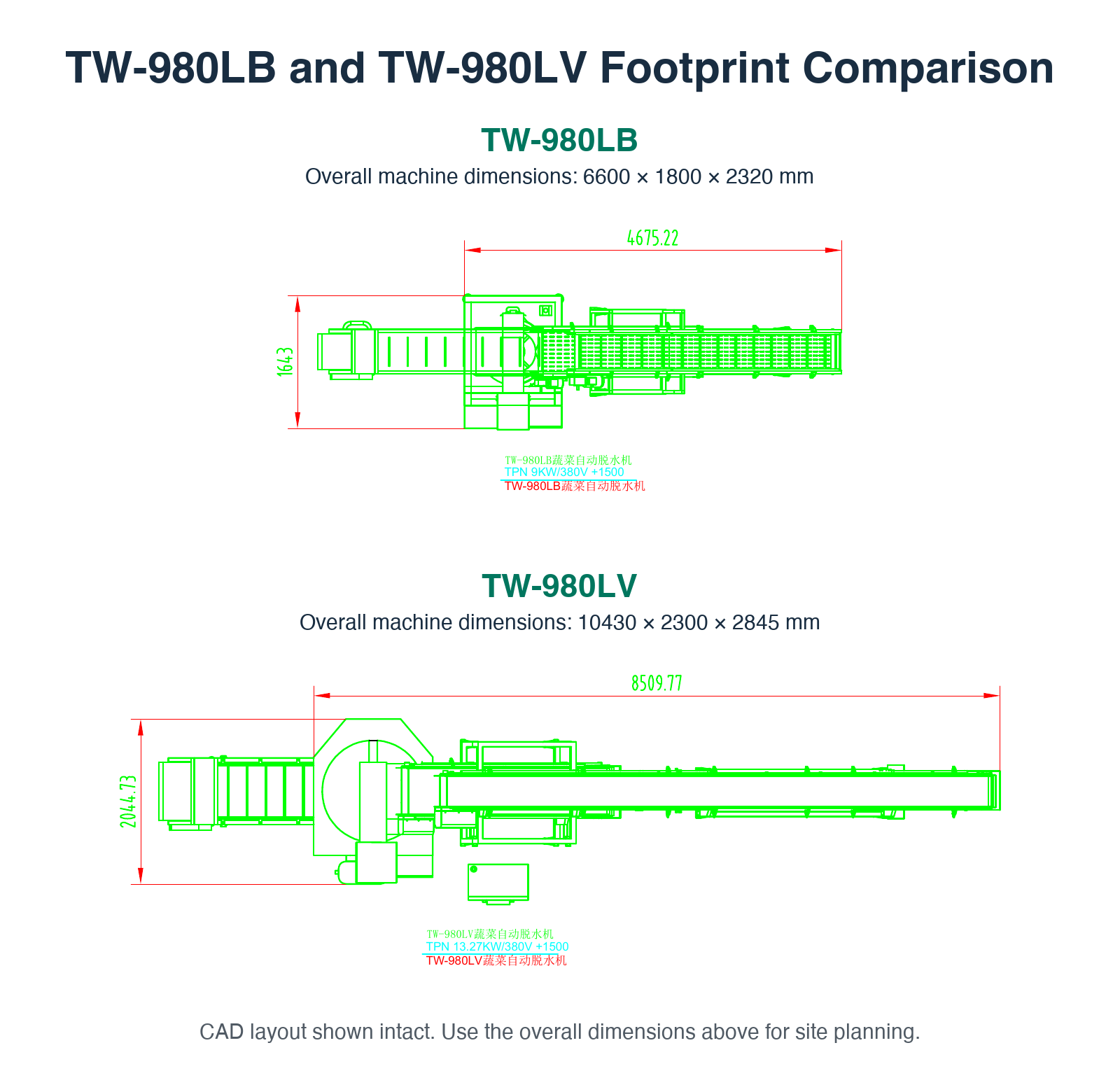
The TW-980LB has a 600 mm effective basket diameter and a standard adjustable range of 83–800 rpm. The current configuration allows higher speeds where the product and mechanical conditions justify them.
The larger TW-980LV uses a 900 mm effective basket diameter with a standard 60–700 rpm operating range, while the maximum adjustable speed can reach 840 rpm. Its current technical profile specifies a 250 L basket.
The TW-980LB’s separate product specification lists a 125 L basket and overall dimensions of 6600 × 1800 × 2320 mm.
This makes the distinction between the two models clearer than simply calling one “small” and the other “large.”
The LB is the more compact automatic vegetable spin dryer for roughly one-ton-per-hour applications, while the LV provides a much larger centrifugal basket for operations requiring greater loading volume or higher throughput.
Why leafy-vegetable capacity is lower than root-vegetable capacity
A rated capacity should never be interpreted without looking at the product.
A kilogram of cut lettuce occupies far more volume than a kilogram of diced carrot.
This is especially important after cutting. A cut leafy product becomes more open and bulky, which reduces the amount of kilograms that can be loaded into a given basket volume.
That is why the same centrifugal dewatering machine can show very different throughput figures for different vegetables.
For the TW-980LB, our current practical reference is approximately:
Leafy vegetables: 800 kg–1.2 t/h
Root vegetables: 1.2–1.5 t/h
For the larger TW-980LV:
Leafy vegetables: 1–1.5 t/h
Root vegetables: up to approximately 3 t/h
These figures should still be treated as product-dependent reference throughput rather than universal guaranteed output.
Actual production depends on several interacting variables:
- whole leaf versus cut product;
- cut size;
- bulk density;
- water carried over from washing;
- basket loading;
- dewatering time;
- rotational speed;
- acceptable residual surface water;
- required product appearance;
- upstream washer capacity;
- downstream weighing or packaging rate.
This distinction is particularly relevant when comparing suppliers. A headline capacity expressed as “up to X t/h” does not necessarily tell a buyer what the machine will achieve on baby leaf, Lollo Rosso, cut Iceberg or carrot sticks.
An automatic spin dryer for delicate leafy vegetables as well as roots
Centrifugal drying is sometimes treated as suitable mainly for tougher leafy vegetables or dense root products.
That is too restrictive.
What determines whether a centrifugal spin dryer can process a delicate leaf is not simply the existence of centrifugal force. The important variables are how much force is applied, for how long, at what loading level and how the product is discharged after the cycle.
Products such as:
Lollo Rosso, Iceberg lettuce, frisée, escarole, radicchio, spinach and other leafy vegetables
can require significantly different operating recipes.
The TW-980 systems therefore allow the processor to adjust both dewatering speed and dewatering time rather than forcing every SKU through one fixed high-speed setting.
The TW-980LV operating manual, for example, includes multiple factory programs and explicitly states that the parameters can be adjusted to suit the application. Program selection and engineering-authorized parameter settings allow changes to dewatering time, dewatering speed and related conveyor parameters, with settings retained after power-off.
This matters for processors handling many SKUs.
A plant does not need one lettuce spinning dryer for Lollo Rosso, another for Iceberg and another for root vegetables. The objective is to establish validated recipes for each product family.
A field-tested 600 rpm dewatering recipe
A recent TEEMYEAH washing and centrifugal-dewatering trial provides a useful example of how this recipe approach works in practice.
The trial material was:
Iceberg lettuce with a small amount of Lollo Rosso
The product therefore included both standard cut lettuce and a more delicate leafy component.
The recorded TW-980LB operating parameters were:
Program: 3
Dewatering cycle: 50 seconds
Drive frequency: 38 Hz
Basket rotational speed: 600 rpm
These settings came directly from the machine HMI during the on-site test.
The measured product weights were:
| Process stage | Weight |
|---|---|
| Raw incoming material | 13.50 kg |
| After cutting and trimming / before washing | 9.80 kg |
| After washing | 13.30 kg |
| After TW-980LB spin drying | 10.35 kg |
The washing stage increased measured product weight by 3.50 kg.
After the 50-second centrifugal cycle at 600 rpm, the TW-980LB removed 2.95 kg from the washed product.
This corresponds to a:
22.18% wet-weight reduction during centrifugal dewatering
and an estimated:
84.29% removal of the weight added during washing.
These two percentages should not be confused.
The 22.18% dewatering rate describes the reduction relative to the total wet weight entering the spin dryer.
The 84.29% figure estimates how much of the net weight gained during washing was subsequently removed.
It does not mean that the industrial spin dryer removed 84.29% of the inherent moisture inside the lettuce tissue.
The calculated post-dewatering weight remained approximately 0.55 kg above the pre-wash baseline, equivalent to roughly 5.3% of the final measured weight. This should be treated as a production-weight estimate of remaining excess water, not laboratory moisture analysis.
The more useful conclusion for a processor is that a fixed, repeatable recipe was recorded:
50 s / 38 Hz / 600 rpm
Once a processor validates an acceptable combination of water removal and leaf appearance, that operating condition can be retained as a reference recipe and adjusted where required for different products.
RPM matters—but RPM alone does not determine drying performance
It is tempting to compare one industrial spinning dryer with another based on maximum rpm.
That number has limited meaning by itself.
Centrifugal force also depends on the radius of the basket.
This is why the TW-980LV can use a lower nominal rpm than the TW-980LB while still creating substantial centrifugal force: the LV has a significantly larger 900 mm effective basket diameter compared with 600 mm on the LB.
The engineering objective is therefore not to maximize rpm.
It is to find the appropriate combination of:
basket diameter × rpm × product loading × spin time
for the vegetable being processed.
For delicate leafy vegetables, excessive speed or excessive cycle time can reduce product quality even if more water is removed.
For dense cut root vegetables, stronger centrifugal conditions may be acceptable and can support much higher kg/h throughput.
This adjustable operating window is one of the reasons industrial processors should evaluate a programmable centrifugal dewatering machine rather than selecting equipment based solely on maximum speed.
Basket capacity matters just as much as speed
Basket volume is another parameter that is often underestimated.
The TW-980LB uses a 125 L basket, while the TW-980LV doubles this to 250 L.
That additional physical volume can be particularly important for bulky cut vegetables.
For low-density leafy products, the machine may become volume-limited before it becomes weight-limited. A larger basket therefore allows more product to be handled in each controlled batch even when the actual kilogram loading remains far below what would be possible with dense root vegetables.
This is also why two machines with similar rpm values can deliver very different production results.
A useful industrial vegetable dryer comparison should therefore look at:
- basket volume;
- effective basket diameter;
- rpm range;
- loading control;
- product density;
- cycle time;
- infeed buffer design;
- discharge method;
- line automation.
Not maximum rpm alone.
Full automation from washer discharge to the next process
The strongest distinction between the TW-980 series and a conventional vegetable centrifuge is the material-handling sequence.
A manual basket-type vegetable spin dryer still relies heavily on operators between washing and packaging.
The TW-980LB and LV are designed to automate those transfers.
Washed product can be elevated to the infeed section, temporarily held or dosed, transferred into the centrifugal drum, spin-dried according to the selected recipe, decelerated, released from the drum and conveyed onward.
For the LB, air is used to assist product release from the inner drum and reduce material hold-up after centrifugation. The air knife is a discharge aid; it should not be confused with an air-knife drying system.
For the LV, the operating manual also shows automatic and remote operating modes, retained product programs, individual parameter settings, alarm history and detailed monitoring of motor speed, current and accumulated operating time.
In practical production terms, this means the dewatering stage can become part of an integrated fresh-cut line rather than remaining an isolated basket-handling operation.
Field-Proven Automatic Dewatering: More Than 555,000 Cycles in Customer Operation
Specifications describe what an industrial spin dryer is designed to do. Long-term field operation shows whether the automation, centrifugal mechanism and supporting components can continue doing it under real production conditions.
One TW-980LV automatic centrifugal dewatering line has been operating at a customer site since November 2021.
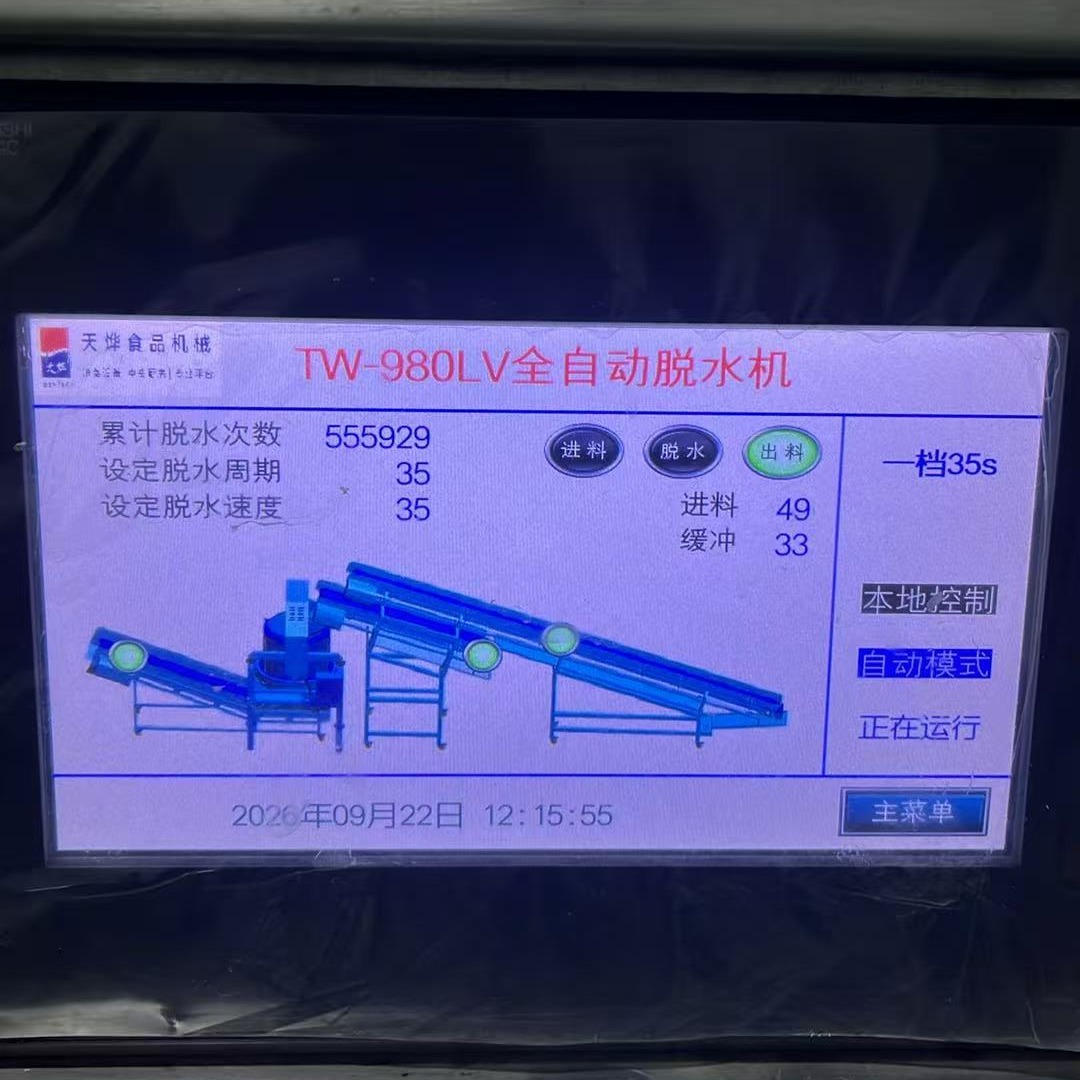
A customer-site HMI photo taken on 22 September 2026 shows a cumulative total of:
555,929 dewatering cycles
The machine was still shown running in automatic mode, with a 35-second dewatering program selected.
The customer reports a typical production schedule of approximately five days per week and about 10 hours per day.
According to customer feedback, the system had completed these 555,929 dewatering cycles without a reported equipment failure since entering service in November 2021.
For a fully automatic vegetable spin dryer, this kind of operating history is particularly relevant because the machine is doing more than rotating a basket. During every production cycle, the system coordinates feeding, buffering, centrifugal spinning, braking, discharge and onward conveying.
Over several years of production, the reliability requirement therefore applies not only to the centrifugal drum, but also to the drive system, controls, conveyors, pneumatic components, sensors and automatic discharge sequence.
This long-term field record is one reason TEEMYEAH continues to develop the TW-980 series around repeatable automatic operation rather than treating the equipment as simply a larger batch spinner.
The current TW-980LV control architecture also allows operating time and cumulative dewatering-cycle counts to be monitored directly from the HMI, supporting maintenance tracking and production records.
What does 555,929 cycles actually tell a buyer?
A cycle counter does not by itself guarantee how another product or factory will perform.
But it does provide evidence that the machine design has already been exposed to long-term repetitive centrifugal operation in a real customer environment, rather than existing only as a new laboratory or exhibition configuration.
That matters for buyers evaluating a fully automatic industrial spin dryer, because centrifugal equipment repeatedly experiences acceleration, high-speed rotation, deceleration and product discharge.
For this reason, we believe machine selection should consider not only headline capacity and maximum rpm, but also:
- long-term operating history;
- vibration control;
- mechanical structure;
- drive and bearing design;
- automatic discharge reliability;
- control-system stability;
- maintenance accessibility;
- availability of operating records.
The TW-980LV customer record provides one practical reference: in service since November 2021 and more than 555,000 recorded dewatering cycles by September 2026.
Construction for industrial centrifugal operation
More than 555,000 recorded cycles also put the mechanical construction of a centrifugal dewatering machine into context.
An industrial spin dryer operates under repetitive dynamic loads.
For that reason, equipment evaluation should include far more than the phrase “304 stainless steel.”
Both TW-980LB and TW-980LV use stainless-steel construction, but sheet thickness varies according to structural function.
For the current TEEMYEAH construction, the sheet-metal specification is generally 1–3 mm, with 1 mm as the thinnest sheet section.
This does not mean every panel should use the same thickness.
Covers, food-contact components, conveyors, machine frames and highly loaded structural areas perform different jobs and therefore require different material thicknesses and reinforcement.
When comparing two industrial centrifugal dryers, buyers should therefore review not only stainless-steel grade but also:
- sheet thickness;
- frame design;
- drum support;
- vibration control;
- welding quality;
- bearing and drive arrangement;
- guarding;
- service access;
- sanitation access.
A machine can be described as “304 stainless steel” while still being built to a very different mechanical standard.
How do TEEMYEAH automatic spin dryers compare with KRONEN?
KRONEN provides a useful established benchmark in industrial fresh-cut centrifugal drying.
KRONEN itself describes the K650 and K850 as large centrifuges for continuous, fully automatic drying, while its KS series represents smaller spin-dryers with manual batch loading.
That distinction is closely aligned with the difference between a conventional batch vegetable spin dryer and the automatic line architecture used by the TW-980LB and TW-980LV.
A specification comparison looks like this:
| Specification | TEEMYEAH TW-980LB | KRONEN K650 | TEEMYEAH TW-980LV | KRONEN K850 |
|---|---|---|---|---|
| Centrifuge / basket diameter | 600 mm | 650 mm | 900 mm | 850 mm |
| Basket / total volume | 125 L | 90 L | 250 L | 200 L |
| Maximum speed | Up to 960 rpm | 750 rpm | Up to 840 rpm | 660 rpm |
| Overall machine / system dimensions | 6600 × 1800 × 2320 mm | 7500 × 4000 × 2400 to 9600 × 3000 × 2400 mm | 10430 × 2300 × 2845 mm | 11000 × 3300 × 3400 mm straight configuration |
| Published / reference capacity | Leafy 0.8–1.2 t/h; root 1.2–1.5 t/h | Up to 2.8 t/h | Leafy 1–1.5 t/h; root up to 3 t/h | Up to 5 t/h |
KRONEN’s current K650 specification lists a 650 mm centrifuge, 90 L total volume, maximum 750 rpm and up to 2.8 t/h, while also stating that capacity depends on the product.
The K850 specification lists an 850 mm centrifuge, 200 L total volume and maximum 660 rpm; KRONEN markets the system with headline capacity up to 5,000 kg/h.
Those headline values, however, should not be interpreted as universal output for all vegetables.
KRONEN’s own published production case provides a very useful example.
A K850-equipped washing and drying line was reported at approximately:
- 2,500 kg/h for Iceberg lettuce
- 700 kg/h for baby leaf
- 600 kg/h for rocket
- up to 4,000 kg/h for products such as onions or carrot sticks
while the K850 itself is advertised at up to 5,000 kg/h for suitable products.
This illustrates exactly why a buyer should not compare industrial spin dryer capacity using one headline number.
The same centrifugal drying system can process several times more kilograms per hour of a dense root vegetable than of a light, bulky or delicate leaf.
KRONEN has also publicly shown a K850 line configured for approximately 1,000 kg/h of baby leaf or mixed lettuce, and another demonstration line for up to 1,500 kg/h of cut lettuce and baby-leaf mixes.
Those examples support the same underlying engineering principle used in TEEMYEAH’s capacity definitions: product form determines real throughput.
One comparison should not currently be made numerically: KRONEN’s published machine specifications reviewed here do not state the sheet-metal thickness of the K650 or K850. TEEMYEAH can state its own typical 1–3 mm sheet-metal construction with a 1 mm minimum section, but a direct sheet-thickness claim against KRONEN would require verified KRONEN manufacturing documentation.
TW-980LB or TW-980LV: which industrial vegetable spin dryer fits the line?
The TW-980LB is generally the more suitable starting point for processors looking for a compact fully automatic vegetable spin dryer around the one-ton-per-hour range.
Its 125 L basket, 600 mm effective diameter and broad speed adjustment make it suitable for multi-product fresh-cut operations handling both leafy and root vegetables.
The larger TW-980LV doubles basket capacity to 250 L and increases the effective diameter to 900 mm.
That extra volume becomes important for processors running larger quantities of bulky leafy products or requiring significantly higher root-vegetable throughput.
The decision should therefore not simply be:
“Which centrifuge has the higher rpm?”
A better selection process asks:
What products are being processed?
Are they whole, cut or shredded?
How bulky are they after cutting?
How much water arrives from the washer?
What final surface-water condition is required?
How much product must leave the dryer per hour?
What equipment comes before and after the dewatering stage?
Those answers determine whether TW-980LB or TW-980LV is the more appropriate automatic centrifugal dewatering machine.
Product trials turn an adjustable spinning dryer into a repeatable production process
For a buyer handling delicate leafy products, specification tables are only the starting point.
The most meaningful validation is an actual-product trial.
A useful trial should record:
- product type;
- cut format;
- pre-wash weight;
- post-wash weight;
- post-dewatering weight;
- basket loading;
- dewatering time;
- rpm;
- drive setting where relevant;
- visible breakage or bruising;
- residual surface-water target.
Once an acceptable result is found, the settings become a repeatable operating reference.
The recent Iceberg and Lollo Rosso trial demonstrates that approach clearly: Program 3, 50 seconds, 38 Hz and 600 rpm produced a 22.18% wet-weight reduction and removed an estimated 84.29% of the net weight added during washing.
The significance of that result is not that every lettuce product should be run at 600 rpm.
It is that the industrial spin dryer is adjustable, and the processor can establish a validated recipe for each product instead of relying on one fixed factory setting.
That is particularly valuable for fresh-cut plants handling dozens of SKUs.
Looking for a fully automatic industrial spin dryer?
Are you looking for a fully automatic industrial spin dryer, spinning dryer or centrifugal dewatering machine for delicate leafy vegetables, conventional leafy greens or root vegetables?
Send TEEMYEAH your product list, cut formats, target capacity and required post-wash condition.
We can evaluate whether the TW-980LB or TW-980LV automatic vegetable dewatering system is the more suitable starting point and arrange actual-product trials to establish the appropriate basket loading, rpm and dewatering time for your process.
Planning international delivery or line installation? Read our guide to overseas equipment delivery, installation and commissioning support.
Frequently Asked Questions
What does “fully automatic” mean for the TW-980LB and TW-980LV?
“Fully automatic” refers to the normal material-handling sequence during production. Washed vegetables can move through automatic infeed, controlled holding or dosing, recipe-controlled centrifugal dewatering, deceleration, automatic discharge and onward conveying without repeated manual basket loading and tipping.
The equipment still requires personnel for supervision, cleaning, product changeovers, inspection and maintenance. Fully automatic operation should therefore be understood as automation of the normal production sequence, not unattended operation.
Can the TW-980LB and TW-980LV process delicate leafy vegetables?
Yes. Both systems can be used for delicate leafy vegetables, conventional leafy vegetables and root vegetables. For delicate products such as Lollo Rosso, the key is not simply using the highest available rpm. Dewatering time, rotational speed and loading should be adjusted as a product-specific recipe to balance surface-water removal with acceptable leaf appearance.
The systems allow dewatering speed and time to be adjusted and saved by product, so different recipes can be established for delicate leaves, cut lettuce and denser vegetables rather than using one fixed setting for every SKU.
Why does the actual throughput of an industrial spin dryer vary by product?
Throughput depends strongly on product form and bulk density. Cut leafy vegetables are relatively light and bulky, so they occupy more basket volume per kilogram than dense root vegetables. Water carry-over from washing, cut format, basket loading, dewatering time, rpm and the required final surface-water condition also affect practical output.
As reference ranges, the TW-980LB is approximately 800 kg–1.2 t/h for leafy vegetables and 1.2–1.5 t/h for root vegetables. The TW-980LV is approximately 1–1.5 t/h for leafy vegetables and up to about 3 t/h for suitable root-vegetable applications. These figures should be evaluated against the actual product rather than treated as universal output for every vegetable.
How should a processor choose between the TW-980LB and TW-980LV?
The TW-980LB is the more compact configuration, with overall dimensions of 6600 × 1800 × 2320 mm, a 125 L basket, a 600 mm effective basket diameter and a standard adjustable speed range of 83–800 rpm. It is generally suited to applications around the 800 kg–1.2 t/h leafy-vegetable range and 1.2–1.5 t/h root-vegetable range.
The TW-980LV is larger, with overall dimensions of 10430 × 2300 × 2845 mm, a 250 L basket, a 900 mm effective basket diameter and a standard adjustable speed range of 60–700 rpm. Its reference throughput is approximately 1–1.5 t/h for leafy vegetables and up to about 3 t/h for root vegetables. Selection should therefore consider product density, cut form, required throughput, available space and the capacity of the upstream and downstream equipment.
How should the 600 rpm lettuce trial result be interpreted?
The recorded TW-980LB trial used Program 3 with a 50-second dewatering cycle, a 38 Hz drive-frequency setting and a basket speed of 600 rpm. The product was Iceberg lettuce with a small amount of Lollo Rosso. The washed product weight decreased from 13.30 kg to 10.35 kg after dewatering.
This corresponds to a 22.18% washed wet-weight reduction. The estimated 84.29% figure refers to removal of the weight added during washing, not removal of 84.29% of the product’s internal moisture. The result should be treated as one validated reference recipe for that specific test condition, not as a universal setting for all lettuce products.
What information should a customer prepare before a product trial or quotation?
For a useful equipment evaluation, customers should provide the main products to be processed, whether they are whole, cut, sliced or shredded, the required hourly capacity and the expected process position before and after dewatering. For leafy vegetables, it is also helpful to describe the cut format and whether the product is relatively delicate or bulky.
For an actual-product trial, TEEMYEAH can record product type, cut format, pre-wash weight, post-wash weight, post-dewatering weight, basket loading, dewatering time, rpm and visible product condition. These data make it easier to define a suitable operating recipe and to evaluate whether the TW-980LB or TW-980LV is the more appropriate starting configuration.

