Summary
For a dumpling, wonton, bao or frozen prepared-food project, understanding the industrial vegetable chopper working principle is useful only when it leads to a better technical decision: whether a filling-chopper architecture deserves a representative trial with your actual ingredients and whether one configuration can cover the texture matrix required by production.
A feed-through multi-blade chopper such as the TEEMYEAH TY-923 can move prepared vegetables toward finer fragments or paste-like material through repeated blade contact, with an adjustable setting used to work toward different fineness. A compact machine such as the TW-103B follows a different operating sequence involving its chopping knife and bowl. These architectures should therefore be evaluated through ingredient-specific trials rather than treated as interchangeable based on a catalogue capacity figure.
For technical validation, record cabbage, onion, carrot and any other target ingredient as separate trial rows. Define how each material enters the machine, what texture should leave it, how much oversize or excessive fines are acceptable, whether visible free liquid matters, and whether the chopped material actually passes the downstream filling, mixing or forming check. The decision at this stage is whether TY-923, TW-103B or another preparation route should advance into the project configuration.
Start With the Filling Texture, Not the Machine Name
A project team evaluating vegetable preparation for dumplings or similar fillings usually has a deceptively simple request: chop cabbage, onion, carrot or other vegetables into the right filling texture. The engineering problem is more specific. The required output may be irregular fine fragments, a relatively coarse chopped structure, or a much finer and more paste-like material. That target cannot be translated reliably from the word “chopper” alone.
The first technical question is therefore whether the required output belongs to a filling-chopping process at all. Dimensioned slices, cubes, strips and shreds are normally controlled by geometry-oriented cutting equipment. Filling preparation often asks for something different: repeated cutting that progressively reduces an ingredient until its texture is appropriate for blending with meat, seasoning or other filling components.
This distinction matters when comparing machines. A slicer may produce repeatable 3 mm slices, while a dicer may target a nominal cube dimension. Neither specification automatically tells you whether the resulting material behaves correctly in a dumpling filling. A filling chopper should instead be evaluated against the texture that the next process actually accepts.
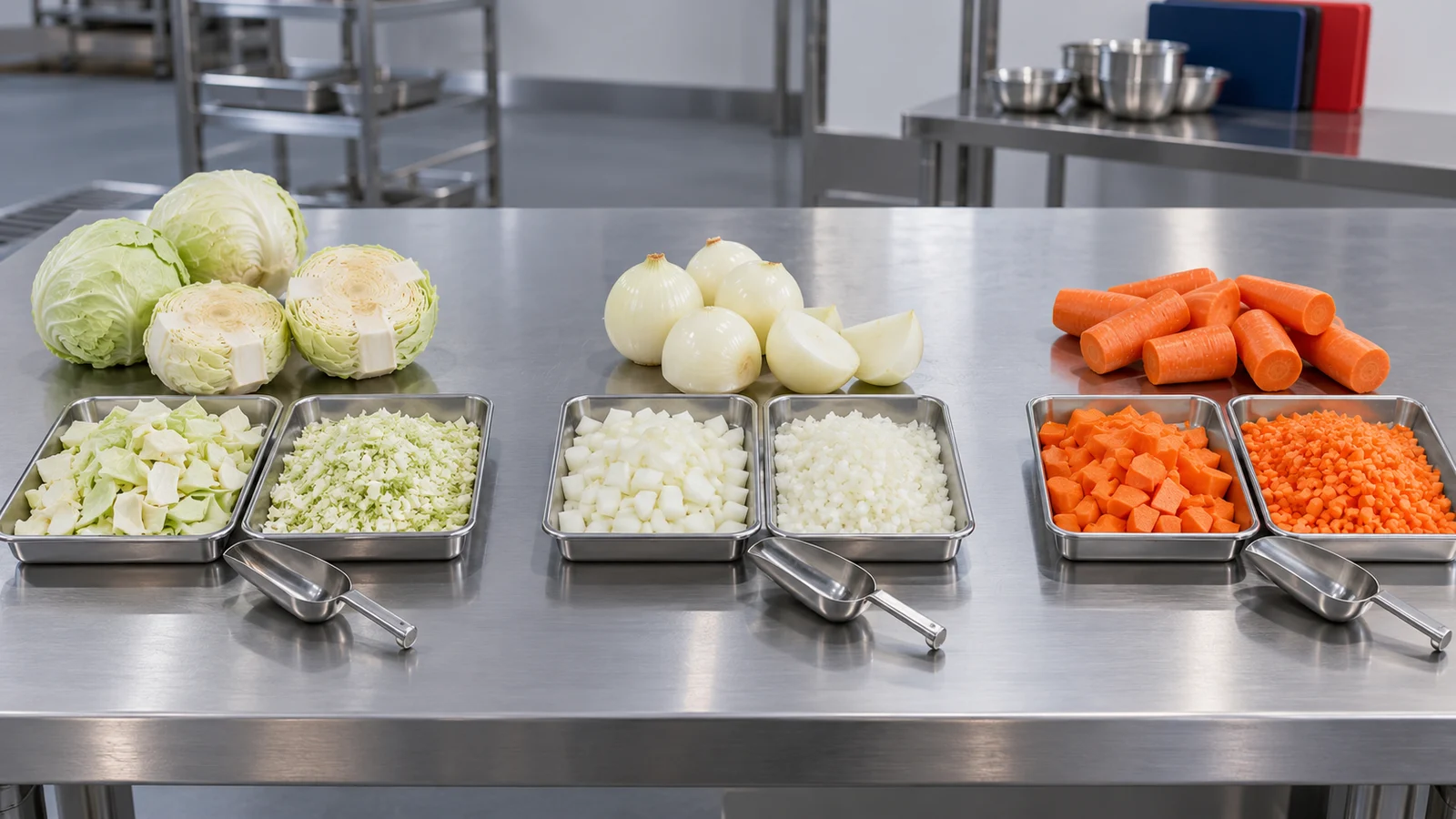
For this reason, the most useful sample you can send during feasibility review is often not a dimensional drawing. A photograph, physical reference sample or clearly documented texture from existing production can communicate the intended result more effectively. That reference becomes the basis for a controlled trial rather than leaving “fine,” “coarse” or “paste-like” open to interpretation.
How the TY-923 Feed-Through Chopping Architecture Should Be Evaluated
The TY-923 is documented for ingredients including garlic, ginger, potato, spinach, onion, peanuts and cabbage. Its stated process role is producing finely cut or paste-like produce for bun filling and related food preparation. The machine is built in SUS304 and includes a built-in frequency converter so the operating setting can be adjusted according to the ingredient while working toward different fineness.
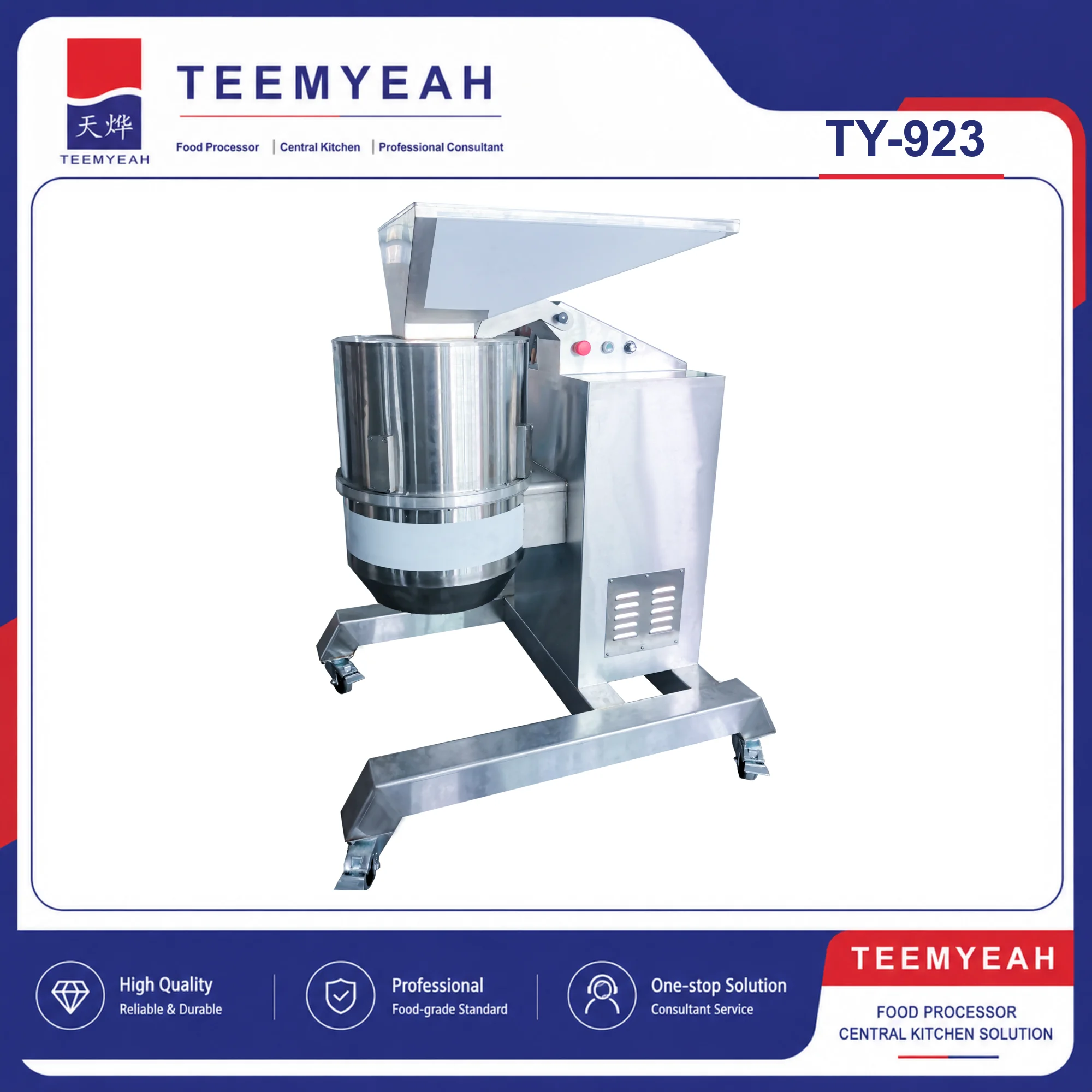
The useful way to interpret the industrial vegetable chopper working principle here is through the effect that must be tested. Prepared material enters from the top, passes through an adjustable multi-blade chopping chamber and is discharged below. As vegetable pieces encounter cutting action repeatedly, larger structures can be reduced toward progressively finer fragments. Depending on the ingredient, feed condition and selected setting, the material may move from relatively coarse chopped pieces toward much finer or paste-like output.
The setting alone does not define the result. Cabbage leaves, onion tissue and a firm carrot sample do not enter the cutting zone with the same structure, hardness, moisture distribution or initial geometry. Their number and character of blade contacts can therefore produce different output patterns even when a project team begins from the same nominal machine setting.
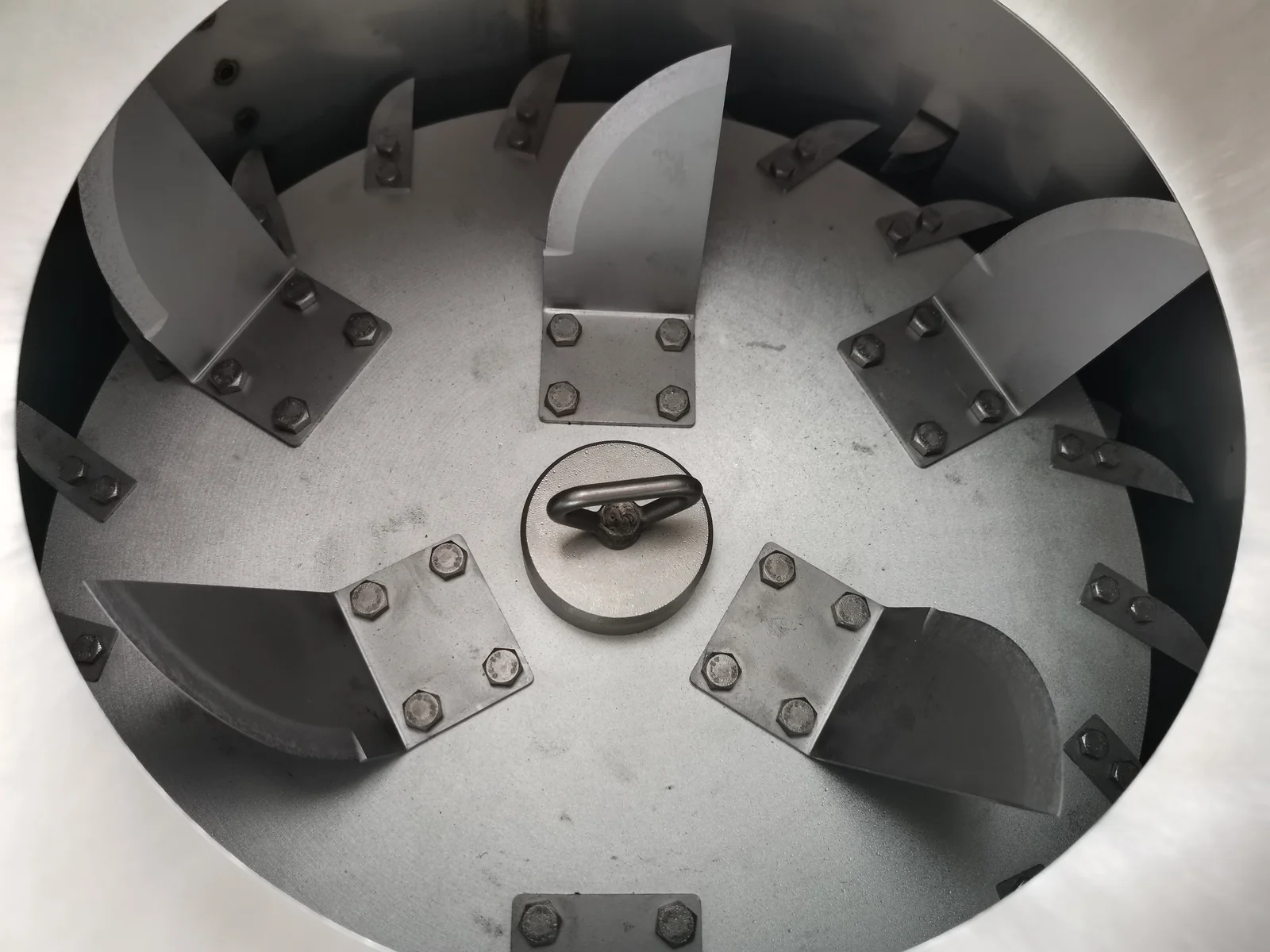
TEEMYEAH also has a 79.644-second working video showing manual top-hopper feeding and ongoing discharge while chopping parsley and round cabbage. It is useful for understanding the physical feeding and discharge concept and visibly confirms chopped output for those materials. A technical acceptance trial should add what a normal demonstration video does not capture: controlled input mass, prepared state, setting, sampling method, texture reference, oversize and fines observations, visible free liquid and downstream filling acceptance.
The TY-923 catalogue lists 500–1,000 kg/h. During feasibility work, use that range as an initial sizing reference and verify the meaningful project figure with the intended ingredient and accepted texture. The useful capacity number is the rate at which acceptable filling material is produced under the agreed trial condition, not simply the mass that can pass through the machine.
Why Adjustable Chopping Does Not Mean One Setting Fits Every Vegetable
Adjustable speed gives the project team an important trial variable, but it should not be interpreted as a universal recipe for every ingredient. The machine setting interacts with prepared piece size, feed consistency and the physical structure of the vegetable.
Consider three materials that frequently appear in a dumpling-filling discussion: cabbage, onion and carrot. Cabbage and onion are documented TY-923 application examples. Carrot should be treated as a representative trial input requiring confirmation for the proposed project condition.
Cabbage: Separate Leaf Preparation From Core Preparation
Round cabbage is structurally uneven. Thin leaf regions, thick ribs and the central core do not behave as one homogeneous feedstock. If whole or poorly prepared cabbage enters a trial, the test may end up measuring inconsistent preparation rather than the chopper configuration itself.
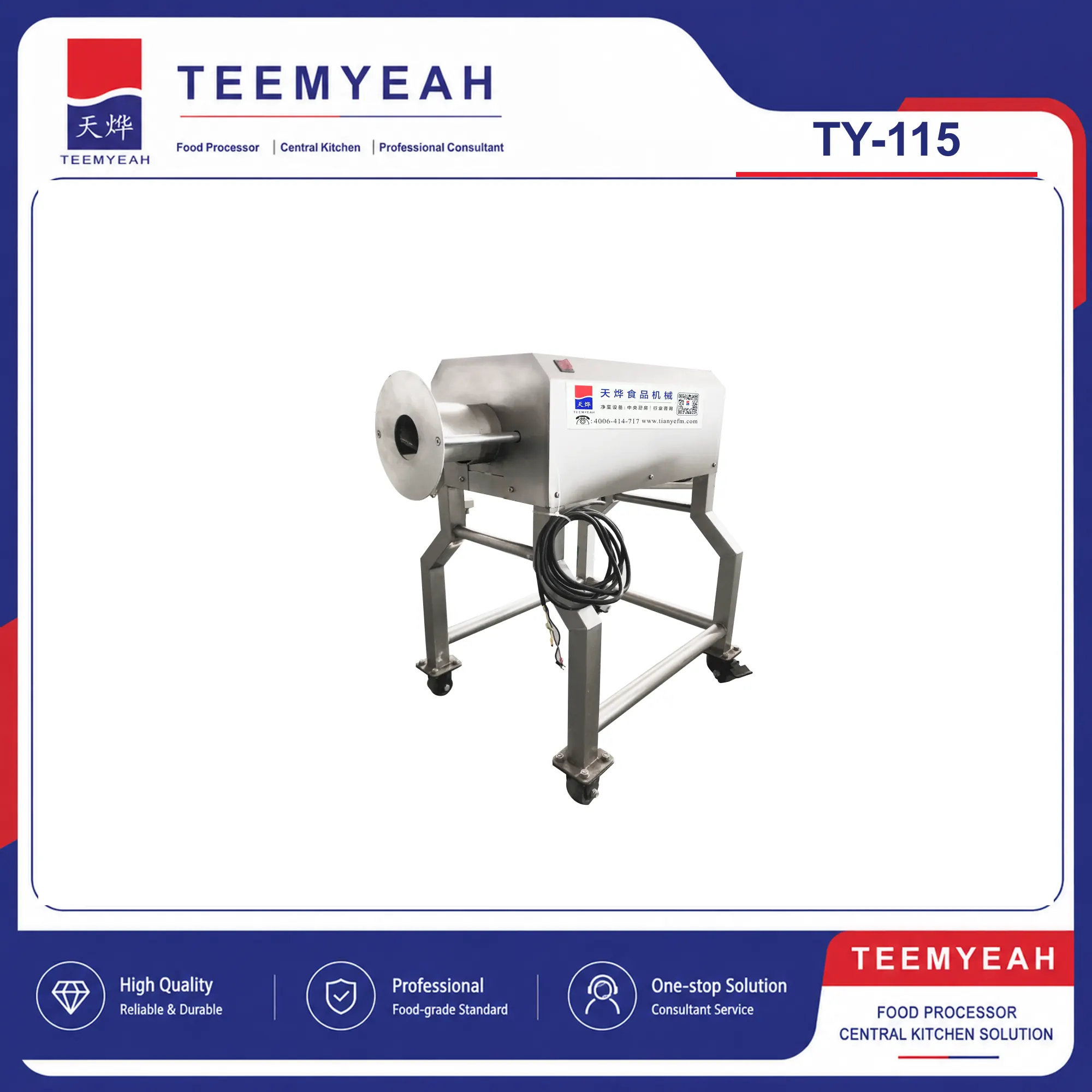
A more useful trial defines whether the core is removed, how the head is divided before feeding and what variation in leaf and rib structure remains. If a project requires a separate coring step, the TY-115 cabbage coring machine is one preparation option TEEMYEAH can review. It uses manual loading with automatic centering and coring for Chinese cabbage, round cabbage and baby Chinese cabbage, with a catalogue rate of 10–15 heads per minute. The relevant project question is whether that preparation state gives the filling chopper a more consistent input.
Onion: Define the State That Actually Reaches Chopping
“Onion” is not a sufficient trial description. The team should record whether the sample is peeled, trimmed, halved, quartered or otherwise pre-cut and whether the process sends a relatively consistent bulb size into the chopper. Those choices change the initial geometry entering the cutting chamber.
For filling applications, visible free liquid can also become an acceptance observation. The correct question is not whether a machine universally prevents liquid release. It is whether the selected preparation and chopping condition creates an onion texture that remains acceptable to the buyer’s downstream filling process.
Carrot: Use It as a Deliberate Validation Input
Carrot is valuable in a trial matrix precisely because it raises different technical questions. Its harder structure and incoming diameter may challenge the same configuration differently from cabbage or onion. Record peel status, trim condition and pre-feed piece size, then trial it against its own target texture.
Do not force all three ingredients into one acceptance sentence such as “fine enough for dumplings.” A configuration can only be considered a strong candidate for a mixed-ingredient project after each material has passed its own row of acceptance criteria.
TY-923 Versus TW-103B: Two Architectures, Two Sets of Trial Questions
Some factories need continuous or semi-continuous preparation of substantial ingredient volumes. Others need smaller batches, frequent recipe changes or a compact station for lower-volume ingredients. Comparing TY-923 and TW-103B at feasibility stage is therefore less about declaring one machine universally better and more about identifying which operating architecture fits the ingredient matrix.
TY-923: Feed-Through, Adjustable Multi-Blade Chopping
With TY-923, the project team should investigate how prepared material behaves when fed through the top hopper, repeatedly cut in the chopping chamber and discharged continuously below. Key questions include whether feeding remains consistent, whether the chosen setting produces the required texture across the ingredient variation, and whether discharged material can be sampled consistently enough for process acceptance.
Its replaceable cutting-tool parts and compatibility with a lifting feeder also matter when the project moves beyond an isolated sample test. At the current validation stage, however, the immediate decision is whether the architecture can produce acceptable material from representative inputs.
TW-103B: Compact Bowl-and-Knife Operating Sequence
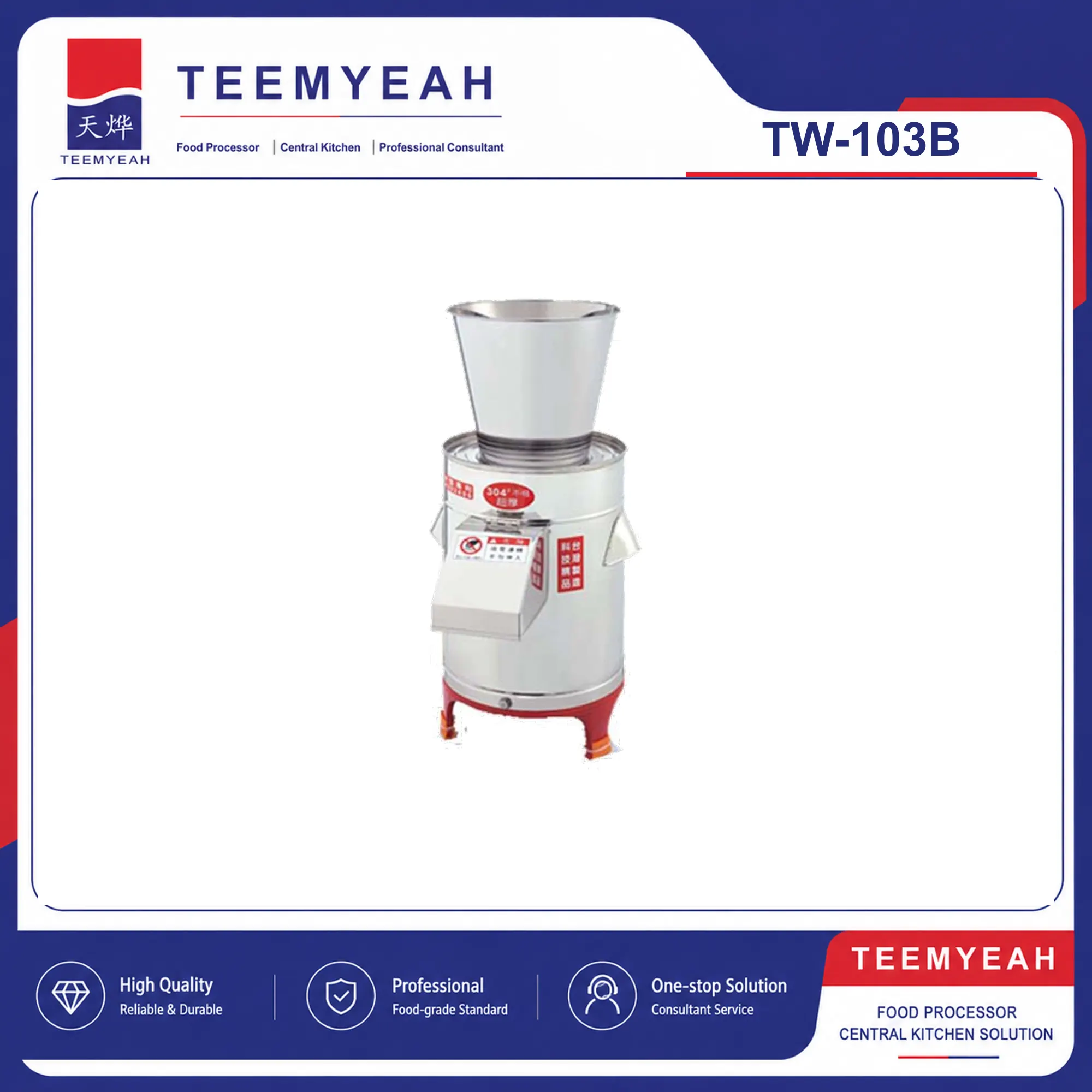
The TW-103B compact filling chopper is documented for cabbage, scallion, melon, radish, bamboo shoot and lotus root. It is a compact 220 V single-phase machine, with a product sheet listing 0.25 kW power and 20 kg machine weight.
Its operating manual describes a bowl-and-knife sequence: the chopping knife is started before the bowl, and the knife has high and low operation. That creates a different trial framework from a feed-through chamber. A project engineer should ask how batch loading, knife setting, bowl operation and stop point affect the desired texture, particularly when individual ingredients are prepared in smaller quantities.
The manual also specifies isolating power during tool handling and cleaning. The machine is IPX1, so sanitation planning should use an appropriate cleaning procedure rather than spray-jet washing the unit.
For U.S. facility reviews, 21 CFR 117.40 is a useful design reference for equipment and utensils that are adequately cleanable. Apply the requirements relevant to the project’s facility, product and sanitation program when the trial configuration moves into purchasing review.
The Comparison the Project Actually Needs
If one ingredient is produced in substantial quantity while several secondary ingredients are made in small batches, the answer may not be “one machine for everything.” A useful representative trial can reveal whether a single architecture covers the full matrix acceptably or whether high-volume feed-through chopping and compact batch preparation should remain separate process roles.
This is also why direct catalogue capacity comparison is insufficient. One architecture may fit continuous feeding more naturally, while another may fit smaller controlled batches. The relevant decision combines texture acceptance, feeding pattern, changeover, cleanout and the factory’s ingredient schedule.
Surface Drainage Before Chopping Is a Different Process Question From Filling Moisture Adjustment
Vegetables often arrive at the chopping stage after washing, so buyers frequently ask about water. That discussion becomes more useful when two different process tasks are separated.
Surface drainage before chopping concerns water physically carried into the chopper after washing. The buyer may need the washed ingredient to drain for a defined period or pass through a separate surface-water-control step so the chopping trial begins with a repeatable input condition.
Moisture adjustment after chopping is a different process question. Some recipes may use pressing, formulation changes, mixing procedures or other downstream controls to manage filling moisture. Those actions should not be silently combined with the chopper trial because they can mask whether the cutting condition itself is producing an acceptable texture.
For a cabbage trial, for example, record whether the prepared leaves arrive visibly wet, drained or at another specified condition. After chopping, record visible free liquid separately from texture. The project team can then decide whether the cutting configuration passes and whether a separate downstream recipe or moisture-management operation still needs evaluation.
If the project also includes washing, TEEMYEAH can review the chopper as one module within a broader preparation flow. The TW-606-3 washer, for example, is documented as a first washing stage in a clean-vegetable line using water jets, bubbles, conveying and external-circulation debris removal. Its catalogue range of 800–2,000 kg/h should be balanced against the actual ingredient condition and accepted output requirements of the downstream modules rather than assumed to define complete-line capacity.
Build the Trial Around Representative Input, Not a Convenient Sample
A short demonstration can confirm that a vegetable can physically be chopped. A procurement-grade trial needs to answer a harder question: can the proposed configuration repeatedly create material that the buyer would actually release to the next production step?
The trial record should therefore preserve enough detail for engineering, production and purchasing teams to compare results without relying on memory. At minimum, capture the following information for every ingredient condition:
- Ingredient and variety: identify the actual vegetable, grade or commercially relevant variety.
- Prepared input condition: washed, drained, peeled, cored, trimmed or otherwise prepared.
- Core, peel and trim status: document exactly what has been removed before chopping.
- Piece size before feed: record whole, halved, quartered or other approximate preparation geometry.
- Input mass: use a controlled trial quantity so settings can be compared meaningfully.
- Machine setting: record the selected adjustable condition or high/low mode as applicable.
- Feed method: note whether material is manually fed, batch loaded or introduced through another planned method.
- Sample point and time: define where and when output samples are taken.
- Accepted texture reference: compare against an approved photo, physical sample or existing-production reference.
- Oversize and fines: record whether visibly unacceptable large pieces or excessive fine material appear.
- Visible free liquid: observe separately from particle texture.
- Product temperature: record it when temperature is controlled by the buyer’s recipe or production system.
- Cleanout and changeover time: measure this when multiple ingredients must share the station.
- Downstream acceptance: confirm whether the chopped material behaves correctly in the buyer’s actual mixing, depositing, filling or forming check.
Where throughput also affects feasibility, use the same representative condition for capacity verification. TEEMYEAH’s guide to food processing equipment capacity verification explains why accepted output, feeding condition and process assumptions should be recorded together. For a wider project intake, the food processing line requirements checklist can help organize upstream and downstream information before equipment configuration is fixed.
Vegetable Filling Chopper Trial Input and Acceptance Matrix
The table below can be used directly during an RFQ review or representative trial meeting. Numerical acceptance limits should come from the buyer’s actual recipe and downstream process rather than being invented before samples are available.
| Ingredient | Incoming Preparation | Target Texture Reference | Trial Variable | Measurement / Observation | Acceptance Decision | Next Action |
|---|---|---|---|---|---|---|
| Cabbage | Record variety; washed/drained state; core removed or retained; head division; approximate pre-feed piece size; leaf/rib condition. | Approved filling sample, production sample or clearly photographed coarse/fine texture required after chopping. | Preparation state, feed consistency and adjustable chopping setting. | Compare texture with reference; observe oversize leaf/rib pieces, excessive fines, visible free liquid and consistency across sampled output; record accepted output rate if capacity is part of the trial. | Pass only when the chopped cabbage matches the agreed filling texture and passes the downstream filling/mixing check under the recorded condition. | Keep the successful setting/preparation as a candidate recipe, retest another condition, or review upstream coring/preparation if input inconsistency is driving the result. |
| Onion | Record onion type and approximate size; peeled/trimmed state; whole, halved, quartered or other pre-cut condition; drainage condition if washed. | Approved chopped-onion texture from the buyer’s filling formulation or representative sample/photo. | Incoming geometry, feed method and adjustable chopping setting. | Observe coarse pieces, excessive fines, texture uniformity, visible free liquid and behaviour when incorporated into the intended downstream filling process. | Accept when the trial output matches the agreed onion texture and downstream process requirement rather than applying the cabbage rule to onion. | Retain the candidate condition, adjust preparation or setting, or maintain onion as a separate recipe/configuration if the shared condition is unsuitable. |
| Carrot — representative trial required | Record variety where relevant; peel and trim condition; diameter range; whole or pre-cut condition; approximate feed-piece size. | Buyer-provided filling sample, approved photo or existing-production texture. Do not assume the cabbage/onion target applies. | Pre-feed size, hardness-related material variation, feed behaviour and proposed machine setting. | Observe whether the candidate machine processes the representative carrot successfully; compare target texture, oversize pieces, fines, consistency and downstream filling acceptance. Record trial output rate where required. | Accept only if the representative carrot condition reaches the buyer’s own texture and downstream criteria. | Proceed with the candidate configuration if successful, repeat with additional carrot sizes/conditions where necessary, or evaluate a different preparation route if the required result is not reached. |
How to Decide Whether One Configuration Covers the Ingredient Matrix
Once individual trial rows are complete, the project team can evaluate the configuration as a system rather than as a collection of isolated successful samples.
A single configuration is a strong candidate when the planned ingredients can each reach their own approved texture using controllable preparation and settings, while feeding, cleaning and changeover remain practical for the production schedule. The settings do not need to be identical. What matters is whether the operator can move between validated conditions in a repeatable way.
By contrast, a machine that performs well on cabbage but requires impractical preparation or changeover for every low-volume secondary ingredient may not be the most efficient architecture for the entire matrix. That is where a combination of feed-through and compact preparation routes can remain technically valid.
Three questions are especially useful before closing the feasibility stage:
- Does every critical ingredient have an accepted trial condition? A successful cabbage demonstration cannot substitute for onion, carrot or another materially different input.
- Can production move between those conditions practically? Review ingredient sequence, cleanout, setting changes, batch size and how material is fed.
- Does the output pass the process that follows chopping? The final technical acceptance should connect texture observations with the buyer’s actual mixing and filling behaviour.
Answering these questions before final equipment configuration is more useful than choosing purely from nominal capacity. It allows the project team to decide whether the TY-923 fruit and vegetable filling chopper should move forward, whether the compact TW-103B architecture should be tested, or whether different ingredients need separate preparation routes.
Procurement FAQs for Filling-Chopper Technical Validation
1. Should we send only our most difficult ingredient for the first trial?
Send the ingredients that represent different processing behaviours, not merely the hardest one. If the project uses cabbage, onion and carrot, treat them as separate rows because their structures and preparation requirements differ. Include the ingredient that dominates production volume as well as any material that could force a different preparation or chopping route.
2. Can we use the TY-923 catalogue capacity directly in our line balance?
The 500–1,000 kg/h catalogue range is useful for preliminary sizing. For line balancing, verify the rate achieved with your representative ingredient, prepared input and accepted texture. Record accepted output rather than relying only on material feed rate. If different ingredients have materially different trial rates, the production mix should be considered when sizing the surrounding modules.
3. How should we specify a filling texture if we do not have a particle-size standard?
Use the best production reference available: a retained filling sample, chopped vegetable sample, high-resolution close-up photographs beside a scale reference, or material from the existing process. During the trial, define what constitutes unacceptable oversize material and excessive fines. This gives both teams a visual and process-based acceptance target without inventing a particle-size distribution that the factory does not currently use.
4. Can one TY-923 setting be accepted for cabbage, onion and carrot?
Only a representative trial can establish whether the same condition happens to work for several ingredients. Do not make identical settings an objective by themselves. A more practical result may be separate validated settings for each material, provided changeover between those conditions is manageable and each output passes its own downstream acceptance check.
5. Should washed vegetables be tested immediately after the washer?
Test the condition that production intends to send to chopping. If the real process includes a drainage period or surface-water-control step, reproduce that condition during the trial and record it. This keeps carried wash water from becoming an uncontrolled variable. Downstream pressing or recipe moisture adjustment, where required by the buyer’s formulation, should be evaluated as a separate operation.
6. When would it make sense to trial both TY-923 and TW-103B?
Testing both architectures can be useful when the production matrix combines different operating patterns. For example, one group of ingredients may require higher-volume feed-through preparation while another is produced in small batches with frequent recipe changes. The trial should compare texture acceptance, practical feeding, changeover and cleanout requirements rather than trying to establish direct performance equivalence between two different mechanisms.
7. What should we record if downstream filling equipment is not available during the chopper trial?
Record the chopped sample comprehensively and retain the acceptance reference where practical. Document ingredient condition, machine setting, sample point, texture, oversize, fines and visible free liquid, then take representative material into a later mixing or forming check. Avoid closing the final texture decision solely from visual appearance if downstream behaviour is an important production criterion.
8. How do we know when the chopper trial is detailed enough to select the next project configuration?
The trial has served its feasibility purpose when each critical ingredient has a reproducible candidate condition, the accepted texture is defined, downstream suitability has been checked or clearly scheduled for validation, and the team understands whether one operating architecture can practically cover the ingredient schedule. At that point, capacity, upstream preparation and surrounding modules can be configured around actual trial conditions rather than assumptions.
Send Your Filling Ingredient List and Target Texture Samples
To review whether a filling-chopper architecture should enter your representative trial, send TEEMYEAH the ingredient list together with photos of the incoming vegetables and their preparation state. For each important ingredient, include a target chopped-texture sample or close-up photo, expected batch or hourly requirement, and any acceptance requirement from downstream mixing, depositing, filling or forming.
Please also provide the available electrical supply, approximate processing-area layout and any relevant upstream preparation steps such as washing, drainage, peeling, trimming or cabbage coring. These inputs make it possible to review the actual ingredient matrix rather than selecting equipment from a single nominal capacity figure.
TEEMYEAH can use this information to assess whether the TY-923 fruit and vegetable filling chopper, the TW-103B compact filling chopper or a different preparation route should enter the representative trial. If the project also requires washing, coring, conveying or other coordinated preparation modules, the discussion can be expanded through TEEMYEAH’s custom food pre-processing line project route while keeping the filling-texture acceptance criteria defined at machine level.