







Summary: Select Herb Washing and Dewatering Equipment by Dryer Handoff
Select herb washing and dewatering equipment by working backward from the condition required at the hot-air dryer inlet. For moringa and other delicate herbs, the practical decision is whether washing followed by vibratory drainage provides a sufficiently even feed, or whether a batch or automatic centrifugal stage is also needed to control retained surface water.
The specification should define the incoming herb, allowable free water, clump condition, feed depth, transfer method and production rhythm. Catalog capacity is useful for preliminary equipment selection, but accepted herb output and dryer-feed stability must be demonstrated with representative material. Thermal-drying settings and final moisture remain separate validation points agreed with the dryer owner.
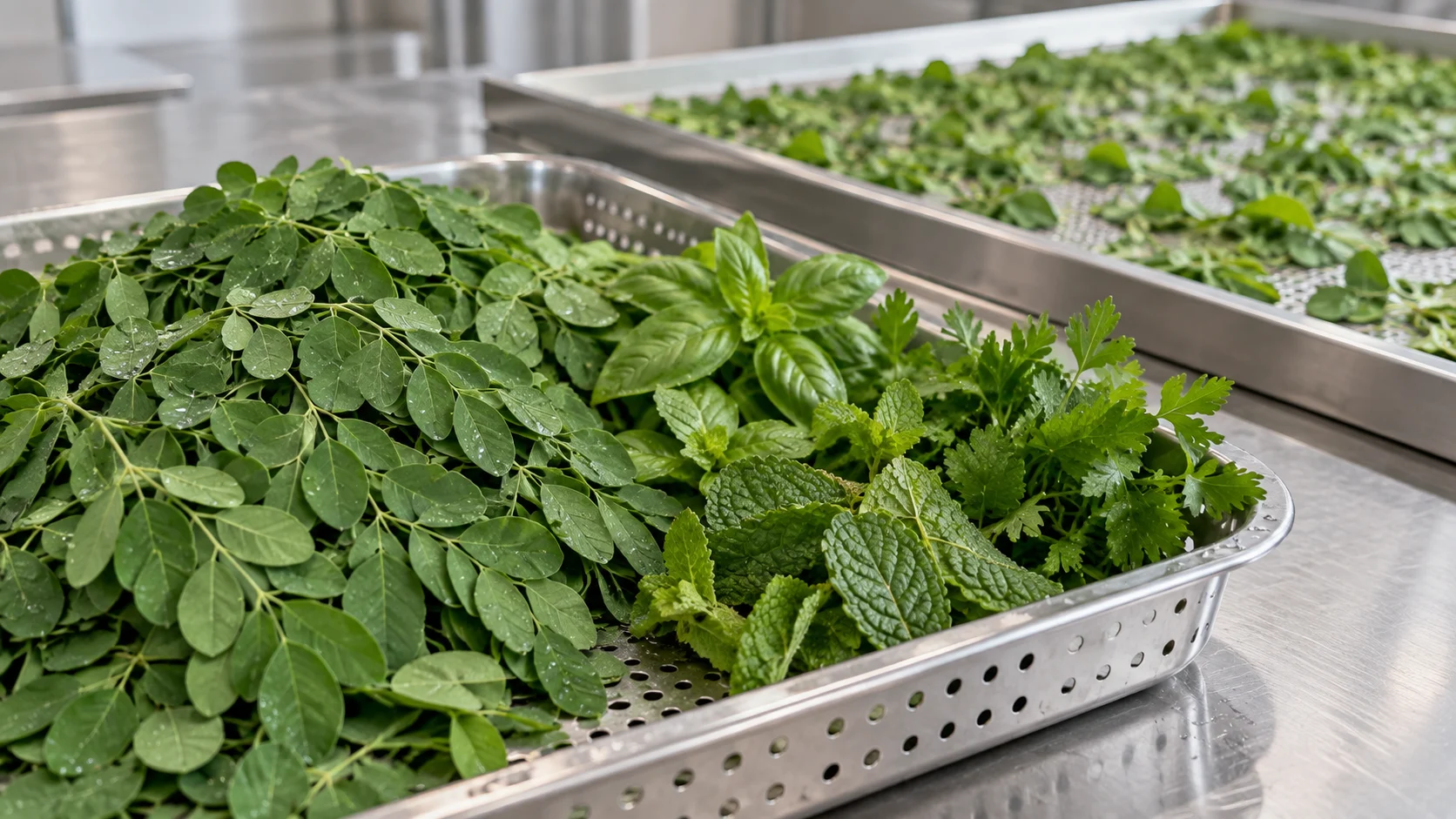
Begin With the Dryer-Feed Condition, Not a Machine List
A washing line and a hot-air dryer interact through the product delivered between them. If that intermediate condition is poorly defined, the buyer can purchase capable machines and still experience irregular loading, water pooling, clumped leaves, long waiting periods or unstable labor demand.
The right selection question is therefore specific: what combination of washing, drainage, spreading, buffering and optional centrifugal surface-water removal will deliver the required herb to the dryer at the planned rate and in a repeatable physical condition?
For one project, gentle washing followed by vibratory drainage may provide an acceptable feed. Another project may need batch centrifugation because production changes frequently between species and recipes. A higher-volume line may require controlled buffering and automatic centrifugal handling to keep a continuous dryer inlet supplied. None of these architectures should be selected solely because one machine has a higher catalog kg/h figure.
This distinction is particularly important for moringa. Detached moringa leaves, young leaflets, mature leaves and partially stemmed sprigs can behave very differently in water, on screens and during mechanical dewatering. The same applies to basil, mint, parsley, coriander, medicinal leaves and other botanical materials. Their geometry, fragility, surface structure and incoming condition determine how the equipment must be configured.
Define the Incoming Herb Before Specifying the Wash Section
“Fresh herbs” is not a sufficient equipment specification. Procurement teams should convert that broad description into a material profile that engineering and trial personnel can reproduce.
Species and commercial form
Identify every species expected during the initial production phase and indicate whether it arrives as whole branches, whole sprigs, trimmed bunches, detached leaves or a mixture. A line intended for detached moringa leaves faces a different retention problem from one receiving stems with leaves attached. Parsley bunches create a different bed structure from loose basil leaves, while fine botanical leaves may challenge openings that retain larger leafy vegetables successfully.
If several species will share the line, distinguish the principal sizing product from occasional products. The product with the highest annual volume is not automatically the most demanding one. A low-volume herb with small leaves, weak petioles or strong clumping behavior may govern screen selection, wash intensity or dewatering recipe.
Stems-on or stems-off condition
State where stem removal occurs and what level of stem remains acceptable. Long stems can entangle, bridge across transfers or bind leaves into wet bundles. Fully detached leaves may drain more evenly, but small leaflets and fragments can pass through unsuitable screens. If trimming is manual, record the expected consistency between operators and shifts.
Leaf dimensions, maturity and strength
Provide a realistic size distribution rather than one typical dimension. Young leaves may be smaller and more delicate; mature leaves may have stronger veins, larger areas or different surface behavior. Include photos with a scale, representative minimum and maximum dimensions, and the proportion of small fragments normally present.
Mechanical strength also matters. The line must remove soil and foreign material without turning acceptable leaves into fragments. This balance cannot be inferred reliably from a photograph or species name. Representative washing and dewatering trials are used to set water movement, residence behavior, vibration and centrifugal operation.
Temperature and time since harvest
Record typical receiving temperature, the expected range and the delay between harvest and processing. These conditions may change flexibility, surface moisture and resistance to handling. If the plant receives herbs during both cool and hot periods, samples should represent the commercially relevant variation rather than only the easiest batch.
Debris and normal variability
Describe the actual foreign-material load: loose soil, sand, stones, insects, field residues, damaged leaves, weeds, ties or packaging fragments. Quantify it where practical and explain seasonal differences. Washing equipment can support separation, but the line still needs an agreed incoming limit. Otherwise, a trial conducted with unusually clean hand-selected material will not represent routine production.
| Input | Information to record | Why it affects selection |
|---|---|---|
| Species | Primary and secondary herbs or botanical leaves | Changes buoyancy, fragility, clumping and screen-retention behavior |
| Preparation state | Sprigs, detached leaves, bunches, stems-on/off and fragment content | Influences washing movement, entanglement and transfer losses |
| Size distribution | Photos with scale, minimum, typical and maximum leaf dimensions | Supports screen, opening and transfer-point review |
| Receiving condition | Temperature, harvest delay, visible moisture and compaction | Affects handling response and trial representativeness |
| Foreign material | Types, typical load and seasonal variation | Defines sorting, washing and separation duties |
Translate the Dryer Inlet Into a Measurable Handoff Specification
The dryer interface is more than a flange dimension or conveyor height. It includes the product state, the delivery rhythm and the time allowed between washing and thermal drying.
Free surface water
“Well drained” is subjective. Create a repeatable plant measurement for free water. One practical method is to collect a defined sample mass after a defined settling period in a standard perforated container, then measure the water released under the same handling procedure. Another method may use a controlled drip period followed by weighing. The project team should select one procedure, document it and use it consistently during trials and acceptance.
This measurement concerns loose or readily released surface water. It is not the final moisture content of dried herb, and it is not a substitute for the dryer owner’s thermal process validation.
Clumps and feed distribution
Leaves that exit a washer as dense wet clumps can create an uneven dryer bed even when their average mass flow appears correct. Define how clumps will be classified: maximum acceptable cluster dimensions, mass, frequency or a visual category supported by reference photos.
The dryer owner should also state the required bed depth or spreading condition. If the inlet uses trays, define the target mass per tray and loading method. If it uses a belt, confirm effective belt width, permissible loading depth and how the feed will be spread across that width. “Even feed” becomes useful only when operators can recognize and record it.
Batch or continuous rhythm
A batch dryer may need weighed portions delivered at scheduled intervals. A continuous dryer usually requires steadier delivery and may be less tolerant of long gaps followed by surges. The washing and dewatering system should follow that rhythm rather than produce material that accumulates unpredictably in carts or bins.
Document the dryer’s nominal loading window, inlet dimensions, batch interval or continuous demand, upstream start-up sequence and planned shutdown sequence. Include the response to short interruptions. A suitable buffer can decouple the wash section from the dryer, but excessive holding can allow compaction, continued dripping and loss of feed uniformity.
Buffer and allowable holding time
Specify the maximum permitted time from completion of washing to entry into the dryer. Also define the approved holding container, fill depth and drainage arrangement. A deep, unventilated bin can recreate clumps and water pooling after an effective dewatering step. Buffer design must preserve the condition established upstream.
The practical boundary is clear: washing and surface-water control must be matched to the dryer inlet and operating rhythm. Dryer air temperature, air velocity, loading recipe, drying duration and final moisture are validated with the owner or supplier of the customer’s hot-air drying system. Research on cabinet drying likewise treats temperature and air velocity as downstream process variables, as illustrated by Alim, Islam, Akter and co-authors in their 2023 cabinet-drying study of moringa leaves.
A Staged Route From Receiving to Measured Dryer Feed
A robust project separates each duty so buyers can identify where losses, water variation or feed instability originate.
1. Sort, trim and decluster
Remove unacceptable leaves and non-product material before washing. Break compressed bunches into a form the washer can circulate without creating protected pockets. If leaves must be detached from stems, define whether that task occurs manually or through another process before the TEEMYEAH wash section.
2. Wash with controlled intensity and retention
The wash stage should wet, circulate and clean the herb while retaining commercially acceptable material. Water movement that works for robust leafy vegetables may be too aggressive for a delicate herb, while overly gentle operation may not separate the actual field debris. Sample trials establish the operating balance.

3. Add a rinse stage when the process requires it
A separate rinse may be appropriate when the plant’s wash-water program, product specification or operating procedure requires one. Water quality, replacement, monitoring and hygienic handling should form part of the processor’s food-safety plan. The Codex Code of Hygienic Practice for Fresh Fruits and Vegetables, CXC 53-2003, provides general context for wash-water management and hygienic handling. It does not establish a herb-specific equipment recipe.
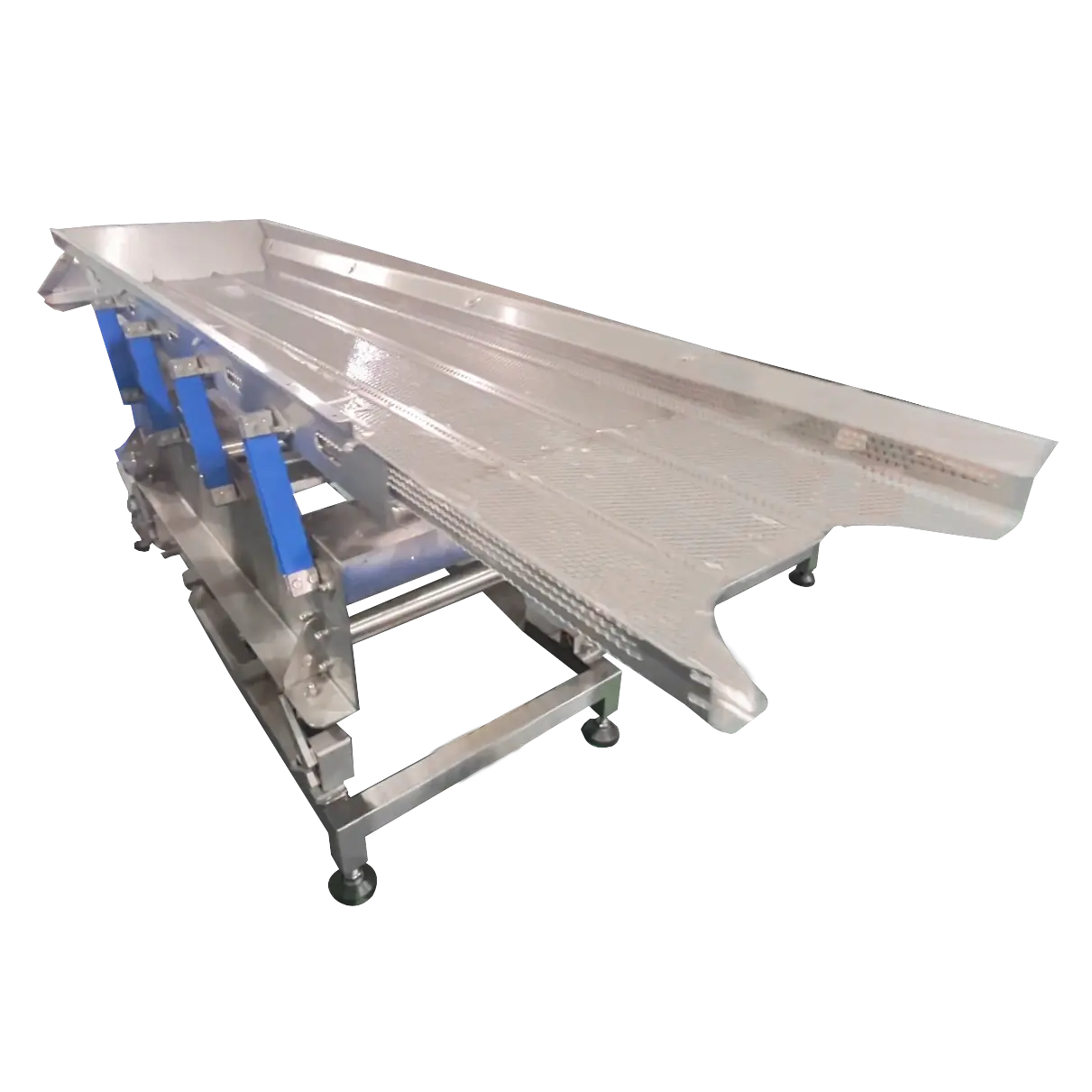
4. Use vibratory drainage to release loose water and spread the bed
Vibratory drainage gives water an escape path while moving and opening the product bed. It can reduce pooling, separate some loose clusters and create a more controlled transfer to inspection or the next dewatering stage. Its role is drainage and spreading—not thermal dehydration.
5. Add centrifugal surface-water removal when the handoff requires it
A centrifuge may remove more retained surface water than gravity and vibration alone, but it introduces additional decisions. Speed, operating time, load mass, fill distribution and acceleration behavior can affect dewatering consistency, leaf damage and clumping. Batch equipment also introduces loading, unloading and basket-handling labor. Automatic equipment requires controlled feeding, buffering, retention review and stable discharge.

6. Inspect before the dryer interface
Place an inspection point where operators can see excessive fragments, remaining foreign material, wet clumps and feed-distribution problems. The inspection method should use defined categories rather than an unrecorded visual judgment.
7. Measure and transfer the dryer feed
Record accepted mass and feed condition at the final handoff, not merely the mass introduced into the washer. The transfer conveyor, tray loader or container system should preserve drainage and distribution. This final point is where the upstream line’s performance becomes relevant to the dryer owner.
The small-scale postharvest sequence described in UC Davis SAREP’s A Guide to Drying Moringa also places washing and the handling of water before drying. An industrial project requires its own equipment trials and acceptance limits, but the sequence reinforces why free-water control should be resolved before dryer settings are evaluated.
Compare Three Practical Equipment Architectures
| Architecture | Best-fit operating situation | Main decisions | Trial focus |
|---|---|---|---|
| Wash + vibratory drainage only | The dryer or loading method can accept gravity-drained product, and the herb releases loose water readily without a centrifugal stage. | Washer intensity, screen retention, drainage area, vibration setting, spreading and direct transfer timing. | Free-water repeatability, clumps, fragments, screen losses and stability at the dryer feed point. |
| Wash + vibratory drainage + batch centrifuge | Multiple recipes, smaller production lots or manual batch handling make controlled recipe changes practical. | Batch load, basket fill, speed, time, loading labor, unloading method, number of baskets and synchronization with the dryer. | Full batch cycle, surface-water measurement, damaged leaves, batch-to-batch variation, labor and queue time. |
| Wash + controlled buffer + automatic centrifuge | A more continuous process requires automatic feeding and discharge with reduced manual basket handling. | Buffer residence, metering, feed consistency, internal retention, automatic discharge behavior and restart control. | Herb retention, leaf damage, clumping, screen losses, surge response and continuous dryer-feed stability. |
The simplest architecture that meets the documented dryer handoff is usually the clearest one to operate and accept. A centrifuge should be added because the measured feed condition requires it, not because centrifugal dewatering sounds more complete. Conversely, a drainage-only route should not be assumed adequate when pooled water or unstable clumps remain at the dryer inlet.
Match Candidate TEEMYEAH Models to Specific Roles
The following models provide a starting point for preliminary engineering. Their catalog references describe equipment scale or documented applications; they are not proof of accepted output for moringa or another herb.
| Model | Documented role or reference | Herb-project decision |
|---|---|---|
| TW-705 | Supports soaking, water-flow rinsing, tumbling or bubble washing and foreign-material separation for leafy products. | Set wash intensity and product retention through sample trials using the actual stem and leaf condition. |
| TYN-1200 | Vibratory surface-water removal after washing; current catalog reference is 400 kg/h. | Use the figure for preliminary selection only. Measure retained accepted output, fragments, clumps and free-water condition with the project herb. |
| TYN-1400 | Higher-output vibratory drainage and spreading; current documentation lists 800–1,200 kg/h for leafy vegetables. | Verify herb retention, screen behavior, spreading, fragments, clumps and accepted output under the intended feed condition. |
| TW-980B1 | 70 L removable-basket batch centrifugal dewaterer with adjustable speed and operating time. | Suitable for evaluation where manual batch handling and recipe flexibility fit the project. Test load distribution, full cycle, handling labor and the exact herb recipe. |
| TY-980C | Another adjustable batch centrifugal route with project-specific leafy-load references. | Develop the herb load and operating recipe through testing rather than treating prior leafy-product loads as universal results. |
| TW-980LB | Automatic feeding, buffering, centrifugal dewatering and discharge architecture documented for lettuce, cabbage and shredded potato. | Treat herbs as a representative-trial application. Evaluate screen retention, leaf damage, clumping, internal transfer and discharge condition. |
| TW-980S | Compact small-batch reference with catalog figures of 6 kg per cycle and 2 minutes per cycle. | Confirm whether its scale and manual rhythm fit the project, then establish herb-specific loading and results by trial. |
Model selection should also account for available floor space, cleaning access, basket movement, inspection position, operator reach, electrical supply, water management and the height and direction of the dryer interface. A nominally suitable machine can create unnecessary handling if its discharge does not align with the customer’s trays, belt or feed containers.
Build a Representative Trial and Acceptance Plan
A useful trial reproduces the commercial material and operating sequence closely enough to support a purchasing decision. It should compare complete routes, not only show that leaves can pass through an individual machine.
Prepare representative samples
Include the normal mixture of leaf sizes, stems, fragments, incoming moisture and field debris. Where seasonal variability is important, use more than one defined material condition. Record the sample source, harvest or storage history, receiving temperature, preparation state and mass before processing.
Fix the route and operating settings
Document the sort and trimming method, washer settings, wash time or feed rate, rinse arrangement, drainage settings, transfer delays and any centrifugal recipe. For batch centrifuges, record loading start, operating period, deceleration, unloading and preparation for the next load. For an automatic route, record buffer level, metering behavior, interruptions and restart.
Measure retained and rejected material
Collect material retained on screens, found in tanks, left at transfer points or rejected during inspection. Separate acceptable recovered leaves from damaged leaves, undersized fragments, stems and foreign matter. The categories should be defined before testing so different observers classify material consistently.
Use a repeatable free-water test
Select one sampling mass, container, settling or drip period and weighing procedure. Take samples at the same process point and under the same timing conditions. The goal is not to claim a universal moisture value; it is to compare routes and runs using a stable method that represents the project’s dryer handoff.
Record clumps and visible damage
Create reference photographs or physical definitions for acceptable, review and reject categories. Count or weigh the affected material where practical. Damage assessment should distinguish pre-existing defects from damage associated with washing, drainage, centrifugation or transfer.
Calculate gross and net accepted output separately
Gross flow may include stems, fragments, excess free water and material that later fails inspection. Net accepted output is the mass reaching the agreed dryer-feed point within the acceptance categories. Record operating time, planned pauses, unplanned stops, cleaning and manual intervention so the reported result can be interpreted correctly.
| Record | Measurement point | Buyer value |
|---|---|---|
| Incoming mass and condition | Before sorting or washing | Confirms whether the trial material represents normal production |
| Screen and transfer losses | Washer, drainage equipment, centrifuge and conveyors | Shows where acceptable leaves or fragments are being lost |
| Damaged leaves | Before processing and at final inspection | Separates incoming defects from process-related change |
| Clump classification | At drainage discharge and dryer handoff | Evaluates whether the route creates an even feed |
| Repeatable free-water result | At the defined dryer-feed sampling point | Supports route and recipe comparison |
| Gross and net accepted output | Line entry and accepted handoff | Prevents raw throughput from being confused with usable dryer feed |
| Labor and intervention | Throughout the complete route | Reveals basket handling, declustering, inspection and restart requirements |
| Full batch cycle | Loading through readiness for the next batch | Allows realistic synchronization with a batch dryer |
| Cleaning and restart | At planned product change or stoppage | Tests access, retained material and recovery to stable operation |
| Dryer-feed stability | Across the agreed operating window | Shows whether delivery remains even rather than averaging out surges |
Why Catalog kg/h Is Not Accepted Herb Output
A catalog capacity figure usually provides an initial indication of equipment scale. It does not define the incoming material, acceptable product, operating recipe, cleaning time, screen loss, manual intervention or downstream feed condition for a specific herb project.
For example, the documented leafy-vegetable range for a vibratory drainage model cannot automatically be converted into accepted moringa kg/h. Small leaves may require different retention arrangements. Wet clumps may limit spreading. A higher feed rate may increase carryover or reduce the consistency of free-water removal. The final accepted rate is therefore established at the agreed handoff point under the project’s material and acceptance conditions.
Centrifugal equipment creates another distinction between machine cycle time and line output. A batch calculation must include loading, load distribution, operating time, deceleration, unloading, inspection, basket return and any waiting for the dryer. An automatic centrifuge must be evaluated across feeding, buffering, internal handling and discharge—not only the nominal action of its dewatering chamber.
Dryer productivity also depends on downstream variables beyond the upstream equipment scope. Bed depth, loading uniformity, temperature, air movement, drying recipe and final-moisture criterion belong to dryer validation. A successful upstream trial can demonstrate a stable, defined inlet condition. It cannot, by itself, prove finished dryer productivity.
Separate Surface-Water Removal From Thermal Drying in the Purchase Specification
Clear scope language prevents two different moisture-control duties from being combined into one vague promise.
| Upstream washing and surface-water-control specification | Customer or third-party dryer validation |
|---|---|
| Incoming species, preparation state and variability | Dryer loading recipe and acceptable incoming range |
| Wash route, retention and foreign-material separation criteria | Air temperature, air velocity and thermal process settings |
| Drainage, clump and repeatable free-water categories | Drying duration and thermal cycle behavior |
| Accepted feed mass, rhythm, dimensions and transfer method | Final moisture method, sampling and finished-product acceptance |
| Upstream cleaning, restart and labor observations | Dryer sanitation, energy use and finished-product validation |
The purchase specification can require the upstream line to deliver herb within agreed free-water, clump, damage, retention and feed-stability categories. It should identify exactly where samples are taken and how each category is measured. The dryer owner can then validate thermal performance using a known and repeatable inlet condition.
Procurement FAQs
Should the smallest herb determine the screen specification?
It should be included in the retention review, but screen selection must also consider drainage, cleaning and the proportion of small material that is commercially acceptable. Test the normal size distribution rather than designing around one unusually small leaf. Where several herbs share the line, document separate retention results for the limiting products.
Can one centrifugal recipe be used for every herb SKU?
That should not be assumed. Leaf strength, surface structure, load density and clumping behavior vary by species and preparation state. A practical control plan may contain several validated recipes with defined load, speed and time settings, plus a method for selecting the correct recipe during changeover.
How should procurement compare removable-basket and fixed automatic systems?
Compare the complete work cycle. For removable baskets, include filling, transport, loading, unloading, basket return, operator ergonomics and spare-basket requirements. For an automatic system, examine buffer behavior, metering, retained product, restart, cleaning access and discharge stability. The lower-labor option depends on the actual layout and operating rhythm.
What happens when the dryer stops while washing continues?
The control philosophy should identify where upstream feeding stops, how much product can remain in each machine, where drained material is held and how long that hold is permitted. Restart trials should check whether accumulated leaves compact, clump or create a surge at the dryer inlet.
Should the line be accepted with clean hand-selected samples?
Clean samples can be useful for setting initial machine parameters, but final acceptance material should represent normal commercial variability. Include the usual size range, stems, fragments, receiving moisture and agreed foreign-material load so that retention, cleaning demand and accepted output are meaningful.
How can a buyer compare free-water results between suppliers?
Issue the same written sampling method to every supplier. Fix the sample location, sample mass, collection container, settling or drip duration, weighing procedure and number of repetitions. Results obtained with different methods should not be compared as if they described the same condition.
When is a buffer necessary between dewatering and the dryer?
A buffer is useful when the upstream and downstream rhythms cannot remain synchronized, but its size and design should be justified by the allowable holding time. Review container depth, drainage, first-in/first-out movement and discharge control. A large uncontrolled bin may hide production imbalance while degrading feed uniformity.
What should be checked during a product changeover?
Record remaining leaves at screens, tank corners, baskets, conveyors and discharge points. Verify cleaning access, water removal, recipe selection, restart time and prevention of product mixing. If botanical identity is commercially important, the acceptance plan should include the processor’s required line-clearance procedure.
How should a future capacity increase be considered without oversizing the first line?
Identify which functions can be modular: additional sorting positions, a larger drainage stage, more batch baskets, a second batch centrifuge or a revised automatic feed route. Reserve realistic floor space and utility access, while accepting the first phase against its own herb samples and dryer demand. Future projections should not replace present-stage acceptance data.
Send Your Herb Samples and Dryer Feed Requirements
To develop a preliminary route for herb washing and dewatering equipment, submit the following project information:
- Herb species and clear photos with a size reference
- Stems-on or stems-off state, including whole sprigs or detached leaves
- Normal variation in leaf size, maturity, temperature, debris and incoming condition
- Target net accepted kg/h at the defined dryer-feed handoff
- Dryer inlet dimensions, height, width and loading interface
- Batch or continuous dryer rhythm, including loading intervals or steady feed demand
- Allowable clumps and the required repeatable free-water category
- Planned feed container, tray, conveyor or transfer method
- Acceptance categories for retained leaves, fragments, damaged leaves, losses, labor and feed stability
TEEMYEAH can use these inputs to propose a washing, draining and surface-water-removal trial plan and a preliminary equipment route. The result can then be coordinated with the customer-owned or third-party hot-air dryer so both parties work from the same defined inlet condition.
