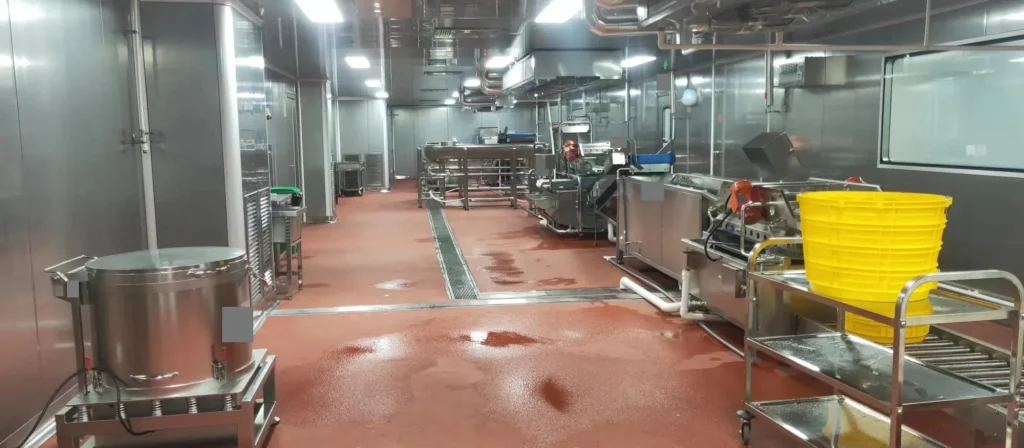
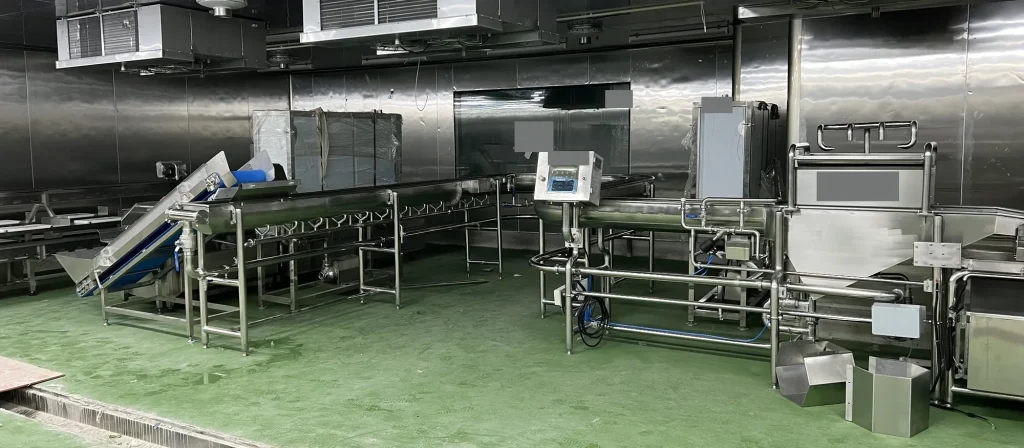
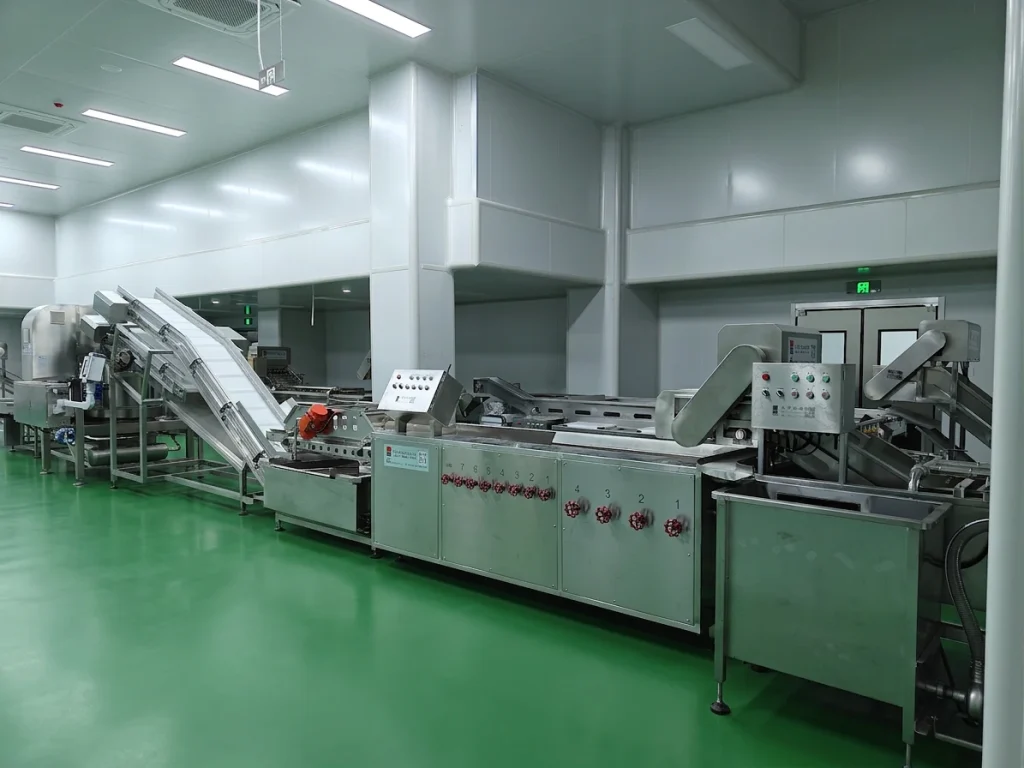
There is a particular kind of challenge in food processing that only surfaces at extreme scale. When you are cutting, washing, sterilizing, and packaging enough vegetables to feed over a million schoolchildren before the delivery trucks leave at 6 AM, there is no room for bottlenecks, no tolerance for contamination, and absolutely no second chance if a line goes down at 3 AM.
This project involved three purpose-built factory sites, totaling over 15,000 square meters of production floor, each handling a different category of vegetables. Together, they process 130 to 150 tons of fresh-cut product per day within a 4 to 6 hour early morning production window. That translates to a peak processing requirement of 20 to 25 tons per hour, a throughput figure that demanded equipment and line design far beyond what any standard configuration could deliver.
What Made This Project Different
The client did not need a vegetable cutting machine. They needed an entire industrial system, designed from the ground up, where every machine speed, every conveyor transfer rate, and every buffer stage was calculated to sustain 20 to 25 tons per hour without a single manual bottleneck. TEEMYEAH was selected to provide the complete end-to-end solution: facility layout engineering, process flow design, all core processing equipment, digital monitoring integration, installation across all three sites, commissioning, and operator training.
Multiple parallel lines of TW-506L bubble washers, TW-902P and TW-806 high-throughput cutters, EOS8132-SD ozone sterilization systems, and TW-980LB automated dehydration lines were deployed and synchronized to sustain the required flow rate. Every machine was selected not just for its individual capacity, but for how its throughput meshed with adjacent stages.
The Number Everyone Asks About: Labor
Before automation, a manual facility of this scale would require roughly 80 to 120 workers per factory just for the vegetable prep section. Across three sites, that is 240 to 360 people. The automated lines reduced this to 12 to 18 machine operators per factory, a total labor reduction of over 200 workers. At ASEAN-equivalent wages, this represents well over half a million dollars in annual labor cost avoided.
But labor savings are only half the story. The other half is what machines do that people cannot: run at a consistent speed for six hours without fatigue, produce identical cuts on the millionth cabbage shred as on the first, and maintain zero direct hand contact with food product from raw input to sealed package. In a government-audited school meal program where a single contamination event could shut down the entire operation, that consistency is not optional.
Digital Traceability: Not a Feature, a Requirement
Government school meal programs demand full traceability. The client needed to prove, for any given package of sliced carrots delivered to any school on any given morning, exactly when it was processed, on which line, at what temperature, with what water quality parameters, and by which operator shift. TEEMYEAH’s digital monitoring system delivers this: real-time dashboards tracking throughput, water quality, equipment status, and energy consumption. Automated alerts flag deviations before they become problems. The system generates auditable batch records that satisfy regulatory inspection requirements.
Results
| Daily output | 130–150 tons across 3 factories (was 15–20 T manual) |
| Peak hourly rate | 20–25 T/h (was 3–5 T/h manual bottleneck) |
| Total labor reduction | 200+ workers replaced by 36–54 operators |
| Material waste | Reduced from 12–18% to 3–5% |
| Yield improvement | +7–13 percentage points |
| Food safety documentation | Manual HACCP logs replaced by real-time digital traceability |
| Workplace injuries | Zero since commissioning |
| Full ROI | Achieved within 14 months |

Planning a similar project? Request a tailored processing proposal from TEEMYEAH.