







Centralized ingredient preparation restaurant chains use a shared central kitchen, commissary, or food pre-processing facility to handle selected activities such as sorting, washing, peeling, cutting, portioning, dewatering, mixing, or packing before ingredients are distributed to individual outlets. The model can reduce duplicated preparation work, improve specification consistency, support higher throughput, and create better conditions for process control, yield management, hygienic design, and future automation. It is not automatically superior to decentralized preparation, however. Outlet-level processing may remain more practical when volumes are low, menus change frequently, products lose quality quickly after preparation, or distribution distances make central production inefficient. Many growing restaurant groups therefore adopt a hybrid model: high-volume, repeatable processes are centralized, while fragile ingredients, final seasoning, menu-specific preparation, or time-sensitive tasks remain at the outlet. The correct operating model depends on SKU mix, labor intensity, actual production capacity, yield, sanitation requirements, RTC versus RTE risk, changeover time, logistics, and expansion plans. Centralization should therefore be evaluated as a process and network-design decision rather than simply as an equipment investment, with automation introduced only where volume, repeatability, food-safety controls, and commercial justification support it.
What Does Centralized Ingredient Preparation Restaurant Chains Mean as an Operating Model?
A restaurant group can centralize purchasing without centralizing preparation. It can also centralize selected preparation steps while continuing final cooking, seasoning and assembly inside each outlet. These distinctions matter because the term “central kitchen” covers very different operating models.
In a decentralized system, whole or minimally processed ingredients are delivered to individual locations. Each outlet performs its own trimming, washing, peeling, cutting and portioning. This model provides local flexibility but duplicates preparation labor, equipment, workstations and management controls across the network.
Centralized ingredient preparation moves repeatable upstream activities to a shared facility. Prepared materials are subsequently dispatched to restaurants, catering sites or satellite kitchens according to production schedules and demand forecasts. A hybrid model lies between the two: high-volume, standardized work is centralized while fragile products, short-life ingredients and menu-specific preparation remain at the outlet.
This operating-model distinction is more useful than asking whether a restaurant chain “needs a central kitchen.” A chain may already have a distribution center, production kitchen or commissary but still perform most vegetable preparation in individual stores. Conversely, a relatively compact preparation facility can centralize several labor-intensive processes without replacing outlet kitchens.
For a deeper examination of the consequences of duplicating preparation across locations, see what happens when every outlet handles its own ingredient preparation.
| Operating Model | Where Preparation Happens | Typical Strength | Typical Constraint | Best Fit |
|---|---|---|---|---|
| Decentralized | Primarily inside individual outlets | High local flexibility and short time between preparation and service | Duplicated labor, equipment and process variation across locations | Small networks, highly variable menus, low daily preparation volume |
| Hybrid | Standard processes centrally; final or sensitive preparation locally | Balances standardization with outlet flexibility | Requires clear responsibility and specification control between central facility and outlets | Growing restaurant groups and multi-SKU catering operations |
| Highly Centralized | Most repeatable ingredient preparation in central facility | Greater potential for line balancing, process control and equipment utilization | Higher dependence on planning, cold chain, distribution and central-facility uptime | High-volume networks with repeatable specifications and reliable logistics |
Why Restaurant Chains Reconsider Outlet-Level Preparation as They Grow
A preparation method that works for five restaurants can become inefficient at fifty. The difficulty usually appears gradually. An outlet adds another preparation worker during peak days. A second cutting table is squeezed into the kitchen. Managers compensate for inconsistent trimming by ordering extra raw material. Production starts earlier to protect service time. None of these changes looks transformational in isolation, yet they create a larger network-level cost when repeated across every location.
Labor dependence increases with duplicated preparation
Food preparation remains labor-intensive in many markets, and recruitment pressure cannot be evaluated only through hourly wage rates. U.S. Bureau of Labor Statistics projections provide useful context: approximately 148,000 openings for food preparation workers are projected annually over 2024–2034 despite declining total employment in that occupation, with those openings attributed to workers transferring occupations or leaving the labor force. The broader food-and-beverage serving category is projected to have about 1.16 million openings annually. These figures are U.S.-specific workforce projections rather than restaurant-level turnover rates, but they illustrate why replacement hiring remains an operating consideration for foodservice businesses.
The relevant management question is not simply “How many people work in preparation?” It is “How many paid hours are required to produce a defined quantity of usable ingredients?” Measuring labor in relation to output exposes differences between outlets that headcount alone hides.
A useful indicator is:
Labor hours per 1,000 kg = Total direct preparation labor hours ÷ Saleable prepared kilograms × 1,000
This metric should include the activities that actually disappear or change under centralization: raw-material handling, washing, peeling, cutting, sorting, weighing, internal transfer and relevant clean-up. Including unrelated cooking or service labor will overstate potential savings.
Preparation work also carries ergonomic and occupational risks
Repetitive chopping, lifting containers, prolonged standing and repeated reaching are not merely efficiency issues. OSHA identifies repetitive motion, awkward reaching and lifting as ergonomic hazards in food preparation and food-service work, while its restaurant guidance also addresses knife handling and powered-equipment safety. Centralization does not automatically eliminate these risks; poorly designed industrial workstations can simply concentrate them. It does, however, create an opportunity to redesign material flow, working heights, lifting methods and repetitive tasks more systematically.
Consistency becomes harder to manage across many kitchens
One outlet may remove more outer cabbage leaves than another. One employee may cut carrots to 4 mm while another produces 7 mm pieces. Potato peeling may vary by operator, and lettuce portions may depend on how aggressively damaged material is trimmed.
These differences affect more than appearance. Cut dimensions influence cooking time, portion weight and final texture. Excessive trimming changes yield. Variable dewatering can affect recipe weight or package condition. When central preparation is justified, a major benefit is therefore the ability to define one input specification, process method and finished-preparation specification for many downstream kitchens.
This does not mean every agricultural ingredient can be forced into an identical process. Seasonal differences in size, maturity, moisture, soil load and mechanical condition can change how a crop behaves during washing, peeling and cutting. Standardization should control the result while allowing operating parameters to adapt to raw-material variability.
Which Preparation Tasks Should Be Centralized?
The most effective central kitchens do not necessarily centralize everything. They centralize the processes whose economics and control improve when volume is aggregated.
A practical assessment starts at SKU level. For each ingredient, map its raw state, preparation steps, finished specification, daily quantity, dispatch method, required holding conditions and downstream use. High-volume ingredients that repeatedly pass through the same process are the strongest candidates.
| Preparation Step | Centralization Is More Attractive When | Local Preparation May Remain Better When | Useful Measure |
|---|---|---|---|
| Sorting and trimming | Specification is stable and the same material serves many outlets | Final selection is highly menu-specific or appearance depends on last-minute preparation | Trim loss % |
| Washing | Large repeated volumes justify controlled washing and material handling | Daily quantity is very small or ingredient is delivered ready for use | kg/h, water use, rewash/reject rate |
| Peeling | Root crops are consumed in substantial standardized volumes | Volumes are too low to offset cleaning and changeover | Yield %, kg/operator-hour |
| Cutting | Cut specifications repeat across outlets and consistency matters | Products require highly irregular artisanal cuts or immediate use after cutting | Cut conformity, usable kg/h |
| Dewatering | Washed leafy vegetables or fresh-cut products need controlled surface-moisture removal | Product is immediately transferred into a process where residual water is irrelevant | Product condition, cycle output, downstream weight stability |
| Mixing or marination | Recipes are standardized and batch traceability is required | Outlet-level customization is a central part of the menu | Batch accuracy, mixing time |
| Portioning and packing | Stores require repeatable quantities and distribution units | Demand varies too quickly for economical pre-portioning | Weight variance, orders completed on time |
Vegetable preparation often becomes an early centralization candidate because washing, cutting and peeling are repetitive and can consume substantial workspace. Restaurant groups handling mixed vegetables, fruit, meat and other categories may need a broader multi-ingredient food pre-processing model rather than a single-purpose vegetable line.
Centralized Preparation Changes the Process Architecture
Moving preparation upstream changes more than the physical location of a knife or washing tank. It creates a production-and-distribution system. The central facility receives raw materials, transforms them into controlled intermediate products, holds them where necessary, allocates them to orders, dispatches them and transfers responsibility to downstream kitchens.
A typical high-level architecture may include:
- Receiving and incoming-material verification
- Raw-material storage and production staging
- Sorting and preliminary trimming
- Washing or peeling according to ingredient type
- Cutting, dicing, slicing or portioning
- Additional washing, treatment or dewatering where the product requires it
- Inspection and specification verification
- Weighing, batching or packing
- Cold holding or controlled staging
- Order allocation and dispatch
- Transport to outlets or catering sites
- Final cooking, assembly or service
The exact sequence cannot be standardized across every product. Lettuce intended for an RTE salad, potatoes destined for cooking, marinated meat for a restaurant kitchen and whole washed peppers may all require different process logic.
The detailed physical flow—from receiving through chilled distribution—is better treated separately from the operating-model decision. Teams already designing that layer can use the central kitchen workflow from receiving to chilled distribution, while new-build projects should address utilities, zoning, layout and installation requirements through a broader central kitchen planning framework.
Production Capacity Must Be Based on Real Throughput, Not Machine Nameplate Capacity
Capacity mistakes are common when a project begins with equipment catalogues rather than demand. A machine may have a nominal processing range, yet a restaurant network does not consume nameplate capacity. It needs saleable material available by a specific dispatch deadline.
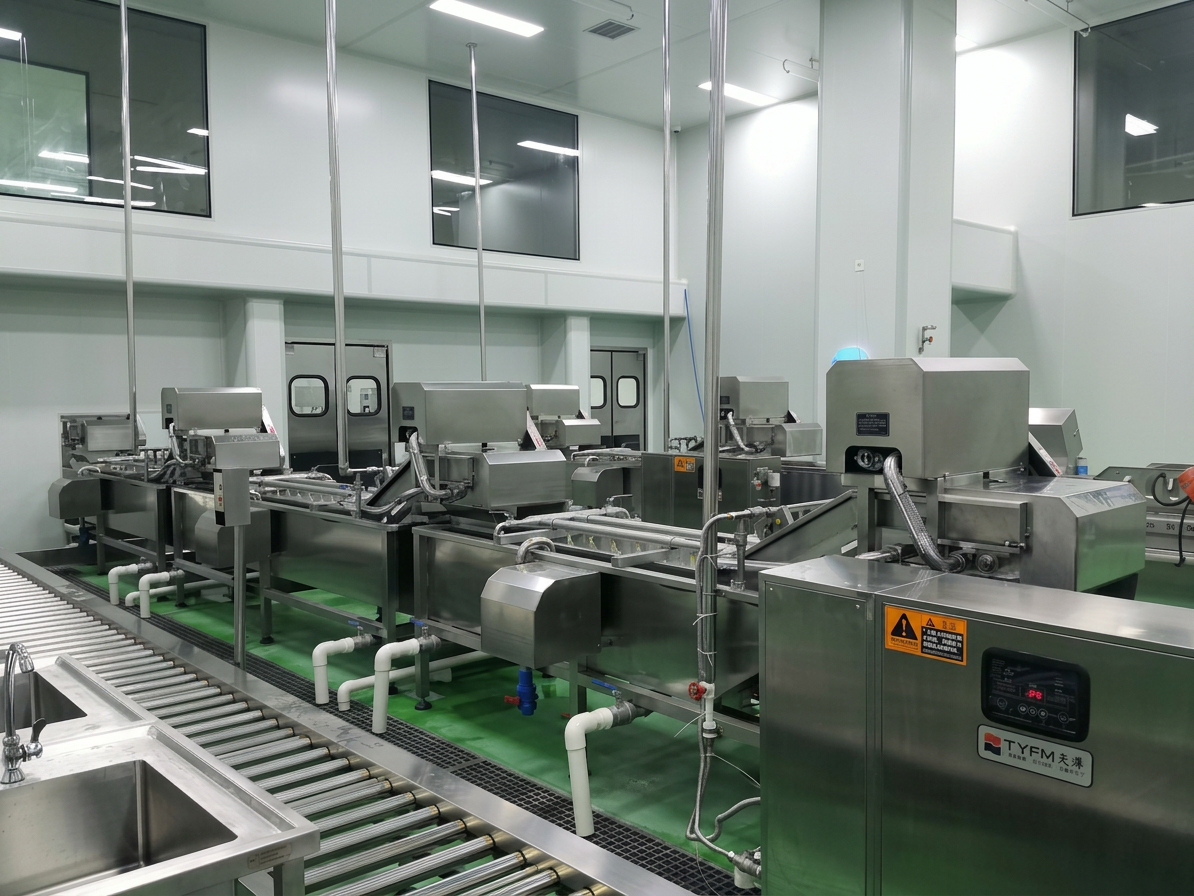
Required output rate = Required saleable daily output ÷ Effective production hours
Effective production hours are lower than scheduled shift hours because production time is consumed by sanitation, product changeover, breaks, minor stops, inspections, replenishment and other planned or unplanned losses.
Consider a hypothetical example. A chain of 20 outlets requires an average of 60 kg of centrally prepared vegetables per store per day. Total finished demand is therefore 1,200 kg/day. If the preparation facility has an eight-hour production window but only 75% of that time is effectively available for processing, the base required finished throughput is:
1,200 kg ÷ (8 × 0.75) = 200 kg/h
If average saleable yield is 85%, the raw-material requirement becomes approximately:
1,200 ÷ 0.85 = 1,412 kg/day
This is an illustrative calculation, not an equipment recommendation. Real projects must also account for peak days, SKU sequencing, product-specific yields, raw-material variation and dispatch cut-off times.
The bottleneck determines line output
Suppose a process combines a 1,000 kg/h cutter, a 700 kg/h wash stage and a 400 kg/h batch dewatering operation under the actual product mix. The line does not become a 1,000 kg/h production system because the cutter has the largest specification.
Real output is constrained by the slowest required stage, its utilization and the way intermediate product accumulates around it.
This is the basis of line balance: matching the practical capacity of connected processes so one section does not repeatedly starve or overload another.
When evaluating vegetable-processing equipment, for example, a cutter such as a large vegetable cutter, a continuous vegetable washing machine or a vegetable and fruit dicing machine should be selected from the required process backward. Their catalogue capacities are screening information; product testing and complete-line analysis determine whether the combination fits the required throughput.
A Small Set of Metrics Can Reveal Whether Centralization Is Working
Many facilities monitor daily tonnage but miss the operational variables that explain why costs or service levels change. A useful central-preparation dashboard should connect labor, material recovery, equipment performance and delivery.
| Metric | Example Formula | What It Reveals |
|---|---|---|
| Labor hours per 1,000 kg | Direct prep hours ÷ finished kg × 1,000 | Labor intensity independent of daily volume |
| Yield | Saleable prepared kg ÷ incoming raw kg × 100 | Material loss through sorting, peeling and trimming |
| Preparation cost per kg | Relevant preparation cost ÷ saleable prepared kg | True processing economics |
| Capacity utilization | Actual output ÷ practical available capacity × 100 | Whether investment is appropriately sized and used |
| Downtime rate | Unplanned downtime ÷ scheduled operating time × 100 | Reliability impact on production |
| On-time production rate | Orders completed by dispatch cut-off ÷ total scheduled orders × 100 | Ability to support outlet service windows |
| Changeover time | Time from last conforming unit of SKU A to first conforming unit of SKU B | Impact of SKU complexity |
The objective is not to maximize every metric independently. Aggressive peeling may increase apparent speed while reducing yield. Larger batches may improve equipment utilization while extending WIP holding time. A very high utilization rate can leave insufficient capacity for peak demand. Measures have to be interpreted as a system.
SKU Complexity Can Matter More Than Total Daily Tonnage
Two central kitchens may each prepare five tonnes per day and require completely different designs.
One may process three vegetables continuously for several hours. The other may process forty ingredients in small batches, switching repeatedly between leafy vegetables, roots, fruit and proteins. The second facility can experience much greater operational complexity even at the same total tonnage.
Each SKU can introduce a combination of:
- different raw-material dimensions and contamination loads;
- different trimming and peeling requirements;
- different cut specifications;
- different equipment settings or cutting tools;
- allergen or cross-contamination considerations;
- different sanitation requirements;
- different packaging and portion sizes;
- different production priorities and dispatch destinations.
This is why changeover time belongs in capacity calculations. A nominal eight-hour shift containing six significant product changes may provide far less processing time than a shift dedicated to one product.
A high-SKU restaurant group may therefore benefit more from flexible semi-automatic work cells than from a single highly integrated continuous line. Automation should follow demand concentration, not the visual appeal of continuous equipment.
Yield Is a Strategic Variable, Not Just a Waste Statistic
Labor savings are often the first argument for centralized preparation, but material recovery can be equally important when raw ingredients are valuable.
Yield is calculated as:
Yield (%) = Saleable finished product weight ÷ Incoming raw-material weight × 100
Measuring yield correctly requires a defined point of comparison. “Incoming raw material” could mean material after receiving inspection, after initial sorting or directly from the supplier. The selected boundary must remain consistent if management wants to compare outlets, shifts or process changes.
Over-trimming is a common manual source of loss, but automation can also reduce yield when the wrong machine or operating parameter is used. Abrasive peeling can remove more edible material than necessary. An unsuitable cutter can create fragments. Aggressive conveying can bruise delicate produce. Excessive mechanical action during washing can damage leaves.
The correct objective is therefore not minimum human handling at any cost. It is a stable process that meets finished-product specifications while preserving acceptable material recovery.
RTC and RTE Preparation Require Different Food-Safety Thinking
A central facility producing ready-to-cook vegetables is not managing exactly the same risk profile as one preparing ready-to-eat salad ingredients.
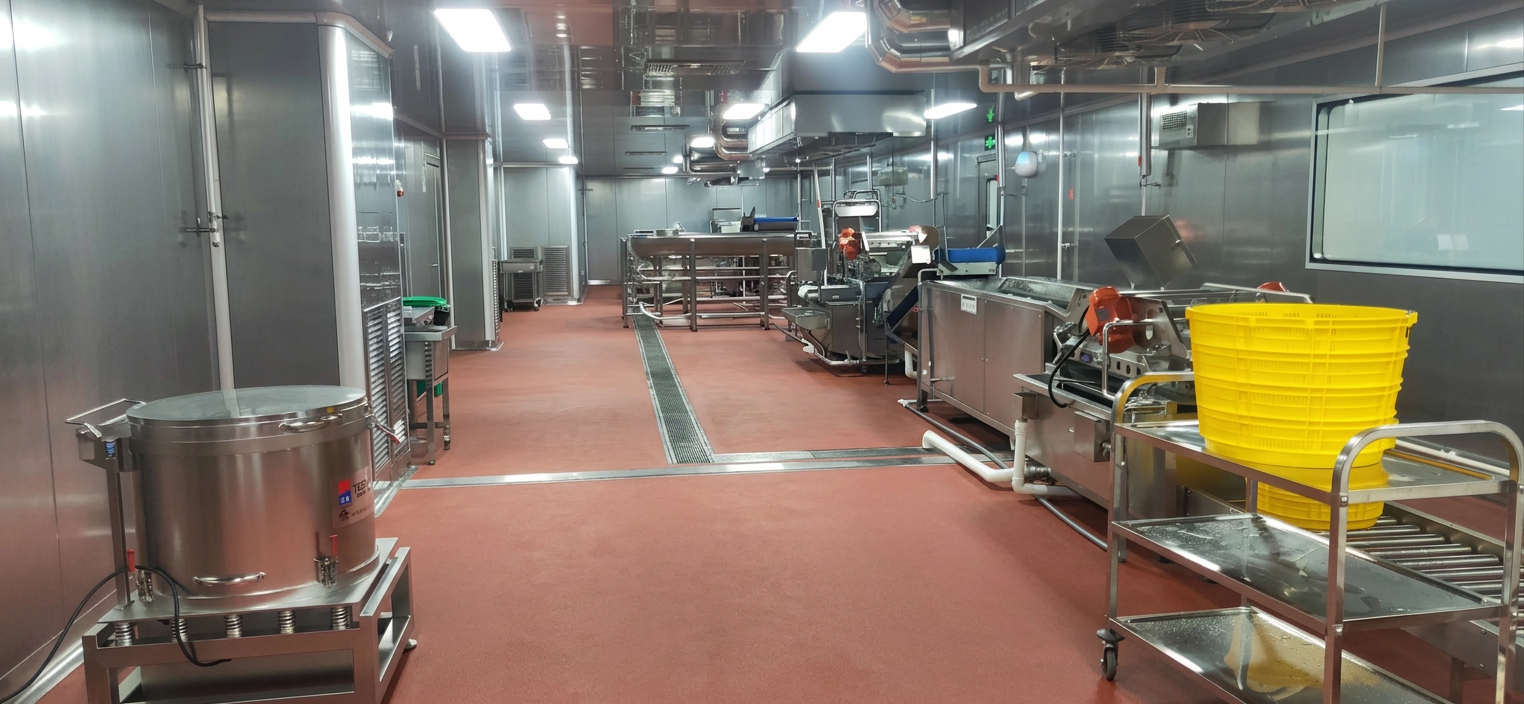
RTC ingredients normally undergo a later cooking step before consumption. That does not remove the need for hygienic preparation, contamination control or appropriate time-temperature management, but the downstream process can include a validated lethal step.
RTE products require greater caution because the consumer may receive the product without a later cooking stage. FDA guidance on fresh-cut fruits and vegetables explains that cutting or shredding breaks the natural exterior barrier, can release cellular fluids that support microbial survival or growth, and can spread contamination through processing. It specifically identifies the absence of a subsequent lethal process such as heat as one factor relevant to fresh-cut product risk.
For restaurant chains considering centralized salad preparation, the practical consequence is significant. Centralizing washing and cutting does not itself make a product safer. Process zoning, personnel movement, water management, equipment sanitation, cold-chain control, storage duration and protection from recontamination become part of the production design.
CDC restaurant-outbreak guidance likewise identifies sick food workers and food-preparation practices among important contributing factors to restaurant outbreaks and notes that cross-contamination can arise when an infected or inadequately trained worker handles food. These findings do not prove that a centralized facility is inherently safer than an outlet kitchen; they reinforce the importance of controlling people, practices and process interfaces in either model.
Date marking is not the same as validated shelf life
The FDA Food Code provides a useful U.S. retail-food reference but must not be treated as a universal shelf-life rule. The 2022 Food Code is a model code intended for adoption by relevant jurisdictions. Under its date-marking provisions, certain refrigerated ready-to-eat time/temperature control for safety foods prepared in a food establishment and held for more than 24 hours are marked for a maximum seven-day period at 5°C/41°F or below, with the preparation day counted as Day 1. That provision is a food-safety control within its regulatory context, not evidence that every centrally prepared salad or cut vegetable will maintain acceptable commercial quality for seven days.
Product shelf life must be established for the specific recipe, process, packaging, temperature conditions, distribution system and applicable jurisdiction.
Sanitation and Hygienic Design Become Production-Capacity Issues
When preparation is scattered across small kitchens, cleaning may be treated mostly as an outlet-management task. Once volume is concentrated, sanitation becomes part of industrial production planning.
Equipment should be evaluated not only for output but for whether food-contact areas can be accessed, inspected, cleaned and sanitized effectively. FDA fresh-produce guidance treats equipment surfaces such as containers and conveyor belts that contact produce as food-contact surfaces, while fresh-cut guidance emphasizes hygiene and sanitation practices because the processing environment itself can become a route of contamination.
The operational questions include:
- How long does wet cleaning take after each production run?
- Which parts require tools for removal?
- Can operators visually inspect product-contact surfaces?
- Are there difficult-to-drain areas where water or organic material can remain?
- Does changing between product families require an intermediate sanitation step?
- Where does dirty raw material move relative to prepared or RTE product?
- Can cleaning be completed within the production schedule without forcing shortcuts?
A machine that processes quickly but requires excessive cleaning time may have lower daily effective capacity than a slower machine with easier changeover. Hygienic design and maintainability therefore belong in line-balance calculations.
Manual, Semi-Automatic and Integrated Lines Serve Different Operating Conditions
Centralization and automation are separate decisions. A company can centralize preparation while keeping several processes manual, and it can automate a single high-labor task without building a fully integrated central line.
| Approach | Most Suitable Conditions | Main Advantage | Main Risk |
|---|---|---|---|
| Manual centralized preparation | Moderate volume, changing menu, many irregular tasks | Flexible and relatively simple to modify | Labor dependence and operator variation remain |
| Semi-automatic work cells | Several repeatable high-labor processes but significant SKU variation | Targets bottlenecks without over-integrating the facility | Material transfer and WIP may remain labor intensive |
| Integrated processing line | High repeatable throughput, concentrated SKU families, stable process specification | Better continuity and reduced manual transfer between compatible stages | A line-balance or reliability problem can affect a large share of production |
A leafy-vegetable operation with repeatable salad specifications may eventually justify an integrated leafy vegetable processing line. A business preparing potatoes, carrots, onions and similar crops can evaluate a dedicated root vegetable washing, peeling and cutting process. Neither configuration should be selected simply because the restaurant group has many outlets; ingredient volumes and process compatibility must support the investment.
The more detailed question of when equipment should replace or reorganize manual work is covered in when a central kitchen should automate food preparation.
Automation Introduces New Risks as Well as New Capabilities
Automated food preparation can reduce repetitive manual work, but it creates dependency on equipment availability, spare parts, maintenance skills, correct settings and disciplined sanitation.
One large line can create a single point of failure that did not exist when twenty outlets prepared vegetables independently. A cutter breakdown before the morning dispatch window can affect many stores simultaneously. Oversized equipment may run inefficiently for small SKU batches. Undersized downstream machinery can cause WIP accumulation even when the upstream machine appears fast enough.
Other common risks include:
- selecting equipment from theoretical capacity without product testing;
- automating an inefficient workflow instead of redesigning it;
- assuming all varieties of the same vegetable behave identically;
- underestimating sanitation and changeover time;
- failing to provide bypass or contingency procedures;
- concentrating RTE and raw-material traffic without appropriate hygiene separation;
- neglecting operator training because equipment is described as automatic;
- depending on proprietary parts without a practical spare-parts strategy.
Equipment cannot replace process design, food-safety management, preventive maintenance or competent supervision. Automation changes where human decisions are required; it does not remove them.
How to Evaluate the Financial Case for Centralized Preparation
A sound investment model should compare the cost of the current operating model against the future system rather than comparing machine price against wages alone.
Current preparation cost can include:
- direct preparation labor;
- supervision associated with preparation;
- raw-material loss and over-trimming;
- outlet-level preparation equipment;
- cleaning labor and utilities;
- preparation-related floor-space constraints;
- rework or specification failures;
- training and replacement-labor burden;
- internal handling and waste disposal.
The centralized model can add costs that did not previously exist:
- central facility investment or rent;
- food pre-processing equipment;
- cold storage and utilities;
- central production staff;
- packaging or reusable container systems;
- transport and route planning;
- maintenance and spare parts;
- quality-control and traceability systems.
A simple payback calculation can be written as:
Simple payback period = Initial incremental investment ÷ Annual net operating benefit
Annual net operating benefit should be calculated after additional central-facility costs, not from gross labor reduction alone.
For example, if a hypothetical project requires an incremental capital investment of $300,000 and the validated annual net benefit after labor, material, utility, maintenance, logistics and operating changes is $100,000, simple payback would be three years. This is an illustrative model only. It does not estimate the payback of a TEEMYEAH system or any specific central kitchen.
A project may still be commercially attractive even when direct labor payback is not short. Capacity for additional stores, access to institutional customers, tighter specification control or release of valuable outlet kitchen space may carry strategic value. Those benefits should be stated separately rather than converted into artificial “savings” unless the business can quantify them credibly.
Centralization Works Best as a Phased Operating-Model Change
Restaurant groups often have more success when they centralize by process family rather than attempting to move the entire menu at once.
A staged program might begin with a high-volume root vegetable that consumes large amounts of peeling labor. The next stage could centralize cutting for cabbage, carrots and onions. Washing and dewatering for selected leafy vegetables might follow once cold-chain and hygiene controls are ready. More sensitive RTE preparation can remain separate until the facility has the necessary sanitation, zoning, verification and product-life controls.
This phased approach creates operating data before a larger line is specified. Actual yields, hourly demand, changeover durations and SKU profiles become engineering inputs rather than estimates.
It also allows the business to determine whether its bottleneck is truly preparation. A chain may discover that washing is not limiting capacity at all; the real constraint may be order picking, cold storage, dispatch scheduling or downstream cooking.
When Centralized Preparation or Automation Is the Wrong Choice
Centralized ingredient preparation should not be treated as the inevitable destination of every growing restaurant group.
Keeping preparation at individual kitchens can remain rational when:
- the network contains only a few locations;
- daily volumes per ingredient are low;
- menus change frequently and require skilled manual preparation;
- prepared ingredients deteriorate rapidly during storage or transport;
- outlets are geographically dispersed beyond an economical distribution radius;
- existing outlet labor has sufficient capacity;
- centralization would introduce more packaging, handling or logistics than it removes;
- the business lacks reliable cold-chain or production-management capability.
Semi-automation is often preferable when one or two processes are clear bottlenecks but product diversity remains high. A dedicated vegetable cutter or peeling machine can remove repetitive work while workers continue loading, inspection, trimming and product transfer.
Fuller line integration begins to make sense when several conditions converge: significant repeatable volume, compatible product families, stable specifications, predictable production windows, sufficient floor space and utilities, a capable sanitation program, reliable maintenance and a distribution model able to use the resulting output.
A Decision Framework for Restaurant Chains and Catering Operators
Before choosing equipment or designing a central facility, management should be able to answer seven questions:
- What preparation work is duplicated today? Quantify it by SKU, outlet and labor hours.
- Which ingredients have enough aggregated volume? Concentration matters more than total network sales.
- What finished specification must the central facility deliver? Define cut, trim, portion, moisture condition and downstream use.
- What is the required practical throughput? Calculate from peak demand and dispatch windows rather than nominal daily averages.
- What should remain at the outlet? Protect product quality and menu flexibility instead of centralizing by default.
- How will food-safety responsibility change? Separate RTC and RTE logic and design sanitation, zoning, cold holding and traceability accordingly.
- Does the financial model remain positive after logistics and central operating costs? Compare complete operating systems, not equipment price against wages.
Once these answers are available, equipment selection becomes much more disciplined. The business can decide whether it needs isolated machines, semi-automatic cells, an integrated vegetable processing line or a multi-category central preparation facility.
Centralized Preparation Is a Process Redesign, Not a Machine Purchase
The most important decision in centralized ingredient preparation for restaurant chains is not which machine to buy. It is where each activity should occur within the network.
Central preparation can reduce duplicated work, improve process visibility and create a stronger platform for capacity expansion. Yet it can also concentrate food-safety responsibility, production risk and logistics dependence. A badly designed central facility may simply replace many small inefficiencies with one large one.
The strongest projects begin with demand, SKU structure and operating constraints. They measure real labor inputs, throughput, yield, changeover time and dispatch performance; distinguish RTC from RTE requirements; determine which activities still benefit from human flexibility; and only automate processes whose volume and repeatability justify it.
For restaurant groups, QSR operators and catering businesses assessing this transition, the broader restaurant-chain and QSR preparation framework provides the industry context for connecting centralized workflow decisions with equipment and project planning.
Explore the Centralized Preparation Model
If your organization is deciding whether to move ingredient preparation from outlets into a central kitchen, begin with the current process rather than an equipment list. Map your major SKUs, daily and peak volumes, preparation labor, finished specifications, outlet requirements, available production hours and distribution model. That information makes it possible to identify the first genuine bottleneck and determine whether manual centralization, targeted semi-automation or an integrated processing line is commercially justified.
TEEMYEAH works as a food pre-processing equipment supplier, vegetable processing equipment manufacturer and customized food preparation solution provider for central kitchens, restaurant groups, catering operations, food manufacturers and RTC/RTE facilities. Project discussions can cover process flow, raw-material testing, capacity matching, sanitary design considerations, equipment configuration, layout and long-term operation rather than starting from a predetermined machine package.
For teams moving from operating-model evaluation toward equipment planning, the next practical step is to compare current and target capacity and identify which preparation process should be automated first.
FAQ
1. What Does Centralized Ingredient Preparation Restaurant Chains Mean in Practice?
Centralized ingredient preparation is an operating model in which selected tasks such as washing, peeling, cutting, sorting, portioning or packing are performed in a central kitchen or commissary instead of being repeated at every restaurant. The prepared ingredients are then distributed to outlets for cooking, assembly or service. Centralization does not require every task to move away from stores. Many restaurant groups use a hybrid model in which high-volume standardized preparation is centralized while fragile ingredients, final seasoning and menu-specific work remain local.
2. When should a restaurant chain consider a central kitchen?
A central kitchen becomes worth evaluating when the same preparation activities are being repeated across many outlets and the combined volume is large enough to support dedicated production. Signals can include rising preparation labor, inconsistent cut specifications, variable yield, insufficient outlet kitchen space, difficulty completing preparation before service or plans to add more locations. These signals do not prove that centralization will be profitable. The chain should compare current preparation cost, aggregated SKU volumes, logistics requirements and central-facility costs before making the decision.
3. Is centralized food preparation always cheaper than outlet preparation?
No. Centralization may reduce duplicated preparation labor and improve equipment utilization, but it also creates facility, packaging, refrigeration, transport, maintenance and production-management costs. For low-volume operations or geographically dispersed restaurant networks, those additional costs can outweigh preparation savings. A useful comparison calculates preparation cost per saleable kilogram under both models and includes logistics and expected raw-material yield. Strategic benefits such as releasing outlet space or supporting expansion should be considered separately where they can be quantified.
4. What food preparation tasks are easiest to centralize?
Repeatable, high-volume activities are usually the strongest candidates. Examples include washing vegetables, peeling potatoes or carrots, standardized slicing and dicing, portioning commonly used ingredients and preparing batches that serve multiple outlets. Tasks are less attractive to centralize when product quality deteriorates quickly after preparation, volumes are small, specifications change frequently or final preparation is closely tied to the restaurant’s service concept. SKU-level analysis is more reliable than deciding by broad categories such as “all vegetables” or “all meat.”
5. How do you calculate central kitchen preparation capacity?
Start with the quantity of finished, saleable ingredients required by the outlets during the peak production period. Divide that volume by effective production hours rather than scheduled shift hours. Effective hours should account for sanitation, changeovers, breaks and expected downtime. Raw-material requirements must then be adjusted for yield. Each processing stage should be checked separately because the practical capacity of the complete line is governed by its bottleneck, not by the machine with the largest catalogue throughput.
6. What is the difference between theoretical capacity and actual throughput?
Theoretical or catalogue capacity normally describes what an individual machine can process under defined conditions. Actual throughput is the saleable output a facility can repeatedly produce within its real operating schedule. Product characteristics, operator loading, sanitation, changeovers, inspection, equipment stops and downstream bottlenecks can all reduce real throughput. For restaurant-chain planning, practical capacity should therefore be established using representative raw materials and the intended process sequence. A machine rated at a high hourly capacity cannot compensate for a slower required downstream process.
7. Does centralizing food preparation improve food safety?
It can improve control by moving preparation into a facility designed around defined workflows, sanitation procedures and trained production teams, but centralization is not inherently safer. A central facility also concentrates larger volumes of food and can distribute a process failure to many outlets. RTE preparation requires particular care because the product may not receive a later cooking step. Food safety depends on process separation, employee practices, sanitation, time-temperature control, equipment design, traceability and management systems rather than on centralization alone.
8. Should RTC and RTE ingredients use the same preparation line?
Not automatically. Ready-to-cook ingredients and ready-to-eat products have different downstream risk profiles because RTC foods are intended for subsequent cooking while RTE products may be consumed without a later lethal step. Whether equipment can be shared depends on the products, process sequence, sanitation controls, zoning, scheduling and applicable food-safety requirements. A facility should conduct a hazard-based assessment before combining workflows. Equipment availability or floor-space savings alone are not sufficient reasons to place incompatible processes on the same line.
9. Is full automation necessary for a central kitchen?
No. Many central kitchens are better served by selective automation. Manual work remains useful for variable products, visual inspection, irregular trimming and small batches. Semi-automatic equipment can target high-labor operations such as washing, peeling or cutting while retaining operator flexibility. Integrated lines become more appropriate when volumes are high, product families are compatible and specifications are stable. The required level of automation should be determined from bottlenecks, labor intensity, SKU complexity and investment economics rather than from the size of the facility alone.
10. How should a restaurant chain calculate ROI for food preparation automation?
Compare the incremental investment with annual net operating benefit. Potential benefits may include reduced direct preparation labor, improved yield, lower rework or greater usable capacity. Deduct additional maintenance, utilities, sanitation, logistics, packaging and other operating expenses created by the new model. Simple payback equals initial incremental investment divided by annual net benefit. The calculation should use measured facility data whenever possible. Supplier assumptions or general industry savings percentages should not be substituted for the chain’s own volumes, labor rates, yields and operating schedule.
11. What information should be prepared before discussing a centralized preparation line with a supplier?
Prepare a SKU list showing each raw ingredient, incoming condition, finished format, daily average and peak quantity, preparation process and downstream use. Add available production hours, required dispatch times, floor-space information, utility constraints, current labor allocation and relevant hygiene requirements. For variable agricultural products, representative raw-material photos or samples are valuable. This information allows an equipment supplier to evaluate process compatibility, practical capacity and potential bottlenecks instead of producing a quotation based only on a requested machine capacity.
Data and Source Note
- U.S. Bureau of Labor Statistics — Occupational Outlook Handbook, Food Preparation Workers, 2025 edition using 2024–2034 projections. Used for U.S.-specific employment and annual-opening context. The data should not be interpreted as an individual restaurant’s turnover rate.
- U.S. Bureau of Labor Statistics — Occupational Outlook Handbook, Food and Beverage Serving and Related Workers, 2025 edition using 2024–2034 projections. Used as broader U.S. foodservice labor-market context.
- U.S. Food and Drug Administration — Food Code 2022, January 2023 version. Used for the regulatory context of retail and foodservice controls and the distinction between model Food Code provisions and jurisdiction-specific legal requirements.
- U.S. Food and Drug Administration — Food Code Section 3-501.17, Ready-to-Eat, Time/Temperature Control for Safety Food, Date Marking. Used to explain the U.S. Food Code’s date-marking framework; it is not used as a general commercial shelf-life claim.
- U.S. Food and Drug Administration — Guide to Minimize Microbial Food Safety Hazards of Fresh-Cut Fruits and Vegetables, 2008. Used for the effects of cutting on produce, contamination opportunities and the significance of the absence of a subsequent lethal process in many fresh-cut applications.
- U.S. Centers for Disease Control and Prevention — Restaurant Food Safety: Contributing Factors and Root Causes, updated 2024. Used for context on worker-related contamination, preparation practices, training and cross-contamination in restaurant outbreaks.
- U.S. Occupational Safety and Health Administration — Restaurant/Food-Service Ergonomics and Food Preparation Guidance. Used for ergonomic considerations involving repetitive work, reaching, lifting, prolonged preparation work and safe use of food-preparation equipment.

