




Summary
Manual vegetable preparation often appears to be the lowest-cost option because the visible investment is small: tables, sinks, knives, cutting boards, baskets and labor.
But this comparison is incomplete.
The real cost of manual vegetable preparation includes not only hourly wages, but also training, absenteeism, supervision, inconsistent trimming, variable cutting quality, downtime, injury exposure, sanitation work, work-in-process, floor-space consumption and the difficulty of increasing output without continuously adding more people.
For a small kitchen processing highly variable products, manual work can still be the right solution. As daily volume grows, however, a business can reach a point where manual preparation becomes an operational bottleneck rather than a cost advantage.
The correct question is therefore not:
“Is a machine more expensive than a worker?”
It is:
“What does it actually cost us to prepare one kilogram of saleable vegetables, at the required quality, every day?”
That distinction changes the entire investment discussion.
Why Manual Vegetable Preparation Often Looks Cheaper Than It Really Is
A vegetable processor, central kitchen, catering company or fresh-cut produce business may begin with a relatively simple preparation system.
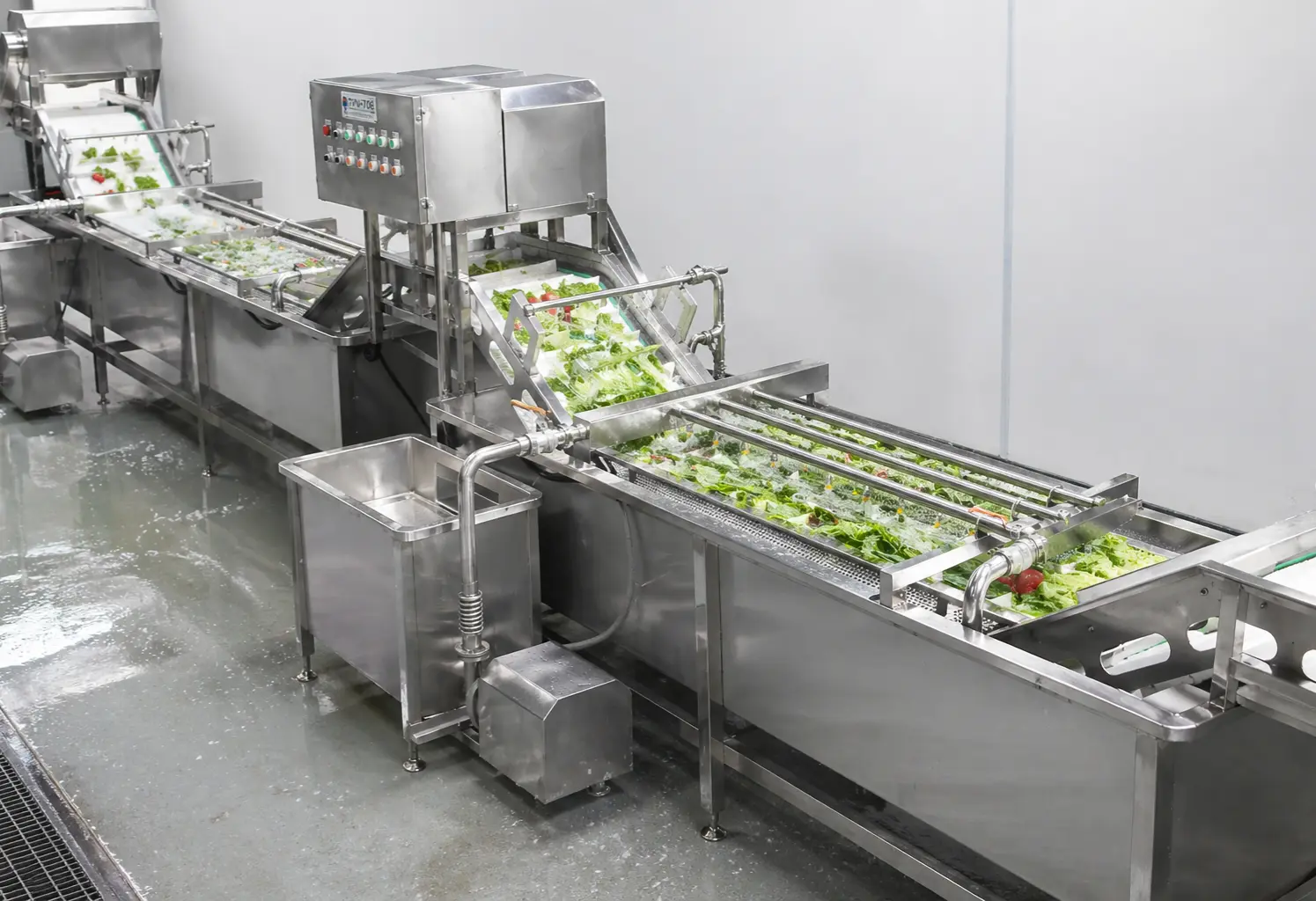
Workers receive raw vegetables. They sort them manually, remove damaged leaves or roots, wash the product in sinks or tanks, trim it with knives, cut it to size, transfer it between baskets and finally send it to cooking, packing or further processing.
At low volumes, this system can be highly practical.
The equipment investment is limited. Workers can handle different vegetables without complex changeovers. A skilled operator can make decisions that are difficult for a fixed machine to make—for example, deciding how much of a damaged cabbage should be removed or whether an irregularly shaped root vegetable is acceptable.
The problem is that manual preparation usually grows gradually.
One worker becomes three.
Three become eight.
Another table is added. More plastic crates appear. A second washing sink is installed. Production starts earlier in the morning. Overtime becomes normal during peak periods.
Because each individual change seems small, management may never stop to calculate what the entire preparation system now costs.
This is where the hidden cost of manual vegetable preparation begins.
1. Labor Cost Is More Than the Hourly Wage
The most obvious cost of manual vegetable preparation is labor.
But even this cost is often underestimated.
According to the U.S. Bureau of Labor Statistics, the median hourly wage for food preparation workers was $16.45 in May 2024. This figure represents wages alone; it does not automatically represent the complete cost to an employer of recruiting, scheduling, supervising and maintaining a workforce.
Consider a simple illustrative calculation.
A vegetable preparation department employs:
- 8 workers
- 8 hours per day
- 250 operating days per year
Using the BLS median wage merely as a reference:
8 × 8 × 250 × $16.45 = $263,200 per year in direct wages
That is before considering additional costs such as:
- payroll-related employer costs;
- overtime;
- recruitment;
- onboarding;
- training;
- uniforms and personal protective equipment;
- supervisors and team leaders;
- temporary replacement workers;
- absenteeism;
- employee turnover;
- paid non-production time.
This does not mean that every facility should replace eight workers with machinery. Nor does it mean that one machine can automatically perform all eight jobs.
It does show why comparing a machine purchase price with a single worker’s monthly salary can produce a misleading investment decision.
The more useful metric is:
Labor Cost per Kilogram of Saleable Product
A processor should calculate:
Total preparation labor cost ÷ kilograms of acceptable finished product
This matters because two shifts with the same payroll may produce very different amounts of saleable product.
For example:
- Shift A uses eight workers and produces 2,000 kg.
- Shift B uses eight workers and produces 1,500 kg because of slower raw-material sorting, more trimming, worker absence or a difficult vegetable variety.
The payroll is almost unchanged.
The labor cost per kilogram, however, has increased significantly.
That is the first major weakness of a labor-intensive process: cost is attached to time, while revenue is attached to saleable output.
2. Manual Throughput Is Usually More Variable Than the Headcount Suggests
A manager may say:
“Ten workers can process three tons per day.”
But what does that number actually mean?
Three tons of what?
Whole cabbage?
Leafy vegetables with heavy soil?
Peeled potatoes?
Mixed vegetables in 20 different SKUs?
Raw vegetables with already-trimmed roots?
Produce arriving directly from farms with large amounts of field waste?
Manual preparation capacity is strongly influenced by raw-material condition and product specification.
A worker may process one product quickly in the morning and a completely different product slowly in the afternoon. Even within the same vegetable category, raw-material size, maturity, soil level and defect rate can change the amount of work required.
This creates a problem for production planning.
Theoretical headcount may remain constant while actual hourly throughput changes.
That variability can affect:
- cooking schedules;
- packing schedules;
- truck departure times;
- order completion;
- downstream equipment utilization;
- cold-room congestion;
- overtime.
A cutting machine that is capable of processing 1,000 kg per hour provides little value if the washing and trimming department can only supply 300 kg per hour.
Likewise, installing a high-capacity washing line does not solve the problem if manual sorting or trimming remains the bottleneck.
The important concept is therefore line balance.
Automation should not be evaluated machine by machine. The entire vegetable preparation process—from receiving to finished-product discharge—needs to be considered as one connected system.

3. Inconsistent Trimming Can Turn Raw Material Into an Invisible Cost
Vegetable yield is one of the most underestimated costs in manual preparation.
Imagine two workers trimming the same vegetable.
One removes exactly what is necessary.
The other removes slightly more.
The difference may only be a few grams per vegetable.
At industrial scale, small differences accumulate.
Consider a processor handling 2,000 kg of raw vegetables per day for 300 production days per year.
A difference of just 1% of incoming weight represents:
2,000 kg × 1% × 300 days = 6,000 kg per year
This is an illustrative calculation, not a claim that automation automatically improves yield by 1%.
The actual yield difference depends on:
- vegetable type;
- raw-material quality;
- trimming specification;
- operator skill;
- cutting method;
- machine configuration;
- required final product.
The calculation simply demonstrates why processors should measure yield rather than assume it.
USDA estimates that food waste represents roughly 30–40% of the U.S. food supply, although this figure covers the wider food system and should not be interpreted as the waste rate of a vegetable processing facility. The broader lesson is that discarded food also carries the embedded costs of purchasing, transporting, storing and handling that material.
For an industrial vegetable processor, the relevant measurement is much narrower:
Yield % = Saleable Finished Product ÷ Raw Material Input × 100
This should be tracked by:
- SKU;
- supplier;
- raw-material grade;
- operator or shift;
- cutting specification;
- season.
Without this data, management may focus intensely on reducing labor while losing much more money through unnecessary trimming.
A lower labor cost with poor yield is not necessarily a more efficient process.
4. Cut Consistency Has an Economic Value
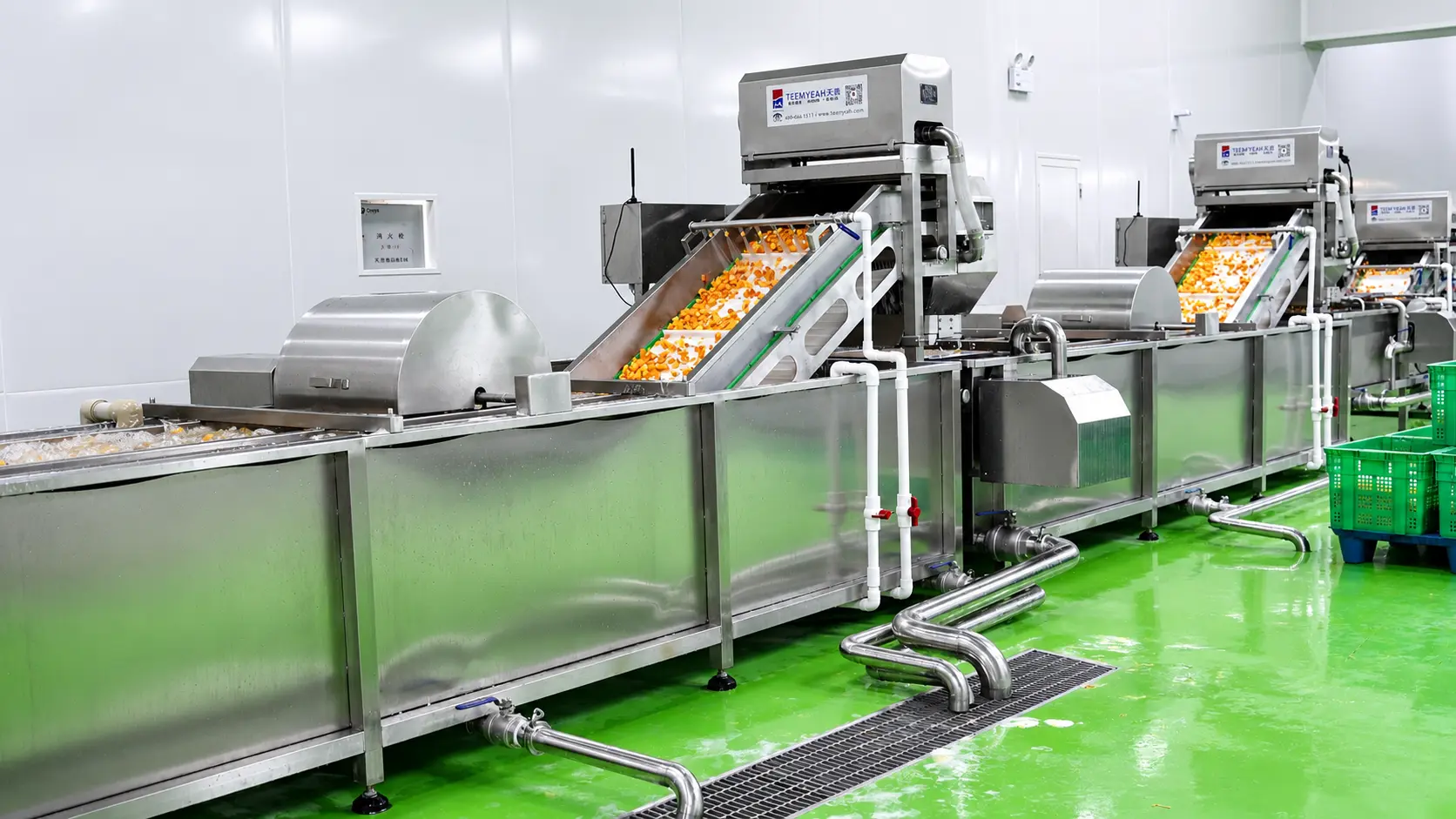
Manual cutting is flexible, but it is not always consistent.
Two experienced workers may produce similar results.
Two inexperienced workers may not.
Differences can appear in:
- slice thickness;
- dice dimensions;
- shred width;
- trimming depth;
- product length;
- breakage;
- bruising.
This affects much more than appearance.
For vegetables that will be cooked, inconsistent dimensions can create inconsistent cooking behavior. Smaller pieces may soften faster while larger pieces remain underprocessed.
For portioned meals, inconsistent cuts can also affect visual presentation and serving uniformity.
For fresh-cut products, physical damage matters because processing changes the product itself. FDA defines fresh-cut produce as fruits or vegetables that have been physically altered from their whole state through operations such as chopping, dicing, peeling, shredding, slicing or tearing.
A processor therefore needs to distinguish between two very different questions:
- Can workers cut the vegetable?
- Can the operation repeatedly produce the required specification at commercial scale?
The first is a capability question.
The second is a process-control question.
This difference becomes increasingly important when supplying:
- restaurant chains;
- convenience stores;
- airlines;
- hospitals;
- schools;
- supermarkets;
- meal-kit businesses;
- ready-to-cook brands;
- ready-to-eat salad businesses.
Large customers are often purchasing consistency, not merely vegetables.
5. The Cost of Manual Preparation Includes Occupational Risk
Vegetable preparation involves repetitive movements, wet environments, lifting, reaching and sharp tools.
OSHA specifically identifies repetitive tasks and hand-tool use among ergonomic risk factors in food-service work. It also identifies knives and other sharp utensils as cutting hazards in food preparation.
At the wider industry level, U.S. Bureau of Labor Statistics data show that food manufacturing recorded 3.3 total recordable injury and illness cases per 100 full-time workers in 2024. The rate for frozen fruit, juice and vegetable manufacturing was 4.5 cases per 100 full-time workers. These figures describe entire industries rather than manual vegetable cutting specifically, but they illustrate that occupational safety is a material operating issue in food production.
A real OSHA investigation provides a simple example.
In 2021, a restaurant employee cutting carrots with a knife suffered a finger laceration requiring medical treatment. This was one individual accident, not a statistical estimate of vegetable-preparation injury frequency, but it shows how an ordinary preparation activity can become an occupational incident.
The financial cost of an injury may include more than medical treatment.
Operational consequences can involve:
- lost working time;
- replacement labor;
- investigation;
- production interruption;
- additional supervision;
- workers’ compensation exposure;
- lower productivity during recovery.
Automation does not eliminate occupational risk.
Machines introduce different hazards and require proper guarding, training, lockout procedures and safe cleaning practices.
The objective is therefore not to replace one unmanaged risk with another.
A well-designed process moves suitable repetitive tasks from continuous manual execution into controlled equipment while retaining human judgment where it adds value.
6. Every Extra Handling Step Is Another Process-Control Point
Food safety is one of the most important areas where simplistic arguments about automation should be avoided.
A machine does not automatically make food safe.
A poorly designed or poorly cleaned machine can spread contamination.
Manual preparation, however, can also create a large number of contact points:
- hands;
- gloves;
- knives;
- cutting boards;
- tables;
- baskets;
- tubs;
- transfer containers;
- sinks.
The operational question is not simply manual versus machine.
It is:
How many uncontrolled or difficult-to-standardize product-contact events exist in the process?
FDA guidance for fresh-cut fruits and vegetables explains that contamination present on raw agricultural commodities can spread to additional produce during processing if it is not adequately controlled. FDA also states that washing—even with disinfectants—can reduce pathogens but cannot be assumed to eliminate them.
That is particularly important for ready-to-eat products, where there may be no later cooking step to provide a kill step.
The consequences of a produce safety failure can be severe.
The 2018 multistate E. coli O157:H7 outbreak linked to romaine lettuce from the Yuma growing region resulted in 210 reported cases, 96 hospitalizations and five deaths. The outbreak was traced to the growing region; it should not be presented as evidence that manual vegetable preparation caused the event. It does demonstrate the potential consequences when contamination enters a ready-to-eat produce supply chain.
CDC estimates that foodborne illness causes approximately 48 million illnesses, 128,000 hospitalizations and 3,000 deaths annually in the United States. These figures cover the entire food system, not vegetable preparation alone.
The practical lesson for processors is straightforward.
As volume increases, food safety should depend less on individual memory and more on process design.
That may include:
- defined product flow;
- hygienic zoning;
- controlled wash parameters;
- separation of raw and higher-hygiene areas;
- standardized sanitation;
- documented chemical concentration where applicable;
- controlled contact time;
- equipment that can be inspected and cleaned;
- traceable production records.
The value of automation is not that steel is inherently safer than people.
Its value is that a repeatable process can be easier to define, monitor and audit—provided that the equipment and sanitation system are properly designed.
7. Cleaning Ten Small Things Can Cost More Than Cleaning One Well-Designed System
Manual preparation is often described as simple because the individual tools are simple.
But simple tools can multiply.
A growing preparation room may contain:
- 20 knives;
- 10 cutting boards;
- multiple washing tubs;
- dozens of plastic baskets;
- several tables;
- mobile carts;
- storage racks;
- weighing containers.
Every food-contact item must be managed.
The cost appears in:
- collection;
- pre-rinsing;
- washing;
- sanitizing;
- inspection;
- drying;
- storage;
- replacement.
This does not mean that larger machinery is automatically easier to clean.
Some machines are difficult to access and poorly designed for sanitation.
This is why sanitary design and cleanability should be major equipment-selection criteria.
When evaluating a vegetable washing machine, cutting machine or complete fresh-cut vegetable processing line, processors should ask:
- Can food-contact areas be accessed?
- Can belts or components be removed where necessary?
- Are there hidden product accumulation points?
- How long does changeover take?
- How much labor is required for sanitation?
- Can operators visually verify cleanliness?
A low purchase price can become expensive if sanitation requires excessive labor every day.
8. Manual Processes Consume More Space Than Most Managers Realize
A manual vegetable preparation department does not only require space for workers.
It also needs space between workers.
It needs:
- raw-material staging;
- empty crate storage;
- full crate storage;
- worktables;
- washing containers;
- trimming waste containers;
- handwashing access;
- walkways;
- temporary work-in-process.
As production grows, the preparation area can become increasingly fragmented.
Workers start moving products between stations because the process itself does not flow continuously.
The result is often:
receive → wait → trim → wait → wash → wait → cut → wait → transfer
Each waiting stage creates work-in-process.
Work-in-process occupies space, requires containers and makes production status more difficult to see.
A continuous or semi-continuous line can reduce some of these interruptions by connecting suitable process steps.
But good layout comes before equipment.
A badly planned automated line can simply create a more expensive traffic problem.

9. The Biggest Manual Cost May Appear Only When the Business Tries to Grow
A manually operated facility may perform well at 500 kg per day.
At 1,000 kg per day, management adds workers.
At 2,000 kg, another shift begins.
At 4,000 kg, the problem becomes more complex.
More people require:
- more supervision;
- more training;
- more lockers and welfare facilities;
- more working space;
- more scheduling;
- more coordination.
Output does not always increase linearly with headcount.
At some point, workers begin interfering with each other’s movement. Product waits for available tables. Wash stations become congested. Downstream machines wait for material.
This is why fast-growing food businesses often feel that they have a “labor problem” when they actually have a process architecture problem.
The solution may not be complete automation.
It may be a combination such as:
- manual inspection;
- mechanical washing;
- standardized cutting;
- automated transfer between selected stages;
- mechanical dewatering;
- manual final quality control.
The correct level of automation depends on the product.
Manual vs. Semi-Automated vs. Automated Vegetable Preparation
| Factor | Primarily Manual | Semi-Automated | More Highly Automated |
|---|---|---|---|
| Initial capital investment | Low | Medium | High |
| Product flexibility | Very high | High | Depends on line design |
| Dependence on labor availability | High | Medium | Lower |
| Throughput consistency | Highly operator-dependent | More stable | Potentially highly stable |
| Ability to handle irregular products | Strong | Strong with manual inspection | Depends on equipment |
| Cutting consistency | Operator-dependent | More standardized | Highly standardized when correctly configured |
| Expansion method | Add workers and stations | Add equipment or shifts | Increase utilization or line capacity |
| Maintenance requirement | Low | Medium | Higher |
| Sanitation complexity | Many small tools and contact surfaces | Mixed | Depends heavily on sanitary design |
| Data and process control | Often limited | Moderate | Potentially strong |
| Best fit | Low volume, high variation | Growing processors | Stable, higher-volume production |
The purpose of this comparison is not to identify one universally superior system.
A vegetable processor with 50 highly variable SKUs may benefit from a different configuration than a processor producing 20 tons per day of a limited product range.
Automation is most effective when applied to repetitive, measurable bottlenecks.
The Real Comparison: Fixed Investment vs. Recurring Operational Cost
Many equipment discussions begin with this comparison:
Machine price versus labor salary.
A better comparison is:
Manual System Cost
Labor + supervision + recruitment + training + overtime + yield loss + injuries + sanitation labor + space + production variability
versus:
Automated System Cost
Capital investment + financing + operators + utilities + maintenance + spare parts + sanitation + depreciation + downtime risk
Both sides have costs.
Automation is not free after installation.
Machines require:
- maintenance;
- cleaning;
- trained operators;
- spare parts;
- technical support.
The business case becomes attractive when the automated or semi-automated system reduces the total cost and risk of producing the required output—not simply because it reduces headcount.
A Better Way to Calculate the Cost of Vegetable Preparation
Processors considering food pre-processing automation should build a baseline before requesting equipment quotations.
Track the current process for several representative production days.
1. Raw Material Input
Record kilograms entering the preparation process.
2. Saleable Output
Measure the acceptable finished product.
3. Labor Hours
Include:
- direct operators;
- team leaders;
- overtime;
- temporary workers.
4. Processing Time
Record:
- start time;
- finish time;
- waiting time;
- changeover time.
5. Waste
Separate:
- unavoidable biological waste;
- damaged material;
- excessive trim;
- rejected finished product.
6. Downtime
Record why production stops.
Possible causes include:
- waiting for labor;
- waiting for raw material;
- cleaning;
- equipment failure;
- downstream congestion.
The result allows management to calculate several important metrics:
Labor Hours per 1,000 kg
Total direct labor hours ÷ output × 1,000
Yield
Saleable output ÷ raw material input × 100
Processing Cost per Kilogram
Total preparation operating cost ÷ saleable kilograms
Throughput
Saleable kilograms ÷ production hours
Without this baseline, it is extremely difficult to calculate a credible vegetable processing ROI.
An Illustrative ROI Model
Assume a processor currently uses eight workers for vegetable preparation.
Using the previously cited U.S. median food-preparation wage only as a reference, direct wages could total approximately $263,200 per year under the assumed operating schedule.
Now imagine a proposed system changes the process.
The correct calculation is not:
Eight workers minus two workers equals machine savings.
Instead calculate:
Annual Measurable Benefit
Potentially including:
- reduction in direct labor hours;
- reduction in overtime;
- increased throughput;
- increased usable yield;
- reduced rejected product;
- reduced outsourcing;
- avoided need for additional production shifts.
Then subtract:
- maintenance;
- utilities;
- consumables;
- spare parts;
- additional sanitation cost;
- financing cost where relevant.
The remaining amount is the estimated annual operational benefit.
Simple Payback Period
Net Equipment Investment ÷ Annual Net Operational Benefit
This model is more useful than generic claims such as:
“The machine saves 70% of labor.”
That type of number is meaningless without knowing:
- the original process;
- the vegetable;
- the product specification;
- the line capacity;
- the required operators.
When Manual Vegetable Preparation Still Makes Sense
Automation is not always the right answer.
Manual preparation may remain appropriate when:
Production volume is low
A machine with significant capacity may remain underutilized.
SKU variety is extremely high
A facility processing many low-volume products may lose more time in equipment changeovers than it saves in production.
Raw materials are highly irregular
Some products still require human judgment for sorting or selective trimming.
Demand is unstable
A business without predictable orders may not yet have sufficient utilization to justify major capital investment.
The current bottleneck is somewhere else
Automating cutting will not improve total output if washing, packing or cold storage is already the true constraint.
This is why a professional automation project should begin with a process study rather than a machine catalog.
When Manual Preparation Becomes a Warning Sign
A business should investigate automation when several of the following conditions appear repeatedly:
- production cannot increase without adding workers;
- overtime is becoming normal;
- experienced workers are difficult to replace;
- daily throughput varies significantly;
- cut specifications are inconsistent;
- excessive work-in-process accumulates;
- downstream equipment regularly waits for prepared vegetables;
- the preparation area is becoming congested;
- sanitation consumes increasing labor;
- supervisors spend too much time coordinating basic production;
- large customers require higher consistency or traceability.
One symptom alone may not justify investment.
Several occurring together usually indicate that the existing preparation model is approaching its practical limit.
Do Not Automate a Bad Process
One of the most expensive mistakes in food processing is automating an inefficient workflow.
Suppose the current process contains unnecessary handling:
crate → table → basket → tank → basket → table → crate
Buying faster equipment without redesigning material flow may simply move the bottleneck.
Before selecting equipment, map:
- raw-material receiving;
- sorting;
- trimming;
- pre-washing;
- cutting;
- main washing;
- dewatering;
- inspection;
- packing.
Not every product follows this exact sequence.
Whole vegetables, cut vegetables, leafy salads and root vegetables may require different processes.
The aim is to determine:
- which steps require human judgment;
- which steps are repetitive;
- where product waits;
- where contamination control is critical;
- where damage occurs;
- where labor is concentrated.
Only then should the equipment configuration be designed.
The Best Automation Strategy Is Often Phased
For many growing food businesses, the choice is not:
100% manual or 100% automatic.
A phased approach is often more practical.
Phase 1: Remove the Main Bottleneck
This might involve:
Phase 2: Connect the Process
Reduce unnecessary manual transfers between major machines.
Phase 3: Improve Process Control
Add appropriate monitoring, standardized operating parameters and production records.
Phase 4: Expand Capacity
Increase equipment capacity only after demand justifies it.
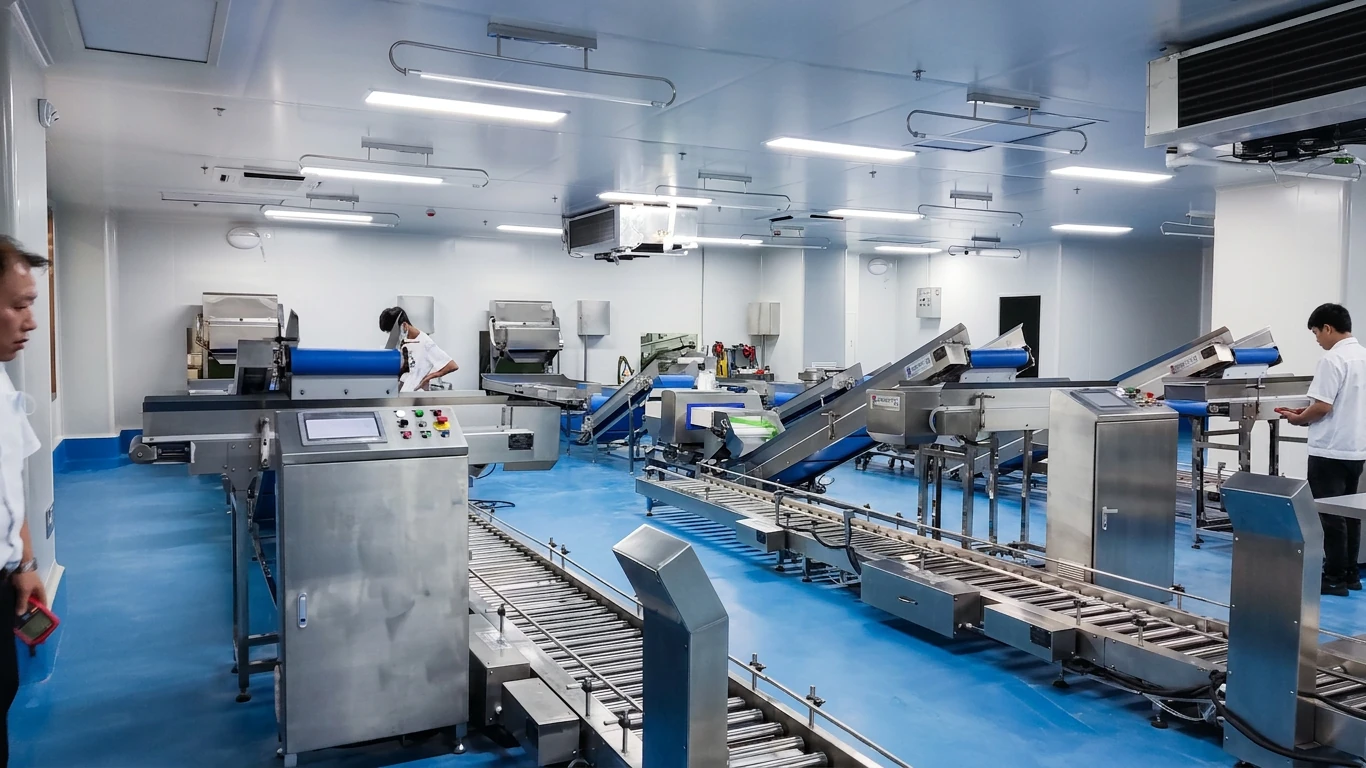
This approach can reduce capital risk while allowing the production system to grow with the business.
What Should You Look for in Vegetable Processing Equipment?
Price matters.
But it should not be the only selection criterion.
A vegetable preparation system must operate in the real world—not in a supplier’s quotation.
Evaluate:
Product Compatibility
Can the machine process your actual vegetables without unacceptable damage?
Realistic Capacity
Is the stated capacity based on a comparable raw material and product specification?
Yield
Does the process remove more usable material than necessary?
Product Quality
Does washing, cutting or conveying damage the product?
Sanitary Design
Can operators access and clean the product-contact areas?
Reliability
Can the equipment operate consistently during the required production schedule?
Maintenance
Are wear parts and spare parts available?
After-Sales Support
What happens when technical assistance is required?
Line Balance
Does each machine match the capacity of upstream and downstream processes?
A low-cost machine that becomes a daily bottleneck is expensive.
A high-capacity machine that cannot be properly cleaned is also expensive.
The best system is not necessarily the machine with the largest motor, highest theoretical capacity or lowest quotation.
It is the system that repeatedly produces the required product, at the required quality and capacity, with a manageable total operating cost.
Conclusion: Manual Work Is Not Free Just Because There Is No Machine Invoice
Manual vegetable preparation will always have an important role in food processing.
Human operators remain extremely valuable for:
- inspection;
- judgment;
- irregular raw materials;
- quality control;
- flexible production.
The mistake is assuming that manual processing remains the cheapest system simply because no large capital purchase appears on the balance sheet.
As volume grows, manual preparation can create costs that are distributed across the operation:
- labor;
- yield;
- variability;
- food safety;
- occupational risk;
- sanitation;
- space;
- supervision;
- delayed expansion.
Because these costs appear in different budgets, they are easy to miss.
The most useful question is therefore not:
“How much does an automated vegetable processing line cost?”
The better starting question is:
“What is our current cost to produce one kilogram of consistent, saleable product—and what is preventing that cost from falling as we grow?”
Once that number is understood, automation becomes a business decision rather than a machinery purchase.
Planning a More Efficient Vegetable Preparation Process?
TEEMYEAH develops vegetable pre-processing equipment and customized processing solutions for food manufacturers, central kitchens, catering operations, fresh-cut vegetable processors and ready-to-cook or ready-to-eat production facilities.
Rather than starting with a machine model, a more useful discussion starts with your actual operation:
- What vegetables are you processing?
- What condition are they in when received?
- What finished products do you need?
- What is your current and target capacity?
- Where is the existing bottleneck?
- How much space is available?
Based on this information, a suitable process can be evaluated—from individual washing, cutting or dewatering equipment to a more integrated vegetable preparation line.
Discuss your project with TEEMYEAH →
Frequently Asked Questions
1. Is manual vegetable preparation cheaper than automation?
It can be at low production volumes.
Manual preparation requires relatively little capital investment and offers excellent flexibility. As volume grows, however, labor, supervision, inconsistent throughput, sanitation, work-in-process and other operating costs can increase.
The correct comparison is total cost per kilogram of acceptable finished product, not simply worker salary versus machine price.
2. At what production capacity should a business automate vegetable preparation?
There is no universal capacity threshold.
The decision depends on:
- vegetable type;
- SKU variety;
- labor cost;
- production hours;
- required cut specification;
- existing process;
- facility layout.
A 500 kg-per-hour operation with many highly variable products may require a different automation strategy from a 500 kg-per-hour operation producing one standardized product.
3. How can I calculate the real cost of manual vegetable preparation?
Track:
- raw-material kilograms;
- finished-product kilograms;
- labor hours;
- overtime;
- processing time;
- waste;
- rejected product;
- downtime.
Calculate labor hours per 1,000 kg, yield percentage, throughput and total preparation cost per saleable kilogram.
This baseline can then be compared with a proposed automated or semi-automated system.
4. Does automation always improve vegetable yield?
No.
Yield depends on the vegetable, raw-material quality, trimming requirements and equipment configuration.
A poorly selected machine can damage product or remove too much usable material.
Yield testing with representative raw materials should therefore be part of equipment evaluation whenever possible.
5. Can automated vegetable processing improve food safety?
Automation can make a process more standardized and reduce some uncontrolled handling, but equipment alone does not guarantee food safety.
Fresh-cut produce still requires proper process design, sanitation, hygienic zoning, water management and operational controls. FDA guidance also emphasizes that washing can reduce pathogens but should not be assumed to eliminate them.
6. What is the difference between semi-automated and fully automated vegetable processing?
A semi-automated process combines human operations with machines.
For example:
manual inspection → automated cutting → mechanical washing → mechanical dewatering → manual final inspection
A more highly automated line may also integrate conveying, dosing and automatic transfers.
Many food processors do not need complete automation. Removing the largest bottlenecks can often be a more practical starting point.
7. What should I consider before buying a vegetable processing line?
Consider:
- raw materials;
- finished-product specifications;
- realistic capacity;
- yield;
- product damage;
- hygiene;
- cleanability;
- reliability;
- spare parts;
- technical support;
- factory layout;
- upstream and downstream capacity.
The cheapest quotation does not necessarily create the lowest operating cost.
8. What is the biggest hidden cost of manual vegetable preparation?
It varies by operation.
For one business, labor may dominate.
For another, the biggest cost may be excessive trimming, inconsistent output, overtime, sanitation or an inability to expand production.
This is why a process should be measured before automation decisions are made.
Data and Source Notes
The external data used in this article are drawn from the U.S. Bureau of Labor Statistics, OSHA, FDA, CDC and USDA. Industry-wide statistics are used for context and are not presented as performance guarantees for an individual vegetable processing facility. Illustrative calculations in the article are clearly identified as examples and should be replaced with a processor’s own labor, yield, production and operating data when conducting an investment analysis.

