




Automated food pre-processing line cost can vary widely, and an automated food pre-processing line can cost anywhere from the price of several standalone machines to a multimillion-dollar investment in a fully integrated processing facility.
That answer is accurate, but it is not very useful to a food manufacturer, central kitchen or catering company preparing an investment budget.
A more practical answer is that the cost depends on what the line must actually accomplish.
A system that washes and cuts 300 kilograms of vegetables per hour is not comparable with a ready-to-eat salad line processing 1,500 kilograms per hour. A central kitchen handling 30 ingredients in short batches has different requirements from a factory processing one product continuously. A ready-to-cook vegetable line does not require exactly the same hygienic zoning, water controls or post-wash handling as a ready-to-eat production line.
The equipment price is therefore only one part of the investment.
Companies also need to account for installation, utilities, drainage, refrigeration, hygienic construction, packaging, commissioning, employee training, spare parts, maintenance and the cost of integrating the line with the rest of the factory.
There is an equally important question behind the quoted price:
Will the line produce acceptable food, at the required capacity, with stable operation and a commercially viable yield?
A low-priced line that damages the product, loses too much usable material or stops frequently can become more expensive than a higher-quality system within a relatively short operating period.
This guide explains the realistic cost structure of an automated food pre-processing line, why published prices vary so widely, what buyers should include in a project budget and how to compare competing proposals without allowing the lowest quotation to hide the highest long-term cost.
What Is an Automated Food Pre-Processing Line?
An automated food pre-processing line is a connected system of machines that prepares raw food materials for cooking, packaging, freezing, mixing or further manufacturing.
Depending on the product, the line may perform some or all of the following operations:
- raw-material receiving;
- sorting and visual inspection;
- trimming;
- peeling;
- cutting, slicing, shredding or dicing;
- washing;
- antimicrobial treatment;
- rinsing;
- dewatering or drying;
- inspection;
- weighing;
- packing;
- transferring ingredients to the next production process.
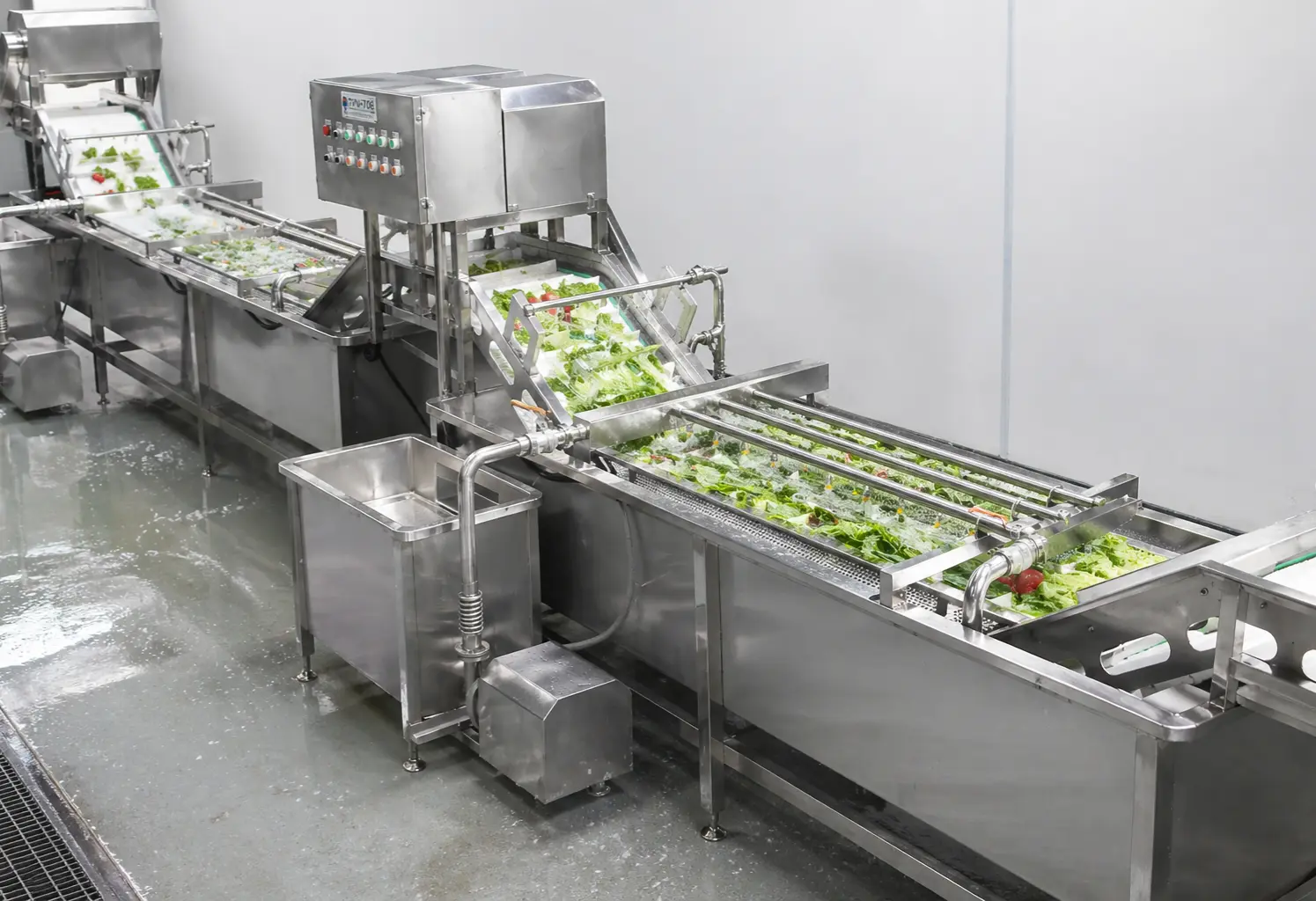
A vegetable processing line, for example, may include an inspection table, vegetable cutting machine, washing tanks, sanitizer dosing system, vibration dewatering unit, centrifugal dryer and packing conveyor.
A root-vegetable line may use abrasive peeling, trimming, cutting and washing equipment.
A central kitchen may need several smaller machines instead of one continuous line because it processes many ingredients in different batch sizes.
The word automated also covers several levels of automation.
It does not always mean that raw produce enters one end of a factory and packaged products leave the other end without human involvement. Most systems still require employees to inspect ingredients, trim defects, load products, monitor processing conditions, change cutting tools, collect output and complete sanitation procedures.
The investment can therefore range from partial automation of one bottleneck to a highly integrated facility with conveyors, process controls, automatic chemical dosing, water filtration, data collection and packaging equipment.

How Much Should a Company Budget?
There is no authoritative global database showing the average price of an automated food pre-processing line. Suppliers configure systems differently, public quotations rarely include the same scope, and facility construction costs vary significantly by country.
The ranges below should therefore be treated as early-stage capital-planning bands, not fixed market prices or formal quotations.
They are intended to help a company determine whether its project is closer to a small equipment upgrade, a semi-automated preparation department or an industrial processing facility.
| Project level | Typical configuration | Indicative equipment budget | Common applications |
|---|---|---|---|
| Standalone automation | One or several independent cutters, peelers, washers or dewatering machines | USD 10,000–75,000 | Restaurants, small commissaries, catering kitchens, pilot production |
| Compact semi-automated line | Sorting, cutting, washing and dewatering with manual transfer or packing | USD 50,000–200,000 | Central kitchens, produce distributors, small fresh-cut processors |
| Integrated medium-capacity line | Connected conveyors, inspection, cutting, multi-stage washing, dewatering and basic controls | USD 150,000–500,000 | Restaurant groups, institutional caterers, regional food manufacturers |
| High-hygiene or higher-capacity line | Multiple washing stages, dosing and monitoring, hygienic design, automated transfer and packaging integration | USD 400,000–1.5 million | RTE salad plants, large central kitchens, industrial fresh-cut production |
| Turnkey processing facility | Several product lines, refrigeration, utilities, wastewater systems, packaging, building modifications and process engineering | USD 1 million–10 million or more | Large food factories, national distribution facilities, multi-category plants |
These ranges overlap because two lines with similar hourly capacity may have very different technical scope.
A basic 1,000-kilogram-per-hour root-vegetable washing line may cost less than a lower-capacity ready-to-eat leafy vegetable line. Root vegetables can often tolerate stronger mechanical action, while delicate salad leaves may require controlled water movement, multiple washing stages, gentle transfer, sanitizer management and careful dewatering.
Publicly described commercial lines illustrate the capacity variation. One European supplier describes vegetable processing systems with capacities of up to 1,000 kilograms per hour and larger configurations reaching 2,000 kilograms per hour, with cutting, washing, sorting and drying stages selected according to the application. The supplier does not publish a universal price because the process is configured around the customer’s products and requirements.
That absence of a standard price is typical of industrial food-processing equipment. The supplier cannot calculate a responsible quotation without knowing what the customer is processing and what the finished product must look like.
Why Do Food Pre-Processing Line Prices Vary So Much?
A line price is influenced by more than its physical size.
The major cost drivers are product characteristics, required capacity, process complexity, hygiene level, degree of automation and the amount of facility work needed to make the equipment operational.
1. The Raw Material
Different foods require different mechanical handling.
Potatoes, carrots and other dense root vegetables can normally withstand stronger washing and transfer forces. Lettuce, spinach, herbs, tomatoes and cut fruit are much more sensitive to impact, compression and long drop heights.
A machine that moves product aggressively may achieve impressive throughput during an empty or water-only demonstration, yet damage a significant percentage of delicate produce during actual production.
The supplier may need to change:
- conveyor materials;
- belt openings;
- water flow;
- air-bubble intensity;
- spray pressure;
- tank dimensions;
- cutting tools;
- discharge heights;
- dewatering speed;
- contact time.
The same nominal capacity can therefore require different engineering and equipment costs for different foods.
2. The Required Finished Product
“Vegetable processing” is too broad to define a line.
A supplier needs to know whether the customer requires:
- whole washed vegetables;
- peeled vegetables;
- 3-millimeter slices;
- 10-millimeter dice;
- shredded cabbage;
- separated lettuce leaves;
- ready-to-cook ingredients;
- ready-to-eat salad;
- chilled bulk packs;
- retail-size packages.
Cutting accuracy, surface damage, residual moisture and allowable defects may all affect machine selection.
A factory supplying ingredients for soup may tolerate more variation than a retail fresh-cut producer selling visually consistent products in transparent packaging.
3. Hourly Capacity
Capacity is one of the strongest price drivers, but it is also one of the most frequently misunderstood specifications.
A quotation stating “1,000 kg/h” is incomplete unless it identifies:
- the product;
- incoming size and condition;
- required cut;
- acceptable damage;
- number of operators;
- continuous or batch operation;
- cleaning and changeover time;
- test conditions;
- whether the figure refers to input or acceptable output.
One cubic meter of leafy vegetables does not weigh the same as one cubic meter of potatoes. A conveyor that transports dense root vegetables efficiently may become overloaded by bulky lettuce even when the weight is lower.
Buyers should ask for product-specific capacity rather than a single number applied to every ingredient.
4. RTE Versus RTC Production
Ready-to-cook food receives a cooking step before consumption. Ready-to-eat food may be consumed without a subsequent kill step.
That difference affects the entire line design.
A ready-to-eat fresh-cut vegetable system may require:
- stronger hygienic separation;
- multiple washing stages;
- controlled sanitizer dosing;
- water-quality monitoring;
- lower product temperatures;
- reduced post-wash exposure;
- hygienic dewatering;
- protected packing areas;
- more intensive sanitation verification.
FDA guidance for fresh-cut fruit and vegetable processors emphasizes that equipment design, processing water, sanitation, employee hygiene and prevention of cross-contamination must be considered as a connected food-safety system.
The price of an RTE line should not therefore be compared directly with the price of a basic vegetable washer. They are solving different operational and food-safety problems.
5. Degree of Automation
A line using employees to transfer baskets between machines will generally cost less than a continuous line using conveyors, automatic feeding and integrated controls.
Automation may include:
- feed conveyors;
- automatic level control;
- variable-speed drives;
- automatic chemical dosing;
- water recirculation;
- sensors;
- alarms;
- recipe settings;
- automatic weighing;
- production data collection;
- packaging integration;
- centralized control panels.
Each feature adds capital cost, but some features reduce dependence on operator judgment and improve process repeatability.
The correct decision is not to maximize automation. It is to automate the tasks that constrain capacity, quality, hygiene or labor efficiency.
6. Hygienic Design and Cleanability
Food-contact equipment must be designed for its intended use and must support cleaning, sanitation and maintenance.
FDA HACCP guidance states that production equipment should follow sanitary design principles, while preventive-maintenance, calibration and cleaning procedures should be established and documented.
Cleanability affects price through:
- stainless-steel grade and thickness;
- weld quality;
- drainage design;
- open or hollow structural sections;
- belt-removal systems;
- tool-free disassembly;
- access to pumps and pipework;
- protection of motors and electrical components;
- avoidance of product-retention points;
- sanitary fittings;
- compatibility with cleaning chemicals.
A cheaper machine may use more fixed covers, inaccessible pipework or belts that are difficult to remove. That saving appears in the quotation, but the factory pays for it every day through longer sanitation time and higher contamination risk.
7. Packaging and Cold-Chain Requirements
A processing line may stop at dewatering, or it may continue through:
- weighing;
- filling;
- modified-atmosphere packaging;
- vacuum packaging;
- sealing;
- metal detection;
- labeling;
- case packing;
- palletizing.
Packaging can represent a substantial part of the project cost.
Fresh-cut produce may also require chilled raw-material storage, temperature-controlled processing rooms, finished-product refrigeration and refrigerated distribution. These expenses are often excluded from an equipment-only quotation.
What Is Included in the Quoted Equipment Price?
Before comparing suppliers, buyers should normalize the scope of each proposal.
One supplier may quote only the machines. Another may include conveyors, electrical controls, installation and commissioning. The second quotation will naturally appear higher even when it offers better overall value.
The following table shows the items that should be checked.
| Cost item | Frequently included? | Questions the buyer should ask |
|---|---|---|
| Main processing machines | Usually | Are all required operations included? |
| Transfer conveyors | Sometimes | Who supplies the connections between machines? |
| Cutting blades and tools | Partially | How many cutting specifications are included? |
| Electrical control cabinet | Usually | Does it meet local voltage and component requirements? |
| Sanitizer dosing system | Optional | Are monitoring instruments and calibration included? |
| Water filtration or recycling | Optional | What water-quality assumptions were used? |
| Dewatering equipment | Sometimes | Is it suitable for the actual product and residual-moisture target? |
| Packaging equipment | Often excluded | Where does the quoted process end? |
| Freight and insurance | Often excluded | Is the price EXW, FOB, CIF or delivered? |
| Customs duties and taxes | Usually excluded | Who is responsible for import clearance? |
| Installation | Varies | Does the supplier provide mechanical and electrical installation? |
| Commissioning | Varies | Will the line be tested with the customer’s products? |
| Operator training | Sometimes | Is training remote or on site, and in which language? |
| Spare parts | Partially | Which startup and wear parts are included? |
| Building work | Usually excluded | Are floors, drains, walls and foundations ready? |
| Utilities | Usually excluded | Who provides water, air, power, steam and refrigeration? |
| Certification or inspection | Varies | Which local standards must the equipment satisfy? |
A buyer comparing only the final numbers at the bottom of two quotations may unknowingly compare different projects.

Equipment Cost Versus Total Installed Cost
The line itself is often not the total investment.
A useful early-stage formula is:
Total installed project cost = equipment + freight + import costs + installation + utilities + facility modifications + commissioning + training + startup inventory
Facility-related expenses can include:
- floor drainage;
- waterproof wall and ceiling finishes;
- hygienic partitions;
- electrical distribution;
- compressed air;
- hot and cold water;
- wastewater handling;
- refrigeration;
- ventilation;
- foundations or platforms;
- fire protection;
- staff changing facilities;
- laboratory or quality-control areas.
For a new factory, the processing machines may be only one part of a much larger project.
For an existing central kitchen with suitable utilities and drainage, installation may be comparatively simple.
This is why the same equipment package can produce significantly different total project costs in two facilities.
A Practical Cost-Comparison Example
Consider two suppliers offering a vegetable washing and cutting line.
Supplier A quotes USD 120,000. Supplier B quotes USD 155,000.
At first glance, Supplier A appears to be USD 35,000 cheaper.
A detailed comparison shows the following:
| Evaluation item | Supplier A | Supplier B |
|---|---|---|
| Quoted equipment price | USD 120,000 | USD 155,000 |
| Transfer conveyors | Excluded | Included |
| Installation supervision | Remote only | On-site support included |
| Startup spare parts | Minimal | Two-year recommended package |
| Blade specifications | Two | Five |
| Belt-removal design | Requires tools | Tool-free quick removal |
| Sanitizer monitoring | Manual | Integrated dosing and monitoring |
| Local electrical components | Not confirmed | Confirmed |
| Product test | Water-only factory test | Test with customer’s raw material |
| Performance criteria | Input capacity | Acceptable finished output |
| Warranty response | Case-by-case | Defined response procedure |
The purpose of this example is not to suggest that the more expensive supplier is automatically better. Supplier A may still be appropriate for a simple RTC application.
It shows why the initial price difference cannot be evaluated until the technical and service scope is normalized.
The Price of Poor Yield
Yield is one of the most financially important factors in food pre-processing, yet it is frequently absent from purchasing discussions.
The basic calculation is:
Yield percentage = acceptable finished product ÷ incoming raw material × 100
Imagine a factory processing 2,000 kilograms of vegetables each day for 300 production days per year.
Supplier A’s line produces an average acceptable yield of 82%. Supplier B’s line produces 85%.
The difference is three percentage points.
Annual raw-material throughput:
2,000 kg × 300 days = 600,000 kg
Additional acceptable output from the three-point yield improvement:
600,000 kg × 3% = 18,000 kg
At a raw-material value of USD 1.20 per kilogram, that difference represents USD 21,600 of product annually before considering the value added through cutting, washing and packaging.
| Yield scenario | Acceptable annual output | Difference |
|---|---|---|
| 82% yield | 492,000 kg | — |
| 85% yield | 510,000 kg | 18,000 kg |
| Value at USD 1.20/kg | USD 590,400 | USD 21,600 more usable material |
This is a hypothetical calculation rather than a claimed result for a particular machine. It demonstrates why even a small difference in peeling loss, cutting damage or product rejection can materially affect the investment decision.
A line that costs USD 30,000 less but loses USD 20,000 more product every year is not the cheaper line in economic terms.

Output Rate Is Not the Same as Saleable Output
Suppliers may measure capacity in different ways.
One may report the amount entering the line. Another may report the amount leaving the final machine. Neither number necessarily represents acceptable, packed product.
A better performance measure is:
Saleable output per hour = processed output − defects − damage − excess trim − rework
The buyer should define acceptance criteria before testing:
- permissible breakage;
- cut-size tolerance;
- residual peel;
- defect rate;
- foreign-material standard;
- residual moisture;
- product temperature;
- microbial or process-water requirements where applicable.
Without agreed criteria, a machine can appear to meet capacity while producing output the customer cannot sell.
Stability and Uptime Matter More Than Peak Speed
A line that reaches 1,500 kilograms per hour for a short demonstration is not necessarily more productive than a line that runs steadily at 1,200 kilograms per hour for an entire shift.
Sustainable capacity depends on:
- feeding consistency;
- product accumulation;
- blade changes;
- cleaning interruptions;
- jams;
- sensor faults;
- operator skill;
- maintenance;
- downstream capacity.
Overall equipment effectiveness, or OEE, is often used to evaluate the relationship between availability, performance and quality:
OEE = availability × performance × quality
Suppose Line A has a rated capacity of 1,500 kg/h but achieves:
- 75% availability;
- 85% performance;
- 92% acceptable quality.
Its effective output factor is approximately 58.7%.
Line B is rated at 1,200 kg/h but achieves:
- 90% availability;
- 92% performance;
- 97% acceptable quality.
Its effective output factor is approximately 80.3%.
| Measure | Line A | Line B |
|---|---|---|
| Rated capacity | 1,500 kg/h | 1,200 kg/h |
| Availability | 75% | 90% |
| Performance | 85% | 92% |
| Quality | 92% | 97% |
| Calculated OEE | 58.7% | 80.3% |
| Effective acceptable output | About 881 kg/h | About 964 kg/h |
Although Line A has the higher catalogue capacity, Line B produces more acceptable output under the assumptions used.
Again, this is an illustrative calculation. The inputs must be replaced with factory data during a real investment study.
Why Maintenance and Downtime Belong in the Cost Calculation
Industrial equipment eventually requires inspection, adjustment, replacement parts and repair.
The economic issue is not whether maintenance will occur. It is whether the supplier and factory are prepared to manage it.
NIST reported that U.S. manufacturers spent approximately USD 50 billion on reported maintenance and repair in 2016, excluding some internal labor, materials and losses from unscheduled downtime. NIST’s broader maintenance research also notes manufacturer-reported reductions of 35%–45% in downtime and 65%–95% in defects after improvements in maintenance practices, although results vary by company and application.
These figures are not specific to vegetable-processing lines, but they illustrate an important purchasing principle: maintenance capability has financial value.
Before selecting equipment, investigate:
- expected service intervals;
- wear-part life;
- local availability of bearings, motors and sensors;
- blade-sharpening requirements;
- lubrication points;
- access for inspection;
- diagnostic functions;
- preventive-maintenance documentation;
- supplier response time;
- remote troubleshooting capability;
- stock of critical spare parts.
A specialized machine may perform well but still create unacceptable risk if a low-cost sensor or imported belt takes several months to replace.
After-Sales Service: What Should Be Compared?
“After-sales service included” is too vague to be useful.
Buyers should ask suppliers to describe the service process in operational terms.
| Service factor | Weak answer | Stronger answer |
|---|---|---|
| Warranty scope | “One-year warranty” | Written list of covered and excluded parts |
| Response time | “We reply quickly” | Defined acknowledgement and troubleshooting target |
| Remote support | Messaging only | Video diagnosis, wiring diagrams and guided testing |
| On-site support | “Available if needed” | Engineer availability, rates and travel responsibility stated |
| Spare parts | “Parts can be supplied” | Recommended stock list and lead times |
| Documentation | Basic manual | Operation, cleaning, maintenance and parts documentation |
| Training | Machine introduction | Operator, sanitation and maintenance training |
| Software support | Not specified | Backup, access level and update policy |
| Local components | Unknown brands | Components selected for regional availability |
| Escalation | Salesperson handles everything | Technical escalation path and responsible contacts |
A supplier with reliable equipment and responsive engineering support may create more value than a supplier offering a lower price but weak documentation and uncertain spare-part availability.
Manual Preparation Versus an Automated Line
Automation should be compared with the actual cost of the existing process, not with labor wages alone.
The full manual cost may include:
- direct preparation labor;
- supervision;
- recruitment and training;
- overtime;
- inconsistent yield;
- product rework;
- occupational injuries;
- excess floor space;
- duplicated preparation across sites;
- production delays;
- sanitation labor.
The U.S. Bureau of Labor Statistics reported a median hourly wage of USD 16.45 for food preparation workers in May 2024. It also reported a median annual wage of USD 40,050 for food-processing equipment workers, showing that automated production still requires trained employees rather than eliminating labor entirely.
A realistic labor model must include payroll taxes, benefits, overtime, absence coverage and the employees who continue operating, inspecting and cleaning the automated line.
Illustrative Labor Comparison
Suppose a manual department uses 12 preparation workers, while the proposed line requires four operators and inspectors.
Assume:
- loaded labor cost: USD 22 per hour;
- one eight-hour shift;
- 250 production days per year.
Manual annual labor:
12 × USD 22 × 8 × 250 = USD 528,000
Automated-line operating labor:
4 × USD 22 × 8 × 250 = USD 176,000
Illustrative gross labor difference:
USD 352,000 per year
The calculation does not prove that a particular line will remove eight positions. It shows how the buyer should structure the analysis.
The final model must also deduct:
- maintenance;
- energy;
- water;
- consumables;
- financing;
- additional sanitation;
- replacement parts.
Automation Does Not Always Produce the Expected Savings
A useful automation article must also discuss unsuccessful or incomplete business cases.
Chipotle tested an automated tortilla-chip system but reported that setup and cleanup costs offset much of the expected labor savings. The company later deployed other technologies, including an avocado-processing system capable of processing an avocado in 26 seconds, while continuing to evaluate operational feedback before wider deployment.
The lesson is not that food automation fails.
The lesson is that automating the visible production task is insufficient when setup, cleaning, loading or product changeovers still consume substantial labor.
Food-processing buyers should calculate the entire work cycle:
setup → production → product changeover → shutdown → cleaning → reassembly
A machine that performs quickly during production may still offer a poor return if employees spend several hours disassembling and cleaning it.
A Public Example of Equipment Price Versus Project Economics
Public food-processing equipment prices are uncommon, but one documented case involving the Western Massachusetts Food Processing Center provides a useful perspective.
The center identified a used individually quick-frozen machine for approximately USD 20,000. Even at that discounted equipment price, the broader economics—including facility and operating considerations—made the investment difficult at the project’s scale.
This case reinforces a recurring pattern:
A low machine-purchase price does not guarantee an affordable processing project.
The equipment must have enough throughput and utilization to cover:
- installation;
- utilities;
- labor;
- cleaning;
- maintenance;
- storage;
- packaging;
- sales and distribution.
A machine used for only a few weeks each year may have a much longer payback than a higher-priced machine operating daily.
How to Calculate the Payback Period
A simplified payback calculation is:
Payback period = total installed investment ÷ annual net operating benefit
Annual net operating benefit may include:
- labor savings;
- additional contribution from higher output;
- improved yield;
- reduced rework;
- reduced outsourcing;
- lower product loss;
- lower preparation cost across multiple locations.
Operating expenses must then be deducted:
- energy;
- water;
- chemicals;
- maintenance;
- spare parts;
- additional skilled labor;
- finance cost where applicable.
Example
Assume:
- total installed investment: USD 350,000;
- labor savings: USD 150,000 per year;
- yield benefit: USD 35,000;
- additional contribution from new capacity: USD 80,000;
- annual maintenance, utilities and consumables: USD 45,000.
Annual net benefit:
USD 150,000 + USD 35,000 + USD 80,000 − USD 45,000 = USD 220,000
Simple payback:
USD 350,000 ÷ USD 220,000 = approximately 1.6 years
This is only an example. It excludes taxes, depreciation, financing, residual value and the time value of money.
For major investments, companies should use discounted cash-flow methods such as net present value and internal rate of return rather than relying only on simple payback.
Total Cost of Ownership: The Better Comparison
The total cost of ownership, or TCO, looks beyond the purchase price.
A practical food-processing TCO model can be written as:
TCO = acquisition + installation + operation + maintenance + downtime + quality losses + disposal − residual value
The comparison should include at least:
| TCO category | Examples |
|---|---|
| Acquisition | Equipment, controls, tooling, freight, import costs |
| Installation | Mechanical work, electrical work, utilities, commissioning |
| Operation | Labor, water, energy, chemicals, packaging |
| Maintenance | Service labor, blades, belts, bearings, pumps, sensors |
| Downtime | Lost production, overtime, emergency outsourcing |
| Quality loss | Low yield, damaged product, rework, rejected packs |
| Sanitation | Cleaning labor, water, chemicals, reassembly time |
| End of life | Removal, disposal, resale or residual value |
NIST defines life-cycle cost as the total discounted cost of owning, operating, maintaining and disposing of a system over the selected study period.
Although that definition is applied broadly rather than specifically to food-processing equipment, it provides the correct financial principle for comparing production lines.
What Factors Should Be Considered Besides Price?
Price is important. It simply should not be evaluated alone.
1. Product Suitability
The line must be designed for the actual raw materials, not a generic category such as “vegetables.”
Request trials using representative products from the customer’s production range.
A test should include difficult products, not only the easiest ingredient.
2. Acceptable Yield
Measure incoming weight, trim loss, process loss, damaged product and acceptable finished output.
Do not accept capacity claims without quality and yield criteria.
3. Stable Continuous Operation
Ask how long the system has been tested continuously.
A five-minute demonstration cannot prove shift-level stability.
The factory-acceptance test should include production duration, starts and stops, product accumulation and changeover where practical.
4. Hygienic Design
Inspect welds, hollow sections, drainage, food-contact surfaces, belt access and dismantling procedures.
A stainless-steel exterior does not automatically mean hygienic construction.
5. Cleaning Time
Ask the supplier to demonstrate disassembly and cleaning access.
Cleaning time affects daily available production hours and labor cost.
6. Maintenance Accessibility
Technicians should be able to inspect and replace wear parts without dismantling unrelated sections of the line.
7. Spare-Part Availability
Identify which parts are standard and which are custom.
Critical spare parts should be stocked before production begins.
8. Supplier Engineering Capability
A project supplier should be able to discuss product flow, hygiene zones, capacity balance and downstream processes—not merely machine models.
9. Industry Experience
Years in business do not guarantee performance, but processing experience matters.
Ask for applications involving comparable products, capacity and hygiene requirements.
10. Research and Development Capability
A supplier with internal engineering and testing capability is better positioned to modify conveyors, blades, water movement and control logic when standard equipment does not fit the application.
11. Safety
Automation can reduce repetitive manual work, but it introduces moving blades, conveyors, rotating components and electrical systems.
Guarding, interlocks, emergency stops, lockout procedures and training must be included in the evaluation.
12. Scalability
The line should accommodate realistic future changes.
Consider whether the customer may later need:
- another washing stage;
- higher throughput;
- new cut specifications;
- sanitizer dosing;
- automatic packaging;
- data collection;
- additional product categories.
A modular system can reduce the cost of future expansion.
How Should Buyers Compare Competing Food Pre-Processing Lines?
Use a weighted evaluation rather than awarding the project automatically to the lowest bidder.
| Evaluation category | Suggested weighting |
|---|---|
| Product quality and yield | 20% |
| Sustainable capacity | 15% |
| Hygienic design and cleanability | 15% |
| Reliability and maintenance | 15% |
| Technical solution and process fit | 10% |
| After-sales service | 10% |
| Total installed cost | 10% |
| Expansion potential | 5% |
| Total | 100% |
The weighting can be adjusted according to the project.
An RTE salad facility may assign more weight to hygiene and water control. A high-volume RTC central kitchen may emphasize capacity, changeover and labor efficiency. A remote facility may give greater weight to spare parts and technical support.
The important point is that price should remain visible without being allowed to erase every other operating requirement.
Questions to Ask Before Requesting a Quotation
A supplier can prepare a more credible proposal when the buyer provides:
- product list;
- product photographs;
- incoming raw-material condition;
- required cut shapes and dimensions;
- hourly or daily volume by product;
- operating hours;
- RTE or RTC classification;
- required washing process;
- sanitizer currently used;
- residual-moisture target;
- packaging format;
- available floor plan;
- electrical specification;
- water and drainage conditions;
- labor objectives;
- target commissioning date.
Without these details, the first quotation is usually a rough equipment estimate rather than a complete processing solution.
Final Perspective
The cost of an automated food pre-processing line cannot be reduced to one price per kilogram of capacity.
A compact group of standalone machines may require tens of thousands of dollars. An integrated washing, cutting and dewatering line may require several hundred thousand dollars. A high-hygiene RTE facility with packaging, refrigeration, utilities and building modifications can exceed one million dollars and may reach several million.
The correct investment is not necessarily the cheapest line, the most automated line or the line with the largest catalogue capacity.
It is the system that can consistently deliver:
- the required product;
- at the required quality;
- with acceptable yield;
- at sustainable capacity;
- under the required hygiene conditions;
- with manageable maintenance and service risk;
- at the lowest reasonable total cost of ownership.
Before asking only, “How much does the line cost?”, buyers should ask a more useful set of questions:
What will it cost to install? What will it cost to operate? How much acceptable product will it produce? How often will it stop? How long will it take to clean? What happens when a part fails? And what will the system save—or lose—over the next five to ten years?
Those questions reveal the real price of a food pre-processing line.
Planning an Automated Food Pre-Processing Line?
TEEMYEAH develops food pre-processing equipment and integrated solutions for vegetable washing, cutting, peeling, dewatering and centralized food preparation.
Our team evaluates the project according to raw-material characteristics, finished-product specifications, target capacity, RTE or RTC requirements, factory layout and future expansion plans. The objective is not simply to place machines into a quotation, but to build a balanced process in which washing, cutting, inspection, dewatering and transfer capacity work together.
For an initial project assessment, prepare:
- the products you intend to process;
- required finished shapes and sizes;
- hourly or daily capacity;
- current labor arrangement;
- available factory layout;
- RTE or RTC application;
- packaging requirements.
Website: teemyeah.com
Email: [email protected]
WhatsApp: +86 131 1273 2696
Frequently Asked Questions
How much does a small automated food processing line cost?
A compact system using standalone or semi-connected cutting, washing and dewatering machines may require an equipment budget of approximately USD 50,000–200,000. The actual cost depends on the products, capacity, automation level and whether installation, packaging and utility work are included.
How much does a vegetable processing line cost?
A vegetable processing line may range from several standalone machines costing tens of thousands of dollars to an integrated industrial line costing several hundred thousand dollars. High-hygiene RTE lines with packaging and refrigeration can exceed USD 1 million.
These figures are planning ranges rather than fixed market prices.
Why do two food processing line quotations differ so much?
The proposals may include different equipment, materials, conveyors, controls, cutting tools, hygiene features, installation, commissioning and after-sales services. The stated capacities may also be based on different products or test conditions.
Is a fully automated line always more profitable?
No. Automation is most profitable when the equipment has sufficient utilization and removes a genuine production constraint. High setup, cleaning, maintenance or changeover requirements can reduce the expected labor benefit.
What costs are normally excluded from an equipment quotation?
Freight, customs duties, installation, electrical work, drainage, refrigeration, building modifications, wastewater treatment, packaging equipment, travel expenses and startup spare parts may be excluded. The buyer should confirm the quotation scope in writing.
How is food processing line ROI calculated?
ROI calculations should include labor savings, higher saleable output, improved yield, reduced rework and additional production contribution. Maintenance, water, energy, chemicals, spare parts, financing and sanitation costs must be deducted.
What is a reasonable payback period for food processing automation?
There is no universal target. Some high-utilization projects may achieve a relatively short payback, while seasonal or low-volume operations can require much longer. Companies should also evaluate net present value, risk and strategic capacity rather than relying only on simple payback.
How important is product yield when selecting a line?
Yield can be as important as labor savings. A small percentage difference in peeling loss, cutting damage or product rejection can represent a substantial annual financial difference in a high-volume facility.
How can a buyer verify production capacity?
The buyer should define the product, incoming condition, cut specification and acceptable output quality, then conduct a factory-acceptance test with representative raw materials. Capacity should be measured over a meaningful operating period rather than a short demonstration.
What is the difference between rated capacity and effective capacity?
Rated capacity is usually the theoretical or tested throughput under defined conditions. Effective capacity accounts for downtime, speed losses, product defects, cleaning, changeovers and the capacity of connected processes.
Should buyers choose equipment based on the lowest price?
Lowest price can be appropriate when the technical scope, quality, performance and service are genuinely equivalent. In most projects, buyers should compare total installed cost, yield, uptime, hygiene, cleanability, maintenance and after-sales support before deciding.
What after-sales support should a food equipment supplier provide?
Useful support may include installation guidance, commissioning, operator training, cleaning and maintenance documentation, remote troubleshooting, spare-part recommendations, defined warranty coverage and access to technical engineers.
Why is hygienic design important to equipment cost?
Hygienic equipment may require better materials, drainage, weld finishing, removable belts, accessible food-contact surfaces and protected electrical systems. These features can increase the initial price but reduce sanitation time and contamination risk.
How much should be budgeted for maintenance?
Maintenance costs vary by equipment, utilization, environment and service strategy. Rather than applying one fixed percentage, buyers should request a preventive-maintenance schedule, wear-part list, estimated replacement intervals and critical-spare-parts package from each supplier.
Can one food pre-processing line handle both RTE and RTC products?
It may be mechanically possible, but the decision must be based on hazard analysis, hygienic zoning, cleaning validation, product sequence and water management. RTE products normally require stricter control because they may not receive a later cooking step.
What information is needed to obtain an accurate quotation?
Suppliers normally need the product list, photographs, raw-material conditions, cut requirements, capacity by product, operating hours, RTE or RTC classification, washing requirements, packaging format, facility layout and local utility specifications.
Is used food processing equipment a good way to reduce costs?
Used equipment can reduce the purchase price, but buyers should assess remaining service life, hygiene condition, obsolete controls, spare-part availability, dismantling, transport, reinstallation and whether the equipment fits the intended products. A low used-equipment price does not guarantee a low total project cost.

