







Summary
A packhouse fresh-cut processing upgrade is not simply the addition of a vegetable washer and cutter to an existing sorting and dispatch operation. Once a facility begins converting whole produce into peeled, sliced, diced, shredded or otherwise fresh-cut products, the operating model changes. Product surfaces are exposed, water becomes a process-control issue rather than only a cleaning utility, finished products may require controlled post-wash handling, foodservice packaging must be integrated with production, and lot identity must remain visible as raw produce is transformed into multiple finished SKUs.
A practical upgrade therefore starts with the product route rather than the machine list. Define whether each SKU remains whole, becomes ready-to-cook (RTC), or becomes ready-to-eat (RTE); map receiving, soil removal, trimming, peeling, cutting, washing, dewatering, inspection, packing, cold storage and dispatch; separate incompatible flows; calculate practical rather than catalog throughput; and determine where manual, semi-automatic or integrated processing makes commercial sense.
The objective is to convert an existing produce packhouse into a controlled food pre-processing operation without assuming that every process needs automation. The right configuration protects usable yield, maintains line balance, supports sanitation and traceability, and leaves enough flexibility for seasonal crops, SKU changes and future foodservice contracts.
Why a Fresh-Cut Upgrade Changes the Role of the Packhouse
A conventional produce packhouse can perform demanding work without being a fresh-cut factory. Receiving field product, removing visibly defective produce, sorting, grading, weighing, cooling, placing whole commodities into containers and preparing pallets for shipment are fundamentally different from intentionally transforming produce into foodservice-ready pieces.
The distinction becomes important when a distributor decides to supply diced onions, shredded cabbage, peeled potatoes, salad ingredients, sliced carrots or prepared vegetable mixes rather than whole produce. Cutting or peeling creates new exposed surfaces. Multiple incoming lots may be scheduled through shared equipment. Washing may occur after cutting. Water, equipment surfaces, employees and conveyors can become routes through which contamination is transferred. The operation must also manage cut-size specifications, usable yield, surface moisture, package weight and the time between processing and refrigerated dispatch.
For U.S. operations, this difference also has a regulatory dimension. The FDA Produce Safety framework focuses on covered growing, harvesting, packing and holding activities on farms, whereas manufacturing or processing activities can bring different requirements into consideration. FDA’s August 2026 final guidance specifically defines fresh-cut produce as fresh fruit or vegetables physically altered from the whole state through activities such as chopping, dicing, peeling, shredding or slicing and distributed in fresh form. The exact regulatory status of a particular business depends on its activities, ownership, location, products and applicable exemptions, so facility classification should be reviewed rather than assumed.
From an engineering perspective, the practical implication is clearer: the project is no longer merely a faster packhouse. It is a food pre-processing system.
Planning a Packhouse Fresh-Cut Processing Upgrade from the Product Backward
The strongest starting point is a finished-product matrix. Equipment should follow that matrix, not the other way around.
A distributor processing ten tonnes of whole carrots is solving a different problem from a distributor converting part of those carrots into peeled foodservice packs, julienne for a central kitchen and diced RTC ingredients. The raw material may be identical, yet the processing risks, throughput constraints and packing requirements are not.
| Product Route | Typical Operations | Main Engineering Priority | Questions to Resolve |
|---|---|---|---|
| Whole produce | Receive, sort, grade, optional wash, cool, pack | Gentle handling and dispatch efficiency | How much soil must be removed? Is washing required? What grading and pack formats are needed? |
| RTC fresh-cut | Wash or pre-clean, trim/peel, cut, optional post-cut wash, dewater, portion, pack, chill | Yield, cut consistency, cooking performance and production flexibility | What happens downstream? What cut tolerance is required? How many SKUs share equipment? |
| RTE fresh-cut | Controlled preparation, cutting, washing/treatment as applicable, dewatering, inspection, controlled packing, cold storage | Post-process hygiene, wash-water control and exposure management | Will it be consumed without a later pathogen-reduction step? What hazards and preventive controls apply? |
| Mixed foodservice packs | Prepare separate ingredients, weigh, combine, pack, chill | Ingredient traceability, moisture balance, scheduling and cross-contact control | Can the ingredients share processing conditions? At what point should lots be combined? |
This product-first approach prevents a common investment error: buying a high-capacity washer or cutter because its nominal throughput appears suitable, only to discover that dewatering, manual inspection, changeover or packing controls the real output of the line.
Facilities evaluating broader packhouse conversion can use TEEMYEAH’s produce distribution and packhouse processing framework as an internal reference for how washing, preparation and packing modules can fit around an existing operation.
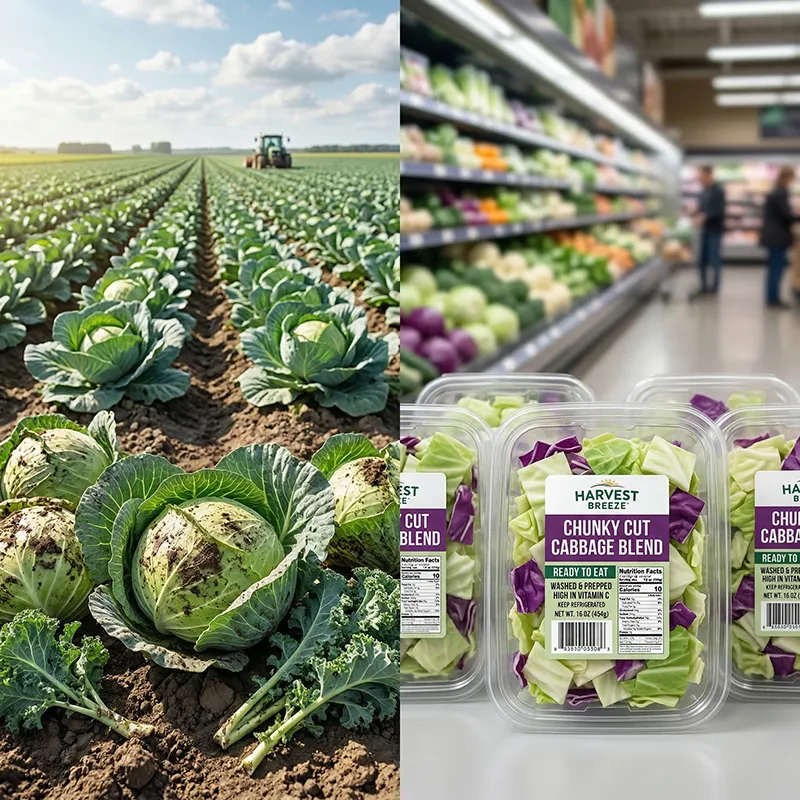
Before-and-After Facility Map: What Actually Has to Be Added?
A before-and-after map is more useful than a machine list because it exposes changes in material flow, personnel movement, water management, waste handling and cold storage. In many existing packhouses, the available floor area is not the main constraint. The problem is that the available area was never intended to separate field-contaminated produce from exposed fresh-cut product.
| Facility Function | Typical Whole-Produce Packhouse | Fresh-Cut Upgrade Requirement |
|---|---|---|
| Receiving | Unload, identify supplier or grower lot, inspect | Retain lot identity and route incoming product according to processing status |
| Dirty-end preparation | Sorting, soil removal, grading | Dedicated soil-heavy handling before cleaner operations where required |
| Pre-washing | Optional commodity wash | Commodity-specific pre-cleaning before peeling or cutting when needed |
| Trimming and peeling | Limited manual trimming | Controlled manual or mechanical preparation with reject and yield measurement |
| Cutting | Usually absent | Dedicated cutting cell or inline cutter selected around crop geometry and finished specification |
| Post-cut washing | Usually absent | Controlled wash/rinse stages where required by product and process design |
| Dewatering | May rely on draining | Defined draining or centrifugal/other dewatering according to product tolerance |
| Final inspection | Whole-product quality check | Foreign-material, cut-quality, defect and finished-condition inspection |
| Foodservice packing | Cartons, sacks, crates | Portioning, weighing and protected packing of exposed finished product |
| Cold storage | Commodity storage | Finished-product cold storage sized around production and dispatch profile |
| Traceability | Grower/lot to pallet | Incoming lot → production batch → transformed SKU → packed lot → shipment |
| Waste | Culls and field debris | Peels, trim, cut rejects and wet organic waste removed without crossing clean product flow |
| Personnel flow | General packhouse access | Defined access, hygiene transition and task-specific movement between process zones |
The important word is controlled. A physical wall is not automatically required between every activity, nor does installing partitions by itself create hygienic processing. Separation can involve location, time, barriers, controlled personnel routes, dedicated utensils, airflow strategy or other measures appropriate to the hazard and process. The correct combination comes from the food-safety plan and facility assessment.
Build the Process Flow Around the Raw Material, Not a Universal Sequence
There is no single correct order such as “cut → wash → dry” for every vegetable. Commodity condition and finished-product requirements determine the sequence.
Root crops arriving with heavy soil may need receiving inspection, stone or foreign-material removal and substantial pre-washing before they approach peeling and cutting equipment. Feeding muddy potatoes directly into a precision cutter would increase cleaning burden and potentially damage downstream components. A root-vegetable route may therefore look like:
Receive → sort → remove heavy contamination → pre-wash → peel/trim → inspect → cut → rinse or treat if required → dewater → inspect → pack → cold store.
Leafy vegetables present a different handling problem. Excessive mechanical action can damage leaves, while cut product releases cellular material that changes the washing environment. Depending on the product specification, a leafy route may use:
Receive → trim/sort → cut → controlled washing/rinsing → dewater → inspect → portion/pack → cold store.
Whole herbs, delicate leaves and some fruits may need different sequences again. The engineering question is not which sequence looks most automated. It is which sequence produces the required finished product while controlling contamination routes, physical damage, excess water and unnecessary handling.
For a deeper comparison of RTC and RTE routes, the fresh-cut vegetable processing guide and the article on RTE and RTC processing separation provide useful internal follow-up reading.
Hygienic Zoning Must Follow Product Exposure
One of the largest mistakes in packhouse conversion is thinking of hygiene zoning as a color-coded floor plan added after the equipment layout is finished. Zoning should be derived from product exposure and contamination routes.
The receiving end may handle soil, damaged outer leaves, field crates and wet raw material. After cleaning, cutting and controlled washing, the product may be exposed with no further step capable of significantly reducing a biological hazard before consumption. Allowing the same carts, floor traffic, hoses, waste containers or personnel routes to move freely between those areas defeats much of the value of the process design.
When evaluating an existing building, map at least five flows independently:
- Product: raw receiving to finished dispatch.
- Personnel: entry, changing, hand hygiene, production access and breaks.
- Waste: field debris, peel, trim, rejects and packaging waste.
- Equipment and utensils: clean tools, dirty tools, movable bins and sanitation equipment.
- Water and drainage: clean-water entry, process water, floor drainage and wastewater exit.
Watch for crossings. A waste cart moving from a peeling area through the finished-pack zone is a layout problem even if every machine is stainless steel. A floor drain receiving dirty-end water beside exposed post-wash product is another warning sign. Condensation above a clean-product conveyor or inaccessible spaces between equipment and walls can likewise undermine cleaning.
For covered U.S. facilities, current good manufacturing practice provisions in Part 117 address facility construction, cleanability, working space, contamination prevention, sanitary operations, water quality and handwashing, among other requirements. These provisions do not prescribe one standard packhouse layout; they reinforce why effective separation and cleanable design must be considered during renovation.
Washing Is a Process-Control Decision, Not Just a Bigger Tank
A packhouse may already wash whole produce. That does not mean the same washing system should automatically be used after cutting.
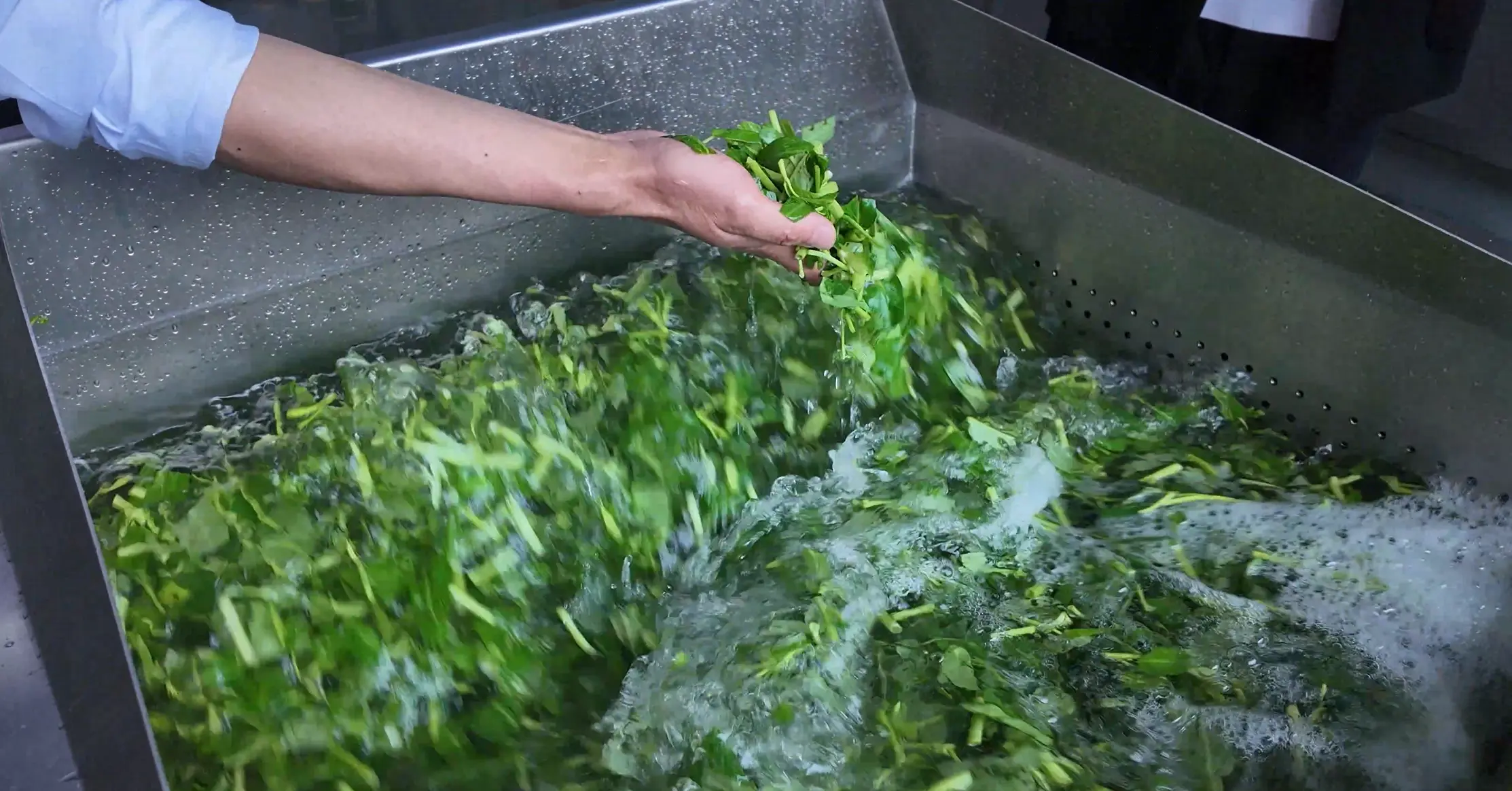
Fresh-cut washing has to account for product type, cut size, organic load, water turnover, agitation, product-to-water ratio, temperature where relevant, contact conditions and any antimicrobial treatment used. Cut tissue can release organic material into the water, and incoming soil or plant debris can change process conditions during a run. The system therefore needs defined operating parameters rather than an assumption that water remains equivalent from the beginning of a shift to the end.
FDA’s current RTE fresh-cut guidance makes a particularly important distinction: an antimicrobial used in wash water should not be interpreted as a conventional pathogen “kill step” on the produce. Its role may include controlling microorganisms released into wash water and reducing transfer through the washing system. This is why concentration alone is not an adequate process specification.
A useful wash-control sheet should define, as applicable:
- commodity and cut size;
- batch or continuous feed rate;
- water volume and turnover;
- target treatment parameters and lawful conditions of use;
- where and how the parameter is measured;
- organic-load indicators or water-replacement criteria;
- contact or residence time where relevant;
- corrective action when the operating limit is missed;
- cleaning and sanitation between production runs.
Those limits cannot be copied blindly from another processor. Water chemistry, commodity load and process configuration matter, and chemical use must follow the applicable authorization and validated operating conditions for the jurisdiction and application.
Equipment selection comes after that process definition. A washer may use bubble action, hydraulic circulation, spraying, vortex action or multiple stages, but the machine is only useful when its physical action matches the produce and its control points can support the intended process.
Cutting Capacity Is Meaningless Without Yield and Cut Specification
Vegetable cutters are often compared using kilograms per hour. For a packhouse upgrade, that number is incomplete.
A cutter can move large quantities of product while creating excessive fines, broken leaves, irregular dice, crushed edges or trim that cannot be sold under the customer’s specification. The relevant output is accepted finished product, not material that merely passed through the machine.
Track at least three weights during product trials:
Incoming raw weight → intentional trim/peel/reject weight → accepted finished-product weight.
From those values:
Usable yield (%) = accepted finished-product kg ÷ incoming raw-material kg × 100
For products that require peeling, separate unavoidable peel loss from avoidable over-peeling. For cutters, measure the proportion meeting the required geometry rather than reporting only total discharge weight.
Raw-material variation matters here. Diameter, maturity, firmness, variety and seasonal moisture condition can change feeding behavior and usable yield. A machine tested on uniform carrots may behave differently when the facility runs mixed diameters from several growers. Leafy material can vary even more because head density, leaf size and field condition change bulk density and therefore the mass moving through the line at a given conveyor speed.
This is one reason raw-material testing belongs in equipment selection. TEEMYEAH’s TW-806 industrial vegetable cutter, for example, should be evaluated as a process component against the target crop, cut format and downstream flow rather than selected solely from its catalog capacity. The same principle applies to other cutter types.
Dewatering Connects Washing to Reliable Foodservice Packing
Surface water is frequently overlooked because it does not look like a major production stage. In practice, it affects package appearance, weighing consistency, downstream handling and product condition.
The correct moisture target depends on the product. Aggressive centrifugal action that works for robust cut cabbage may damage delicate leaves. Passive draining may protect fragile produce but create a large WIP buffer if its cycle is too slow. Continuous production therefore needs the dewatering method and cycle time to be balanced with the washer and packing system.
Foodservice packing creates another design decision. The packhouse may need five-kilogram bulk bags for a central kitchen, smaller restaurant packs, ingredient tubs, sealed pouches or customer-specific formats. The packing station should be sized around actual order profiles, not average kilograms alone.
Ask how many units per hour have to be filled, weighed, sealed, labelled and placed into secondary packaging. A line producing 1,000 kilograms per hour into 10-kilogram foodservice packs creates a very different packing workload from the same mass divided among small portions.
Packaging should also not be treated as a food-safety substitute. Vacuum or modified-atmosphere systems, where used, require product- and process-specific evaluation. They do not compensate for inadequate raw-material controls, sanitation, time-temperature management or hygienic handling.
Cold Chain Begins During Processing, Not at the Loading Dock
A whole-produce distributor may already operate refrigerated storage, yet the fresh-cut line can create new temperature-management requirements. Cutting changes the product, processing generates dwell time, and freshly prepared output can accumulate between washing, dewatering, packing and dispatch.
The relevant question is therefore not simply, “Do we have a cold room?” It is, “How long does each finished product spend between preparation and controlled storage, and what time-temperature conditions does the hazard analysis and product specification require?”
Measure dwell time at the points where WIP can accumulate. A line may be technically capable of high throughput while routinely leaving product waiting for the packer or cold-room transfer. In that case the solution may be scheduling, buffer redesign or packing capacity rather than another washer.
Refrigerated transport should be considered in the same process map. FDA’s sanitary transportation framework addresses practices such as appropriate refrigeration where required, vehicle cleanliness and protecting food from contamination during transport. For international projects, equivalent requirements and customer standards must be reviewed for the destination market.
Calculate Practical Throughput from the Bottleneck
Catalog capacity is a component specification. Practical throughput is a system result.
Suppose a packhouse installs a cutter nominally capable of processing substantially more product than its washer. That does not make the line a high-capacity line. If the washer is faster but dewatering is batch based, the dewatering cycle may become the bottleneck. If all machines are fast but six workers must manually inspect product before packing, inspection may define the sustainable output.
A useful starting model is:
Practical line throughput ≈ the lowest sustainable accepted-product rate among required processing stages.
Do not use only instantaneous machine output. Measure the production window that includes normal feeding, product variation and the operating conditions required to maintain quality.
| Metric | Calculation | What It Reveals |
|---|---|---|
| Actual throughput | Accepted finished kg ÷ operating hours | Real sellable output rather than nominal machine capacity |
| Capacity utilization | Actual output ÷ sustainable available capacity × 100 | Whether installed capacity is being used effectively |
| Labor hours per 1,000 kg | Direct preparation labor hours × 1,000 ÷ accepted finished kg | Labor intensity across products and process configurations |
| Usable yield | Accepted finished kg ÷ incoming kg × 100 | Raw-material conversion performance |
| Changeover burden | Total changeover minutes ÷ scheduled production minutes | Impact of SKU complexity |
| Unplanned downtime rate | Unplanned downtime ÷ scheduled production time × 100 | Reliability loss |
| Preparation cost per kg | Relevant preparation operating cost ÷ accepted finished kg | True comparison between manual and automated routes |
| On-time production rate | Orders or batches completed by required time ÷ total due × 100 | Ability to meet customer dispatch windows |
These measures become particularly useful during seasonal peaks. A packhouse may appear underutilized during most of the year but become constrained during a six-week harvest window. Conversely, sizing every stage for the theoretical seasonal maximum can create excessive capital cost and poor utilization for the remainder of the year. Parallel modules, overtime, seasonal labor or temporary buffers may be more rational than building the entire line around one short peak.
SKU Complexity Can Matter More Than Total Daily Volume
A twenty-tonne-per-day facility making two products is not operationally equivalent to a twenty-tonne facility making thirty products.
Each additional SKU can introduce a different cut set, trim specification, washing condition, allergen consideration if other foods are handled, pack size, label, production batch and cleaning requirement. Frequent changeovers can consume the theoretical labor savings created by automation.
Before selecting equipment, build a SKU family matrix. Group products that can share the same preparation method, cut tooling, washing route and hygiene status. Run compatible families together where food-safety and customer requirements allow.
A multifunctional machine may be valuable when volumes are moderate and formats change frequently. Dedicated equipment becomes more attractive when one high-volume SKU occupies enough production time that repeated reconfiguration creates a bottleneck.
The decision should be made from the production schedule rather than from the product catalog.
Labor Reduction Should Target Difficult Work, Not Remove People Indiscriminately
Fresh produce preparation contains tasks that vary considerably in their automation potential. Repetitive lifting, carrying, bending, manual cutting and transferring heavy containers can create ergonomic exposure. OSHA’s ergonomics guidance emphasizes fitting tasks to workers and reducing demanding lifting, reaching and repetitive handling where practical.
This gives the upgrade team a better question than “How many operators can this machine replace?” Ask instead:
- Which task consumes the most labor hours per 1,000 kilograms?
- Which task creates repetitive motion or awkward handling?
- Where does absenteeism cause the line to miss dispatch windows?
- Which skill takes the longest to train reliably?
- Where is manual work actually protecting quality because human judgement is required?
Inspection is a good example. Removing people from product inspection simply because conveyors are automated can be counterproductive. Human operators may still be the most flexible way to identify unusual defects, foreign material or crop-specific quality problems, particularly with variable agricultural raw materials.
Automation makes the most sense when it stabilizes repetitive, measurable work and allows skilled operators to concentrate on process control, quality, sanitation and exception handling.
Traceability Must Survive Transformation
Whole-product traceability often follows a straightforward chain: supplier or farm lot, receiving record, pack lot, pallet and customer shipment. Fresh-cut processing makes this more complicated because one raw lot can become several SKUs, and several incoming lots may potentially enter a production schedule.
A practical traceability model should be able to reconstruct:
Supplier/grower lot → receipt → storage location → production batch → processing route → finished-product lot → packaging record → cold-storage location → shipment/customer.
If ingredients are combined, the system should preserve the relationship between each input lot and the mixed finished lot.
For U.S. businesses handling foods covered by the Food Traceability List, additional requirements may apply under the Food Traceability Rule. Fresh-cut fruit, fresh-cut leafy greens and other fresh-cut vegetable categories appear within that framework, subject to the rule’s definitions, scope and exemptions. The exact legal recordkeeping obligation should therefore be assessed separately from a general ERP or customer traceability specification.
Even outside that jurisdiction, the engineering principle remains useful: traceability data should be generated where the transformation occurs. Trying to reconstruct lots from warehouse paperwork after production is far less reliable than defining batch identity at the line.
Manual, Semi-Automatic or Integrated Line? A Practical Comparison
| Configuration | Best Fit | Advantages | Limitations |
|---|---|---|---|
| Primarily manual preparation | Low or irregular volume, many unusual SKUs, pilot contracts | Low capital requirement, highly flexible, easy to test market demand | Labor intensive, harder to stabilize repetitive cuts and hourly output, ergonomic burden can increase |
| Semi-automatic cells | Moderate volume, varied products, staged upgrade | Automates the most repetitive steps while preserving flexibility | Manual transfer can create WIP, labor balance remains important, sanitation interfaces need management |
| Integrated processing line | Stable product families, repeatable schedules, sustained throughput requirement | Reduced transfers, clearer line balance, stronger process integration and data collection | Higher capital exposure, less tolerant of poor product definition, bottlenecks can propagate through the system |
| Parallel or hybrid system | High volume plus seasonal or specialty SKUs | Dedicated route for core products with flexible side cells for exceptions | More complex scheduling, utilities and sanitation coordination |
The comparison explains why “more automation” is not automatically the next maturity level. An integrated line only creates value when the product mix, operating hours, process controls and demand profile justify integration.
When a Packhouse Should Not Automate the Whole Process
There are several situations where manual or semi-automatic processing is commercially more sensible.
Demand is not yet stable
If a new foodservice contract has uncertain volume or the customer specification is still changing, a modular cell can provide evidence before the business commits to an integrated line.
The SKU mix changes constantly
When products require different cutting methods, small batches and frequent washdowns, high fixed automation can spend more time in changeover than production.
The raw material is highly irregular
Some crops require substantial human judgement before automated feeding becomes reliable. Grading or pre-trimming may need improvement before a downstream machine can perform consistently.
The building cannot support hygienic flow
Installing food processing equipment inside a layout with uncontrolled dirty-to-clean traffic, inadequate drainage or insufficient cold storage solves the wrong problem.
Packaging remains the true constraint
A faster washer only creates a larger WIP queue when downstream weighing and packing cannot absorb the output.
The sanitation burden has been underestimated
More conveyors and automatic transfer devices add surfaces, guards, belts, joints and mechanical components that have to be inspected, cleaned and maintained. Equipment that saves production labor but dramatically increases cleaning complexity can move cost rather than remove it.
Automation also introduces new risks: sensor failure, unsuitable recipes, damaged blades, incorrect chemical dosing, control-system downtime, dependence on specialist spare parts and the possibility of producing defects faster when a process drifts out of specification.
Equipment cannot replace process design, food-safety management, preventive maintenance, supervision or employee training.
Use Phased Automation When the Facility Is Still Learning
For many produce distributors, the lowest-risk route is not a one-time conversion from packhouse to fully integrated factory. It is a staged system.
Phase 1: Establish controlled preparation. Create a defined receiving-to-packing route, improve zoning and drainage, standardize manual processing, and measure yield, labor hours and actual throughput.
Phase 2: Automate the first repeatable bottleneck. This may be washing, peeling, cutting, dewatering or transfer depending on measured production data.
Phase 3: Connect compatible operations. Add conveyors or integrated handling once the production sequence is stable enough that automated transfer reduces rather than creates WIP.
Phase 4: Strengthen monitoring and packing integration. Connect process records, weighing, batch identification and packaging interfaces where commercially justified.
Phase 5: Add capacity only after verifying the new bottleneck. Once one operation is improved, another process usually becomes the limiting stage.
This phased approach is especially useful for packhouses moving into foodservice because customers themselves can influence the final configuration. A restaurant chain may require a particular julienne dimension, bulk pack weight or delivery format that was not part of the original plan.
Evaluate ROI from Accepted Output, Not Headcount Alone
A payback model for a fresh-cut upgrade should include more than labor reduction.
Potential benefits may include reduced direct preparation hours, lower rework, improved usable yield, more consistent pack weights, greater production capacity, fewer missed orders or the ability to accept a customer specification the packhouse could not previously supply. Whether those benefits actually occur must be measured rather than assumed.
Potential costs include equipment, building modification, drainage, electrical service, water treatment, refrigeration, packaging equipment, sanitation labor, cleaning chemicals, consumables, maintenance, spare parts, training and additional quality-control work.
A simple model is:
Simple payback period = net project investment ÷ annual incremental operating cash benefit.
Illustrative calculation only — not an industry benchmark: if a hypothetical upgrade required a net investment of $240,000 and verified annual incremental operating benefit after additional operating expenses were $96,000, the simple payback would be 2.5 years. Those figures are deliberately hypothetical. A real project should substitute measured plant data, customer volumes, local labor costs, utility costs, yield performance and realistic production utilization.
Yield deserves special attention because a small change in accepted product recovery can materially alter economics when raw produce is the dominant variable cost. That does not justify assuming an automated peeler or cutter will improve yield. It just means yield should be measured during trials and included in the investment model.
What to Validate Before Selecting the Equipment Configuration
A feasibility review should be possible before requesting a final quotation. The engineering team needs a concise but operationally meaningful input set:
- raw materials and seasonal condition ranges;
- photos or videos of representative and worst-case incoming produce;
- finished-product dimensions and acceptable tolerances;
- RTC, RTE or further-processing status of each product;
- current daily and hourly volumes;
- target daily and peak-hour output;
- number of SKUs and planned production sequence;
- existing labor by process step;
- current yield or trim loss where available;
- required washing or treatment process;
- foodservice package format and unit size;
- factory layout and usable room dimensions;
- doorways, columns, drains and floor levels;
- water, drainage, electrical and refrigeration availability;
- cold-room capacity;
- customer or audit requirements;
- future expansion assumptions.
That information allows equipment to be sized around the process rather than forcing the process around purchased machinery.
For leafy products, the leafy vegetable processing line illustrates how cutting, washing, dewatering and downstream handling can be configured by finished-product route. Facilities handling potatoes, carrots, onions, cassava or similar crops can compare the different logic used in a root vegetable processing line.
Map the Required Packhouse Upgrades
Converting a whole-produce operation into fresh-cut processing is ultimately a facility and process redesign. Washing, cutting and packing equipment are components of that redesign, not the project by themselves.
TEEMYEAH works as a food pre-processing equipment supplier, customized food preparation solution provider and vegetable processing equipment manufacturer for central kitchens, food manufacturers, fresh-cut processors and RTC/RTE facilities. For an early-stage packhouse project, the useful next step is not necessarily a quotation.
Share the raw materials, finished-product formats, current and target capacity, foodservice packaging, factory layout and intended RTC/RTE routes. These inputs can be used to map the required process additions, identify the likely bottleneck, compare manual, semi-automatic and integrated configurations, discuss equipment matching and determine what should be tested before a line concept is finalized.
FAQ
1. What is a packhouse fresh-cut processing upgrade?
A packhouse fresh-cut processing upgrade converts an operation that mainly handles whole produce into one capable of controlled preparation such as peeling, cutting, washing after preparation where required, dewatering, foodservice packing and refrigerated distribution. The main change is not simply adding machines. The facility has to manage exposed product, hygienic flow, process water, sanitation, finished-product specifications, traceability and cold-chain handling. The required level of change depends on whether the packhouse produces whole, RTC or RTE products.
2. Is a produce packhouse the same as a fresh-cut processing facility?
No. A packhouse may sort, grade, cool, wash and pack whole agricultural commodities without operating as a fresh-cut processor. Fresh-cut operations intentionally alter produce from its whole state through activities such as slicing, dicing, shredding or peeling and distribute it in fresh form. Regulatory classification varies by jurisdiction and the exact activities performed. In the United States, farm packing activities and manufacturing or processing activities can fall under different FSMA frameworks, so the facility’s actual operations must be reviewed.
3. Should vegetables be washed before or after cutting?
There is no universal sequence for every commodity. Heavily soiled root vegetables generally require effective cleaning before precision cutting equipment, while many leafy-vegetable processes include washing after cutting. Some products use both pre-cleaning and post-cut washing. The correct sequence depends on soil load, product geometry, finished specification, microbiological risk, water-control strategy and downstream use. A process test should evaluate product damage, organic load, washing performance and practical throughput rather than adopting one sequence for all vegetables.
4. What is the biggest bottleneck when a packhouse starts fresh-cut production?
The bottleneck varies by facility. Manual trimming may limit one operation, while another is constrained by washing residence time, batch dewatering, inspection or packing. The correct method is to measure accepted finished kilograms per hour at every required stage. Practical line capacity is limited by the lowest sustainable rate, not by the fastest machine. Changeover and sanitation should also be included because a line with strong instantaneous output may deliver poor daily throughput when frequent SKU changes interrupt production.
5. Does an RTE fresh-cut line need to be separated from RTC processing?
RTE and RTC products should not automatically be treated as identical processes. RTE products may reasonably be consumed without further processing that significantly minimizes biological hazards, so post-process contamination control can be especially important. RTC products are intended for further cooking, but that does not remove the need for hygienic processing or appropriate hazard controls. Whether separate rooms, schedules, equipment or other controls are required depends on the products, hazard analysis, traffic patterns, sanitation program and applicable food-safety requirements.
6. How should a packhouse calculate the capacity of a fresh-cut line?
Start with accepted finished-product demand rather than machine nameplate capacity. Measure or estimate each required operation: receiving, preparation, peeling, cutting, washing, dewatering, inspection, weighing and packing. The slowest sustainable stage normally limits line output. Include SKU changeovers, cleaning, planned downtime and product-specific differences in bulk density or feeding. Seasonal peaks should be evaluated separately from annual averages. Product testing is particularly valuable when raw material dimensions, soil load or firmness vary significantly.
7. When is semi-automation better than a complete processing line?
Semi-automation is often better when demand is still developing, product variety is high, production batches are relatively small or the facility is learning which process will become the permanent bottleneck. A packhouse might automate cutting and washing while retaining manual trimming, inspection and transfer. This reduces repetitive labor without locking the operation into a rigid configuration. Once production families, schedules and customer specifications become stable, connecting compatible modules into an integrated line may become commercially justified.
8. What data should be collected to evaluate automation ROI?
Useful data include labor hours per 1,000 kilograms, accepted yield, trim and reject loss, actual throughput, overtime, changeover duration, cleaning time, unplanned downtime, packaging labor and on-time order performance. Equipment investment should be evaluated together with building modifications, utilities, refrigeration, sanitation, consumables, maintenance and spare parts. Avoid calculating payback only from the number of operators theoretically removed. A reliable model uses measured existing performance and validated trial results for the proposed process.
9. What traceability changes are needed when a packhouse begins cutting produce?
Traceability must follow transformation. The operation should be able to connect incoming grower or supplier lots with receiving records, production batches, processing routes, finished SKUs, packed lots and outgoing shipments. If several ingredients are combined, their input identities should remain recoverable from the finished lot. Some jurisdictions impose additional requirements for certain foods; in the United States, specified fresh-cut categories are included within the Food Traceability List, subject to the rule’s detailed scope and exemptions.
10. Can existing packhouse equipment be reused in a fresh-cut upgrade?
Often yes, but reuse should be based on function and hygienic suitability rather than age alone. Existing receiving conveyors, graders, whole-product washers, cold rooms or material-handling systems may remain useful. Equipment used around exposed finished product needs closer assessment for cleanability, access, drainage, construction, transfer points and sanitation. Existing utilities also need review because fresh-cut processing can change water demand, wastewater load, refrigeration demand and production cleaning requirements. A layout assessment should identify which assets can remain before new machinery is specified.
Data and Source Note
U.S. Food and Drug Administration, Human Foods Program — Guidance for Industry: Guide to Minimize Biological Hazards in Ready-to-Eat Fresh-Cut Produce, August 2026. Final, nonbinding FDA guidance used here to define the RTE fresh-cut processing context and to inform discussion of biological hazards, wash-water process control, sanitation, temperature management, supply-chain controls and related preventive-control considerations. FDA states that the guidance is directed to manufacturers/processors of applicable RTE fresh-cut produce and is not intended as guidance for farms. Recommendations must not be interpreted as universal operating limits or as a substitute for applicable regulations and facility-specific hazard analysis.
Electronic Code of Federal Regulations — 21 CFR Part 117, Current Good Manufacturing Practice, Hazard Analysis, and Risk-Based Preventive Controls for Human Food. Current U.S. regulatory text used for the discussion of covered manufacturing/processing facilities, hazard analysis, facility design, sanitary operations, water, working space and preventive controls. Part 117 does not automatically apply in the same way to every produce packhouse; applicability, exemptions and facility status must be determined from the actual operation.
U.S. Food and Drug Administration — FSMA Final Rule on Produce Safety. Used to distinguish the Produce Safety Rule’s growing, harvesting, packing and holding scope from the manufacturing/processing issues addressed in this article. The article does not assume that every farm packhouse becomes subject to Part 117 merely because it performs post-harvest activities.
U.S. Food and Drug Administration and U.S. Department of Agriculture — Guide to Minimize Microbial Food Safety Hazards for Fresh Fruits and Vegetables, 1998. Used as background for the farm-to-distribution fresh-produce continuum and good agricultural and management practices. It is an older, nonbinding guidance document and is not used as a substitute for the August 2026 FDA guidance on RTE fresh-cut processing.
FAO/WHO Codex Alimentarius — CXC 53-2003, Code of Hygienic Practice for Fresh Fruits and Vegetables. Used for internationally oriented good hygienic practice principles. Its Annex on RTE fresh pre-cut fruits and vegetables addresses physically altered fresh produce, washing, cold holding, drainage, processing hygiene and related controls. Codex texts are not presented here as jurisdiction-specific law.
U.S. Food and Drug Administration — FSMA Final Rule on Sanitary Transportation of Human and Animal Food. Used for the discussion of refrigeration where required, vehicle sanitation and protection of food during transport. Exact U.S. applicability and exemptions need project-specific review.
U.S. Food and Drug Administration — Questions and Answers About Requirements for Additional Traceability Records for Certain Foods, 2026, and Food Traceability List. Used to support the discussion of critical tracking events, transformation and covered fresh-cut food categories. The article does not provide a compliance determination for any individual company.
U.S. Occupational Safety and Health Administration — Ergonomics Overview and Grocery Warehousing ergonomic guidance. Used to inform the discussion of repetitive handling, lifting, reaching and workstation design. OSHA guidance supports ergonomic risk reduction but does not establish an expected labor-saving percentage for a food-processing project.
No TEEMYEAH customer yield improvement, labor-saving percentage, shelf-life extension, ROI, payback period or production-capacity outcome has been assumed in this article. The payback calculation is explicitly hypothetical and is included only to demonstrate the calculation method.

