




Summary
A useful food processing equipment supplier evaluation tests three things before contract award: whether the factory can build the proposed scope, whether representative material can be processed under defined conditions, and whether the evidence will be written into the proposal, FAT protocol and delivery documents. Buyers should inspect material definitions, weld and finish quality, cleaning access, guarding, controls, drawings, spare-parts planning and the people responsible for delivery. Use the downloadable scorecard to record evidence rather than impressions. Critical gaps such as an unclear contracting entity, undefined food-contact materials, missing safety responsibilities or an unmeasurable FAT should be closed before an irreversible payment.
Start with Project Scope, Not the Quotation Total
A purchasing team may receive three proposals that look broadly similar. Each includes stainless-steel equipment, a capacity figure, a delivery time, a warranty, and a statement that the machines are suitable for food production. One quotation is cheaper, another carries more certificates, and the third contains the most attractive layout.
Can the supplier explain how incoming product condition affects yield and throughput? Does the quoted capacity refer to instantaneous machine rate, sustainable production, raw input, or acceptable finished output? Which food-contact materials are included? Can the machine be inspected and cleaned without unsafe improvisation? Who owns the control logic and line interfaces? What happens when representative-product testing fails? Which installation tasks, utilities, guarding, documentation, spare parts, travel expenses, and validation activities have been excluded?
These questions matter because a food pre-processing project is not completed when a machine leaves the factory. It must still be imported, installed, connected, cleaned, commissioned, operated, maintained, and integrated into the buyer’s production and food-safety systems. A proposal that leaves those responsibilities undefined may simply transfer risk from the supplier to the buyer.
A broad food processing equipment buying guide can help a company identify what it needs to purchase. Supplier due diligence begins later and goes deeper. Its purpose is to determine whether a particular organization has the people, systems, evidence, and contractual discipline needed to deliver the proposed scope.
What a Food Processing Equipment Supplier Evaluation Must Decide
Supplier evaluation should answer four different questions:
- Can the supplier build the proposed equipment?
- Can the equipment perform the buyer’s intended process under defined conditions?
- Can the supplier document, test, deliver, and support that equipment responsibly?
- Can the parties convert the proposal into a contract with measurable obligations?
These are related, but they are not interchangeable.
A factory may be capable of fabricating stainless-steel tanks while lacking experience with delicate fresh-cut vegetables. An application team may understand leafy vegetable washing but depend on an undocumented third party for electrical controls. A machine may process a product during a short demonstration yet remain difficult to clean between production runs. A supplier may hold a quality-management certificate while the particular machine still lacks the safety or conformity evidence required in the destination market.
The evaluation must therefore examine the supplier as an operating organization, not merely the machine as a physical object.
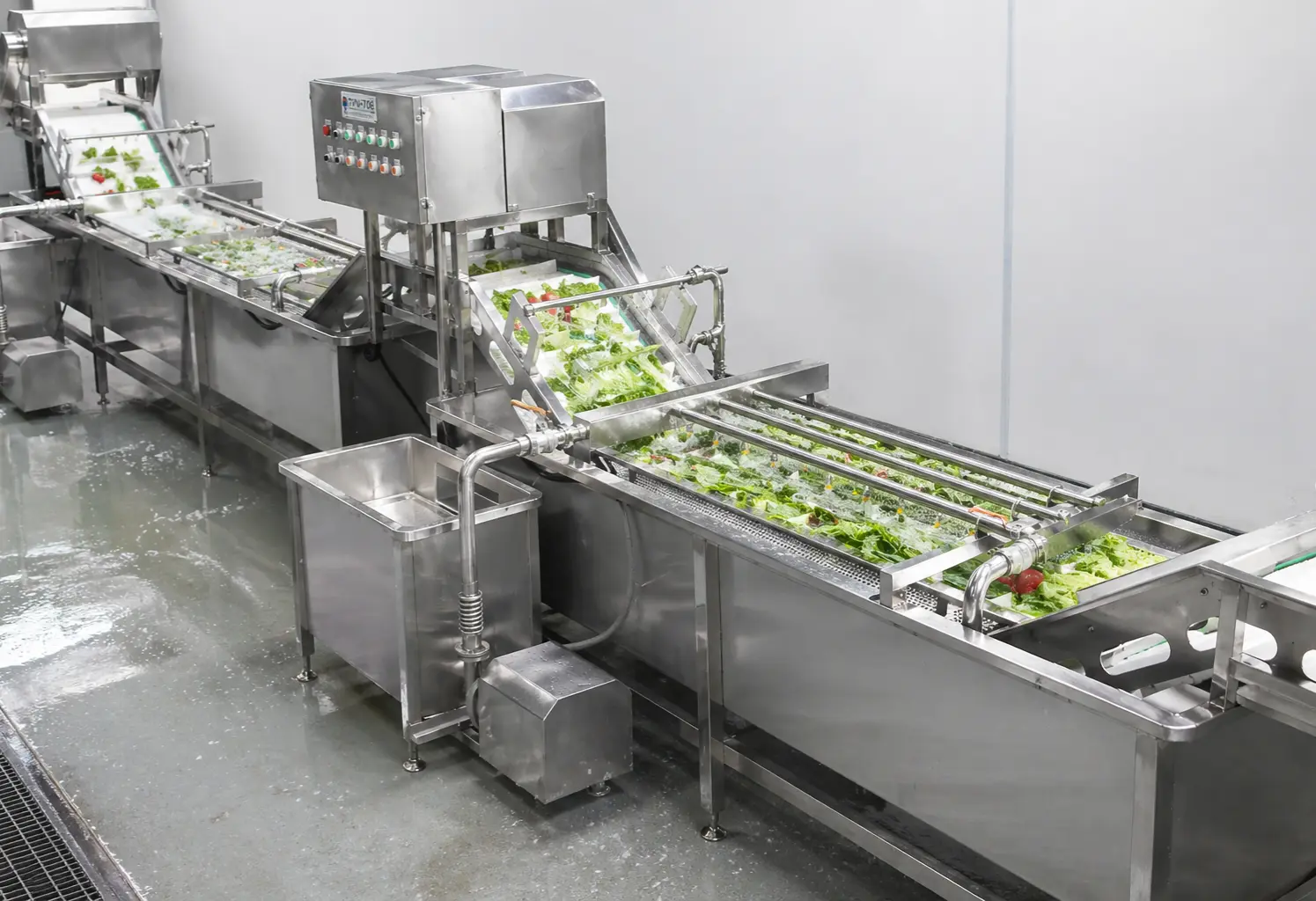
For central kitchens, fresh-cut vegetable plants, and ready-to-cook or ready-to-eat facilities, this also means reviewing how the supplier treats product variation. Leaf density, root dimensions, soil load, firmness, ripeness, temperature, cut geometry, seasonal condition, and incoming preparation can change machine behavior. A credible supplier states these dependencies openly and identifies what must be tested before final configuration.
Audit the Factory as an Operating System
A factory audit should trace how an approved requirement becomes a finished, documented machine. Touring a showroom is not enough.
During an in-person or live remote audit, follow one representative order through the organization. Review how the supplier receives requirements, approves designs, purchases materials, controls revisions, manages fabrication, assembles electrical systems, records inspections, resolves nonconformities, performs tests, prepares documentation, packs equipment, and supplies replacement parts.
Useful audit evidence includes:
- A controlled engineering drawing with revision history
- A material receipt or identification method linked to production
- Inspection records linked to a machine or job number
- Calibration status for relevant measuring equipment
- A nonconformance record and evidence of corrective action
- Preventive-maintenance records for critical manufacturing tools
- Training or competency records for specialized work
- A completed FAT record from a comparable project, with confidential details removed
- Packing and shipment controls for sensitive components
- A spare-parts identification and order process
NIST Manufacturing Extension Partnership guidance encourages buyers to look beyond sales claims by examining quality systems, maintenance practices, staffing resilience, training records, capacity, logistics, and factory conditions. This is general U.S. manufacturing guidance rather than a food-equipment certification scheme, but the underlying principle is highly relevant: supplier reliability must be observed through systems and records.
If travel is impractical, request a guided live tour rather than a pre-edited corporate video. Ask the camera operator to move from the company sign to engineering, fabrication, assembly, testing, document control, packing, and spare-parts areas. Confidentiality can be protected through an agreement, but confidentiality should not become a blanket reason to withhold all evidence.
Examine Hygienic Design Scope, Not the Word “Hygienic”
In the United States, 21 CFR 117.40 requires food-processing equipment and utensils within its scope to be adequately cleanable and maintained to protect against contamination and allergen cross-contact. It addresses matters including appropriate materials, installation for cleaning and maintenance, corrosion resistance of food-contact surfaces, smooth bonding of seams, and sanitary maintenance of conveying and manufacturing systems.
That regulation applies within the U.S. food-manufacturing framework. It is not a global machine certificate, and it does not mean the FDA approves a supplier’s equipment proposal. Buyers in other jurisdictions must identify their own applicable food-hygiene and food-contact requirements.
Translate regulatory principles into machine-specific questions:
- Which surfaces contact food directly?
- What materials and finishes are specified for those surfaces?
- Are seals, belts, plastics, hoses, lubricants, and fasteners identified?
- Can retained food, soil, cleaning solution, and rinse water drain?
- Which components require removal for cleaning?
- Are tools required, and how long does disassembly normally take?
- Can operators visually inspect critical areas after cleaning?
- Are hollow structures, bearings, motors, cables, and control enclosures protected appropriately for the cleaning method?
- Can adjacent floor and wall areas be cleaned after installation?
- Do quick-release features create new trapping or safety problems?
- Which areas are excluded from washdown?
- Who develops and validates the final cleaning procedure?
EHEDG Guideline 13, third edition published in 2024, specifically addresses equipment used in wet-cleaned open food-processing environments. Its scope includes design, construction, installation, integration, and minimum documentation for hygienic use. This makes it a useful reference when evaluating open vegetable washing, cutting, inspection, and conveying equipment.
An EHEDG-related claim still requires scope verification. EHEDG explains that certification involves equipment-specific design review and, where applicable, defined testing through authorized parties. Certification of one model or component does not automatically extend to every machine, customized line, installation, or cleaning regime supplied by the same company. EHEDG also states that its test methods are not intended to prove performance in every application; the food manufacturer remains responsible for developing a cleaning regime suitable for the process.
The practical lesson is straightforward: request the exact certificate, model, class, validity, and certified configuration where certification is claimed. If the quoted machine differs from that configuration, ask the supplier to identify the differences.
Determine Whether the Supplier Can Support a Credible FAT
A factory acceptance test is valuable only when the supplier has the facilities, people, instruments, representative materials, and project controls needed to execute it. Supplier evaluation should therefore assess FAT capability without replacing the full test protocol.
Ask whether the supplier can:
- Safely assemble and operate the quoted configuration
- Provide temporary utilities comparable enough for the planned test
- Receive, store, and prepare representative raw material
- Identify test instruments and their calibration status
- Measure input, acceptable output, rejects, and losses
- Record operating settings and interruptions
- Demonstrate line controls, alarms, guarding, and emergency functions
- Show cleaning access and changeover procedures
- Issue a controlled FAT report
- Record deviations, corrective actions, and retest results
- Preserve approved product samples, photographs, or video where useful
- Prevent shipment until contractual release conditions are met
The contract should state the product, incoming condition, test quantity, operating duration, staffing, allowable stops, measurement methods, tolerances, witnesses, report format, deviation categories, retest responsibility, and shipment-release rule. “Machine will be tested before shipment” is an activity statement, not an acceptance commitment.
The detailed test design belongs in the project FAT procedure. Buyers can use the separate food processing equipment factory acceptance test guide when converting these commitments into a test protocol.
Examine Service, Spares, and Long-Term Maintainability
“After-sales support” is too vague for contract evaluation. Convert it into operating questions.
Who receives the first fault report? During which hours? What information must the buyer provide? How is the issue escalated from sales to engineering? Is remote diagnosis included? What requires a paid site visit? Who covers travel, visas, accommodation, local transport, and waiting time? When does the warranty begin, and what pauses or ends it?
Response time and resolution time are different. A supplier can acknowledge a message quickly while still lacking the component, drawing, or engineer needed to restore production.
Review spare parts by category:
- Commissioning spares
- Routine wear parts
- Recommended operating spares
- Safety-critical components
- Long-lead or imported parts
- Proprietary components
- Commercially available local components
- Special tools
- Software, parameters, backups, and access credentials
The supplier should identify part numbers, quantities, expected replacement triggers, storage requirements, and normal lead times. If a component becomes obsolete, the buyer should understand the replacement and software-compatibility process.
Maintenance documentation should distinguish operator checks, sanitation inspection, planned mechanical work, electrical work, lubrication, blade or belt replacement, calibration, and work requiring supplier support. Maintenance access should be reviewed during design, not after equipment is installed against a wall.
Identify Commercial Exclusions and Total Cost
A low quotation may reflect a narrower scope rather than better value. Require a consolidated exclusion schedule and resolve contradictions between the quotation, drawings, correspondence, and technical agreement.
Commonly overlooked items include:
- Export packing and moisture protection
- Freight, insurance, import duties, and taxes
- Unloading, cranes, forklifts, and internal movement
- Foundations, platforms, guardrails, and floor modifications
- Water treatment, tanks, pumps, drainage, and wastewater handling
- Compressed air, steam, refrigeration, ventilation, and electrical distribution
- Cables and pipework outside the machine boundary
- Interface engineering with third-party equipment
- Product, packaging, chemicals, and consumables for testing
- Translation and destination-language manuals
- Travel and labor for installation or commissioning
- Site acceptance testing
- Operator and maintenance training
- Validation or laboratory testing
- Initial spare parts and special tools
- Software licenses, remote-access services, and future updates
A useful comparison is:
Lifecycle cost = purchase price + logistics + import cost + site preparation + installation + commissioning + training + spares + planned maintenance + expected downtime exposure + quality or yield losses + disposal or replacement cost
Expected downtime and yield loss cannot always be forecast precisely before purchase. They should still be discussed as risk categories. False precision is less useful than identifying which design and service choices could create those costs.
Put Contract Hold Points Before Irreversible Payments
Hold points prevent the project from advancing until defined evidence has been approved. They are more effective than trying to negotiate corrective action after shipment.
| Contract hold point | Evidence required before release | Risk controlled |
|---|---|---|
| Technical scope freeze | Approved equipment list, process assumptions, inclusions, exclusions, product specifications, capacity basis | Wrong machine or incomplete supply scope |
| Layout and interface approval | General arrangement, utility schedule, transfer heights, access, responsibility matrix | Site incompatibility and interface disputes |
| Hygiene and safety review | Food-contact schedule, cleaning concept, guarding concept, risk-assessment status, residual issues | Late redesign and unsafe sanitation access |
| Manufacturing release | Approved drawings, critical components, material requirements, document schedule | Production against uncontrolled information |
| Pre-FAT readiness | Completed internal checks, FAT procedure, test product plan, calibrated instruments, open-item list | Buyer attendance before the equipment is ready |
| FAT acceptance | Signed results, deviations, corrective actions, retest status, approved evidence | Shipment of technically unacceptable equipment |
| Documentation and packing release | Manuals, drawings, parts lists, conformity documents, packing list, preservation plan | Equipment arrives without usable records or protection |
| Shipment release | Contractual FAT closure and approved shipping dossier | Loss of leverage before dispatch |
| Site commissioning and acceptance | Installation checks, functional testing, training, site deviations, agreed performance evidence | Unresolved integration and handover problems |
The payment structure should align with project risk, applicable law, financing arrangements, Incoterms, and negotiated commercial terms. It does not need to follow one universal percentage pattern. What matters is that major payments are linked to measurable completion rather than calendar dates or unsupported statements of progress.
Local legal, customs, insurance, and conformity advice may be necessary for international projects. The technical schedule, responsibility matrix, document list, FAT procedure, exclusion list, warranty, and acceptance process should be attached to or clearly incorporated into the contract.
The Final Decision: Select the Evidence, Not the Presentation
The right supplier is not necessarily the company with the lowest price, largest factory, longest history, most certificates, or most automated proposal. It is the supplier that can demonstrate relevant capability, expose assumptions, document responsibilities, support credible testing, resolve project-specific risks, and accept measurable obligations.
A disciplined food processing equipment supplier evaluation follows a clear progression:
Claim → project-specific document → observation or test → contractual commitment → hold-point verification
That progression is especially important for central kitchens, food manufacturers, fresh-cut processors, and ready-to-cook or ready-to-eat facilities, where product behavior, cleaning, food safety, labor, yield, line balance, and downstream integration interact.
Automation should ultimately be treated as process redesign, not simply machine purchasing. A good contract cannot rescue a fundamentally unsuitable process, but it can make responsibilities, evidence, acceptance, and corrective action far clearer before the buyer’s capital is committed.
Use the Supplier Due-Diligence Scorecard
The workbook contains 26 criteria covering contracting identity, manufacturing, materials, welds, hygienic access, controls, safety, trials, FAT, documents, commercial scope, installation and after-sales. Rate only evidence you can identify and carry critical gaps into the proposal deviation log.
After completing the workbook, attach it with the product photos, layout or operating records requested on this page. TEEMYEAH will use the submitted inputs to prepare the next defined engineering step; the download itself is not a quotation or validation result.
Frequently Asked Project Questions
Which evidence should be requested before visiting the factory?
Ask for the proposed equipment list, preliminary layout, material schedule, utility schedule, control-component list, drawing index, trial plan, FAT outline and responsibility matrix. The visit can then test whether the documents match the operating factory.
How should sample testing be recorded for contract use?
Identify the sample, condition, quantity, cut format, start and stop time, input, accepted output, rejects, damage observations, settings and deviations. Attach the signed record and unresolved points to the technical agreement.
When should a low price be treated as a scope warning?
Compare the same categories across suppliers. A lower equipment total can exclude conveyors, controls, freight, installation, commissioning, training, spares, site work or testing that another proposal includes.
Which factory findings should become payment hold points?
Use objective releases such as drawing approval, material or component confirmation, successful FAT closure, document delivery and shipment readiness. Avoid milestones controlled only by calendar dates.
Can a factory audit replace FAT?
No. The audit evaluates the supplier and manufacturing system. FAT tests the agreed machine or line against a defined protocol before shipment.

