Summary: Define Apple Preparation Before the Cutter Trial
If you are evaluating an apple slicing machine for drying, the first technical decision is not simply which cutter can produce an apple slice. It is whether the cutter will receive whole apples, peeled apples, cored apples, or pre-segmented fruit—and whether the resulting fresh slices meet the acceptance conditions required before they enter your dryer.
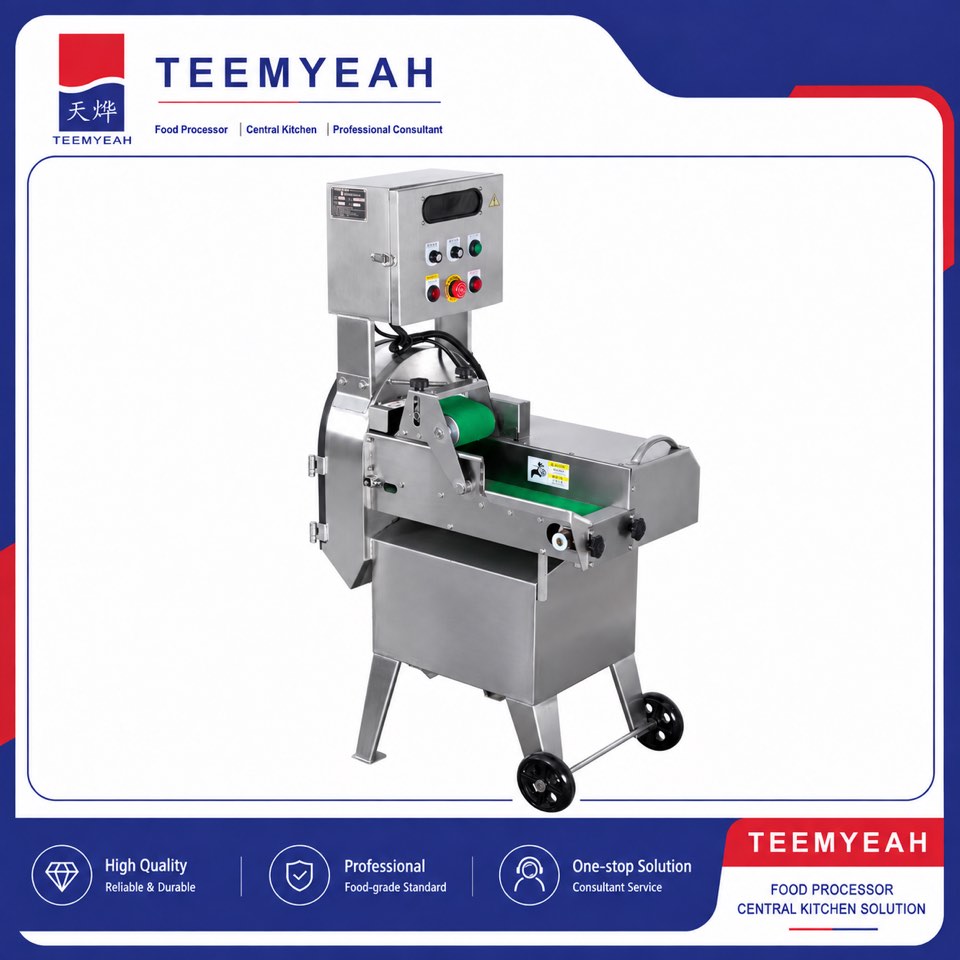
A standalone TEEMYEAH cutter can be technically evaluated when your project can define the incoming apple condition and accept the resulting slice geometry. A historical TEEMYEAH TW-805 demonstration provides useful feasibility evidence: two whole, unpeeled apples were fed to the cutter and discharged as round slices in a video labelled “805 cutting 3 mm apple slices.” Multiple discharged slices visibly retained core and seeds. That makes the demonstration valuable for a specific engineering question: can the proposed dried product accept that center condition, or must peeling and/or coring occur upstream?
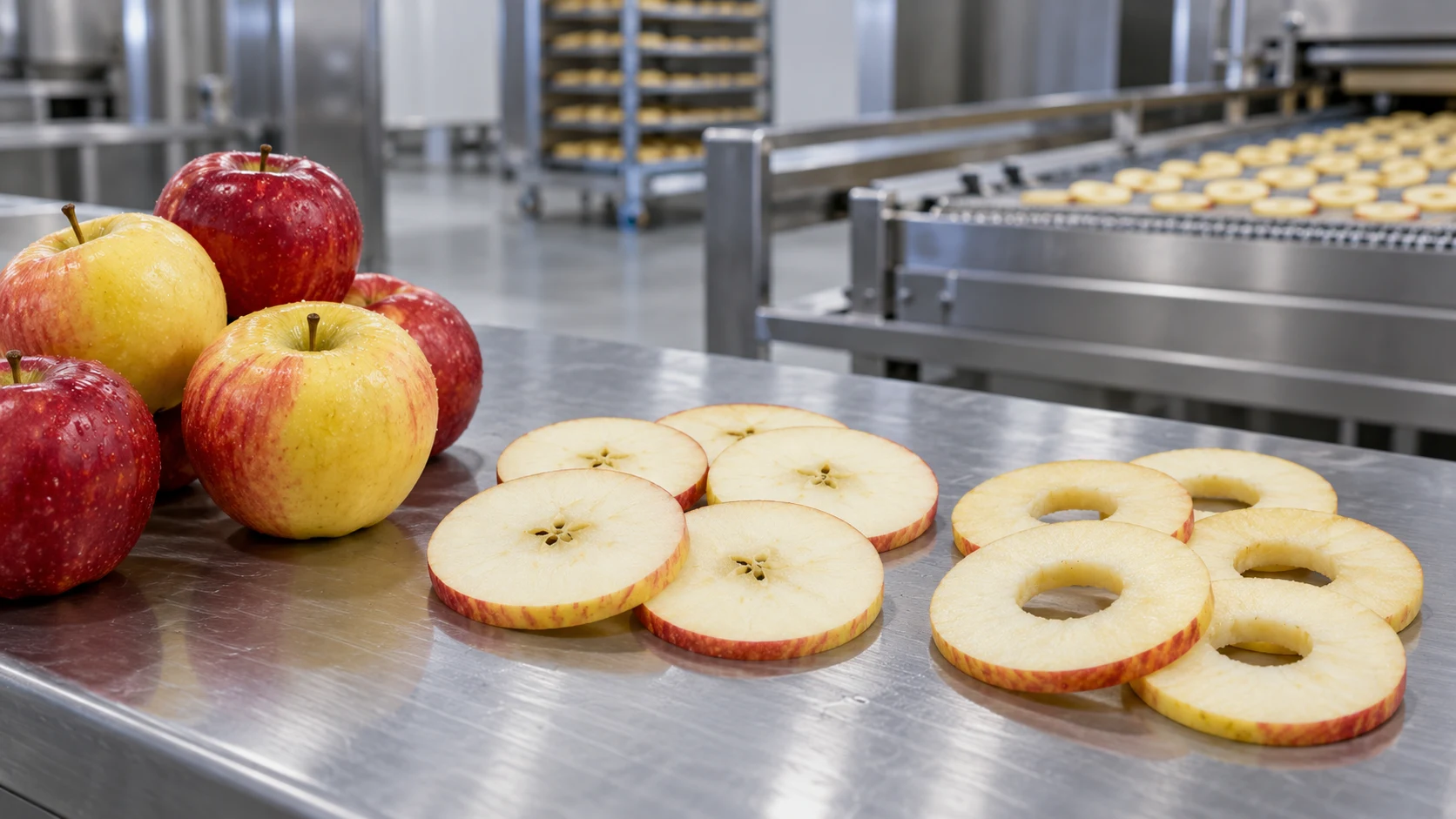
If the finished dried product requires peeled, open-center rings or a tightly controlled absence of seeds, core and carpel tissue, define that preparation requirement before selecting the cutter. The cutter trial can then evaluate the correct prepared apple rather than asking the slicing machine to resolve an upstream preparation specification.
For technical validation, TEEMYEAH can review your apple variety, size range, maturity and firmness; define whether the test feed is whole, peeled, cored or segmented; select a cutter candidate; plan representative sample trials; and connect slice acceptance to your dryer inlet. The most useful result is therefore not “the machine cut apples.” It is a measured answer covering slice-thickness distribution, whole-ring or whole-slice percentage, fragments, seeds/core/carpel tissue, accepted output and the transfer condition presented to the dryer.
When Is an Apple Slicing Machine for Drying Enough?
A large dried-apple project usually reaches cutter selection only after several product decisions have already been made. The apple may be dried with skin, peeled before slicing, cored to form open-center rings, divided into segments before cutting, or prepared in another project-specific form. Those alternatives may look similar on a process flow diagram, yet they present very different feed geometry to the cutter.
The practical distinction is between testing a cutter against a defined prepared input and specifying a machine or process route that combines several preparation functions before slicing.
A standalone cutter trial is appropriate when the project can state exactly what arrives at the cutting point. For example, the trial may receive washed whole apples with skin, manually cored whole apples, peeled-and-cored apples, or pre-cut segments. The cutter can then be evaluated against a fresh-slice specification that is meaningful for the dryer.
A dedicated peel/core/slice route starts from a different requirement. In that case, removal of peel, central core, seeds or associated tissue is an explicit part of the product specification before slicing. Those functions must be resolved in the upstream preparation route rather than inferred from the slicing result.
This difference matters because a circular slice can be geometrically consistent while still being unacceptable for the intended dried product. A slice containing seed cells or hard carpel tissue may have the correct thickness but fail the project's defect criterion. Conversely, a skin-on dried product may have no requirement for peel removal at all. Cutter selection becomes much clearer once those product rules are written down.
TEEMYEAH's custom food pre-processing line approach treats fruit inspection, peeling where required, cutting, selected rinsing or draining and transfer as project-defined stages. For an apple-drying project, that allows the preparation boundary to be established before a cutter candidate is tested.
Translate the Dried-Apple Specification Back to the Cutter Trial
The dryer receives fresh apple slices, but the commercial specification is usually written around the dried product. Technical validation therefore works backwards: identify the dried form you intend to accept, determine which fresh-slice attributes influence that form, and turn those attributes into measurable cutter-trial criteria.
Define the apple before defining the setting
Variety, maturity, firmness and fruit size can all change how an apple behaves during feeding and cutting. A trial based on one uniform supermarket sample tells you little about a project that will receive a wider industrial size distribution or fruit at several maturity levels.
Record the commercial varieties expected during the production season, the minimum and maximum apple diameter or another agreed sizing method, and representative firmness or maturity information. If multiple varieties are materially different, keep them identifiable during the trial rather than mixing everything into one average result.
That information also helps separate a machine effect from a material effect. An increase in broken rings among softer fruit, for example, should not be hidden inside the same sample result as firmer apples without identifying the feed condition.
State whether the trial feed is skin-on, peeled, whole, cored or segmented
This is the most important preparation field on the trial sheet. “Apple” is not an adequate machine input specification.
If whole apples are tested, decide whether visible core, seeds and surrounding tissue are acceptable in the resulting slices. If the target product is an open-center ring, establish how the core will be removed before the apple reaches the slicer. If segmented fruit will be supplied, document the segment geometry because orientation, available cutting face and piece size differ from whole-fruit feeding.
Keep peeling separate from coring as well. A project may require peeled but uncored slices, skin-on cored rings, or peeled-and-cored rings. Each creates a different technical validation condition.
Convert “3 mm slices” into a distribution requirement
A nominal thickness is only the center of the specification. The trial should state how thickness will be measured, how many pieces will be sampled, what tolerance band is accepted and how pieces outside that band will be classified.
This is particularly important before drying. In an experimental study of convective thin-layer drying of apple slices, Royen, Noori and Haydary tested slice thicknesses from 4 to 12 mm and reported a material influence of thickness on drying time under the studied conditions. The study does not prescribe a TEEMYEAH cutter setting or your dryer recipe; it demonstrates why thickness has to be treated as a controlled dryer-interface variable rather than a cosmetic slicing dimension.
Your technical specification might therefore state a nominal fresh thickness, an acceptable tolerance band, an agreed sampling method and the maximum permitted proportion outside that band. The correct values should come from your dried-product and dryer development work.
Define the center condition: seeds, core and carpel tissue
The U.S. Department of Agriculture's dried-apple grading standard provides a useful example of why this distinction matters. It describes dried apples prepared through operations including peeling, coring and cutting, and it separately defines loose core, seeds and carpel tissue when evaluating defects. It also evaluates styles such as slices or rings and considers size uniformity and small pieces.
This is a U.S. voluntary grading and inspection reference, rather than a universal processing rule for every dried-apple project. Its value during feasibility work is the vocabulary: “core removed” is more precise when the project defines what happens to seeds, seed cells, hard surrounding tissue and partial core remnants.
If your own market specification differs, use your specification. The important engineering action is to convert it into a trial criterion before the cutter is selected.
Define intact slices and fragments quantitatively
“Good slices” is difficult to measure. Record instead the percentage by mass or count that qualifies as a whole ring, practically whole ring, whole circular slice, partial slice or fragment according to your product definition.
This becomes especially useful when comparing different apple sizes or preparation states. A cutter may produce an attractive sample during a short run but generate a different fragment ratio when fruit diameter, firmness or feed rhythm changes. Technical validation should expose that difference.
TW-805 and TW-822B: Two Different Apple Trial Routes
TEEMYEAH can begin feasibility review with more than one cutter route, but the evidence behind each candidate is different. The comparison below is intended to help a project engineer decide what should actually be tested, rather than treating catalogue figures as equivalent proof of an apple result.
| Technical question | TW-805 project-specific demonstration route | TW-822B document-supported test route |
|---|---|---|
| Apple-specific basis | A historical 24-second TEEMYEAH video labelled “805 cutting 3 mm apple slices” visibly shows two whole, unpeeled apples entering the cutter and round apple slices being discharged. | The current TW-822B technical specification explicitly lists apple as a suitable product. It should be treated as a candidate for representative sample testing. |
| What the existing evidence helps establish | Actual apple cutting feasibility on TW-805 and a clear requirement to define whether core and seeds may remain in the slice. | A technically documented cutter option whose suitability can be evaluated against the project's apple, tooling and fresh-slice specification. |
| Visible apple condition | Whole and unpeeled in the historical demonstration. | Project input should be specified before testing: whole, peeled, cored or segmented as required. |
| Center condition | Core and seeds remain visible in multiple slices from the historical demonstration. The project must state whether this is acceptable. | Core/seed/carpel acceptance should be defined in the trial protocol according to the prepared feed condition. |
| Cutting capability / tooling information | Slices, strips and segments; adjustable 1–30 mm range. | Slices, strips and batons; optional 3–6 mm tooling. |
| Catalogue capacity reference | 500–800 kg/h. | 500–1,200 kg/h, subject to material and cut specification. |
| Machine dimensions | 770 × 560 × 1300 mm. | 730 × 750 × 1270 mm. |
| Power | 0.75 kW. | 1.5 kW. |
| Electrical reference | 220 V, single phase. | 380 V, three phase. |
| Other documented information | 120 mm conveyor; machine weight 60 kg. | Final tooling and apple result should be confirmed through the planned sample test. |
| Main trial question | Can the prepared apple be fed consistently and produce the required thickness distribution, intact-slice percentage and center condition? | Does the selected tooling and prepared apple condition produce the required accepted slice under representative feeding? |
The TW-805 product page provides the current machine specification for preliminary project review. For apple, the historical cutting demonstration is the product-specific reason to consider it for a sample trial.

The TW-822B represents a different validation route. Its apple listing and tooling information support putting it into the technical test plan, while the project still needs representative apples and an agreed acceptance method before the result can be judged.

Neither route should be chosen from the largest catalogue kg/h number. At feasibility stage, the more important question is which candidate can be tested with the correct preparation state and measured against the dryer-feed specification you actually intend to use.
Apple Slice Trial Input and Acceptance Matrix
The following matrix can be completed directly during project review. It is designed to turn a dried-apple requirement into a repeatable cutter trial rather than a visual demonstration.
| Trial field | Information to define before testing | What to record during the trial | Acceptance question |
|---|---|---|---|
| Apple variety | Commercial variety or varieties expected in the project. | Variety used in each run; keep materially different varieties identifiable. | Does the candidate remain suitable across the representative varieties that matter to the project? |
| Maturity and firmness | Representative maturity window and any available firmness criterion. | Condition of the test fruit and observable differences among lots. | Does slice integrity remain within the agreed limit across representative fruit condition? |
| Incoming size range | Minimum, typical and maximum apple diameter or agreed sizing method. | Size distribution of the test lot and any feed difficulty by size. | Can the required commercial size range be presented consistently to the cutter? |
| Skin condition | Skin-on or peeled before cutting. | Actual preparation state of every test batch. | Does the discharged slice match the intended fresh-slice specification? |
| Core preparation | Whole, manually cored, mechanically pre-cored or another defined state. | Core state before cutting and any remaining center material after cutting. | Is the center condition acceptable for the intended dried product? |
| Feed geometry | Whole apple, cored whole apple or defined segment. | Orientation, feed behavior, slipping, rolling or irregular presentation where relevant. | Can representative feed geometry be processed repeatably? |
| Nominal fresh-slice thickness | Required nominal value in mm. | Actual measured thickness from the agreed sample quantity. | Does the measured distribution fit the stated dryer-feed tolerance? |
| Thickness tolerance | Acceptable range and maximum out-of-range proportion. | Count or mass within, below and above the tolerance band. | Is thickness variation acceptable before dryer testing? |
| Slice form | Closed-center circular slice, open-center ring, partial ring, segment or other defined geometry. | Count or mass by accepted geometry class. | Does the cutter output match the intended product style? |
| Whole-ring / whole-slice percentage | Minimum percentage and measurement basis: count or weight. | Accepted whole pieces versus partial pieces. | Is intact-piece yield high enough for the product specification? |
| Fragments and small pieces | Definition of a fragment and maximum permitted percentage. | Fragment mass or count separated from accepted slices. | Does breakage remain inside the agreed limit? |
| Seeds | Permitted level, if any, expressed with a measurable sampling rule. | Seed incidence in the inspected sample. | Does the chosen preparation route provide the required seed condition? |
| Core / carpel tissue | Permitted center tissue and inspection definition. | Incidence or measured quantity according to the project method. | Does upstream preparation need to change before cutter selection? |
| Surface damage | Acceptable tearing, crushing or edge damage. | Damaged-piece percentage using agreed visual examples. | Is the fresh cut suitable for downstream handling? |
| Discoloration-control handoff | Maximum transfer interval and the next process step defined by the project. | Time from cutting to transfer and actual handling sequence. | Can the cutter discharge be handed to the project's next step at the required rhythm? |
| Dryer tray or belt presentation | Tray dimensions, belt width, permitted bed depth, overlap rule and feed method. | Slice accumulation, clumping, overlap and transfer behavior. | Can accepted slices be presented to the dryer in the required loading condition? |
| Target accepted output | Required kilograms per hour of slices that satisfy the agreed acceptance specification. | Total feed, accepted slices, rejects/rework and timed run duration. | Does measured accepted-output rate support the required dryer-feed rhythm? |
| Operating pattern | Expected hours per shift and product/changeover pattern relevant to sizing. | Continuous run time, interruptions and any setting changes made during the test. | Is the tested operating pattern representative enough for feasibility sizing? |
| Changeover and cleaning observation | Products or thicknesses that may require changes during the intended schedule. | Time required for the test changeover and cleaning sequence being evaluated. | How should non-cutting time be included when calculating sustainable accepted output? |
Keep Catalogue kg/h Separate from Accepted Apple-Slice Output
Catalogue capacity is useful for narrowing the equipment range, but it is not the same measurement as kilograms per hour of slices that satisfy a dried-apple project's acceptance criteria.
The difference becomes obvious when whole apples are sliced. Suppose the cutter continuously processes a certain feed mass, but part of the discharge contains fragments, out-of-tolerance thickness, an unacceptable center condition or pieces that require rework. Counting the entire discharge as usable output would overstate the rate delivered to the dryer.
For technical validation, record at least four mass values: total feed presented to the cutter, accepted slices, rejected output and rework output. Record the corresponding effective cutting time as well.
Gross trial rate can be calculated from total feed mass divided by effective cutting time. Accepted-output rate should be calculated from the mass of slices that meet the agreed specification divided by the same defined run time. If your operating model includes preparation interruptions, changeovers or cleaning within the sizing window, record those durations separately so the project team can model the required production rhythm transparently.
This distinction becomes even more important when comparing preparation routes. A whole-apple trial may achieve one feed rate but produce a center condition that requires further sorting. A pre-cored apple may enter at a different rhythm while producing more directly acceptable rings. The project should compare those outcomes using the same accepted-output definition.
For a broader method of separating rated figures from measured sustainable production, see TEEMYEAH's guide to Rated Capacity vs Sustainable Output.
Trial and FAT Acceptance Sequence for Technical Validation
A strong feasibility trial should be designed so the same acceptance logic can later be used in FAT planning when FAT is included in the agreed project scope. The objective is repeatability: another engineer reviewing the test record should understand what apples were used, how they were prepared, what was measured and why the result matters to the dryer.
1. Prepare representative apples
Select fruit that represents the project's expected varieties, size range and maturity or firmness conditions. Avoid relying only on unusually uniform fruit. Record lot identification, photos and size measurements before cutting.
2. Document the exact preparation state
Photograph and describe the feed immediately before it reaches the machine. State skin-on or peeled, whole or segmented, and cored or uncored. Where coring is part of the proposed route, record the remaining opening diameter or other geometry needed to reproduce the condition.
3. Run candidate settings as separate test conditions
Keep each test condition identifiable. Record cutter model, tooling, relevant setting, feeding method, total input mass, start and stop time and any operating observation that changes the interpretation of the result.
If several nominal thicknesses are under consideration, test them as separate conditions rather than combining their output. The purpose is to determine which fresh-slice condition deserves downstream dryer validation.
4. Take a defined output sample
Collect samples using an agreed method so the assessment is not based on the best-looking handful of slices. The sampling method should capture normal discharge across the test run. Record sample mass or piece count.
5. Measure distribution and defects
Measure slice thickness at the locations defined by your protocol and classify the pieces into the agreed acceptance bands. Separate whole slices or rings, partial pieces and fragments. Inspect the center condition and record seeds, core or carpel tissue according to the project's chosen method.
If skin condition, edge damage or another visible feature affects the dried product, include that classification in the same sample record.
6. Connect the accepted slice to the dryer inlet
The cutter result should not stop at a stainless-steel collection tray. Place or transfer the accepted slices using the planned dryer interface as far as the feasibility test allows. Evaluate whether pieces can be distributed according to the intended tray or belt loading rule, whether excessive overlap develops and whether the cutter's discharge rhythm is compatible with the intended downstream feed method.
The thickness selected for the cutter still needs validation in the buyer's actual drying process. Research showing that apple-slice thickness can materially influence drying behavior is a reason to conduct that interface validation—not a substitute for it.
7. Repeat the representative condition
Once a promising condition has been identified, repeat it with representative material instead of accepting a single successful batch. Compare the thickness distribution, intact-slice percentage, defects and accepted-output rate between runs.
Repeatability is particularly useful when different apple sizes or firmness levels are expected. It shows whether the proposed preparation and cutting condition remains technically credible beyond one carefully selected lot.
How to Decide Between a Standalone Cutter Test and an Upstream Peel/Core Route
The decision can usually be reached from the product specification rather than from a more complicated machine comparison.
| Required dried-product condition | Feasibility implication | Recommended validation action |
|---|---|---|
| Skin-on circular slices; defined core/seed presence is acceptable | Whole-apple cutting may be a relevant trial condition. | Test representative whole apples and measure thickness, intact slices, fragments and center condition. |
| Skin-on slices but seeds/core tissue must meet a tight limit | Core preparation becomes part of the feed specification. | Compare the whole-apple result with a defined pre-cored input before cutter selection. |
| Open-center rings | A cored input must be established before the ring-slicing result can be judged. | Prepare representative cored apples and validate ring integrity, thickness distribution and dryer loading. |
| Peeled rings or peeled circular slices | Peeling is an upstream preparation requirement. | Test the cutter with fruit prepared to the required peeled/cored condition rather than extrapolating from unpeeled fruit. |
| Dried segments rather than rings | Segment geometry becomes the cutter input specification. | Define upstream segmentation, orientation and target fresh geometry before the cutter trial. |
| Several product styles are still under technical evaluation | One machine setting cannot represent all alternatives. | Build separate trial conditions for each commercially relevant prepared input and slice specification. |
The historical TW-805 apple demonstration is useful here because it makes the choice visible. Whole unpeeled fruit can be cut into round slices, while core and seeds remain visible in multiple pieces. For a project that accepts such a center condition, that may justify a more detailed TW-805 trial. For a project requiring open-center rings or tighter core-defect limits, it tells the engineering team exactly which upstream preparation condition should be introduced before the cutter is evaluated.
Define the Dryer Handoff Before Freezing the Cutter Specification
A fresh apple slice is only technically acceptable if it can be delivered to the next process in the required condition. That means the trial protocol should include information from the dryer side before the cutting specification is finalized.
Ask the dryer engineer for the allowable fresh-slice thickness range, tray dimensions or belt width, preferred loading method, allowable product depth, overlap rule, feed rate or batch rhythm, inlet height and any transfer limitation that affects how slices arrive.
If the project uses trays, establish whether slices are expected to be manually distributed, mechanically spread or transferred by another method. If the dryer uses a continuous belt, establish the required mass flow and distribution pattern. These details influence whether a cutter's accepted-output rate is meaningful for the project.
The discoloration-control handoff should also be defined as an interface. Record what process follows cutting and how quickly the slice is expected to reach it. The cutter trial does not need to establish a universal browning-control process; it needs to demonstrate that the proposed preparation and transfer sequence can connect to the process selected by the dried-apple project.
Teams working on other dehydration applications may also find the measurement approach in Carrot and Beetroot Slicing Equipment Before Dehydration useful, particularly where slice-thickness distribution and dryer loading need to be treated as one technical interface.
Decision FAQs for Apple Slicing Technical Validation
Can we select an apple slicing machine for drying from a 3 mm sample video?
Use the video to establish a testable starting point, not to finalize the project condition. The historical TW-805 footage confirms that whole unpeeled apples were actually cut and discharged as round slices in a demonstration labelled 3 mm. Build the next step around representative project apples, measure the resulting thickness distribution and define whether the visible core and seed condition is acceptable. The dryer team should then validate the selected fresh-slice condition using its own inlet and process requirements.
If our dried apple must be an open-center ring, what should we test?
Define a cored apple as the cutter input. Record the core opening or another reproducible preparation specification, then evaluate ring integrity, thickness distribution, fragments and accepted-output rate. Testing whole uncored fruit would answer a different question because it would combine cutter behavior with a center condition that does not match the intended product.
Should peeled and unpeeled apples be tested in the same run?
Keep them as separate trial conditions. Peeling changes the prepared input, while the commercial product may also have different acceptance criteria for each style. Label the batches, use the same sampling method and compare slice integrity, thickness distribution and handling separately. This keeps the result traceable if the project is still deciding which prepared form should advance to dryer validation.
How should we compare TW-805 with TW-822B for an apple project?
Compare them against the same representative input and the same acceptance matrix rather than comparing catalogue capacity alone. The TW-805 has project-specific apple-cutting demonstration evidence; the TW-822B is a document-supported apple test candidate with optional 3–6 mm tooling. For each candidate, record accepted slice output, thickness distribution, intact-piece percentage, fragments and center condition. This produces an engineering comparison tied to the actual dried-apple specification.
What if our incoming apples vary significantly in diameter?
Include the expected size distribution in the representative trial lot and keep minimum, typical and maximum sizes identifiable during evaluation. Record any change in feeding behavior, intact-slice percentage or thickness distribution. If one size class behaves materially differently, the project can then evaluate whether incoming sizing or a narrower feed specification should become part of the preparation route.
How much core or seed material should be allowed in a trial?
Set the limit from your intended finished-product specification and market requirements before testing. The USDA dried-apple grading standard can provide useful terminology because it distinguishes loose core, seeds and carpel tissue, but its limits should not automatically be copied into a project serving a different specification. Convert your chosen limit into an inspection method that can be applied consistently to every cutter sample.
Can catalogue capacity be used as the dryer-feed capacity?
Use catalogue kg/h for preliminary machine sizing, then measure accepted-output kg/h during representative testing. Record total feed, accepted slices, rejects or rework and effective run time. Compare the accepted output with the dryer feed rhythm rather than assuming that every kilogram passing through the cutter becomes an acceptable dryer input. Changeover and cleaning observations should also remain visible in the technical record when they affect the intended operating pattern.
When should the cutter trial include the dryer team?
Include dryer-interface requirements before the trial protocol is finalized. The dryer team should define the fresh-slice thickness range to be validated, loading arrangement, tray or belt dimensions, allowable overlap or bed condition and required feed rhythm. The cutter trial can then produce and measure the exact fresh-slice condition that the dryer engineer needs to evaluate, avoiding a later mismatch between a successful cutting demonstration and an unsuitable dryer feed.
Send Your Apple Preparation and Dried-Slice Specification
For a feasibility review, send TEEMYEAH enough information to define the prepared apple before a cutter candidate is tested. Useful project inputs include:
- photos of the incoming apples and the expected size range;
- apple variety, maturity and firmness information;
- whether the product will be skin-on or peeled;
- whether the cutter will receive whole, cored or segmented apples;
- target fresh-slice geometry, nominal thickness and tolerance;
- photos or physical examples of the intended dried product where available;
- acceptable core, seed and carpel-tissue level;
- required accepted slice output rather than only total feed capacity;
- dryer tray, belt or inlet requirements and intended loading condition;
- planned operating hours;
- site utilities; and
- available layout and the upstream/downstream equipment that must connect to the cutting stage.
TEEMYEAH can use those inputs to review the preparation route, identify a suitable cutter candidate, define the representative sample condition and build a trial acceptance method around the slice your dryer actually needs.
References
U.S. Department of Agriculture, Agricultural Marketing Service. Dried Apple Grades and Standards. The standard is used here as a U.S. voluntary grading and inspection reference for dried-apple styles, size uniformity and defect terminology.
U.S. Department of Agriculture, Agricultural Marketing Service. United States Standards for Grades of Dried Apples.
Royen, M. J., Noori, A. W., and Haydary, J. “Experimental Study and Mathematical Modeling of Convective Thin-Layer Drying of Apple Slices.” Processes, 2020, 8(12), 1562. View the study.