Summary: Choose Onion Processing Equipment for Dehydration by Product Form
Choose onion processing equipment for dehydration from the required finished form: use a slicer or ring cutter when the downstream product will be onion slices, rings or flakes. The acceptance test should focus on thickness distribution, intact pieces, fused stacks, torn material and fines.
Choose a true three-dimensional dicer when the order requires controlled dried pieces or granules with defined length, width and height. Measure all three dimensions and separate accepted dice from oversize, undersize, fines, compressed pieces and incomplete cuts.
Consider separate machines when sliced and diced products run in parallel, when format changes are frequent, or when one cutting route would otherwise limit dryer utilization. A multi-format cutter can be a practical choice for low- or medium-volume factories with mixed orders, provided every required onion and cut format is tested separately.
The purchasing decision should be based on net accepted kilograms per hour, not the largest capacity number printed in a catalog. Representative onion trials should reproduce the intended cultivar, bulb size, firmness, peel condition, feeding method, geometry tolerance and dryer transfer arrangement.
Start with the Saleable Onion Form, Not the Machine Name
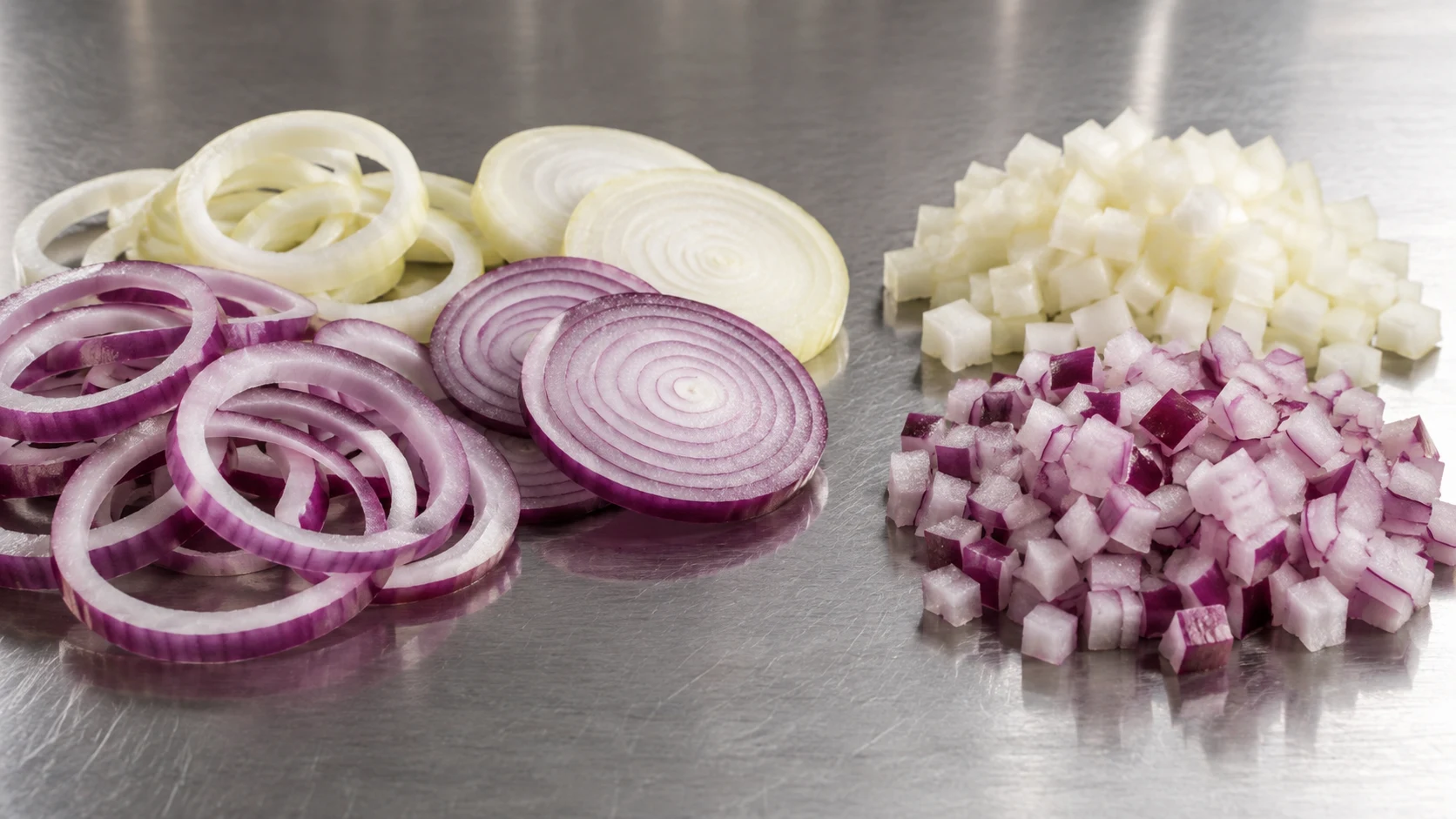
Two machines can both be described as onion cutters while producing outputs that behave very differently in a dehydration plant. A ring or slice is governed mainly by thickness, diameter and structural integrity. A dice is governed by three dimensions, corner definition and the percentage of pieces that remain within the buyer’s tolerance after cutting and transfer.
This distinction matters because the cutting stage creates the physical feed presented to the dryer. Variations in thickness, fused layers, fragments and irregular dice can change the way pieces spread, overlap and move through the downstream system. The cutter should therefore be selected as part of the dryer-infeed plan rather than treated as an isolated machine.
For sliced products, the commercial description may include rings, half-rings, segments or material that will later become flakes. The factory must decide how much ring breakage is acceptable and whether the order requires visually intact rings or simply controlled-thickness onion pieces. Those are different acceptance standards even when the same thickness setting is used.
For diced products, descriptions such as “5 mm onion” or “10 mm onion” need more detail. Does the number refer to a nominal cutter configuration, a maximum dimension or an acceptable range around three measured dimensions? Is a rectangular piece acceptable, or does the buyer expect near-cubic geometry? How will curved outer layers, small bulb centers and loose layers be classified?
Powder requires a different downstream step. Cutting can prepare slices or pieces for dehydration, but powder size and uniformity are created later by grinding, sieving and classification. Powder production should not be included in the cutting machine’s acceptance promise.
| Buyer requirement | Preferred cutting route | Primary acceptance measurements | Typical decision risk |
|---|---|---|---|
| Onion rings or slices for sale as slices or further conversion into flakes | Dedicated slicing or ring-cutting configuration | Thickness distribution, intact rings or segments, fused stacks, torn pieces and fines | Judging performance from nominal thickness while ignoring breakage and stacking |
| Controlled dried onion pieces or granules with three-dimensional limits | True dicing configuration | Length, width, height, oversize, undersize, fines, compressed pieces and incomplete cuts | Calling a two-dimensional cut “dice” without checking all three dimensions |
| Several formats produced in smaller campaigns | Interchangeable-disc or multi-format cutter, subject to separate trials | Accepted output for each format, conversion time, cleaning time and restart waste | Assuming one capacity applies equally to every disc and geometry |
| High-volume sliced and diced products running in parallel | Separate slicing and dicing routes | Net accepted output, route availability, labor, dryer balance and campaign schedule | Creating a shared cutting bottleneck that leaves downstream equipment waiting |
Which TEEMYEAH Onion Cutter Fits Each Role?
TEEMYEAH’s current range provides three relevant starting points: the TW-812/TW-812H family for flexible bulb-vegetable cutting, the TD1-800 for defined three-dimensional dicing work, and the compact TW-812S for lower-throughput mixed-format duties. The final match depends on the accepted product specification rather than the model name alone.
TW-812 and TW-812H: Flexible Slicing, Ring Cutting and Format Changes
The TW-812 bulb vegetable cutting machine is suitable for onion and uses interchangeable discs for slices, strips and dices. Its technical range includes slice thicknesses from 2 to 20 mm, strips starting from 2 × 2 mm and dice settings from 8 to 20 mm. The machine uses SUS304 stainless steel, and its public catalog capacity is 200–800 kg/h.
The related TW-812H provides another configuration in the same bulb-vegetable cutting family. Whole red onions have been run through a TW-812H to produce visible rings and slices, making this family a practical starting point when ring or slice production is the central requirement.
Published capacity figures provide a preliminary basis for equipment sizing. The purchase criterion is the sustained weight of accepted onion output produced with the intended cultivar, bulb diameter, firmness, cut geometry, feeding method and classification standard.
If a purchase specification uses the word “dice,” clarify the geometry before choosing this family. The TW-812 lists a dice role, but an order requiring closely controlled length, width and height should be assessed against a three-dimensional sample specification. For demanding cubic or near-cubic requirements, the TD1-800 is usually the clearer machine to evaluate first.

TD1-800: The Main Route for Controlled Three-Dimensional Dice
The TD1-800 vegetable and fruit dicing machine explicitly includes onion among its applicable materials. Its documented dice and baton range is 3–20 mm, with a catalog capacity of 500–800 kg/h.
Peeled red onions have been trialed on the TD1-800 in 5 mm and 10 mm configurations. These trials show how those particular onion samples passed through the dicing process, while a buyer’s production acceptance must still reproduce the cultivar, diameter distribution, firmness and dimensional tolerance used in the actual contract.
This distinction becomes important at small nominal sizes. Onion layers naturally separate and curve, and smaller cuts can create a larger proportion of fine material or incomplete shapes. A configuration that produces a visually satisfactory 10 mm piece does not automatically establish the accepted yield for a tighter 5 mm specification. Each saleable format needs its own measured result.
Use the TD1-800 as the principal evaluation route when purchase orders define dice by three dimensions, when oversize and undersize limits are commercially important, or when the downstream dryer requires a narrow piece-size distribution for stable loading.

TW-812S: A Compact Option for Lower-Throughput Mixed Production
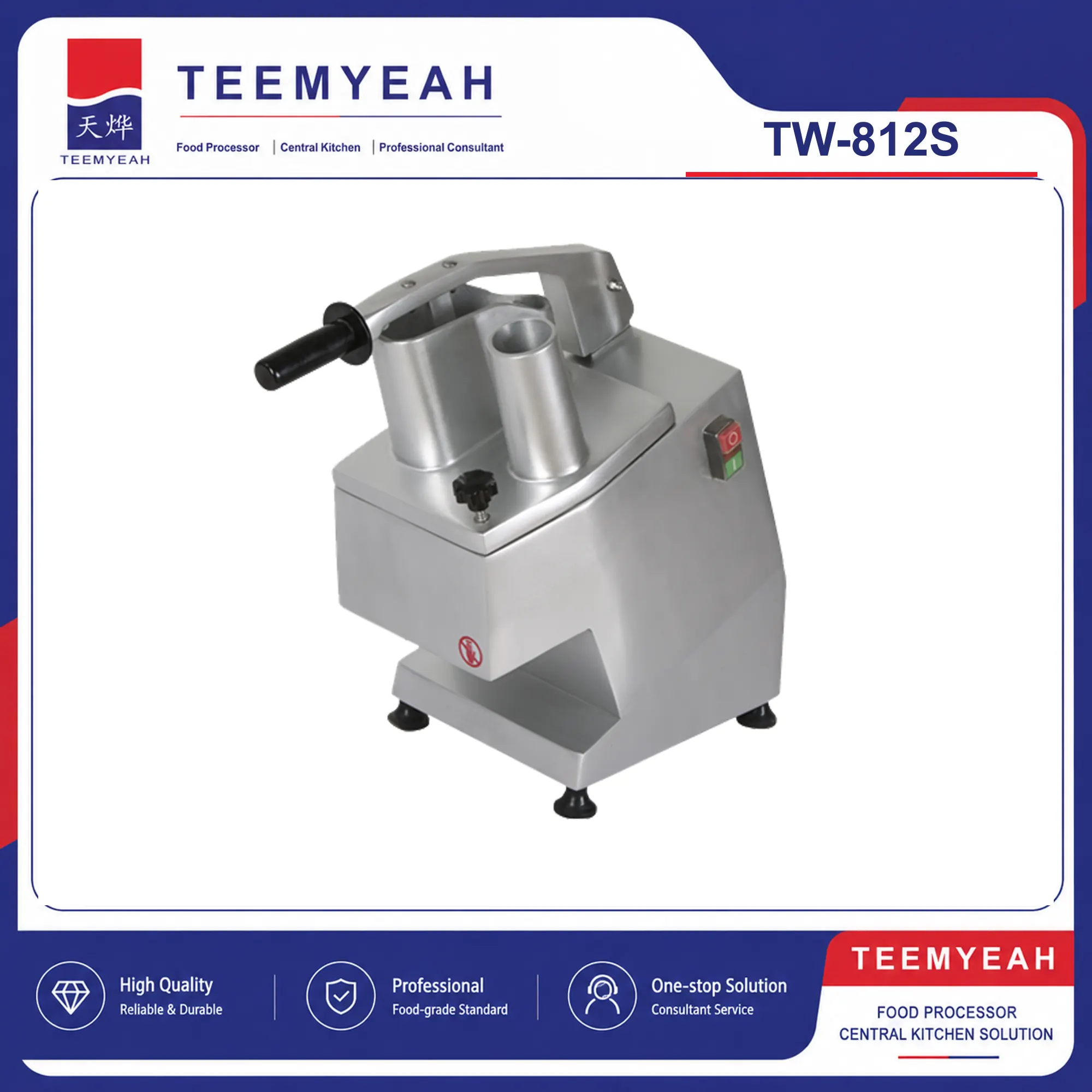
The TW-812S compact root vegetable cutter is onion-compatible and offers interchangeable discs for slices, strips and dices. Its catalog capacity is 200–300 kg/h.
This model can suit pilot production, smaller campaigns, recipe development or factories where several vegetables share one cutting area. Its compact format should not be confused with automatic suitability for every onion specification. The same checks still apply: feed preparation, finished geometry, accepted yield, operator rhythm, disc change, cleaning and transfer to the next process.
Define the Incoming Onion Before Requesting a Machine Match
The quality of the machine selection depends on the quality of the input description. “Peeled onion, 500 kg/h” leaves several engineering questions unanswered. A useful inquiry describes the actual raw material population, the condition in which it reaches the cutter and the product categories that will be sold after dehydration.
Cultivar affects bulb structure, firmness and layer behavior. Bulb diameter affects how consistently the onion enters and engages with the cutting mechanism. A broad diameter distribution may require grading, separate campaigns or a feeding arrangement that prevents small bulbs from moving unpredictably beside much larger ones.
Firmness should be assessed under normal production conditions. Storage history, handling and raw-material condition can influence deformation, tearing and layer separation. A trial lot should represent routine factory supply rather than a specially selected group of unusually firm and uniform bulbs.
Top and root condition also needs a clear definition. State whether tops and roots are already removed, how closely they are trimmed and how much hard root plate may remain. Storage-onion top/tail preparation and peeling should be treated as a separate project input matched to bulb size, skin condition and the required peeled finish before the cutting section is integrated.
Storage onion bulbs require a dedicated peeling and top-tail configuration because their geometry, skin structure and incoming preparation state differ from spring onions and chives. Photos, bulb dimensions and representative samples will help the engineering team evaluate the appropriate upstream preparation route.
| Input to provide | Useful detail | Why it changes the equipment decision |
|---|---|---|
| Cultivar and sourcing pattern | Named varieties where available, seasonal changes and whether varieties are mixed | Helps structure representative trials around firmness, layers and likely variation |
| Bulb diameter range | Minimum, typical and maximum diameters, plus the approximate distribution | Affects feeding, orientation, cut consistency and possible grading needs |
| Firmness and raw-material condition | Fresh or stored condition, soft-bulb allowance and normal defect range | Influences deformation, torn layers, fines and incomplete cuts |
| Top, root and peel state | Fully peeled or partly peeled, trimming method, remaining root plate and acceptable finish | Defines the cutter feed condition and the separate upstream preparation requirement |
| Target product form | Ring, slice, segment, flake feed, dice or granule feed | Determines whether slicing or true three-dimensional dicing is the correct route |
| Geometry tolerance | Nominal size, permitted range and classification rules for broken or irregular pieces | Converts a general cut description into a measurable acceptance standard |
| Accepted production requirement | Required accepted kg/h, operating hours and campaign volume by format | Prevents nameplate throughput from being mistaken for saleable output |
| Cleaning and changeover schedule | Formats per shift, allergen or recipe separation needs, cleaning frequency and available labor | May favor one flexible machine or separate dedicated routes |
| Dryer-infeed limits | Allowable geometry, surface-water state, loading depth, batch or continuous rhythm and container method | Defines the required cutting discharge and transfer arrangement |
Why Nominal Cut Size Is Only the Beginning
Setting a slicer to a nominal thickness does not mean every piece leaving the machine will have exactly that thickness. Natural bulbs contain curved layers, changing diameters and a denser central structure. Feeding orientation and continuity can also influence the output population.
For that reason, slice acceptance should be expressed as a distribution. Measure a defined sample and classify how much material falls within the permitted thickness band. Add separate categories for intact rings or usable segments, fused stacks, torn pieces and fines. This gives procurement and production teams a realistic view of how much cut material can proceed without rework or rejection.
Fused stacks deserve their own category. Several onion layers may appear to form a single thick slice even though the blade setting is correct. If these stacks remain joined when loaded into the dryer, they may not behave like individual slices. The trial should therefore include the normal transfer process rather than assessing only a small hand-separated display sample.
Dice acceptance needs another method. Measure length, width and height according to the agreed sampling rule. A piece can meet the target in two directions and still be too long, too thin or incompletely separated in the third. Oversize and undersize should be weighed, not merely counted, because procurement decisions and line yields are normally managed by mass.
Compressed pieces and incomplete cuts should also be separated. They may pass through a simple screen or appear acceptable at a glance but behave differently during conveying and dryer loading. Establishing these categories before the trial prevents disagreements after the machine has already been built.
Research on onion dehydration reinforces the importance of defining cut geometry alongside dryer conditions. Mitra and co-authors studied onion slices from 1 to 5 mm under specific vacuum-drying conditions and showed that thickness affected drying kinetics. Those laboratory settings are not universal commercial targets, but the work illustrates why a cutting specification and a drying validation plan cannot be developed independently.
More recent open-access research by El-Mesery and co-authors likewise examines the interaction among slice thickness, airflow and heating conditions. For a factory project, the useful conclusion is practical: specify the upstream geometry, transfer state and loading pattern, and allow the dryer owner to validate them with the intended heating and airflow conditions.
Build the Trial Around Accepted Output
A useful equipment trial resembles the intended production process closely enough to answer a purchasing question. It should not be limited to showing that onions can pass through the machine. The trial must reveal how much acceptable product is produced, how consistently it is produced and what operating effort is needed to sustain it.
Each required SKU and cut format should receive a separate trial. If the factory plans 3 mm slices, 5 mm dice and 10 mm dice, record them as three different operating conditions. Do not average their outputs into one general capacity figure. Blade or disc configuration, feeding rhythm, breakage level and classification result may differ substantially.
Use representative production lots. Include the normal diameter range and ordinary variation in firmness, trimming and peeling. Record the initial raw-material weight after defining whether that weight is measured before or after top, root and peel removal. Consistent measurement boundaries are essential when comparing trials.
Collect the cutter discharge without selecting only the best-looking pieces. Take a time-based or batch-based sample large enough to represent normal operation. Classify the entire sample using the previously agreed categories and weigh each category.
For slices and rings, the accepted group should meet the agreed thickness and integrity rules. Oversize, undersize, fused stacks, torn pieces and fines should be weighed separately. If broken ring segments are commercially acceptable, define the minimum segment size or other classification method before the test.
For dice, the accepted group must meet the dimensional rule in all three directions. Weigh oversize, undersize, fines, compressed pieces and incomplete cuts separately. A visual tray photograph is useful for discussion, but it should accompany measured weights and dimensions rather than replace them.
Net accepted output can then be calculated from the accepted weight produced during the measured operating period. This result is more meaningful than gross discharge because it connects machine selection to the material that can actually proceed under the buyer’s agreed specification.
Record the number of operators involved in feeding, observation, container handling and discharge management. If an operator must continually reposition onions or clear accumulated product, that activity belongs in the trial record. It affects the practical line design even when it does not change the cutter’s motor capacity.
Format change and cleaning should also be timed. Begin with the machine in its normal end-of-run state, document the safe stop and access process, complete the required component change or cleaning procedure, reassemble the machine and measure the material produced before stable acceptable output resumes. That final portion is the restart waste.
| Acceptance item | Slices and rings | Dice | Record for procurement |
|---|---|---|---|
| Representative input | Cultivar, diameter, firmness, peel and trimming condition | Cultivar, diameter, firmness, peel and trimming condition | Lot identity, sample weight and input photographs |
| Geometry | Thickness distribution and agreed ring or segment integrity | Length, width and height distribution | Sampling method, measuring tool, nominal target and tolerance |
| Nonconforming output | Thick or thin pieces, fused stacks, torn pieces and fines | Oversize, undersize, fines, compressed pieces and incomplete cuts | Weight and percentage of every agreed category |
| Sustained production | Accepted slice or ring weight during measured stable operation | Accepted dice weight during measured stable operation | Gross kg/h, net accepted kg/h and test duration |
| Operating input | Feeding rhythm, orientation, supervision and container exchange | Feeding rhythm, supervision and discharge management | Operator count, defined tasks and interruptions |
| Format conversion | Disc change, inspection, restart and stable output | Cut-set change, inspection, restart and stable output | Changeover minutes and restart waste |
| Cleaning | Product-contact access, removed components and reassembly | Product-contact access, cutting-set handling and reassembly | Cleaning minutes, labor and inspection points |
| Dryer handoff | Separation, transfer damage, stacking and delivery rhythm | Transfer damage, segregation, accumulation and delivery rhythm | Container size, transfer method, batch frequency and buffer requirement |
Factories preparing a formal purchase test can also use TEEMYEAH’s guidance on food-processing equipment capacity verification and factory acceptance testing to structure responsibilities, samples and recorded results.
Connect the Cutter to the Dryer-Infeed Requirement
The cutting machine ends one operation and begins a transfer problem. Acceptable pieces must leave the cutter, enter a container or conveyor, reach the loading point and be distributed according to the downstream process rhythm. If any of those steps creates accumulation, compression, separation or breakage, the final infeed may differ from the sample inspected directly under the cutter.
Ask the dryer owner to define the allowable geometry, loading depth, surface-water condition and feed rhythm. A batch dryer may need weighed containers delivered at fixed intervals. A continuous system may require a controlled flow with limited surging. These inputs allow TEEMYEAH to configure the cutting discharge and upstream handoff around a defined receiving condition.
Surface water should be described separately from thermal dehydration. If peeled onions are washed before cutting, the process plan should state whether they arrive wet, drained or surface-dewatered. Removing free surface water is not the same operation as reducing internal moisture through thermal drying, and the two should have separate equipment and acceptance language.
Container selection matters more than it may appear. Deep bins can compress lower layers, while long holding periods can allow cut material to settle or clump. Small containers may protect product condition but require frequent manual exchanges. A conveyor can create a steadier handoff, although its speed, drop height and discharge point still need to match the cutter and receiving system.
Line balance should be calculated from accepted output and actual operating time. For example, a cutter that produces a high gross rate but requires frequent stops, classification or container changes may supply less usable material over a shift than a nominally slower configuration with stable output. Cleaning and format conversion further reduce the available production window.
A buffer may help separate short interruptions between cutting and dryer loading, but it should not become a place where onions wait without a defined time and handling rule. Buffer volume, residence time, discharge method and cleaning access should be discussed as part of the layout.
One Flexible Cutter or Separate Slicing and Dicing Machines?
A single multi-format machine can be commercially sensible when the factory handles a mixed portfolio in modest campaigns. It reduces the number of installed machines and may simplify the initial layout. This route works best when production planning allows one format to finish before another begins and when changeover, cleaning and restart time fit comfortably within the shift.
Calculate the decision using campaign hours rather than the number of SKUs alone. A factory may sell six onion formats but produce only one or two on most days. In that case, a flexible cutter with interchangeable components may be more useful than several lightly utilized machines.
Separate slicing and dicing routes become more attractive when both forms must run at the same time, when each has substantial weekly volume, or when frequent switching would consume a meaningful part of the operating schedule. Dedicated routes also reduce the risk that maintenance or cleaning on one shared machine stops every cut product.
The product specifications may also lead to separate equipment. Ring production is evaluated through thickness and integrity, while precision dice is evaluated in three dimensions. A machine chosen mainly for convenient format flexibility may not produce the highest accepted yield for both demanding specifications.
Dryer scheduling can make the choice clearer. If the downstream system alternates long campaigns, one flexible cutter may follow the same sequence. If different dryers or loading systems require sliced and diced feed in parallel, separate routes can protect utilization and simplify transfer control.
Compare the options with five numbers for every format: accepted kg/h, production hours required, changeover time, cleaning time and restart waste. Add operator requirements and planned overlap between products. This operational picture is more reliable than comparing purchase prices or catalog capacities in isolation.
Procurement Specifications That Prevent Ambiguity
A strong purchase specification describes the result and the test method without prescribing unnecessary machine details. State the representative onion condition, required output geometry, tolerance, nonconforming categories, sample method and accepted production rate. Attach photographs or physical reference samples where appearance matters.
For sliced onions, write the nominal thickness and permitted range, then define how fused layers, broken rings and fragments are classified. If half-rings or large segments are acceptable, say so. If the order requires intact rings above a certain diameter, define the measurement and sampling method.
For diced onions, specify length, width and height tolerances. Include classification rules for curved pieces, thin layer fragments, compressed material and incomplete cuts. State whether acceptance is based on weight percentage, piece count or a combination. Weight-based classification is generally more useful for yield and line-balance calculations.
Define capacity as net accepted output over a measured stable interval. The test record should show gross input, gross discharge, accepted output and each nonconforming category. If onions are prepared before weighing, describe exactly where the measurement boundary begins.
Include the expected operating pattern: hours per shift, product changes per day, cleaning frequency and available operators. A machine that meets an hourly target may still miss the daily production requirement if cleaning and conversion occupy too much of the scheduled window.
The factory acceptance plan should also identify the supplied cutting components, guards, product-contact materials, required tools and change parts. Agree on how the machine will be inspected after reassembly and how stable production will be confirmed following a format change.
Decision-Grade FAQs
Can we use one TW-812 family machine for both onion slices and dice?
It can be a practical multi-format route because the family uses interchangeable discs and lists slice, strip and dice functions. The deciding factor is the finished-piece specification. If the diced product has strict tolerances in length, width and height, compare its measured sample result with a TD1-800 trial before selecting one shared machine. Include changeover time, cleaning time and restart waste in the comparison.
When should we specify the TD1-800 instead of a general bulb-vegetable cutter?
Start with the TD1-800 when the order calls for controlled three-dimensional onion pieces, when oversize and undersize percentages affect saleable yield, or when the dryer requires a narrow piece-size distribution. It is also the clearer route when purchase documents define nominal 5 mm, 10 mm or other dice sizes across three dimensions rather than describing a general chopped product.
How should we compare a catalog capacity with our required 600 kg/h?
Define whether 600 kg/h means raw onions entering the machine, gross cut discharge or accepted pieces after classification. Procurement should normally use net accepted output. Run representative onions for a measured stable period, weigh all accepted and nonconforming categories, and record interruptions and operator input. The result can then be compared with the dryer’s actual receiving rate.
Should 5 mm and 10 mm dice be covered by the same acceptance test?
No. Each nominal size should be treated as a separate operating condition. Smaller dice may produce a different proportion of fines, incomplete cuts or irregular layer fragments, while the feeding rate and discharge behavior can also change. Test, measure and classify both sizes independently.
How do we set a fair acceptance limit for intact onion rings?
Begin with the commercial use of the product. If intact rings are sold as a visible grade, define the minimum diameter or integrity rule and measure their weight separately. If large segments can enter the same grade, define that category too. Keep fused stacks, torn pieces and fines separate so a high total discharge weight does not hide a low saleable-ring yield.
What should we do if bulb diameters vary widely during the season?
Provide minimum, typical and maximum diameters together with an approximate distribution. Trial representative lots from the expected range. The results may support one operating setup, or they may indicate that grading, separate campaigns or adjusted feeding practices will improve consistency. Avoid basing the machine decision on uniformly sized presentation samples if routine supply is much broader.
When do two dedicated cutters make more financial sense than one flexible machine?
Separate machines become compelling when sliced and diced products run simultaneously, when changeovers would repeatedly interrupt a high-volume schedule, or when each product has a demanding acceptance standard. Compare weekly accepted output, lost time during conversion, cleaning labor, restart waste and the cost of leaving the dryer short of feed. These operational effects can outweigh the lower initial cost of one shared machine.
What information is needed to design the handoff to an existing dryer?
Provide the accepted cut geometry, allowable loading depth, surface-water condition, required batch size or continuous feed rate, container dimensions, transfer height and permitted delivery variation. Also describe whether cut onions may wait in a buffer and, if so, the intended residence time and discharge method. TEEMYEAH can then match the cutting discharge and transfer arrangement to those defined infeed conditions.
Sources
The following references provide useful context for dehydrated-onion product forms and the relationship between cut thickness and drying conditions. Dryer settings and finished-product targets should be validated for the factory’s own raw material, equipment and process.
- ISO 5559:1995 — Dehydrated onion (Allium cepa Linnaeus): Specification. The ISO overview identifies a recognized international specification for dehydrated onion and notes that the edition was confirmed as current in 2024.
- Mitra et al., “Vacuum dehydration kinetics of onion slices”. The laboratory study varied onion slice thickness from 1 to 5 mm under specific vacuum-dehydration conditions and demonstrates why thickness must be considered in process validation.
- El-Mesery et al. (2025), open-access onion drying research. The article provides further context on the interaction among slice thickness, airflow and heating conditions during dryer evaluation.
Send Your Onion Cut Formats for Equipment Matching
Share your onion cultivar, bulb diameter range, peel and trimming condition, required slice or dice sizes, tolerance, accepted kg/h and dryer-infeed limits. TEEMYEAH can compare the appropriate slicing, multi-format and true dicing routes and define the sample trial around your saleable output.