







Summary
A central preparation hub workflow connects multiple restaurant, QSR, catering or institutional foodservice locations to one controlled preparation facility, but the system begins long before vegetables reach a washing machine. Outlet demand must be captured by a defined order cut-off, consolidated by SKU, translated into production quantities, issued against available raw materials, processed under the correct RTC, RTE or cooked-chilled controls, identified by lot, allocated to routes, loaded in dispatch sequence and transferred through a controlled cold chain. Each outlet then accepts a defined set of responsibilities for receiving, storage, final cooking, assembly or service.
The commercial value of the model comes from coordinating these handoffs. A hub that can process 2,000 kg per shift is still poorly designed if 900 kg required for the first delivery route is not packed when the vehicle arrives. Likewise, automation cannot compensate for inaccurate outlet orders, excessive SKU changeovers, poor sanitation zoning or an undefined receiving procedure.
The right design therefore starts with demand timing, product classification, service levels and practical throughput. Equipment selection follows. High-volume repeatable processes can justify integrated automation; mixed menus often favor semi-automatic cells; fragile, highly variable or last-minute products can remain at the outlet.
Why a Central Preparation Hub Is a Network Workflow, Not Just a Central Kitchen
Imagine a restaurant group operating twenty or thirty locations. At 6:00 p.m., individual outlets begin submitting their requirements for the following day: washed lettuce, sliced cabbage, diced onion, peeled potatoes, portioned vegetables, marinated components and perhaps chilled cooked ingredients. By late evening, those separate requests have to become a single executable production plan. By early morning, the correct quantities must be packed for the correct outlets, positioned for the correct delivery routes and released without confusing one production lot with another.
This is where the real central preparation problem appears. The technical task is not simply to process a large quantity of food. It is to transform distributed demand into synchronized production and then transfer responsibility back to distributed locations without losing specification, traceability, temperature control or service reliability.
A hub-and-spoke operating model therefore contains two flows moving in opposite directions. Demand information travels from the outlets toward the hub; physical product travels from the hub toward the outlets. Production planning sits between them.
If either flow is weak, investment in faster food pre-processing equipment can produce surprisingly little improvement. A 1,000 kg/h vegetable cutter cannot rescue an order that was submitted after production sequencing was frozen. A sophisticated washing line cannot prevent dispatch mistakes if packages are not identified against the route and destination. Extra refrigeration capacity does not compensate for prepared product sitting unnecessarily in uncontrolled work-in-progress queues before it reaches chilled holding.
For this reason, the most useful design question is not, “What machines should the central kitchen buy?” It is, “What information and product handoffs must occur between the outlet order cut-off and final service, and what capacity must each handoff support?”
Central Preparation Hub Workflow: The Complete Hub-and-Spoke Handoff Model
The following model keeps responsibilities visible from demand creation through outlet execution. It is deliberately broader than an equipment process flow because a multi-location foodservice network succeeds or fails at the interfaces between planning, production, logistics and outlet operations.
| Handoff | Primary Owner | Information Required | Physical Output | Typical Failure | Useful Control Metric |
|---|---|---|---|---|---|
| Demand capture | Outlet / operations planning | SKU, quantity, service date, special requirements | Confirmed outlet order | Late or unrealistic order changes | Order submission compliance |
| Order consolidation | Planning team | Network demand by SKU and route | Consolidated demand plan | Duplicate, missing or conflicting quantities | Order accuracy |
| Production release | Hub production planning | Demand, stock, yield, route cut-off, capacity | Production schedule and batch quantities | Daily tonnage fits, but early dispatch demand does not | Schedule attainment |
| Raw-material issue | Warehouse / production | Lot, required raw quantity, approved status | Traceable staged raw material | Wrong lot or insufficient usable material | Material issue accuracy |
| Preparation | Production | Process specification and product classification | Conforming prepared component | Bottleneck, excess trim, damage or cut variation | Actual throughput and yield |
| Cooling or chilled holding | Production / food safety | Product-specific hazard controls | Released chilled component | Excessive cooling or WIP dwell time | Release compliance |
| Lot identification | Production / packing | Batch, product, destination and use information | Identifiable distribution unit | Loss of traceability after repacking | Label or lot accuracy |
| Route staging | Dispatch | Route, vehicle, stop sequence, departure time | Complete route load | Correct product on wrong route | Route completeness |
| Transport | Logistics | Required transport conditions and delivery windows | Delivered shipment | Temperature excursion or excessive door-open time | On-time-in-full delivery |
| Outlet receiving | Outlet manager / receiving staff | Expected quantity, lot, condition and acceptance criteria | Accepted and correctly stored stock | Uncontrolled receiving delay or unidentified rejection | Receiving compliance |
| Final preparation | Outlet kitchen | Recipe, final process and holding requirements | Finished menu item | Hub-prepared component handled incorrectly locally | Service and product conformity |
This model also clarifies an important limitation of centralization: the hub does not “own” food safety or product quality all the way to the customer. Responsibility changes hands. The design has to make each handoff explicit enough that the receiving party knows what condition the product is in, what remains to be done and what would make the shipment unacceptable.
Stage 1: Start With Outlet Demand and a Real Order Cut-Off
The first operational control point is not receiving raw materials. It is the moment when the network stops changing tomorrow’s demand and permits the hub to plan production.
Restaurant and catering operations rarely have perfectly stable demand. Weekends, promotions, weather, local events, corporate bookings, school calendars and menu changes can all affect consumption. A hub should therefore distinguish between a forecast, which supports purchasing and staffing, and a committed outlet order, which drives production allocation.
A practical order record normally needs more than a quantity. It should identify the outlet, required delivery date, SKU, finished specification, requested quantity, distribution unit and any approved exception. Where multiple menus use the same component, the hub can consolidate demand into one production SKU rather than processing restaurant recipes independently.
Suppose twelve restaurants each use 5 mm shredded cabbage in three separate dishes. From the hub’s perspective, this can be one preparation SKU distributed in different quantities. If five outlets call the product “coleslaw cabbage,” four call it “burger cabbage” and three call it “cabbage garnish,” uncontrolled naming can fragment one manufacturing requirement into three apparent products. Master-data discipline becomes a capacity issue.
Why the order cut-off matters to equipment utilization
Production needs enough time between order closure and dispatch to sequence preparation, complete sanitation or product changeovers, perform any required cooling or chilled holding, allocate product and stage delivery routes. If outlets can change quantities at any time, production protects itself with extra inventory, excess raw-material issue or emergency work. Those buffers can hide poor planning until waste or shortages become material.
A sensible policy does not mean that emergencies are forbidden. It means that late changes have a defined escalation rule. A planner can decide whether an additional order fits unused capacity, can be transferred from later demand, must be locally prepared, or should be declined. Without that hierarchy, the fastest equipment simply allows production instability to move faster.
Useful measures include order cut-off compliance, forecast-versus-order variance, emergency order frequency and the proportion of orders changed after production release.
Stage 2: Consolidate SKUs Before Building the Production Schedule
Once outlet orders close, the hub should convert location-level demand into manufacturing demand. This is the point where a hub-and-spoke model creates scale: thirty small outlet requirements can become one production campaign for a common ingredient specification.
Consolidation should happen by true process specification, not merely by raw ingredient. Carrots diced to 10 mm and carrots julienned for a salad are different production SKUs because tooling, throughput, downstream use and possibly hygiene requirements differ. Conversely, two dishes using the same 10 mm carrot dice can share one production lot when the food safety and recipe requirements permit it.
For each SKU, the planner needs to know:
- finished quantity required by each outlet;
- total network requirement;
- raw material and current lot availability;
- expected usable yield or a suitable planning range;
- preparation route;
- equipment and labor resource required;
- sanitation or allergen changeover requirements;
- dispatch wave and latest completion time;
- holding or cooling requirements where applicable;
- package or distribution-unit configuration.
This creates a very different production schedule from simply sorting SKUs from largest to smallest. The highest-volume product is not necessarily the first one to run. A smaller SKU for a 4:30 a.m. vehicle can have higher operational priority than a large quantity leaving at 8:00 a.m.
Schedule backward from dispatch, not forward from shift start
A useful production planning approach is to start with each route’s loading deadline and work backward through route staging, packing, inspection, cooling or holding where required, preparation and raw-material staging.
Latest process start = Route loading cut-off − downstream handling time − required processing time − planned contingency
This calculation should be made by SKU family or production campaign. A facility that only compares total daily demand with total daily capacity can look adequate on paper while repeatedly missing the first dispatch wave.
The planning team also needs to protect cleaning and changeover windows. If eighteen SKUs require tool changes, product flushes, allergen controls or sanitation, those minutes are part of the schedule. They cannot be treated as invisible time between production runs.
Stage 3: Translate Finished Demand Into Raw-Material Issue Quantities
Production planning deals in finished requirement, but stores and warehouses hold raw material. Yield connects the two.
Yield percentage = Saleable prepared weight ÷ Incoming raw weight × 100
Required raw quantity = Required finished quantity ÷ Expected yield
If 700 kg of usable peeled and cut potatoes are required and the planning yield is 82%, an illustrative raw issue would be approximately 854 kg. This is a planning example, not a universal potato yield. Variety, size, skin condition, soil, mechanical damage, storage age, peeling method and finished specification can materially alter actual recovery.
A central hub should therefore avoid using one permanent yield factor for all seasons. Incoming agricultural materials change. A smaller root crop can expose more surface area to peeling. Lettuce affected by field damage can require greater trimming. Dirty product can slow washing. Variation that is insignificant in an individual restaurant becomes visible when thousands of kilograms are aggregated.
The warehouse should issue material against approved lots and production batches so traceability survives the transition from whole raw material to prepared component. If three incoming lots of cabbage are combined into one finished batch, the record system should preserve that relationship rather than losing it once outer packaging is removed.
Raw-material staging can become an invisible bottleneck
Automated processing equipment is often evaluated in kilograms per hour, but real throughput can be constrained because the next pallet, crate or bin is not available when required. Production workers then stop a line to find material, verify a lot or move containers.
The staging area should therefore be sized around the production rhythm rather than maximum warehouse inventory. Too little staging starves the line. Too much creates congestion, unnecessary WIP, longer exposure outside controlled storage and more difficult cleaning.
A useful planning measure is minutes of prepared raw-material buffer before each critical process. The objective is a controlled buffer, not maximum buffer.
Stage 4: Separate Product Classes Before Choosing One Process Flow
A restaurant preparation hub should not treat every centrally prepared food as the same risk category. The operational flow depends heavily on what happens after the product leaves the hub.
Four broad groups are particularly useful for workflow design: chilled raw or ready-to-cook components, ready-to-eat items, cooked-chilled components and items deliberately retained for outlet preparation.
| Product Class | Typical Hub Role | Typical Outlet Role | Key Workflow Concern | Why It Should Not Be Treated Like Every Other SKU |
|---|---|---|---|---|
| Chilled raw / RTC components | Sort, wash, peel, cut, portion or marinate as appropriate | Final cooking or other validated preparation | Cross-contamination, condition, lot control and cold-chain continuity | A downstream cooking step exists, but upstream hygiene still affects quality and food safety |
| RTE components | Prepare under controls appropriate to food eaten without a later kill step | Assembly, portioning or direct service | Hygiene zoning, contamination prevention, validated process controls and post-process handling | The outlet cannot assume cooking will correct contamination introduced at the hub |
| Cooked-chilled components | Cook, cool under the defined food safety plan, identify and hold for dispatch | Store, reheat, finish or serve according to the product process | Cooling performance, controlled holding, transport and downstream reheating/handling | Cooking followed by cooling creates different time-temperature control requirements from raw RTC preparation |
| Outlet-prepared items | Supply whole or minimally prepared material where appropriate | Cut, season, cook, finish or assemble immediately before service | Maintaining local consistency without unnecessary central handling | Some products gain little from central preparation or lose desirable quality during distribution |
There should be no assumption that all four categories share one temperature specification or one shelf-life rule. Critical limits, holding conditions, packaging and allowable time must be established from the product hazard analysis, validated process and applicable local regulation.
In the United States, the FDA Food Code provides a model framework used by jurisdictions when developing or updating retail and foodservice requirements. It is a model code, not a universal law for every country or even an automatically identical rule across all U.S. jurisdictions. International projects should verify the rules applying at the actual production and destination locations.
RTC does not mean hygiene is unimportant
Ready-to-cook products will undergo a later cooking step, but that does not make uncontrolled handling acceptable. Cross-contamination can spread hazards to equipment, workers, containers or other foods. Excessive microbial growth before cooking can also create additional risk depending on the organism and process conditions.
RTC hub design commonly focuses on controlled raw-material separation, washing or peeling as required, consistent cutting, batch identification, suitable holding and a clear instruction that the outlet is responsible for the final cooking step.
RTE requires a stronger post-process contamination mindset
Ready-to-eat vegetables, salad components and other products consumed without a subsequent validated kill step deserve special attention. Once the product has passed its controlled preparation stages, every contact surface, transfer point, employee interaction, container and packaging operation becomes important because the outlet cannot rely on later cooking to correct a problem.
This is why an RTE area should not simply be a more expensive version of an RTC line. Hygiene zoning, personnel movement, utensils, cleaning tools, drainage, equipment cleanability, post-wash handling and environmental controls can change the architecture of the facility.
A washing or sanitizing system can support a defined control program, but equipment should never be marketed internally as “sterilizing” the risk out of a poorly designed process. Product safety remains a food safety management responsibility.
Cooked-chilled products create a different handoff
Where a hub cooks a sauce, protein, grain, vegetable or prepared dish and distributes it chilled, cooling becomes part of the production process rather than a storage afterthought.
CDC restaurant food safety research provides useful U.S. context for why this matters. Its review of 1998–2008 data identified 504 restaurant outbreaks associated with hot food cooling too slowly. The same research program documented practical weaknesses including inadequate monitoring and unsuitable cooling practices. These historical findings should not be transferred directly into a predicted risk rate for a particular hub, but they demonstrate why cooling needs defined methods, measurement and release criteria.
When cooked-chilled production is included, the schedule must reserve enough time and cooling capacity before route loading. A cooking vessel can produce faster than the facility can safely cool; in that case the cooler, blast-chilling step, container geometry or handling process—not the cooking equipment—sets practical output.
Some items should intentionally remain at the outlet
Centralization is most effective when aggregation improves control or economics. It is not a requirement to process every ingredient upstream.
Very fragile garnishes, products whose desirable sensory characteristics deteriorate rapidly after cutting, last-minute seasoning, highly customized components and extremely low-volume SKUs can be more practical to finish locally. The same can apply when route duration consumes too much of the useful quality window or when demand changes so close to service that centralized pre-portioning creates excessive returns or waste.
A hybrid model is often stronger than maximum centralization because it reserves the hub for processes where repeatability and aggregated volume create real value.
Stage 5: Design Food Pre-Processing Around Practical Throughput and Line Balance
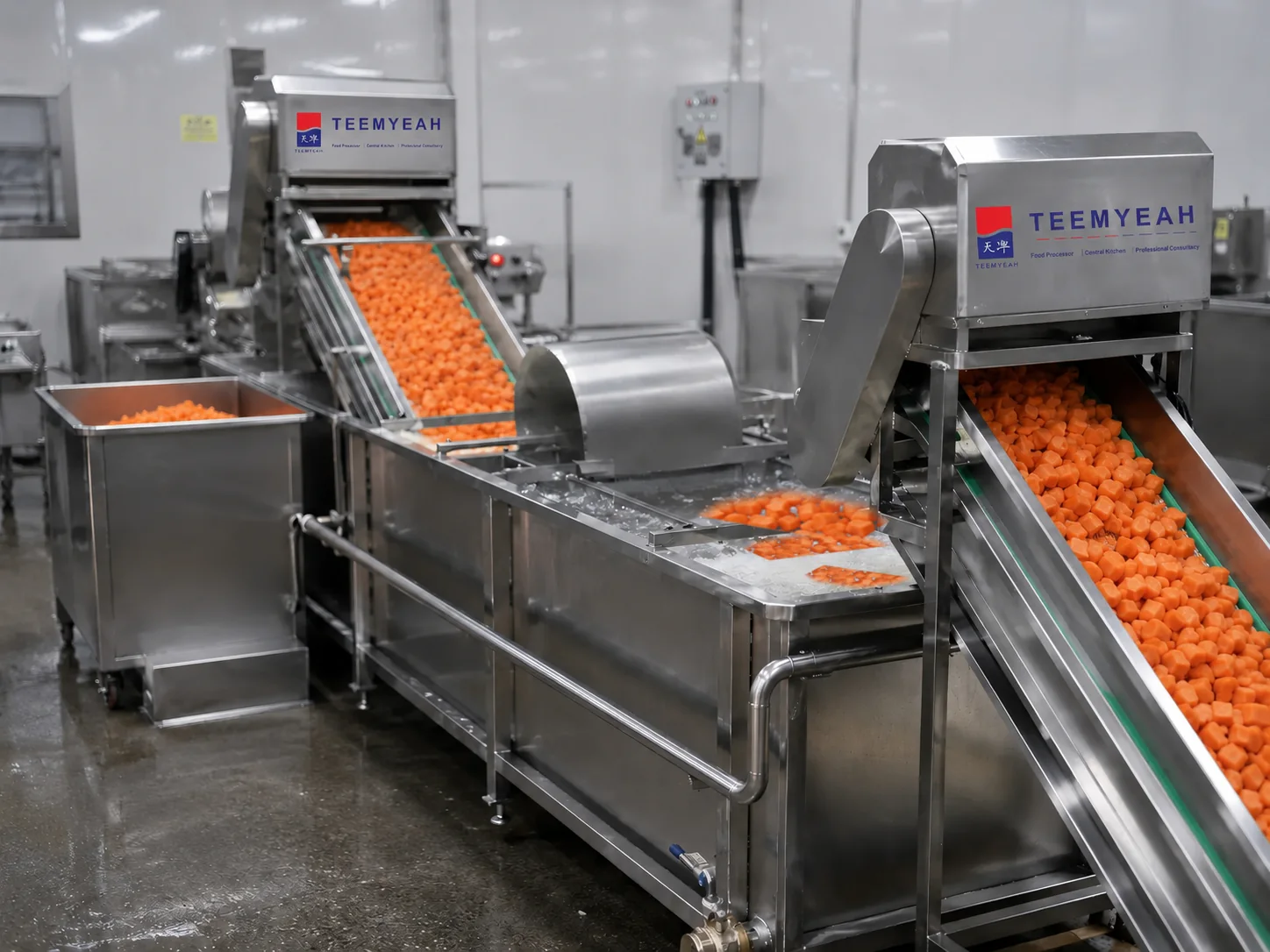
Once product classification and dispatch timing are clear, engineers can define the actual preparation sequence. Vegetable-processing flows can include receiving issue, trimming, peeling, cutting, washing, inspection, dewatering, mixing, portioning and transfer. The order changes with the raw material and finished specification.
The critical concept is practical throughput: the saleable quantity the system can consistently complete under real operating conditions. It is not the highest catalog capacity printed beside one machine.
A cutter rated for a nominal 1,000 kg/h does not create a 1,000 kg/h vegetable processing line if the actual product mix allows the wash stage to handle only 650 kg/h or the dewatering section repeatedly waits for batch unloading. Manual inspection can also become the limiting process, particularly when incoming material quality is variable.
Practical line throughput ≈ capacity of the required bottleneck process under the actual product and operating conditions
“Required” matters. A machine does not constrain a SKU that bypasses it. One product family can therefore have a different bottleneck from another even when both use the same facility.
Theoretical capacity should be adjusted for operating losses
A production shift contains sanitation, blade changes, replenishment, inspection, meal breaks, minor stoppages, product changeovers, quality checks and planned maintenance. A facility scheduled for eight hours may have substantially fewer effective processing hours.
Effective production time = Scheduled time × operating availability
Required finished throughput = Required finished output ÷ effective production time
Operating availability should come from measured data where possible. If a new facility has no history, the engineering team can create several scenarios rather than choosing an optimistic percentage simply to make equipment appear sufficient.
SKU count can be more important than tonnage
A hub processing 3,000 kg of four repeatable SKUs can be much easier to automate than another processing the same mass across forty-five SKUs. Every additional product can introduce another blade, cut dimension, wash requirement, allergen consideration, inspection standard, package size, sanitation step or destination rule.
Changeover time should therefore be measured from the last conforming output of SKU A to the first conforming output of SKU B. Counting only the physical blade-change time can underestimate the actual production loss because operators can also need to empty conveyors, remove product residues, clean contact surfaces, reset controls and verify the first output.
When SKU diversity is high, several flexible processing cells can outperform one visually impressive integrated line. The engineering objective is not maximum mechanization. It is the lowest-risk way to complete the required product mix before dispatch.
Stage 6: Control WIP, Cooling and Chilled Holding Before Dispatch
Work in progress is often treated as harmless inventory inside the facility. For food preparation, it can affect service reliability, quality, traceability and food safety.
If cut vegetables wait in an uncontrolled buffer because the downstream washer is full, the preparation schedule is already out of balance. If cooked food waits for cooling space, an upstream cooking process is producing faster than the downstream control step can accept. If completed outlet orders fill an aisle because dispatch staging is too small, production volume has exceeded material-flow capacity even if every machine is still operating.
CDC’s definitions of foodborne-illness contributing factors specifically recognize prolonged preparation time outside temperature control as a condition that can permit pathogens to multiply. That does not mean every food requires identical controls, but it demonstrates why engineers should measure time in process rather than looking only at equipment speed.
A useful metric is:
WIP dwell time = Timestamp entering a waiting state to timestamp entering the next controlled process
For product classes requiring controlled cooling or chilled holding, release criteria should be defined by the facility’s food safety plan and local regulatory requirements. The workflow should specify who records the result, what happens if the criterion is not met and whether the affected product can be reworked, held for evaluation or must be rejected.
Cold rooms should also be evaluated for operating flow. Nominal room volume means little if pallets block evaporator airflow, staged routes repeatedly leave doors open, or first-dispatch products are inaccessible behind later orders.
Stage 7: Preserve Lot Identity While Converting Production Batches Into Outlet Orders
Production works efficiently in batches; distribution works in orders. The hub has to convert one into the other without losing traceability.
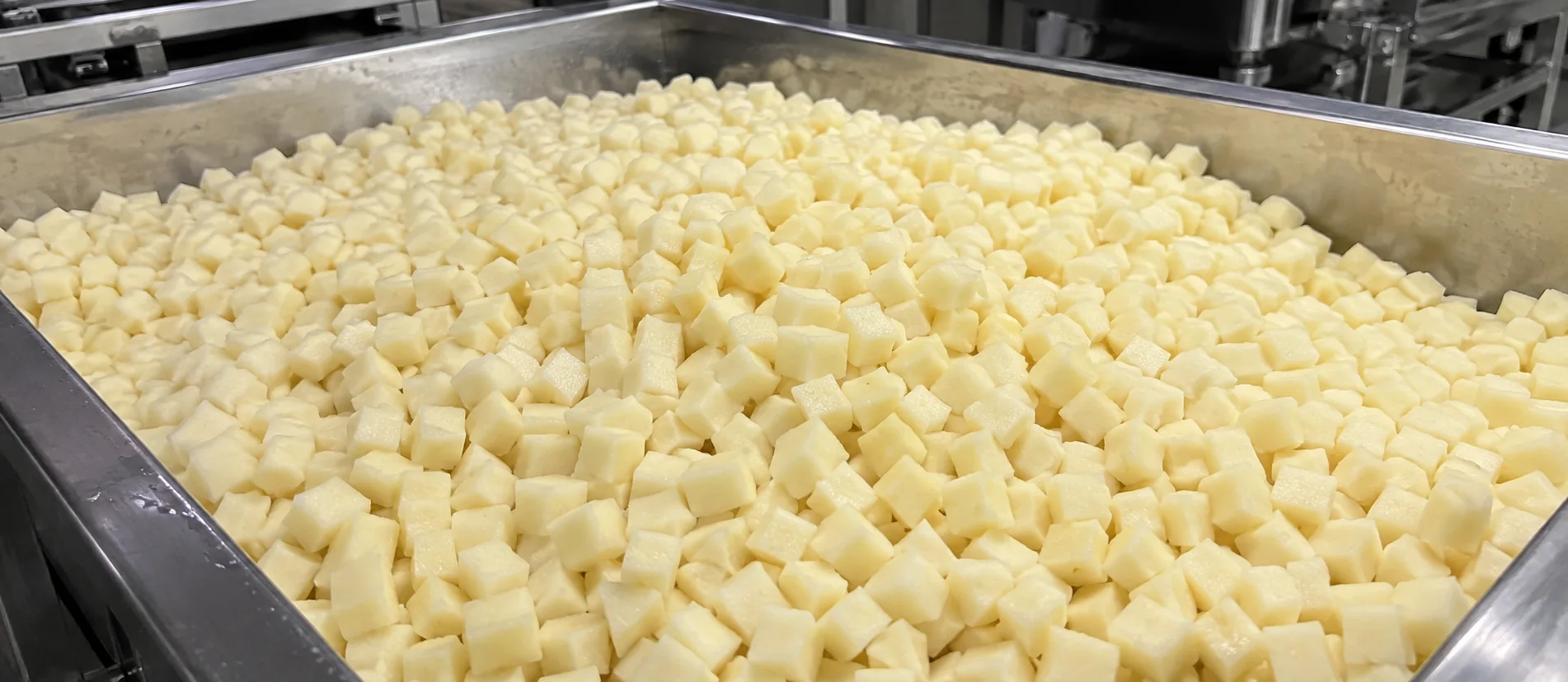
A 400 kg batch of sliced carrots, for example, can be divided across twelve outlets. Each distribution unit should still be traceable to the relevant production and raw-material records. Conversely, one outlet order can contain components from many production batches.
The identification system does not need to be technologically elaborate to be useful, but it should answer operational questions quickly:
- What product is this?
- Which production lot or batch does it belong to?
- Which incoming lots contributed to it where required?
- When was it produced?
- What outlet or route is it allocated to?
- What handling condition applies?
- What quantity should be present?
- Who released the batch or shipment?
A common weakness appears when traceability is strong in raw-material receiving and again in finished dispatch, but the connection is lost during trimming, cutting, washing or bulk holding. Container transfer therefore deserves as much attention as software. If employees move product into unmarked tubs during a rush period, a digital traceability platform cannot reconstruct information that was never maintained physically.
Allocation should occur before the loading dock becomes the sorting area
Route loading is faster and less error-prone when outlet allocation is complete before product reaches the dock. Using the loading area to finish picking, count loose packages and resolve shortages makes vehicle departure dependent on last-minute manual decisions.
Where production volume justifies it, an allocation area can organize product by route, outlet and stop sequence. The objective is not necessarily automated sortation. Clear identification, controlled scanning or verification and enough physical separation can already remove significant ambiguity.
Stage 8: Plan Dispatch From Route Departure Backward
For a multi-outlet network, the dispatch schedule is effectively another production schedule.
A central hub can finish the required daily tonnage and still fail operationally if the wrong quantity is ready at 5:00 a.m. The meaningful service level is therefore not simply “daily kilograms produced.” It is whether the complete route order is released before loading must begin.
On-time production rate = Orders or route loads completed by the required dispatch cut-off ÷ total scheduled orders or route loads × 100
Loading sequence should follow delivery logic. Product for the last stop should not necessarily block the first stop, particularly where repeated searching increases door-open time or handling. Route planning should consider vehicle capacity, stop sequence, unloading practicality, temperature-control requirements, delivery windows and the receiving capability of each outlet.
FDA’s U.S. Sanitary Transportation rule illustrates the broader principle that transport safety is shared across multiple actors. Its requirements address shippers, loaders, carriers and receivers and include suitable vehicles, sanitary operations, temperature controls where needed, prevention of contamination and records. The exact legal applicability depends on jurisdiction and operation, but the workflow lesson is widely relevant: cold-chain performance should have named owners at each transfer point.
Stage 9: Treat Cold-Chain Transport as a Process, Not a Temperature Display
Cold-chain control is sometimes reduced to the temperature visible on a vehicle display. That number is useful, but a robust dispatch process considers more variables.
Was the vehicle suitable and clean before loading? Was the product in the correct condition before it entered the vehicle? How long did loading take? Were raw and RTE products segregated appropriately? Did packages remain intact? How often were doors opened? Did the route exceed the validated distribution window? Was the receiving outlet ready when the vehicle arrived?
Transport cannot correct poor upstream control. Loading warm product into a refrigerated vehicle is not equivalent to properly completing a required cooling process. Likewise, excellent hub sanitation can be undermined by dirty reusable containers or unsuitable transport equipment.
The required transport temperature and allowable duration must be tied to the specific product, packaging, hazard analysis, process validation and local regulatory framework. A restaurant network carrying washed RTC vegetables, RTE salads and cooked-chilled sauces should not automatically assume that one generic shelf-life or handling statement adequately controls every SKU.
Useful network metrics include transport-temperature compliance where required, route departure adherence, on-time-in-full delivery, rejected delivery rate and route duration variance.
Stage 10: Define What the Outlet Must Do After Receiving Hub-Prepared Food
Central preparation does not remove outlet responsibility. It changes it.
A restaurant receiving pre-cut RTC potatoes should know whether the component needs further washing, what cooking step applies, how it should be stored and when it should be rejected. An outlet receiving an RTE salad component needs a handling process that protects it from raw-food contamination. A catering site receiving cooked-chilled food needs the correct downstream holding, reheating or service process for that product.
Receiving should therefore include defined acceptance criteria rather than a driver simply placing containers in a back room.
Typical checks can include:
- correct outlet and delivery;
- correct SKU and quantity;
- package integrity;
- product condition;
- required lot or date identification;
- temperature or other specified acceptance criteria where applicable;
- evidence of transport deviation if the system uses monitoring;
- documented response to shortages, damage or rejection.
The receiving process also needs speed. A technically compliant refrigerated vehicle provides little value if delivered food remains on a warm loading platform because outlet staff are busy with service.
For many restaurant chains, the operational objective of a hub is to reduce heavy or repetitive outlet preparation so local staff can focus on cooking, assembly and customer service. That makes the remaining local tasks more important, not less. Standard operating procedures, training and verification still have to reach every spoke.
Which Service-Level Metrics Show Whether the Hub-and-Spoke System Is Working?
A central hub can report impressive machine utilization while restaurant managers complain about missing products. It can achieve low labor hours per kilogram while producing too much inventory. It can improve yield while repeatedly delaying dispatch because inspection has become understaffed.
Performance should therefore connect production economics with outlet service.
| Metric | Example Formula | What It Answers | Management Warning |
|---|---|---|---|
| Labor hours per 1,000 kg | Direct preparation labor hours ÷ saleable kg × 1,000 | How labor-intensive is preparation? | Do not include unrelated cooking or service labor when evaluating prep automation. |
| Yield | Saleable output kg ÷ raw input kg × 100 | How much purchased material becomes usable prepared product? | Higher speed can reduce yield if trimming or peeling becomes excessive. |
| Preparation cost per kg | Relevant preparation cost ÷ saleable output kg | What does the hub spend to create usable product? | Include sanitation, utilities, maintenance and relevant packaging, not labor alone. |
| Practical throughput | Saleable output ÷ effective processing hours | What output can the system actually sustain? | Do not substitute the nameplate rating of the fastest machine. |
| Changeover time | Last conforming SKU A to first conforming SKU B | How much capacity is lost to SKU complexity? | Blade-change duration alone understates many changeovers. |
| Downtime rate | Unplanned downtime ÷ scheduled operating time × 100 | How much capacity is lost to reliability problems? | Track causes, not only total minutes. |
| On-time production | Orders completed by dispatch cut-off ÷ scheduled orders × 100 | Can production support logistics? | Daily tonnage can be achieved while this metric is poor. |
| On-time-in-full delivery | Complete deliveries within agreed window ÷ scheduled deliveries × 100 | Are outlets receiving what they need when they need it? | Separate production shortages from transport failures. |
| Order adjustment rate | Orders changed after cut-off ÷ total orders × 100 | How stable is the planning input? | High variability can make central production inefficient. |
| WIP dwell time | Time waiting between controlled process stages | Where is material accumulating? | Large buffers can conceal a bottleneck while increasing handling risk. |
These indicators should be reviewed together. Optimizing one in isolation can damage another. Producing very large batches can raise machine utilization but create long WIP queues. Aggressive trimming can increase apparent labor productivity but reduce material yield. Extremely lean inventory can improve working capital while leaving no protection against an unreliable incoming supply chain.
Worked Hypothetical Example: Capacity Must Meet Dispatch Waves, Not Just Daily Tonnage
The following is an illustrative calculation. It does not represent a TEEMYEAH customer, a recommended staffing model or a guaranteed operating result.
Consider a preparation hub supplying 24 restaurant locations. After the daily order cut-off, confirmed finished-preparation demand totals 2,400 kg across multiple vegetables and prepared components.
- Route A serves 8 outlets and requires 840 kg, departing at 5:00 a.m.
- Route B serves 9 outlets and requires 900 kg, departing at 6:15 a.m.
- Route C serves 7 outlets and requires 660 kg, departing at 7:30 a.m.
The scheduled preparation period provides eight hours, but the planning team estimates that sanitation, changeovers, breaks, inspection and ordinary minor stops leave 78% of those hours effectively available.
Effective processing time = 8 hours × 0.78 = 6.24 hours
Average required finished throughput = 2,400 kg ÷ 6.24 hours ≈ 385 kg/h
A first-pass equipment review might therefore conclude that a 400–500 kg/h line is sufficient. That conclusion is incomplete.
Route A cannot wait for the daily average. Its 840 kg must pass preparation, any required cooling or holding, allocation, packing and route verification early enough for loading before the 5:00 a.m. departure. If several Route A SKUs share one 300 kg/h bottleneck, the first dispatch can fail even though the entire day still achieves 2,400 kg.
The production planner should therefore assign each SKU a latest completion time based on its route. The line can run Route A products earlier, combine common SKUs for several routes where holding conditions permit, or use parallel processing where justified. Another option is changing route departure or production start time if logistics and labor economics support it.
Convert finished demand to raw demand by SKU, not one network-wide yield assumption
Suppose the planning team uses an illustrative weighted average yield of 82% for an early screening calculation:
Illustrative raw-material requirement = 2,400 kg ÷ 0.82 ≈ 2,927 kg
This number should not become the purchasing standard. A leafy product with trimming loss and a peeled root vegetable do not have the same yield. The useful calculation is performed by SKU or product family and updated with measured results.
If seasonal material changes reduce actual recovery, the hub might need more than 2,927 kg raw input to satisfy the same finished orders. That affects receiving volume, storage, waste removal, preparation time and purchasing cost simultaneously.
Daily capacity can pass while dispatch capacity fails
This example demonstrates why capacity planning for a hub should contain at least three layers:
- Daily mass capacity: can the facility produce the total required amount?
- SKU process capacity: can each product pass its required bottleneck and changeovers?
- time-phased dispatch capacity: can the correct mix be completed for each vehicle departure?
Only when all three fit can the operation reasonably claim that production capacity matches network demand.
How Equipment Selection Changes in a Hub-and-Spoke System
Once the demand model, process classes, time-phased capacity and facility constraints are understood, equipment selection becomes much more disciplined.
A vegetable processing line can combine cutting, washing, peeling, inspection, dewatering and conveying, but the correct configuration depends on how those functions serve the order schedule. Equipment should be evaluated by practical product performance, cleanability, changeover requirements, material handling and integration—not only nominal kilograms per hour.
Cutting equipment: consistency must coexist with flexibility
Cut dimensions affect appearance, cooking behavior and portion consistency. For a restaurant hub, however, the fastest cutter is not automatically the best choice. A machine producing multiple cut formats with manageable blade changes can be more valuable in a high-SKU operation than a higher-capacity specialist machine that sits idle between short campaigns.
Product testing should consider cut conformity, breakage, juice loss, feeding behavior, usable yield, cleaning access and actual throughput with representative incoming materials.
Washing: process purpose must be defined before tank count
“Vegetable washing” can refer to very different objectives: soil removal from whole produce, washing cut vegetables, controlled RTE processing, removal of floating debris or a product-specific sanitizer program.
The required washing principle, number of stages, water management and downstream separation should therefore follow the hazard analysis and quality objective. More tanks are not inherently safer. Poorly controlled water can create another transfer mechanism for contamination, while excessive mechanical action can damage delicate products.
Where sanitizer dosing forms part of a validated process, concentration, contact conditions, water quality and monitoring have to be managed as a system rather than treated as a chemical added to a tank.
Peeling: speed and yield have to be evaluated together
Root vegetable peeling illustrates why equipment selection should include material cost. A more aggressive process can appear productive because material leaves the machine quickly, yet excessive flesh removal reduces saleable yield.
Testing should therefore compare usable output mass and product condition, not just the number of kilograms fed into the peeler.
Dewatering: downstream product condition matters
For washed leafy vegetables and selected fresh-cut products, excess surface water can affect downstream weighing, packaging and product condition. Dewatering capacity should be matched to the washing stage and actual basket or continuous-cycle behavior.
If a washer continuously discharges product into a batch dewatering process, buffer design becomes important. Without adequate synchronization, employees can create large temporary piles around the dewatering section, making the nominal capacities of both machines misleading.
Conveying and transfer should reduce handling rather than merely connect machines
A conveyor does more than move food. Its speed, height, accumulation characteristics and cleaning accessibility affect line balance, ergonomics and sanitation.
Automation can also create risk if transfer sections are difficult to inspect, disassemble or clean. Hidden residues, inaccessible belt returns and complex product traps can convert labor-saving equipment into a sanitation burden.
Sanitary design should therefore be treated as part of production capacity because every additional minute required for cleaning reduces effective operating time.
Manual, Semi-Automatic or Integrated: Which Hub Configuration Fits?
A central preparation hub does not need to jump directly from knives and sinks to a fully integrated automated line. The right automation level depends on demand concentration, SKU stability, labor intensity, sanitation requirements, available space and dispatch risk.
| Configuration | Usually Fits When | Strength | Constraint | Typical Decision Signal |
|---|---|---|---|---|
| Primarily manual hub | Aggregated volume remains low, SKU variation is high and many operations require judgment | High flexibility and low initial equipment commitment | Labor dependence, variable output and limited scalable throughput | Equipment utilization would remain too low to justify dedicated automation |
| Semi-automatic work cells | Several repetitive processes have sufficient volume but menus still change frequently | Balances mechanization with routing flexibility | More manual transfers and planning discipline required | Different product families need different processing sequences |
| Integrated line | High repeatable volume follows a stable process with compatible SKU families | Reduced handling and stronger continuous-flow potential | Higher dependence on line balance, uptime and sanitation design | Large share of daily demand follows the same process path |
| Hybrid hub plus outlet preparation | Some high-volume tasks centralize well while fragile or last-minute items do not | Combines network efficiency with local responsiveness | Responsibility boundaries must be exceptionally clear | Centralization value varies strongly by SKU |
When manual processing still makes sense
Manual preparation can remain rational for low-volume specialty products, irregular trimming, frequent menu trials and ingredients requiring visual judgment. A machine that requires twenty minutes of cleaning to process a ten-minute product batch can increase total workload.
Manual work also provides flexibility during a new hub’s demand-learning phase. Buying large dedicated equipment before the restaurant network stabilizes its SKU specifications can lock the facility into the wrong process.
When semi-automation is often the stronger choice
Semi-automatic cells work well when washing, cutting or peeling volumes justify equipment but product routing remains complex. Operators can move different products between specialist processes instead of forcing everything through one fixed line.
This architecture can also support phased investment. A group can mechanize the highest-labor or highest-capacity constraint, measure results and add downstream automation only when demand supports it.
When integrated automation becomes commercially meaningful
Integrated automation is easier to justify where high-volume SKUs repeatedly follow the same processing sequence, dispatch demand is predictable enough to load the line effectively, sanitation design is compatible with the product class and enough upstream and downstream capacity exists to keep the system balanced.
The key threshold is not a universal daily tonnage. It is the combination of repeatable hours of use, process compatibility and measurable cost or service improvement.
Labor Planning Changes, but Labor Does Not Disappear
Central hubs usually shift labor rather than eliminate the need for people. Outlet-level peeling, cutting and cleaning can decline while the hub adds receiving, staging, inspection, machine operation, sanitation, maintenance, quality control, dispatch and planning responsibilities.
U.S. Bureau of Labor Statistics data provide context rather than a universal cost assumption. The agency reported a May 2024 median hourly wage of $16.45 for food preparation workers and projected about 148,000 openings per year on average over 2024–2034, mainly because workers transfer to other occupations or leave the labor force. Wage rates and labor availability differ substantially by country and city, so a project model should use the facility’s actual employment cost rather than importing U.S. figures.
Labor evaluation should include recruitment, training, absence coverage, supervision and sanitation time as well as hourly wages.
Labor hours per 1,000 kg = Direct relevant preparation hours ÷ saleable prepared kg × 1,000
This metric is useful because it allows comparison when production volume changes. Headcount alone can be misleading: ten operators preparing 1,000 kg and twelve operators preparing 2,000 kg do not represent the same labor productivity.
Ergonomics should remain part of the design. Mechanization can reduce repetitive chopping or heavy manual transfer, yet new risks can appear if operators repeatedly lift machine baskets, reach across wide conveyors or work around wet floors. Equipment layout should consider working height, container weight, access, lifting frequency, knife use, traffic routes and cleaning tasks.
Automation Can Create New Operational Risks
Automation is valuable when it removes a known constraint. It becomes risky when the project assumes the equipment itself will create process discipline.
A single failure can affect many outlets
Decentralized preparation distributes operational risk. A failure in one restaurant affects one restaurant. Centralization aggregates that risk. If the hub’s critical washing, cutting, refrigeration or dispatch process stops, many locations can be affected simultaneously.
Reliability planning therefore deserves more attention as centralization increases. Teams should identify critical equipment, likely failure modes, available bypass routes, maintenance capability, spare parts and the amount of time available before an outage threatens the next dispatch.
Automation can move the bottleneck downstream
Increasing cutting speed without expanding inspection, washing or dewatering capacity simply creates a larger queue. The improvement should be evaluated at the system output, not the upgraded machine.
Complex equipment can lengthen sanitation
A continuous line with many belts, guards, pumps and transfer points can require more extensive cleaning than several simple machines. If sanitation time is underestimated, effective throughput falls and labor savings can be offset by additional cleaning effort.
Incorrect equipment can damage product or reduce yield
Soft leafy vegetables, hard roots and irregular produce respond differently to mechanical force. A line proven with one ingredient should not automatically be assumed suitable for another. Raw-material testing is especially important when product condition changes seasonally.
Digital planning does not fix bad master data
Scheduling software cannot determine that three differently named outlet items are actually the same production SKU unless the organization’s master data reflects that relationship. Automation amplifies the quality of its inputs, including bad inputs.
When a Central Preparation Hub Is the Wrong Solution
A central hub should be rejected or limited when the network does not provide enough operational advantage to compensate for additional distribution, facility and coordination requirements.
Warning conditions include:
- very low aggregated preparation volume;
- large distances between outlets that make delivery expensive or consume too much useful product life;
- extreme daily demand volatility that cannot be forecast before production;
- products whose desired sensory quality deteriorates rapidly after central preparation;
- menus dominated by local customization rather than common components;
- insufficient cold-chain or transport infrastructure;
- no practical backup when one central facility stops;
- frequent SKU changes that keep automated equipment underutilized;
- a hub proposed only to reduce headcount without accounting for logistics, sanitation, maintenance and central overhead;
- poorly developed food safety management that would simply concentrate existing problems in one larger facility.
A small restaurant group can sometimes achieve better economics by improving outlet workstations, buying pre-processed ingredients or centralizing only one or two high-volume tasks. The strategic decision is not binary. It is possible to centralize cabbage washing and cutting, root vegetable peeling or protein portioning while leaving several other preparations in the restaurant.
A Decision Table for Evaluating the Hub-and-Spoke Model
| Decision Factor | Supports More Centralization | Supports Hybrid or Local Preparation | Evidence to Collect |
|---|---|---|---|
| Network volume | High aggregated repeatable demand | Low or fragmented demand | Finished kg/day by SKU |
| SKU commonality | Many outlets use the same specifications | Each location uses different preparations | Volume by true process SKU |
| Order stability | Demand can be committed before production | Requirements change near service time | Post-cut-off adjustment rate |
| Product durability | Prepared component tolerates validated distribution process | Quality depends on immediate local preparation | Product testing over intended process window |
| Transport network | Reliable routes and practical delivery windows | Long, unpredictable or costly routes | Route duration and variability |
| Labor pattern | High duplicated prep labor across outlets | Outlet prep labor is already minimal | Relevant labor hours per 1,000 kg |
| Food safety capability | Hub can implement suitable zoning, sanitation and records | Central facility would concentrate uncontrolled processes | Hazard analysis and prerequisite-program assessment |
| Automation utilization | Equipment can operate for meaningful repeatable campaigns | Machines spend much of the shift changing or waiting | Run hours, changeover time and SKU sequence |
| Resilience | Critical failures have practical contingency | One outage would stop the entire network | Critical-process recovery plan |
| Expansion | New outlets add volume to established SKUs and routes | Expansion is geographically dispersed or menu-diverse | Three-year network and menu scenarios |
How to Evaluate ROI Without Assuming Automation Will Pay Back
Payback should be calculated from verified changes to the entire operating model, not from the purchase price of a vegetable processing line compared with outlet wages.
Simple payback period = Net incremental investment ÷ verified annual net benefit
The investment side can include equipment, installation, building modifications, utilities, cold storage, additional packaging, vehicles, software, commissioning and working capital. The benefit side can include preparation labor genuinely removed or redeployed, measurable yield improvements, avoided duplicate equipment, reduced rework or other validated operating changes.
New central costs must also be included: hub sanitation, maintenance, spare parts, supervisors, quality staff, logistics, energy, packaging and facility overhead.
Consider a hypothetical project that expects to redeploy outlet preparation labor. If the model assumes every released hour becomes a cash saving while the same employees remain scheduled for service, the ROI is overstated. The benefit might still be commercially valuable through higher service capacity or reduced recruitment pressure, but it is not the same as a payroll reduction.
Yield benefits should be treated similarly. Do not insert a generic “5% waste reduction” into the financial model. Run product tests, measure raw input and saleable output, and compare the proposed process with the actual current process.
A stronger business case uses at least three scenarios: conservative, expected and high-demand. This reveals whether the investment depends on optimistic outlet growth or remains workable under current volume.
How to Phase a Hub Instead of Over-Automating From Day One
Phased automation can reduce the risk of designing around forecasts that later change.
Phase 1: Standardize demand and product specifications
Before equipment selection, define common SKUs, cut dimensions, batch requirements, packaging units, outlet order rules and receiving responsibilities. A fragmented product master cannot be solved mechanically.
Phase 2: Mechanize the strongest bottlenecks
Measure labor hours, throughput, yield, WIP and changeover. High-volume washing, repetitive cutting or root peeling can become early candidates when those activities dominate the current process.
Phase 3: Connect compatible operations
Once practical capacity is known, conveying, inspection, dewatering, dosing, weighing or other modules can be integrated where they reduce handling without creating sanitation or flexibility problems.
Phase 4: Expand automation only when the network uses it
Additional outlets can change the economics. A semi-automatic cell that is appropriate for twelve restaurants might become a continuous processing line candidate when thirty restaurants consume the same core SKUs. Expansion should be triggered by measured demand and operating data rather than by an assumption that “full automation” is the natural final state.
What Information Should Be Ready Before Designing the Hub?
A useful preliminary line concept requires more than a target tonnage. Engineering teams should assemble a project input sheet covering demand, product and facility conditions.
- Outlet network: current locations, planned expansion, delivery windows and route structure.
- Order process: forecast timing, final cut-off, allowable late changes and daily demand variation.
- Raw materials: vegetable, fruit, meat or other ingredient types; incoming dimensions; seasonal condition; soil or contamination load where relevant.
- Finished SKUs: cut size, peeled or unpeeled condition, washed state, RTC/RTE classification, portion size and downstream outlet use.
- Capacity: average and peak finished kilograms per day by SKU, not only total annual volume.
- Yield: current measured recovery where available.
- Dispatch: route departure times and kilograms required by each wave.
- Food safety: product hazard analysis, required process controls, hygiene zoning and applicable local rules.
- Sanitation: available cleaning window, chemical program where applicable and separation requirements.
- Facility: floor plan, ceiling height, drainage, water, power, refrigeration, access and future expansion space.
- Labor: current hours by preparation activity, shift pattern and difficult-to-staff tasks.
- Operations: expected changeovers, maintenance capability, critical-spare strategy and contingency plan.
These inputs make it possible to design from outlet service requirements backward toward equipment rather than forcing restaurant demand into a predefined production line.
Automation Is a Redesign of the Operating System, Not a Machine Purchase
A successful central preparation hub does not simply replace twenty sets of knives with one industrial cutter. It changes where decisions are made, when demand becomes fixed, how raw materials are issued, how common SKUs are consolidated, how product risk categories are separated, how batches are identified and how the final responsibility is transferred to the outlet.
The strongest hub-and-spoke design therefore starts with the customer-facing service requirement: each restaurant or catering location must receive the correct prepared component, in the required condition, in the required quantity and before the local kitchen needs it.
From that target, planners work backward through receiving, transport, route departure, dispatch staging, chilled release, preparation and raw-material issue. Only after those requirements are quantified should the engineering team choose washing machines, cutters, peelers, dewatering systems, conveyors or integrated lines.
That sequence protects the project from two common mistakes: buying equipment sized around theoretical capacity and centralizing products that should have remained local. The goal is not maximum automation. It is a preparation network whose capacity, hygiene controls, labor model and logistics remain balanced as the restaurant or catering business grows.
Design Your Hub-and-Spoke Preparation Flow
If you are evaluating a central hub for a restaurant chain, QSR network or multi-site catering operation, prepare your raw materials, finished SKU specifications, average and peak quantities, outlet count, dispatch waves, available floor plan and current preparation process. TEEMYEAH can use those inputs to discuss a preliminary process recommendation, equipment configuration, capacity balance and layout concept.
As a food pre-processing equipment supplier and customized food preparation solution provider, TEEMYEAH supports central kitchens, food manufacturers, fresh-cut processors and RTC/RTE facilities with process-flow development, raw-material testing, equipment matching, sanitary-design considerations and line integration. You can review the restaurant chain and QSR processing framework or explore how a custom food pre-processing line can be configured around your actual SKU and capacity requirements.
The most useful starting point is not a machine model. It is a capacity and equipment checklist that shows what each outlet needs, when it needs it and which preparation steps are commercially justified to move into the hub.
FAQ
1. What is a central preparation hub workflow?
A central preparation hub workflow is the complete operating sequence that converts demand from multiple restaurant or catering locations into centrally prepared products and distributes those products back to the correct outlets. It includes order cut-off, SKU consolidation, production planning, raw-material issue, food pre-processing, cooling or chilled holding where required, batch identification, route allocation, loading, transport, outlet receiving and final local preparation. The workflow is broader than a central kitchen equipment layout because it defines how information, product and responsibility move between the hub and each outlet.
2. How does a central preparation hub decide what quantity to produce?
The hub should consolidate confirmed outlet orders by true production SKU and then convert finished demand into raw-material requirements using measured or appropriately conservative yield assumptions. Planning must also consider existing inventory, product changeovers, practical equipment throughput and route deadlines. Total daily kilograms are not enough: quantities required for an early delivery route must be completed earlier than products leaving several hours later. Forecasts can support purchasing and labor planning, while an agreed order cut-off provides the committed demand used for production release.
3. What should be centralized and what should remain at restaurant outlets?
High-volume, repeatable processes such as standardized washing, peeling, cutting, portioning or selected mixing operations are stronger centralization candidates when multiple outlets use the same specification. Local preparation can remain preferable for fragile ingredients, highly customized products, last-minute garnishes, very low-volume SKUs or foods whose desired quality declines rapidly after preparation. Many restaurant groups therefore use a hybrid model. The decision should be made SKU by SKU using volume, labor, quality, food safety, logistics, shelf-life validation and service requirements rather than a rule that everything must move upstream.
4. How are RTC and RTE products handled differently in a central hub?
Ready-to-cook products will receive a later cooking or other validated process at the outlet, while ready-to-eat products are intended to be consumed without a subsequent kill step. This changes the risk model. RTE preparation requires particularly strong attention to hygiene zoning, post-process contamination prevention, equipment cleanability, personnel practices and controlled transfer. RTC areas still require appropriate hygiene and cross-contamination control; downstream cooking does not justify poor upstream handling. Exact temperatures, sanitizer controls, holding times and shelf life should come from product-specific hazard analysis, validation and applicable local regulation.
5. How should a restaurant chain calculate central preparation hub capacity?
Start with finished demand by SKU and dispatch wave, convert scheduled hours into effective processing hours, and identify the practical bottleneck for each process route. A basic calculation is required finished throughput = finished output divided by effective production hours. The result must then be tested against SKU changeovers and route deadlines. A facility can have enough daily capacity but still miss the first vehicle if early-route products share a bottleneck. Raw-material requirements should also be calculated by yield, because purchased kilograms can be substantially different from saleable prepared kilograms.
6. Does a central preparation hub automatically reduce labor costs?
No. Centralization can reduce duplicated washing, peeling, cutting and cleaning work across individual outlets, but the hub adds its own receiving, machine operation, sanitation, quality, maintenance, planning, packing and dispatch labor. Logistics can also increase. The correct financial model measures the labor hours genuinely removed, redeployed or avoided rather than assuming every outlet preparation hour becomes payroll savings. Labor hours per 1,000 kg is useful for comparing preparation intensity, but investment decisions should include logistics, utilities, maintenance, packaging and central-facility overhead as well as wages.
7. Should a central preparation hub use a fully automated processing line?
Only when the product mix and demand justify it. Integrated lines fit high-volume, repeatable SKU families that follow compatible process steps and generate enough operating hours to use the equipment effectively. High-SKU hubs with frequent changeovers can be better served by semi-automatic work cells that allow products to follow different routes. Low-volume specialty preparation can remain manual. The automation decision should consider practical throughput, changeover and sanitation time, product damage, yield, equipment utilization, reliability and the consequences of one critical machine stopping the network.
8. What are the most important KPIs for a hub-and-spoke central kitchen?
No single KPI is sufficient. Useful measures include yield, labor hours per 1,000 kg, practical throughput, preparation cost per kilogram, changeover time, unplanned downtime, WIP dwell time, order changes after cut-off, on-time production and on-time-in-full delivery. Restaurant networks should connect production metrics with outlet service. High machine utilization has little value if route orders leave incomplete, while extremely large batches can improve utilization but increase holding time. A balanced dashboard helps managers determine whether problems originate in demand planning, production, equipment, dispatch or transport.
9. How should cold-chain transport be designed for multiple outlets?
Cold-chain design starts with the individual product’s required condition and validated handling process. The hub should define release criteria before loading, suitable transport equipment, loading and segregation procedures, route duration, delivery windows and outlet receiving responsibilities. Temperature monitoring can be one control, but it does not replace correct cooling, clean transport equipment or timely unloading. There is no single universal temperature or shelf life suitable for every raw RTC, RTE and cooked-chilled component. Requirements should follow the hazard analysis, product validation and regulations applying in the relevant jurisdiction.
10. When is a central preparation hub unsuitable for a restaurant or catering network?
A hub can be commercially unattractive when aggregated preparation volume is low, menus differ substantially between outlets, demand changes too late for efficient centralized production, transport distances are excessive or important products lose quality rapidly after preparation. It can also create unacceptable network risk when one facility failure would stop many locations and no contingency exists. In these situations, decentralized or hybrid preparation can be stronger. The decision should compare the complete network cost and service model rather than assuming that a centralized facility is automatically more efficient than outlet-level preparation.
Data and Source Note
- FDA Food Code. FDA currently identifies the 2022 Food Code as its most recent full edition and explicitly describes the Food Code as a model that jurisdictions use to develop or update retail and foodservice rules. This supports the article’s treatment of Food Code controls as U.S. model guidance rather than universal law; operators must verify applicable local requirements.
- FDA FSMA Final Rule on Sanitary Transportation of Human and Animal Food. The FDA rule establishes sanitary-transportation requirements for covered shippers, loaders, motor or rail carriers and receivers, including vehicle suitability, temperature controls where necessary, contamination prevention, training and records. This supports the article’s handoff-based transport model. Its legal scope is U.S.-specific and should not be presented as globally applicable regulation.
- FDA Retail & Food Service HACCP. FDA states that retail food safety management incorporates HACCP principles and active managerial control and recognizes the wide range of foodservice operations from limited-service facilities to complex operations serving hundreds or thousands of meals. This supports the article’s risk-based rather than machine-based treatment of process design.
- CDC Food Cooling. CDC’s EHS-Net summary states that 504 restaurant foodborne-illness outbreaks in 1998–2008 were associated with hot food cooled too slowly. It also reports practical cooling gaps, including one in seven restaurants in the study storing food in refrigerators above 41°F, four in ten using containers deeper than three inches during cooling and one in four not ventilating food during cooling. These figures describe the referenced U.S. restaurant research and are not estimates for any individual central kitchen.
- CDC Proliferation Contributing Factors. CDC includes prolonged preparation outside temperature control among conditions that can permit bacterial or fungal proliferation. This supports measuring WIP dwell time and avoiding excessively long uncontrolled preparation queues.
- U.S. Bureau of Labor Statistics, Food Preparation Workers. BLS reports about 902,700 U.S. food preparation worker jobs in 2024, a May 2024 median wage of $16.45 per hour and approximately 148,000 projected openings annually on average over 2024–2034, primarily from replacement needs. These figures provide U.S. labor-market context only and should not be applied directly to another country’s wage or turnover assumptions. BLS also describes food-preparation work as involving prolonged standing, food preparation and sanitation tasks, with workplace exposure to slips, cuts and burns.

