







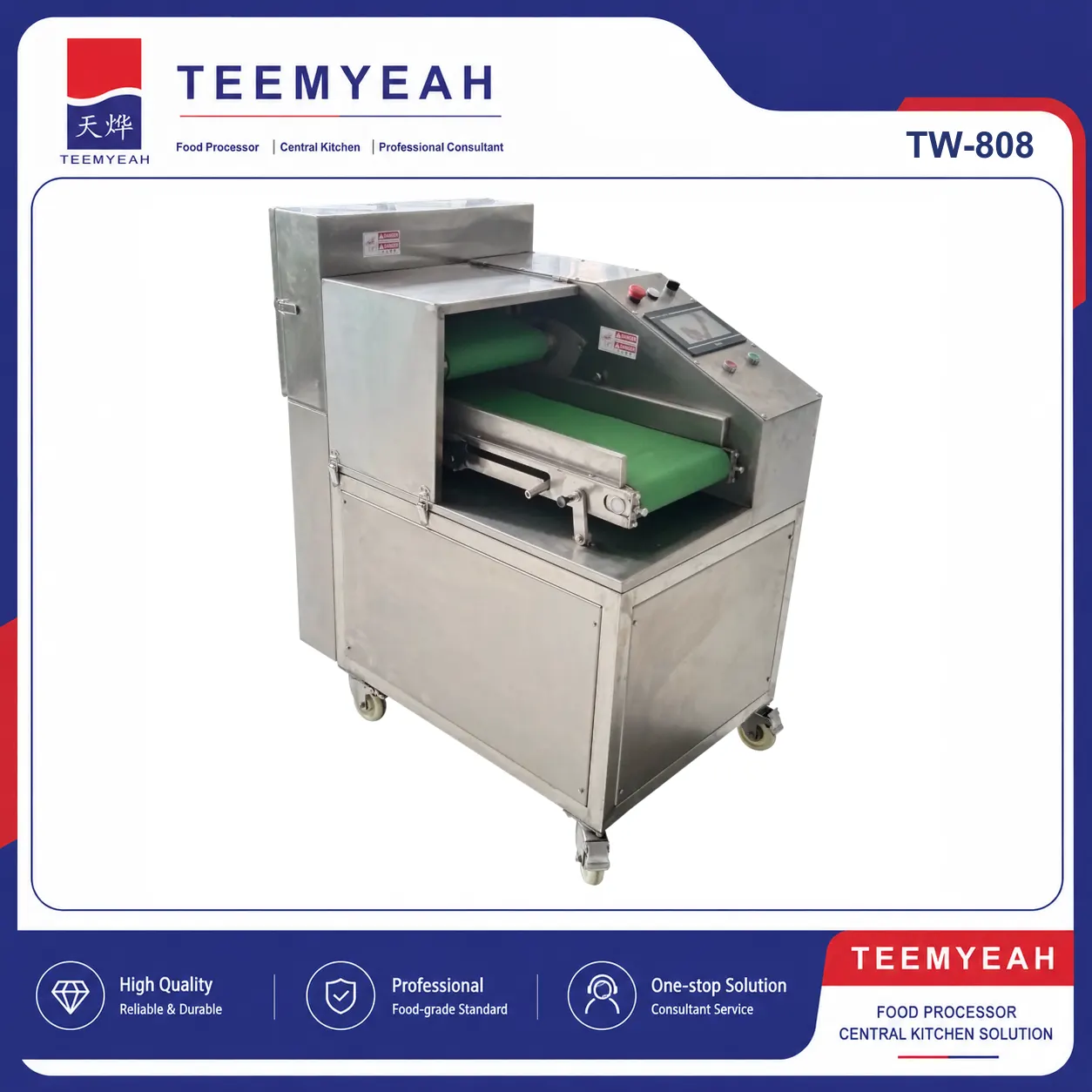
TEEMYEAH TW-808 Vegetable Segment and Block Cutter
Adjustable segment cutting for prepared green beans and other vegetables
The TW-808 cuts vegetables into segments, slices and blocks, including beans, corn, winter melon, potato, pumpkin, Chinese cabbage and small chillies.
For green beans, set the target segment length and plan end trimming and inspection separately. The cutter does not automatically remove stems or tips.
- Segment length continuously adjustable from 2 to 60 mm
- 300 mm infeed width and 80 mm maximum infeed height
- PLC and touchscreen control with variable-frequency and servo systems
- Removable upper and lower conveyor belts for cleaning
- Typical machine output of 2–3 t/h, depending on material and cut length
Cut Segments, Slices or Blocks with the Correct Tooling
The TW-808 advances material on its infeed conveyor in steps while the knife cuts inside the enclosed knife housing. The operator sets cutting length and knife speed at the touchscreen. A slicing blade is used for segment or slice work; block-cutting configurations use the corresponding cutting tool.
Choose the tool and feeding arrangement for the actual vegetable and finished shape. The 2–60 mm segment setting is not a guarantee that randomly oriented or curved beans will all produce the same accepted length. A representative sample run should check the feed arrangement, complete separation, short pieces and accepted segment distribution.
For a combined preparation route, review the custom food pre-processing line and an application-matched TW-606-3 vegetable washer. Washer loading and transfer details need confirmation for the actual bean lot.
TW-808 Technical Specifications
| Parameter | Specification |
|---|---|
| Model | TW-808 |
| Segment length | 2–60 mm, continuously adjustable |
| Block cutting formats | 25 × 25 mm; 30 × 30 mm standard; 40 × 40 mm. Confirm the supplied tool. |
| Infeed width | 300 mm |
| Maximum infeed height | 80 mm |
| Cutting speed | 50–100% adjustable; maximum 140 strokes/minute |
| Typical machine output | 2–3 t/h, depending on material and cut length |
| Dimensions (L × W × H) | 1150 × 680 × 1200 mm |
| Installed power | 2.5 kW |
| Electrical supply | 380 V, three-phase, five-wire; confirm site supply before ordering |
| Construction | 304 stainless steel with removable conveyor belts |
Output varies with material, cut length and feeding. Confirm the machine configuration, electrical connection and installation footprint for your project.
Vegetable Preparation Applications
- Green bean or long-bean segment preparation after the required end trimming and inspection
- Corn segment cutting with the appropriate tool and sample confirmation
- Winter melon, potato and pumpkin blocks or slices
- Chinese cabbage blocks and small chilli rings
Central kitchens, vegetable processors and food factories can evaluate the TW-808 for these duties. Confirm variety, maturity, firmness, temperature and the actual cut specification during a sample test.
Match the TW-808 to Your Bean Segment Specification
Send photos of the incoming beans, state whether stems and tips have already been removed, and provide the target segment length and tolerances, accepted kg/h, material condition and downstream receiving requirements. TEEMYEAH can use these inputs to assess cutter configuration, preparation responsibilities and the scope of a representative sample test.
Arrange a bean sample cutting discussion. Confirm the available machine, sample quantity and receiving address with the team before shipping produce.
Whole Pods and Pretrimmed Beans Need Different Preparation
Untrimmed pods require a defined end-removal and inspection step before a segment-cutting result can be accepted. Already-trimmed beans still need an incoming specification and checks for remaining stems, attached clusters and damaged pods. A cutting machine should not be used as evidence that these preparation tasks have disappeared.
Keep manual trimming output, rejected incoming material and accepted cutter output separate when assessing labor and line balance.
Define the Handoff Before a Freezing Process
Provide the downstream process owner’s requirements for product state, segment dimensions, accepted feed rate, surface water, temperature and transfer method. Establish whether cutting is before or after any thermal step and verify cutter suitability for that actual material state.
The TW-808 does not by itself establish a blanching recipe, freezing performance or ready-to-eat release status. Its role and every upstream or downstream machine belong in the agreed supply boundary.
Compare Machine Ratings with Accepted Product
Use a representative bean lot and an agreed dimensional acceptance method. Record accepted mass over elapsed production time, along with short pieces, uncut connections, rejects and routine interruptions.
Knife strokes per minute and machine-level capacity are not the same as the accepted output of a complete preparation line. Use the equipment capacity verification guide to set the trial measurement boundary.
TW-808 Selection Questions
Related Products

Related News
Summary Food processing equipment capacity verification should answer a practical question: how much acceptable product can the equipment or line […]