







Summary
An industrial carrot processing line should be configured around the carrot product you will sell: washed whole roots, peeled whole carrots, rounds, dice, julienne or straight sticks. Each requires a different acceptance specification, and the same incoming carrots will not necessarily deliver the same usable output across these formats. Diameter, taper, curvature, soil load and surface defects influence the preparation route, feeding conditions and amount of material that meets the finished specification.
Start by defining whether the line receives dirty roots or verified prewashed carrots. Decide whether peeling is required, specify the dimensions and tolerances of each cut, and express capacity as accepted product per hour under agreed operating conditions. Catalogue machine ratings help identify candidates; a representative carrot trial establishes whether the proposed combination fits your product.
A useful purchasing comparison records first-pass output, recoverable rework, discarded material, operating time and utilities from the same carrot lot. It also identifies the preparation, cutting or handling stage that limits sustained output. For raw ready-to-eat carrots, your food-safety team must separately define the hygiene, wash-water, cold-chain and release requirements that accompany the equipment configuration.
Cover: AI-generated concept illustration.
Specify the carrot product before selecting machines
A request for a “carrot washing peeling cutting line” leaves several purchasing decisions unresolved. A packhouse supplying washed whole carrots may retain the skin. A central kitchen may need peeled carrots for subsequent cooking. A fresh-cut processor producing raw snack sticks needs an agreed length, cross-section and appearance, together with a defined food-safety process.
Write one specification for each saleable SKU. Include incoming carrot dimensions, permitted defects, required surface condition, finished geometry and the rate of accepted output. If several SKUs share equipment, identify their daily quantities and production sequence. This makes the proposal reflect the actual product mix.
| Finished product | Measurements to agree | Configuration decision | Trial acceptance record |
|---|---|---|---|
| Washed whole or peeled whole carrots | Root length, diameter range, curvature, surface finish and permitted residual skin | Retain or bypass peeling; define any manual trimming and inspection | Accepted whole roots, remaining defects, breakage and preparation loss |
| Rounds or slices | Thickness tolerance, diameter range and allowance for tapered end pieces | Confirm slicing equipment and feeding conditions for the incoming diameter bands | Thickness distribution, incomplete slices and small end-piece fraction |
| Dice | Three dimensions, dimensional tolerances and permitted irregular edge pieces | Confirm carrot suitability, cutting configuration and handling of tapered roots | Conforming dice, irregular pieces, fines and recoverable off-size material |
| Julienne or straight sticks | Cross-section, length range, straightness, taper and permitted short pieces | Distinguish shredded julienne from calibrated snack sticks before selecting equipment | Length and cross-section distribution, curved pieces, shorts and breakage |
Diameter deserves more attention than an average measurement. A mixed lot containing narrow and thick roots can produce very different cutting results even when its average diameter matches the specification. Record meaningful size bands and inspect the output from each. Curvature and taper also matter when the finished product must have a consistent straight profile.
For carrot sticks processing equipment, provide physical examples or dimensioned photographs of the intended product. “Sticks” can describe short cooking strips, fine julienne or long snack batons. A quotation using that word alone cannot establish whether the proposed cutter produces the required geometry.
Choose the route for dirty-in or clean-in carrots
Dirty whole roots: establish the preparation boundary
Receiving dirty carrots introduces soil and potentially stones or other foreign material before peeling or cutting begins. Assess the delivered condition, including loose soil, adhering deposits and damaged roots. The proposal should identify how this material is assessed and removed before carrots enter operations handling exposed tissue or the designated clean area.
A practical planning sequence is receiving assessment, appropriate precleaning, inspection, optional peeling, any specified trimming, and the selected cutting operation. Additional washing, draining and inspection depend on the finished product and the buyer’s process. The exact equipment and arrangement require confirmation; a generic process sequence does not establish which modules are included in a quotation.
Separate tasks that are easily hidden under “preparation.” If an operator must remove tops, trim damaged tips or reject unsuitable roots, include that work in the staffing and throughput assessment. Agree how soil, stones, peel and rejected carrots leave the area without obstructing product movement or cleaning access.
Prewashed carrots: verify the incoming condition
Clean-in feed can reduce the preparation scope, but “prewashed” needs an incoming specification. Establish permitted residual soil, root condition, supplier handling information and the checks required on receipt. A visually clean carrot is not automatically ready to eat, and an upstream supplier’s washing step does not define the receiving plant’s release requirements.
Peeling may be bypassed when the buyer accepts the skin and incoming carrots meet the required surface specification. Where peeling is required, confirm whether the existing wash condition is suitable for feeding that operation. Plan the bypass as a usable handling route with appropriate inspection and access, rather than an assumption that operators will carry product around a machine.
Keep the intended use visible throughout the proposal. Ready-to-cook carrots and raw ready-to-eat carrots may share some mechanical operations, but the food-safety controls and product-release decisions must reflect their different uses.
Match industrial carrot processing line modules to their actual roles
TEEMYEAH’s published machine information provides starting points for equipment selection. The useful comparison is between each machine’s documented role and the result your carrot SKU requires. Catalogue throughput and installed motor power belong in the proposal, alongside a separate field for the product rate to be demonstrated.
| Machine candidate | Published role and catalogue reference | Carrot proposal decision | Required trial evidence |
|---|---|---|---|
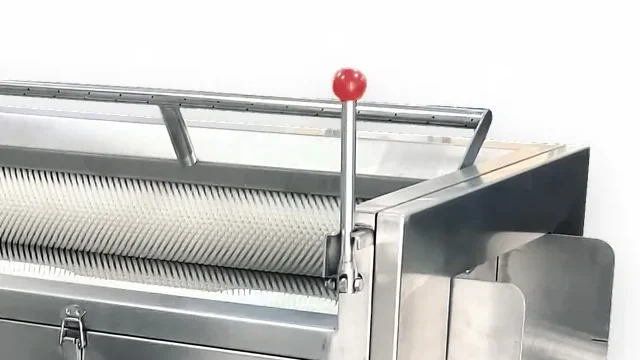
| TY-1500A brush peeler | Carrot application listed; seven brushes, differential speed and U-shaped chamber; 600–1,000 kg/h; 1.5 kW | Assess the required cleaning and peeling finish against root condition and geometry | Accepted surface finish, preparation yield and sustained output at recorded settings |
| TW-922A julienne cutter | Carrot application listed for root shredding/julienne; 2–3 t/h; 1.5 kW | Evaluate for the specified julienne product; do not assume straight snack batons, slices or dice | Actual cut geometry, shorts, fines, feeding consistency and accepted output |
| TD1-800 dicer candidate | Published dice/baton styles; 500–800 kg/h; 0.75 kW; carrot is not explicitly listed among application examples | Confirm carrot suitability and the requested cut before selecting it | Representative carrot test, available cutting configuration and measured conforming output |
The TY-1500A cleaning and peeling machine is therefore a candidate for the upstream carrot preparation stage. Its catalogue range is a preliminary machine reference. Brush condition, loading, residence time, spray conditions and root geometry must be recorded when evaluating the result.
The TW-922A high-speed julienne machine has a different role. Its higher published capacity does not increase the output available from a slower preparation stage. Nor does its carrot application establish suitability for every product described commercially as a stick.
For rounds, calibrated long sticks or another geometry outside the demonstrated configuration, request identification of the actual proposed machine and change parts. The supplier should confirm tool compatibility, feeding requirements and product dimensions for that model. Blade arrangements should never be transferred between models by assumption.
Accept peeling by surface condition and retained product
The peeling decision begins with the surface your customer will accept. A cooking ingredient may have a different appearance requirement from a peeled whole carrot displayed in retail packaging. Specify permitted skin remnants, defects and surface damage so the operator has a defined stopping point.
Compare peeling settings using carrots from the same lot and similar size bands. A setting that improves the appearance of thick roots may remove excessive material from narrow roots. Include the subsequent manual trimming requirement: a machine setting that retains more mass can still create additional inspection and trimming work.
If abrasive and knife peeling are under consideration, compare complete routes against the same finished specification. The relevant question is which route delivers acceptable carrots with suitable retained mass, labor and output. The broader brush peeling versus abrasive peeling comparison provides background for discussing methods; the carrot purchase decision needs the proposed equipment and representative samples.
No universal carrot peel-loss percentage determines acceptance. Agree the project’s minimum usable yield and surface standard before testing, then assess both together.
Build a carrot mass balance that separates product from soil and water
Start the receiving record with gross delivered mass and the tare of containers. Record removed soil, stones and other non-carrot material separately. Water carried into or out of washing can distort comparisons, so agree a weighing and draining procedure and apply it consistently.
For the processing comparison, a useful denominator is cleaned, consistently drained whole-carrot mass before trimming or peeling. State this definition on the trial record. It allows preparation losses to remain visible while avoiding a yield calculation inflated or depressed by different amounts of field soil.
| Mass category | What to record | Accounting treatment |
|---|---|---|
| Receiving material | Gross load, container tare, removed soil and foreign material | Reconcile receiving conditions separately from carrot processing yield |
| Carrot input | Cleaned, drained roots before trimming and peeling | Use as the declared processing-yield denominator |
| Preparation removals | Tops, tips, peel and rejected defects | Keep separate from cutting rejects |
| First-pass accepted output | Product meeting the intended SKU specification without further processing | Count once as directly accepted product |
| Cutting fractions | Fines, shorts, off-size pieces and material allocated to rework | Separate discard, alternate use and recoverable rework |
| Final accepted output | First-pass accepted product plus additional accepted product recovered through rework | Exclude remaining rework and avoid counting recirculated mass twice |
First-pass yield (%) = first-pass accepted mass ÷ defined carrot input mass × 100.
Final accepted yield (%) = (first-pass accepted mass + additional accepted mass recovered through rework) ÷ defined carrot input mass × 100.
Rework input is not itself accepted output. Record the time and any additional losses needed to recover it. If short sticks are sold as a separate cooking ingredient, report that secondary product separately from the yield of the original stick SKU.
Where the balance does not reconcile, investigate water carryover, retained product inside equipment, sampling and weighing differences. Do not automatically label the unexplained difference as peel loss.
Find the bottleneck using accepted product and elapsed time
A line rating cannot be obtained by adding machine capacities. Taking the smallest catalogue number is also insufficient when the ratings refer to different products, feed conditions or output definitions. Establish a common carrot specification and measure the proposed sequence.
Accepted output rate = accepted product mass ÷ the agreed elapsed production time in hours.
State whether that interval includes feeding interruptions, routine clearing, inspection and other stops. If final accepted output includes rework, the corresponding rate must include the time and resources required to complete that rework. Otherwise, the proposal combines a recovered yield with an unrealistically short production period.
Observe queues between operations. A growing accumulation before cutting suggests that the cutter or its feeding arrangement cannot maintain the upstream pace under those conditions. Repeated starvation can reveal an upstream limitation. Inspection, manual trimming and transfer handling may constrain output even when the machines themselves have spare capacity.
Record buffer capacity and product waiting time, including what happens when a downstream stage stops. Buffers can support coordination, but they do not remove a sustained mismatch. Use the root vegetable line capacity guide for broader balancing principles, then base the carrot proposal on measured conditions.
Use the Carrot Trial Scorecard to compare settings fairly
Download the two-page, fillable Carrot Trial ScorecardIts 31 fields record the project and lot, feed condition, size and shape, intended use, format, tolerances, surface standard, target output, settings, mass results, rework, quality, time, utilities and the pass, revise or repeat decision. It does not calculate results automatically.
Complete the specification fields with the supplier before the run. Agree which defects cause rejection, how dimensions will be checked, where samples will be taken and what qualifies as accepted product. The tolerances should come from the buyer’s SKU requirements; there is no single acceptance threshold suitable for every carrot application.
Divide a representative lot into comparable portions for settings comparisons. Keep the size-band proportions and root condition reasonably consistent, and record any differences that could affect interpretation. Changing both the incoming carrots and the machine settings makes it difficult to identify the cause of a changed result.
Inspect samples across the run and across multiple carrot size bands. Retain photographs showing incoming roots, prepared surfaces, conforming pieces and rejected fractions, with a dimensional reference where useful. Photographs support the written measurements; a selected tray of attractive output cannot establish the distribution of the full batch.
Record actual operating time, stops and their causes. Include loading, manual interventions, inspection, rework and the people required to maintain the observed pace. Note whether upstream and downstream equipment ran together or whether an isolated machine received specially prepared feed.
When multiple SKUs are planned, document the changeover: tools removed and installed, adjustments, cleaning, checks and time until acceptable product resumes. Record water conditions and consumption where measurable, electrical information, waste handling and any relevant buffer behavior. Nameplate motor power should remain distinct from measured energy use.
Close the record with a decision and an owner for unresolved items. “Revise” should identify the setting, component or feed specification to change. “Repeat” should state what evidence is still missing and which conditions must remain comparable.
Turn the trial into a site-specific purchase scope
The buyer’s production team should confirm SKU quantities, shift pattern, staffing, incoming supply and packing requirements. The supplier should identify the proposed models, included components, product-contact materials, utility connections and layout dimensions. Together, both parties should document the accepted operating conditions and the scope of any further testing.
The site team needs water supply and drain information, waste collection arrangements, available electrical service and the proposed equipment positions. Catalogue electrical specifications must be checked against local power. Include space for operators, product containers, maintenance and cleaning, rather than fitting only the machine footprints onto the drawing.
Define the packing interface: required draining condition, transfer method, accumulation and downstream receiving pace. The buyer’s food-safety team should set applicable wash-water, hygiene, cold-chain and release requirements. FDA/USDA’s voluntary fresh-produce guidance addresses microbial risk reduction, including water and packing practices; it does not establish that washing alone makes raw carrots safe to eat.
For facilities subject to US requirements, 21 CFR 117.40 addresses equipment cleanability, installation access, food-contact surfaces and maintenance. These considerations belong in layout and equipment review. They do not represent a global certification or an approval of a particular machine.
Use the agreed carrot specification and trial record to develop the TEEMYEAH root vegetable processing line configuration, with each supply item and site responsibility identified in the purchase scope.
Carrot line configuration and acceptance FAQs
How should stated kg/h be adjusted for carrot diameter, soil load and target cut?
Request separate results for the feed conditions and formats you expect to process. There is no defensible universal reduction factor. Include representative diameter bands, the expected receiving condition and the actual finished specification. Ask the supplier to report feed mass, accepted mass, rejected fractions and elapsed time for each run, so the proposed rate has a clear basis.
When does abrasive peeling create unacceptable yield loss compared with knife peeling?
It becomes unacceptable when the tested route fails your agreed combination of retained mass, surface quality, labor and output. Set those criteria before comparing equipment. Weigh preparation removals and subsequent trimming separately, using comparable carrots. If knife peeling is proposed as an alternative, require its own sample result and operating scope rather than assuming it will provide a particular yield improvement.
Which change parts are required for sticks, slices and dice?
Ask for a model-specific list tied to each finished dimension, including the applicable cutting tools, holders, feeding components and adjustments. Have the supplier distinguish included parts from optional purchases and demonstrate the intended changeover. A machine described as multifunctional should still be evaluated for each requested format; compatible tooling and acceptable carrot results cannot be inferred from another model.
Can one julienne cutter produce long, straight carrot snack sticks?
Do not accept “julienne” as confirmation of that requirement. Submit the desired length range, cross-section, straightness and tolerance for tapered ends. Ask the supplier to demonstrate those dimensions using your representative roots and to quantify shorts and irregular pieces. If the result is shredded julienne, it should be evaluated as that product rather than accepted under a snack-stick specification.
How should a mixed lot of narrow and thick carrots be tested?
Record the size distribution and test the bands that meaningfully affect feeding or finished geometry. Also run a representative mixture if that is how production will operate. Compare quality by band and for the combined output. If separate handling or purchasing specifications are needed, identify who will provide them and include their labor and space requirements in the proposal.
Should recovered off-size carrots count toward the guaranteed output?
Only count recovered material toward the agreed SKU when it meets that SKU’s acceptance specification. Record recovery time, labor and additional equipment use. Material diverted to a different product should have a separate output entry. Before contracting, define whether the accepted production rate covers first-pass output or completed production including rework, so both parties measure the same result.
How can a buyer compare proposals when only individual machines are demonstrated?
Request consistent feed specifications, weighing methods and time definitions for every demonstration. Mark transfer handling, buffers, inspection and downstream restrictions that remain untested. The purchase documents should identify how these interfaces will be reviewed or demonstrated. Isolated machine results can support selection, but they leave questions about sustained combined operation that the final configuration must address.
What should be agreed before shipping carrots for a trial?
Confirm equipment availability, sample quantity, receiving destination, suitable shipping arrangements and the intended test scope with the team. Submit the carrot condition, finished dimensions, accepted-rate requirement and site details in advance. Where a machine is unavailable, the scheduled live demonstration may be a technical session; agree how and when the physical product test will be addressed.
Send Carrot Samples for a Line Trial
Bring your industrial carrot processing line enquiry to a measurable specification: incoming root condition, carrot size bands, finished SKU, accepted output requirement and site constraints. Include photographs and the completed specification fields from the scorecard so the discussion can focus on the proposed process branches and equipment.
Arrange your carrot sample line trialEnter “carrot sample trial” in the material or message field and include your product, rate and site details. Confirm the available equipment, sample quantity and shipping destination with the TEEMYEAH team before sending produce.
References and Data Note
Machine capacities and motor powers quoted above are published catalogue references, not measured carrot trial results or accepted line performance. The yield and output formulas define a proposed measurement method; no customer results or carrot-specific yield figures are asserted.
- FDA/USDA: Guide to Minimize Microbial Food Safety Hazards for Fresh Fruits and Vegetables, October 1998 final voluntary guidance.
- 21 CFR 117.40: Equipment and utensils, current eCFR text verified September 15, 2026.

