







Summary
For an IQF broccoli project, washing equipment should normally receive prepared florets or short spears rather than untrimmed whole heads. Receiving, sorting, leaf removal, stem trimming, floretting and final size correction must therefore be organized before the washer. TEEMYEAH’s supported equipment scope begins with washing the prepared product, using the TW-606-3 industrial vegetable bubble washer as a relevant configuration option.
Before the layout and quotation can be fixed, the buyer should define the saleable product style, acceptable piece dimensions, hourly prepared-product feed, wash endpoint, post-wash surface-water condition and the operating requirements of the blancher, cooler, draining stage and IQF intake. These inputs determine how the washer is loaded, how small pieces are retained, how the discharge is arranged and how upstream manual preparation is synchronized with the downstream thermal process.
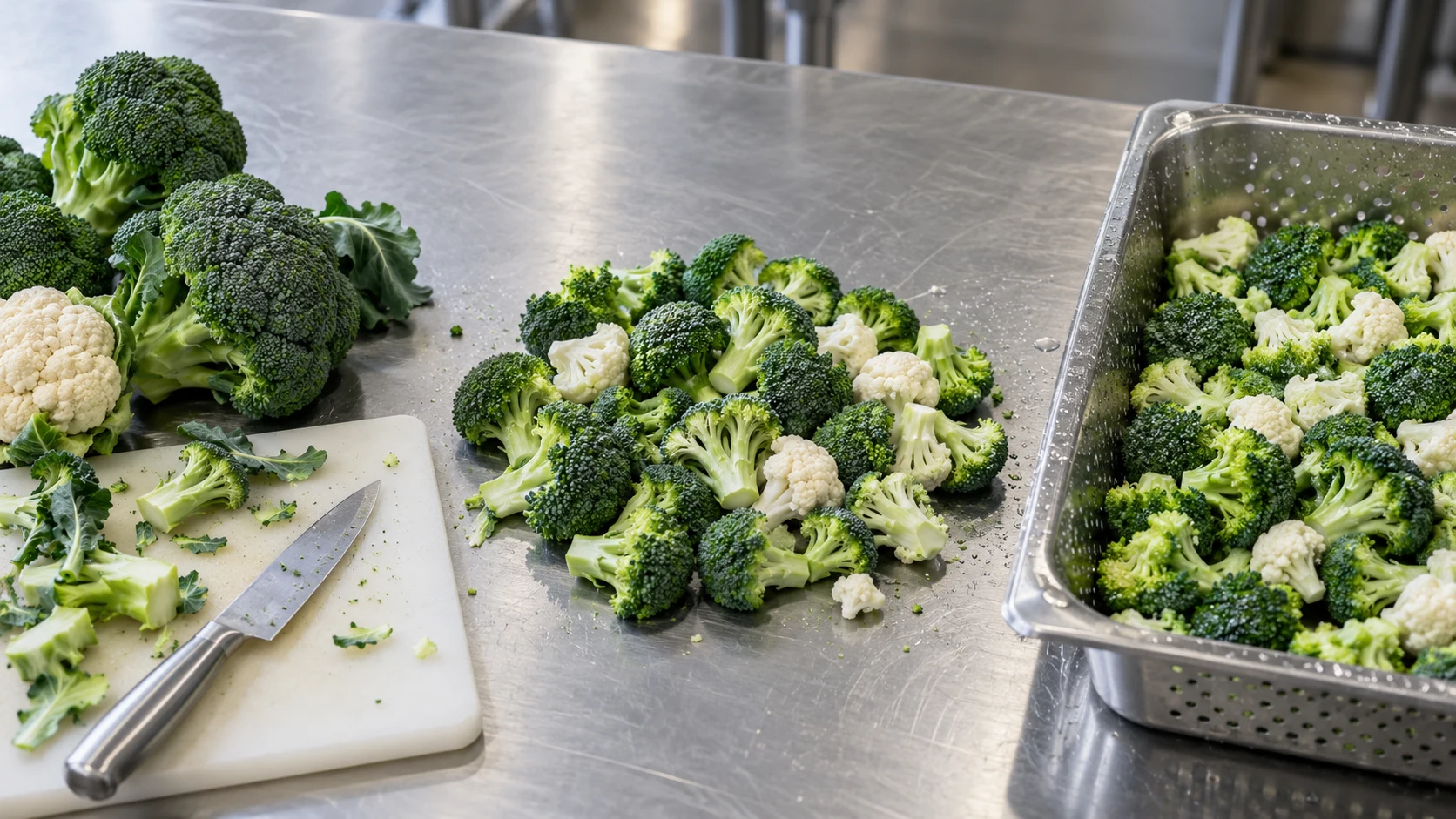
Broccoli washing equipment occupies a specific position in an IQF line. It is not the beginning of raw-material preparation, and its discharge is not yet frozen product. Its job is to receive broccoli that has already been converted into the required commercial form, apply the selected water and bubble action, separate removable debris through the circulation and filtration arrangement, and transfer the washed pieces toward the buyer’s downstream process.
This boundary matters because whole broccoli heads, crowns, florets and short spears behave very differently in a washing system. A catalog capacity expressed in kilograms per hour cannot resolve those differences. The buyer needs to connect the product specification, preparation method, washer settings and downstream handoff into one operating plan.
For broccoli projects within this scope, the TW-606-3 vegetable washing machine provides water spray and bubble action, continuous conveyor transfer, an external circulating-water flow and debris filtration/removal arrangement. The productive result still depends on what enters the machine, how it is loaded and what the next process can accept.

Define the Frozen Broccoli Product Before Selecting the Wash Step
The most useful starting point is not the washer model. It is the frozen product that the factory intends to sell. “IQF broccoli” may refer to florets, short spears, longer spears, cut portions or another contract-defined presentation. Each style produces a different combination of head material, attached stem, loose buds, leaves and small fragments during preparation and washing.
The buyer’s own specification should establish the commercial target. At minimum, it should identify the product style, minimum and maximum dimensions, measurement direction, allowable stem length, permitted attached leaf, unit-weight rule where applicable, size tolerances, defect classifications and sampling method. If production serves several customers, each specification should be reviewed because one customer’s acceptable floret may be another customer’s undersize piece.
International and national standards provide useful references, but they should not be merged into a single assumed specification. The broccoli annex in Codex CXS 320-2015 describes quick-frozen broccoli prepared from fresh, clean and sound stalks or shoots that are sorted, trimmed, washed and sufficiently blanched. It describes a floret as the head plus the adjoining portion of stem and gives a reference length range of 15–80 mm.
The USDA Frozen Broccoli Grade Standard is voluntary and uses its own styles and evaluation framework. Its short-spear or floret style refers to pieces measuring 2.5–9 cm and weighing more than 6 g. These USDA values should not be substituted for the Codex range, nor should either reference automatically override a buyer’s contract or the requirements applicable in the destination market.
| Specification item | Decision the buyer must make | Why it affects broccoli washing equipment |
|---|---|---|
| Product style | Florets, short spears, longer spears, cut portions or another defined presentation | Changes the piece shape, stem proportion, buoyancy, movement and transfer behavior. |
| Size range | Minimum and maximum dimensions, including the measurement method | Influences retention screens, openings, conveyor interfaces and the amount of small material that must remain with the product. |
| Attached stem | Maximum length, diameter or visual allowance | Affects prepared yield, piece weight, loading density and manual correction requirements. |
| Unit weight | Whether a minimum or target weight applies | Helps distinguish acceptable florets from fragments before and after washing. |
| Defect rules | Allowances for leaves, loose buds, discoloration, damage, insects, foreign material and poor trimming | Determines what inspection must remove before washing and what should be checked at discharge. |
| Sampling method | Sample size, frequency, location and acceptance decision | Creates a repeatable way to compare incoming prepared product with washer discharge. |
| Applicable standard | Customer contract, destination regulation, Codex, voluntary grade standard or a defined combination | Prevents equipment acceptance from being based on an undefined idea of a “standard floret.” |
This product definition also controls upstream preparation. A factory targeting compact florets with a tightly limited stem cannot prepare broccoli in the same way as a factory selling larger short spears. If the preparation team sends mixed styles to the washer, later size-compliance results will reveal a preparation problem as well as a possible transfer problem. Washer acceptance should therefore begin with a confirmed incoming-product description.
Two Practical Incoming Routes to the Washer
Factories commonly approach a broccoli project from one of two incoming routes. Both can lead to the same washing stage, but their labor balance, buffer requirements and control points are different.
Route A: Whole Heads or Crowns Prepared Before Washing
Whole heads or crowns arrive at a receiving and preparation area. Operators sort the raw material, remove unsuitable leaves, trim stems, separate the head into the specified florets or short spears, and correct pieces that fall outside the intended style. Waste and by-product streams should be separated from accepted prepared pieces rather than carried toward the washer.
The preparation area needs enough working positions to supply the planned washer feed without forcing workers to rush trimming decisions. It also needs a controlled way to move accepted pieces forward while taking stems, leaves, damaged material and other rejects away from the product route. Where production changes between raw-material sizes or finished-product specifications, the preparation rate may change even if the washer settings remain similar.
A practical line should release only specification-ready florets or short spears to the washing stage. Floretting and cutting can remain manual or be assigned to a separately selected upstream system; in this TEEMYEAH configuration, the equipment scope begins when those prepared pieces enter washing.
Route B: Prepared Florets Delivered to the Washing Area
Some factories purchase prepared florets, receive them from another department or use an upstream preparation system that is outside the washing-line package. In this route, inspection remains important. The washing team should not assume that every delivered piece matches the frozen-product specification.
Incoming inspection can check the declared product style, size spread, stem condition, leaf content, obvious damage, foreign material and the proportion of loose buds or very small pieces. The inspection point also protects the mass-balance record: if unacceptable trimming arrives at the washer, the resulting correction loss should not be misclassified as a washing loss.
Prepared florets may also arrive in batches that exceed the immediate downstream demand. A buffer can smooth short preparation interruptions, but it needs defined maximum residence time, product depth, handling method and release sequence. Large uncontrolled piles can change the consistency of washer loading and make an otherwise stable line appear erratic.
| Planning factor | Whole heads or crowns | Already prepared florets |
|---|---|---|
| Primary work before washing | Sorting, leaf removal, stem trimming, floretting and size correction | Receipt verification, inspection and removal or correction of nonconforming pieces |
| Main rate constraint | Manual or separate preparation capacity under the actual product specification | Delivery rhythm, inspection capacity and consistency of the supplied preparation |
| Waste handling | Substantial stem, leaf and trimming streams should be removed before the washer | Usually a smaller correction stream, although this depends on supplier conformity |
| Buffer purpose | Separates fluctuations in preparation labor from continuous washing demand | Controls batch release and prevents irregular loading |
| Key incoming record | Whole-head mass and accepted prepared mass | Received prepared mass and inspection rejects |
| Washer feed definition | Accepted prepared florets or short spears after correction | Inspected prepared florets or short spears released for washing |
Assign Each Process Handoff Before Drawing the Layout
A useful line layout shows more than a row of equipment. It identifies who owns each result, where the product changes state and which acceptance point releases it to the next stage. This prevents the washer from becoming the assumed solution for inconsistent trimming, uncontrolled accumulation or downstream stoppages.
| Process stage | Primary activity | Required output or decision | Typical project ownership |
|---|---|---|---|
| Receiving and sorting | Receive heads, crowns or prepared florets; identify unsuitable raw material | Accepted material released under a defined receiving specification | Buyer’s raw-material and quality team |
| Floretting and trimming | Remove leaves and excess stem, form the required pieces and correct size | Prepared florets or short spears that match the washer feed specification | Manual preparation team or separately selected upstream system |
| Prepared-product inspection | Check size, stem, visible defects and unwanted small material | Controlled feed approved for washing | Buyer’s operations and quality team |
| TEEMYEAH washing | Apply configured spray and bubble action, circulate and filter water, convey product to discharge | Washed prepared pieces meeting the agreed wash endpoint | TEEMYEAH equipment scope, configured with buyer inputs |
| Post-wash transfer | Control free water, product depth, accumulation and delivery to the next process | A stable feed condition compatible with downstream intake | Defined jointly at the equipment interface |
| Blanching, cooling and draining | Apply the buyer’s validated thermal and cooling process and prepare product for freezing | Product at the temperature, condition and surface-water state required by IQF intake | Buyer or third-party downstream system supplier |
| IQF freezing | Freeze product under the selected process and freezer operating conditions | Frozen product evaluated against the final contract specification | Buyer or freezer supplier |
The boundary between washing and blanching deserves particular attention. Washer discharge height, conveyor width and flow pattern affect the physical connection, while the downstream process determines whether product can enter continuously, requires metered feeding or needs a short buffer. This interface should be decided before utilities and floor positions are frozen.
Why Washer Capacity Is Not Accepted-Floret Output
The TW-606-3 has a catalog capacity of 800–2,000 kg/h, depending on the product and line conditions. This range describes equipment capability under applicable operating conditions; it is not a promise of 800–2,000 kg/h of accepted IQF-ready florets.
A broccoli factory has several distinct rates. Whole-head receiving rate, prepared-product feed rate, washer discharge rate, compliant washed-floret rate and IQF intake rate are not interchangeable. Stems and leaves removed before washing may represent a material portion of the incoming mass. Additional pieces may be rejected for size, condition or trimming. Water retained on the product can also distort short-duration weight measurements if the weighing point is not standardized.
A transparent mass balance begins with the raw material entering the defined observation boundary:
Incoming mass = accepted prepared mass + stem/trim mass + other reject mass + unexplained variance
Each term should be measured over the same batch or time window. The weighing method, container tare, sampling location and timing should remain consistent. “Accepted prepared mass” should mean product that meets the stated feed specification before washing, not every piece placed on the preparation table.
The unexplained variance is not a target loss category. It is a reconciliation value that directs the project team to check weighing errors, unrecorded product remaining in containers, water carryover, material dropped during transfer or waste assigned to the wrong category. Keeping it visible is more useful than forcing all missing weight into an assumed yield figure.
Once washing begins, a second control can compare the mass and condition of prepared feed, retained saleable pieces, rejected pieces, product remaining within the system and discharge samples. The method needs enough detail to distinguish a genuine retention issue from differences caused by water pickup, incomplete equipment emptying or inconsistent sample timing.
The line’s sustainable accepted-product rate is controlled by the slowest relevant step under the agreed specification. That constraint may be manual floretting, final inspection, washer loading, post-wash handling, blancher feed, cooling, draining or IQF intake. Planned sanitation and product-change intervals also affect the practical production schedule.
For a more detailed procurement method, buyers can review TEEMYEAH’s guide to food-processing equipment capacity verification. The same principle applies here: specify the material, product condition, test window and acceptance measurement rather than comparing headline kilograms per hour alone.
Define a Verifiable Wash Endpoint
“Clean broccoli” is too broad for equipment acceptance. A useful wash endpoint describes observable product and transfer conditions at a stated inspection location. The definition should be practical enough for operators to apply during commissioning and routine production.
Visible Soil and Debris Condition
State what the discharge sample should look like and what visible material is unacceptable. The wording may address soil, loose leaves, field debris and other specified visible material, supported by a defined sample quantity and inspection method. If different raw-material lots carry different soil loads, record the incoming condition alongside the discharge observation.
Product Integrity
Specify the relevant integrity defects: broken heads, detached buds, crushed pieces, split stems or other damage categories meaningful to the commercial product. Record the incoming condition before attributing every damaged piece to washing. The inspection should compare like with like under a defined sampling rule.
Retention of Small Saleable Pieces
The buyer should distinguish saleable small florets from unwanted fragments. Once the smallest acceptable dimension or unit weight is known, the screen and transfer interfaces can be reviewed around that requirement. If this limit remains undefined, one team may view a retained small piece as product while another classifies it as debris.
Discharge Condition
The discharge requirement should cover product depth, clumping, free-water behavior, visible pooling and the consistency of release to the next conveyor or vessel. This is especially important where the next stage requires controlled loading rather than intermittent surges.
Handoff Readiness
A passed wash endpoint means the pieces are ready for the specified downstream handoff—not that the full IQF process has been completed. Washing should not be treated as sanitization, sterilization, a pathogen-reduction guarantee or a shelf-life result. Food-safety controls must be established within the factory’s hazard analysis, water-management program, sanitation procedures and validated downstream process.
| Wash-endpoint category | Buyer-defined acceptance input | Suggested observation point |
|---|---|---|
| Visible soil and debris | Named material, sample quantity, inspection surface and allowable condition | Washer discharge before downstream processing |
| Piece integrity | Defect definitions and comparison against incoming prepared product | Matched feed and discharge samples |
| Small-piece retention | Smallest saleable piece and classification of loose buds or fragments | Discharge, filter collection and transfer interfaces |
| Surface-water condition | Acceptable visible free water or a specified measurement method | Final transfer point before blancher intake |
| Feed continuity | Permitted flow variation, product-bed depth and accumulation limit | Downstream receiving conveyor or infeed |
TW-606-3 Configuration Questions for Broccoli Projects
The TW-606-3 is an industrial vegetable bubble washer designed for food-processing lines. Its current catalog configuration combines water spray and bubble action with a full-process conveyor, external circulating-water flow, debris filtration/removal, SUS304 stainless-steel construction and a stainless high-flow pump.
Catalog specifications list dimensions of 3681 × 1583 × 1621 mm, a capacity range of 800–2,000 kg/h, 380 V three-phase power and 2.65 kW. These values provide a starting equipment envelope. The project configuration should be reviewed against the following operating questions.
What Exactly Will Enter the Washer?
Confirm whether the feed consists of florets, short spears, mixed pieces or another presentation. Provide the expected size distribution rather than only an average size. Include attached stem, loose bud and leaf conditions because these influence movement, retention and debris loading.
How Will Product Be Loaded?
Identify whether product arrives continuously, by tote, from a preparation conveyor or through a controlled feeder. State the intended prepared-product rate, typical product depth and permitted variation. A sudden dump of light florets creates different hydraulic and conveyor conditions from a uniform feed at the same average hourly mass.
How Should Water Action Be Set?
Bubble action and spray conditions should support product movement and the required wash endpoint while respecting the piece structure. The buyer should identify especially fragile styles, loose-bud limits and acceptable integrity conditions. Water level and spray adjustment can then be considered together with loading depth and conveyor rhythm.
What Must the Filtration Arrangement Capture?
List the likely debris stream: loose leaf, soil, small trimmings, non-saleable fragments and any other expected material. Also identify the smallest saleable piece. Filtration and product-retention decisions should separate removable debris from acceptable product rather than applying an undefined “fine screen” requirement.
Where Are Additional Screens or Retention Features Needed?
Review openings not only inside the washing section but also at transitions, conveyor gaps, discharge points and adjacent equipment. Small florets may be retained successfully in the washer yet lost at a poorly matched handoff. A dimensioned product specification allows these interfaces to be reviewed before fabrication.
What Discharge Geometry Fits the Next Stage?
Provide the downstream infeed height, usable width, direction of travel and available connection length. If the next process is supplied by another manufacturer, interface drawings should be exchanged early. The discharge should place product onto the receiving equipment without an unnecessary fall or uncontrolled accumulation.
How Will the Machine Be Accessed for Cleaning?
The layout should preserve access to the tank, conveyor, filtration area, circulation components and surrounding floor. It should also provide routes for removing collected debris and conducting routine inspection. Machine dimensions alone are therefore insufficient for the final footprint; service and operator zones must be added.
How Will Adjacent Equipment Respond?
Clarify whether preparation, washing and blanching run continuously at the same nominal rhythm. If one stage stops, define what happens to product already in the washer or on the transfer conveyor. Controls, signals and buffer decisions should be based on this operating sequence.
Fix the Downstream Handoff Before Finalizing the Washer Layout
The most expensive interface problems often arise after individual machines have already been selected. A washer may fit the available floor area while still discharging at the wrong height, overfeeding the blancher or holding too much product when the freezer line stops. The downstream data should therefore enter the washing-equipment discussion before the quotation is finalized.
- Feed height and width: Provide dimensioned drawings for the receiving conveyor, blancher or intermediate equipment, including useful belt or opening width rather than external frame width alone.
- Required feed rate: State the downstream demand as prepared washed product, together with the minimum, normal and maximum operating rhythm where available.
- Product temperature: Identify the temperature expected at washer entry and the condition required at the downstream handoff. The complete thermal process remains a line-level design matter.
- Surface-water condition: Define how much visible free water or carryover the next stage can accept. If a measurement is required, name the method and sampling point.
- Accumulation limit: State how much product may wait, where it may wait and for how long under normal and interrupted production.
- Stop/start response: Define signals, conveyor behavior, water-system response and operator actions when preparation or downstream equipment stops.
- Product transfer: Confirm permitted drop height, conveyor direction, product-bed depth and any requirement for spreading or metering before blanching.
Post-wash surface-water control deserves precise language. A draining conveyor, vibration stage or other transfer arrangement may reduce free surface water, but it should not automatically be described as “drying.” The selected method and acceptance measurement should match what the downstream process actually requires.
The final frozen result depends on blanching, cooling, draining, freezer loading and IQF operating conditions in addition to raw material and washing. For that reason, the washing acceptance plan should stop at a clearly defined handoff condition while still recording the downstream inputs that influence the line rhythm.
Plan for Downstream Stops, Not Only Normal Production
Normal hourly output describes only one operating state. A practical line design must also address preparation gaps, water-system checks, downstream alarms and planned pauses. Broccoli florets already in water or on a transfer conveyor cannot be managed through an undefined instruction to “wait until the line restarts.”
The operating sequence should answer several concrete questions. Can the upstream preparation conveyor stop before additional product enters the washer? Will the washer conveyor continue long enough to discharge pieces already in process? Is there a permitted downstream buffer, and what is its capacity in both kilograms and minutes? Who decides whether held product can return to production after a prolonged stop?
These decisions affect sensors, interlocks and operator instructions. They also affect layout because a controlled buffer requires physical space. Where the downstream blanching and IQF system has strict feeding requirements, a short accumulation conveyor or metering interface may be more valuable than increasing the washer’s nominal capacity.
Cauliflower Requires Its Own Prepared-Product Specification
Broccoli and cauliflower can appear together in one project because both are separated into head portions before washing. They should still be treated as separate products during configuration and acceptance.
Cauliflower head structure, stem proportion, leaf arrangement, target color condition and required piece presentation may differ from broccoli. A cauliflower specification may also classify compact curd pieces, broken curd, stem exposure and small particles differently. Those differences influence manual preparation, accepted-piece yield, debris composition and retention requirements.
When one washing system is intended to handle both products, prepare two input sheets rather than labeling the feed “broccoli/cauliflower.” For each product, record:
- incoming state and variety or raw-material description;
- target presentation and measurement method;
- minimum and maximum acceptable piece dimensions;
- stem and leaf allowances;
- expected preparation method and release rate;
- smallest saleable piece;
- expected debris and reject types;
- wash-endpoint inspection method;
- downstream handoff condition; and
- product-change cleaning and adjustment sequence.
The washing-equipment review can then evaluate the prepared broccoli pieces and prepared cauliflower pieces separately. If they require different loading depths, water settings, retention arrangements or conveyor speeds, those operating recipes can be documented without assuming that one undifferentiated setting will suit both.
Codex CXS 320-2015 includes separate annexes for broccoli and cauliflower, which reinforces the value of maintaining distinct product definitions. The applicable customer contract and destination requirements should remain the final reference for each project.
Download the Broccoli Washing Line Input and Acceptance Sheet
Download the Editable XLSX Sheet
The Broccoli Washing Line Input and Acceptance Sheet is an editable project workbook for organizing the information needed before layout, quotation and equipment acceptance. It records project inputs, process ownership, mass balance, prepared yield, stem/trim ratio, size compliance, wash-endpoint results and downstream handoff conditions.
Begin by entering the product style and customer specification. Complete the process-ownership section so receiving, manual preparation, washing, post-wash transfer and downstream thermal processing have clear boundaries. Add target interface data even when measured production data are not yet available.
When representative sample data become available, enter the actual incoming mass, accepted prepared mass, stem and trim mass, other rejects and unexplained variance. The same workbook can record size-compliance observations and washer-discharge results during a later assessment or acceptance activity.
The sheet is a structured project record, not a calculator that predicts yield or performance. A prior product trial is not required to discuss a supported process configuration. Measured samples can refine the preparation balance, settings and acceptance limits as the project progresses.
Build an Acceptance Plan Around the Product and Interface
Equipment acceptance becomes more useful when it reflects the product that will actually run in the factory. Before the test, define the prepared-product condition, test duration or batch boundary, stable operating period, sampling points and responsibilities for weighing and inspection.
The plan should distinguish equipment observations from complete-line outcomes. Appropriate washing-stage checks may include feed consistency, conveyor operation, water circulation, filtration behavior, product retention, discharge condition and access for routine cleaning. Final frozen-product quality is evaluated after the buyer’s full blanching, cooling, draining and IQF process.
Photographs, sample records and signed data sheets can support the acceptance record, provided that each observation identifies the operating condition. A photograph without the feed rate or product specification cannot establish whether the same result applies to another production setting.
Buyers preparing a formal inspection can use TEEMYEAH’s guide to the food-processing equipment factory acceptance test to structure responsibilities, instruments, samples and sign-off conditions.
Supplier-Ready Input Checklist
A project manager can shorten the quotation cycle by sending one coordinated information package rather than separate messages about capacity, layout and product size. The following checklist covers the principal inputs for broccoli washing equipment before IQF:
- Raw material received as whole heads, crowns or prepared florets.
- Photographs and representative dimensions of the incoming material.
- Target product style: florets, short spears or another defined presentation.
- Minimum and maximum piece dimensions, with the measurement direction.
- Allowable stem length, attached leaf and loose-bud condition.
- Unit-weight requirement, if one applies.
- Defect definitions, tolerances and sampling method.
- Customer contract, destination-market requirement and reference standard.
- Preparation method and number of manual working positions, where already planned.
- Prepared-product feed rate rather than whole-head receiving rate alone.
- Expected stem, leaf, trim and other reject streams.
- Smallest acceptable saleable piece.
- Incoming soil and debris condition.
- Required wash endpoint and proposed inspection method.
- Available water supply, drainage and electrical conditions.
- Available room dimensions, columns, doors and sanitation access.
- Required feed direction and proposed operator positions.
- Downstream receiving height, width and connection drawing.
- Blancher or intermediate equipment feed requirement.
- Acceptable post-wash surface-water condition.
- Normal, minimum and maximum downstream feed rhythm.
- Permitted accumulation quantity and residence time.
- Required stop/start signals and response sequence.
- Whether cauliflower or another product will share the washing equipment.
- Required cleaning access and product-change procedure.
Where some values are not yet available, mark them as open project inputs rather than replacing them with assumptions. The quotation can then identify which dimensions and interfaces are fixed, which are configurable and which must be confirmed before manufacturing.
Frequently Asked Operational Questions
Can the washer be discussed before a broccoli sample is available?
Yes. A process configuration can be discussed from the incoming form, target product style, prepared-product rate, wash endpoint, layout, utilities and downstream interface. Representative sample measurements can later refine water settings, retention details and acceptance criteria. The project should distinguish between decisions that can be made from defined process inputs and results that require measurement under the buyer’s actual conditions.
Should the quotation use the whole-head rate or the prepared-floret rate?
Provide both, but identify the prepared-floret rate as the washer feed. Whole-head receiving mass is needed for preparation planning and mass balance; it should not be treated as the mass entering the washer after stems, leaves, unsuitable pieces and other trim have been removed.
How should mixed floret sizes be described to the equipment supplier?
Send the minimum, typical and maximum dimensions, together with the proportion expected in each relevant size band. Include the measurement direction and the smallest piece that remains saleable. A single average dimension does not reveal the openings and transfer gaps that may affect the smallest pieces.
Can the same settings be used for broccoli and cauliflower?
They may share equipment, but settings should be evaluated by product. Record separate incoming conditions, target pieces, loading depth, water action, retention requirements and wash endpoints. The operating instructions can then specify which adjustments are needed during a product change.
What information is needed if the blancher has not yet been purchased?
Define the intended downstream feed rate, preferred transfer direction, provisional height range, allowable product accumulation, surface-water requirement and control philosophy. Reserve an interface zone in the layout and identify the blancher connection as a confirmation item. This allows washing equipment planning to continue while protecting the future handoff.
How should frequent downstream stops be reflected in the line design?
Provide the expected stop frequency and duration, then define whether upstream feeding stops immediately, whether product already in the washer continues to discharge and where that product may accumulate. The answer may require interlocked conveyors, a controlled buffer or an operator response procedure. The permitted product residence condition should be set by the factory’s process and food-safety team.
When is an extra screen or retention feature justified?
It is justified when the defined smallest saleable piece could pass through an existing opening or transfer gap, or when the expected debris stream requires additional separation. The decision should compare product dimensions with the relevant openings and should also consider cleaning access, blockage risk and collected-material removal.
What should be checked when the factory processes several customer specifications?
Create a specification matrix showing each product style, size range, stem rule, smallest acceptable piece, defect method and downstream feed requirement. Identify the most demanding condition at each equipment interface. If settings or retention arrangements must change between contracts, include those adjustments in the production and cleaning instructions.
Configure the Broccoli Washing Section Around Your Actual IQF Line
TEEMYEAH can use your prepared-product specification, wash endpoint and downstream interface data to develop the washing section and its transfer arrangement. The project discussion can cover the TW-606-3, working access, product-retention requirements, adjacent conveyors, utilities and the operating relationship between manual preparation and downstream intake.
To request a project review, send:
- the broccoli or cauliflower product specification;
- incoming and target-product photographs with dimensions;
- whole-head and prepared-product rates;
- a floor plan with available length, width and height;
- water, drainage and electrical information;
- the required wash endpoint;
- downstream equipment drawings or provisional interface dimensions; and
- the completed Broccoli Washing Line Input and Acceptance Sheet.
Submit Your Broccoli Washing Line Inputs to TEEMYEAH
The resulting discussion will focus on the prepared-product washing step, the physical line handoffs and the buyer inputs needed to move from a general equipment selection to a workable quotation and layout.