







Summary
Water-based ozone can be a useful antimicrobial option in fresh-cut and ready-to-eat produce processing, but it should be evaluated as one controlled step within a broader food-safety system rather than as a standalone kill step. U.S. food regulations permit ozone to be used as an antimicrobial agent in food treatment, storage and processing, including direct food contact in gaseous or aqueous form under good manufacturing practice. That regulatory position does not mean that FDA approves individual ozone machines or guarantees a specific microbiological result.
For an RTE processor, the engineering question is whether dissolved ozone can be generated, measured and maintained consistently under real production conditions while protecting product quality and controlling worker exposure. Organic load, water temperature, product type, contact time, flow and turnover, water quality, off-gas management and equipment cleanability all influence whether the process is suitable.
Recent Cyclospora and Listeria outbreaks also show why sanitation cannot be reduced to sanitizer selection. Upstream contamination may not be correctable by washing, while environmental contamination inside an RTE facility may require hygienic equipment design, zoning, cleaning, environmental monitoring and preventive controls. Water-based ozone is therefore most valuable when it is integrated into a validated process rather than treated as a substitute for one.
Why Fresh-Cut and RTE Produce Need a Different Sanitation Strategy
Fresh-cut vegetables occupy an unusual position in food processing. They are processed enough to create additional contamination opportunities, yet often remain raw enough that the processor cannot rely on a later heat treatment to provide a decisive microbial reduction step.
A head of lettuce entering a factory may be visually simple, but its microbiological history is not. Before processing, it may have been exposed to agricultural water, soil, field equipment, harvesting crews, transport containers, cooling operations and multiple handling points. Processing does not erase that history.
Cutting changes the risk profile again.
When lettuce, cabbage, spinach, herbs or other vegetables are sliced, shredded or chopped, new plant surfaces are exposed. Plant fluids can enter the process water, increasing organic load. A shared washing system can become a contamination-transfer route if water quality is not controlled. Conveyors, cutters, tanks and dewatering equipment create additional food-contact surfaces. After washing, the product may enter a higher-hygiene zone where recontamination becomes particularly important because the finished salad may be consumed without cooking.
This is why an RTE washing line should not be designed around one question:
Which sanitizer has the highest oxidation potential?
The more useful question is:
Can the complete process maintain a defined and verifiable hygiene condition from raw-material entry through packaging?
That changes the decision from chemical selection to process engineering.
A credible RTE sanitation strategy may need to address:
- incoming raw-material risk;
- separation of raw and post-wash zones;
- initial soil and debris removal;
- process-water condition;
- antimicrobial treatment;
- water recirculation and replacement;
- product contact time;
- equipment cleanability;
- drainage and residue retention;
- personnel movement;
- dewatering;
- post-wash handling;
- environmental monitoring;
- refrigeration;
- cleaning and sanitation between production runs.
Water-based ozone can support several of these objectives, especially controlled antimicrobial washing and food-contact sanitation. It cannot replace supplier controls, hygienic zoning, environmental monitoring or validated cleaning procedures.
That distinction is fundamental for evaluating the technology correctly.
What Recent Food-Safety Events Show About RTE Risk
Two recent U.S. outbreak investigations are useful for understanding why fresh-cut food safety needs multiple layers of control. They should not, however, be treated as evidence that any one sanitizer would have prevented the events.
Taylor Farms de Mexico Iceberg Lettuce and Cyclospora
As of August 5, 2026, FDA and CDC reported 6,358 illnesses across 15 states, at least 278 hospitalizations and two deaths in an ongoing Cyclospora outbreak investigation linked to iceberg lettuce sourced from central Mexico and recalled by Taylor Farms de Mexico.
Taylor Farms de Mexico initiated a recall on July 17, 2026. FDA’s investigation remained ongoing as of the August 5 update.
This event is important for sanitation engineering because Cyclospora does not behave like a typical vegetative bacterial contaminant.
Routine washing cannot be assumed to eliminate it. Standard chlorine-based sanitizers are not considered reliably effective against Cyclospora, and FDA has specifically cautioned that commercial washing may be insufficient to remove the parasite.
That means the engineering lesson is not:
“Use a stronger wash sanitizer.”
The lesson is:
Certain hazards must be controlled before they reach the processing line.
Agricultural water, sanitation in the growing environment, worker hygiene, supplier controls, source verification and preventive practices can be more important than attempting to correct contamination after harvest.
Ozone should therefore not be presented as a proven corrective measure for the Taylor Farms de Mexico outbreak. The investigation does not establish that an ozone wash would have prevented those illnesses, and the pathogen characteristics make such an implication inappropriate.
Fresh & Ready Foods and Listeria monocytogenes
The Fresh & Ready Foods event illustrates a different risk pathway.
FDA’s investigation into ready-to-eat foods produced by Fresh & Ready Foods involved 10 illnesses, 10 hospitalizations and one death. The outbreak investigation was completed in July 2025 and was subsequently declared over.
During the investigation, FDA found Listeria in environmental samples collected during a routine surveillance inspection. Whole-genome sequencing showed that the strain recovered from the facility environment matched the outbreak strain.
The significance for RTE engineering is very different from the Cyclospora case.
Listeria can persist in food-processing environments and can spread through equipment, surfaces, drains, moisture, personnel movement and difficult-to-clean niches. For a product that receives no later cooking step, post-process environmental contamination can become a critical concern.
This case therefore reinforces the importance of:
- hygienic equipment design;
- accessible product-contact surfaces;
- drainage;
- elimination of difficult-to-clean niches;
- validated sanitation procedures;
- environmental sampling;
- high-care zoning;
- separation of cleaned product from raw-material traffic.
An antimicrobial washing stage may reduce certain risks on incoming product or in process water. It cannot compensate for an environmental reservoir downstream.
The Two Events Should Not Be Used to Prove the Same Point
The pathogen, contamination route and relevant controls are different.
| Event | Primary organism | Relevant risk lesson | What the event does not prove |
|---|---|---|---|
| Taylor Farms de Mexico iceberg lettuce | Cyclospora | Upstream contamination prevention and supplier/agricultural controls are essential | That an ozone wash would have prevented the outbreak |
| Fresh & Ready Foods RTE foods | Listeria monocytogenes | RTE environmental hygiene, equipment cleanability and contamination control matter | That a stronger produce sanitizer alone would solve environmental Listeria |
Together, however, they support one broader engineering conclusion:
RTE food safety has to be designed across the complete process, not assigned to one washing tank.
What FDA’s Position on Ozone Actually Means
Ozone is permitted under U.S. food regulations for antimicrobial use in food treatment, storage and processing.
Under 21 CFR 173.368, ozone may be used as an antimicrobial agent in the treatment, storage and processing of foods, including in direct contact with food in gaseous or aqueous form, subject to the prescribed conditions and current good manufacturing practice.
This is an important regulatory foundation for aqueous ozone applications in fresh-cut processing.
It should nevertheless be described accurately.
It does not mean:
- every ozone generator is FDA approved;
- FDA has approved a TEEMYEAH ozone machine;
- every ozone concentration is appropriate for food;
- ozone provides a universal pathogen reduction;
- compliance with the regulation automatically validates a commercial process.
A more accurate statement is:
U.S. food regulations permit ozone as an antimicrobial agent for food processing applications, including aqueous food-contact applications under appropriate conditions.
For a processor, regulatory permission is only one decision gate.
The next questions are technical:
- What dissolved ozone concentration actually reaches the product?
- How quickly is that concentration consumed?
- How long does product remain in the treatment zone?
- How does organic load affect performance?
- Does the product tolerate the oxidation conditions?
- Can airborne ozone be maintained within occupational requirements?
- Can the process be monitored during production rather than only during commissioning?
- Can the equipment be cleaned completely?
These questions determine whether an ozone system is useful in a particular plant.
What Water-Based Ozone Can Realistically Contribute

Ozone is attractive because it is a strong oxidant and can be generated at the point of use.
In an aqueous system, the objective is to dissolve ozone into process water and use that water as the treatment medium for produce or food-contact surfaces.
Potential operating advantages include reducing dependence on stored sanitizer concentrates, removing the need to manually dilute ozone as a chemical concentrate, and allowing the antimicrobial medium to be generated when needed.
These advantages need qualification.
On-Site Generation
Ozone is unstable and is normally generated close to the point of application.
From an operating perspective, this avoids storing ozone as an inventory chemical. The plant still requires generation equipment, water-conditioning components, maintenance, monitoring and appropriate safety controls.
Reduced Conventional Chemical Handling
An ozone stage may reduce the amount of chlorine, PAA or other chemical sanitizer required in that particular operation, depending on the validated process design.
That does not mean the complete facility becomes chemical-free. Cleaning chemicals, detergents, CIP chemicals, surface sanitizers or other process chemicals may still be necessary elsewhere in the facility.
Rapid Reaction
Ozone reacts quickly.
That is both an advantage and a design challenge.
A strong and rapidly consumed oxidant can provide useful antimicrobial action, but it can also lose concentration quickly when exposed to organic material. A concentration generated at the machine outlet may therefore differ significantly from the concentration available around product later in the tank.
For this reason, generator output is not the same as treatment concentration.
Limited Persistence of Ozone Itself
Ozone decomposes rather than remaining indefinitely as ozone in the process environment.
This characteristic can reduce concerns associated with a persistent sanitizer residual, but “ozone leaves no residue” should not be converted into the broader claim that every ozone treatment creates no reaction products.
Ozone reacts with compounds in water and on food. Those reactions depend on the water matrix and product environment. A processor should therefore evaluate the actual application rather than rely on a simplified “no residue” statement.
Water-Based Ozone vs Chlorine vs PAA vs Water-Only Washing
There is no universally superior produce-washing chemistry.
The correct choice depends on the hazard analysis, product, water system, customer requirements, regulatory environment, factory capabilities and validation resources.
The following comparison is intended as an engineering screening tool rather than a performance ranking.
| Decision Factor | Water-Based Ozone | Chlorine-Based Washing | PAA-Based Washing | Water-Only Washing |
|---|---|---|---|---|
| Active antimicrobial treatment | Yes, when dissolved ozone is generated and maintained at a validated condition | Yes, when active chlorine is maintained within the specified process range | Yes, when PAA concentration is maintained within the specified process range | No added antimicrobial |
| Supply method | Generated on site | Chemical supply and controlled dosing | Chemical supply and controlled dosing | Potable or otherwise suitable process water |
| Main process measurement | Dissolved ozone at representative treatment points; water condition; airborne ozone where relevant | Active chlorine, pH and other application-specific parameters | PAA concentration and application-specific water parameters | Water quality, temperature, flow, turnover and contamination control |
| Sensitivity to organic load | Can be rapidly consumed; actual dissolved concentration must be checked under production load | Available active chlorine can decrease as demand increases | Performance and available concentration still need monitoring as process conditions change | No active antimicrobial reserve against cross-contamination |
| pH dependence | Application performance depends on overall water chemistry, although ozone control is not normally managed in the same way as chlorine pH control | Speciation and antimicrobial performance can be strongly influenced by pH | Often operationally less dependent on narrow pH adjustment than chlorine, but the process still requires validated conditions | pH mainly affects product/water characteristics rather than sanitizer chemistry |
| Chemical storage | No stored ozone concentrate; generation and service equipment required | Chemical storage and dosing infrastructure required | Chemical storage and dosing infrastructure required | No sanitizer storage |
| Occupational considerations | Off-gassing must be assessed; ventilation and airborne ozone monitoring may be necessary | Chemical handling, mixing, dosing and exposure controls are required | Chemical handling, dosing and exposure controls are required | Lowest sanitizer-related occupational complexity, although general plant hygiene risks remain |
| Potential impact on product | Excess concentration or exposure may oxidatively affect sensitive produce | Incorrect concentration or process conditions may affect quality | Excessive exposure can affect product depending on application | Generally lowest chemical impact, but may provide insufficient microbial cross-contamination control |
| Cross-contamination management | Can contribute if dissolved ozone remains effective throughout the water system | Can contribute if adequate active sanitizer remains available | Can contribute if the process concentration remains controlled | Relies primarily on water turnover, single-pass design and contamination prevention |
| Maintenance profile | Ozone generator, water-conditioning system, sensors, mixing system and off-gas components require maintenance | Dosing equipment, storage, instrumentation and chemical-management system require maintenance | Dosing equipment, storage and monitoring system require maintenance | Mechanically simpler but still requires water-system sanitation and hygienic equipment |
| Best fit | Plants able to validate dissolved ozone and manage off-gas while seeking on-demand antimicrobial treatment | Plants with established chlorine expertise and appropriate chemical/water control | Plants that prefer a controlled chemical sanitizer program compatible with their products and standards | Soil removal, initial rinse, certain NRTE applications, or processes where another validated control follows |
| Main limitation | Concentration can change quickly with organic load and process conditions | Chemistry and available active fraction require disciplined control | Requires chemical supply, dosing and exposure management | Does not provide an active antimicrobial barrier in the wash water |
A processor considering ozone should therefore compare complete systems, not only sanitizer purchase price.
A chlorine system may be appropriate in a facility that already has validated dosing, pH control, monitoring and trained operators.
A PAA program may be appropriate where plant standards, product compatibility and existing chemical systems support it.
Water-only washing can also be reasonable in specific operations, especially where the objective is physical soil removal, product is not ready-to-eat, a later validated microbial reduction step exists, or the hazard analysis does not justify adding an antimicrobial at that stage.
Ozone becomes attractive when on-site generation, controlled aqueous delivery and reduced dependence on sanitizer storage create real operational value and the facility can support the required validation.
The Engineering Question: Can the Ozone Process Be Controlled?
An ozone system should not be selected primarily from a brochure concentration.
A stronger engineering assessment starts with six questions:
- Can the dissolved ozone concentration at the actual product-contact point be measured?
- Can effective product contact time be established?
- Does the concentration remain stable as organic load increases?
- Can the water system maintain appropriate temperature, flow and turnover?
- Does the product retain acceptable quality at the proposed treatment condition?
- Can off-gas and worker exposure be controlled?
If any of these cannot be answered, the plant does not yet have a defined ozone process.
A Practical Process-Intensity Indicator for Ozone Evaluation
During preliminary testing, one useful internal indicator is:
Ozone Process Intensity = Verified Dissolved Ozone Concentration × Effective Product Contact Time
For example:
PIₒ₃ = Cverified × teffective
where:
- Cverified = representative verified dissolved ozone concentration during actual treatment, typically expressed in mg/L;
- teffective = effective product contact time in minutes;
- PIₒ₃ = internal process-intensity indicator expressed in mg·min/L.
This indicator can help engineers compare different operating conditions during controlled trials.
It is not a lethality formula.
It cannot be used to predict a universal log reduction.
Two treatments with the same calculated PIₒ₃ may produce different microbiological and product-quality results because the indicator does not inherently account for:
- target microorganism;
- product surface complexity;
- cut vs whole product;
- organic load;
- water chemistry;
- ozone decomposition rate;
- temperature;
- mass transfer;
- mixing;
- protective microbial niches;
- product geometry;
- ozone demand;
- treatment uniformity.
For that reason, PIₒ₃ is useful for process organization and test comparison, not for replacing microbiological validation.
Use Verified Concentration, Not Generator Setpoint
The concentration used in the calculation should come from the treatment environment, not simply the ozone generator display.
In a continuous line, useful measurement locations may include:
- water entering the treatment section;
- representative points inside the wash tank;
- downstream treatment water;
- recirculation return;
- the condition measured after the system has processed product for a defined period.
A process that produces an acceptable dissolved ozone concentration in clean startup water but collapses after 30 minutes of lettuce production is not stable merely because the generator remains at the same setting.
Effective Contact Time Is Not Always Tank Volume Divided by Flow
Product residence time may vary.
Leafy vegetables float, fold, overlap and move through water differently from dense root vegetables. Conveyor speed, product loading and hydraulic patterns can create a residence-time distribution.
For preliminary engineering, a conservative effective contact time should therefore be based on observed product movement or a validated residence-time study rather than an optimistic theoretical average.
The Variables That Must Be Evaluated Alongside Concentration × Time
Organic Load
Fresh-cut processing continuously adds organic material to water.
Leaf fragments, plant exudate, soil and other material can consume ozone. This makes organic loading one of the most important variables in determining whether a continuous aqueous-ozone process remains stable.
Useful site-specific indicators may include:
- turbidity;
- conductivity trends;
- oxidation-reduction measurements where appropriate;
- filter loading;
- water replacement rate;
- cumulative kilograms processed since water change;
- direct dissolved ozone measurements.
The objective is not to choose one universal proxy. It is to establish a practical relationship between product loading and sanitation performance in the actual line.
Water Temperature
Temperature affects ozone stability, product physiology and sanitation conditions.
Cold process water may support product temperature management for leafy vegetables, but the correct operating range must be determined together with ozone generation and product-quality requirements.
The treatment should therefore be validated at the temperatures expected during normal production, not only at commissioning conditions.
Flow and Turnover
A tank with strong local ozone concentration but poorly distributed water can create uneven treatment.
Engineers should evaluate:
- recirculation flow;
- mixing pattern;
- fresh-water addition;
- overflow;
- filtration;
- tank turnover;
- dead zones;
- product loading distribution.
Hydraulic design and sanitizer chemistry are interconnected.
Product Quality
The microbiologically strongest condition may not be commercially useful if it damages the salad.
Product trials should evaluate:
- visual appearance;
- cut-edge browning;
- texture;
- bruising;
- wilting;
- aroma;
- color;
- package behavior;
- acceptable shelf-life characteristics.
A processor should establish a treatment window where hygiene objectives and product quality can coexist.
Off-Gas and Air Monitoring
Dissolved ozone is the intended treatment medium, but ozone may escape from water.
Occupational controls must therefore be considered in the equipment and room design.
OSHA lists an eight-hour permissible exposure limit for ozone of 0.1 ppm. Local regulations, customer standards or facility requirements may impose additional constraints.
An ozone installation may need:
- local exhaust;
- room ventilation;
- ambient ozone monitoring;
- interlocks;
- alarm thresholds;
- controlled shutdown;
- off-gas destruction;
- worker procedures.
Water-based ozone should be described as a way to target ozone through process water, not as a technology that makes ozone exposure impossible.
TEEMYEAH’s Water-Derived iEOG Architecture
TEEMYEAH’s technical documentation for its water-based ozone systems describes an indirect electrolytic ozone generation architecture, or iEOG.
The documented process uses conditioned water as the source for ozone generation.
The system uses electrolysis together with selective proton-exchange technology to separate reaction products and generate an ozone-containing oxygen stream. Ozone is subsequently dissolved into water for use as the process medium.
This is different from simply drawing surrounding factory air through a conventional gas-generation system and injecting the resulting ozone directly into a treatment environment.
The equipment documentation also describes water-conditioning stages upstream of the electrolytic generation module. For the documented system, pretreatment includes filtration and internal water-conditioning components designed to provide the water quality required by the ozone-generation cell.
From an engineering perspective, this architecture has two relevant implications.
The first is generation consistency. Because the ozone-generation source is conditioned water rather than untreated ambient air, changes in factory air quality are less directly tied to the generation mechanism described in the system.
The second is off-gas management.
Managing Undissolved Ozone Before Release
The TEEMYEAH technical documentation describes gas-liquid separation for ozone that is not dissolved in the process water.
Undissolved ozone passes through an internal treatment stage where a catalytic mechanism is used to convert residual ozone before discharge.
This is an important design feature, but it should be interpreted correctly.
It does not mean that ambient ozone monitoring or ventilation can automatically be eliminated.
Connections, tanks, open water surfaces, spray action and process disturbances can still create off-gassing opportunities.
The proper claim is narrower:
The documented system includes an engineered stage for treating undissolved ozone rather than intentionally releasing the full generated ozone stream into the surrounding work environment.
For an RTE plant, this supports a more controlled design philosophy.
The final occupational assessment still needs to consider the complete installation, including the washing tank, room volume, ventilation and operating pattern.
Why the Washer Design Matters as Much as the Ozone Generator
A well-controlled sanitizer cannot correct poor hygienic equipment design.
This is particularly relevant in RTE salad production, where small vegetable fragments and organic material can lodge in equipment after production.
Consider two washing tanks operating at the same verified antimicrobial condition.
One has accessible internal surfaces, smooth transitions and components that can be removed quickly.
The other contains sharp internal corners, inaccessible gaps, difficult conveyor removal and stagnant pockets that trap plant residue.
Those two systems do not represent the same sanitation risk.
The first may allow the sanitation crew to expose, inspect and clean the food-contact zone effectively.
The second may repeatedly retain organic material that is difficult to see and difficult to remove.
For RTE applications, equipment cleanability should therefore be included in the sanitizer decision.
TW-705: Gentle Washing and Hygienic Design for Leafy Vegetables
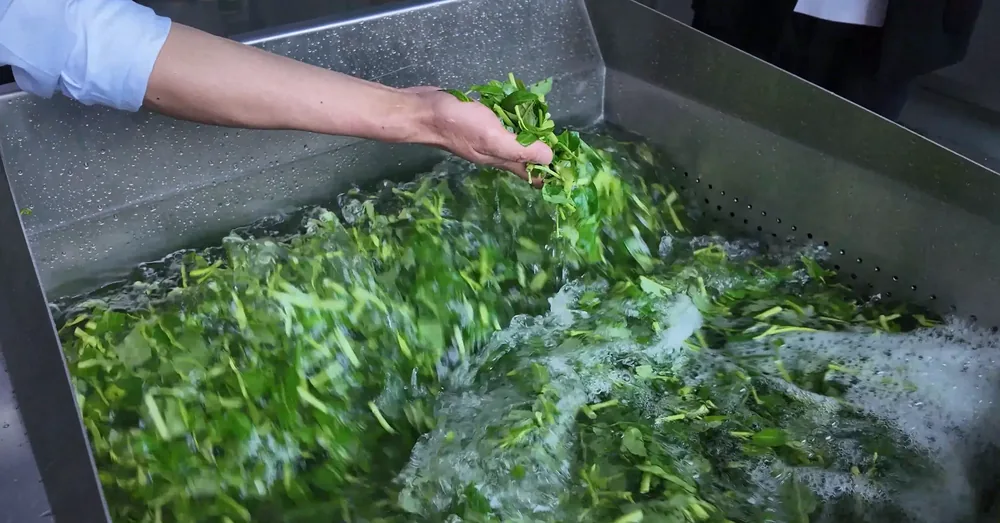
In TEEMYEAH’s RTE salad processing applications, the TW-705 washing system is designed around product handling and cleanability as well as washing action.
Gentle Water Movement
Leafy vegetables need enough water movement to separate product, remove debris and support washing, but excessive mechanical force can damage fragile leaves.
The TW-705 is designed around relatively gentle product movement so the washing process does not depend on aggressive agitation.
This is relevant for:
- cut lettuce;
- leafy salad mixes;
- spinach;
- similar delicate fresh-cut products.
Product handling still needs to be tested with the customer’s actual raw material, because leaf strength, cut size and variety differ.
Curved Internal Transitions
The washing tunnel uses curved or radiused transitions rather than relying on abrupt right-angle internal interfaces in key areas.
The purpose is hygienic cleanability.
Sharp internal corners can be difficult to rinse and inspect, particularly where small leaf fragments and organic material accumulate.
Curved transitions do not eliminate the need for cleaning, but they can reduce difficult-to-access geometry and make sanitation work more practical.
Quick-Disassembly Design
Components that require routine cleaning and maintenance are designed for easier removal.
In an RTE plant, fast disassembly is not merely a convenience feature.
It affects whether the sanitation team can:
- expose product-contact surfaces;
- remove trapped vegetable matter;
- inspect the machine;
- complete cleaning within the available sanitation window;
- reassemble the line consistently.
The most valuable hygiene feature is often the one the sanitation crew can use every day.
Integrating Ozone Into a Complete RTE Salad Processing Line

The sanitation system should be selected together with the complete line.
A typical fresh-cut leafy vegetable process may include:
Raw vegetable receiving → manual sorting/trimming → cutting → preliminary washing → controlled sanitation washing → transfer → dewatering → inspection/mixing → packaging → refrigerated holding
The exact sequence changes by product.
For some applications, initial washing before cutting may help reduce soil entering later stages.
For others, a post-cut washing step is central because the final commercial product is cut salad.
The location of the ozone stage should therefore be chosen according to what the processor wants the stage to accomplish.
Possible objectives include:
- maintaining antimicrobial activity in shared process water;
- treating product after cutting;
- reducing cross-contamination potential in a wash stage;
- supporting food-contact sanitation;
- reducing reliance on conventional chemical dosing.
Each objective leads to different monitoring requirements.
Do Not Combine Every Purpose Into One Tank
A common engineering mistake is expecting one wash stage to perform too many functions simultaneously:
- remove heavy field soil;
- wash cut vegetables;
- maintain sanitizer concentration;
- cool product;
- remove foreign material;
- provide a final high-hygiene treatment.
Heavy soil removal increases organic load, which may conflict with the need to maintain a stable oxidant concentration.
Separating functions can create a more controllable system.
For example:
Pre-wash → controlled sanitation wash → dewatering
may be easier to validate than expecting a single highly loaded tank to handle every operation.
A Practical Ozone Evaluation Worksheet
Before selecting equipment, a processor can build a preliminary worksheet around the following fields.
Product Inputs
- vegetable type;
- whole or cut;
- cut dimensions;
- expected soil load;
- incoming product temperature;
- maximum hourly throughput;
- peak production duration;
- target RTE or NRTE status.
Water Inputs
- source water;
- hardness;
- pH;
- conductivity;
- temperature;
- existing filtration;
- expected fresh-water availability;
- wastewater constraints.
Ozone Process Inputs
- verified dissolved ozone at start of treatment;
- representative dissolved ozone during treatment;
- dissolved ozone after defined production load;
- effective contact time;
- flow rate;
- recirculation rate;
- fresh-water makeup;
- filtration method.
Process-Intensity Tracking
For each trial:
PIₒ₃ = Cverified × teffective
Record the value together with:
- kilograms processed;
- organic-load proxy;
- water temperature;
- product-quality observations;
- microbiological test result;
- ambient ozone reading;
- operator observations.
The value should only be used to compare conditions within the validated development program.
It should not be copied from another product or factory and treated as an equivalent sanitation dose.
A Simple Example of the Evaluation Logic
Suppose an RTE salad producer is comparing two trial conditions.
Trial A
- higher verified dissolved ozone;
- shorter residence time;
- low initial organic load.
Trial B
- lower dissolved ozone;
- longer residence time;
- higher accumulated organic load.
Even if both produce the same nominal concentration × time indicator, they should not be considered equivalent automatically.
Trial B may experience faster ozone demand because the process water has handled more cut vegetables.
Trial A may create a higher instantaneous oxidation condition that affects leaf quality differently.
The correct evaluation therefore asks:
- Did both maintain measurable dissolved ozone throughout treatment?
- Was the concentration uniform?
- Was product contact time actually achieved?
- Did organic load change during the run?
- Were microbiological results acceptable?
- Was product quality acceptable?
- Was airborne ozone controlled?
- Could the condition be repeated?
This is the difference between using a formula to organize testing and incorrectly treating the formula as validation.
When Ozone Is Not the Right Choice
Ozone should not be specified merely because it sounds technologically advanced.
There are several situations where another solution may be more appropriate.
When Dissolved Ozone Cannot Be Reliably Monitored
If the plant cannot verify what ozone concentration actually reaches the product, the process cannot be controlled with sufficient confidence.
A generator display alone is not enough.
If reliable monitoring, sampling or process verification cannot be implemented, a chemical sanitizer with an established plant monitoring program may be a more practical choice.
When Ventilation and Occupational Exposure Controls Are Inadequate
An open ozone-water process can release ozone to the surrounding environment.
If the room has poor ventilation, no feasible exhaust arrangement and no ability to monitor airborne ozone, adding ozone may create an unnecessary occupational-control problem.
The answer is not to assume water-based ozone is harmless.
The answer may be to improve the facility first or select a different sanitation strategy.
When the Main Hazard Is Upstream and Not Correctable by Washing
The Cyclospora outbreak associated with iceberg lettuce is a useful example of this limitation.
If the hazard analysis identifies agricultural water, field contamination or supplier practices as the dominant risk, investment may need to focus on:
- supplier qualification;
- field controls;
- raw-material specifications;
- agricultural-water management;
- traceback;
- rejection criteria.
A more sophisticated washer cannot substitute for prevention of contamination that washing cannot reliably remove.
When the Product Is Sensitive to Oxidation
Some products may show unacceptable quality changes when exposed to the ozone conditions required for the intended process objective.
Potential signs may include changes in:
- texture;
- color;
- cut edges;
- aroma;
- visual quality;
- storage behavior.
If there is no operating window that provides the required process benefit while maintaining product quality, ozone should not be forced into the application.
When Organic Load Cannot Be Controlled
If a process receives heavily soiled product and operates with insufficient filtration, water replacement or pre-washing, ozone demand may become too variable.
In that case, engineering should address the water system before adding generation capacity.
Possible improvements include:
- pre-washing;
- better solids removal;
- staged tanks;
- filtration;
- increased fresh-water makeup;
- redesigned recirculation.
When a Low-Volume Project Cannot Support Validation and Maintenance
Small operations sometimes assume ozone is attractive because it avoids chemical dosing.
The equipment still requires:
- maintenance;
- water pretreatment;
- monitoring;
- service;
- operating discipline;
- safety checks.
For a very low-volume processor, a simpler water-only wash for an appropriate NRTE product, or an established controlled chemical program, may offer a better operational fit.
The decision should consider lifecycle complexity, not only sanitizer consumption.
When an Existing Chlorine or PAA System Is Already Well Controlled
Changing technologies introduces new risk.
If a plant already has:
- a validated sanitizer process;
- trained operators;
- established monitoring;
- acceptable product quality;
- compliant worker-safety systems;
- stable microbiological performance,
switching to ozone should require a defined improvement objective.
Technology change for its own sake is not good engineering.
Building an Ozone Validation Program
A preliminary evaluation should progress through controlled stages.
Stage 1: Define the Objective
The processor should specify what ozone is expected to achieve.
Examples include:
- improve wash-water antimicrobial control;
- reduce conventional sanitizer handling;
- provide an aqueous treatment stage for cut vegetables;
- improve process standardization;
- support a specific customer requirement.
A vague objective such as “improve food safety” is too broad to validate.
Stage 2: Characterize the Product and Water
Record representative operating conditions:
- product types;
- peak load;
- cut sizes;
- soil level;
- water source;
- temperature;
- hardness;
- pH;
- conductivity;
- organic-load development.
Stage 3: Confirm Hydraulic Performance
Before microbiological evaluation, determine whether the washer provides controlled product movement.
Check:
- residence time;
- mixing;
- product distribution;
- recirculation;
- water replacement;
- stagnant regions.
Stage 4: Establish Measurable Ozone Conditions
Measure dissolved ozone at representative locations and times.
Do not limit the evaluation to startup water.
Measurements should include periods after meaningful production loading.
Stage 5: Evaluate Product Quality
Use representative product lots and the intended cut form.
Assess quality immediately and through the intended commercial storage period.
Stage 6: Conduct Microbiological Validation
The validation plan should be developed around the actual hazard and process objective.
Results from another vegetable, another line or another ozone system should not be assumed to transfer directly.
Stage 7: Evaluate Occupational Conditions
Measure airborne ozone under representative production conditions, including expected worst-case operating periods.
Assess ventilation, off-gas handling, alarms and shutdown strategy.
Stage 8: Repeat Under Production Conditions
A successful laboratory or short commissioning run does not establish long-term process consistency.
The final process window should be tested under:
- peak throughput;
- realistic organic load;
- normal operator practices;
- expected water temperature;
- real shift duration.
Sanitation Technology and Hygienic Design Must Be Evaluated Together
Fresh-cut processors often separate equipment procurement from sanitation planning.
That creates avoidable problems.
A technically capable antimicrobial process can still underperform operationally when:
- tanks cannot drain fully;
- conveyors are difficult to remove;
- residue remains behind guards;
- wash zones contain inaccessible interfaces;
- cleaning takes longer than the available sanitation window.
For RTE production, these issues directly affect the reliability of the hygiene system.
The better approach is to evaluate:
Sanitizer + washer hydraulics + water management + equipment cleanability + environmental control
as one process package.
This is also why a washing-machine specification should include more than:
- machine length;
- motor power;
- kilograms per hour;
- tank volume.
For RTE applications, specifications should also address:
- internal geometry;
- drainability;
- component access;
- cleaning sequence;
- disassembly requirements;
- food-contact materials;
- water recirculation;
- instrumentation;
- sanitation integration.
What a Processor Should Request From an Ozone-System Supplier
Before approving an ozone-based produce line, ask for evidence that allows the process to be engineered rather than marketed.
Useful questions include:
- Where is dissolved ozone measured?
- Is displayed concentration directly measured or calculated?
- How does the system respond as water demand changes?
- What pretreatment does the ozone generator require?
- How is undissolved ozone handled?
- What ventilation assumptions are required?
- Can ambient ozone monitoring be integrated?
- Which parts require regular maintenance?
- Can the washer be opened for inspection?
- How quickly can product-contact components be removed?
- How is the process validated with the customer’s vegetables?
- What happens when flow, water pressure or ozone generation falls outside operating limits?
- Can the equipment support trials before final process parameters are fixed?
A supplier who only gives a maximum ppm figure has not yet defined the sanitation process.
The Decision Is Not “Ozone or No Ozone”
A well-designed fresh-cut line may use different treatment strategies at different stages.
For example, one facility might use:
- potable water for initial soil removal;
- controlled antimicrobial water for a later wash;
- dedicated high-care environmental sanitation downstream.
Another facility may use PAA because its corporate standard, existing infrastructure and validation program already support it.
Another may use chlorine because it can be controlled effectively in its process and the operating team has established expertise.
Another may use aqueous ozone because on-site generation and integration with a controlled RTE wash system provide operational advantages.
The correct solution is the one that can be:
- measured;
- maintained;
- validated;
- cleaned;
- operated safely;
- repeated every shift.
That standard is more useful than asking which sanitizer is theoretically strongest.
From Sanitizer Selection to RTE Process Engineering
The most important shift in fresh-cut sanitation is not the arrival of another antimicrobial technology.
It is the move from sanitizer selection to process control.
For water-based ozone, that means understanding that the ozone generator is only one component of the system.
The complete sanitation performance depends on:
Generation → dissolution → distribution → product contact → concentration decay → water management → off-gas control → equipment cleaning → verification
Any weak point can affect the result.
FDA’s allowance for ozone in food-processing applications provides a legitimate regulatory basis for evaluating aqueous ozone.
It does not remove the need for application-specific engineering.
Recent outbreak investigations reinforce the same principle from another direction.
The Taylor Farms de Mexico Cyclospora event demonstrates why upstream controls remain essential when a hazard may not be reliably corrected by washing.
The Fresh & Ready Foods Listeria event demonstrates why RTE environmental hygiene and equipment cleanability remain essential after product treatment.
Water-based ozone sits between those boundaries as a possible processing tool.
Its value depends on whether it can be integrated into a controlled system rather than presented as the system itself.
Next Step
If you are evaluating water-based ozone for an RTE salad or fresh-cut vegetable project, the most useful next step is a process review rather than selecting a generator size from a catalog.
Provide your raw materials, finished product format, target capacity, available production space, current washing or sanitation process, water conditions and validation objectives.
Based on those inputs, TEEMYEAH can support a preliminary process recommendation, capacity matching, layout discussion and product-testing plan to determine whether water-based ozone, another sanitation method or a combination of controls is more appropriate for the application.
FAQ
Is ozone approved by FDA for washing fresh vegetables?
U.S. food regulations permit ozone to be used as an antimicrobial agent in food treatment, storage and processing, including food-contact applications in aqueous and gaseous form under prescribed conditions and good manufacturing practice. This should not be described as FDA approval of a particular ozone machine. The processor remains responsible for ensuring that the actual application, equipment, operating conditions and food-safety system are appropriate for the product and jurisdiction.
Is water-based ozone safer than gaseous ozone?
Aqueous ozone changes the intended delivery method: the primary treatment medium is water rather than the surrounding room atmosphere. This can make ozone easier to target within a washing process. It does not eliminate the possibility of off-gassing. Open tanks, turbulence, spraying and process disturbances can release ozone into air. Facilities still need to evaluate ventilation, off-gas treatment, ambient ozone monitoring and applicable occupational exposure requirements.
Can ozone replace chlorine or PAA in every fresh-cut processing line?
No. Ozone, chlorine and PAA each require their own control system and validation. A plant with an established chlorine or PAA program may have no reason to change unless ozone provides a defined operational or process advantage. Product tolerance, water quality, organic load, monitoring capability, chemical-management strategy, occupational controls and customer requirements should all be considered before changing sanitation technology.
Does ozone guarantee pathogen elimination on RTE vegetables?
No. Fresh-produce washing should not be treated as a universal kill step. The outcome depends on the microorganism, product, water matrix, concentration, contact time, organic load and process design. Some hazards may not be reliably controlled through washing at all. Cyclospora is an important example of why upstream contamination prevention remains necessary. Ozone performance therefore needs application-specific validation rather than relying on a generic concentration claim.
What dissolved ozone concentration should an RTE salad line use?
There is no single concentration that should be copied across products and factories. The appropriate operating window depends on product sensitivity, target process objective, organic load, contact time, water temperature, system hydraulics and validation results. A useful trial program measures the actual dissolved ozone reaching the product, rather than relying only on the generator setting, and evaluates microbiological performance together with product quality and worker exposure.
What is the concentration × time indicator used in this article?
The indicator multiplies representative verified dissolved ozone concentration by effective product contact time. It can help engineers organize and compare test conditions within a development program. It is not a universal lethality equation and should not be used to predict log reduction. It does not inherently account for microorganism resistance, organic demand, product geometry, mass transfer, water chemistry or treatment uniformity, so microbiological validation remains necessary.
Why is organic load so important for aqueous ozone?
Ozone is highly reactive. Cut vegetables introduce plant fluids, leaf fragments, soil and other material into wash water, all of which may create ozone demand. A system that maintains a target dissolved concentration in clean startup water may behave differently after processing a significant product load. This is why representative measurements should be made during production and why pre-washing, filtration, water replacement and staged washing can be important design decisions.
Can ozone eliminate the need to clean the washing machine?
No. Chemical or oxidative sanitation cannot substitute for physical cleaning and hygienic equipment design. Product residues need to be removed, internal surfaces need to be accessible, and equipment needs to be inspected and sanitized according to the facility’s procedures. Features such as radiused internal surfaces and quick-disassembly components can improve cleanability, but they do not remove the requirement for a validated cleaning program.
When is water-only washing a reasonable choice?
Water-only washing may be appropriate when the objective is physical soil removal rather than an antimicrobial treatment, particularly for certain NRTE products or processes that have another validated control step later. It may also be used as an initial pre-wash before a controlled antimicrobial stage. For RTE products sharing recirculated wash water, the absence of an active antimicrobial should be considered carefully because process water can become a vehicle for cross-contamination.
What information is needed before designing an ozone-based RTE line?
Useful inputs include raw-material type, cut size, finished-product specification, hourly and peak capacity, expected soil and organic load, RTE or NRTE status, water source and temperature, existing washing or sanitation method, factory layout, available utilities, packaging process, and the intended validation objective. The processor should also clarify whether ozone is being considered for wash-water control, product treatment, chemical-handling reduction, or another defined purpose. For sensitive leafy vegetables, product testing is especially important because the operating window must balance dissolved ozone concentration, effective contact time, water conditions, microbiological objectives, product quality, and occupational exposure controls before equipment configuration and process parameters are finalized.
Data and Source Note
U.S. Food and Drug Administration — Investigation of 15-State Outbreak of Cyclospora Illnesses: Iceberg Lettuce, updated August 5, 2026.
Used for the Taylor Farms de Mexico outbreak status and case data: 6,358 illnesses, at least 278 hospitalizations, two deaths and 15 states. FDA described the investigation as ongoing as of that update. The outbreak is used here only to illustrate upstream produce-safety and contamination-prevention limits; it is not evidence that ozone would have prevented the event.
U.S. Food and Drug Administration — Outbreak Investigation of Listeria monocytogenes: Ready-to-Eat Foods, 2025.
Used for the Fresh & Ready Foods case data: 10 illnesses, 10 hospitalizations and one death. FDA reported that the investigation was complete in July 2025 and later declared the outbreak over. FDA environmental sampling and whole-genome sequencing findings are used to illustrate the relevance of RTE environmental hygiene and equipment cleanability.
Electronic Code of Federal Regulations — 21 CFR 173.368, Ozone.
Used to establish the regulatory scope for ozone as an antimicrobial agent in food treatment, storage and processing, including gaseous and aqueous food-contact use under the prescribed conditions and good manufacturing practice. This regulatory provision does not constitute FDA approval of TEEMYEAH equipment.
U.S. Food and Drug Administration — Guide to Minimize Food Safety Hazards of Fresh-Cut Produce and related produce guidance.
Used for the discussion of fresh-cut/RTE risk, absence of a later lethal step, shared wash-water cross-contamination, and the limitation that washing generally reduces rather than eliminates microbial hazards.
U.S. Food and Drug Administration — Cyclospora and Cyclosporiasis Produce-Safety Information, 2026.
Used for the distinction between Cyclospora and typical bacterial hazards, including FDA’s caution that standard chlorine-based sanitation and commercial washing may not reliably eliminate the parasite.
Occupational Safety and Health Administration — Ozone Chemical Data.
Used for the occupational ozone exposure discussion, including the 0.1 ppm eight-hour OSHA permissible exposure limit.
TEEMYEAH / BES Compact Sanitation System Technical Documentation — iEOG Water-Based Ozone System.
Used only for equipment-architecture descriptions supported by the supplied documentation: water-derived indirect electrolytic ozone generation, selective proton-exchange architecture, water pretreatment requirements, dissolved-ozone production, gas-liquid separation and catalytic treatment of undissolved ozone. Claims in the supplier documentation regarding universal antimicrobial performance, pesticide reduction or broader residue outcomes are not treated here as independently validated facts.
TEEMYEAH TW-705 RTE Washing System — supplied project and product information.
Used for the described design characteristics: relatively gentle water movement for leafy vegetables, radiused/curved internal tunnel transitions intended to improve cleanability, and quick-disassembly features intended to simplify routine cleaning and maintenance. These are equipment-design characteristics, not microbiological performance claims.
