







Summary
A decentralized ingredient preparation restaurant chain creates a separate preparation operation in every outlet, with each location repeating the same washing, trimming, cutting, portioning, cleaning, and recording work. This can preserve local flexibility, but it also multiplies labor demand across the network and makes performance harder to standardize. Small differences in trimming practice, blade condition, raw-material quality, and employee judgment can produce outlet-to-outlet variation in usable yield, cut size, cooking behavior, portion cost, and finished-product consistency.
The model also increases the number of sanitation and traceability control points. Every kitchen must manage raw and ready-to-eat separation, food-contact surface cleaning, labeling, lot information, waste records, and corrective actions. During busy preparation windows, limited sinks, cutting stations, storage space, or trained staff can delay production and compete with service activities, creating peak-hour capacity pressure.
The correct response is not automatically a central kitchen or a fully automated line. Restaurant groups should measure labor hours, yield, specification compliance, sanitation time, actual throughput, and record retrieval across representative outlets. The results can show which activities remain sensible locally, which should move to a regional hub, and which may justify centralized preparation after transport, shelf-life, food-safety, and continuity risks are considered.
When Twelve Outlets Become Twelve Small Processing Departments
Consider a restaurant group with twelve outlets. Each kitchen receives the same vegetables, washes them in a sink, trims them by hand, cuts them to an internal specification and stores the prepared product for service. On paper, the arrangement appears flexible. Each manager controls local volume, and the company avoids investing in a separate preparation facility.
The network is also running twelve small processing departments.
There are twelve receiving routines, twelve sets of cutting tools, twelve sanitation cycles, twelve training environments and twelve opportunities for specifications to drift. Management may still see ingredient cost, payroll and outlet sales, yet it may not see the combined cost of preparation as a separate production function.
That distinction matters. Washing and cutting ingredients are not merely kitchen tasks. Once they are repeated at scale, they form a distributed food pre-processing system. Like any production system, it has capacity, labor, yield, quality, sanitation, traceability and reliability constraints.
The Hidden Operating System of a Decentralized Ingredient Preparation Restaurant Chain
Decentralized preparation means that individual outlets perform some or all of the activities required to convert incoming raw ingredients into cooking-ready or serving-ready components.
These activities may include:
- receiving and inspecting raw materials;
- washing and sorting;
- peeling or trimming;
- slicing, dicing, shredding or portioning;
- dewatering or draining;
- mixing or marinating;
- internal conveying and container handling;
- labeling and refrigerated storage;
- equipment cleaning and sanitation;
- recording supplier, lot, quantity and preparation information.
The model is not automatically inefficient. It can provide freshness, local control and flexibility. A restaurant with low volume and a frequently changing menu may be better served by skilled manual preparation than by a rigid central process.
The operational risk comes from replication. A ten-minute setup that seems insignificant in one outlet becomes 100 minutes across ten outlets. A one-percentage-point yield difference becomes material when applied to the entire network’s ingredient volume. A specification that is interpreted differently by each kitchen affects cooking time, portion cost and customer experience.
The result is a network in which management may standardize recipes while leaving ingredient conversion largely uncontrolled.
| Preparation activity | What each outlet repeats | Possible network-wide consequence |
|---|---|---|
| Receiving | Inspection, weighing and supplier checks | Different acceptance standards and fragmented records |
| Washing | Filling sinks, handling baskets and draining | Variable wash practices, water use and preparation time |
| Trimming and peeling | Manual judgment about what to remove | Outlet-to-outlet yield variation |
| Cutting | Knife work or small-machine operation | Specification drift, product damage and cooking variation |
| Portioning | Manual weighing or visual estimation | Food-cost and serving-size variation |
| Changeover | Tool replacement and workstation reset | Lost production time multiplied across locations |
| Cleaning and sanitation | Disassembly, washing, sanitizing and verification | Repeated labor and inconsistent execution |
| Storage and labeling | Container preparation and local recordkeeping | Uneven shelf-life control and traceability fragmentation |
| Training | Teaching the same tasks in every location | Higher retraining exposure when turnover occurs |
The table does not prove that centralization is cheaper. It shows why the network must be measured as a system rather than evaluated one outlet at a time.
Duplicated Labor Is More Than the Time Spent Holding a Knife
The visible labor in decentralized preparation is the time employees spend washing, cutting or peeling. The full labor requirement is wider:
- collecting tools and containers;
- moving ingredients from storage;
- setting up sinks or small machines;
- waiting for space or equipment;
- separating usable product from waste;
- changing between SKUs;
- correcting nonconforming cuts;
- labeling prepared batches;
- moving work-in-process;
- disassembling and cleaning equipment;
- completing records;
- supervising inexperienced employees.
This labor may be absorbed into opening duties or mixed with cooking and service responsibilities. As a result, managers may underestimate its cost.
A useful measure is:
Preparation labor hours per 1,000 kg = Total direct preparation hours ÷ Accepted raw-material kilograms × 1,000
“Accepted raw material” means the quantity released into production after receiving inspection. Using purchase quantity without accounting for rejected or unusable material can distort the calculation.
The metric should be calculated by ingredient family. Preparing 1,000 kilograms of leafy vegetables is not equivalent to preparing 1,000 kilograms of potatoes, bone-in meat or delicate fruit. The process steps, handling intensity and usable yield differ.
Labor dependence also includes availability. When an experienced preparation employee is absent, the effect may not appear as a complete production stop. Instead, the kitchen may start late, simplify a recipe, use more overtime, transfer employees from service or accept inconsistent cuts.
Recruitment and turnover amplify the problem because decentralized systems require the same knowledge to be reproduced in many locations. A strong employee in one outlet does not automatically improve performance elsewhere. Training materials can standardize instructions, but they cannot guarantee that each team interprets raw-material defects, trim limits or cutting specifications in the same way.
U.S. Bureau of Labor Statistics Occupational Employment and Wage Statistics can help U.S. operators estimate local wage inputs by occupation and geography. Those figures should not be treated as universal restaurant-chain labor costs. Payroll taxes, benefits, overtime, supervision, agency labor and regional employment conditions must be added according to the company’s actual situation.
Yield Variation Turns Ingredient Cost into a Local Judgment
Yield is the proportion of accepted raw material that becomes usable output.
Yield percentage = Usable prepared output ÷ Accepted raw input × 100
If an outlet receives 100 kilograms of carrots and produces 88 kilograms of specification-compliant cut carrots, the preparation yield is 88%. The remaining 12 kilograms may include peel, tops, soil, defects, excessive trimming, damaged product and process loss.
Yield should not be maximized without considering quality. Leaving unacceptable defects in the product may raise measured yield while reducing food safety, appearance or customer acceptance. The objective is controlled yield against a defined raw-material and finished-product specification.
Decentralized yield varies for several reasons:
- employees make different trimming decisions;
- knives and blades are maintained differently;
- raw materials differ by season, size, maturity and supplier;
- each outlet applies its own defect tolerance;
- scales may not be used consistently;
- waste may not be separated or weighed;
- prepared product may be damaged during washing or handling;
- cutting size influences breakage, moisture loss and cooking behavior.
An aggregate purchasing report may hide these differences. Two outlets can purchase the same quantity and report similar sales while converting the raw material at different yields.
Network management therefore needs more than average food cost. It needs yield by outlet, ingredient, supplier lot, specification and shift.
Useful indicators include:
- usable yield percentage;
- trim loss percentage;
- defect rejection percentage;
- cutting damage or fines;
- kilograms of unclassified waste;
- yield variation between outlets;
- yield variation between shifts;
- supplier-lot effect on yield;
- output that requires rework.
A high-performing outlet should not immediately become the benchmark without investigation. Its reported yield may reflect better technique, less demanding specifications, inaccurate waste recording or differences in incoming material. Comparable measurement requires common definitions and calibrated weighing methods.
Specification Drift Affects More Than Appearance
A restaurant chain may define a vegetable strip as 5 millimeters wide, a potato dice as 12 millimeters or a meat portion as a specific weight. In practice, the written specification can gradually become a range of local interpretations.
Cutting inconsistency changes:
- cooking time;
- heat penetration;
- sauce absorption;
- moisture release;
- texture;
- plate appearance;
- portion weight;
- packing density;
- holding performance;
- waste during cooking;
- customer perception of the brand.
A thick piece and a thin piece exposed to the same cooking process may not reach the same texture at the same time. The kitchen may compensate by extending cooking, accepting mixed doneness or manually sorting pieces. None of these corrections is free.
Specification drift can also move upstream. An outlet that struggles to cut a particular raw material may ask purchasing to source a smaller size. Another may trim more heavily to simplify cutting. A third may modify the recipe. The network gradually loses the relationship between purchasing specifications, preparation standards and finished-product performance.
A practical audit should sample prepared ingredients before cooking and record:
- target dimensions or weight;
- measured distribution, not only the average;
- percentage within specification;
- oversize and undersize proportions;
- visible crushing, tearing or bruising;
- required rework;
- effect on cooking time and finished quality.
The purpose is not to impose industrial tolerances on every culinary operation. It is to distinguish acceptable natural variation from uncontrolled preparation.
Peak-Hour Capacity Is Often a Scheduling Problem Disguised as a Labor Problem

Restaurant outlets rarely have unlimited time for preparation. Raw ingredients may arrive in the morning, storage space may be restricted, and preparation must be completed before cooking and service demand increase.
When prep runs late, management often concludes that more employees are needed. The underlying issue may be a bottleneck such as:
- one sink shared by receiving, washing and cleaning;
- one cutter serving multiple SKUs;
- insufficient drainage or dewatering time;
- a slow peeling operation;
- limited refrigerated staging space;
- repeated movement between distant workstations;
- frequent changeovers;
- an outlet receiving all ingredients at the same time;
- downstream cooking that cannot accept prepared output;
- packaging or container shortages.
Theoretical capacity is the output expected under defined or ideal conditions. It may be based on a machine rating, an employee standard or a calculated cycle time.
Actual throughput is the accepted output achieved during real scheduled production after waiting, changeovers, cleaning, interruptions, rejects and minor stops.
Actual throughput per hour = Specification-compliant output ÷ Scheduled production hours
A cutter rated for a high hourly output does not create a high-capacity process if washing cannot supply it, employees cannot load it consistently or finished product waits for containers. The same principle applies to manual operations.
This is line balance: the sustained capacity of connected stages must be aligned with production demand. The process is constrained by its effective bottleneck, not by the fastest individual step.
At outlet level, poor line balance creates work-in-process piles, crossed traffic, rushed sanitation and competition between preparation and service. At network level, it creates inconsistent opening readiness and makes labor planning unreliable.
Why SKU Complexity Changes the Decision
A restaurant preparing one standardized vegetable mix every day has a different operating profile from an outlet handling forty ingredients in small batches.
SKU count affects:
- number of tools and blade sets;
- preparation sequences;
- allergen and cross-contact controls;
- cleaning frequency;
- changeover time;
- labeling requirements;
- storage containers;
- production planning;
- operator skill;
- raw-material-specific settings;
- usable batch size.
High SKU variety does not automatically justify automation. It may do the opposite. A rigid production line can perform poorly when every batch is small and requires different handling.
The more useful question is whether SKUs can be grouped into stable process families. For example:
- leafy vegetables requiring cutting, washing and dewatering;
- root vegetables requiring peeling, washing and dicing;
- whole produce requiring inspection and washing;
- raw animal proteins requiring separate temperature and hygiene controls;
- ready-to-eat ingredients requiring higher post-process protection.
Grouping by process family reveals whether selective mechanization or a shared preparation hub could handle repetitive volume while unusual or delicate products remain local.
Changeover should also be measured rather than assumed.
Changeover ratio = Total changeover and cleaning time ÷ Scheduled preparation time × 100
A machine that processes a batch quickly may still reduce effective capacity if it takes too long to disassemble, clean and configure between products.
Food Safety Control Points Multiply Across Outlets
Decentralization does not inherently make food unsafe, and centralization does not inherently make it safe. Both models require management controls, trained personnel, appropriate facilities and verified sanitation procedures.
The network difference is the number of control points.
When each outlet prepares raw ingredients, each location must manage:
- employee hygiene;
- separation of raw and ready-to-eat food;
- utensil and food-contact surface sanitation;
- chemical concentration and contact time;
- potable water;
- temperature control;
- employee illness policies;
- waste removal;
- pest control;
- cleaning records;
- corrective actions.
The U.S. FDA Food Code 2022 is a model code used to support retail and foodservice safety systems in the United States; adoption and enforcement depend on the relevant jurisdiction. It addresses subjects such as handwashing, prevention of cross-contamination, protection of ready-to-eat food and cleaning of food-contact surfaces.
The distinction between ready-to-cook (RTC) and ready-to-eat (RTE) is particularly important.
RTC ingredients are intended to receive a later cooking step. That step may reduce relevant biological hazards when it is properly designed and executed, but it does not excuse poor hygiene, uncontrolled temperature or cross-contamination.
Many fresh-cut RTE products, including prepared salad ingredients, have no subsequent cooking or equivalent lethality step after final washing and cutting. Contamination introduced during preparation may therefore remain with the product through service. The risk profile requires tighter separation, employee controls, sanitary handling and protection after washing.
Small outlet kitchens may struggle to create distinct zones for:
- unwashed raw produce;
- washed product;
- raw animal protein;
- cut RTE ingredients;
- dirty utensils;
- cleaned and sanitized equipment.
Temporal separation—performing incompatible activities at different times—can be effective when supported by validated cleaning and disciplined scheduling. It is not equivalent to simply assuming that employees will “be careful.”
CDC research on U.S. restaurants has linked certified kitchen managers with stronger food-safety practices and a lower likelihood of outbreaks in the studied populations. That finding supports investment in competent supervision. It does not prove that a certified manager, automation or centralization can prevent every incident.
Sanitation Time Is Production Time
Cleaning is often excluded from capacity calculations because no saleable product is created during sanitation. Operationally, sanitation occupies labor, equipment and production hours.
For each preparation area, measure:
- pre-operational setup and inspection time;
- between-SKU cleaning time;
- allergen changeover time where applicable;
- end-of-shift cleaning time;
- equipment disassembly and reassembly;
- chemical preparation;
- rinsing and drainage;
- sanitation verification;
- corrective recleaning;
- time waiting for equipment to dry or become available.
A decentralized network repeats many of these activities at every outlet. A centralized facility may reduce the number of sanitation locations but introduce larger equipment, longer cleaning circuits and more complex verification. Neither model is free of sanitation cost.
Sanitary design affects how reliably cleaning can be performed. Relevant considerations include accessible product-contact surfaces, removable components, drainage, avoidance of product traps, suitable materials and the ability to inspect cleaned areas.
A machine that is fast during production but difficult to clean may provide poor net throughput. Equipment selection should therefore compare accepted output per scheduled hour, including required cleaning and changeover, rather than quoting only nominal processing capacity.
Traceability Becomes Fragmented When Preparation Records Stay Local
Traceability is the ability to connect food with relevant source, lot, movement and transformation information.
In a decentralized network, each outlet may receive ingredients directly and maintain its own invoices, receiving sheets, labels, preparation notes and disposal records. When systems are inconsistent, the company may know which supplier served the network but not immediately know:
- which outlets received a specific lot;
- how much remained in inventory;
- which prepared batches used the lot;
- whether material was transferred between outlets;
- what quantity was discarded;
- which menu products were affected;
- whether local substitutions occurred.
The U.S. FDA Food Traceability Rule applies to specified foods and covered entities rather than every food or every restaurant activity. FDA guidance explains that retail food establishments and restaurants generally maintain receiving information for covered foods. It also distinguishes an outlet preparing food for direct sale to consumers from a central kitchen that transforms covered food and ships it to another business.
This difference illustrates a broader operational point: changing the preparation model can change recordkeeping responsibilities. A central facility may consolidate information, but it also creates formal shipping and transformation records that local direct-to-consumer preparation may not require in the same way.
Technology alone does not solve traceability. Paper, electronic systems, barcodes and enterprise platforms can all fail when lot identity is lost during decanting, relabeling, mixing or transfer.
The process must define:
- where lot information enters the system;
- how it remains connected to containers and batches;
- when a new internal batch is created;
- who records transformation;
- how outlet deliveries are identified;
- how corrections are controlled;
- how quickly records can be retrieved.
Repetitive Preparation Also Has an Ergonomic Cost
Food preparation exposes employees to repetitive hand work, reaching, lifting, prolonged standing and movement of containers. OSHA identifies lifting, reaching, repetitive tasks, deep sinks, heavy containers and hand tools among relevant musculoskeletal risk factors in foodservice settings.
The risk should not be reduced to knife injuries alone. Common pressure points include:
- reaching into deep sinks;
- lifting wet baskets;
- twisting while transferring containers;
- repetitive trimming;
- sustained wrist deviation during cutting;
- working at an unsuitable table height;
- pushing overloaded carts;
- standing in wet areas;
- carrying ingredients through congested kitchens.
Centralization can reduce repetitive outlet work by moving it to a purpose-designed area. It can also concentrate exposure among fewer employees. A poorly designed central line may require repetitive loading, awkward inspection positions or frequent lifting.
Good ergonomics depends on workstation height, container weight, reach distance, mechanical assistance, task rotation, floor condition and work organization—not merely the presence of machinery.
A Multi-Outlet Cost and Yield Measurement Framework
A restaurant group should establish a baseline before comparing local, hub-and-spoke or centralized preparation.
The baseline should cover representative operating weeks and include normal demand variation. Measuring only a demonstration shift or the best-performing outlet creates a misleading picture.
| Metric | Calculation | What it reveals | Common measurement error |
|---|---|---|---|
| Preparation labor hours per 1,000 kg | Direct preparation hours ÷ accepted input kg × 1,000 | Labor dependence by ingredient and outlet | Excluding setup, cleaning or supervision |
| Usable yield | Specification-compliant output ÷ accepted input × 100 | Conversion efficiency | Treating all waste as avoidable |
| Preparation cost per usable kg | Relevant preparation costs ÷ usable output kg | Comparable unit cost | Using raw input rather than usable output |
| Actual throughput | Compliant output kg ÷ scheduled production hours | Real production capacity | Reporting only machine running speed |
| Capacity utilization | Actual output ÷ demonstrated sustainable capacity × 100 | Remaining operating headroom | Using catalog capacity as the denominator |
| Changeover ratio | Cleaning and changeover time ÷ scheduled prep time × 100 | Effect of SKU complexity | Recording only blade-change time |
| Downtime rate | Unplanned stopped time ÷ scheduled operating time × 100 | Reliability and disruption | Ignoring minor recurring stops |
| Specification compliance | Output within approved range ÷ sampled output × 100 | Consistency | Measuring only the average dimension |
| On-time preparation rate | Batches completed by required time ÷ planned batches × 100 | Readiness for cooking and service | Changing deadlines after delays occur |
| Network yield gap | Highest comparable outlet yield − lowest comparable outlet yield | Degree of outlet variation | Comparing different lots or specifications |
| Traceability retrieval time | Time needed to identify affected outlets and batches | Record usability | Testing only head-office records |
| Sanitation labor per production hour | Sanitation hours ÷ productive hours | Cleaning burden | Excluding pre-operational inspection |
Preparation cost per usable kilogram should be built from relevant local inputs:
Preparation cost per usable kg = Labor + utilities + water treatment + chemicals + disposables + maintenance + waste handling + allocated occupancy cost ÷ Usable output kg
This is an operating model, not an accounting standard. The company should define which costs are included and use the same basis across alternatives.
Illustrative Calculation: Why Small Yield Differences Matter
The following is a hypothetical example, not a TEEMYEAH customer result or a forecast.
Assume twelve outlets each accept 160 kilograms of the same vegetable per day. Total accepted input is:
12 × 160 kg = 1,920 kg per day
At a weighted network yield of 88%, usable output is:
1,920 kg × 88% = 1,689.6 kg
At a weighted yield of 90%, usable output would be:
1,920 kg × 90% = 1,728 kg
The difference is 38.4 kilograms of usable product per day.
This does not mean centralization will add two percentage points of yield. The example only demonstrates why a difference that appears small at outlet level deserves investigation across the full network. The cause may be employee technique, incoming quality, specification design, measurement error or process damage.
The same method applies to duplicated setup. If each outlet spends 35 minutes per day preparing and restoring a workstation, twelve outlets consume seven labor hours across the network before direct cutting time is counted. A shared process might reduce repetition, but transport, central sanitation and distribution labor would need to be added before a valid comparison could be made.
Local, Hub-and-Spoke or Centralized Preparation?
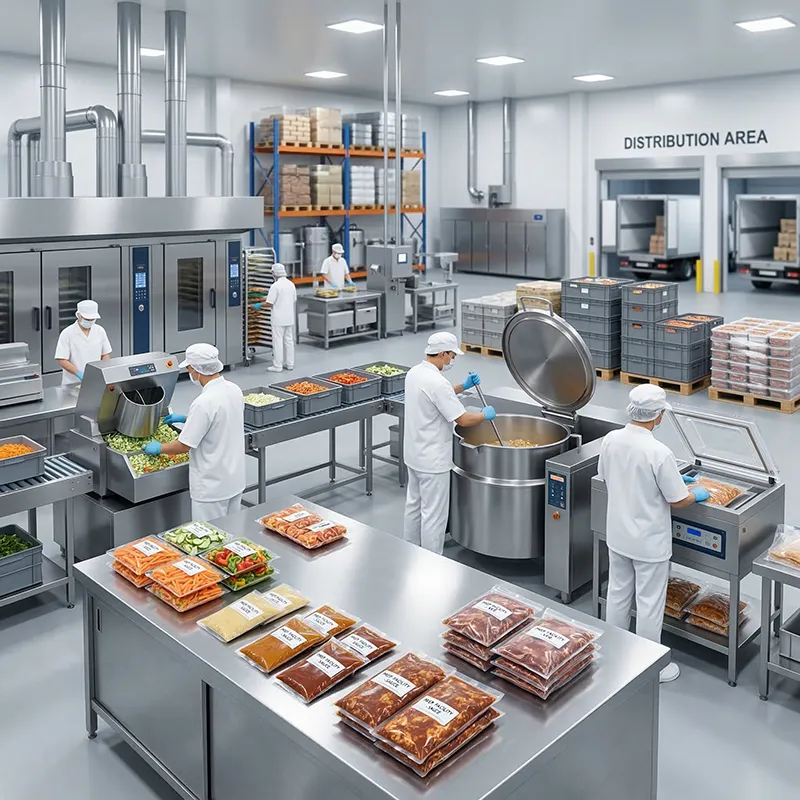
The decision is not binary. Many restaurant groups use a hybrid structure.
A local model keeps preparation at each outlet.
A hub-and-spoke model uses one or more regional preparation hubs serving a defined group of outlets.
A centralized model moves selected preparation into a larger central kitchen or processing facility serving much of the network.
| Decision factor | Local outlet preparation | Hub-and-spoke preparation | Centralized preparation |
|---|---|---|---|
| Network density | Suitable for dispersed or isolated outlets | Suitable for regional outlet clusters | Stronger when delivery routes and demand density support it |
| Menu variability | High local flexibility | Moderate flexibility by hub | Best for stable, repeatable process families |
| Daily volume | Low or irregular volume can remain practical | Medium regional volume | Higher consolidated volume may support dedicated systems |
| Freshness window | Minimal transport after cutting | Short regional distribution | Requires controlled scheduling, packaging and cold chain |
| Labor structure | Preparation skills required at every outlet | Skills concentrated regionally | Skills and supervision concentrated centrally |
| Yield control | Dependent on local execution | More consistent within each hub | Greater potential for common measurement |
| Food-safety controls | Many smaller control environments | Fewer, more structured environments | Concentrated controls but larger consequence of failure |
| Traceability | Records distributed by outlet | Consolidated by region | Central transformation and shipment records become important |
| Capital requirement | Lower shared-facility investment | Moderate facility and logistics investment | Higher infrastructure and integration requirement |
| Disruption risk | One outlet failure remains local | Hub failure affects several outlets | Central failure may affect a large part of the network |
| Transport | Whole ingredients delivered to every outlet | Prepared product distributed regionally | More dependent on route, cold-chain and delivery reliability |
| Automation potential | Small tools or standalone machines | Selective mechanization | Integrated processing may become commercially viable |
A restaurant group may centralize high-volume vegetables, retain delicate garnishes locally and use regional hubs for products with short distribution windows. The operating model should be designed around product characteristics rather than organizational preference.
When Manual, Semi-Automated and Integrated Processing Make Sense
Manual Preparation Can Remain Rational
Manual preparation may be appropriate when:
- volumes are low or irregular;
- menus change frequently;
- batches are too small for efficient machine use;
- ingredients are delicate or visually selected;
- preparation is part of the customer experience;
- outlets are geographically dispersed;
- transport after cutting would reduce acceptable quality;
- local labor and space are available;
- capital must be preserved for more critical constraints;
- the process has not yet been standardized.
The correct response may be better workstations, clearer specifications, improved tools, training and disciplined measurement rather than automation.
Semi-Automation Fits Repetitive Bottlenecks
Semi-automation uses equipment for selected operations while employees continue loading, inspection, transfer, changeover or quality control.
It may fit when washing, cutting, peeling or dewatering has become repetitive, but the overall product mix remains too variable for a fixed line.
Examples include:
- a standalone vegetable cutter serving several outlets;
- mechanical peeling followed by manual defect trimming;
- washing equipment with manual sorting;
- centrifugal dewatering with manual loading;
- conveyors that reduce lifting without controlling the entire process.
Semi-automation can be phased and easier to adapt. It can also create disconnected islands of capacity. A fast cutter placed between a slow wash stage and manual packing may increase work-in-process without increasing accepted daily output.
Integrated Automation Requires Stable Process Logic
An integrated vegetable processing line may connect feeding, cutting, washing, sorting, sanitation treatment, dewatering, conveying and packing preparation.
This level becomes more relevant when:
- consolidated volume is sufficiently stable;
- product families follow repeatable routes;
- target specifications are defined;
- demand can be scheduled;
- utilities and space are available;
- sanitation procedures are engineered;
- upstream supply and downstream packing are matched;
- maintenance capability exists;
- disruption risk is understood;
- distribution can protect the prepared product.
Automation is not a substitute for process design. It magnifies both good and bad assumptions.
Reverse Judgment: When Centralization or Automation Is the Wrong Move
A project should be delayed, reduced in scope or rejected when the business cannot clearly define what the proposed system must solve.
Warning conditions include:
- no reliable data on raw-material volume;
- sales forecasts used as if they were production schedules;
- undefined finished-product specifications;
- hundreds of SKUs treated as one process;
- no distinction between RTC and RTE requirements;
- raw-material seasonality ignored;
- catalog capacity accepted without product testing;
- insufficient drainage, refrigeration or electrical capacity;
- no maintenance or spare-parts plan;
- no distribution model for prepared ingredients;
- no ownership of sanitation validation;
- no contingency if the central system stops;
- transport time longer than the acceptable product window;
- a desire to remove labor without redesigning inspection, loading and cleaning work.
Centralizing an unstable process can spread the instability across the entire network. A local problem that once affected one outlet may become a central failure affecting every outlet served by the facility.
The reverse judgment is therefore essential: the organization should be able to explain not only why a process should move, but also why it should not remain local.
New Risks Introduced by Automation
Equipment changes the risk profile rather than eliminating risk.
Incorrect Equipment Selection
A machine may damage delicate products, cut an unsuitable raw-material shape, remove excessive edible material or fail to achieve the required specification. Nominal capacity does not confirm product compatibility.
Line Imbalance
One oversized stage can create queues, moisture loss and unnecessary handling if adjacent stages cannot match it.
Sanitation Complexity
Integrated equipment can contain belts, piping, guards and transfer points that require defined access and cleaning procedures. Poorly designed cleaning can reduce available production time or leave inaccessible residues.
Concentrated Downtime
A failure in one central bottleneck may stop several downstream operations. Redundancy and contingency planning become more important as dependency increases.
Maintenance and Spare Parts
Operators need preventive maintenance schedules, wear-part inspection, blade management and access to replacement components. After-sales support should be assessed in relation to operating location and required recovery time.
False Precision
Automated controls may produce detailed data without proving that the underlying measurements are valid. Sensors, scales and production records require calibration, verification and responsible interpretation.
Loss of Flexibility
A system optimized for a stable product may respond poorly to a sudden menu change, new ingredient or smaller batch pattern.
These risks do not argue against automation. They explain why automation should follow process definition, raw-material testing, capacity planning and supplier evaluation.
How to Assess the Current Preparation Model
Map Every Preparation Step
Document the actual path from receiving to cooking or service. Include waiting, storage, movement, inspection, rework and cleaning. The written procedure may not reflect what employees do during peak periods.
Separate Ingredients into Process Families
Group ingredients according to required operations, hygiene level, temperature, fragility, batch size and final specification. Avoid averaging unrelated products into one capacity figure.
Record Input, Output and Time
For a representative period, measure accepted input, usable output, waste, labor hours, scheduled time, downtime and sanitation time.
Compare Outlets on a Common Basis
Use the same specification, lot-quality assumptions and measurement rules. Investigate the causes of variation rather than simply ranking locations.
Identify the True Bottleneck
Look for the stage that limits on-time completion. It may be washing, trimming, container availability, dewatering, storage or scheduling rather than cutting.
Define What Must Stay Local
Some items may need immediate preparation, culinary judgment or local finishing. Centralization should not become an ideological target.
Model the Alternatives
Compare the full cost and risk of:
- improving the existing outlet process;
- standardizing tools and workstations;
- adding selective equipment;
- creating a regional preparation hub;
- developing a central kitchen;
- purchasing prepared ingredients from an external processor.
Test Before Committing
Raw-material testing should evaluate yield, damage, cutting quality, wash behavior, throughput, cleaning and operator requirements. One product demonstration should not be generalized to the complete menu.
Assess Your Current Preparation Model
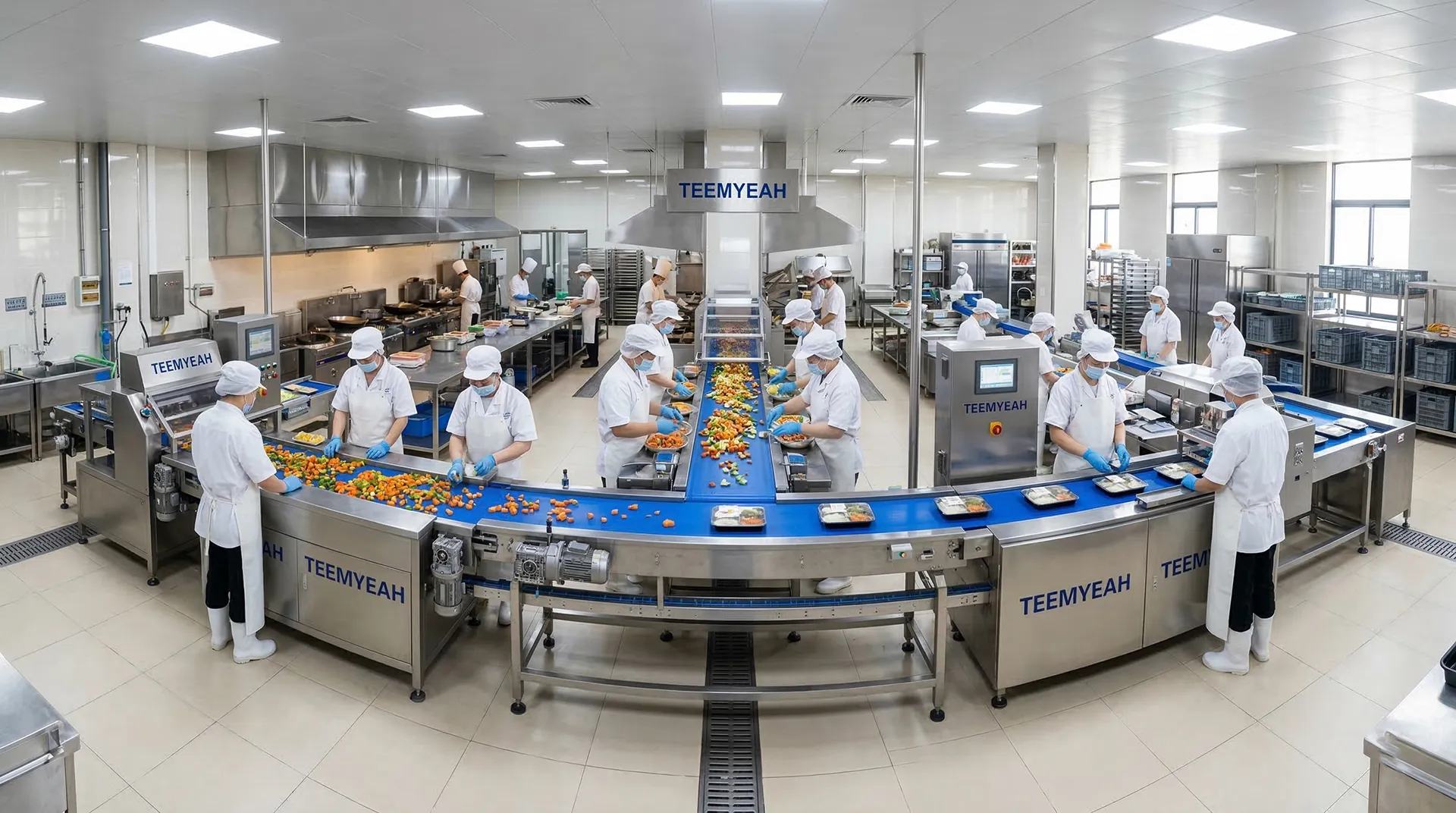
When every outlet performs its own washing, trimming and cutting, the first objective is not to eliminate local preparation. It is to determine what the network is paying for repetition and where variation is affecting quality, capacity or control.
Build a multi-outlet cost map using accepted raw volume, preparation labor, usable yield, sanitation time, actual throughput, specification compliance and on-time completion. The results should show which processes remain efficient locally, which could be shared regionally and which deserve a centralized workflow study.
TEEMYEAH supports central kitchens, restaurant chains, fresh-cut processors and RTC/RTE facilities as a food pre-processing equipment supplier and customized food preparation solution provider. An early discussion can focus on your current and target capacity, the main bottleneck and whether process improvement or automation is commercially justified—without assuming that a complete automated line is the correct answer.
FAQ
1. What is a decentralized ingredient preparation restaurant chain?
A decentralized ingredient preparation restaurant chain allows individual outlets to wash, trim, peel, cut, portion or otherwise prepare raw ingredients instead of receiving all prepared components from a shared facility. The model can offer flexibility and short preparation-to-service times, particularly for low-volume or geographically dispersed locations. Its hidden challenge is repetition: each outlet needs labor, tools, sanitation procedures, records and supervision for similar work. The model should therefore be evaluated using network-wide labor, yield, throughput, food-safety and traceability data rather than judging each kitchen only by its local payroll or food cost.
2. Is centralized ingredient preparation always cheaper than in-store preparation?
No. Centralized preparation introduces facility, equipment, management, packaging, refrigeration, transport and distribution costs. It can also create a larger operational consequence when a central process fails. In-store preparation may remain more economical for low volumes, unstable menus, remote outlets or ingredients that deteriorate quickly after cutting. A valid comparison calculates preparation cost per usable kilogram for each model and includes labor, yield, sanitation, utilities, waste, maintenance, transport, cold-chain requirements and disruption risk. Centralization is justified only when its combined operational benefits exceed its additional costs and constraints.
3. How can a restaurant chain measure preparation labor accurately?
Record all labor directly associated with receiving, setup, washing, trimming, cutting, handling, labeling, changeover, cleaning and production records. Divide those hours by accepted raw-material volume and report labor hours per 1,000 kilograms. Measure ingredient families separately because leafy vegetables, root crops and proteins require different work. Avoid counting only active knife time; setup and sanitation may represent a significant portion of the workload. The company should also distinguish regular hours, overtime, temporary labor, supervision and rework so that outlets are compared on a consistent basis.
4. Why does ingredient yield vary between restaurant outlets?
Yield varies because raw-material quality, employee technique, trimming decisions, blade condition, cut specification and waste recording are not always consistent. Seasonal changes can also alter size, maturity, soil load, defects and usable proportion. A yield difference does not automatically indicate poor employee performance. The company must compare equivalent products, supplier lots and specifications. Measure accepted input, compliant output, categorized waste and rework. Unexplained differences should trigger process observation and measurement review before management assumes that centralization or a machine will correct the problem.
5. What is the difference between theoretical capacity and actual throughput?
Theoretical capacity describes output under defined or ideal conditions, such as a machine’s rated capacity or a calculated manual cycle time. Actual throughput is the specification-compliant output achieved during scheduled production after setup, waiting, product variation, changeovers, cleaning, minor stops and rejects. For decision-making, actual throughput is more useful. It shows whether the complete process can meet demand within the available production window. A high-capacity cutter does not increase daily output when washing, inspection, dewatering, packing or refrigerated storage remains the bottleneck.
6. Does central preparation automatically improve food safety?
No. A central facility can reduce the number of preparation environments and support more structured zoning, supervision and sanitation verification. It can also spread a failure across many outlets if controls are weak. Food safety depends on process design, employee health policies, training, hygienic handling, temperature control, cross-contamination prevention, cleaning and management verification. RTE products require particular attention when no later cooking step will reduce hazards introduced after preparation. Centralization changes where risks are managed; it does not remove the need for competent food-safety systems.
7. Should ready-to-cook and ready-to-eat ingredients share one preparation process?
They should not be combined without a documented risk assessment and suitable controls. RTC ingredients are intended to receive a later cooking step, while many fresh-cut RTE products are consumed without a downstream lethality treatment. Shared equipment or space can create cross-contamination risks if zoning, scheduling, cleaning and employee movement are not controlled. A facility may use temporal separation or dedicated areas depending on products, regulations and risk. The decision should consider raw-animal ingredients, allergens, sanitation capability, traffic flow and the protection required after final washing and cutting.
8. When is semi-automation more appropriate than a complete processing line?
Semi-automation is often suitable when one or two repetitive stages have become bottlenecks but the total product mix remains variable. A restaurant group might mechanize cutting, peeling, washing or dewatering while retaining manual inspection and transfer. This can reduce repetitive work without committing the business to a fixed integrated flow. The limitation is line imbalance: a fast standalone machine may create queues if surrounding stages remain slow. The proposed equipment should therefore be assessed against actual batch sizes, changeovers, sanitation time, upstream supply and downstream handling.
9. What information is needed before evaluating food preparation automation?
The assessment should include raw-material types, condition and seasonal variation; daily and peak volume; batch size; number of SKUs; required cuts and finished specifications; current labor; usable yield; available production time; cleaning requirements; RTC or RTE status; floor space; utilities; downstream capacity and distribution needs. Managers should also identify the present bottleneck and define which products must remain local. Without this information, equipment capacity and ROI calculations are based on assumptions rather than an operating process that can be tested.
10. What should a multi-outlet cost map include?
A multi-outlet cost map should include accepted raw volume, usable output, categorized waste, preparation labor, sanitation labor, actual throughput, downtime, changeover time, specification compliance and on-time completion. Financial inputs may include wages, utilities, water treatment, cleaning chemicals, disposables, maintenance, waste handling, allocated space, packaging, refrigeration and transport. The map should separate ingredients by process family and compare representative outlets using common definitions. Its purpose is to identify where repetition and variation are commercially important, not to predetermine that every process must be centralized.
Data and Source Note
This article uses authoritative U.S. sources to explain foodservice controls and measurement methods. Their geographic and legal scope should be understood before applying them elsewhere.
The U.S. FDA Food Code 2022, together with its 2024 Supplement, is a model framework for retail and foodservice safety. It is not automatically binding nationwide. State, local, tribal and territorial authorities determine adoption and enforcement, and international operators must follow the requirements applicable in their own jurisdictions.
FDA’s September 2022 restaurant traceability factsheet explains receiving-record expectations and the distinction between direct-to-consumer restaurant preparation and central-kitchen transformation followed by business-to-business shipment. The document states the original January 20, 2026 compliance date. FDA’s current Food Traceability Rule page reports that the agency proposed moving the date to July 20, 2028 and that Congress directed FDA not to enforce the rule before that date. Operators should verify current status, exemptions and applicability rather than relying solely on an older factsheet.
CDC restaurant food-safety materials summarize U.S. studies associating certified kitchen managers with improved practices and lower outbreak occurrence in studied establishments. These are observational findings and do not prove that certification, centralization or automation independently prevents foodborne illness.
OSHA’s foodservice ergonomics material identifies repetitive work, lifting, reaching, deep sinks, heavy containers and hand-tool use as musculoskeletal risk factors. It supports workplace assessment but does not quantify the risk for a specific restaurant or preparation facility.
The U.S. Bureau of Labor Statistics May 2025 Occupational Employment and Wage Statistics tables provide U.S. occupational wage and employment estimates by occupation, industry and geography. They should be combined with the operator’s actual compensation, benefits, overtime, supervision and regional labor conditions.
All yield, labor and throughput calculations in this article are illustrative methods. The twelve-outlet example is hypothetical and does not represent a TEEMYEAH project, customer result, promised saving or expected return.

