







Summary
A food processing equipment investment decision should not begin and end with the machine shown on a quotation. A washer, cutter, peeler, dehydrator, mixer, conveyor, or packing unit only creates value when it performs reliably within the surrounding production system.
That system includes the condition of incoming raw materials, operator activities, upstream preparation, product transfer, downstream capacity, utilities, hygienic zoning, cleaning procedures, maintenance resources, production records, and the finished-product specification. A machine can meet its published rating while the overall line produces less saleable output, consumes more labor, creates excessive work-in-progress, or introduces food safety and sanitation problems.
Buyers therefore need to convert a single-machine quotation into a clearly defined system boundary. They should validate every critical interface, measure line-level throughput rather than nominal machine speed, establish yield and quality requirements, test performance across realistic operating conditions, and compare lifecycle cost rather than purchase price alone.
This does not mean every operation needs a fully automated line. Manual preparation, standalone machines, and semi-automatic configurations may remain commercially and operationally sensible. The right decision depends on volume, SKU complexity, hygiene risk, labor conditions, facility constraints, product value, and the ability of the organization to operate and maintain the proposed system.
A Quotation Can Describe a Machine Without Describing Production
A central kitchen receives a quotation for a vegetable cutting machine rated at 1,000 kilograms per hour. The machine appears capable of replacing a large amount of manual cutting, and its price fits the capital budget. Yet several unanswered questions remain.
Can the trimming team feed 1,000 kilograms per hour in the required condition? Can the washer receive cut product at the same rate without increasing damage or reducing cleaning effectiveness? Is there enough dewatering capacity after washing? How much time is lost when changing from cabbage to onions or from strips to dice? Where will product wait when the next process stops? Can the equipment be cleaned before the next allergen, product category, or hygiene class enters the area?
The quotation may be technically accurate. The investment can still fail.
This distinction matters because machine output and production output are not the same measurement. Machine output describes what one unit can process under stated conditions. Production output describes the quantity of acceptable product that the complete operation can deliver within the available time, after accounting for feeding, inspection, transfer, cleaning, changeovers, stoppages, rejects, and downstream constraints.
NIST manufacturing research makes the same distinction at a broader industrial level: line throughput depends on the operations, buffers, their positions, and their interactions. Improving one machine does not automatically improve the system surrounding it.
The purchasing question should therefore change from:
Can this machine process the required quantity?
to:
Can the defined production system repeatedly deliver the required quantity, specification, hygiene condition, and delivery schedule?
That second question cannot be answered by a catalogue capacity figure.
A Food Processing Equipment Investment Decision Starts With the System Boundary
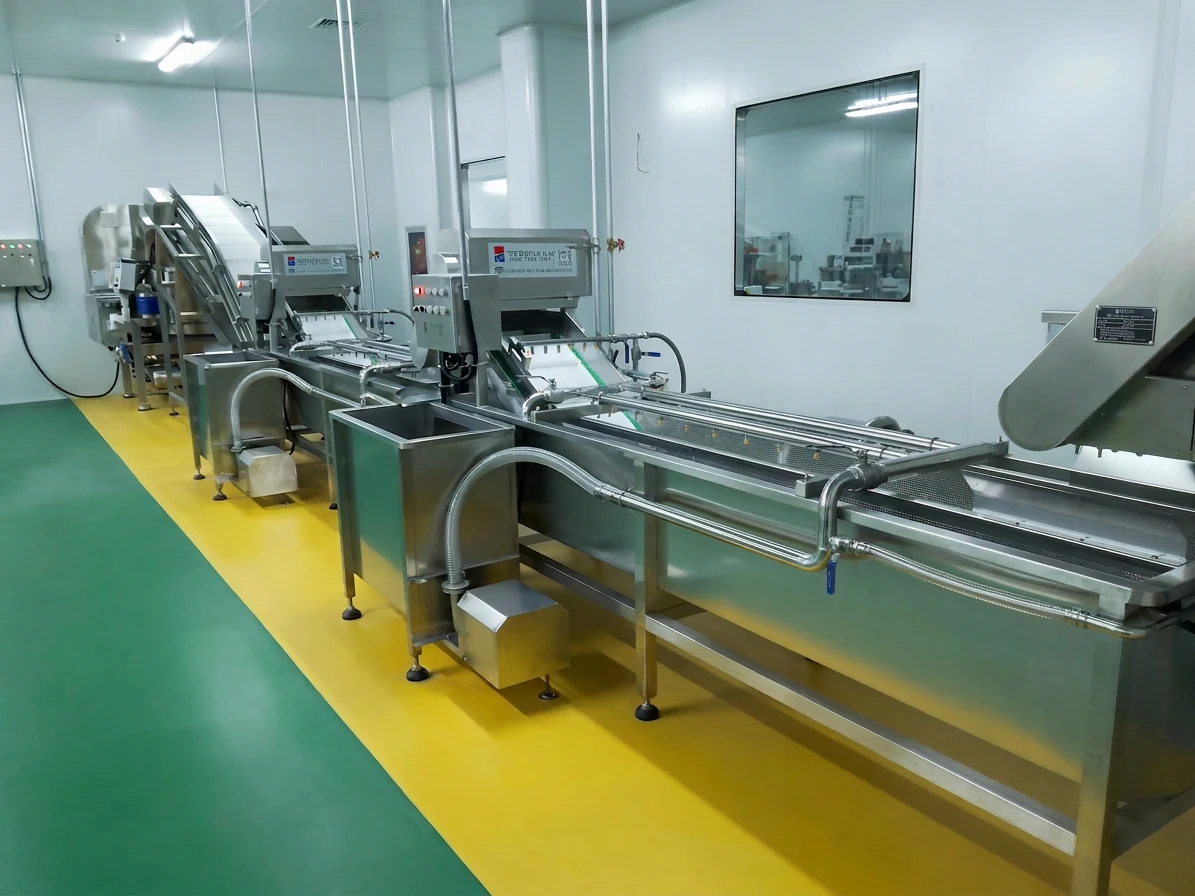
A system boundary defines what the buyer expects the proposed investment to include, influence, and prove. Without that boundary, the buyer and supplier may be discussing different projects while using the same quotation.
For a standalone vegetable washer, the supplier may define the scope as the washer body, pump, conveyor, electrical components, and control panel. The buyer may unconsciously assume the scope also covers stable feeding, soil removal, sanitizing, water management, final rinsing, transfer to cutting, operator access, wastewater handling, and the required clean-product output.
Neither interpretation is necessarily unreasonable. The problem is that the difference remains invisible until installation.
A practical system boundary should begin before the quoted machine and end after its output has reached a stable, usable condition. It should cover five connected layers.
Material boundary
Define what enters and leaves the proposed system.
Incoming specifications may include:
- ingredient type and variety;
- whole, trimmed, peeled, cut, chilled, frozen, or partially thawed condition;
- soil load, surface moisture, foreign material, stones, stems, roots, bones, or packaging;
- minimum, average, and maximum product dimensions;
- seasonal variation and supplier-to-supplier variation;
- acceptable temperature range;
- batch size and daily SKU sequence.
The output definition should describe saleable or process-ready product, not simply material that has passed through the machine. Cut dimensions, residual peel, product damage, foreign-material tolerance, surface moisture, temperature, and destination process may all matter.
Process boundary
Document every operation needed to convert incoming material into the required output. In food pre-processing, this may involve receiving, sorting, trimming, washing, peeling, inspection, cutting, sanitizing, rinsing, dewatering, mixing, conveying, weighing, temporary holding, and transfer to cooking or packaging.
The boundary must also identify operations that remain manual. Manual work does not disappear merely because a machine is added. It often moves to feeding, inspection, rework, container handling, cleaning, or downstream recovery.
Time boundary
A line does not operate only during its steady-state production period. The daily system includes:
- start-up and pre-operational inspection;
- product feeding and normal processing;
- planned breaks;
- blade, screen, or recipe changes;
- minor stops and blockage recovery;
- sanitation and chemical preparation;
- product changeover;
- end-of-shift cleaning;
- maintenance checks;
- restart verification.
A buyer who calculates capacity from eight clock hours while ignoring two hours of cleaning and changeover is not measuring eight productive hours.
Hygiene and safety boundary
FDA current good manufacturing practice requirements address plant and equipment design, sanitary operations, facility sanitation, and production controls. The equipment decision therefore cannot be separated from how the surrounding area is zoned, cleaned, staffed, and monitored.
The boundary should identify raw and clean areas, personnel routes, container circulation, drainage, product-contact surfaces, chemical controls, cleaning access, and the risk of cross-contamination between ingredients or process stages.
Workplace safety also belongs inside the boundary. OSHA’s ergonomics guidance emphasizes adapting the job to the worker. A fast machine that requires continuous lifting, twisting, unsafe reaching, or manual recovery of blocked product has transferred rather than solved the labor problem.
Responsibility boundary
Every interface needs a named responsible party. The supplier may provide the equipment, while the buyer manages utilities, floor drainage, foundations, upstream tables, downstream conveyors, lifting devices, network access, sanitation chemicals, and production labor.
A responsibility matrix should distinguish among:
- supplied by the equipment manufacturer;
- supplied by the buyer;
- supplied by a third-party contractor;
- jointly designed;
- tested by the supplier;
- verified after installation;
- excluded from the project.
“Not included” is not automatically a problem. An undefined exclusion is.
Machine Purchase Versus Production-System Evaluation
| Decision Area | Machine-Purchase View | Production-System View | Evidence to Request |
|---|---|---|---|
| Capacity | Published machine rating | Sustainable good output across the full process | Timed trial with defined input, output, stops, and staffing |
| Raw materials | Product name only | Variety, size, maturity, soil load, temperature, and seasonal range | Representative samples and worst-case test conditions |
| Feeding | Assumed continuous | Required trimming, orientation, loading, and buffer method | Feeding rate and operator task analysis |
| Downstream flow | Outside the quotation | Receiving capacity, transfer method, waiting time, and WIP limit | Line balance and mass-flow calculation |
| Product quality | Product passes through | Yield, cut accuracy, damage, moisture, temperature, and rework | Agreed sampling and acceptance method |
| Food safety | Stainless steel equipment | Hygienic zoning, cleanability, sanitation controls, records, and recontamination risk | Cleaning review, hazard assessment, and sanitation test |
| Labor | Operators listed in brochure | Direct labor, material handling, inspection, cleaning, and maintenance labor | Labor-hours-per-output calculation |
| Flexibility | Machine can process several products | Changeover time, tools, recipes, sanitation needs, and output stability by SKU | Multi-SKU trial and changeover observation |
| Reliability | Component warranty | Line availability, failure impact, recovery time, spares, and service capability | Failure-response plan and critical-spares list |
| Investment | Purchase price | Integration, utilities, installation, yield, labor, downtime, cleaning, maintenance, and expansion cost | Lifecycle-cost model with stated assumptions |
| Acceptance | Machine switches on | Complete system meets measurable production and quality requirements | Factory and site acceptance protocol |
The purpose of this comparison is not to make every purchase more complicated. It is to make the level of evaluation proportional to the operational consequence of failure.
A spare tabletop cutter used for occasional batches does not require the same validation program as a vegetable processing line supplying ready-to-eat products to hundreds of outlets. The decision framework should expand as volume, hygiene risk, customer dependency, automation complexity, and downtime consequence increase.
Interfaces Determine Whether Individual Machines Become a Line
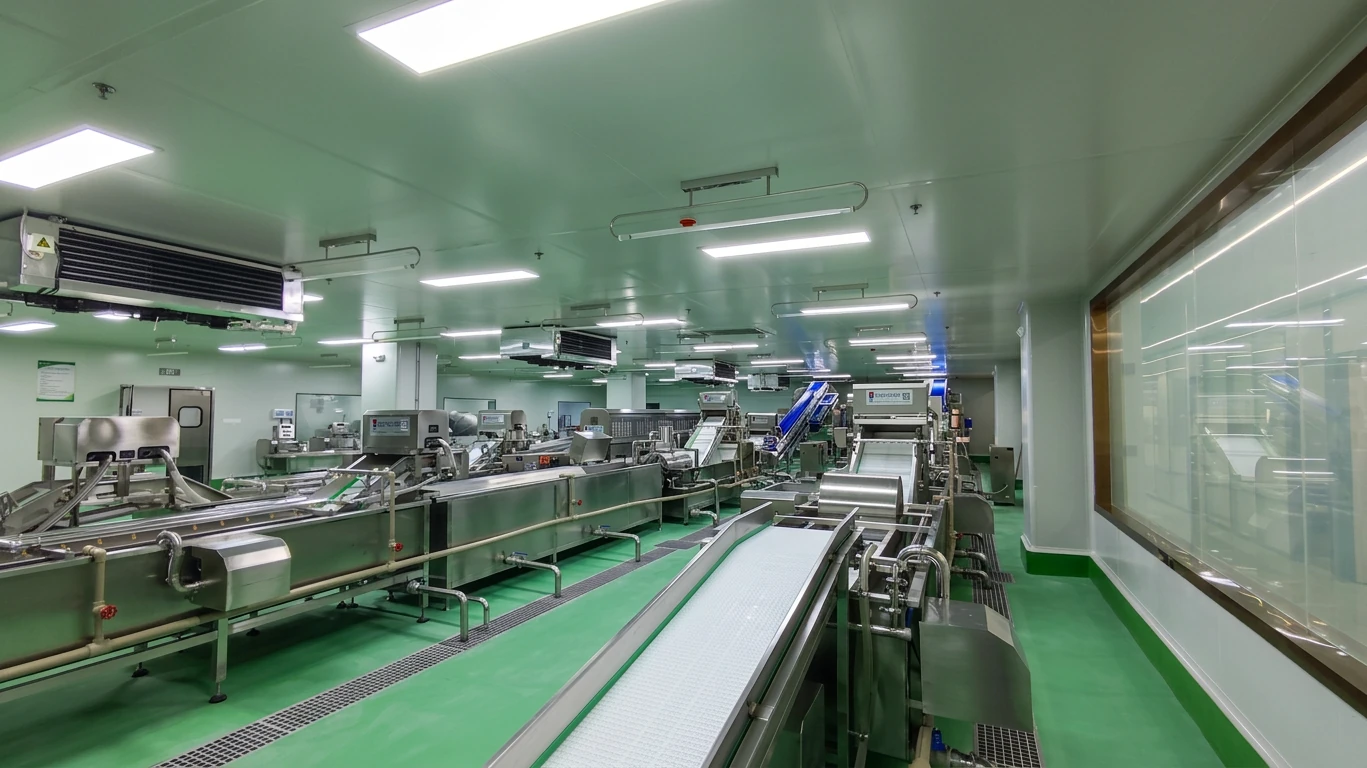
Equipment integration is often described as placing several machines in sequence. Real integration is the management of interfaces between those machines.
An interface is any point where material, information, utilities, responsibility, or timing passes from one process element to another. Weak interfaces create hidden labor, unstable throughput, damaged product, sanitation gaps, and disputes during commissioning.
Mass-flow interfaces
Each stage must receive and discharge material at a rate compatible with the stages around it.
Consider a nominal sequence:
- trimming: 600 kg/h;
- cutting: 1,200 kg/h;
- washing: 900 kg/h;
- dewatering: 500 kg/h;
- packing preparation: 700 kg/h.
The cutter’s 1,200 kg/h rating does not make this a 1,200 kg/h line. Without parallel dewatering or controlled buffering, the process may be limited to approximately 500 kg/h before accounting for breaks, product variation, cleaning, and minor stops.
The mass-flow review must also account for yield changes. One tonne of untrimmed vegetables does not remain one tonne through peeling, cutting, inspection, and dewatering. Downstream capacity should be matched to the mass entering that stage, not automatically to the original receiving weight.
Physical interfaces
Product transfer affects quality as well as labor.
A poorly positioned discharge can require operators to catch product in bins, move the bins across a wet floor, lift them to the next machine, and wait for space. High drop distances may bruise soft fruit or damage cut vegetables. Narrow chutes can bridge or block. Conveyors may carry water into areas intended to remain drier.
The interface specification should define discharge height, receiving height, belt width, container type, allowable drop, transfer speed, drainage, guarding, cleaning access, and how product is recovered after a stop.
Timing and buffer interfaces
Buffers can protect a line from short interruptions, but they can also conceal poor balance.
A buffer is not merely floor space for extra bins. It should have:
- a defined maximum quantity;
- a maximum holding time;
- a product identification method;
- temperature and hygiene conditions;
- first-in, first-out control where required;
- a response rule when the maximum is reached.
Excessive WIP may increase oxidation, moisture loss, temperature drift, mix-ups, physical damage, or exposure to the environment. For fresh-cut vegetables, delays after cutting can be particularly significant because the protective surface has been disrupted.
Utility interfaces
Water flow, pressure, drainage capacity, compressed air, electrical supply, steam, cooling, ventilation, and chemical dosing can constrain production.
A washer may function during a short demonstration but perform differently when several machines draw water simultaneously. A high-capacity wash line may be unusable if floor drains cannot receive its discharge. A dewatering unit may create an electrical demand or structural vibration not considered in the original facility plan.
Utility values should be classified as maximum, normal, start-up, and simultaneous demand. Average consumption alone may not identify peak-load problems.
Control and data interfaces
Connected equipment needs an agreed operating philosophy.
Questions include:
- Does the upstream machine stop when the downstream unit is unavailable?
- What happens to product already between the machines?
- Can conveyor speeds be coordinated?
- Which alarms require operator action?
- Can recipes and settings be restricted by user level?
- What production, sanitation, or downtime records are retained?
- How are sensors calibrated and failures detected?
- Can the line operate safely if a communication connection fails?
Automation adds visibility and repeatability, but it also introduces sensors, software, networks, and control dependencies. NIST’s work on manufacturing performance assurance warns that increasingly connected systems create additional failure and information-security considerations. A more automated system is not automatically a more resilient one.
Human interfaces
Operators remain part of the production architecture.
They receive raw materials, identify defects, feed irregular products, verify settings, respond to alarms, inspect output, clean equipment, change tools, and communicate problems. Their tasks should be engineered with the same seriousness as machine functions.
A credible proposal should show where people stand, what they lift, how frequently they move, what decisions they make, and whether the expected pace is sustainable. Automation that depends on constant manual correction is not fully integrated.
Nominal Capacity Is Not the Same as Proven Line Throughput
Published capacity is usually conditional. It may be based on a particular ingredient, size range, feed condition, cut specification, operator method, or uninterrupted test period. The figure can be useful, but it is not a universal production promise.
Nominal machine capacity is the stated rate under specified or assumed conditions.
Demonstrated machine capacity is the rate observed during a defined test.
Sustainable line throughput is the quantity of acceptable output produced by the complete process over a representative operating period.
Required production capacity is the output needed to meet demand within the actual available production window.
These quantities should not be treated as interchangeable.
Measure good output, not movement
A cutter may discharge 800 kilograms in an hour, but 40 kilograms may require rework and another 20 kilograms may be unusable. The relevant output is not gross discharge. It is acceptable product that can proceed to the next stage or be sold.
Good throughput rate
Formula: Good Throughput Rate = (Accepted Output Weight) / (Actual Operating Time)
Where possible, the calculation should be reported by SKU. Averaging cabbage, onions, potatoes, and delicate leaves into one number can hide important differences.
Separate clock time from operating time
A production shift can be divided into:
- scheduled production time;
- planned sanitation and changeover;
- unplanned downtime;
- minor stops;
- starved time caused by insufficient upstream feed;
- blocked time caused by downstream inability to receive product;
- productive operating time.
NIST distinguishes equipment-level indicators from line-level throughput and notes that buffers and interactions affect the full line. This is why a machine with high local utilization may still contribute to poor system performance. It may simply be producing faster than the next stage and building inventory.
Test a performance envelope
A single successful trial proves performance only under that trial’s conditions.
A useful performance envelope defines the range of conditions within which the buyer expects the system to remain acceptable. It may cover:
- minimum and maximum batch size;
- normal and difficult raw-material conditions;
- different product sizes and varieties;
- multiple cut specifications;
- peak and normal feed rates;
- clean and partially loaded water conditions;
- beginning and end of a production run;
- different operator teams;
- planned SKU sequences;
- acceptable ambient and product temperatures.
The acceptance target should not require identical performance under every condition. It should define acceptable ranges and disclose where lower output, higher labor, or additional changeover is expected.
A Concrete Measurement Framework for the Investment Decision
A buyer does not need dozens of disconnected KPIs. The measurement set should explain whether the production system creates acceptable output safely, predictably, and economically.
1. Yield percentage
Formula: Yield Percentage = (Accepted Product Weight) / (Raw Material Input Weight) × 100
Yield should be measured at important stages, not only at the final output. Stage-level measurements help distinguish unavoidable trimming loss from over-peeling, cutting damage, wash loss, inspection rejection, and handling loss.
Yield must also be interpreted with quality. A very high yield is not desirable if peel, defects, bones, damaged leaves, or foreign material remain in the product.
2. Labor hours per 1,000 kilograms
Formula: Labor Hours per 1,000 kg = (Total Direct Labor Hours) / (Accepted Output Weight) × 1,000
Include feeding, sorting, inspection, transfer, rework, routine cleaning, changeover, and production support labor. Excluding workers who move bins or clean the line can make an automated process appear artificially efficient.
This metric helps compare manual, semi-automatic, and integrated alternatives without assuming that automation eliminates labor.
3. Preparation cost per accepted kilogram
Formula: Preparation Cost per kg = ( Labor + Utilities + Consumables + Maintenance + Waste Cost + Allocated Downtime Cost ) / ( Accepted Output kg )
Raw-material cost may be shown separately because its effect is already partly reflected in yield. When it is included, the model should avoid counting the same yield loss twice.
4. Downtime rate
Formula: Downtime Rate = (Unplanned Downtime) / (Scheduled Production Time) × 100
Downtime should be categorized by cause: mechanical, electrical, control, cleaning recovery, product blockage, utility interruption, missing labor, upstream starvation, or downstream blockage. A single downtime percentage identifies the size of the problem but not where to act.
5. Changeover burden
Formula: Changeover Burden = (Total Changeover and Required Cleaning Time) / (Scheduled Production Time) × 100
For high-SKU central kitchens, changeover burden can be more important than maximum machine speed. A line that is highly productive during one long run may perform poorly when recipes, cuts, allergens, or hygiene categories change repeatedly.
6. On-time production rate
Formula: On-Time Production Rate = fracOrders or Batches Completed by Required Time Total Scheduled Orders or Batches × 100
This links equipment performance to the business requirement. A process may meet its average daily tonnage while failing to release early-morning orders, urgent hospital meals, airline-catering loads, or dispatch windows.
7. Line balance ratio
A simple diagnostic version is:
Formula: Line Balance Ratio = fracLowest Sustainable Stage Capacity Highest Sustainable Stage Capacity
A low ratio indicates a large mismatch, although it does not fully model buffers, parallel machines, product routes, or planned idle time. The calculation should therefore be used as a warning indicator, not as a complete line simulation.
8. Quality conformance rate
Formula: Quality Conformance Rate = fracAccepted Units or Sample Weight Meeting Specification Total Units or Sample Weight Inspected × 100
The specification may cover cut dimensions, peel removal, product damage, foreign material, residual moisture, portion weight, temperature, color, or other product-specific characteristics.
9. Cleaning and sanitation performance
Cleaning performance should not be reduced to elapsed minutes. Record:
- disassembly time;
- cleaning time;
- inspection and verification time;
- number and type of tools required;
- water and chemical use;
- inaccessible or repeatedly failed areas;
- time until safe production restart;
- whether cleaning creates exposure to moving, sharp, hot, or elevated components.
For facilities subject to a preventive-controls framework, sanitation procedures, monitoring, corrective actions, verification, and records may form part of the food safety system. Equipment selection should support those controls rather than make them impractical.
10. Capacity utilization
Formula: Capacity Utilization = fracActual Accepted Output Proven Available Capacity for the Same Period × 100
The denominator should use proven capacity under comparable products and schedules, not an unrelated catalogue maximum.
Low utilization does not always indicate failure. It may reflect seasonal demand, intentionally reserved peak capacity, necessary hygiene separation, or a staged expansion plan. The commercial question is whether the unused capacity has a justified role.
Illustrative Calculation: Converting a Machine Quote Into a System Model
The following is a hypothetical example. It is not a TEEMYEAH customer result, an industry benchmark, or a prediction for any specific factory.
A processor plans to prepare mixed vegetables during an eight-hour scheduled shift.
Assumptions:
- raw material input: 1,000 kg;
- accepted output: 860 kg;
- total direct labor: 24 labor-hours;
- actual line operating time: 6.2 hours;
- unplanned downtime: 0.7 hour;
- changeover and required cleaning: 1.1 hours;
- loaded labor rate: USD 18 per hour;
- utilities: USD 60;
- consumables: USD 25;
- maintenance allocation: USD 20;
- waste handling: USD 15.
The calculated indicators are:
Formula: Yield = frac8601,000 × 100 = 86%
Formula: Good Throughput = (860) / (6.2) ≈ 139 kg/h
Formula: Labor Hours per 1,000 kg = (24) / (860) × 1,000 ≈ 27.9
Formula: Downtime Rate = (0.7) / (8) × 100 = 8.75%
Formula: Changeover Burden = (1.1) / (8) × 100 = 13.75%
Formula: Preparation Cost per Accepted kg = ((24 × 18)+60+25+20+15) / (860) ≈ $0.64
Suppose a proposed machine is rated at 600 kg/h. That rating alone does not show whether the investment will improve the 139 kg/h system result. The buyer must determine which part of the current loss comes from cutting speed, feeding, washing, dewatering, changeovers, raw-material variation, downtime, or downstream waiting.
The model becomes useful when the proposed future state is calculated using testable assumptions. If the quotation merely replaces the current throughput with the machine’s nominal capacity, it is not yet an investment model.
Yield and Product Quality Can Reverse the Apparent Capacity Advantage
Food production is not measured only in kilograms processed. It is measured in usable product produced to specification.
A high-speed peeler may remove more edible flesh. A cutter may create irregular pieces that cook at different rates. Aggressive washing or transfer may damage delicate leaves. Insufficient dewatering may leave excess surface moisture that interferes with packaging or product quality. A poorly controlled mixer may create batch variation even when its hourly capacity appears adequate.
The financial effect can be substantial because raw material is often a recurring cost, while the machine is a periodic capital cost. Yet buyers should resist inserting an unsupported “yield improvement percentage” into an ROI spreadsheet.
Instead, require a test protocol:
- Weigh a defined incoming lot.
- Record unavoidable sorting and trimming loss separately.
- Operate the proposed equipment using agreed settings.
- Collect all accepted product, rework, and waste.
- Evaluate the finished specification using an agreed sampling method.
- Repeat the test with representative raw-material variation.
- Document water gain or loss where washing or dewatering affects weight.
Water can complicate vegetable yield calculations. A product may temporarily gain surface water during washing or lose free water during dewatering. Weight should therefore be measured at consistent process points and after a defined draining period.
Cut consistency also needs a measurable method. Depending on the product, the parties may agree on dimensional tolerance, percentage of fines, broken-leaf rate, residual peel, visual defects, or cooking-performance checks. “Good cutting result” is not an acceptance criterion.
RTE and RTC Products Require Different System Judgments
Ready-to-cook and ready-to-eat products may use similar equipment names, but their risk context can be different.
An RTC ingredient normally receives a cooking step before consumption. The cooking process may control certain biological hazards when it is properly designed and implemented, although it does not excuse poor upstream hygiene, chemical hazards, allergens, foreign material, or cross-contamination.
An RTE product may be consumed without a later microbial kill step. Post-wash handling, hygienic zoning, environmental conditions, sanitation, personnel movement, containers, conveyors, dewatering, and packing interfaces therefore require particular scrutiny.
FDA guidance for fresh-cut fruits and vegetables explains that cutting disrupts the natural exterior barrier and releases plant fluids that may support microbial survival or growth. The preventive-controls rule also recognizes environmental monitoring as a verification activity when contamination of an RTE food with an environmental pathogen is identified as a hazard requiring a preventive control.
These principles do not mean every RTE facility must use one prescribed equipment arrangement. They mean the food safety plan, process design, equipment selection, sanitation program, and verification activities must work together.
Combining RTE and RTC production on the same equipment may be possible in some operations, but it should not be assumed merely because both products involve vegetables. The assessment should consider:
- product and hazard profile;
- raw-material contamination;
- process sequence;
- validated cleaning and sanitation;
- hygienic zoning;
- personnel and container routes;
- production scheduling;
- environmental monitoring requirements;
- the effect of shared water or shared contact surfaces;
- whether the later RTC cooking step could create false confidence in earlier shared operations.
Equipment cannot replace hazard analysis or food safety management. It must support them.
Labor Cost Is More Than the Number of Operators Beside a Machine
A quotation may state that a machine needs two operators. That number rarely represents the full labor system.
The operation may also require people to:
- open cartons or sacks;
- trim and inspect ingredients;
- orient irregular products;
- move bins;
- load elevators;
- remove rejects;
- replace blades or screens;
- clean product spills;
- prepare sanitation chemicals;
- wash and inspect the equipment;
- respond to blockages;
- record batch information;
- perform preventive maintenance.
Labor dependency also includes recruitment, training, absenteeism, turnover, skill variation, and supervisory effort. Automation may reduce repetitive work while increasing the need for trained operators and maintenance personnel.
In the United States, the Bureau of Labor Statistics reported a median annual wage of USD 40,050 for food processing equipment workers in May 2024 and projected about 37,500 openings per year on average from 2024 to 2034, many associated with replacement needs. These figures provide context for the U.S. labor market only. They do not establish labor cost, availability, or turnover conditions in another country or in a particular facility.
A buyer should use local loaded labor cost, including wages, statutory contributions, overtime, shift premiums, recruitment, training, supervision, uniforms, and relevant benefits.
The more useful question is not “How many people can the machine replace?” It is:
How will the investment change total labor hours, skill requirements, ergonomic exposure, supervision, cleaning workload, and operational resilience per unit of accepted output?
That question allows manual, semi-automatic, and automated options to be compared fairly.
Sanitation and Changeover Are Production Functions
Cleaning is often treated as time when production is not happening. In food processing, sanitation is part of production capability.
A line that produces quickly but requires prolonged disassembly, difficult access, uncontrolled high-pressure cleaning, or repeated corrective cleaning may deliver less daily output than a slower but more cleanable alternative.
The buyer should evaluate:
- accessibility of product-contact surfaces;
- visibility during inspection;
- tool-free or tool-assisted disassembly;
- retained water and self-draining characteristics;
- hollow areas and difficult joints;
- compatibility with cleaning chemicals;
- protection of bearings, motors, sensors, and electrical components;
- safe access to blades and moving parts;
- reassembly error risk;
- changeover between allergens or hygiene categories;
- procedures for verifying cleaning effectiveness.
Sanitary design is not demonstrated by stainless steel alone. Surface condition, geometry, drainage, sealing, weld quality, accessibility, component selection, and installation all affect cleanability.
A standalone machine may be easier to clean and isolate than a tightly connected line. Conversely, an integrated line can reduce manual transfer and uncontrolled container movement when its hygienic design and cleaning procedures are developed as one system.
The choice depends on the process, not on the label “automatic.”
Acceptance Evidence Should Be Defined Before the Purchase Order
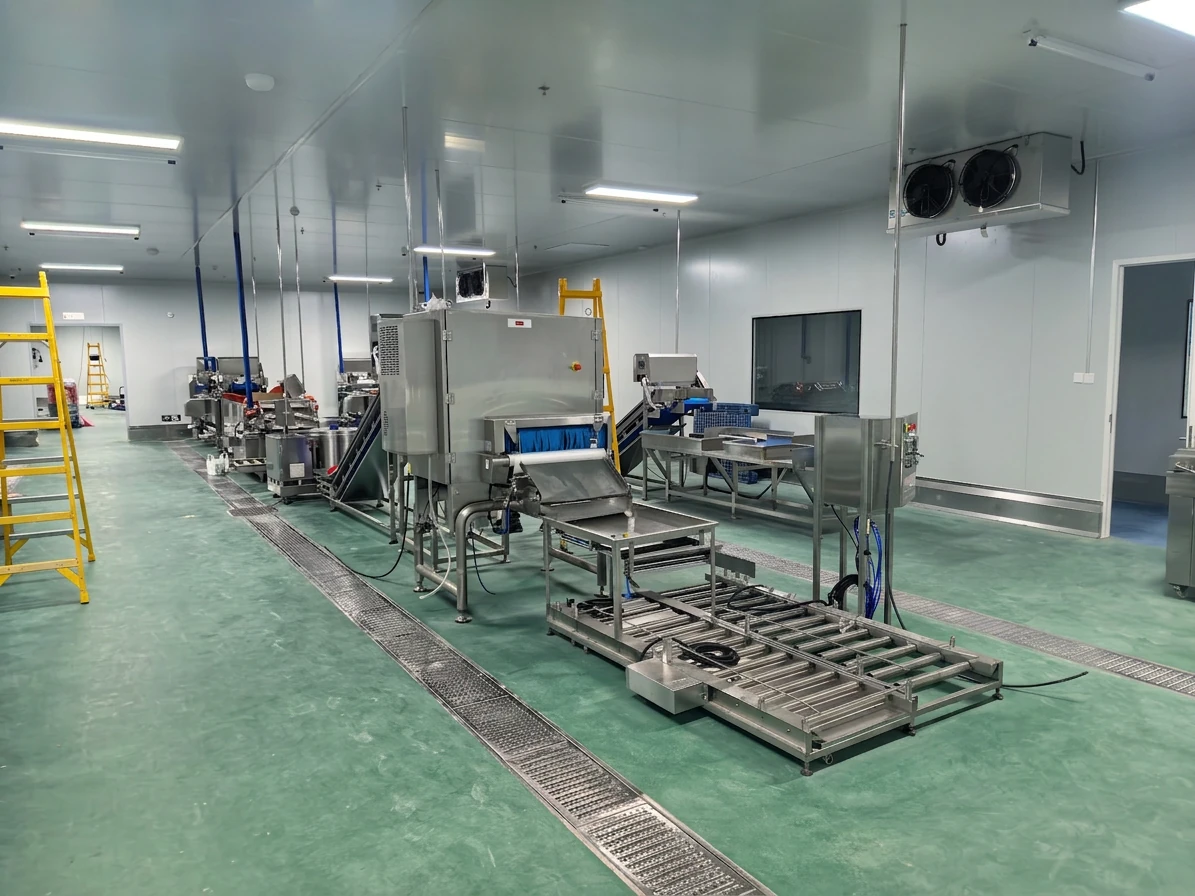
A successful demonstration is valuable, but it should not be confused with formal acceptance.
Acceptance evidence connects the buyer’s business requirement to a measurable test. The protocol should be agreed before manufacturing or configuration is finalized, especially when the equipment is customized.
Factory acceptance testing
A factory acceptance test may confirm:
- equipment scope and configuration;
- safety devices and interlocks;
- control functions and alarms;
- no-load and loaded operation;
- capacity under agreed test conditions;
- product-quality results;
- utility demand where measurable;
- disassembly and cleaning access;
- supplied documentation;
- spare parts and tools;
- deviations requiring correction.
When the buyer’s raw material cannot be shipped to the supplier, both parties should document the substitute material and the remaining site-validation requirements.
Site acceptance testing
Site testing confirms the installed system under the buyer’s utilities, layout, workforce, product conditions, and downstream process.
A site protocol should define:
- product and batch quantities;
- test duration;
- staffing;
- start and stop rules;
- acceptable downtime;
- yield calculation;
- throughput calculation;
- product-quality sampling;
- cleaning and changeover test;
- utility stability;
- record collection;
- responsibility for corrective work;
- retest conditions.
A short run may establish basic function, but it may not reveal heat buildup, water deterioration, blade wear, end-of-shift sanitation difficulties, accumulating WIP, or repeated minor stops. The required duration should reflect the risks of the specific process.
Acceptance matrix
A concise acceptance matrix may include:
| Requirement | Target | Test Method | Test Condition | Responsible Party | Evidence |
|---|---|---|---|---|---|
| Accepted throughput | Project-defined kg/h | Timed mass balance | Named product and specification | Joint | Signed test record |
| Yield | Project-defined range | Input/output weighing | Defined drain and inspection method | Joint | Weight and quality log |
| Cut specification | Agreed tolerance | Sample measurement | Beginning, middle, and end of run | Buyer quality team | Inspection report |
| Changeover time | Maximum agreed time | Observed changeover | Defined previous and next SKU | Joint | Time record |
| Cleaning access | Agreed procedure completed | Disassembly and inspection | End-of-run condition | Buyer sanitation team | Checklist and findings |
| Downtime | Maximum agreed rate | Event log | Representative trial duration | Supplier and buyer | Cause-coded log |
Targets should be project-specific. Copying acceptance values from an unrelated facility creates false precision.
System Risk Should Be Modeled, Not Merely Discussed
Every configuration carries risk. Manual processes can suffer from labor variability, ergonomic exposure, inconsistent output, and limited records. Automated systems can suffer from common-mode failure, control faults, sanitation complexity, rigid product assumptions, and dependence on specialized parts.
A practical risk review can classify each risk by:
- likelihood;
- consequence;
- detectability;
- recovery time;
- affected output;
- food safety relevance;
- available preventive control;
- available contingency.
A simple internal prioritization score can be calculated as:
Formula: Risk Priority Score = Likelihood × Consequence × Recovery Difficulty
This is a management screening tool, not a substitute for a regulatory hazard analysis, HACCP study, preventive-controls plan, machinery safety assessment, or professional engineering review.
System risks commonly overlooked during purchasing include:
Common-point failure
One conveyor, control panel, washer, chiller, or dewatering stage may stop several downstream operations. Redundancy is not always required, but the buyer should understand the production consequence and recovery plan.
Faster propagation of defects
An integrated line can process and distribute a quality problem rapidly. Incorrect settings, damaged blades, inadequate washing, or a contaminated contact surface may affect more product before operators recognize the problem.
Excessive rigidity
A system optimized for one product may struggle with new sizes, recipes, packaging formats, or seasonal ingredients. Flexibility should be tested rather than inferred from a long product list.
Hidden manual fallback
Some proposals assume that workers will manually bypass an unavailable stage. The fallback may require unsafe lifting, uncontrolled product exposure, additional containers, or labor that is not available.
Maintenance concentration
A highly integrated system may need fewer operators but more specialized maintenance. Critical components, diagnostic access, remote support, software backups, and spare-part lead times should be evaluated.
Data without action
Sensors can collect large amounts of information without improving decisions. Each recorded variable should have a purpose, response limit, responsible person, and retention requirement.
Lifecycle Cost Changes the Apparent Price Comparison
Purchase price is visible, but it is only one element of ownership.
A lifecycle-cost model may include:
Formula: beginaligned Lifecycle Cost =;& Equipment Price &+ Engineering and Integration &+ Freight, Installation, and Commissioning &+ Facility and Utility Modifications &+ Training and Start-up Loss &+ Labor Cost &+ Yield Loss Cost &+ Utilities and Consumables &+ Cleaning and Changeover Cost &+ Maintenance and Spare Parts &+ Expected Downtime Impact &- Residual Value endaligned
The model should use a defined evaluation period and discount rate when comparing alternatives with different timing of costs. Taxes, financing, depreciation, and incentives should be reviewed with the buyer’s financial advisers because their treatment varies by jurisdiction.
Payback period
Formula: Simple Payback Period = fracNet Initial Investment Annual Net Cash Benefit
Simple payback is easy to understand but ignores the timing of cash flows after payback, financing effects, and the time value of money. It should not be the only investment criterion.
The annual benefit should be built from defensible operational changes, such as:
- measured labor-hour reduction;
- tested yield difference;
- reduced overtime;
- avoided outsourcing;
- additional accepted capacity with confirmed demand;
- reduced changeover time;
- lower verified reject or rework cost;
- measurable maintenance difference.
“Future efficiency improvement” is not a cash-flow assumption until it has a defined calculation.
Risk-adjusted scenarios
Use at least three scenarios:
- conservative: lower utilization, limited labor redeployment, modest yield benefit, longer ramp-up;
- expected: evidence-based normal operating assumptions;
- upside: higher demand or stronger operational improvement, clearly separated from the approval case.
The investment should not depend entirely on the upside scenario to appear viable.
Reverse Judgment: When a Standalone Machine Is the Better Choice
Evaluating equipment as a system does not mean purchasing a complete line. In some cases, the system analysis demonstrates that a standalone machine is the more rational investment.
Demand is low, uncertain, or seasonal
A complete automated line can create excessive fixed cost and underused capacity when demand is irregular. A standalone washer, cutter, peeler, or mixer may address the current workload while preserving capital.
Product mix requires human judgment
Irregular raw materials, premium hand-finished products, frequent special orders, or defect-sensitive inspection may still benefit from skilled manual work. Mechanizing the repetitive or ergonomically difficult stage while retaining human judgment can be more effective than pursuing maximum automation.
One operation is clearly constrained
When measurement shows that one stage consumes disproportionate labor or limits output, a single machine may solve the defined problem. The surrounding process still needs interface validation, but full line replacement may be unnecessary.
The facility may change
A business planning relocation, major building work, or an uncertain product strategy may prefer portable, modular equipment. A rigid integrated line could create avoidable reinstallation or redesign cost.
Hygiene separation favors independent modules
Separate equipment can sometimes support clearer segregation among raw materials, allergens, proteins, RTC products, and RTE products. Integration should not override hygienic zoning.
Downstream demand cannot absorb more output
Increasing preparation capacity has little commercial value when cooking, cooling, packing, cold storage, dispatch, or confirmed sales remain limiting. A smaller investment may be appropriate until the downstream constraint is resolved.
Maintenance capability is limited
A simpler machine with locally serviceable components may provide better availability than a sophisticated line the facility cannot diagnose or maintain. Technical capability is part of system fit.
Process knowledge is still developing
A pilot machine or semi-automatic cell can generate data about yield, staffing, cleaning, product behavior, and demand before a larger commitment. Phased automation is not indecision when each phase has a defined learning objective and expansion path.
When Semi-Automation Is More Appropriate
Semi-automatic production combines mechanized processing with manual feeding, inspection, transfer, or packing. It is often suitable when volumes have outgrown fully manual preparation but product variation or capital constraints do not justify a continuous line.
A strong semi-automatic design should not be a random collection of machines. It still requires:
- defined product flow;
- compatible working heights;
- controlled containers and transfer routes;
- clear WIP limits;
- safe material handling;
- capacity matching;
- sanitation procedures;
- expansion provisions;
- line-level measurement.
Semi-automation may offer better resilience because a failed machine can be bypassed more easily. It may also require more labor, floor space, container handling, and production discipline.
The relevant comparison is not “automatic versus manual.” It is which allocation of work among people, machines, and controls produces the best combination of safety, quality, capacity, flexibility, and cost.
When an Integrated Line Becomes Commercially Justified
A more integrated line becomes increasingly reasonable when several conditions occur together:
- sustained production volume;
- predictable demand or confirmed expansion;
- repeated labor-intensive operations;
- high cost of inconsistent cuts, yield, or batches;
- tight dispatch windows;
- multiple facilities requiring standardized ingredients;
- significant WIP and manual transfer;
- mature product specifications;
- stable raw-material categories;
- suitable utilities and facility space;
- clear hygiene zoning;
- internal maintenance and production-management capability.
Integration is particularly valuable when improving one process would otherwise move the bottleneck immediately to the next stage. In such cases, coordinated capacity, controls, and transfer can produce more benefit than isolated machine improvements.
Even then, the project should remain modular where practical. Modular architecture allows maintenance isolation, future expansion, product routing, and phased investment without treating every component as permanently inseparable.
What a Buyer Should Know Before Requesting a Line Quotation
A supplier can only evaluate the proposed production system against the information available. A useful inquiry should include:
- raw-material list and photographs;
- incoming condition and dimensional range;
- finished-product specifications;
- current and target daily output;
- required production hours and dispatch deadlines;
- batch size and SKU sequence;
- current labor by task;
- current yield and waste categories;
- RTE, RTC, allergen, and hygiene requirements;
- upstream and downstream equipment;
- facility layout and available space;
- utility conditions;
- cleaning procedures;
- local regulatory and audit requirements;
- expected expansion;
- current operational problem.
Unknown information should be identified as unknown rather than replaced by assumptions.
A responsible supplier may ask for product testing, process clarification, layout changes, parallel equipment, or staged investment. These questions are not necessarily attempts to increase project scope. They may reveal whether the requested machine can deliver the buyer’s intended outcome.
The buyer should also expect the supplier to state limitations. A proposal that claims equal performance for every ingredient, season, cut, and operating condition is less useful than one that explains where testing or adjustment is required.
The Real Investment Is a Controlled Production Capability
A machine is a physical asset. A production capability is the repeatable ability to deliver acceptable product at the required time, cost, capacity, hygiene condition, and quality.
That capability depends on equipment, but also on process design, raw-material control, people, sanitation, maintenance, utilities, information, and management response. Removing any one of those elements from the investment evaluation creates blind spots.
The strongest food processing equipment investment decision is therefore not automatically the largest project, the fastest machine, or the lowest quotation. It is the option whose system boundary is understood, whose assumptions can be tested, whose risks can be managed, and whose performance can be measured after commissioning.
Automation may be part of that answer. It is not the answer by itself.
See What a Complete Line Evaluation Includes
Before comparing equipment configurations, evaluate the current and target process as a connected flow: incoming materials, labor, capacity, yield, product specification, hygiene classification, changeovers, utilities, and downstream demand.
TEEMYEAH’s overview of a custom food pre-processing line shows how washing, cutting, dewatering, conveying, weighing, and other preparation modules can be assessed around the operation rather than selected as isolated machines. The appropriate next step is to identify the main process constraint and determine whether a standalone machine, phased upgrade, semi-automatic cell, or integrated line is commercially justified.
FAQ
1. What is a food processing equipment investment decision?
A food processing equipment investment decision is the evaluation of whether a proposed machine or production system can deliver the required operational and commercial result. It should consider more than purchase price and nominal capacity. Relevant factors include accepted throughput, product yield, quality, sanitation, labor, changeovers, utilities, maintenance, integration, risk, and lifecycle cost. The decision may support a standalone machine, semi-automatic configuration, phased project, or integrated line. The correct outcome depends on the buyer’s actual process rather than a general preference for automation.
2. Why is machine capacity different from production-line capacity?
Machine capacity measures one unit under defined or assumed operating conditions. Production-line capacity depends on every connected stage, including feeding, inspection, washing, cutting, dewatering, transfer, buffers, cleaning, changeovers, and downstream handling. The slowest or least reliable stage may limit sustainable output. Product variation and quality rejection also reduce accepted throughput. A machine rated at 1,000 kilograms per hour therefore does not prove that the facility can deliver 1,000 kilograms of acceptable finished product each hour.
3. Which KPIs should be used to evaluate food processing equipment?
A practical KPI set should include accepted throughput, yield percentage, labor hours per 1,000 kilograms, preparation cost per accepted kilogram, downtime rate, changeover burden, quality conformance, on-time production, and sanitation time. The measurements should be reported by important SKU or product family when performance differs significantly. Machine-level indicators such as availability can support diagnosis, but they should not replace line-level measures. The selected KPIs should connect directly to the business objective and be measurable during testing and normal operation.
4. How should a buyer verify a supplier’s capacity claim?
The buyer should define the input material, incoming condition, output specification, batch size, test duration, staffing, allowable stops, and measurement method before the trial. Accepted output should be weighed, and rework or reject material should be recorded separately. Trials should use representative products and, where possible, difficult raw-material conditions. A short demonstration can confirm basic function, but sustainable capacity may require longer testing and site verification. Any difference between test materials and actual production materials should remain an open validation item.
5. Does an automated food processing line eliminate labor?
No. Automation can reduce repetitive cutting, washing, lifting, transferring, or portioning work, but it creates or retains other tasks. Operators may still inspect raw materials, feed equipment, monitor settings, respond to alarms, perform changeovers, clean the line, document production, and conduct maintenance. The labor comparison should therefore use total labor hours per accepted unit of output rather than the number of people standing beside one machine. Skill requirements and ergonomic exposure should also be evaluated.
6. Why do RTE food processing lines require additional evaluation?
Ready-to-eat products may be consumed without a later cooking or microbial kill step. This makes post-wash handling, sanitation, hygienic zoning, personnel movement, environmental conditions, and prevention of recontamination especially important. Cutting fresh produce also disrupts its natural surface and may create conditions that support microbial survival or growth. Equipment cannot independently control these risks. The line must fit the facility’s hazard analysis, sanitation controls, monitoring, verification, container management, temperature control, and environmental program where applicable.
7. When is a standalone food processing machine better than a complete line?
A standalone machine may be better when volume is low or seasonal, demand is uncertain, only one operation is constrained, product handling requires substantial human judgment, or the facility may change. It can also be appropriate when hygiene separation is easier with independent modules or when maintenance capability is limited. The machine should still be evaluated within its immediate process interfaces. Feeding, discharge, labor, cleaning, utilities, and downstream capacity can determine whether the standalone investment succeeds.
8. What costs should be included in food processing equipment ROI?
The ROI model should include equipment, engineering, freight, installation, utilities, building modifications, commissioning, training, labor, yield loss, cleaning, consumables, maintenance, spare parts, and downtime. Benefits should be based on measurable operational changes, such as reduced labor hours, tested yield improvement, reduced overtime, additional accepted output with confirmed demand, or shorter changeovers. Simple payback can be useful, but larger projects should also consider the timing of cash flows, utilization risk, ramp-up, financing, and residual value.
9. What should be included in food processing equipment acceptance testing?
Acceptance testing should cover equipment scope, safety functions, controls, loaded operation, accepted throughput, yield, product quality, downtime, changeover, cleaning access, utilities, documentation, and outstanding deviations. The protocol should state the product, batch size, test duration, staffing, sampling method, targets, and retest rules. Factory testing confirms performance before shipment where possible, while site testing verifies the installed system under the buyer’s actual utilities, layout, workforce, and downstream conditions.
10. Can equipment compensate for poor process design?
Equipment may improve a specific operation, but it cannot correct every process problem. Poor zoning, unstable raw materials, unclear specifications, excessive SKU complexity, inadequate utilities, weak sanitation, insufficient training, or an unresolved downstream bottleneck can prevent the investment from reaching its intended result. Automation may even move the problem or make defects spread faster. Process mapping and measurement should therefore precede equipment selection. The buyer should identify which constraint is being addressed and how success will be verified.
Data and Source Note
The following sources were used for editorial verification. The URLs should be removed before publication.
1. U.S. Food and Drug Administration — Current Good Manufacturing Practices for Food and Dietary Supplements
Used to verify that food CGMP requirements address subjects including plant design, equipment, sanitary operations, facility sanitation, personal hygiene, and production and process controls. The source is U.S.-specific and should not be presented as the regulatory framework for every jurisdiction. ([U.S. Food and Drug Administration])
2. U.S. Food and Drug Administration — FSMA Final Rule for Preventive Controls for Human Food
Used to verify requirements and concepts concerning hazard analysis, risk-based preventive controls, sanitation controls, monitoring, corrective actions, verification, records, employee qualification, and environmental monitoring for certain RTE hazards. Applicability depends on the facility, product, exemptions, and jurisdiction. ([U.S. Food and Drug Administration])
3. U.S. Food and Drug Administration — Guide to Minimize Microbial Food Safety Hazards of Fresh-Cut Fruits and Vegetables
Used to verify that fresh-cut processing disrupts the natural exterior barrier of produce and releases plant cellular fluids that can support pathogen survival or growth when contamination is present. This is FDA guidance and should be interpreted within its stated scope. ([U.S. Food and Drug Administration])
4. Occupational Safety and Health Administration — Ergonomics Overview
Used to support the discussion that ergonomics involves fitting work to people and addressing activities such as lifting, bending, reaching, repetitive tasks, and other physical stressors. It does not support a claim that automation eliminates ergonomic risk. ([职业安全与健康管理局])
5. Occupational Safety and Health Administration — Materials Handling and Storage
Used to verify OSHA’s description of ergonomic controls in material handling, including reducing object size or weight, installing mechanical lifting aids, and changing pallet or shelf height. The publication also states that no approach completely eliminates lifting-related back injuries.
6. National Institute of Standards and Technology — A Hierarchical Structure of Key Performance Indicators for Manufacturing
Used to verify the distinction between basic and comprehensive manufacturing KPIs, the OEE relationship, and the principle that line throughput depends on operations, buffers, their positions, and their interactions. The published case study concerns manufacturing generally rather than food processing specifically. ([国家标准技术研究院])
7. National Institute of Standards and Technology — Methods and Tools for Performance Assurance of Smart Manufacturing Systems
Used to support the performance-assurance framework: define KPIs, establish a performance envelope, identify and integrate system components, test the proposed system, measure against benchmarks, and trace performance problems. Its smart-manufacturing scope is broader than food pre-processing. ([NIST出版物])
8. U.S. Bureau of Labor Statistics — Food Processing Equipment Workers
Used for the U.S.-specific May 2024 median wage of USD 40,050 and the projection of approximately 37,500 openings per year on average from 2024 to 2034. These figures describe a national occupational category and must not be used as evidence of labor cost, turnover, or availability in a particular factory or country. ([Bureau of Labor Statistics])

