







Introduction: Buying Food Processing Equipment Is Not Just a Purchase Decision
For many food businesses, the first question during equipment sourcing is simple:
“How much does this machine cost?”

That is understandable. Purchase price is visible, easy to compare, and often the first number shown on a quotation. But in real production, the price of a food processing machine is only one small part of its total business impact.
A cheaper machine may look attractive at the purchasing stage, but if it causes lower product yield, unstable capacity, difficult cleaning, frequent downtime, high labor dependency, poor spare parts support, or weak food safety control, the business may continue paying for that decision every day after installation.
A better question is:
“What will this equipment cost or save during the next three to five years of operation?”
This is especially important for central kitchens, fresh-cut vegetable suppliers, food factories, catering companies, supermarket suppliers, agricultural processing facilities, and ready-to-cook or ready-to-eat food producers. In these businesses, food processing equipment is not just a machine. It becomes part of the production system, cost structure, food safety management, delivery capability, and long-term competitiveness.
Modern food buyers are also becoming more demanding. Large restaurant chains, supermarkets, institutional catering clients, hospitals, schools, and foodservice groups expect more consistent ingredients, stronger hygiene control, better traceability, and more stable delivery. Food safety is not only a compliance issue; it is also a business continuity issue. The World Bank has estimated that unsafe food costs low- and middle-income economies about USD 110 billion every year in lost productivity and medical expenses.
At the same time, food loss remains a major global challenge. FAO’s 2019 report notes that an earlier broad estimate suggested around one-third of food produced for human consumption was lost or wasted every year, while FAO’s later statistical update highlights that fruits and vegetables have one of the highest global loss rates among major food categories.
For food businesses, these global issues appear in very practical ways: damaged vegetables during washing, excessive peeling loss, inconsistent cutting, product rejection, short shelf life, poor workflow design, and unnecessary labor consumption.
That is why food processing equipment should be evaluated through a complete operating logic, not only by comparing machine prices.
This guide explains the key factors every food business should consider before purchasing food processing equipment, including product yield, real production capacity, operation convenience, cleaning design, food safety compatibility, supplier R&D capability, customization, maintenance, integration potential, and total cost of ownership.
1. Product Yield: How Much Sellable Product Can the Equipment Preserve?
Product yield is one of the most important but most underestimated factors when choosing food processing equipment.
In food processing, yield means how much usable, sellable finished product you can obtain from a certain amount of raw material. If you process 1,000 kg of potatoes, carrots, leafy vegetables, onions, meat, or fruit, the final value of your operation depends not only on how fast the machine runs, but also on how much usable product remains after washing, peeling, cutting, dewatering, and handling.
A machine with poor design may damage the product, remove too much edible material, create irregular cuts, increase rework, or generate unnecessary waste. This waste may not always appear as a separate cost in accounting, but it directly reduces profit.
For example:
- A poorly designed peeler may remove too much flesh together with the skin.
- A cutting machine with unsuitable blades may crush vegetables instead of producing clean cuts.
- A washing system with excessive impact may damage leafy greens or soft produce.
- A transfer conveyor with poor drop height may bruise delicate products.
- A dewatering machine with unsuitable speed may damage fragile ingredients.
- A line without proper flow control may leave semi-finished product waiting too long, causing oxidation, moisture release, and quality decline.
For raw materials with high daily volume, even a small yield difference can become a major financial issue.
If a factory processes 3,000 kg of vegetables per day and improves usable yield by only 3%, that equals 90 kg of additional sellable product per day. Across 300 production days, that becomes 27,000 kg of recovered product. If the raw material value is USD 0.60 per kg, the recovered value is USD 16,200 per year. For higher-value products or larger factories, the impact can be much greater.
This is why equipment selection should never focus only on machine speed. A fast machine that damages product may create lower real profit than a slower but more precise machine.
How different equipment stages affect yield
|
Equipment Stage |
Poor Equipment May Cause |
Better Equipment Should Achieve |
|---|---|---|
|
Washing |
Broken leaves, bruising, excessive water impact, incomplete soil removal |
Clean product with minimal physical damage |
|
Peeling |
Excessive flesh loss, uneven peeling, high trimming requirement |
Skin removal while preserving edible material |
|
Cutting |
Crushed cuts, irregular size, high scrap rate, product rejection |
Clean and uniform cuts with stable output |
|
Transfer |
Bruising, breakage, repeated manual handling |
Smooth product movement between stages |
|
Dewatering |
Product breakage or excessive residual water |
Moisture removal without damaging texture |
|
Packaging connection |
Product waiting, oxidation, moisture accumulation |
Faster transition from processing to packing |
A food processing machine should protect the value of the raw material. The best equipment does not only process food faster; it helps preserve more of what the business has already paid for.
When evaluating equipment, buyers should ask:
- What is the expected yield loss for my raw material?
- Will the machine damage soft, leafy, or fragile products?
- Can the cutting size remain stable without crushing?
- Does the peeling method preserve edible material?
- Can the equipment be adjusted for different product sizes?
- Is the output quality suitable for my target customers?
- Will this machine reduce rejection and rework?
For TEEMYEAH, yield is one of the first factors in equipment selection. Leafy vegetables, root vegetables, fruits, meat, and prepared ingredients should not be treated the same. The machine structure, washing force, cutting method, belt type, feeding mode, and dewatering method must match the product characteristics.
2. Real Production Capacity: Can the Equipment Reach Your Actual Output Target?
Capacity is another key factor, but many buyers misunderstand it.
A machine catalog may show a capacity such as 500 kg/h, 1,000 kg/h, or 2,000 kg/h. However, this number is often a reference value based on specific test conditions. Real production capacity depends on many factors that are not always visible in a quotation.
The real question is not only:
“What is the maximum capacity of this machine?”
The better question is:
“What stable capacity can this machine or line achieve with my raw material, cutting size, labor arrangement, factory layout, working hours, and downstream process?”
For example, a vegetable cutter may be technically capable of high output, but if workers cannot feed the machine continuously, the real output will be lower. A washing machine may process a large amount of product, but if the dewatering machine or packing area cannot keep up, the line will still be limited. A peeler may have high hourly capacity, but frequent cleaning, batch changeover, or manual trimming may reduce daily output.
This is why buyers should distinguish between three types of capacity:
|
Capacity Type |
Meaning |
Why It Matters |
|---|---|---|
|
Theoretical capacity |
Maximum output under ideal conditions |
Useful for reference, but not enough for planning |
|
Stable operating capacity |
Realistic output during continuous production |
More important for daily operation |
|
System capacity |
Output of the full workflow from raw material to finished product |
Most important for production planning |
In actual food production, system capacity is usually the most important number.
A single machine does not define the output of a facility. The slowest stage does.
If washing can handle 1,500 kg/h but cutting can only handle 800 kg/h, the line capacity is closer to 800 kg/h. If cutting can handle 1,000 kg/h but packaging can only handle 500 kg/h, product will accumulate between stages. If workers need to manually transfer materials between machines, human handling becomes the bottleneck.
A useful formula is:
Real Daily Output = Stable Hourly Capacity × Effective Production Hours – Changeover, Cleaning, Waiting, and Transfer Loss
This formula matters because many businesses buy machines based on hourly capacity but operate based on daily delivery needs.
Before purchasing, buyers should clarify:
- How many kilograms or tons must be processed per day?
- How many effective production hours are available?
- How many SKUs or product types will be processed?
- How often will the product change?
- How long does cleaning take between batches?
- Is the process continuous or batch-based?
- Does upstream feeding match the machine capacity?
- Does downstream packaging match the machine capacity?
- Will the machine be used alone or as part of a complete line?
A responsible supplier should not only provide a capacity number. They should help calculate whether the equipment can meet the customer’s real production target.
For TEEMYEAH projects, capacity planning is usually based on product type, finished specification, working hours, SKU structure, available labor, and factory layout. A single machine may solve one bottleneck, but a balanced line solves the production flow.
3. Operation Convenience: Can Ordinary Workers Use the Equipment Correctly Every Day?
A food processing machine does not operate in a showroom. It operates in a real factory, central kitchen, or processing room, often with high humidity, wet floors, time pressure, multiple shifts, and operators with different skill levels.
This makes operation convenience extremely important.
A machine may look advanced, but if it is difficult for ordinary workers to operate, the business will face new problems after installation. Operators may choose wrong settings, avoid using certain functions, damage parts during adjustment, or depend too heavily on one experienced technician. When that technician leaves, production becomes unstable again.
Good food processing equipment should be designed for daily use by real operators.
This does not mean the machine should be overly simple. It means the interface, adjustment method, feeding process, blade change, cleaning access, safety protection, and routine operation should be clear and manageable.
Operation convenience affects:
- Production stability
- Training time
- Worker adoption
- Error rate
- Output consistency
- Safety
- Supervisor workload
- Multi-shift management
A machine that requires highly skilled workers for every adjustment may not be suitable for a facility with high labor turnover. A machine that is difficult to change between cutting sizes may slow down a central kitchen with many SKUs. A machine that is hard to feed continuously may create fatigue and inconsistent output.
Before buying, ask:
- Can a new operator learn basic operation quickly?
- Are the controls intuitive?
- Is the display easy to understand?
- Can cutting size, speed, or process parameters be adjusted safely?
- Is blade replacement simple and protected?
- Can operators clean the machine without complicated tools?
- Does the machine include safety guards and emergency stop functions?
- Can supervisors quickly check operating status?
- Is the machine suitable for different shifts?
The easier a machine is to operate correctly, the easier it is for a food business to standardize production across workers, shifts, and locations.
This is especially important for central kitchens, restaurant chains, and catering companies that may need to replicate a process in multiple sites. Equipment standardization helps reduce dependence on individual workers and allows managers to build more repeatable operating procedures.
4. Cleaning and Sanitation: Is the Equipment Easy to Clean After Production?
Food processing equipment must be evaluated not only by how well it runs during production, but also by how easily it can be cleaned after production.
This is one of the most common areas buyers overlook.
A machine that saves labor during processing but requires excessive labor during cleaning may not be efficient in the real operating environment. Worse, a machine that is difficult to clean may create residue accumulation, microbial risk, cross-contamination, odor, quality problems, and audit issues.
Cleaning design is especially important for:
- Fresh-cut vegetables
- Ready-to-eat products
- Ready-to-cook ingredients
- Meat processing
- Seafood processing
- Central kitchens
- Salad processing
- High-moisture food processing
- Multi-SKU production
- Facilities with frequent product changeovers
Food safety regulations and guidance often emphasize sanitation, hazard control, and preventive systems. FDA’s preventive controls rule for human food requires covered facilities to have food safety plans that include hazard analysis and risk-based preventive controls, while Part 117 establishes requirements for current good manufacturing practice and preventive controls for human food.
Equipment design supports or weakens this system.
If belts are difficult to remove, corners trap residue, tanks do not drain properly, cutting areas are hard to access, or water remains in hidden areas, sanitation becomes harder to manage. Even if workers are trained, poor design increases the risk of incomplete cleaning.
A better sanitation design should include:
- Food-grade stainless steel contact surfaces
- Open and accessible structure
- Reduced dead corners
- Smooth drainage
- Easy belt cleaning or removal where needed
- Quick access to blades, rollers, tanks, and product-contact zones
- Reasonable water flow and discharge design
- Components that support routine sanitation procedures
- Clear separation between electrical parts and washdown areas where appropriate
Poor sanitation design vs better sanitation design
|
Poor Sanitation Design |
Better Sanitation Design |
|---|---|
|
Hidden corners collect residue |
Open structure supports easier cleaning |
|
Belts and rollers are hard to access |
Key parts are accessible or removable |
|
Poor drainage leaves standing water |
Smooth drainage reduces water accumulation |
|
Long cleaning time between batches |
Faster sanitation supports higher production efficiency |
|
Residue remains around blades or tanks |
Food-contact areas are easier to inspect |
|
Cleaning depends only on worker effort |
Equipment design supports proper hygiene control |
Cleaning time should also be considered part of production planning.
If a machine runs for four hours but takes two hours to clean, its real productivity may be lower than expected. In multi-product operations, cleaning time between product changes can strongly affect daily capacity.
Before purchasing equipment, buyers should ask:
- How long does daily cleaning take?
- Which parts must be removed for cleaning?
- Are special tools required?
- Are there hidden areas where food residue can remain?
- Can operators visually inspect product-contact areas?
- Is the machine suitable for wet cleaning?
- Is the design suitable for my hygiene standard?
- How does cleaning affect daily production time?
In food equipment selection, easy cleaning is not a minor convenience. It is part of food safety, labor efficiency, audit readiness, and long-term production stability.
5. Food Safety Compatibility: Does the Equipment Support Your Hygiene Standard?
Food safety compatibility goes beyond cleaning. It includes whether the equipment and line layout can support the hygiene requirements of the final product and target customers.
A restaurant kitchen, a central kitchen, a fresh-cut vegetable facility, and a ready-to-eat food factory may all use food processing equipment, but their food safety requirements are not the same.
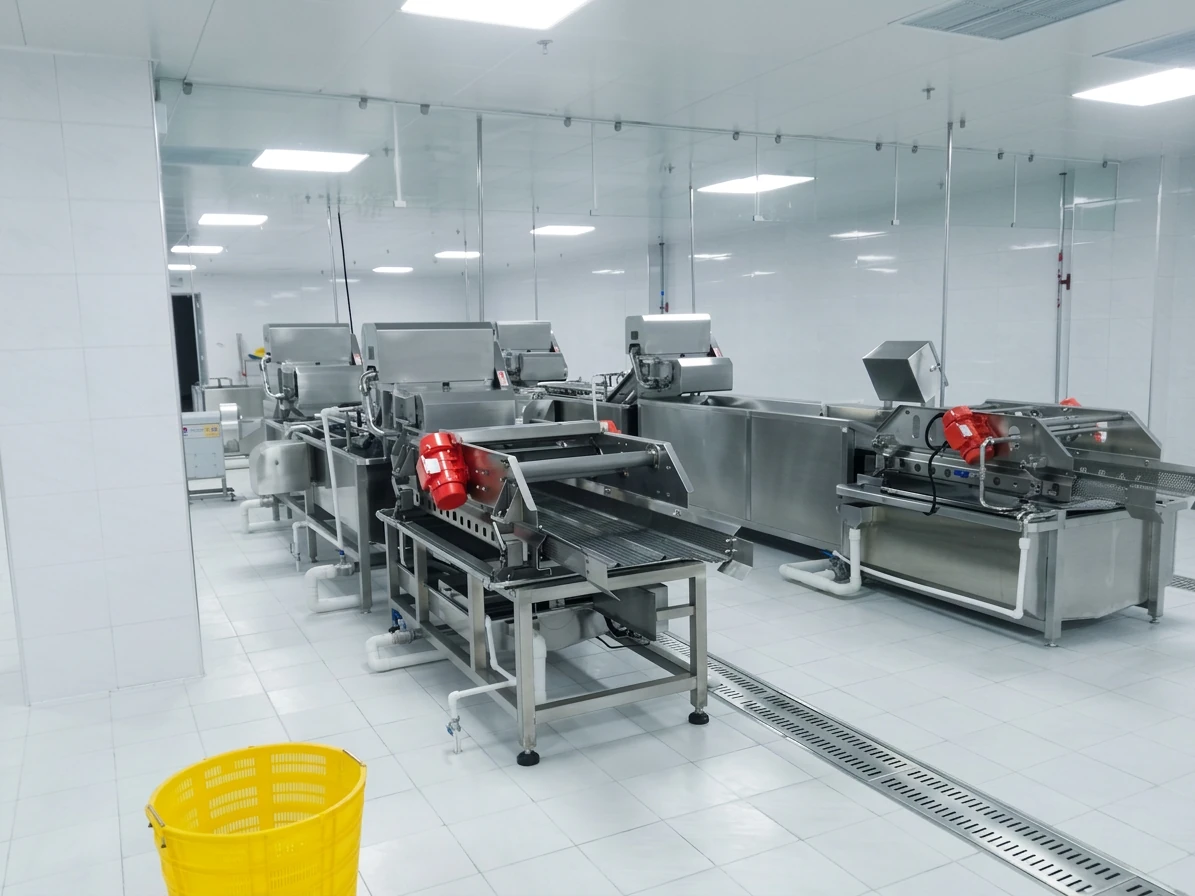
For example:
- Ready-to-cook vegetables will usually be cooked later, but still require controlled washing, cutting, and storage.
- Ready-to-eat fresh-cut vegetables may be consumed without further kill step, so the hygiene requirement is much higher.
- Meat and vegetable processing should usually be physically separated to prevent cross-contamination.
- Raw and cooked product zones should not share uncontrolled flows.
- High-risk products may require stricter sanitation, environmental control, and process monitoring.
The Codex General Principles of Food Hygiene provide a global foundation for food hygiene and HACCP-based control, emphasizing preventive hygiene practices across the food chain. (U.S. Food and Drug Administration)
Equipment can help support these principles when it reduces uncontrolled manual handling, improves process separation, supports cleaning, and makes production flow easier to document.
Food safety compatibility should be evaluated from several angles:
Product Risk
Is the product raw, ready-to-cook, or ready-to-eat? Will it be cooked after processing? How sensitive is it to microbial growth? How long will it be stored before use?
Process Flow
Does the equipment support a logical flow from raw material to clean product? Can dirty and clean areas be separated? Are workers carrying semi-finished products back and forth between zones?
Contact Control
Does the equipment reduce direct hand contact? Are there too many manual transfer points? Are crates, knives, tables, and tools shared between product categories?
Material and Structure
Are food-contact surfaces suitable? Is the structure easy to clean? Are there areas where residue, water, or product particles can remain?
Disinfection or Antimicrobial Process
Does the process require ozone water, peracetic acid, sodium hypochlorite, UV, or other approved antimicrobial steps? If yes, are concentration, contact time, water quality, and validation considered?
Audit and Documentation
Can the process be described clearly to customers, auditors, and internal quality teams? Can sanitation and operating procedures be standardized?
Food safety should not be treated as an afterthought after equipment installation. It should influence equipment selection and factory layout from the beginning.
This is particularly important for central kitchens and fresh-cut processors that want to serve large B2B customers. A buyer may ask not only whether the supplier can produce the product, but also whether the supplier can prove that the process is controlled.
A good equipment supplier should understand this difference. They should not simply recommend one machine for every product. They should help the customer evaluate whether product categories should be separated, whether RTE and RTC products require different workflows, and whether the line design can support future audits.
6. Supplier R&D Capability and Manufacturing Experience: Is the Manufacturer Reliable?
Food processing equipment is not a simple commodity. Two machines may look similar from the outside, but their long-term performance can be very different.
The difference often comes from supplier experience.
A manufacturer with many years of equipment development and field application experience usually understands problems that do not appear in a product photo or short video. They understand how raw materials behave differently, where machines commonly fail, how operators misuse equipment, which structures are difficult to clean, how blades wear, how belts deform, how motors perform under continuous operation, and how different production environments affect stability.
This accumulated experience is difficult to replace.
When evaluating a supplier, buyers should look beyond the quotation and ask:
- How many years has the company been operating?
- Is the supplier a source manufacturer or mainly a trading company?
- Does the company have its own R&D team?
- Does it have a real production facility?
- Does it continuously improve equipment based on customer feedback?
- Can it handle customized requirements?
- Does it understand food processing applications, not only machine sales?
- Can it support both single machines and complete lines?
- Does it have experience with similar products and industries?
- Can it provide spare parts and technical support after delivery?
Supplier evaluation table
|
Supplier Factor |
Why It Matters |
|---|---|
|
Years in business |
Shows accumulated equipment and application experience |
|
R&D capability |
Determines whether the equipment can be improved or customized |
|
Manufacturing base |
Helps control quality, delivery, and spare parts |
|
Application experience |
Reduces the risk of wrong equipment selection |
|
Turnkey line capability |
Supports future scaling beyond single machines |
|
After-sales support |
Reduces downtime risk after installation |
|
Product range |
Helps match different stages of the processing workflow |
|
Engineering communication |
Improves project accuracy before purchase |
This factor is especially important for non-standard food processing projects.
Many food businesses do not need only a catalog machine. They need a practical solution for a specific product, cutting size, capacity target, factory layout, labor structure, and hygiene requirement. A supplier without R&D capability may only say yes or no. A more experienced manufacturer can help adjust structure, configuration, layout, and process flow.
For TEEMYEAH, this is one of the core advantages. TEEMYEAH has long-term experience in food pre-processing equipment, covering vegetable washing, cutting, peeling, dewatering, meat processing, conveyor connection, and complete line configuration. This allows TEEMYEAH to support both standard equipment selection and customized project planning for central kitchens, fresh-cut vegetable facilities, food factories, catering operations, and agricultural processing businesses.
7. Customization Ability: Can the Equipment Match Your Product and Process?
Food processing equipment should match the product, not force the product into a standard machine.
This is a key point because raw materials vary greatly.
A machine used for leafy greens may not be suitable for root vegetables. A washer for potatoes may damage lettuce. A cutter designed for hard vegetables may not be ideal for tomatoes. A dewatering machine suitable for shredded cabbage may not be suitable for delicate herbs. A meat cutting machine should not be treated like a vegetable cutter.
Even within the same category, processing requirements can differ.
For vegetables, customers may need:
- Slices
- Strips
- Shreds
- Cubes
- Dice
- Segments
- Whole washed product
- Peeled whole product
- Mixed ready-to-cook packs
For cutting size, the difference between 2 mm, 5 mm, 10 mm, and 20 mm may affect cooking time, packaging appearance, customer specifications, and final product quality.
For washing, the difference between soil-heavy root vegetables and fragile leafy greens is even greater. Water flow, bubble intensity, spray pressure, conveyor design, residence time, and discharge method must be selected carefully.
Customization may involve:
- Conveyor width
- Belt type
- Machine height
- Feeding method
- Cutting blade configuration
- Washing tank length
- Bubble intensity
- Spray system
- Peeling structure
- Discharge height
- Voltage and electrical configuration
- Line layout
- Operator platform
- Drainage direction
- Material-contact design
- Integration with packaging or downstream equipment
The need for customization does not always mean the entire machine must be redesigned. Often, practical customization means adjusting configuration so the equipment fits the customer’s actual production environment.
Before buying, buyers should provide the supplier with:
- Raw material photos or videos
- Finished product size requirements
- Daily or hourly capacity target
- Current processing method
- Main bottlenecks
- Factory layout
- Available power and water conditions
- Cleaning requirements
- Packaging method
- Future expansion plan
A good supplier should ask detailed questions before recommending equipment. If a supplier recommends a machine immediately without understanding the raw material, finished specification, and capacity requirement, the risk of mismatch is high.
The best equipment decision is not the one that looks most standard. It is the one that fits the product, process, people, and production environment.
8. Maintenance and Spare Parts: What Happens After the Machine Starts Running?
Many buyers focus heavily on what happens before delivery: quotation, payment, production time, packing, and shipment.
But the real test begins after the machine starts running.
Food processing equipment is used in demanding environments. It may operate with water, vegetable residue, starch, fibers, oil, meat particles, cleaning chemicals, humidity, continuous vibration, and frequent product changes. Blades wear. Belts age. Bearings need attention. Motors, sensors, pumps, and rollers must remain stable.
A machine that is difficult to maintain can create serious hidden costs.
Downtime does not only mean repair cost. It can also mean:
- Delayed production
- Idle workers
- Raw material spoilage
- Missed delivery schedules
- Emergency manual processing
- Customer complaints
- Overtime labor
- Lower trust from buyers
- Production planning disruption
This is why maintenance and spare parts should be discussed before purchase, not after a breakdown.
Important questions include:
- What are the main wearing parts?
- How often do blades, belts, seals, or other parts need replacement?
- Are spare parts easy to order?
- Can the customer replace common parts by themselves?
- Does the supplier provide operation and maintenance manuals?
- Is remote technical support available?
- Are videos or training materials provided?
- Is the machine structure easy to inspect?
- Can local technicians understand the maintenance requirements?
- What should be prepared as a spare parts package?
For overseas buyers, spare parts support is especially important. A low-cost machine becomes expensive if a small broken part causes weeks of downtime.
Maintenance should also be considered in equipment design. Machines with unnecessarily complicated structures may look impressive, but if they are difficult to repair or clean, long-term operation may suffer. A practical industrial machine should balance function, durability, sanitation, and maintainability.
When choosing a supplier, buyers should evaluate whether the manufacturer can support the equipment after delivery. The purchase relationship should not end once the machine is shipped.
9. Integration Potential: Can the Equipment Grow Into a Complete Processing Line?
Many food businesses start with one machine because they want to solve one immediate bottleneck.
This is common and reasonable.
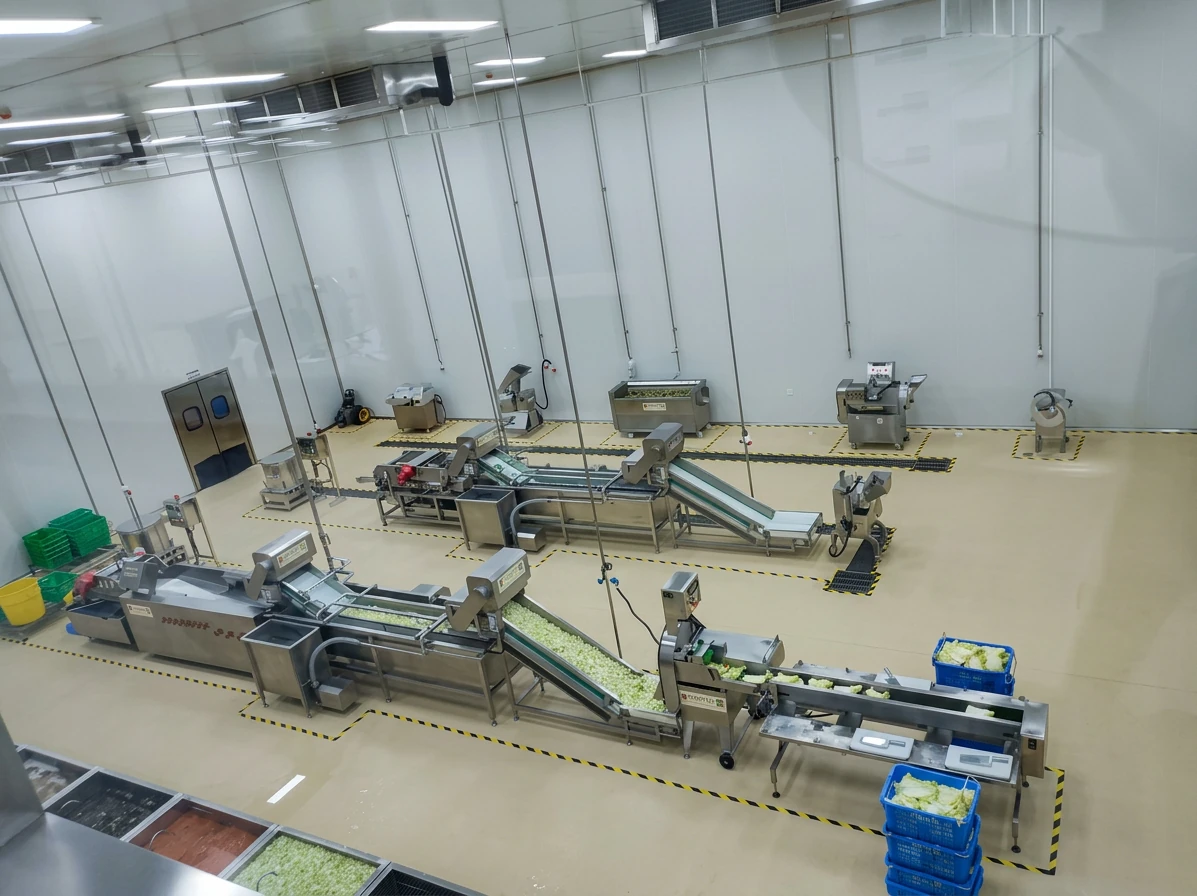
A business may first buy a vegetable cutter because manual cutting is too slow. Another may buy a washing machine because cleaning quality is inconsistent. A central kitchen may buy a dewatering machine because washed vegetables carry too much water into packaging or cooking.
But if the business continues to grow, one machine may later need to become part of a larger workflow.
That is why integration potential matters.
A machine should solve today’s bottleneck without blocking tomorrow’s expansion.
For example:
- Can the machine connect with an upstream conveyor?
- Is the feeding height suitable for future line connection?
- Is the discharge direction flexible?
- Can output move directly into washing, cutting, dewatering, or packing?
- Can the machine capacity match future equipment?
- Is the structure suitable for continuous production?
- Can it be included in a modular pre-processing line?
- Will the current layout allow future expansion?
Without integration planning, businesses may create isolated machines that still require manual transfer between stages. This creates “islands of automation,” where each machine works individually but the overall production flow remains inefficient.
A better approach is to think in stages.
Stage 1: Solve the current bottleneck
This may involve one machine, such as a cutter, washer, peeler, or dewatering machine.
Stage 2: Connect related processes
The business may add conveyors, sorting tables, washing systems, or packaging connections.
Stage 3: Build a complete line
Raw material receiving, sorting, washing, peeling, cutting, dewatering, weighing, packaging, and cold storage can be connected into a more continuous workflow.
Stage 4: Optimize layout and hygiene zones
As the facility grows, equipment layout should support raw and clean zone separation, personnel flow, product flow, waste flow, and sanitation management.
The best equipment suppliers understand this development path. They can help customers avoid short-term purchases that later become obstacles.
For central kitchens, fresh-cut suppliers, and food factories, integration potential is often the difference between buying a machine and building production capability.
10. Total Cost of Ownership: What Will the Equipment Cost or Save Over 3–5 Years?
Total cost of ownership, or TCO, is the most complete way to evaluate food processing equipment.
Purchase price answers only one question:
“How much do I pay now?”
TCO answers a much better question:
“What is the total financial impact of this equipment during its service life?”
A low-price machine may have a higher total cost if it creates excessive waste, downtime, cleaning labor, maintenance difficulty, poor output quality, or short service life. A higher-quality machine may be more expensive at the beginning but cheaper over time if it improves yield, reduces labor, increases capacity, and operates more reliably.
TCO includes:
- Purchase price
- Installation cost
- Training cost
- Labor cost
- Water and energy consumption
- Cleaning time
- Raw material waste
- Product rejection
- Downtime
- Maintenance
- Spare parts
- Service life
- Output improvement
- Food safety risk reduction
- Customer retention
- Future expansion value
A practical formula is:
True Equipment Value = Yield Improvement + Labor Savings + Higher Capacity + Lower Downtime + Better Food Safety + Longer Service Life – Purchase and Operating Cost
This is the logic buyers should use when comparing suppliers.
The cheapest quotation is not always the best decision. The best decision is the equipment that creates the strongest long-term operating value under real production conditions.
Low-price equipment vs high-value equipment
|
Evaluation Point |
Low-Price Equipment Risk |
High-Value Equipment Advantage |
|---|---|---|
|
Yield |
More damage, trimming, and waste |
Better preservation of sellable product |
|
Capacity |
High claimed capacity, unstable real output |
More realistic and stable production planning |
|
Operation |
Harder to use, more operator error |
Easier training and daily operation |
|
Cleaning |
More dead corners, longer sanitation time |
Easier cleaning and better hygiene support |
|
Food safety |
Weak process compatibility |
Better support for controlled workflow |
|
Maintenance |
Difficult spare parts and higher downtime |
More reliable long-term support |
|
Supplier capability |
Limited technical support |
Stronger R&D and application experience |
|
Expansion |
Hard to connect with future line |
Better modular integration potential |
|
ROI |
Looks cheap at purchase stage |
Creates more long-term value |
TCO thinking is especially important for businesses planning to serve large clients. A machine failure or quality issue may affect not only internal cost, but also contract stability and customer trust.
Food processing equipment should be judged as a long-term operating decision, not a one-time procurement expense.
A Practical Pre-Purchase Checklist for Food Processing Equipment Buyers
Before making a final purchasing decision, food businesses can use the following checklist.
Product and Process
- What raw materials will be processed?
- Are the products leafy, root, soft, hard, meat, seafood, or mixed ingredients?
- What finished form is required?
- What cutting size or shape is needed?
- Is the product RTC, RTE, or for further processing?
- Does the product require washing, peeling, cutting, dewatering, or packaging?
Capacity
- What is the required hourly output?
- What is the required daily output?
- How many working hours are available?
- How many product changes happen per day?
- What is the expected cleaning time?
- Which stage is currently the bottleneck?
Facility Conditions
- What is the available floor space?
- Where are raw material receiving, processing, packaging, and cold storage areas?
- Is drainage sufficient?
- What power and water conditions are available?
- Is future expansion planned?
Labor and Operation
- How many workers are currently involved?
- What skill level do operators have?
- Is labor turnover high?
- How much training is acceptable?
- Does the machine reduce or increase supervisor workload?
Food Safety and Cleaning
- Is the equipment easy to clean?
- Are product-contact areas accessible?
- Does the line support hygiene zoning?
- Are RTE and RTC products separated where needed?
- Can sanitation procedures be documented?
Supplier
- Is the supplier a manufacturer?
- Does the supplier have R&D capability?
- How many years of experience does the supplier have?
- Can the supplier provide similar application cases?
- Can the supplier support customization?
- Can spare parts be supplied reliably?
- Is after-sales support available?
This checklist helps buyers move from price comparison to system evaluation.
How TEEMYEAH Helps Buyers Choose the Right Food Processing Equipment
TEEMYEAH supports food businesses by evaluating equipment selection from the perspective of real production.
Instead of recommending a machine only by catalog category, TEEMYEAH considers the customer’s raw materials, finished product requirements, capacity target, factory layout, labor structure, hygiene requirements, and future expansion plan.
TEEMYEAH equipment and solutions cover key stages of food pre-processing, including:
- Vegetable washing
- Leafy vegetable washing
- Root vegetable washing
- Peeling
- Cutting
- Slicing
- Dicing
- Shredding
- Meat cutting
- Dewatering
- Conveying
- Sorting
- Line connection
- Customized pre-processing solutions
For customers who only need one machine, TEEMYEAH can help select a suitable model based on product and capacity. For customers planning a larger facility, TEEMYEAH can help design a more complete workflow, including washing, cutting, dewatering, packaging connection, and production layout recommendations.
The goal is not to push the most complicated solution. The goal is to help customers choose equipment that improves yield, reaches real production capacity, is easy to operate, supports sanitation, reduces labor dependency, and creates long-term value.
Conclusion: The Right Equipment Should Reduce Risk, Not Create New Problems
Food processing equipment should not be purchased only because it looks affordable, has a high capacity number, or appears similar to another supplier’s machine.
A good equipment decision should be based on deeper questions.
Will this machine preserve product yield?
Can it reach stable output in the real workflow?
Can ordinary workers operate it correctly?
Is it easy to clean?
Does it support food safety requirements?
Is the supplier experienced enough to understand the application?
Can the equipment be customized for the product?
Will spare parts and technical support be available?
Can the machine become part of a larger line later?
Will it reduce total operating cost over the next three to five years?
These questions are more important than the first number on a quotation.
The right food processing equipment should help the business become more stable, more efficient, easier to manage, and better prepared for larger customers. It should reduce long-term risk, not create new problems after installation.
For growing food businesses, equipment is not just a production tool. It is part of the company’s ability to scale.
Call to Action
Not sure which food processing equipment is suitable for your product, capacity target, and factory layout?
TEEMYEAH can help you evaluate your raw materials, finished product specifications, production volume, labor structure, hygiene requirements, and future expansion plan before recommending equipment.
Whether you need a single machine or a complete food pre-processing line, our team can help you choose a solution that improves yield, capacity, food safety, operation efficiency, and long-term return on investment.
Contact TEEMYEAH to discuss your food processing equipment project.
Frequently Asked Questions
What should I consider before buying food processing equipment?
Before buying food processing equipment, you should evaluate product yield, real production capacity, operation convenience, cleaning design, food safety compatibility, supplier experience, customization ability, maintenance support, spare parts availability, integration potential, and total cost of ownership.
Is equipment price the most important factor?
No. Purchase price is only one part of the decision. A cheaper machine may create higher long-term costs through product waste, unstable capacity, difficult cleaning, frequent downtime, poor spare parts support, and shorter service life. Buyers should evaluate total operating value, not only quotation price.
Why is product yield important when choosing food processing equipment?
Product yield directly affects profitability. If a machine damages raw materials, removes too much edible material, creates irregular cuts, or increases rejection, the business loses sellable product every day. Better equipment helps preserve more usable product and reduce hidden raw material waste.
How do I calculate the real capacity of a food processing machine?
Real capacity should be calculated based on stable hourly output, effective production hours, product type, feeding speed, cleaning time, changeover time, and downstream process capacity. A useful formula is: Real Daily Output = Stable Hourly Capacity × Effective Production Hours – Changeover, Cleaning, Waiting, and Transfer Loss.
Why is cleaning design important for food processing equipment?
Cleaning design affects food safety, labor cost, downtime, and audit readiness. Equipment with hidden corners, poor drainage, difficult belt access, or hard-to-clean blades can increase sanitation risk and extend cleaning time. Easy-to-clean equipment supports better hygiene control and more efficient production.
How does equipment design affect food safety?
Equipment design affects hand contact, residue accumulation, product flow, cross-contamination risk, sanitation access, and process documentation. A hygienic design can support HACCP-based food safety management, reduce uncontrolled contact points, and make production easier to standardize.
Should I buy a single machine or a complete processing line?
It depends on your current bottleneck and growth plan. If one stage is limiting production, a single machine may be enough. If your business needs higher volume, lower labor dependency, and better flow control, a complete or modular processing line may be more suitable.
Why does supplier experience matter?
Supplier experience matters because food processing equipment performance depends on real application knowledge. Experienced manufacturers understand raw material differences, cleaning problems, blade selection, line balance, operator behavior, maintenance issues, and customization needs. This reduces the risk of wrong equipment selection.
Can food processing equipment be customized?
Yes. Food processing equipment can often be customized according to raw material type, finished product size, capacity target, factory layout, voltage, conveyor height, feeding method, discharge direction, washing structure, cutting configuration, and integration requirements.
What maintenance issues should I consider before buying?
You should consider wearing parts, blade replacement, belt maintenance, spare parts availability, remote technical support, operator training, machine structure, cleaning access, and whether local staff can perform routine maintenance. Maintenance planning helps reduce downtime after installation.
How do I calculate ROI for food processing equipment?
ROI should include labor savings, yield improvement, higher output, reduced rejection, lower downtime, reduced spoilage, improved food safety, and potential new business opportunities. It should also subtract purchase price, installation cost, energy and water use, maintenance, spare parts, and cleaning cost.
What is total cost of ownership in food processing equipment?
Total cost of ownership means the full cost and value of the equipment during its service life. It includes purchase price, labor, yield, energy, cleaning, downtime, maintenance, spare parts, service life, food safety impact, and future expansion value.
How can TEEMYEAH help me choose the right equipment?
TEEMYEAH can evaluate your raw materials, finished product requirements, hourly and daily capacity target, factory layout, labor structure, hygiene standard, and future expansion plan. Based on these factors, TEEMYEAH can recommend suitable single machines or complete food pre-processing line solutions.
Sources
- World Bank, The Safe Food Imperative: Accelerating Progress in Low- and Middle-Income Countries.
- FDA, FSMA Final Rule for Preventive Controls for Human Food.
- eCFR, 21 CFR Part 117 — Current Good Manufacturing Practice, Hazard Analysis, and Risk-Based Preventive Controls for Human Food.
- FAO, The State of Food and Agriculture 2019.
- FAO Statistics, Food Loss and Waste Data Update.
- Codex Alimentarius / FAO, General Principles of Food Hygiene CXC 1-1969.

