







Introduction: Growth in Foodservice Is Becoming a System Question
While exploring the food service and catering markets in Indonesia and Vietnam, TEEMYEAH have noticed an interesting difference compared with the catering supply model that is more familiar in China.
In China, many large-scale catering companies, institutional meal suppliers, and food service operators have already moved toward a more centralized processing model. Vegetables, meat, fruits, and other ingredients are often processed in a central kitchen or centralized food preparation facility, then distributed to different service points through chilled or frozen logistics. The final kitchens mainly focus on cooking, reheating, plating, and service.
However, in many catering companies TEEMYEAH have met in Indonesia and Vietnam, the operating model is still more decentralized. Each factory, school, hospital, business site, camp, or project location often has its own on-site kitchen. Raw materials are delivered directly to each location, and washing, cutting, pre-processing, cooking, and serving are handled locally by each kitchen team.
At first glance, this may look like a simple difference between “central kitchen” and “on-site kitchen.” But after looking more closely at the business models in these two markets, the situation is more complex.
Vietnam and Indonesia both rely heavily on on-site kitchens in many catering operations, but the reasons behind this model are not exactly the same. In Vietnam, on-site kitchens are often connected with factories, industrial parks, schools, hospitals, and office meal services. In Indonesia, the market includes those segments too, but it also has a stronger remote-site catering layer: mining camps, oil and gas projects, offshore operations, construction sites, and worker accommodation facilities.
This difference matters.
For city-based factories, schools, hospitals, and corporate campuses, centralized food preparation may gradually reduce repetitive labor, improve processing efficiency, strengthen food safety control, and standardize meal quality. For remote mining sites, offshore facilities, or island-based projects, the future may not be a full replacement of the on-site kitchen. A more practical direction may be a hybrid food preparation system: centralized procurement, regional preparation hubs, standardized pre-processing, cold-chain or frozen distribution where possible, and well-equipped on-site kitchens for final cooking and service.
The real question is not whether centralized processing is better in theory.
The real question is: when a catering business reaches a certain scale, how can it build a food preparation system that supports growth, reduces labor pressure, improves quality consistency, and keeps food safety under control across every service point?
The Market Background: Southeast Asia Foodservice Is Growing, but Supply Systems Must Catch Up
The Southeast Asia foodservice market is expanding quickly. According to Mordor Intelligence, the market is estimated at USD 252.85 billion in 2026 and is forecast to reach USD 465.45 billion by 2031, with a CAGR of 12.98% during the 2026–2031 period. Indonesia alone is estimated at USD 70.41 billion in 2026 and is projected to reach USD 128.76 billion by 2031, growing at a CAGR of 12.84% during the same period. [1][2]
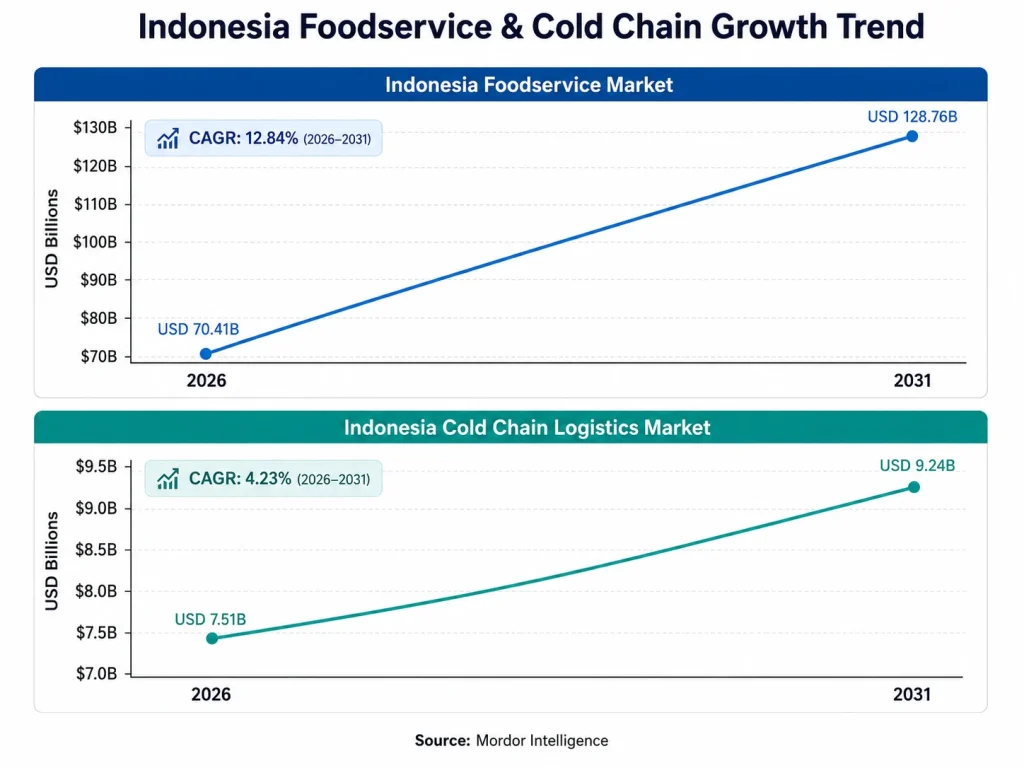
These numbers are not only about more restaurants, cafés, delivery platforms, or consumer spending. For catering and institutional food service companies, market growth means a larger number of factories, schools, hospitals, corporate offices, industrial parks, construction sites, and remote operations will require stable meal supply. As the number of service points increases, food preparation becomes less of a kitchen-level task and more of a supply chain-level challenge.
Cold-chain infrastructure is also becoming more important. Mordor Intelligence estimates that the ASEAN cold chain logistics market will grow from USD 19.98 billion in 2026 to USD 24.43 billion by 2031. Indonesia’s cold chain logistics market is estimated at USD 7.51 billion in 2026 and projected to reach USD 9.24 billion by 2031. Vietnam’s cold storage logistics industry is also developing, with Vietnam Briefing citing a forecast of USD 295 million by 2025, while also noting that cold storage remains uneven and underused by domestic food manufacturers. [3][4]
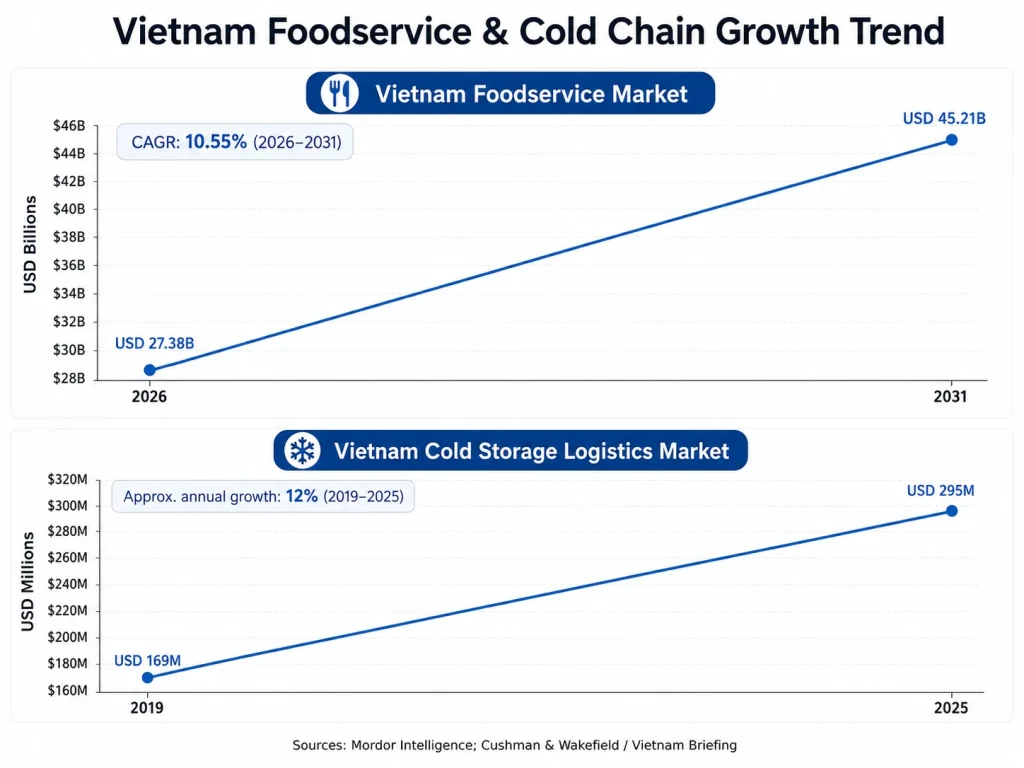
This is important for centralized food preparation.
A centralized food preparation facility does not operate alone. It depends on receiving control, processing standards, chilled storage, distribution timing, and the ability to deliver prepared ingredients safely to final kitchens. Without cold-chain planning, centralized processing can easily become a production bottleneck or a food safety risk. With better cold-chain logistics, however, central kitchens, regional preparation hubs, and semi-prepared ingredient distribution become much more practical.
In other words, Southeast Asia’s foodservice growth is creating demand, but cold-chain and preparation infrastructure will determine how efficiently that demand can be served.
A Market Observation: China, Vietnam, and Indonesia Are Not Following the Same Path
China: Centralized Food Preparation as a Back-End Production Engine
In China, many large-scale catering companies and food service suppliers have already moved toward centralized preparation. This model is especially common among companies that serve multiple sites, restaurant chains, group meal operators, and food supply chain companies.
A centralized food preparation facility may handle raw material receiving, vegetable washing, cutting, trimming, meat pre-processing, marinating, portioning, packaging, chilled storage, and cold-chain dispatch. The final kitchens receive semi-prepared or ready-to-cook ingredients and focus on cooking, heating, plating, and service.
This model does not mean that all cooking disappears from the final kitchen. It means that repetitive, labor-intensive, and hard-to-standardize preparation work is concentrated in a controlled production environment.
The central kitchen becomes the back-end production engine. Each service point becomes a lighter and more standardized front-end execution point.
For a large catering group, this model can improve procurement control, reduce repeated labor, standardize product specifications, and make food safety management more traceable.
Vietnam: On-Site Kitchens Around Factories, Schools, Hospitals, and Industrial Parks
In Vietnam, the on-site kitchen model is still common among industrial catering companies and institutional meal providers.
Many catering companies serve factories, industrial parks, schools, hospitals, and offices. Meals are prepared close to the diners, often inside or near the client’s facility. Raw materials are delivered to the site, and the local kitchen team completes washing, cutting, cooking, and serving.
This model has clear advantages. It is close to the end users, flexible for local taste preferences, and practical for customers that already have kitchen space. It can also respond quickly to shift-based factory meal schedules, school menus, hospital meal requirements, and customer feedback.
Vietnamese industrial catering companies often emphasize food safety, clear ingredient origin, menu rotation, local taste adaptation, and service flexibility. For example, public information from HASECA describes its industrial catering, school meals, and office meal supply services, including ISO 22000:2018, one-way kitchen models, 5S management, and strict ingredient control. Bizen Catering Services in Bien Hoa describes both on-site factory kitchens and central kitchen delivery as service formats for industrial meals. [7]
This suggests that Vietnam may not move from on-site kitchens to centralized processing in one step. Instead, the market may gradually combine both models. Some factories may continue using on-site kitchens, while larger catering groups may centralize vegetable washing, meat pre-processing, portioning, and delivery for multiple service points within a region.
Indonesia: A More Complex Market With Remote-Site Catering
Indonesia has a different layer of complexity.
Like Vietnam, Indonesia has food service demand from offices, schools, hospitals, factories, universities, and industrial clients. But compared with Vietnam, Indonesia also has a stronger remote-site catering segment connected with mining, oil and gas, offshore operations, construction camps, island projects, and remote worker accommodation.
This makes the Indonesian catering market structurally different.
In remote-site catering, the kitchen is not only a place to cook food. It is part of the living-support infrastructure of the site. Workers may live in a camp for long periods. Meal service must support shift schedules, physically demanding labor, remote logistics, limited local supply, and strict safety requirements.
Public information from Sodexo Indonesia shows this dual structure clearly. Sodexo Indonesia operates food services for companies, hospitals, schools, universities, offshore facilities, and other organizations. It also provides Energy & Resources services, including living and dining solutions for remote operations. At the same time, Sodexo Indonesia’s SoKitchen describes its central kitchen as a practical solution for clients lacking on-site kitchen facilities and for corporate event catering. [5]
This means that even a large global operator may not use one single model across Indonesia. For city-based customers without kitchen facilities, a central kitchen solution can work. For offshore, mining, or remote operations, on-site kitchens and integrated site services may still be necessary.
Other Indonesian catering companies show similar patterns. PT Indocater lists oil, gas, and mining company catering, on-shore, off-shore, remote sites, hospital catering, school catering, manufacturing industry catering, and camp-related services such as commissary, kitchen and laundry equipment maintenance, logistics support, and camp management. Aerofood ACS also describes services for oil, mining, gas, town catering, healthcare, and wellness industries. [6]
This is why Indonesia should not be analyzed only through the same lens as Vietnam.
For Indonesia, centralized food preparation is not only a kitchen planning question. It is also a geography, logistics, camp operation, procurement, and remote service question.
Why On-Site Kitchens Still Work in Indonesia and Vietnam
They Are Close to the Final Service Point
The biggest advantage of an on-site kitchen is proximity.
Food is prepared near the people who will eat it. For factory workers, school students, hospital patients, offshore crews, or mining camp workers, this can be important. The kitchen team can adjust menus according to local habits, shift schedules, religious requirements, customer feedback, or emergency changes.
In Vietnam, this flexibility is useful for factories and industrial parks where different customer groups may have different meal budgets, tastes, and shift patterns.
In Indonesia, it becomes even more important for remote projects. A mining camp or offshore operation cannot always depend on daily cold-chain delivery from an urban central kitchen. The site may require its own kitchen team, local storage, equipment maintenance, and emergency food supply planning.
They Require Lower Initial System Investment
An on-site kitchen model is often easier to start.
A catering company can open a kitchen inside a factory, school, hospital, or project site without first building a large central facility. The company can add service points one by one, using local labor and basic kitchen equipment. This is practical during the early growth stage.
A central kitchen or centralized food preparation facility requires more upfront planning. Companies need to consider processing capacity, layout, hygiene zoning, cold storage, distribution routes, packaging format, staff workflow, and food safety standards. This makes centralization more strategic, but also more complex.
For many companies, the question is not whether they understand the benefits of centralization. The question is whether their current service network, capital plan, and logistics conditions are ready for it.
They Support Local Menu Adaptation
Food service is never only an operational activity. It is also connected to culture, taste, budget, and habit.
In Indonesia, catering companies must often consider halal requirements, local flavor preferences, rice-based meals, spicy sauces, fried items, protein variety, and meal satisfaction for physically demanding workers. Mordor Intelligence also notes that halal compliance is mandatory by October 2026 in Indonesia and is important for consumer trust. [2]
In Vietnam, industrial meals are often expected to be familiar, balanced, affordable, and suitable for workers who may eat similar meals every day. Menu rotation and local taste adaptation are important. This is why many Vietnamese catering companies emphasize diverse menus and daily variation.
On-site kitchens can respond to these local needs quickly. A central facility must be planned carefully so standardization does not become rigidity.
The Hidden Challenges of a Decentralized Food Preparation Model
Repetitive Labor Is Multiplied Across Every Site
When every kitchen washes vegetables, cuts ingredients, trims meat, prepares sauces, manages raw storage, and cleans preparation tools independently, the same labor is repeated again and again.
One site may need only a few workers for preparation. But when the company operates 20, 50, or 100 service points, the labor structure becomes heavy. Each new contract creates another local preparation team, another kitchen supervisor, another set of hygiene risks, and another group of workers that must be trained.
This is especially challenging in food service markets where labor availability, training consistency, and turnover can become major issues.
For catering companies, labor is not only a cost. It is also a control point. If every kitchen depends heavily on manual work, the company’s quality depends heavily on the skill, discipline, and stability of every local kitchen team.
Food Preparation Standards Become Harder to Unify
A decentralized model makes standardization difficult.
The same vegetable may be washed differently in different kitchens. Cutting size may depend on the worker’s habit. Meat trimming may vary from site to site. Portioning may be controlled carefully in one kitchen but loosely in another. Cleaning and sanitation may follow the same SOP on paper, but execution may differ in daily practice.
This affects:
- Taste consistency
- Cooking time
- Portion control
- Meal appearance
- Ingredient yield
- Customer satisfaction
- Food safety risk
- Audit performance
For a small company, local variation may be manageable. For a large catering company serving multinational factories, schools, hospitals, or energy clients, inconsistency becomes a business risk.
Customers do not only buy meals. They buy reliability.
Ingredient Loss and Yield Control Become Difficult to Measure
Food loss is often hidden in preparation.
Loss may happen during receiving, sorting, peeling, washing, trimming, cutting, over-preparation, storage, and leftover handling. When preparation is spread across many kitchens, it becomes difficult to calculate true yield by ingredient type.
For example, how much usable product is obtained from 100 kg of leafy vegetables after sorting and washing? How much meat is lost during trimming? How much vegetable waste is caused by inconsistent cutting? How much prepared food is discarded because one site overestimated demand?
Without centralized data, these questions are difficult to answer.
A centralized food preparation facility can measure input, output, waste, yield, processing time, and labor productivity more clearly. This does not automatically solve waste, but it gives management a better foundation for improvement.
Food Safety Depends Too Much on Each Local Team
Food safety is one of the most important challenges for decentralized kitchens.
Every site must manage raw and cooked separation, vegetable washing hygiene, meat handling, tool and container separation, employee hygiene, cold storage temperature, cleaning chemicals, water quality, pest control, waste flow, and cross-contamination prevention.
If one kitchen team performs poorly, the risk may damage the reputation of the whole company.
This matters even more for customers such as schools, hospitals, factories, offshore facilities, and international companies. These clients may care about documentation, traceability, food safety certification, audit readiness, and incident prevention.
In hot and humid environments, fresh vegetables, meat, seafood, and cooked meals require stricter time and temperature control. Indonesia’s island geography and remote-site service structure can further increase the challenge because some locations may face longer delivery routes, less stable supply conditions, or more difficult equipment maintenance.
Procurement and Storage Are Fragmented
A decentralized kitchen system often creates fragmented procurement and inventory control.
If each site receives raw materials directly, the company may face:
- Different supplier quality
- Inconsistent ingredient specifications
- More emergency purchasing
- Lower purchasing power
- Unclear inventory visibility
- Higher storage loss
- More difficult traceability
- Uneven receiving inspection standards
Centralized procurement and centralized preparation can help define ingredient specifications more clearly. For example, leafy vegetables, root vegetables, poultry, beef, seafood, rice, sauces, and packaging materials can be purchased according to standardized requirements.
This gives the company better control over quality, cost, and supplier performance.
Growth Becomes Heavy
This is the central issue.
On-site kitchens can work very well. They are not “wrong.” In many situations, they are necessary.
The problem appears when the same model is repeated across many sites without a stronger central system behind it. The company may grow revenue, but labor, waste, food safety risk, procurement complexity, and management workload also grow.
At a small scale, flexibility is an advantage. At a larger scale, uncontrolled flexibility becomes complexity.
What a Centralized Food Preparation Facility Can Change
It Concentrates Repetitive Preparation Work
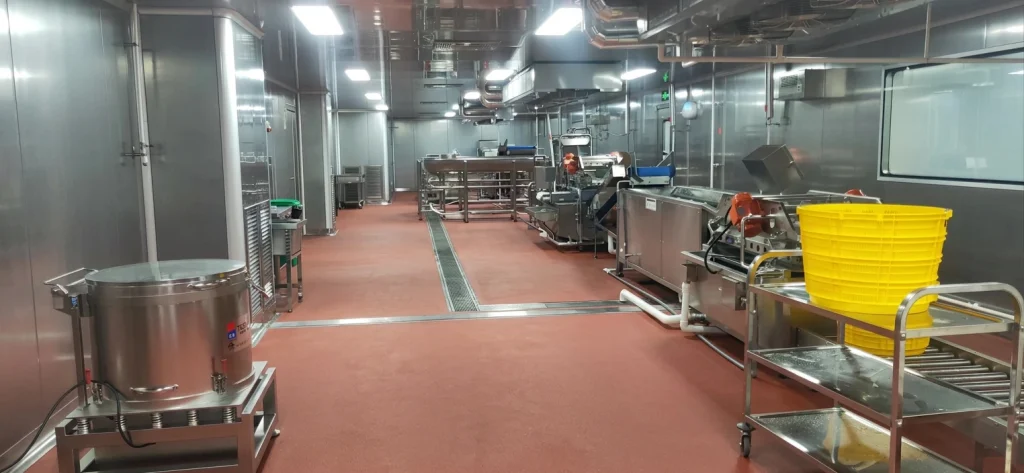
A centralized food preparation facility moves repetitive preparation tasks from many kitchens into one controlled environment.
The facility may handle:
- Raw material receiving and inspection
- Vegetable sorting and washing
- Leafy vegetable cleaning and dewatering
- Root vegetable washing and peeling
- Cutting and trimming
- Meat pre-processing
- Portioning and weighing
- Marinating and seasoning
- Packaging and labeling
- Chilled or frozen storage
- Dispatch preparation
This does not mean all final cooking must be centralized. The final kitchen can still cook, adjust, and serve. But the heavy preparation work can be reduced at each service point.
For a catering company operating many sites, this can reduce repeated labor and improve consistency.
It Makes Labor Easier to Organize by Process
Instead of assigning full preparation teams to every kitchen, a centralized facility can organize labor by process.
There can be a receiving team, sorting team, washing team, cutting team, meat preparation team, packing team, sanitation team, quality control team, and dispatch team.
This creates a clearer management structure. Training becomes easier. Productivity can be measured. Supervisors can focus on process improvement instead of constantly correcting local kitchen variation.
Automation can also be introduced step by step.
A vegetable washing and cutting line, meat cutting solution, dewatering system, peeling machine, conveyor system, or semi-automatic packing area should not be selected only because the machine looks efficient. It should be selected according to product type, hourly capacity, hygiene requirement, labor reduction target, and facility layout.
It Improves Standardization
Centralized preparation allows the company to define and control output standards.
For vegetables, standards may include washing time, cutting size, dewatering level, packaging format, and storage temperature.
For meat, standards may include thawing condition, cutting size, trimming ratio, portion weight, marinating time, and packaging method.
For prepared ingredients, standards may include shelf life, labeling, distribution temperature, batch traceability, and receiving requirements at the final kitchen.
The more standardized the prepared ingredients are, the easier it becomes for the final kitchen to produce stable meals.
It Strengthens Food Safety Design
A central facility can be planned with hygiene zoning and one-way process flow.
Typical zones may include:
- Raw material receiving area
- Pre-sorting and inspection area
- Vegetable washing area
- Meat preparation area
- Ready-to-cook preparation area
- Ready-to-eat or high-care area, if required
- Packaging area
- Cold storage area
- Finished product dispatch area
- Waste handling route
- Staff changing and handwashing area
The key is to reduce unnecessary crossing between raw and cleaned materials, staff and logistics routes, waste and food products, wet and dry zones, and raw and cooked processes.
This is why central kitchen planning should start with process design, not equipment selection.
It Gives Management Better Visibility
Centralized preparation creates better data.
Management can measure:
- Input quantity
- Finished output
- Yield loss
- Labor productivity
- Processing speed
- Batch records
- Supplier performance
- Waste ratio
- Cold storage inventory
- Dispatch accuracy
For a growing catering company, this visibility is valuable. It supports procurement planning, costing, menu engineering, quality control, and future capacity expansion.
Indonesia and Vietnam Need Different Centralization Paths
Centralized food preparation will become increasingly important in Southeast Asia, but it will not develop in one single form. Different catering customers have different service locations, meal requirements, logistics conditions, and kitchen responsibilities. For this reason, the future direction should not be understood simply as “replacing on-site kitchens with central kitchens.”
A more practical view is that centralized preparation can appear in several different models.
Urban Catering Customers: From Central Kitchens to Centralized Food Preparation Facilities
For urban customers, such as corporate offices, schools, hospitals, universities, restaurant groups, and city-based catering clients, a central kitchen model is often easier to develop.
These customers are usually located within a manageable delivery radius. Demand is more predictable, cold-chain distribution is easier to organize, and final kitchens may not need to handle heavy raw material preparation every day. A central kitchen can prepare meal components, semi-finished products, sauces, vegetables, meat, and ready-to-cook ingredients before distributing them to each service point.
As market demand grows, some catering companies may move beyond a traditional central kitchen and gradually upgrade into a more specialized centralized food preparation facility.
This type of facility is not only designed for cooking. It focuses more on upstream preparation work, such as vegetable washing and cutting, meat pre-processing, portioning, packing, chilled storage, and cold-chain dispatch. In this model, centralized food preparation becomes a strategic infrastructure for supporting multiple service points, rather than only a larger kitchen.
For urban food service companies, this transition can help reduce repetitive labor, improve preparation consistency, strengthen food safety control, and make procurement and distribution more organized.
Industrial Parks and Factory Catering: Regional Processing or Clean Vegetable Distribution
For industrial park clients and factory catering companies, the path may be different.
In many cases, the final cooking and meal service still need to happen inside or near the factory. Workers may eat according to fixed shift schedules, menus may need to match local habits, and hot meals are expected to be served fresh. Therefore, the on-site kitchen still has value.
However, this does not mean every factory kitchen needs to wash, trim, cut, and prepare all raw materials independently.
A more realistic solution is regional centralized processing.
A catering company can build a regional food preparation hub or cooperate with a clean vegetable central facility. Vegetables are received, sorted, washed, trimmed, cut, dewatered, packed, and delivered through cold-chain logistics to each on-site kitchen. Meat and other ingredients can also be pre-cut, portioned, or marinated according to production needs.
In this model, the on-site kitchen still completes final cooking, seasoning adjustment, plating, and service. This helps preserve local taste, meal freshness, and kitchen flexibility. At the same time, the most repetitive and labor-intensive preparation work is moved into a more controlled processing environment.
For industrial catering companies, this model can be very practical.
It does not force every factory kitchen to disappear. Instead, it simplifies the kitchen’s daily workload. The site kitchen receives standardized ready-to-cook ingredients, which reduces washing and cutting labor, improves yield control, and makes food safety management easier.
The result is not a loss of flexibility. It is a better division of work.
Centralized facilities handle what should be standardized. On-site kitchens handle what should stay close to the diners.
Remote Mining, Oil and Gas, Offshore, and Construction Sites: A Hybrid Model
For remote-site catering in Indonesia, the situation is more complex.
Mining camps, oil and gas projects, offshore platforms, remote construction sites, and island-based operations often cannot depend entirely on an urban central kitchen. The distance may be too long, cold-chain delivery may be expensive or unstable, and workers may live on site for long periods. In these situations, the kitchen is not only a food preparation space. It is part of the site’s living-support system.
This is why on-site kitchens will not disappear in remote-site catering.
However, they can become more standardized, more equipment-based, and easier to manage.
A hybrid model may be more realistic. Centralized or regional facilities can support procurement, ingredient specifications, partial pre-processing, frozen or chilled semi-prepared products, dry goods supply, packaging standards, and logistics planning. Meanwhile, the remote-site kitchen continues to handle final cooking, hot meal service, shift-based meal adjustment, and daily kitchen operation.
In this model, the on-site kitchen becomes simpler because some preparation work has already been completed before ingredients arrive.
For example, vegetables can be washed, trimmed, cut, and packed before delivery where logistics conditions allow. Meat can be portioned or marinated in advance. Common ingredients can be supplied according to unified specifications. Equipment configuration, hygiene SOPs, storage rules, tool separation, cleaning procedures, and staff workflow can also be standardized across different sites.
This does not remove the need for local kitchens. Instead, it makes local kitchens easier to control.
For remote-site catering operators, the goal is not to centralize everything. The goal is to centralize the parts that can be standardized and simplify the parts that must remain on site.
The Future Is Not One Model, but a More Organized Food Preparation System
For Southeast Asian catering companies, centralized food preparation should not be treated as a single fixed model.
Urban customers may be served by central kitchens or centralized food preparation facilities.
Industrial park and factory catering customers may be served by regional preparation hubs or clean vegetable central facilities with cold-chain delivery to on-site kitchens.
Remote mining, oil and gas, offshore, and construction sites may continue to rely on on-site kitchens, but those kitchens can be supported by standardized procurement, semi-prepared ingredients, better equipment, stronger SOPs, and more controlled process management.
This is the more practical direction for the market.
The on-site kitchen will not disappear. But its role may change.
Instead of handling every raw material preparation step independently, the on-site kitchen can focus more on final cooking, taste adjustment, meal timing, plating, and service. Repetitive preparation work can be gradually moved to a central facility, regional hub, or clean vegetable processing facility.
For catering companies, this creates a more scalable food preparation system.
It reduces repetitive labor without removing local service flexibility.
It improves standardization without making every meal feel industrial.
It strengthens food safety control while still allowing final kitchens to serve fresh hot meals.
It gives management better visibility over procurement, yield, preparation quality, and site-level execution.
This is why the future discussion should not be “central kitchen or on-site kitchen.”
The better question is:
Which preparation work should be centralized?
Which work should remain close to the final service point?
Which ingredients can be delivered as ready-to-cook prepared products?
Which sites require full on-site cooking?
Which regions can be supported by a central preparation facility or regional processing hub?
How can the whole system reduce labor pressure while keeping food quality consistent?
For Indonesia, Vietnam, and other growing Southeast Asian food service markets, centralized food preparation is not just about building a bigger kitchen. It is about building a more organized operating system for catering growth.
What Can Be Centralized First?
Vegetable Washing and Cutting
Vegetable preparation is often one of the first processes to centralize.
Leafy vegetables, root vegetables, cucumbers, carrots, cabbage, lettuce, herbs, onions, potatoes, and other daily-use ingredients are used in large quantities by catering companies. Washing, sorting, cutting, dewatering, and packing these ingredients at every site creates repeated labor.
A centralized vegetable washing and cutting line can help reduce labor pressure and improve product consistency. For example, leafy vegetables may require gentle washing and dewatering to avoid damage, while root vegetables may need stronger washing, peeling, and cutting processes.
The correct solution depends on ingredient type, contamination level, cutting requirement, output format, and hourly capacity.
Meat Pre-Processing
Meat preparation is another process that can benefit from centralization.
For catering companies with stable menus, meat can be cut, portioned, marinated, and packed in a controlled area before being delivered to final kitchens.
This can reduce knife work at each site, improve portion control, and lower cross-contamination risks between raw meat and other ingredients. It can also make costing more accurate because meat yield and portion weight are easier to measure.
However, meat pre-processing requires stricter temperature control, hygiene zoning, tool separation, and cold-chain logistics than many vegetable processes.
Sauce, Marinade, and Semi-Finished Components
Some catering companies may begin centralization with sauces, marinades, soup bases, or standard meal components.
This is useful when menus are repeated across many sites. A standardized sauce or marinade can help final kitchens maintain consistent taste while still allowing local cooking.
For Indonesian and Vietnamese markets, this can be especially important because local flavor expectations are strong. Centralization should not remove local taste identity. It should help control the parts of preparation that need consistency.
Procurement and Ingredient Specifications
Even when full centralized processing is not ready, procurement can often be centralized earlier.
Companies can define ingredient standards, supplier requirements, receiving inspection rules, packaging formats, and traceability systems.
For remote-site catering in Indonesia, this may be one of the most practical starting points. A mining or offshore site may still cook locally, but the food service provider can use centralized procurement and standardized supply planning to reduce variation and improve control.
SOP, Hygiene Control, and Equipment Standardization
Centralization is not only about moving food preparation into one building.
It can also mean standardizing how each on-site kitchen operates.
For remote sites and factory kitchens, companies can standardize:
- Kitchen layout logic
- Raw and cooked separation
- Washing and cutting workflow
- Color-coded tools and containers
- Cold storage requirements
- Cleaning and sanitation routines
- Staff changing and handwashing procedures
- Waste flow
- Food safety records
- Equipment configuration
- Maintenance planning
This turns each on-site kitchen from an independent local operation into a controlled part of the company’s food preparation system.
Centralized Processing Is Not Just an Equipment Investment
Product Categories Must Be Defined First
Before investing in a central kitchen or food preparation facility, catering companies need to define what products will be processed.
Are they processing leafy vegetables, root vegetables, fruits, poultry, beef, seafood, ready-to-cook ingredients, ready-to-eat products, marinated meats, sauces, or packed meal components?
Different products require different process flows.
A leafy vegetable washing line is not the same as a root vegetable peeling and cutting line. A meat pre-processing area is not the same as a vegetable preparation room. RTE products require stricter hygiene control than RTC ingredients. Frozen distribution is different from chilled same-day delivery.
Without clear product definition, equipment planning can easily become disconnected from operational reality.
Capacity Must Be Calculated by Process, Not Only by Meal Volume
Many companies start by saying how many meals they serve per day. This is useful, but it is not enough for facility planning.
A central kitchen needs process-level capacity.
For example:
- How many kilograms of leafy vegetables need to be washed per hour?
- How many kilograms of root vegetables need to be peeled and cut?
- How much meat needs to be portioned per batch?
- How many packs must be prepared per hour?
- How much chilled storage is needed for daily dispatch?
- What is the peak preparation window before delivery?
- How much future capacity should be reserved?
A facility that is too small becomes a bottleneck. A facility that is too large creates unnecessary investment pressure.
The best centralized food preparation solution should match real production data and future growth plans.
Cold-Chain Distribution Must Be Planned From the Beginning
Centralized processing only works if prepared ingredients can reach final kitchens safely.
Companies need to consider delivery distance, vehicle temperature control, delivery frequency, packaging format, dispatch timing, shelf life, receiving conditions, and cold storage at the final site.
In Vietnam, regional distribution may be easier to plan around industrial zones and city clusters.
In Indonesia, geography can be more complex. Urban central kitchen delivery, island logistics, remote mining sites, and offshore operations may require different distribution models.
This is why centralized food preparation and cold-chain distribution should be planned together.
Automation Should Follow the Operating Model
A common mistake is to begin with equipment instead of process.
A catering company should not ask only, “Which machine should we buy?”
It should ask, “Which process should be centralized, what capacity is required, what product quality do we need, and which tasks create the most labor pressure?”
Automation may be highly useful for vegetable washing, cutting, peeling, conveying, dewatering, and some meat preparation processes. But manual sorting, quality inspection, final cooking, and flexible menu adjustment may still be necessary.
The right solution may be full automation, semi-automation, or a hybrid line.
Equipment configuration should follow the operating model. A catering company serving factories in one city and a catering company serving mining camps across remote islands may both need food preparation equipment, but they do not need the same processing system.
When Should a Catering Company Consider Centralized Food Preparation?
When the Company Operates Multiple Service Sites
If a company already serves many factories, schools, hospitals, or corporate clients, repeated preparation work may already be creating hidden cost.
The more sites there are, the more valuable centralization becomes.
When Labor Recruitment and Training Become Difficult
If every new site requires more preparation workers, supervisors, and hygiene management, a centralized food preparation solution can help reduce repeated labor pressure.
When Customers Demand More Consistent Standards
B2B customers, especially factories, hospitals, schools, multinational companies, and energy clients, often care about food safety, documentation, traceability, and consistent execution.
When customer audits become more frequent, decentralized preparation becomes harder to manage.
When Ingredient Loss Is Hard to Measure
If the company cannot clearly measure yield, waste, and over-preparation across sites, centralization can create better process visibility.
When Procurement Volume Is Large but Still Fragmented
If purchasing volume is already large but ingredient standards vary by site, centralized procurement and preparation can improve supplier management.
When Growth Creates More Complexity Than Efficiency
This is the most important signal.
If winning a new contract always means building another full preparation team, the company may be growing, but its operating system is becoming heavier.
At that stage, centralization becomes a strategic question.
Building a Scalable Food Preparation System for Southeast Asia
Centralized food preparation will become more important in Southeast Asia, but it will not develop in exactly the same way everywhere.
Vietnam may move toward regional central kitchens and centralized food preparation facilities for factories, schools, hospitals, and office meal services. On-site kitchens may remain, but their preparation workload can be reduced.
Indonesia may follow multiple paths at the same time. Urban food service customers may use central kitchens. Industrial clusters may use regional preparation hubs. Mining, oil and gas, offshore, and remote camp operations may continue to rely on on-site kitchens, but with more standardized equipment, procurement, food safety control, and pre-processed ingredient supply.
This is why the discussion should not be simplified into “central kitchen vs on-site kitchen.”
The better question is:
Which work should be centralized?
Which work must stay close to the service site?
Which products require stricter hygiene control?
Which processes create the most labor pressure?
Which sites need more flexible local cooking?
Which customers require stronger documentation and audit readiness?
Which cold-chain model can support the business safely?
For catering companies, this is not only an equipment investment. It is an operational transformation.
A central kitchen, regional preparation hub, or hybrid on-site kitchen system should be planned around real products, real capacity, real logistics, real food safety requirements, and real growth goals.
How TEEMYEAH Looks at Centralized Food Preparation Projects
At TEEMYEAH, we believe equipment should follow the process.
Before recommending a vegetable washing line, meat pre-processing solution, dewatering system, peeling machine, cutting machine, conveyor, or complete food preparation line, it is more important to understand the customer’s operating model.
What ingredients are processed every day?
How many kilograms per hour are required?
How many service sites need supply?
Which products are ready-to-cook and which are ready-to-eat?
How far are the final kitchens from the processing facility?
What cold-chain conditions are available?
What food safety standards must be met?
Which processes are currently creating the most labor pressure?
Which parts of the operation should remain on site?
For catering companies in Indonesia, Vietnam, and other Southeast Asian markets, the answer may be different depending on the service model.
A factory catering company in Vietnam may need a centralized vegetable washing and cutting solution, meat pre-processing area, packing process, and chilled distribution plan.
A corporate catering company in Jakarta may need a central kitchen solution for clients without on-site kitchens.
A remote-site catering operator in Indonesia may need a hybrid model with standardized on-site kitchen equipment, centralized procurement, regional storage, semi-prepared ingredients, and strong hygiene SOPs.
The future of catering food preparation is not one single model.
It is a more organized system that connects food preparation, labor efficiency, cold-chain logistics, food safety, procurement, and final service quality.
For companies that are growing across multiple service points, the question is no longer only how to cook more meals. The real question is how to build a food preparation system that can support growth without losing control.
If your company is reviewing its current food preparation workflow, planning a central kitchen, or considering how to reduce repetitive labor across multiple catering sites, TEEMYEAH can support you with process discussion, equipment configuration, and centralized food preparation solution planning.

