






Food Preparation Equipment for Catering & Institutional Meal Service
We plan catering food preparation equipment backward from the cooking deadline, meal-service schedule, packing sequence or dispatch window. Menus, batch rhythm, hygiene zones and downstream interfaces define the preparation route before individual equipment is selected.

Preparation Must Follow the Meal-Service Schedule
Institutional food preparation equipment must be planned around when each ingredient is needed and in what condition. The same raw material can require different batching, staging and transfer arrangements when it feeds a cooking deadline, packing sequence or dispatch window.
Cooking Deadline
Work backward from the cooking sequence so each prepared ingredient reaches the confirmed cooking interface in the required batch and condition.
Packing Sequence
When ingredients move to assembly or packing, the release order and product condition must follow the confirmed downstream responsibility.
Dispatch Window
Where prepared components leave the facility, staging and transfer must follow the dispatch pattern and the operator’s handling controls.
Plan Backward from Cooking, Packing and Dispatch
This destination-first planning sequence reads from service or dispatch back to the earliest preparation functions. It is a planning framework, not a universal operating route; actual stages and responsibilities depend on the menu, product and site.
Meal Service or Dispatch
Start with the required handoff: direct meal service, packing completion or dispatch release.
Packing or Assembly
Define the product condition, sequence and release point needed for assembly or the confirmed packing interface.
Cooking Interface
Confirm how prepared ingredients enter cooking, including batch identity, staging and transfer responsibility.
Prepared Ingredient Staging
Plan buffers and separation around cooking order, product condition and the operator’s holding controls.
Washing, Cutting or Portion Preparation
Select preparation functions only after the destination, sequence and required ingredient condition are clear.
Menu Variety Changes the Preparation Plan
Menu-driven operations should be planned around product and batch matrices rather than one headline capacity. The matrix connects each ingredient condition and sequence to its downstream destination and changeover consideration.
Ingredient group
Finished preparation
Batch or sequence
Downstream destination
Changeover consideration
Ingredient group
Vegetables
Finished preparation
Washed, peeled, cut or drained to the menu specification
Batch or sequence
Group by preparation route, batch identity and release order
Downstream destination
Cooking or cold assembly
Changeover consideration
Incoming soil, cut format, wash route and sanitation procedure
Ingredient group
Protein ingredients
Finished preparation
Cut or portioned to the confirmed preparation specification
Batch or sequence
Separate sequence by product and the operator’s control plan
Downstream destination
Cooking
Changeover consideration
Tools, contact surfaces, cleaning access and changeover order
Ingredient group
Garnishes and fresh components
Finished preparation
Trimmed or cut to the service specification
Batch or sequence
Sequence near the required assembly window
Downstream destination
Assembly or packing
Changeover consideration
Product classification, handling and holding controls
Ingredient group
Mixed meal components
Finished preparation
Prepared ingredients released in the required recipe sequence
Batch or sequence
Coordinate by menu, batch and packing order
Downstream destination
Cooking, assembly or packing interface
Changeover consideration
Ingredient separation, contact surfaces and downstream handoff
Coordinate Vegetable and Protein Preparation Without Treating Them as One Route
Vegetable and protein preparation can share a service schedule while requiring different product routes, tools, sanitation procedures, staging and operator controls. They should be coordinated at confirmed interfaces, not merged into one assumed process.
Vegetable Preparation
Review incoming condition, washing or peeling, cutting specification, water removal, batch release and the transfer to cooking or assembly. Different vegetable groups can require different sequences.
Protein Preparation
Plan cutting or portion preparation around the actual protein, required specification, changeover order, cleaning access and the confirmed cooking handoff. Operator controls remain product-specific.
Meal Assembly or Packing Interface
We define confirmed handoff conditions and mechanical or process interfaces. Assembly or packing equipment is included only when its supply and responsibility are specifically confirmed for the project.
Identify Pressure Points Before Defining Automation
Automation scope should begin with the current constraint and the way that constraint affects menu batches, operator access and downstream deadlines.
Peak Preparation Windows
Where several menus or cooking deadlines concentrate preparation demand into the same operating window.
Batch Overlap
Where product routes, utensils, staging positions or downstream handoffs compete at the same time.
Operator Movement
How people, raw materials and prepared ingredients move between receiving, preparation and cooking interfaces.
Cleaning and Changeover Access
Whether equipment and routes can be accessed in the order required by the operator’s sanitation program.
Staging Before Cooking
Where prepared ingredients wait, how batches remain identified and who controls the release to cooking.
Existing Room and Equipment Constraints
Available space, drainage, utilities, access and current upstream or downstream equipment.
Plan for the present and the next operating direction. We review the current bottleneck together with planned menus, shift structure, facility changes and automation direction. Future requirements are design inputs, not guaranteed outcomes.
What We Review for a Catering Preparation Project
A useful project brief connects the menu and batch plan to the room, hygiene zones and downstream cooking or packing responsibilities.
Menus
Current and planned menu families, including shared ingredients and different finished preparations.
Ingredient Groups
Vegetable, protein, garnish and mixed-component requirements that need separate review.
Preparation Specifications
Required cut, wash, peel, drain, portion or other confirmed ingredient condition.
Service-Period Demand
Meals or batches per service period as a planning input, not a promised equipment result.
Cooking Deadlines
The order and release windows that preparation must support.
Dispatch Pattern
Direct service, packing or dispatch sequence and the responsibility at each handoff.
Shift and Batch Plan
Operating periods, batch overlap, changeover rhythm and planned menu direction.
Layout and Utilities
Room dimensions, access, water, drainage, power and building constraints.
Hygiene Zones
Operator-defined zoning, sanitation-control method and product separation requirements.
Current Equipment
Existing receiving, preparation, cooking, packing, refrigeration and transfer interfaces.
Match Preparation Functions to the Service Workflow
Use the verified categories below to review individual preparation functions. A final equipment scope follows the menu matrix, batch sequence, product controls and site interfaces; it is not a preconfigured universal model-number line. For broader route planning, review our food pre-processing solutions.
Vegetable Washing and Peeling
Review washing or peeling functions against incoming condition and the required downstream preparation.
Vegetable and Fruit Cutting
Match cutting functions to actual ingredient, cut specification, batch plan and changeover need.
Meat Cutting
Evaluate protein preparation as a separate route with confirmed product and operating controls.
Dewatering and Dehydration
Confirm the required surface-moisture condition and downstream handling before selecting a water-removal function.
Weighing, Loading and Vacuum Packaging
Treat weighing or packing as a confirmed interface linked to the product, sequence and operator’s packing plan.
When Intake and Facility Zoning Dominate
Continue to the Centralized Food Preparation Facilities page when the project is primarily about mixed receiving, facility-wide zoning and multiple downstream destinations.
When Mixed Ingredients and Site Interfaces Dominate
Continue to Custom Food Pre-Processing Line planning when selected preparation functions must connect across mixed ingredients, existing equipment or site-specific interfaces.
Related Equipment for Catering Preparation
These verified equipment categories illustrate functions that may support a catering preparation workflow. They remain examples for project review rather than a preconfigured equipment line.
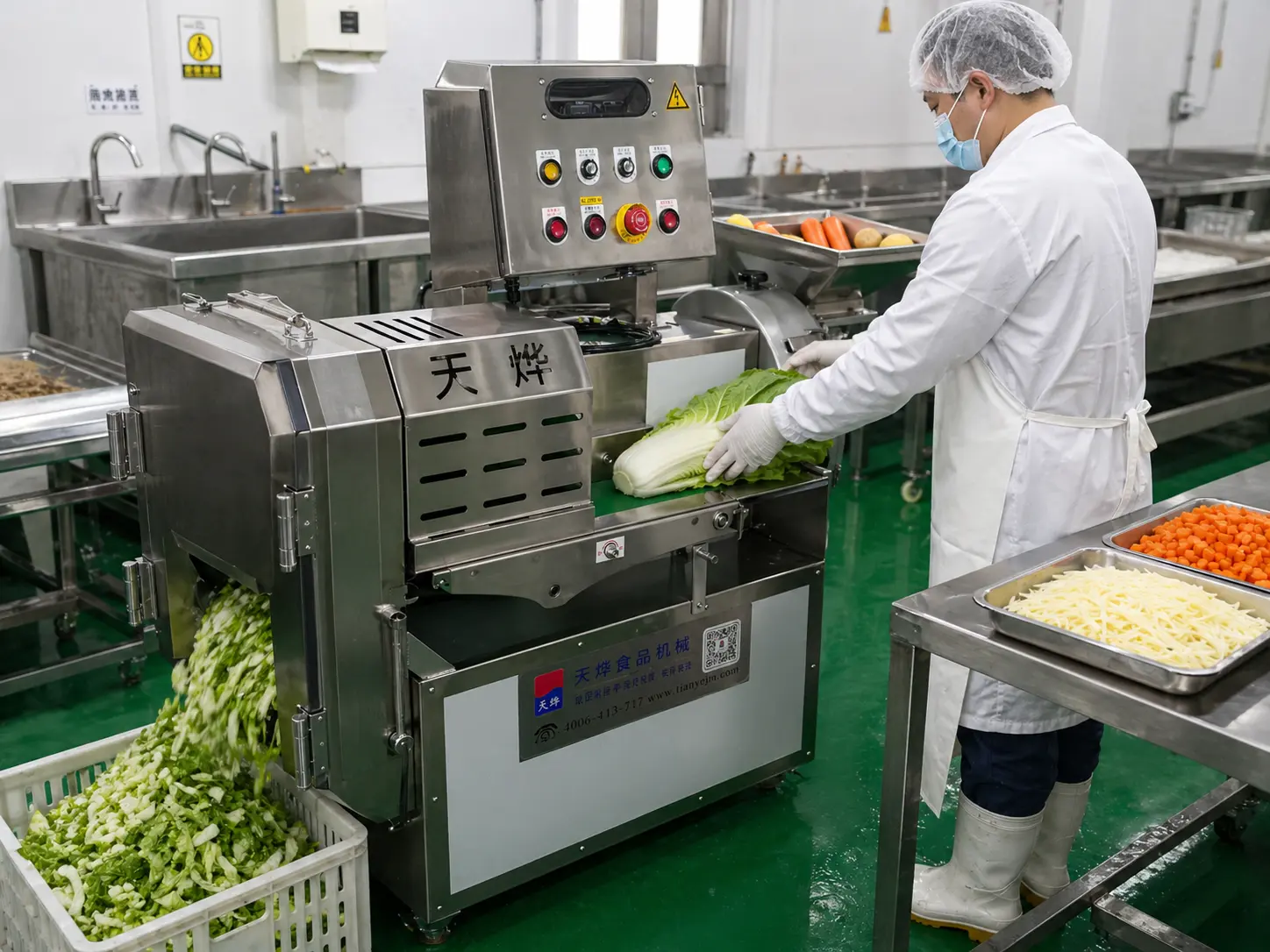
Vegetable Cutting Equipment
Provides cutting functions for defined vegetable batches after the required cut formats, ingredient condition and changeover plan are confirmed.

Meat Cutting Equipment
Supports confirmed slicing, dicing or portion-preparation tasks in a separately planned protein route with project-specific tools and controls.

Dewatering Equipment
Evaluated where the specified downstream condition requires surface-water removal before staging, cooking or a confirmed packing interface.

Weighing and Packing Equipment
Reviewed after the pack format, product condition and handoff responsibility are confirmed; inclusion depends on the agreed project scope.
Project-specific selection applies. These examples are not a preconfigured universal line. Final selection follows the menu and batch matrix, product condition, operator controls and confirmed interface responsibility. Packing interfaces are included only when specifically agreed.
Related Catering and Institutional Projects
These published projects show how preparation routes were considered in specific operating contexts. The card labels are neutral so case-title metrics are not presented as page-wide capability claims.

School Meal Vegetable Preparation Project
A project spanning separate vegetable-preparation facilities, focused on line layout, parallel preparation stages and downstream handoffs.

Mixed-Ingredient Preparation Facility Project
A central preparation project organized vegetable, protein and meal-assembly zones with planned transfer interfaces inside one facility.
Case-specific context. Project conditions, equipment scope, operating controls and outcomes shown in these cases are specific to those projects and are not universal performance promises.
Define the Equipment Scope and Operating Controls Separately
The equipment supply and the operator’s food-safety system must be confirmed as separate responsibilities, with clear interfaces between them.
Pre-Processing and Confirmed Interfaces
We can plan confirmed washing, peeling, cutting, portion preparation, dewatering, staging and transfer functions, together with the mechanical and process interfaces included in our agreed supply.
Systems Requiring Separate Confirmation
Cooking, meal delivery, refrigeration, packing, cold storage, building services and other upstream or downstream systems may remain with the operator or third parties unless specifically included.
Operator validation is essential. The food operator must validate food-safety and sanitation controls for the actual products, intended use, hazard analysis, hygiene program, temperature and holding plan, cleaning procedures and applicable local regulations. Equipment alone does not validate these controls.
Planning Preparation Around a Fixed Meal-Service Schedule?
Send your menu matrix, raw materials, required preparation, service periods, batch plan, target saleable output, layout, sanitation-control method and downstream cooking or packing equipment. We will use those inputs to define the relevant pre-processing stages and confirmed interfaces.